Enterprise AI Memory Layer: The Technical Guide to Persistent Context in 2026

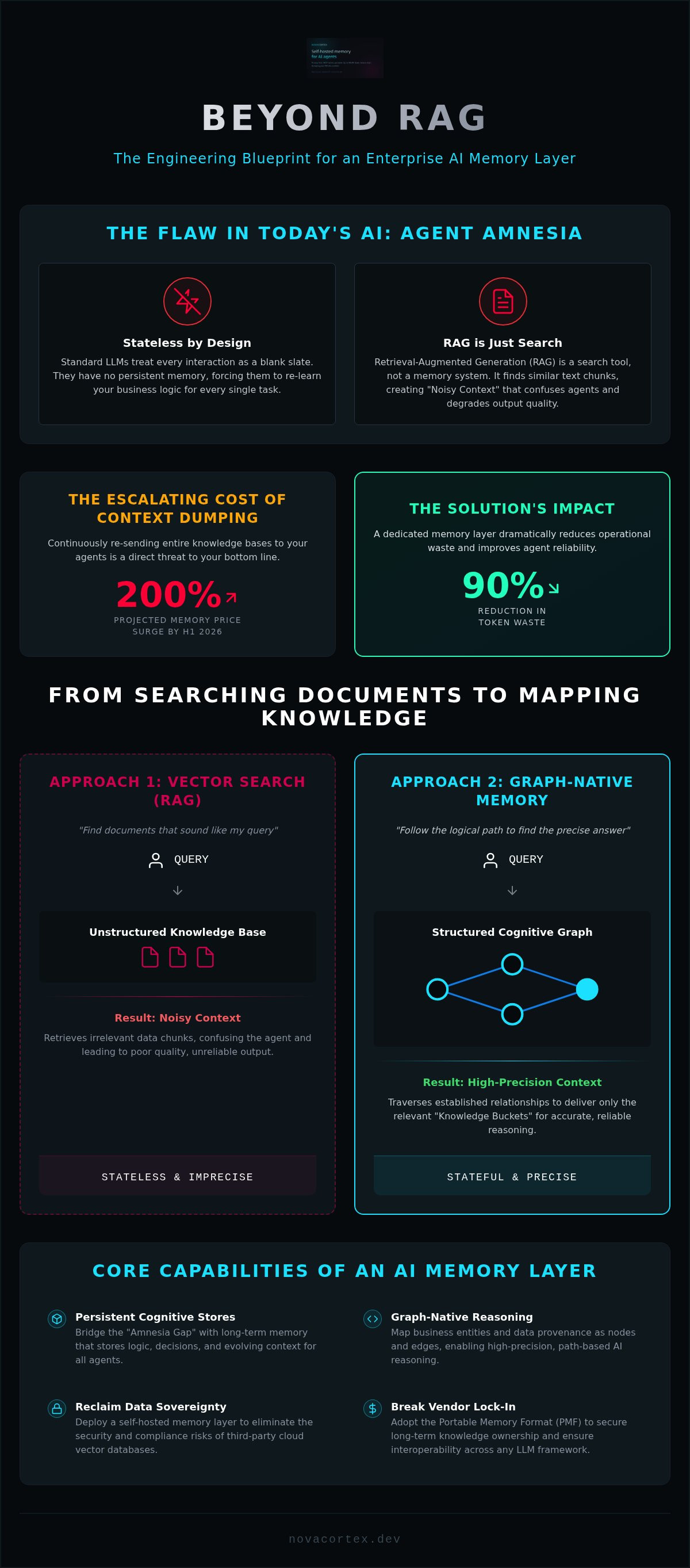
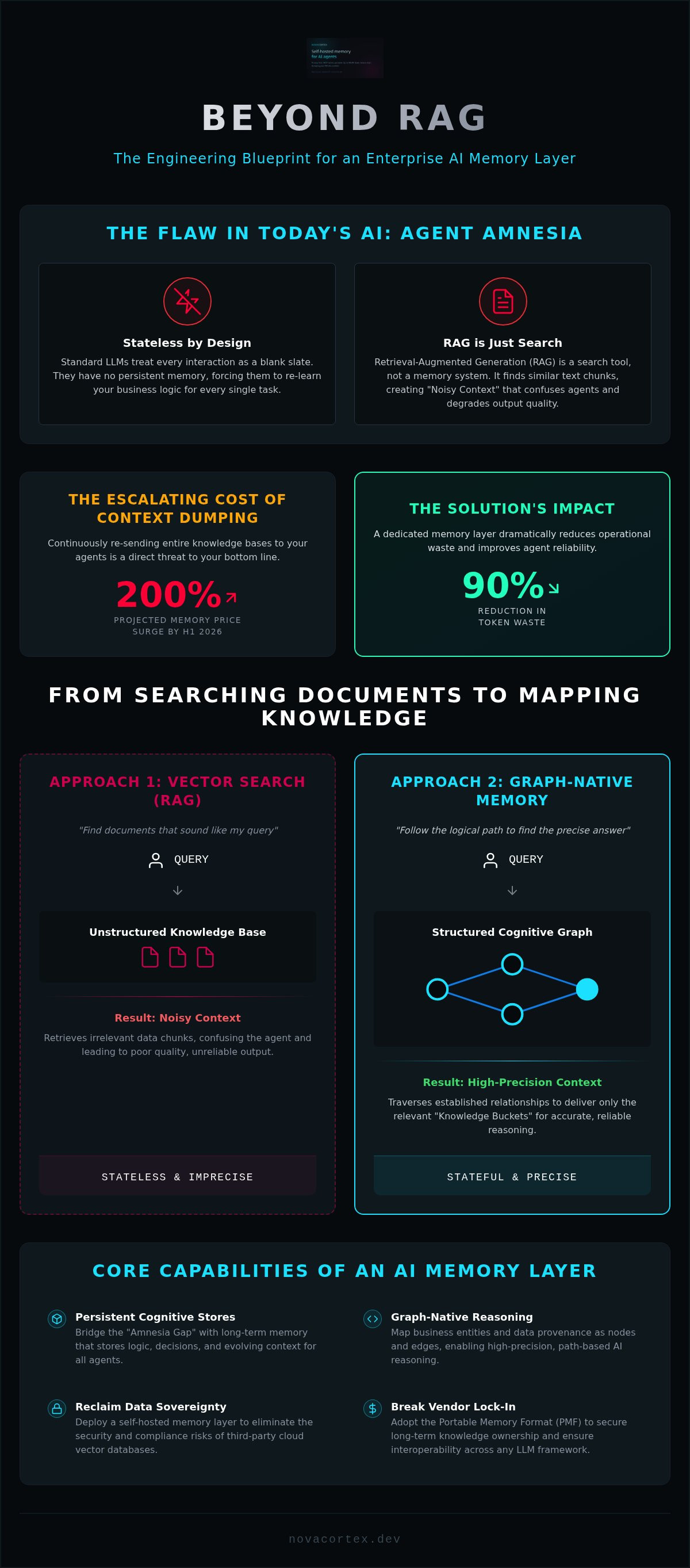
RAG isn't a brain; it's a filing cabinet with a broken lock. Most enterprises are currently burning millions in context tokens just to remind their agents of basic business logic every five minutes. It's a cycle of cognitive waste that bloats operational costs and compromises data sovereignty. With memory prices surging up to 200% in the first half of 2026, the era of re-sending everything is officially over. You need a dedicated enterprise AI memory layer that functions as a persistent, graph-native nervous system for your agents.
You already know that cloud-hosted vector databases are a security liability, especially with the EU AI Act's August 2026 enforcement deadlines looming. You're tired of agents that forget your architecture mid-workflow. This guide provides the technical blueprint to eliminate agent amnesia and secure your intellectual property. You'll learn how to implement a private, scalable memory architecture that achieves a 90% reduction in token waste. We'll examine MCP-native servers, Knowledge Buckets, and the transition to a self-hosted cognitive stack that guarantees full ownership of your AI-generated knowledge.
Key Takeaways
- Implement persistent, structured cognitive stores to bridge the amnesia gap left by standard RAG retrieval.
- Map business entities and provenance using graph-native storage to ensure high-precision, path-based AI reasoning.
- Deploy a self-hosted enterprise AI memory layer to reclaim data sovereignty and eliminate the risks of cloud-hosted vector databases.
- Integrate MCP-native memory servers and Knowledge Buckets to scale multi-agent state across any LLM framework.
- Adopt the Portable Memory Format (PMF) to secure long-term knowledge ownership and break the cycle of vendor lock-in.
What is an Enterprise AI Memory Layer and Why Does RAG Fall Short?
An enterprise AI memory layer is not a simple archive. It is a persistent, structured cognitive store designed specifically for agentic workflows. Unlike traditional databases, it functions as a long-term repository for an agent’s logic, decisions, and evolving business context. Most current AI implementations rely on stateless Large Language Models (LLMs). These models treat every interaction as a blank slate. They require massive injections of data just to understand basic operational rules. This creates the "Amnesia Gap." Agents lose the thread of complex business relationships the moment a session ends or a context window overflows. It's a failure of architecture, not a failure of the model.
Standard Retrieval-Augmented Generation (RAG) was a necessary first step, but it's fundamentally a search tool. It retrieves chunks of text based on keyword proximity. It doesn't understand why those chunks matter. A true enterprise AI memory layer provides stateful cognition. It allows agents to build upon previous work without re-learning the foundation every time they execute a prompt. It transforms a reactive search engine into a proactive business partner that remembers your specific constraints and historical decisions.
The Limitations of Vector-Only Retrieval
Semantic similarity is a poor substitute for actual reasoning. Vector databases find text that looks like your query. They fail to map the underlying semantic network of your organization. If an agent needs to understand how a specific procurement rule affects a vendor contract from three months ago, simple similarity scores won't bridge that gap. This leads to the "Noisy Context" problem. Irrelevant data chunks are pulled into the prompt, which confuses the agent and degrades output quality. Vector search is merely a retrieval component; it is not a complete cognitive architecture for enterprise-grade performance.
The Cost of "Context Dumping"
Relying on massive context windows is a tax on your engineering budget. Enterprises currently waste significant capital dumping entire knowledge bases into every API call. This isn't just expensive; it's inefficient. Research from early 2026 shows that memory prices increased by up to 200%, making token waste a direct threat to your bottom line. When you flood an LLM with too much data, you encounter the "lost in the middle" phenomenon. The model prioritizes the beginning and end of the prompt while ignoring the critical instructions buried in the center. Modern architectures require a self-hosted AI memory layer to manage context with surgical precision. This shift ensures agents receive only the relevant Knowledge Buckets they need to function, reducing costs and improving reliability across the board.
The Technical Architecture of Graph-Native AI Cognition
Graph-native storage represents a fundamental shift from document storage to relationship mapping. In an enterprise AI memory layer, we treat business entities, specific decisions, and data provenance as nodes and edges. This is not just a database; it is a live map of organizational logic. Standard vector search finds text that sounds similar. Graph memory follows the logical paths that actually matter. If an agent needs to know why a specific budget was approved, it doesn't just search for "budget approval." It traverses the edge connecting the "Approval" node to the "Policy" node and the "Authorized User" node. Precision is non-negotiable.
This architectural precision is supported by research into memory-augmented neural network hardware, which emphasizes the need for structured access to stored information. To unify these relationships across your stack, you need an MCP native memory server. This protocol allows disparate data sources to speak a common language. It turns isolated silos into a single, coherent cognitive fabric that agents can query with high velocity.
Vector vs. Graph Memory: A Comparative Analysis
Vector embeddings are excellent for discovery. They handle the "vibe" of a query. However, they fail at multi-step reasoning. Graph traversal provides the rigid logic required for enterprise compliance and complex workflows. NovaCortex utilizes a hybrid approach. We use vector search to narrow the field and graph traversal to finalize the answer. This ensures that agents don't just guess based on similarity; they verify based on established relationships. It's the difference between a hunch and a fact. For technical teams, this means 90% better precision in multi-step agentic tasks.
Organizing State with Knowledge Buckets
Scaling AI shouldn't mean creating a monolithic mess of data. Knowledge Buckets allow you to modularize state. You can isolate memory for HR, engineering, or specific project teams. This prevents cross-contamination. An agent working on payroll shouldn't have its context window cluttered with marketing assets. Bucketed memory ensures high-velocity performance by keeping the retrieved context lean and relevant. If you're ready to start building, you can explore the implementation details in the NovaCortex open-source codebase.
This modularity also solves the scalability bottleneck. Instead of a single, bloated database, you manage a fleet of high-performance buckets. Each bucket can be synced or isolated depending on the security requirements of the task. It's a clean, builder-centric way to manage massive enterprise state without the overhead of traditional, restrictive systems. You get the speed of local hardware with the organization of a global knowledge graph.
Self-Hosted vs. Managed Memory: The Sovereign Advantage
Managed memory is a strategic trap. It appears as a convenient shortcut but quickly matures into a bottleneck for both performance and security. When you outsource your enterprise AI memory layer, you effectively rent your organization's collective intelligence from a third party. This creates unnecessary dependencies. API outages don't just slow down work; they cause a total cognitive collapse for your agentic workflows. Enterprises are now pivoting toward local infrastructure to avoid this systemic fragility and reclaim their architectural independence.
The economic reality is equally stark. A technical analysis of self-hosted vs managed AI memory reveals that managed services carry a heavy "latency tax" and per-token markups that scale poorly. Self-hosting allows you to leverage existing hardware, from a high-end VPS to local data centers or even specialized edge devices. You pay for the compute once rather than paying a vendor for every byte of context retrieved. This shift provides the deployment flexibility required for high-velocity engineering teams who refuse to be boxed in by restrictive cloud provider tiers.
Engineering for Data Sovereignty
Your intellectual property is your only real moat. If your agent’s memory lives in a vendor’s cloud, it's effectively part of their potential training corpus. That's a risk no serious enterprise can afford. With the EU AI Act enforcement beginning in August 2026, data traceability and logging are now legal mandates. NovaCortex Self-Hosted Edition ensures that sensitive IP never leaves your controlled environment. You maintain absolute ownership of the memory logs, the graph structures, and the final cognitive output. It's security by design, not by promise.
Reducing Latency through Proximity
Speed is a functional requirement, not a luxury. Round-trip API calls to cloud vector stores introduce hundreds of milliseconds of lag that kill the user experience in real-time workflows. Local memory retrieval happens in single-digit milliseconds because the data sits inches away from the processing logic. By implementing neurobiologically inspired long-term memory structures on your own hardware, you achieve a level of responsiveness that cloud services cannot match. This proximity eliminates the "thinking" pause. It allows agents to pull from Knowledge Buckets instantly, enabling seamless multi-agent collaboration without the network overhead that plagues traditional RAG setups.
Implementation: Deploying an MCP-Native Memory Server
Deploying a professional-grade memory layer requires more than just a database connection. It demands a standardized protocol. The NovaCortex MCP-Native Memory Server uses the Model Context Protocol to bridge the gap between your local data and any LLM. To start, you'll pull the Docker image or build from source on your local hardware. Initializing the server involves setting your environment variables for storage paths and defining your first Knowledge Buckets. These buckets act as the logical partitions for your data. They ensure that your engineering agents don't accidentally ingest marketing guidelines or HR policies during a production run.
Interoperability is the core value proposition. Whether you're using LangChain, AutoGPT, or custom agentic frameworks, the integration follows a standard request-response pattern through the MCP bridge. This setup eliminates the need for custom wrappers for every new model release. You simply point your framework to the local MCP endpoint. This creates a unified enterprise AI memory layer that remains stable even if you swap your underlying model provider. Precision is mandatory. Implementation is direct. Logic is preserved across every session.
The Model Context Protocol (MCP) Explained
In 2026, MCP has become the universal connector for AI infrastructure. It functions as the USB-C for AI memory by providing a standardized interface that prevents vendor lock-in. MCP is the key to building vendor-neutral AI infrastructure that survives the volatile LLM market. By decoupling the memory layer from the model provider, you ensure that your accumulated business intelligence remains portable. You can switch between LLM providers without losing a single edge in your knowledge graph. It's a clean break from the proprietary silos of the past.
Scaling from VPS to Enterprise Clusters
Moving from a single-node setup to a distributed cluster requires a focus on resource management. While a standard VPS can handle basic workflows, high-traffic agent environments demand horizontal scaling. You'll need to monitor RAM usage closely because graph traversal is memory-intensive. Aim for at least 16GB of dedicated RAM for production nodes to maintain high-velocity retrieval. Load balancing memory requests across multiple Knowledge Buckets prevents any single agent from bottlenecking the system. This modular approach allows you to scale specific departments independently based on their cognitive load. You get the performance of a local build with the reliability of an enterprise-grade cluster.
Future-Proofing AI with Portable Memory Formats (PMF)
Vendor lock-in isn't just a technical nuisance; it's a strategic liability. If your organization's collective intelligence is trapped in a proprietary format, you don't own your AI's brain. You're merely leasing it. Proprietary silos turn your data into a hostage, making migration impossible and leaving you vulnerable to price hikes or service sunsets. A resilient enterprise AI memory layer must be built on open standards to ensure long-term system viability. In 2026, the shift toward architectural independence is no longer optional. It's a requirement for survival.
The introduction of the portable memory format for AI (PMF) provides the escape hatch enterprises need. PMF is a standardized interchange format designed to keep your graph structures, entity relationships, and decision logs portable. It allows for instant migration between infrastructure providers without data loss. By utilizing an Apache-2.0 licensed foundation, you guarantee that your cognitive stack remains accessible and functional regardless of which LLM provider dominates the market next month. You build once. You own forever.
Ending the Vendor Lock-in Cycle
Many early adopters are realizing that managed frameworks often hide restrictive data policies behind polished APIs. For engineering teams seeking an alternative to proprietary cloud-only solutions, NovaCortex offers a path forward centered on open standards. Our architecture allows you to export and sync AI memory across disparate environments with zero friction. Whether you're moving from a local dev box to an enterprise cluster or switching between cloud VPS providers, your Knowledge Buckets remain intact. This portability ensures that your enterprise AI memory layer evolves with your business logic rather than being tethered to a single vendor's roadmap.
NovaCortex ROI: Measuring Token Efficiency
Efficiency is the ultimate benchmark of a well-engineered memory system. NovaCortex's graph-native storage achieves a 98% reduction in token usage by eliminating the need for massive context dumping. Instead of re-sending entire knowledge bases, agents pull only the high-precision nodes required for the current task. This isn't just about saving money on API credits. It's about eliminating the "Cost of Forgetting." When an agent loses context, the business suffers through failed workflows, human intervention, and wasted compute cycles.
NovaCortex Self-Hosted Edition turns these inefficiencies into a competitive advantage. By providing a private, scalable, and portable memory architecture, we enable enterprises to reclaim their data sovereignty. You get a cognitive layer that's faster, cheaper, and more secure than any managed alternative. The result is a high-velocity AI environment where agents remember every detail, respect every privacy boundary, and operate with surgical precision. Stop leasing your intelligence. Start owning it.
Reclaim Your Cognitive Sovereignty
Standard RAG is a legacy bottleneck. True agentic performance requires a persistent enterprise AI memory layer that lives on your own infrastructure. You've seen how graph-native storage eliminates the "lost in the middle" problem and how Knowledge Buckets modularize state for secure, multi-agent collaboration. This isn't just about technical precision; it's about financial efficiency. By achieving 98% token efficiency through localized context management, you turn AI from a variable cost center into a sovereign asset.
The transition to an MCP-native, Apache-2.0 open-source architecture ensures your business logic remains yours. You no longer have to choose between advanced cognition and data privacy. The tools to build a private, high-velocity memory server are available now. It's time to stop renting your intelligence and start owning your stack.
Take control of your agentic workflows. Build a system that remembers, scales, and survives the next wave of industry shifts.
Technical FAQ: Enterprise AI Memory
What exactly is an enterprise AI memory layer vs. a standard vector database?
An enterprise AI memory layer is a structured, graph-native cognitive store, whereas a vector database is merely a similarity search tool. While vector databases retrieve text snippets based on keyword proximity, a memory layer tracks complex relationships, decision provenance, and evolving state over time. It provides the persistent logic required for agents to maintain context across multiple sessions without suffering from amnesia or losing the thread of a business workflow.
How does NovaCortex achieve a 98% reduction in token usage?
NovaCortex utilizes graph-native storage and Knowledge Buckets to deliver surgical context rather than massive document chunks. By mapping specific entities and their relationships, the system sends only the high-precision nodes required for a task. This approach eliminates the "context dumping" seen in traditional RAG setups. You stop paying for redundant data transfers and start leveraging a lean, high-velocity stream of relevant information that keeps your API costs at a minimum.
Can I deploy NovaCortex on my own private cloud or VPS?
Yes, NovaCortex is purpose-built for self-hosting on any VPS, local hardware, or private cloud environment. This deployment flexibility ensures complete data sovereignty and removes the systemic risks associated with third-party managed services. You maintain total control over your infrastructure, allowing you to comply with strict regulations like the EU AI Act while avoiding the latency issues inherent in round-trip calls to external cloud providers.
Is NovaCortex compatible with all major LLMs like GPT-4, Claude, and Llama?
NovaCortex is model-agnostic and functions with any LLM through its MCP-native architecture. It acts as a universal cognitive bridge, allowing you to swap model providers without losing your stored business intelligence. Whether you use OpenAI, Anthropic, or local open-source models, the memory layer remains the stable source of truth. This prevents your organizational knowledge from being trapped within the proprietary ecosystem of a single AI vendor.
What is the Portable Memory Format (PMF) and why does it matter?
PMF is a standardized interchange format that prevents vendor lock-in by making your AI's knowledge base portable across different infrastructure providers. It ensures that your accumulated logic and data relationships aren't held hostage by a specific platform. By using PMF, you can migrate your enterprise AI memory layer between environments instantly. This portability is foundational for long-term IP ownership and architectural independence in a rapidly shifting market.
How does the MCP-Native Memory Server handle multi-agent synchronization?
The server uses the Model Context Protocol (MCP) to provide a unified interface where multiple agents can read and write to shared Knowledge Buckets. This prevents "context drift" by ensuring every agent in your cluster accesses the same real-time state. When one agent updates a decision or a fact, that change is immediately available to the entire fleet. It turns a collection of isolated agents into a coherent, collaborative team with a shared brain.
Is there enterprise support available for the NovaCortex Self-Hosted Edition?
NovaCortex Self-Hosted Edition is an Apache-2.0 licensed open-source project supported by a robust community of engineers and builders. Technical documentation and architectural blueprints are provided through our GitHub repository to facilitate independent deployment. This model respects the spirit of digital sovereignty, giving you the tools to manage your own stack. Enterprises can leverage the codebase to build specialized internal tools without being tethered to a restrictive, managed-service support contract.
What are the hardware requirements for running a local memory server in 2026?
A production-grade memory server typically requires a minimum of 16GB of dedicated RAM and a modern multi-core CPU. While development can happen on smaller devices, enterprise-scale graph traversals are memory-intensive and require high-performance SSDs to maintain speed. We recommend provisioning resources that can handle concurrent requests across multiple Knowledge Buckets. This ensures your agents receive context in single-digit milliseconds, maintaining the high-velocity performance required for real-time business operations.
FAQ
What exactly is an enterprise AI memory layer vs. a standard vector database?
An enterprise AI memory layer is a structured, graph-native cognitive store, whereas a vector database is merely a similarity search tool. While vector databases retrieve text snippets based on keyword proximity, a memory layer tracks complex relationships, decision provenance, and evolving state over time. It provides the persistent logic required for agents to maintain context across multiple sessions without suffering from amnesia or losing the thread of a business workflow.
How does NovaCortex achieve a 98% reduction in token usage?
NovaCortex utilizes graph-native storage and Knowledge Buckets to deliver surgical context rather than massive document chunks. By mapping specific entities and their relationships, the system sends only the high-precision nodes required for a task. This approach eliminates the "context dumping" seen in traditional RAG setups. You stop paying for redundant data transfers and start leveraging a lean, high-velocity stream of relevant information that keeps your API costs at a minimum.
Can I deploy NovaCortex on my own private cloud or VPS?
Yes, NovaCortex is purpose-built for self-hosting on any VPS, local hardware, or private cloud environment. This deployment flexibility ensures complete data sovereignty and removes the systemic risks associated with third-party managed services. You maintain total control over your infrastructure, allowing you to comply with strict regulations like the EU AI Act while avoiding the latency issues inherent in round-trip calls to external cloud providers.
Is NovaCortex compatible with all major LLMs like GPT-4, Claude, and Llama?
NovaCortex is model-agnostic and functions with any LLM through its MCP-native architecture. It acts as a universal cognitive bridge, allowing you to swap model providers without losing your stored business intelligence. Whether you use OpenAI, Anthropic, or local open-source models, the memory layer remains the stable source of truth. This prevents your organizational knowledge from being trapped within the proprietary ecosystem of a single AI vendor.
What is the Portable Memory Format (PMF) and why does it matter?
PMF is a standardized interchange format that prevents vendor lock-in by making your AI's knowledge base portable across different infrastructure providers. It ensures that your accumulated logic and data relationships aren't held hostage by a specific platform. By using PMF, you can migrate your enterprise AI memory layer between environments instantly. This portability is foundational for long-term IP ownership and architectural independence in a rapidly shifting market.
How does the MCP-Native Memory Server handle multi-agent synchronization?
The server uses the Model Context Protocol (MCP) to provide a unified interface where multiple agents can read and write to shared Knowledge Buckets. This prevents "context drift" by ensuring every agent in your cluster accesses the same real-time state. When one agent updates a decision or a fact, that change is immediately available to the entire fleet. It turns a collection of isolated agents into a coherent, collaborative team with a shared brain.
Is there enterprise support available for the NovaCortex Self-Hosted Edition?
NovaCortex Self-Hosted Edition is an Apache-2.0 licensed open-source project supported by a robust community of engineers and builders. Technical documentation and architectural blueprints are provided through our GitHub repository to facilitate independent deployment. This model respects the spirit of digital sovereignty, giving you the tools to manage your own stack. Enterprises can leverage the codebase to build specialized internal tools without being tethered to a restrictive, managed-service support contract.
What are the hardware requirements for running a local memory server in 2026?
A production-grade memory server typically requires a minimum of 16GB of dedicated RAM and a modern multi-core CPU. While development can happen on smaller devices, enterprise-scale graph traversals are memory-intensive and require high-performance SSDs to maintain speed. We recommend provisioning resources that can handle concurrent requests across multiple Knowledge Buckets. This ensures your agents receive context in single-digit milliseconds, maintaining the high-velocity performance required for real-time business operations.