Federated AI Agent Memory: Engineering Persistent Context Across Distributed Systems

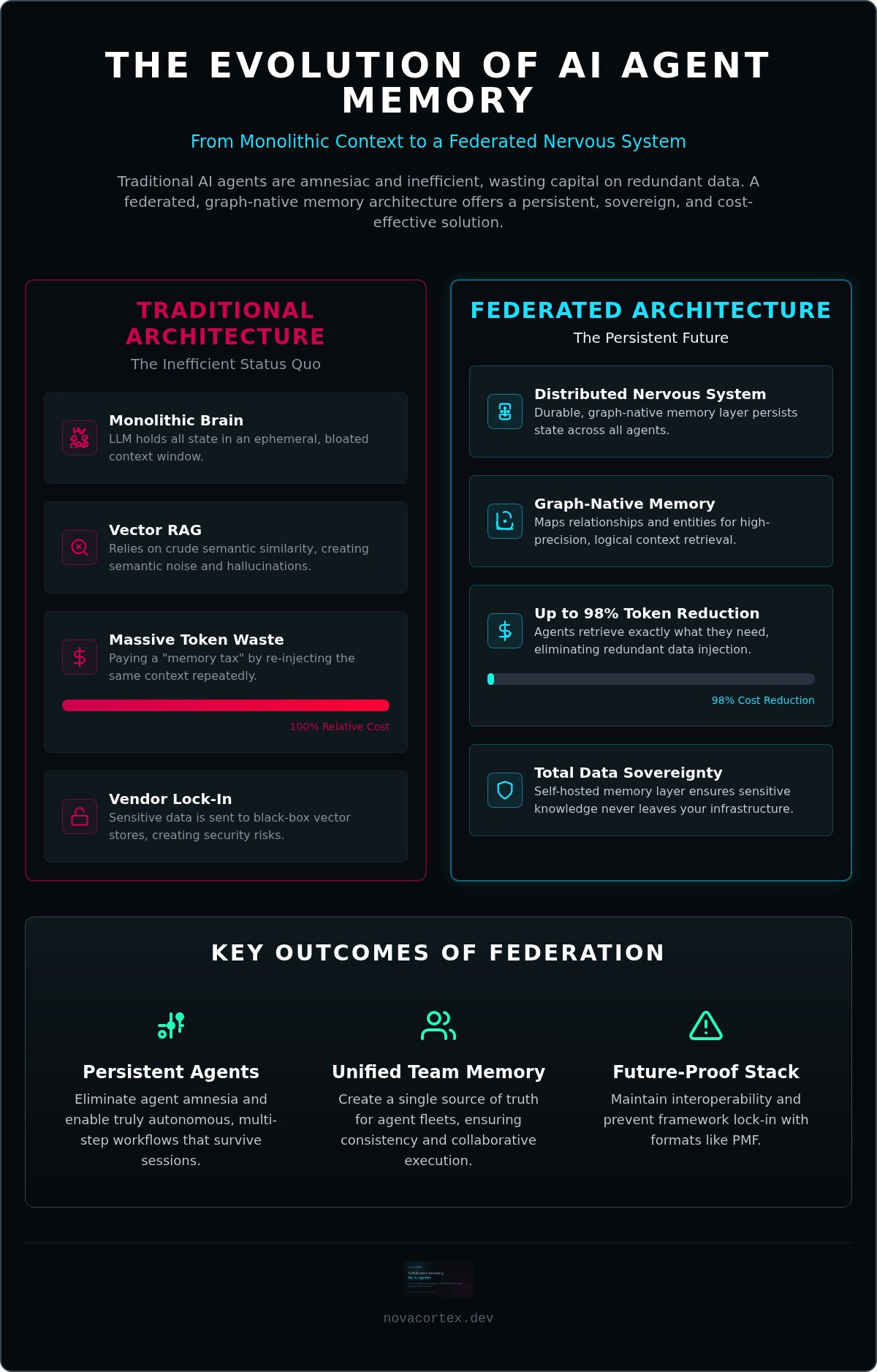
Your autonomous agents are hemorrhaging capital. Every time an LLM re-reads the same context to maintain state, you're paying a memory tax that scales linearly with systemic failure. Standard RAG is a leaky bucket. To build truly persistent, multi-step workflows, you need a federated AI agent memory that acts as a decentralized nervous system rather than a centralized cloud silo. This isn't just about storage; it's about engineering a graph-native layer that survives the session. Current architectures force a choice between intelligence and economy. We're here to reject that compromise.
You've likely felt the friction of agents losing their place in complex loops or the security anxiety of piping sensitive context into black-box vector stores. It's an inefficient, risky status quo that prioritizes vendor lock-in over engineering reality. This guide shows you how to deploy a federated architecture to eliminate agent amnesia and slash token costs by 98%. We'll break down the implementation of graph-native memory layers, MCP-native servers, and the Portable Memory Format (PMF) to achieve total multi-agent synchronization while maintaining absolute data sovereignty.
Key Takeaways
- Shift your architecture from monolithic context windows to a distributed nervous system that persists state across entire agent fleets.
- Deploy a federated AI agent memory using graph-native storage to eliminate the semantic noise and hallucinations inherent in traditional vector RAG.
- Reduce token waste by up to 98% by leveraging relationship-mapped context that provides agents exactly what they need without redundant data injection.
- Future-proof your stack with MCP-native servers and the Portable Memory Format (PMF) to maintain interoperability and prevent framework lock-in.
- Reclaim data sovereignty by moving memory layers to self-hosted environments, ensuring sensitive organizational knowledge never leaves your infrastructure.
What is Federated AI Agent Memory?
Current AI agent deployments suffer from a fundamental architectural flaw: they are amnesiac by design. Most developers treat an agent’s memory as a simple chat history string or a localized vector store. This is a mistake. Federated AI agent memory is a decentralized, external state layer that persists context across multiple agent frameworks and sessions. It moves the burden of "knowing" from the ephemeral context window of the LLM to a durable, graph-native infrastructure. It represents the transition from building isolated bots to engineering persistent digital entities.
In traditional setups, the LLM acts as a monolithic brain attempting to hold every variable in active memory. This is inefficient. We are witnessing a shift toward distributed nervous systems. In this model, the model is merely the processor while the federated memory layer handles state, relationships, and long-term retention. While Federated learning focuses on decentralized model training, federated memory focuses on decentralized context retrieval. It ensures that an agent operating in one environment can access the insights generated by another agent in a completely different framework. This architecture is the only way to achieve truly autonomous, multi-step workflows at scale.
Short-Term Context vs. Durable Federated Memory
Short-term context is the working memory of a single inference call. It's ephemeral and expensive. Developers often attempt to solve agent amnesia by dumping massive amounts of long-term data into the context window. This is an engineering failure. It introduces semantic noise, increases hallucination rates, and inflates API costs. Durable federated memory lives outside the model. It allows for high-precision retrieval of relevant entities and relationships without clogging the context window with redundant data. It transforms a session-based chat into a persistent cognitive workflow that survives the life of a single token stream.
The Single Source of Truth for Distributed Agents
Scaling AI doesn't mean building bigger models; it means coordinating fleets of specialized agents. Knowledge silos are the primary bottleneck. If your LangChain agent can't see what your CrewAI agent just discovered, your system is fragmented. Federated AI agent memory provides a unified source of truth. It enables "Team Memory" for collaborative execution. When multiple agents work on parallel tasks, a shared memory state ensures consistency. One agent updates the graph; the entire fleet immediately inherits that context. This eliminates redundant work, prevents conflicting actions, and keeps the entire system aligned on the current objective.
Graph-Native Architectures: Why Vector RAG is Obsolete for Context
Vector RAG was a necessary bridge. It's now an architectural dead end. Traditional vector databases rely on semantic similarity, which is a crude proxy for actual logic. This creates the "Vector Trap." When your agent queries for a specific project detail, a vector search returns text chunks based on high-dimensional proximity. It doesn't understand hierarchy. It doesn't understand state. The result is semantic noise. This forces you to inject massive, irrelevant context blocks just to ensure the model finds the right needle. This is why federated AI agent memory must move beyond simple embeddings.
Effective context requires structured knowledge traversal. High-dimensional points describe how words sound; graph structures define what they mean. By storing entities and their explicit relationships, you mimic human associative memory. Human cognition doesn't function as a list of floating-point numbers in a vacuum. It functions through links. If you think of a server, you immediately access its IP, its owner, and its recent logs. A graph-native approach allows agents to do the same. Research into Governed Collaborative Memory confirms that multi-agent systems require this level of structured coordination to maintain safety and performance. Without it, you're just guessing with math.
The Limits of Traditional Vector Databases
Retrieval noise is the silent killer of agentic performance. Similarity search often fetches "similar" but factually incorrect data, leading directly to hallucinations. Re-indexing millions of vectors at production scale is computationally expensive and slow. This lag breaks the real-time requirements of autonomous systems. Most importantly, vector-only RAG leads to bloated context windows. You end up paying for thousands of tokens that contribute nothing to the final output. It's an engineering failure. It scales your API bill faster than your utility.
Engineering Efficiency with Graph-Native Storage
Relational context is superior to semantic proximity. Knowing that "Entity A owns Entity B" is far more valuable than knowing they appear in the same paragraph. Using graph-native AI storage enables low-latency retrieval through precise knowledge traversal. Instead of a "top-k" chunk dump, the system provides only the exact required nodes from the knowledge graph. This precision allows for a 98% token reduction compared to standard RAG. You're no longer guessing; you're navigating a map. To see how this works in a production environment, you can explore our open-source core.
Coordinating Multi-Agent Systems via Shared Memory States
Autonomous agents operating in isolation are a liability. When you deploy a fleet of specialized agents, the primary bottleneck isn't model intelligence; it's synchronization. Without a shared nervous system, agents repeat work, contradict peer decisions, and hallucinate based on outdated information. Messaging-based coordination is a high-latency compromise. To build truly collaborative systems, you must implement a federated AI agent memory that functions as a high-speed state bus, allowing every agent in the stack to read from and write to a unified knowledge graph in real time.
State management in multi-agent environments requires more than just a shared database. It requires conflict resolution and data isolation. If two agents attempt to update the same context node simultaneously, your architecture must handle the collision without corrupting the semantic integrity of the graph. This is where federated systems excel. They provide a governed environment where state is persistent, observable, and consistent across different frameworks, ensuring that your research agent and your executive agent are always looking at the same map.
Agentic Synchronization and State Persistence
Preventing redundant execution is critical for keeping API costs under control. If an agent doesn't know its peer has already verified a data point, it will waste tokens re-verifying it. We solve this through Knowledge Buckets. These allow you to categorize data into shared team insights and private agent-specific logic. For example, a research agent can populate a shared bucket with verified facts. An editor agent then pulls directly from that bucket to refine the final output. They don't need to exchange messages; they simply synchronize through the persistent state. This architecture turns a group of individual bots into a cohesive, multi-step execution unit.
Reducing Latency in Multi-Agent Workflows
Direct inter-agent messaging is an architectural bottleneck. Every time Agent A sends a context-heavy prompt to Agent B, you're paying for redundant token injection and waiting on network overhead. Federated memory acts as a high-speed bus for AI agent long term memory. Instead of passing massive JSON objects back and forth, agents simply pass light-weight pointers to graph nodes. This approach optimizes retrieval for real-time production systems in 2026, where speed is as important as accuracy. By moving the state out of the communication channel and into a dedicated memory layer, you slash latency and ensure that your agents spend their compute on reasoning rather than parsing redundant history.
Building Interoperable Context with MCP and PMF
Interoperability is the antidote to architectural fragility. If your agent's state is trapped in a proprietary cloud silo, you don't own your agent; you're renting its cognition. Building a federated AI agent memory requires a protocol-first approach that treats context as a portable asset. We utilize the Model Context Protocol (MCP) to standardize how agents read and write to their long-term state. This moves memory from a hidden database feature to a first-class citizen of the AI stack. It ensures that the knowledge your agents acquire today remains useful five years from now, regardless of which LLM provider dominates the market.
The current landscape is littered with walled gardens. Most vector providers want to lock your data into their specific indexing logic. We reject this. By using open standards, you create a memory layer that is framework-agnostic. Your agents should be able to migrate between local development environments, private VPS instances, and cloud-scale infrastructure without losing their semantic history. This isn't just a convenience. It's a requirement for building resilient, enterprise-grade AI systems that survive the rapid churn of the current model cycle.
The MCP-Native Advantage
Standardizing communication is the first step toward modular AI. Most developers view MCP as a mechanism for connecting LLMs to local files or desktop tools. That's a limited perspective. By deploying MCP native memory servers, you ensure your agents can access their history regardless of the orchestrator. Whether you're using Claude, Cursor, or a custom internal framework, the memory remains accessible and consistent. It eliminates framework lock-in. You can swap your LLM provider or your agent library without losing a single node of accumulated context. It provides a stable bridge between your local development environment and your production deployment.
Portable Memory: Data Sovereignty by Design
Your data belongs on your infrastructure. The current industry trend toward vendor-locked memory silos is an engineering regression that threatens enterprise security. We've established the portable memory format for AI (PMF) to ensure your knowledge base remains fluid and sovereign. PMF allows you to export, sync, and migrate knowledge across distributed environments. It means your agent's long-term memory can move from a local development machine to a secure VPS or a private cloud without re-indexing. This is data sovereignty by design. It ensures your intellectual property stays under your control, even if your underlying model provider changes their terms of service. You own the graph. You own the state. You own the future of your AI agents.
NovaCortex: The Privacy-First Sovereign Memory Layer
Centralized memory is a systemic vulnerability. If you're piping your entire organizational knowledge base into a managed cloud vector store, you've already conceded data sovereignty. NovaCortex Self-Hosted Edition provides a precise correction to this industry-wide flaw. It allows you to build a robust federated AI agent memory that lives entirely within your security perimeter. Whether you're running on a Raspberry Pi for edge operations or a high-performance VPS for enterprise workflows, the architecture remains the same: local, sovereign, and under your total control. You own the infrastructure. You own the cognition.
Privacy isn't a feature; it's a requirement for enterprise-grade deployment. NovaCortex ensures that local knowledge stays local. By moving the memory layer to your own hardware, you eliminate the risk of sensitive data leaking into third-party training sets or being compromised in a provider-side breach. This is the final piece of the architectural roadmap for self-hosted vs managed AI memory. It transforms your agent stack from a series of API calls into a private, persistent digital asset.
Self-Hosted vs. Managed Memory Layers
Managed cloud services offer convenience at the cost of security and scalability. Sending your entire knowledge base to third-party APIs introduces latency and significant long-term costs. Our Total Cost of Ownership (TCO) analysis shows that as agent fleets grow, the subscription fees for cloud RAG services scale exponentially. Self-hosting breaks this cycle. Using the self-hosted AI memory layer provided by NovaCortex allows you to scale your knowledge base without scaling your monthly bills. You pay for the compute you use, not the number of entities you store.
Getting Started with Sovereign Memory
Engineering persistence shouldn't take weeks. You can deploy your first NovaCortex memory server in under 5 minutes using our containerized setup. Once live, you can begin structuring Knowledge Buckets to organize your data. These buckets allow you to define exactly which agents have access to specific datasets, ensuring secure multi-agent synchronization across your fleet. It's time to stop building amnesiac bots. Integrate NovaCortex into your production agentic stack today and give your agents the durable, private memory they need to execute complex, multi-step workflows with precision.
Engineering the Agentic Nervous System
The transition from amnesiac bots to persistent digital entities is an architectural necessity. Relying on bloated context windows and high-latency vector searches is no longer a viable strategy for production-grade systems. By implementing a federated AI agent memory, you replace crude semantic guesswork with graph-native retrieval precision. This shift doesn't just improve accuracy; it slashes token usage by up to 98% by providing agents with the exact relational context they need without redundant data injection.
Digital sovereignty is your most valuable competitive advantage. Utilizing MCP-native and PMF-ready architectures ensures that your organizational knowledge remains interoperable and under your absolute control. You've seen how to eliminate the "Vector Trap" and coordinate multi-agent fleets through shared state layers. You now have the blueprint to build a resilient, self-hosted context layer that survives the session and scales with your ambitions.
Take control of your agentic stack and start building systems that remember. The future of autonomous AI depends on the durability of the memory you build today.
Frequently Asked Questions
What is the difference between federated memory and a standard vector database?
Standard vector databases are localized storage silos that rely on semantic similarity search. They treat data as isolated points in high-dimensional space. Federated memory is an external state layer designed for interoperability across distributed systems. It acts as a shared nervous system rather than a static filing cabinet. While a vector DB might help find a relevant text chunk, federated memory maintains persistent context and relationships across different agent frameworks and sessions.
How does federated memory achieve a 98% reduction in token usage?
High token costs usually stem from "context dumping" where developers inject massive blocks of irrelevant data to ensure an LLM finds a specific fact. Federated memory uses graph-native retrieval to pinpoint the exact relationship or entity required for a task. By providing the model with a precise surgical strike of data instead of a broad semantic search, you eliminate the need for redundant background information. This architectural efficiency directly slashes the input token count per inference call.
Can I use federated memory with multiple different agent frameworks simultaneously?
Yes, that is the core engineering purpose of a federated AI agent memory. It functions as a framework-agnostic state bus. You can have a LangGraph agent writing to a Knowledge Bucket while a CrewAI agent reads from it in real-time. This eliminates the knowledge silos that typically break multi-agent workflows. By using the Portable Memory Format (PMF), you ensure that context remains consistent even when your agents are operating across vastly different software environments.
Is NovaCortex compatible with the Model Context Protocol (MCP)?
NovaCortex is built as an MCP-native memory server. This means it integrates seamlessly with any tool or model that supports the protocol, including Claude and Cursor. You don't need to build custom connectors for every new agent you deploy. The MCP standard allows your agents to talk to their long-term memory using a universal interface. This compatibility prevents vendor lock-in and ensures your memory layer remains a stable part of your infrastructure as models evolve.
Why is a graph-native approach better for agent memory than flat vector storage?
Flat vector storage relies on semantic proximity, which often fetches similar but logically irrelevant noise. This leads to hallucinations in complex workflows. Graph-native memory stores explicit relationships between entities, mimicking human associative cognition. If an agent needs to know who owns a specific resource, the graph provides a direct link rather than a list of paragraphs that mention both terms. This structural clarity is essential for maintaining logical consistency in autonomous, multi-step agentic tasks.
How does self-hosting a memory layer improve AI data privacy and sovereignty?
Self-hosting ensures your data never leaves your controlled environment. When you use cloud-hosted memory layers, your sensitive organizational knowledge is stored on third-party servers and potentially used for model training. NovaCortex Self-Hosted Edition keeps your Knowledge Buckets local. This architecture provides total data sovereignty, allowing you to meet strict regulatory requirements. You maintain absolute control over who accesses the memory and how the data is encrypted, effectively eliminating the risk of provider-side breaches.
What happens if an agent loses connection to the federated memory server?
Robust agentic systems require graceful failure modes. If an agent loses its connection to the federated memory server, it typically reverts to its localized short-term context window. However, NovaCortex is designed for high-availability deployments. You can implement local caching strategies to ensure that critical state remains accessible during brief network interruptions. Once the connection is restored, the agent synchronizes its recent session data back to the global graph, ensuring that the team's shared state remains current and accurate.
How do I migrate my existing RAG knowledge base into NovaCortex?
Migration is a structured process of converting flat text chunks into a relational graph. You can ingest your existing vector data and use NovaCortex to extract entities and relationships. This transforms your leaky bucket RAG into a durable federated AI agent memory. By organizing your existing data into Knowledge Buckets, you can gradually move from session-based retrieval to persistent, graph-native cognition. The Portable Memory Format (PMF) simplifies this transition by providing a standardized schema for your agent's knowledge base.
FAQ
What is the difference between federated memory and a standard vector database?
Standard vector databases are localized storage silos that rely on semantic similarity search. They treat data as isolated points in high-dimensional space. Federated memory is an external state layer designed for interoperability across distributed systems. It acts as a shared nervous system rather than a static filing cabinet. While a vector DB might help find a relevant text chunk, federated memory maintains persistent context and relationships across different agent frameworks and sessions.
How does federated memory achieve a 98% reduction in token usage?
High token costs usually stem from "context dumping" where developers inject massive blocks of irrelevant data to ensure an LLM finds a specific fact. Federated memory uses graph-native retrieval to pinpoint the exact relationship or entity required for a task. By providing the model with a precise surgical strike of data instead of a broad semantic search, you eliminate the need for redundant background information. This architectural efficiency directly slashes the input token count per inference call.
Can I use federated memory with multiple different agent frameworks simultaneously?
Yes, that is the core engineering purpose of a federated AI agent memory. It functions as a framework-agnostic state bus. You can have a LangGraph agent writing to a Knowledge Bucket while a CrewAI agent reads from it in real-time. This eliminates the knowledge silos that typically break multi-agent workflows. By using the Portable Memory Format (PMF), you ensure that context remains consistent even when your agents are operating across vastly different software environments.
Is NovaCortex compatible with the Model Context Protocol (MCP)?
NovaCortex is built as an MCP-native memory server. This means it integrates seamlessly with any tool or model that supports the protocol, including Claude and Cursor. You don't need to build custom connectors for every new agent you deploy. The MCP standard allows your agents to talk to their long-term memory using a universal interface. This compatibility prevents vendor lock-in and ensures your memory layer remains a stable part of your infrastructure as models evolve.
Why is a graph-native approach better for agent memory than flat vector storage?
Flat vector storage relies on semantic proximity, which often fetches similar but logically irrelevant noise. This leads to hallucinations in complex workflows. Graph-native memory stores explicit relationships between entities, mimicking human associative cognition. If an agent needs to know who owns a specific resource, the graph provides a direct link rather than a list of paragraphs that mention both terms. This structural clarity is essential for maintaining logical consistency in autonomous, multi-step agentic tasks.
How does self-hosting a memory layer improve AI data privacy and sovereignty?
Self-hosting ensures your data never leaves your controlled environment. When you use cloud-hosted memory layers, your sensitive organizational knowledge is stored on third-party servers and potentially used for model training. NovaCortex Self-Hosted Edition keeps your Knowledge Buckets local. This architecture provides total data sovereignty, allowing you to meet strict regulatory requirements. You maintain absolute control over who accesses the memory and how the data is encrypted, effectively eliminating the risk of provider-side breaches.
What happens if an agent loses connection to the federated memory server?
Robust agentic systems require graceful failure modes. If an agent loses its connection to the federated memory server, it typically reverts to its localized short-term context window. However, NovaCortex is designed for high-availability deployments. You can implement local caching strategies to ensure that critical state remains accessible during brief network interruptions. Once the connection is restored, the agent synchronizes its recent session data back to the global graph, ensuring that the team's shared state remains current and accurate.
How do I migrate my existing RAG knowledge base into NovaCortex?
Migration is a structured process of converting flat text chunks into a relational graph. You can ingest your existing vector data and use NovaCortex to extract entities and relationships. This transforms your leaky bucket RAG into a durable federated AI agent memory. By organizing your existing data into Knowledge Buckets, you can gradually move from session-based retrieval to persistent, graph-native cognition. The Portable Memory Format (PMF) simplifies this transition by providing a standardized schema for your agent's knowledge base.