Fine-Tuning vs RAG for Enterprise Data: Which Should You Choose

RAG is usually the better starting point for enterprise knowledge that changes often; fine-tuning suits stable, repeatable tasks where model behavior needs to change. The practical choice in fine-tuning vs RAG for enterprise data depends on whether the problem is stale or inaccessible knowledge, or inconsistent outputs and instruction-following. A hybrid can pair retrieval for current facts with fine-tuning for task-specific behavior.
Both approaches can make an AI system more useful, but neither removes the work of preparing and governing data. RAG depends on clean, well-indexed sources and reliable retrieval; fine-tuning depends on curated examples and a model-update cycle.
This comparison explains how each approach handles freshness, privacy, governance, data preparation, and compute costs. It also covers when a hybrid architecture justifies its added complexity, and how to choose based on the problem your enterprise system needs to solve.
Key Takeaways
- Choose retrieval when enterprise knowledge changes frequently; choose fine-tuning when the core need is consistent model behavior on repeatable tasks.
- Assess freshness across the full retrieval pipeline, including document updates, re-indexing, and removal of outdated content.
- Build privacy and governance into the architecture with access controls, trusted sources, and traceable data lineage.
- Improve retrieval quality through careful document parsing, chunking, embeddings, and metadata before reaching for model training.
- Compare ongoing retrieval infrastructure and inference costs with the data preparation, training, and maintenance demands of fine-tuning.
What Is Retrieval Augmented Generation?
Meta AI introduced retrieval augmented generation in 2020 for knowledge-intensive tasks. RAG connects a model to external knowledge at query time, rather than relying only on information encoded in its weights.
Retrieving and Using External Knowledge
RAG first indexes enterprise documents, then retrieves relevant passages when a user submits a query. Semantic search can match meaning through embeddings and vector databases, even when the query uses different words. The model receives those passages as context and uses them to generate an answer. Unlike fine-tuning, retrieval can draw on updated source material without changing model weights.
That separation makes RAG useful for current policies, product documentation, and incident reports. It also adds a retrieval step, which can increase latency and prompt token use. Retrieval quality depends on whether the right document was indexed and surfaced. Answer quality depends on whether the model uses that context accurately.
Prompting and Retrieval Workflows
Use a staged workflow: prompt the base model first, add RAG when answers need external facts, then fine-tune if behavior remains unreliable. Fine-tuning changes model weights using curated examples, targeting persistent problems such as inconsistent formats or instruction-following. Distillation can follow when a capable model’s learned behavior needs to transfer to a smaller model.
These methods address different types of failure. RAG supplies evidence; fine-tuning shapes response behavior; distillation transfers capabilities. A hybrid combines retrieval for changing facts with fine-tuning for stable domain language or schema adherence. For example, a legal assistant can retrieve recent case files while following a tuned reporting format.
Monitor both sides of the pipeline. Ingestion failures can leave a retrieval index stale even as source documents change. Parsing can flatten tables or omit images, stripping meaning before retrieval. Track document versions, retrieval results, citations, and answer quality over time. Validate fine-tuned models separately when terminology or expected behavior shifts.
Diagnose failures by logging retrieved chunks, prompt text, and citations for each response. If the relevant passage is absent, investigate parsing, indexing, metadata, or search. If it is present but the answer misuses it, investigate generation, prompt construction, or model behavior. Evaluate retrieval and generation separately; the National Institute of Standards and Technology (NIST) describes evaluating answer quality, citations, and supporting documents.
| Option | Knowledge source | Update path | Primary role |
|---|---|---|---|
| Prompting | Instructions and supplied context | Edit the prompt | Guide existing behavior |
| RAG | Retrieved external documents | Update and re-index sources | Provide current evidence |
| Fine-tuning | Curated training examples | Retrain and validate | Change repeatable behavior |
| Hybrid | Retrieved documents and tuned weights | Maintain both components | Combine current facts with consistent behavior |
| Distillation | Outputs or capabilities from a stronger model | Train a smaller model | Transfer model behavior |
Choose the lightest workflow that fixes the observed failure: retrieve missing or changing facts, and fine-tune persistent behavior gaps.
Knowledge freshness and update frequency
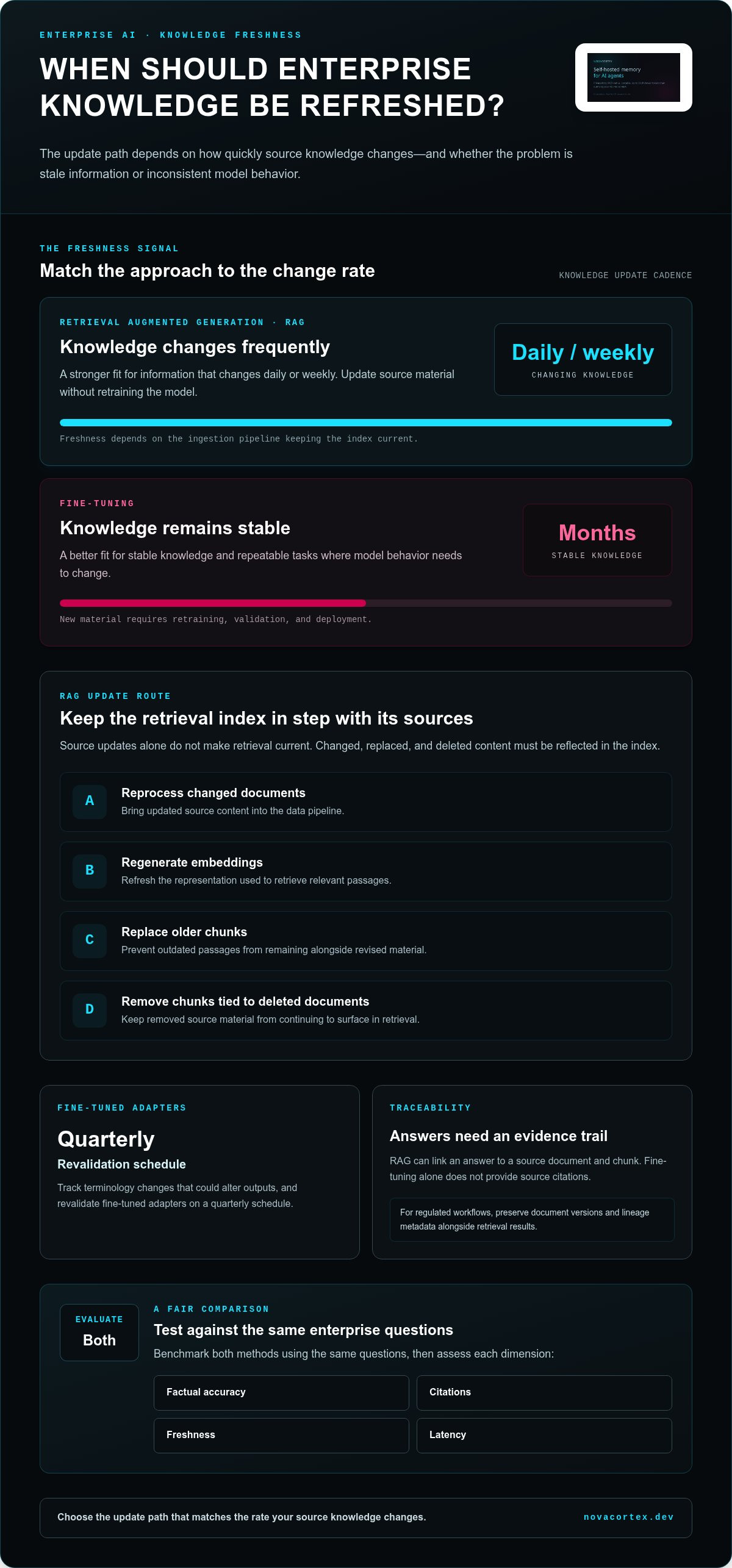
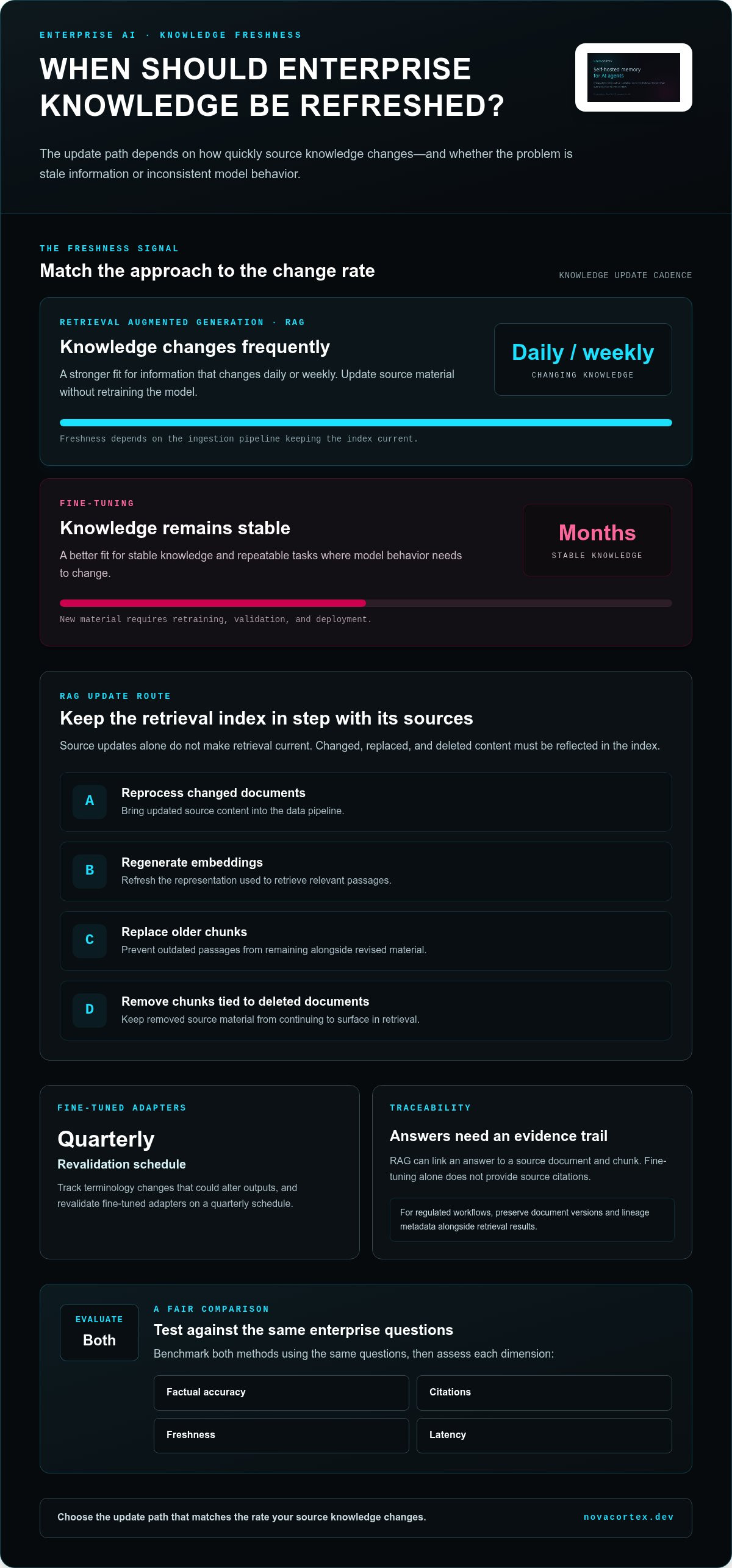
For knowledge that changes daily or weekly, retrieval is the stronger fit; fine-tuning suits knowledge that remains stable for months. Benchmark both methods against the same enterprise questions, scoring factual accuracy, citations, freshness, and latency. The National Institute of Standards and Technology (NIST) describes evaluating answer quality, citations, and supporting documents.
Knowledge Freshness and Traceability
Retrieval augmented generation reads from an external corpus, so teams can update knowledge without retraining the model. That advantage depends on a working data pipeline: reprocess changed documents, regenerate embeddings, replace older chunks, and remove chunks tied to deleted documents. Fine-tuned knowledge changes differently, requiring retraining, validation, and deployment before the model reflects new material.
Choose an update frequency that reflects how quickly the source changes. A policy revised weekly needs a different update path from a stable reference manual. Retrieval can use real-time or near-real-time data, but an index is only as current as its ingestion pipeline. For fine-tuned adapters, schedule quarterly revalidation and track terminology changes that could alter outputs.
Traceability also differs. Retrieval can connect an answer to a specific chunk and source document, supporting audits and source review. Fine-tuning alone doesn't provide source citations, so its output is harder to trace to a training example. For regulated workflows, preserve document versions and lineage metadata alongside retrieval results.
Data Freshness, Citations, and Hallucinations
A model’s general knowledge can't replace current, domain-accurate source material. If an organization asks about a recently changed policy, retrieval can provide the updated text; a fine-tuned model can remain stale until its refresh cycle. Citations help show the evidence behind an answer, but they don't prove retrieval found the newest or most relevant source.
Controlling hallucinations requires two checks: whether retrieval supplied sound evidence and whether generation stayed grounded in it. Compare citations with retrieved chunks, then inspect unsupported claims and omissions. If the source is missing or outdated, fix ingestion and indexing; if the model distorts a relevant source, examine prompt construction and generation behavior.
Freshness brings operational trade-offs. Retrieval requires indexing, embedding updates, and vector database optimization, plus a retrieval step that can increase latency and token use. Fine-tuning avoids retrieval at inference and can use a leaner prompt, but periodic model updates require training and validation effort. Both approaches need governance: control source access and apply documented retention and access policies to training data.
Set the benchmark around the actual application. For a sales assistant, test current pricing documents and citation accuracy; for a fixed-format classifier, test output consistency and retraining needs. Track freshness alongside answer relevance, retrieval accuracy, and source attribution, rather than treating fluent generation as proof of correctness. Teams structuring evolving knowledge can explore portable enterprise knowledge workflows.
Data privacy, security, and governance
Privacy depends on where enterprise data flows, who can access it, and how each use is recorded. RAG and fine-tuning have different control points, so governance must cover both retrieval sources and training data.
Data Residency and Governance
Data residency concerns where source documents, embeddings, prompts, and model-training examples are stored and processed. With RAG, map every stage, including ingestion, vector storage, retrieval, and model inference, to the organization’s approved infrastructure. A retrieval filter can restrict context by user identity and role before documents reach the model.
Fine-tuning shifts the focus to the training dataset and resulting model artifacts. Keep examples under the same governance policies as production operational data, with documented retention periods and platform-enforced access controls. GDPR and CCPA are relevant privacy frameworks for enterprise systems handling personal data; design data flows around the rules that apply to the organization.
Governance and Auditability
RAG can preserve source lineage in metadata, creating a path from an answer to its retrieved chunk and source document. Log user identity, retrieved passages, prompt context, and citations to reconstruct how an output was produced. Enforce access controls during retrieval, before context enters the prompt.
Fine-tuning needs a separate audit trail: record dataset versions, approval decisions, retention rules, and model releases. Training can cause a model to memorize sensitive information, so exclude credentials, private keys, and unnecessary regulated identifiers. These controls differ from RAG’s document-level authorization because learned information may not map cleanly to a retrievable source.
Governance and Data Quality
Governance also determines whether source material should influence model output. For RAG, identify trusted sources, assign owners, preserve version metadata, and remove stale chunks when documents are deleted. Conflicting policy files can undermine accuracy even when retrieval returns relevant passages.
Fine-tuning depends on curated, labeled training data. Review examples for sensitive fields, duplicates, outdated instructions, and inconsistent labels before training. Record each dataset’s purpose and access; domain-specific data can improve a task while still embedding errors or unwanted patterns in model behavior.
Apply controls across the full data path. Restrict employee access to information beyond their roles, and prevent unauthorized personally identifiable information from entering retrieval context. For RAG systems, protect confidential sources and verify retrieval uses only trusted repositories. For training, retain examples under documented governance policies and enforce access through the platform.
Governance gaps are common: Gartner found that 63% of organizations either lacked or were unsure they had the data management practices needed for AI, in February 2025. Treat that as an architecture issue, not a model setting. Assign data owners, define access rules, and test whether controls hold across ingestion, retrieval, training, and audit logs.
What Is Fine Tuning?
Fine-tuning adapts a pretrained model with curated, labeled examples, updating its weights for a selected task or domain. Enterprise RAG systems follow a different path: ingest documents, parse their content, create chunks and embeddings, attach metadata, then retrieve relevant context during generation.
To build an enterprise RAG system, identify trusted sources, parse documents, chunk content, generate embeddings, and store vectors with metadata. Connect retrieval to the model and enforce access filters, then evaluate retrieved passages and generated answers separately.
Parsing comes first. Extract text while preserving document structure, tables, headings, and identifiers. A policy table flattened into disconnected rows can lose relationships that determine meaning. Keep source names, version information, and section boundaries available for retrieval and audit. Clean extraction protects accuracy before a model sees the content.
Chunking divides parsed documents into retrievable units. Make each chunk coherent enough to preserve its meaning, but focused enough to match a specific request. For example, separate policy sections by topic rather than splitting a rule from its conditions. Preserve document identifiers and section metadata so retrieved context can be traced to its source.
Embeddings represent data numerically, capturing semantic meaning rather than relying only on exact keywords. Models such as Word2Vec and BERT can generate embeddings. An embedding model maps both a query and document chunks into representations that support similarity search in vector databases. This lets a question about “expense approval” retrieve a passage titled “spending authorization,” even without a shared phrase.
Metadata supplies a control layer around those vectors. Attach source, version, owner, timestamp, and access attributes to each chunk. Retrieval can then filter by user permissions or current document versions before assembling context. Without those fields, a semantically relevant match could still be unauthorized or obsolete.
Ingestion is not a one-time load. When a source document changes, reprocess it, regenerate its embeddings, and replace older chunks using stable document identifiers. When a document is deleted, remove its associated chunks and embeddings. Monitor pipeline failures so source updates don't leave stale knowledge in the index.
This preparation differs from fine-tuning. Fine-tuning uses labeled examples to change model weights and improve selected behavior; RAG keeps external knowledge in an index and retrieves it at query time. Continuous pretraining instead uses new unlabeled data to deepen domain expertise, while fine-tuning targets a chosen use case. Choose retrieval for changing documents and model adaptation for persistent task behavior.
Fine-tuning data preparation and compute costs
To fine-tune a model, define the task, curate and label relevant enterprise examples, remove sensitive or low-quality data, then train and evaluate the model. Deploy only after validation, monitor outputs, and repeat the cycle when behavior or source data changes.
Data preparation is the hidden workload. Examples must show the desired input and answer, not merely contain internal documents. For a support classifier, label representative requests with consistent categories. For structured extraction, include examples that map varied documents to the required schema. Remove duplicates, correct contradictory labels, and keep evaluation examples separate from training data.
Preparation can account for 20 to 40 percent of the total fine-tuning budget in many organizations. That effort differs from RAG preparation: retrieval needs parsing, chunking, metadata, and embeddings, while fine-tuning needs curated, labeled demonstrations of the behavior the model should learn. Neither path makes poor source material useful. A RAG index can retrieve bad content; fine-tuning can encode inconsistent examples into model behavior.
Compute needs depend on the training method and model. Full fine-tuning updates all model parameters; parameter-efficient methods such as LoRA update only a subset, reducing training demands. That estimate describes a run, not the full lifecycle.
Budget for maintenance as well. Fine-tuning lifecycle maintenance should be budgeted at roughly 3-5 times the training cost over the following year. Revalidation, refreshed examples, and deployment cycles contribute to the total. Parameter-efficient fine-tuning can lower training requirements, but it doesn't remove dataset review or ongoing model evaluation.
RAG has lower initial costs because it doesn't require training, but retrieval infrastructure still requires compute and operations. Each query can add retrieved context to the prompt, increasing token use and latency. At high query volumes, compare cumulative inference and retrieval costs with training runs, maintenance, and the leaner prompts a fine-tuned model can use. The break-even point depends on traffic, model choice, context size, and update frequency.
Use fine-tuning when examples target a persistent behavior gap, such as inconsistent formatting or classification. Use RAG when answers depend on changing internal facts. If both are required, first establish a reliable retrieval baseline, then test whether fine-tuning improves behavior enough to justify its preparation and lifecycle costs.
NovaCortex: NovaCortex Self-Hosted Edition
NovaCortex Self-Hosted Edition fits when enterprise AI needs a locally stored memory layer rather than knowledge embedded only in model weights. It keeps knowledge on your infrastructure and supports retrieval for agent workflows, complementing RAG without requiring fine-tuning for every knowledge update.
Portable Memory Format (PMF) provides a portable approach to stored memory, while the MCP-Native Memory Server connects memory through MCP. Knowledge Buckets organize information into separate knowledge stores. Together, these offerings address data ownership and retrieval structure. The system reduces token usage by up to 98% compared with dumping entire knowledge bases into prompts.
Consider NovaCortex when you want to control where agent memory lives, keep knowledge portable, or avoid repeatedly sending full knowledge bases as context. Explore NovaCortex Self-Hosted Edition as the next step for enterprise memory under your control.
Build the Architecture Your Data Needs
The decision in fine-tuning vs RAG for enterprise data should lead to a testable architecture, not a permanent bet on one technique. Start with representative real tasks. Define what a correct answer must show, then compare system behavior against those criteria as sources and workflows change.
If your next step is keeping agent memory under your organization’s control, NovaCortex Self-Hosted Edition offers a self-hosted memory layer. Portable Memory Format (PMF) supports portability, and the MCP-Native Memory Server provides an MCP-native path for memory access. These offerings fit teams building around locally stored knowledge and a deliberate approach to data ownership.
Choose the architecture that addresses the failure you can observe, then keep measuring it in production. Small, evidence-led decisions build a stronger foundation for enterprise AI.
Frequently Asked Questions
How does RAG work?
RAG searches an external knowledge source for relevant material, then supplies selected passages to a language model for its answer. For example, an employee asking about travel reimbursement can receive an answer grounded in the current internal policy, rather than relying on the model’s general knowledge. Recording which passages support the response helps teams investigate errors and refine search behavior.
What Is a Hybrid Approach?
A hybrid approach combines retrieval with a model adapted through fine-tuning. Retrieval supplies changing evidence, while fine-tuning shapes how the model handles a task. A contract-review application, for example, could retrieve the latest approved clauses and follow a consistent issue-reporting format learned from examples. Use the combination when testing shows that current source material and specialized response behavior are both necessary.
What is RAG LLM meaning?
RAG LLM means a large language model system augmented with retrieval. The model generates responses, while a retrieval component finds relevant information from an external source and provides it as context. In a technical support application, that source might contain product manuals and troubleshooting records. The phrase describes an architecture, not a separate model type or a guarantee that every retrieved answer is correct.
What is the minimum data pipeline needed before I can trust RAG results?
At minimum, connect approved sources, parse documents without losing important structure, and attach identifiers and access metadata. Create searchable representations, enforce permissions before context reaches the model, and remove obsolete content when its source changes or disappears. Then test representative questions against expected sources and log retrieved passages alongside answers. For example, verify that a user without access to HR policies cannot retrieve them through an assistant.
When should you fine-tune an LLM instead of using RAG?
Fine-tune when the repeated failure concerns behavior, not missing facts. Examples include a model that ignores a required output schema, classifies similar support requests inconsistently, or repeatedly violates a task-specific instruction. Build labeled examples showing the expected input and answer, then evaluate against separate examples. If the model instead gives outdated facts, changing its behavior through training won't supply the missing current source.
What is the difference between fine-tuning and RAG for enterprise data?
Fine-tuning changes model behavior using training examples; RAG supplies information from external sources during a request. Consider a procurement assistant: retrieval can surface the current vendor policy, while fine-tuning can standardize how it formats a review. The distinction also affects maintenance. Updating a source document changes retrieval content, while changing learned behavior requires a model update and validation.
When should an enterprise choose fine-tuning over RAG, or use both?
Choose RAG when answers depend on changing internal records, and fine-tuning when a repeatable task still produces inconsistent outputs after prompting. Use both when the system needs live evidence and a specialized response pattern. For instance, an operations assistant could retrieve current incident procedures and format its response using a tuned template. Test retrieval and model behavior separately before adding the hybrid architecture.
What types of enterprise data are best suited for RAG versus fine-tuning?
RAG suits reference material that changes or needs source traceability, such as operational runbooks, product documentation, internal policies, and incident records. Fine-tuning suits labeled examples that demonstrate a stable task, such as routing service requests or extracting fields into a fixed schema. A useful rule is to store changing facts in retrievable sources and use examples to teach consistent task execution. Keep sensitive fields out of training examples unless they're needed.
FAQ
How does RAG work?
RAG searches an external knowledge source for relevant material, then supplies selected passages to a language model for its answer. For example, an employee asking about travel reimbursement can receive an answer grounded in the current internal policy, rather than relying on the model’s general knowledge. Recording which passages support the response helps teams investigate errors and refine search behavior.
What Is a Hybrid Approach?
A hybrid approach combines retrieval with a model adapted through fine-tuning. Retrieval supplies changing evidence, while fine-tuning shapes how the model handles a task. A contract-review application, for example, could retrieve the latest approved clauses and follow a consistent issue-reporting format learned from examples. Use the combination when testing shows that current source material and specialized response behavior are both necessary.
What is RAG LLM meaning?
RAG LLM means a large language model system augmented with retrieval. The model generates responses, while a retrieval component finds relevant information from an external source and provides it as context. In a technical support application, that source might contain product manuals and troubleshooting records. The phrase describes an architecture, not a separate model type or a guarantee that every retrieved answer is correct.
What is the minimum data pipeline needed before I can trust RAG results?
At minimum, connect approved sources, parse documents without losing important structure, and attach identifiers and access metadata. Create searchable representations, enforce permissions before context reaches the model, and remove obsolete content when its source changes or disappears. Then test representative questions against expected sources and log retrieved passages alongside answers. For example, verify that a user without access to HR policies cannot retrieve them through an assistant.
When should you fine-tune an LLM instead of using RAG?
Fine-tune when the repeated failure concerns behavior, not missing facts. Examples include a model that ignores a required output schema, classifies similar support requests inconsistently, or repeatedly violates a task-specific instruction. Build labeled examples showing the expected input and answer, then evaluate against separate examples. If the model instead gives outdated facts, changing its behavior through training won't supply the missing current source.
What is the difference between fine-tuning and RAG for enterprise data?
Fine-tuning changes model behavior using training examples; RAG supplies information from external sources during a request. Consider a procurement assistant: retrieval can surface the current vendor policy, while fine-tuning can standardize how it formats a review. The distinction also affects maintenance. Updating a source document changes retrieval content, while changing learned behavior requires a model update and validation.
When should an enterprise choose fine-tuning over RAG, or use both?
Choose RAG when answers depend on changing internal records, and fine-tuning when a repeatable task still produces inconsistent outputs after prompting. Use both when the system needs live evidence and a specialized response pattern. For instance, an operations assistant could retrieve current incident procedures and format its response using a tuned template. Test retrieval and model behavior separately before adding the hybrid architecture.
What types of enterprise data are best suited for RAG versus fine-tuning?
RAG suits reference material that changes or needs source traceability, such as operational runbooks, product documentation, internal policies, and incident records. Fine-tuning suits labeled examples that demonstrate a stable task, such as routing service requests or extracting fields into a fixed schema. A useful rule is to store changing facts in retrievable sources and use examples to teach consistent task execution. Keep sensitive fields out of training examples unless they're needed.