GDPR-Compliant AI Memory: A Practical Guide for 2026

Self-hosting can keep AI memory on your infrastructure, but it cannot make that memory GDPR compliant by itself. Persistent records such as conversation summaries, user profiles, and retrieval data may contain or reveal personal data, so location is only one part of the assessment. GDPR compliant AI memory depends on what the system stores, why it stores it, and how the data is managed throughout its lifecycle.
If you’re unsure whether an agent’s memory counts as personal data, or where your responsibilities end and a provider’s begin, start by examining the data and the systems involved. This guide explains how GDPR principles apply to persistent AI memory and what to assess before deployment, from defined purposes and data minimisation to retention, access, and erasure processes.
You’ll also find a practical way to evaluate your architecture and the evidence behind its controls. We’ll distinguish controller and processor responsibilities, explain why self-hosting supports infrastructure control without transferring compliance duties, and separate useful product capabilities from proof of compliance. The aim is a clear assessment framework, not a checkbox or legal shortcut.
Key Takeaways
- Assess whether retained agent memory contains or can reveal personal data based on its contents and use.
- Map data from collection through retrieval, updates, and disposal to clarify responsibilities across the memory lifecycle.
- Evaluate GDPR compliant AI memory by documenting purposes, data categories, sources, recipients, and retention decisions.
- Compare self-hosted and managed architectures for control and provider involvement, but don’t mistake data location for compliance.
- Use a readiness checklist to assess privacy controls and evidence, then evaluate tools such as NovaCortex as infrastructure options, not compliance guarantees.
What GDPR-Compliant AI Memory Actually Requires
AI memory is information an agent retains and may retrieve across interactions. It might include a conversation summary, a saved preference, or a record used to tailor a later response. If that information relates to an identified or identifiable person, handling it can involve personal-data processing. The system’s label or deployment model does not settle the question. The contents, purpose, and operation matter.
A privacy-first architecture can reduce exposure and improve control, but it is not verified legal compliance. GDPR compliance depends on the organization’s lawful, documented handling of personal data throughout the memory lifecycle. The General Data Protection Regulation (GDPR) provides a foundation for understanding the framework. Teams still need to assess their specific processing and seek qualified legal advice where needed.
When Does AI Agent Memory Contain Personal Data?
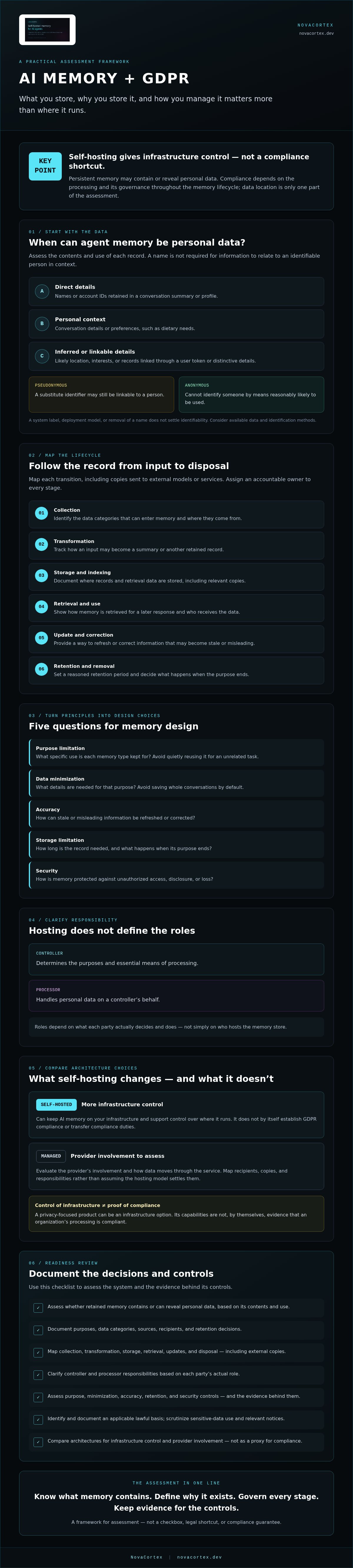
Look beyond obvious identifiers. Memory might store a person’s name or account ID, conversation details, preferences such as dietary needs, or inferred attributes such as likely location or interests. Even without a name, linked records or distinctive details may make someone identifiable in context.
Pseudonymous records use substitutes, such as a user token, but may still relate to an identifiable person if the record can be linked back to them. Genuinely anonymous information cannot identify someone by means reasonably likely to be used. That assessment depends on available data and identification methods, not simply on whether a name was removed.
Which GDPR Principles Shape Memory Design?
These principles translate into engineering questions, not a complete legal test. Decide what the agent needs to retain, how each record will be used, and how the memory lifecycle will be governed. For architecture context, see this guide to the self-hosted AI memory layer.
- Purpose limitation: Define the specific use for each memory type. Don’t quietly reuse it for an unrelated task.
- Data minimization: Store only details needed for that purpose, rather than saving whole conversations by default.
- Accuracy: Provide a way to correct or refresh information that may become stale or misleading.
- Storage limitation: Set a reasoned retention period and decide what happens when the purpose ends.
- Security: Assess how memory is protected against unauthorized access, disclosure, or loss.
These decisions shape the data model, retrieval logic, and operating procedures. A memory store that retrieves useful context is only a starting point. The design must also cover how records are created, maintained, and handled when they are no longer needed.
Map GDPR Responsibilities Across the AI Memory Lifecycle
Persistent memory involves more than one operation. Personal data may enter through a user message, be transformed into a summary, stored or indexed, retrieved for a later response, updated, and eventually removed. Map each transition, including copies sent to external models or services. Assign an accountable owner to every stage of the memory lifecycle.
This map also helps clarify roles. A controller determines the purposes and essential means of processing; a processor handles personal data on a controller’s behalf. The labels depend on what each party actually decides and does, not simply on who hosts the memory store. The European Parliament study on GDPR and AI examines how data-protection obligations intersect with AI system design and use.
Collection, Purpose, and Lawful Basis
Start at the input boundary. List the personal-data categories that can enter memory, where they come from, and why each is needed. Then identify and document an applicable lawful basis for the processing. An agent’s usefulness is not, by itself, the purpose or justification for retaining information.
Check what individuals are told about the memory’s use and operation. Whether consent is appropriate depends on the circumstances; it is not a universal default. Special-category data requires particular scrutiny. Assess notices, consent mechanisms, and the conditions for processing sensitive information for the specific use case, with qualified advice.
Retention, Correction, and Deletion
Memory can outlive its value. A stale preference may produce a poor response, while an inaccurate inference may continue shaping future outputs. Define how information is reviewed or corrected, and decide what should happen when it is no longer needed for its stated purpose.
Test the removal path end to end. Does a deletion request reach the source record, derived summaries, indexes, backups, and copies passed downstream? Identify which systems hold each representation and who owns the action. Deleting a record from one database may not remove every related trace.
Portability matters, too. Moving memory between systems can support migration and reduce dependency on a single storage layer, but teams also need clarity about what data moves and who receives it. A portable memory format for AI is an architectural consideration, not a substitute for governance. Teams assessing implementation options can also review the NovaCortex open-source repository as a reference point, then verify controls against their own requirements.
Self-Hosted vs. Managed AI Memory: What Each Model Changes
Hosting affects where memory is stored and who operates parts of the stack. It does not determine whether processing has a lawful basis, whether people receive appropriate information, or how their rights are handled. Assessing GDPR compliant AI memory starts with the actual data flows and responsibilities in a specific deployment, not its hosting label.
With self-hosting, an organization can keep memory on infrastructure it operates or controls. This can increase control over data location and reduce reliance on a dedicated memory-service vendor. However, cloud infrastructure providers, model providers, or other connected services may still receive or process memory data. Trace those paths as well. The European Parliament analysis on GDPR and AI offers context on applying data-protection principles to AI systems.
A managed service may simplify operations, but it can add a provider that processes personal data on the organization’s behalf or otherwise participates in determining processing purposes and means. The actual role depends on the facts and arrangements. A managed deployment may also require closer examination of subprocessors and international data transfers. Neither model is automatically compliant.
What Self-Hosting Can and Cannot Control
Local infrastructure can give an organization more direct control over where stored knowledge resides. It does not settle why information is collected, what the agent may use it for, or how individuals can exercise their rights. Administrators still need documented practices for access, security, retention, and deletion. They also need to verify that the chosen system supports the controls their design requires.
Keep infrastructure ownership separate from decision-making responsibility. Running the memory layer yourself does not automatically make connected providers irrelevant, and it does not transfer accountability for processing decisions or user requests to the software.
How to Assess Vendors and Data Flows
Build an inventory of every party that can access, process, store, or receive memory data, including infrastructure and model services. For each party, map the data involved, the purpose of access, and the relevant contractual relationship. Review processor terms, subprocessors, transfer arrangements, and safeguards with qualified counsel. The appropriate assessment depends on the deployment and applicable law.
Check whether a request or change can be carried through connected systems instead of assuming one component controls the whole path. A Portable Memory Format can support data portability and reduce dependence on a single memory vendor. It does not establish a lawful basis, validate vendor arrangements, or prove that rights can be fulfilled. Treat portability as an architectural capability to assess, not a compliance shortcut.
Use This GDPR Readiness Checklist for AI Memory
Turn privacy requirements into system tests and named responsibilities. Use this workflow to assess GDPR compliant AI memory before deployment, then repeat it when the data flow, model, or memory architecture changes. This is an engineering checklist, not a legal determination.
- 1. Inventory memory data. Record the categories stored, their sources, how memories are created, and which services or systems can retrieve or receive them. Include derived summaries and indexes, not just the original input.
- 2. Define purpose and ownership. State why each category is retained and who approves that use. Assign owners for privacy decisions, technical controls, handling individual requests, and reviewing the design.
- 3. Document retention decisions. Specify how long each memory type is needed, what event triggers review or removal, and how those decisions apply to derived records and backups. Do not treat indefinite retention as the default.
- 4. Screen for additional assessment. Determine whether the processing may require a Data Protection Impact Assessment, based on its nature, scope, context, and risks. Review whether data moves across borders and assess relevant arrangements with qualified counsel.
- 5. Test rights workflows. Run a request through discovery, correction, access or export, and deletion. Confirm which systems must act, who coordinates the response, and how the team checks that changes reach connected memory copies.
- 6. Verify security and incident handling. Document the safeguards actually in place, who can access each component, and how suspected incidents are escalated and assessed. Confirm specific product capabilities through current documentation and testing. Do not infer them from a feature label.
- 7. Review evidence and repeat. Keep test results, decisions, system changes, and unresolved gaps together. Set a review trigger for material changes to memory logic, providers, data categories, or retrieval paths.
Make the Checklist Testable
A policy that says “delete on request” is not enough. A useful test follows a memory record from its source to every place it may be retrieved, transformed, or retained. Record what happened, where the workflow stopped, and who owns the fix. Apply the same discipline to correction, access restrictions, backup behavior, and incident escalation.
Use the results to compare required controls with verified system behavior. If deletion, retention, access management, encryption, or audit evidence matters to your design, confirm that the selected components support it before deployment. Product descriptions are not operational evidence.
Evaluate Privacy-First AI Memory Without Treating It as a Compliance Shortcut
A privacy-first architecture can improve control over where knowledge is stored and how it moves. It cannot replace documented decisions about purpose, lawful basis, retention, individual requests, or security. Assess GDPR compliant AI memory through both system behavior and organizational governance, not as a badge attached to a tool.
Start with documented requirements. Trace where memory is created, stored, retrieved, exported, and removed. Compare those actual data flows with the architecture you intend to deploy. If the system’s behavior or connected services do not match the plan, address the gap before treating the design as ready.
What to Verify in a Memory Layer
Check the controls relevant to your use case against current product documentation and tests. In particular, verify how deletion and retention work, who can access memory, what security protections are in place, and what audit evidence is available. Do not assume a feature exists because it is common in similar tools.
Assess architecture features separately. A Portable Memory Format may support portability; Knowledge Buckets can shape how information is organized. Neither is a GDPR certification or evidence that a particular data-protection obligation has been met.
Where NovaCortex Fits in the Assessment
NovaCortex Self-Hosted Edition is open source under the Apache-2.0 license and is designed to store knowledge locally on the user’s infrastructure. Its graph-native storage, Portable Memory Format, Knowledge Buckets, and MCP-native memory server are architectural options to evaluate against your data flows and governance requirements. The MCP-native server is an integration approach, not proof that every deployment or connected service meets your needs.
Self-hosting can support infrastructure control, but your organization remains responsible for its processing decisions and operational practices. Before deployment, verify the current capabilities relevant to your requirements, including deletion, retention, access management, encryption, and audit logging. Do not infer their availability from the architecture or product name.
Use the repository to inspect the project and assess whether its architecture fits your requirements.
Build Memory You Can Govern
GDPR compliant AI memory depends on more than where an agent’s knowledge runs. Map personal data across collection, creation, retrieval, updates, and disposal. Define the purpose and responsibilities for each stage, then test whether access, correction, retention, and deletion processes work across connected systems.
Self-hosting can give your organization greater control over data location, but it does not decide lawful basis, transparency, or how people’s rights are handled. Assess the actual deployment, document lifecycle controls, and verify each required capability before relying on it.
NovaCortex offers an architectural option to evaluate. Its Self-Hosted Edition is open source under Apache-2.0 and designed for local deployment on user infrastructure. Its Portable Memory Format supports a vendor-neutral approach to memory portability. These attributes can inform your architecture review, but they are not proof of GDPR compliance.
With clear ownership and evidence behind each control, your team can build agent memory with greater confidence and keep improving it as your system evolves.
Frequently Asked Questions
Is self-hosted AI memory automatically GDPR compliant?
No. Self-hosting can give an organization more control over where memory is stored, but it does not determine the purpose or lawful basis for processing, what people are told, or how their rights are handled. The organization still needs to assess the full data flow, document responsibilities, and verify operational controls. Hosting location is one architectural factor, not proof of GDPR compliance.
Can AI agent memory contain personal data?
Yes. Memory may retain names, account identifiers, conversation details, preferences, or inferred attributes that relate to an identified or identifiable person. Removing a name does not necessarily make a record anonymous if it can be linked to someone using other available information. Assess each memory type in context, including what the agent can retrieve and what other data can be connected to it.
What makes an AI memory system GDPR compliant?
No product feature or label establishes compliance on its own. A GDPR compliant AI memory deployment requires an assessment of the actual processing, including its purpose, lawful basis, data minimisation, accuracy, retention, security, transparency, and handling of individual rights. Teams should map the full lifecycle, assign accountable owners, document decisions, and test relevant controls. Applicable requirements depend on the specific use and should be reviewed with qualified counsel.
Does GDPR require AI memory data to stay in the EU?
GDPR does not impose a blanket rule that all personal data must remain inside the EU. However, transferring personal data outside the European Economic Area can trigger specific transfer requirements and safeguards. Map where memory is stored, accessed, and sent, including through infrastructure, model services, and subprocessors. The appropriate transfer mechanism depends on the destination and circumstances, so verify the arrangement with qualified counsel.
How should an AI memory system handle deletion requests?
Start by locating the person’s data across source memories, derived summaries, indexes, backups, and downstream copies. Determine what must be erased, what can be corrected, and whether any applicable exception affects the request. Test how each system carries out and records the action. Deleting a source record may not remove related copies. Define ownership and escalation steps, and get legal advice on specific requests.
Is a Data Protection Impact Assessment required for AI memory?
Not for every AI memory deployment. A Data Protection Impact Assessment may be required when processing is likely to result in a high risk to people’s rights and freedoms. Screen the system’s purpose, data types, scale, and potential impact, then document the reasoning and consult qualified counsel if applicability is uncertain. A DPIA is a distinct assessment, not a general certificate that a system is compliant.
Does using an open-source AI memory layer guarantee privacy?
No. Open-source licensing lets an organization inspect and use the software under its terms, but it does not establish how a particular deployment handles personal data. Configuration, infrastructure, connected providers, access practices, and lifecycle procedures all matter. NovaCortex is open source under Apache-2.0 and designed for local deployment, but those attributes do not guarantee privacy or GDPR compliance. Assess current capabilities against your documented requirements.
FAQ
When Does AI Agent Memory Contain Personal Data?
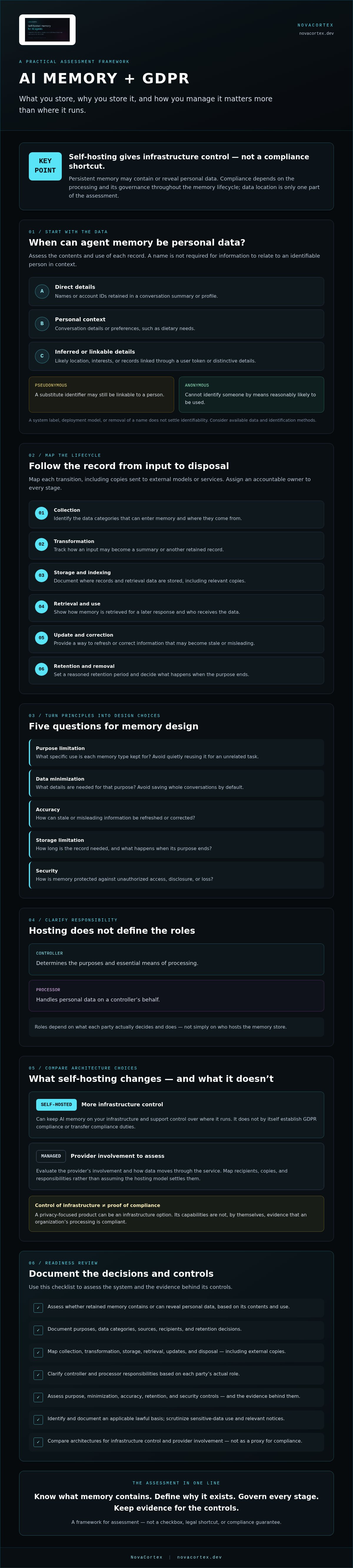
Look beyond obvious identifiers. Memory might store a person’s name or account ID, conversation details, preferences such as dietary needs, or inferred attributes such as likely location or interests. Even without a name, linked records or distinctive details may make someone identifiable in context. Pseudonymous records use substitutes, such as a user token, but may still relate to an identifiable person if the record can be linked back to them. Genuinely anonymous information cannot identify someone by means reasonably likely to be used. That assessment depends on available data and identification methods, not simply on whether a name was removed.
Which GDPR Principles Shape Memory Design?
These principles translate into engineering questions, not a complete legal test. Decide what the agent needs to retain, how each record will be used, and how the memory lifecycle will be governed. For architecture context, see this guide to the self-hosted AI memory layer. These decisions shape the data model, retrieval logic, and operating procedures. A memory store that retrieves useful context is only a starting point. The design must also cover how records are created, maintained, and handled when they are no longer needed. Persistent memory involves more than one operation. Personal data may enter through a user message, be transformed into a summary, stored or indexed, retrieved for a later response, updated, and eventually removed. Map each transition, including copies sent to external models or services. Assign an accountable owner to every stage of the memory lifecycle. This map also helps clarify roles. A controller determines the purposes and essential means of processing; a processor handles personal data on a controller’s behalf. The labels depend on what each party actually decides and does, not simply on who hosts the memory store. The European Parliament study on GDPR and AI examines how data-protection obligations intersect with AI system design and use.
Is self-hosted AI memory automatically GDPR compliant?
No. Self-hosting can give an organization more control over where memory is stored, but it does not determine the purpose or lawful basis for processing, what people are told, or how their rights are handled. The organization still needs to assess the full data flow, document responsibilities, and verify operational controls. Hosting location is one architectural factor, not proof of GDPR compliance.
Can AI agent memory contain personal data?
Yes. Memory may retain names, account identifiers, conversation details, preferences, or inferred attributes that relate to an identified or identifiable person. Removing a name does not necessarily make a record anonymous if it can be linked to someone using other available information. Assess each memory type in context, including what the agent can retrieve and what other data can be connected to it.
What makes an AI memory system GDPR compliant?
No product feature or label establishes compliance on its own. A GDPR compliant AI memory deployment requires an assessment of the actual processing, including its purpose, lawful basis, data minimisation, accuracy, retention, security, transparency, and handling of individual rights. Teams should map the full lifecycle, assign accountable owners, document decisions, and test relevant controls. Applicable requirements depend on the specific use and should be reviewed with qualified counsel.
Does GDPR require AI memory data to stay in the EU?
GDPR does not impose a blanket rule that all personal data must remain inside the EU. However, transferring personal data outside the European Economic Area can trigger specific transfer requirements and safeguards. Map where memory is stored, accessed, and sent, including through infrastructure, model services, and subprocessors. The appropriate transfer mechanism depends on the destination and circumstances, so verify the arrangement with qualified counsel.
How should an AI memory system handle deletion requests?
Start by locating the person’s data across source memories, derived summaries, indexes, backups, and downstream copies. Determine what must be erased, what can be corrected, and whether any applicable exception affects the request. Test how each system carries out and records the action. Deleting a source record may not remove related copies. Define ownership and escalation steps, and get legal advice on specific requests.
Is a Data Protection Impact Assessment required for AI memory?
Not for every AI memory deployment. A Data Protection Impact Assessment may be required when processing is likely to result in a high risk to people’s rights and freedoms. Screen the system’s purpose, data types, scale, and potential impact, then document the reasoning and consult qualified counsel if applicability is uncertain. A DPIA is a distinct assessment, not a general certificate that a system is compliant.
Does using an open-source AI memory layer guarantee privacy?
No. Open-source licensing lets an organization inspect and use the software under its terms, but it does not establish how a particular deployment handles personal data. Configuration, infrastructure, connected providers, access practices, and lifecycle procedures all matter. NovaCortex is open source under Apache-2.0 and designed for local deployment, but those attributes do not guarantee privacy or GDPR compliance. Assess current capabilities against your documented requirements.