Graph-Based RAG Architecture: Engineering Persistent AI Agent Memory
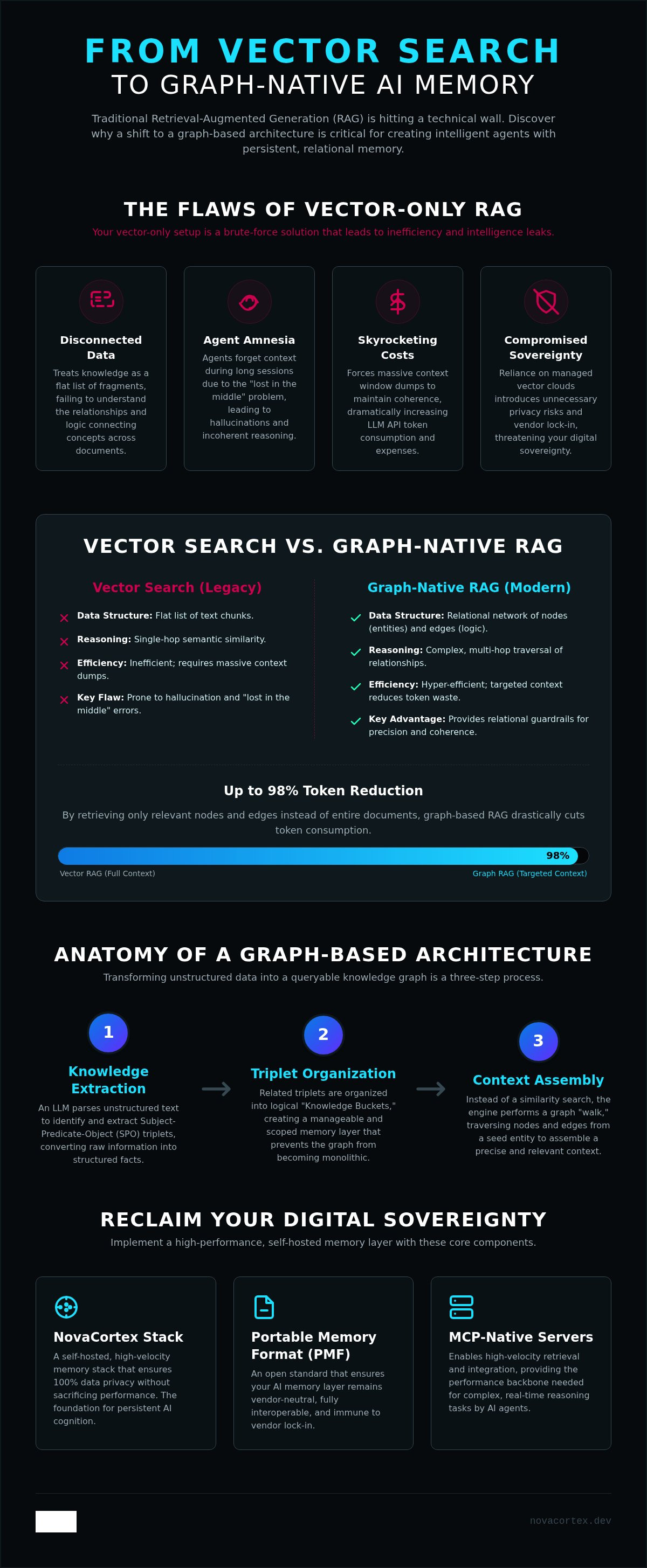
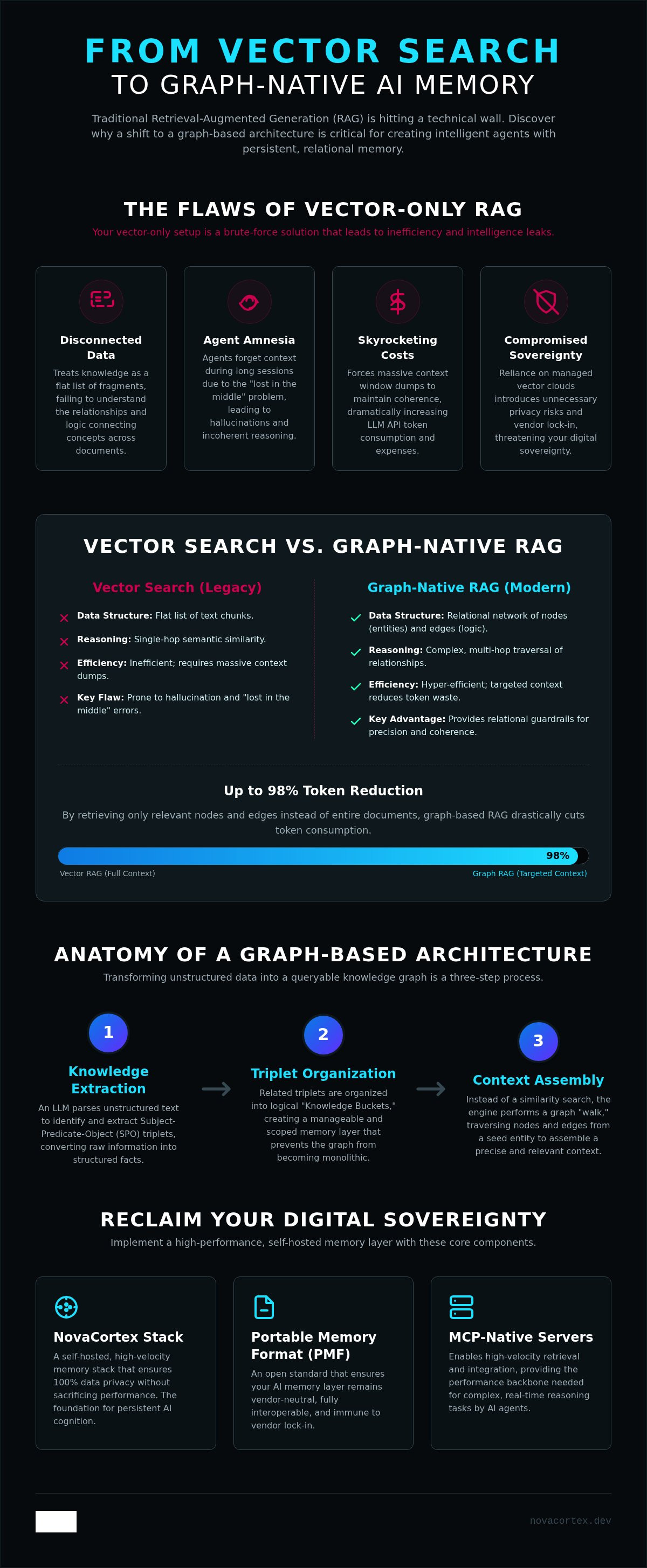
Your vector-only RAG setup is leaking intelligence. It's a brute-force solution to a relational problem. Traditional vector search treats data like a flat list of disconnected fragments, leaving your agents stranded when they need to connect the dots across complex, high-dimensional datasets. You've likely felt the sting of agent amnesia during long-running sessions or watched your LLM API costs skyrocket because you're forced to dump massive context windows just to maintain basic coherence. Managed vector clouds only add to the headache, introducing unnecessary privacy risks and vendor lock-in that compromise your digital sovereignty.
It's time to stop overpaying for architectural inefficiency. Mastering a graph-based RAG architecture is the technical shift required to transition from simple retrieval to true persistent AI memory. By moving to a relational, graph-native approach, you enable the multi-hop reasoning capabilities that flat vector search simply cannot touch. This isn't just a minor upgrade; it's a fundamental correction to how AI agents handle long-term knowledge and private data.
This article provides the blueprint for engineering a high-performance memory layer. We'll explore how to implement a self-hosted architecture that reduces token waste by up to 98% while maintaining 100% data sovereignty. You'll learn to leverage the Portable Memory Format and MCP-native servers to build agents that don't just search, but actually remember.
Key Takeaways
- Learn how a graph-based RAG architecture replaces flat semantic similarity with relational logic to eliminate agent amnesia and enable complex, multi-hop reasoning.
- Stop wasting budget on context dumping by utilizing nodes and edges to prune noise, potentially reducing token consumption by up to 98%.
- Reclaim digital sovereignty by implementing the Portable Memory Format (PMF) to ensure your AI memory layer remains vendor-neutral and fully interoperable.
- Deploy a high-velocity, self-hosted memory stack using NovaCortex and MCP-native integration to maintain 100% data privacy without sacrificing performance.
Beyond Vector Search: The Shift to Graph-Based RAG
Standard Retrieval-Augmented Generation (RAG) has hit a technical ceiling. It relies on vector embeddings to find "similar" chunks of text. Similarity isn't understanding. It's a fuzzy approximation of relevance that ignores the underlying logic of your data. A graph-based RAG architecture fixes this by mapping relationships as first-class citizens. We're moving from a document-centric model, where agents hunt for keywords, to an entity-centric memory layer that understands how concepts connect.
The core issue is the "Multi-Hop" problem. Vector search fails when an answer requires connecting disparate facts across a massive dataset. If Fact A is in Document 1 and Fact B is in Document 100, a standard top-k search might retrieve one but miss the other. It can't follow the breadcrumbs. Graphs solve this through nodes and edges. They navigate the structure of your information, not just the vocabulary. This shift allows agents to synthesize answers by traversing a path of related entities rather than guessing based on semantic proximity.
The Failure of Semantic Similarity
Top-k retrieval is a blunt instrument. It pulls the most "similar" text, but similarity doesn't equate to correctness. In long context windows, LLMs suffer from the "lost in the middle" phenomenon. Information buried in the center of a prompt is often ignored or forgotten. Flat data structures lead to agent hallucinations because the model is forced to invent connections between disconnected retrieved chunks. It lacks the relational guardrails needed for precision. This architectural flaw is why graph-based RAG architecture is becoming the standard for high-stakes engineering tasks.
Graph-Native vs. Graph-Enhanced
Don't confuse a graph index with a graph-native memory layer. Many systems are "graph-enhanced," meaning they slap a basic relationship map on top of a legacy vector store. This is a patch, not a solution. Persistent cognition requires a relational foundation built for high-velocity retrieval. Graph-native storage is the bedrock of agent memory, ensuring that every entity and its connections are preserved in a structured, queryable format. This architecture prevents context fragmentation and ensures your agent maintains a coherent world model. By using graph-native storage, you ensure your data remains structured and accessible for complex reasoning without the overhead of massive, redundant context windows.
Anatomy of a Graph-Based RAG Architecture
Engineering a graph-based RAG architecture requires a fundamental shift in how we structure information. We're moving away from flat text chunks toward a relational schema that mirrors human cognition. In this architecture, nodes represent discrete entities like concepts, people, or events. Edges define the logic between them. This isn't just a layer of metadata. It's the connective tissue that allows an AI agent to understand the "why" and "how" behind the data it retrieves. This structural precision is the only way to build agents that don't just search, but actually reason.
To populate this structure, the indexing pipeline must transform unstructured text into queryable triplets. This process involves using an LLM to identify Subject-Predicate-Object (SPO) relationships. For example, a raw document might state that "NovaCortex reduces token waste." The extraction engine converts this into a node for NovaCortex, a node for token waste, and an edge labeled "reduces." This granular approach turns a messy PDF into a precise map of facts. It's the difference between a pile of bricks and a finished building.
Knowledge Extraction and Triplets
The extraction process is where the heavy lifting happens. By breaking data down into triplets, we eliminate the ambiguity of semantic similarity. We organize these related triplets into Knowledge Buckets. These buckets act as logical containers, allowing the system to scope its memory based on the agent's current operational state. This prevents the graph from becoming a monolithic, unmanageable mess. It ensures that the agent only retrieves context that is architecturally relevant to the task at hand. It's a lean, targeted approach to data management.
Traversal and Context Assembly
Retrieval in a graph-native system is an active process. Instead of a passive similarity search, the engine performs a graph "walk." It starts at a seed node identified from the user query and traverses the edges to find related entities. This method is the core of Microsoft's GraphRAG project, which highlights how traversal enables reasoning across disparate data points that vector search would ignore. It's about finding the logical path, not just the nearest neighbor.
Once the relevant nodes are identified, the system performs dynamic context assembly. It builds the LLM prompt from these specific graph clusters rather than random text fragments. This precision is vital for maintaining a self-hosted AI memory layer that is both efficient and accurate. If you want to see this in action, examine the code in our repository to understand how these traversals are optimized for real-world performance.
Graph vs. Vector: Engineering for Token Efficiency
Context dumping is a tax on engineering inefficiency. Standard RAG setups rely on a scattergun approach, flooding the LLM with disconnected text chunks in the hope that the answer lies somewhere in the top-k results. This brute-force method creates massive noise, forcing the model to sift through irrelevant data while your API costs spiral out of control. A graph-based RAG architecture replaces this waste with surgical precision. By retrieving only the specific nodes and edges necessary to answer a query, you prune the noise by 90% or more before the data ever reaches the prompt.
Performance at scale is where the vector model truly breaks. As your knowledge base grows, semantic similarity becomes increasingly blurred, leading to "retrieval rot" where the most relevant facts are buried under a mountain of similar but useless fragments. Graphs maintain high-velocity retrieval speed because they navigate a structured map. They don't search; they traverse. This ensures that even as your dataset expands to millions of entities, the agent finds the logical path to the truth without needing an infinite context window.
The 98% Token Reduction Metric
The math behind graph efficiency is simple but devastating to traditional vector stores. While a flat vector search might pull 5,000 tokens of "relevant" text, GraphRAG identifies the exact Subject-Predicate-Object triplets required, often reducing that payload to fewer than 100 tokens. NovaCortex benchmarks show that this precision retrieval can achieve up to a 98% reduction in token usage. Analyzing Redis vs graph memory for AI agents reveals that structural precision directly impacts the bottom line by eliminating the redundant context that bloats standard RAG prompts. You're no longer paying for the LLM to ignore 90% of what you send it.
Solving Agent Amnesia
Vector databases are stateless snapshots. They lack a persistent cognitive schema, which is why agents often "forget" the broader context of a long-running session. They lose the thread because they can't relate new information to established facts in a meaningful way. Graph memory acts as a persistent cognitive layer, allowing the agent to build a cumulative world model over time. This architectural shift also solves the data sovereignty crisis. By moving to local, self-hosted graph storage, you ensure that your agent's long-term memory remains under your control, rather than being trapped in a managed vector cloud that compromises your privacy and creates vendor lock-in.
Data Sovereignty and the Portable Memory Format
Your AI agent's memory is its most valuable asset. Entrusting that asset to a managed cloud provider is a strategic error. Most developers are sleepwalking into a situation where their agent's cognitive state is effectively a hostage. When you use a proprietary graph-based RAG architecture hosted on third-party servers, you're surrendering your data's future. Digital sovereignty isn't a buzzword. It's an engineering requirement. If you can't migrate your agent's memory across environments without friction, you don't own the intelligence you've built.
Ending Vendor Lock-in
Managed vector clouds are designed as traps. They make egress difficult and data formats opaque to keep you paying. The portable memory format for AI (PMF) is the necessary correction to this industry flaw. By using a vendor-neutral, JSON-first serialization protocol, PMF allows you to bundle memory into portable units. These .mem bundles include manifests and checksums to ensure data integrity during transfer. This standardization is critical for multi-agent synchronization. It allows different agents to share Knowledge Buckets seamlessly, creating a unified cognitive layer that isn't tied to a single provider's API. You gain the freedom to move your stack as performance or pricing needs change.
Self-Hosted Privacy Protocols
Privacy-first RAG is a myth on managed infrastructure. True security requires keeping your knowledge base entirely local. By deploying a graph-based RAG architecture on your own VPS, Raspberry Pi, or local server, you eliminate the risk of third-party data harvesting. You control the entire stack from the OS to the memory server. This setup is particularly vital for autonomous agents handling sensitive corporate data or private user history. A self-hosted memory layer ensures that your data remains behind your firewall. It's a principled approach to engineering that rejects bloated, restrictive systems in favor of lean, independent operations.
Knowledge Buckets allow you to shard this local memory, ensuring that only relevant contexts are loaded into active memory. This modularity keeps performance high even on modest hardware like a Raspberry Pi 5. Digital sovereignty in the age of autonomous agents means owning the hardware, the software, and the memory. You aren't just building a tool; you're securing a sovereign digital asset that is verifiable and portable under the Apache-2.0 license.
Implementing NovaCortex: A Self-Hosted Graph Memory Layer
Most GraphRAG implementations are marketed as exclusive, cloud-only enterprise features. This is a false barrier. Reject the bloat of general-purpose frameworks that prioritize marketing over engineering reality. Building a graph-based RAG architecture should be lean, specialized, and entirely within your control. NovaCortex Self-Hosted Edition is designed for this specific purpose. It provides the architectural foundation for persistent agent memory without the overhead of managed services or restrictive licenses. You're building a tool for engineers, by engineers.
The implementation process moves rapidly from raw data ingestion to a queryable cognitive map. You start by deploying the memory server on your private infrastructure. This ensures your data never leaves your perimeter. Once the server is live, you ingest unstructured datasets through the extraction pipeline to generate Subject-Predicate-Object triplets. These triplets aren't just stored; they're organized into logical Knowledge Buckets. This sharding strategy allows your agent to maintain high performance by only loading the specific relational clusters required for the task at hand. It's a pragmatic approach to scaling that respects your hardware limits.
MCP-Native Memory Servers
The Model Context Protocol (MCP) has emerged as the new standard for agent-to-memory communication. An MCP native memory server acts as a direct bridge between your LLM and its persistent knowledge base. This removes the need for complex, fragile middleware that often introduces latency and points of failure. By integrating directly via MCP, your agent can query the graph and receive structured context in real-time. This architecture ensures that context retrieval is a low-latency operation, allowing for seamless multi-hop reasoning during active sessions. It's about building a direct pipeline for intelligence.
Getting Started with NovaCortex
Deployment begins with a simple installation on your VPS or local server. After the initial setup, you'll configure your first Knowledge Bucket to define the scope of your agent's memory. You can then begin the extraction process, transforming your documentation into a relational graph-based RAG architecture. Scaling is handled through tiered storage, ensuring that as your knowledge grow, your retrieval speed remains constant. You aren't just setting up a database; you're engineering a persistent cognitive layer that evolves with your agent's needs. The shift from flat search to relational memory is the only way to achieve true agentic autonomy.
Deploy NovaCortex Self-Hosted Edition today
Engineering Sovereign Agent Intelligence
The era of bloated, stateless AI agents is ending. Relying on flat vector similarity is no longer sufficient for systems that require deep relational understanding and high-velocity performance. By adopting a graph-based RAG architecture, you move beyond simple search and into the realm of persistent cognitive memory. This technical shift ensures your agents can connect disparate data points across complex datasets while maintaining absolute data sovereignty on your own infrastructure.
We've detailed the path to achieving up to 98% token savings through precision retrieval and relational logic. With a privacy-first architecture and MCP-native support, your memory layer becomes a specialized engineering asset rather than a generic cloud dependency. It's time to build agents that don't just retrieve fragments but actually remember and reason with intent. Your data deserves an architecture that respects its complexity and your independence.
Take control of your agent's cognitive stack and lead the industry toward better technical practices today.
Frequently Asked Questions
What is the primary difference between vector RAG and graph-based RAG?
Vector RAG relies on semantic similarity to find text fragments that look like the query. This often fails at structural logic. A graph-based RAG architecture uses nodes and edges to map actual relationships between entities. Instead of guessing based on word proximity, the system traverses a logical map. This architectural shift allows agents to handle multi-hop reasoning that flat vector databases simply cannot process without massive context dumping.
How does graph-based RAG architecture reduce token usage?
It reduces token usage by replacing brute-force context dumping with surgical precision. Traditional RAG floods the LLM with thousands of tokens of "similar" text. NovaCortex retrieves only the specific Subject-Predicate-Object triplets required to answer the query. This precision retrieval can reduce token consumption by up to 98%. You're sending the model exactly what it needs to know, not a mountain of irrelevant noise that inflates your API bills.
Can I self-host a graph-based RAG system on a Raspberry Pi?
Yes, you can deploy the NovaCortex Self-Hosted Edition on a Raspberry Pi 5 or any standard VPS. The architecture is engineered for lean operations and high-velocity performance on modest hardware. Because the system uses Knowledge Buckets to shard data, it doesn't require the massive RAM overhead associated with managed vector clouds. Keeping your memory layer on local hardware is the only way to maintain 100% digital sovereignty.
What is a Portable Memory Format (PMF) and why does it matter?
The Portable Memory Format (PMF) is a vendor-neutral, JSON-first serialization protocol for AI memory. It allows you to package an agent's cognitive state into portable units. This matters because it ends the cycle of vendor lock-in. You can move your knowledge bases between different environments or agents without losing relational integrity. It ensures that your data remains a sovereign asset rather than a hostage in a proprietary cloud ecosystem.
Does GraphRAG require a specific graph database like Neo4j?
No, you don't need a legacy database like Neo4j to implement a graph-based RAG architecture. NovaCortex is a specialized, graph-native memory layer that functions independently. While enterprise frameworks often add layers of unnecessary bloat, this system is purpose-built for AI agent persistence. It uses its own optimized storage engine to handle relational triplets, ensuring low-latency traversal without the complexity or restrictive licensing of traditional graph database management systems.
How does the Model Context Protocol (MCP) work with NovaCortex?
NovaCortex functions as an MCP-Native Memory Server. This means it integrates directly with the Model Context Protocol to provide a low-latency bridge between the LLM and its knowledge base. You don't need complex middleware or fragile custom connectors. The protocol allows the agent to query Knowledge Buckets and retrieve structured context in real-time. This direct integration ensures that your agent's memory is always accessible and architecturally synchronized with its reasoning process.
Is graph-based RAG faster than traditional vector search?
Graph-based retrieval is significantly faster at scale. Vector search performance often degrades as the dataset grows because the engine must compare embeddings across a massive high-dimensional space. In contrast, graph traversal follows established edges between nodes. It doesn't search; it walks. This structural efficiency ensures that retrieval speed remains constant even as your Knowledge Buckets expand to millions of entities. It's a high-velocity solution built for real-world engineering demands.
What are Knowledge Buckets in the context of AI agent memory?
Knowledge Buckets are logical containers used to shard and organize an agent's memory. Instead of a monolithic graph, you group related triplets into discrete buckets. This allows the system to scope its retrieval based on the agent's current task or operational state. It prevents context fragmentation and ensures that the LLM isn't overwhelmed by irrelevant data. Buckets make the memory layer modular, portable, and easier to manage across multi-agent environments.
FAQ
What is the primary difference between vector RAG and graph-based RAG?
Vector RAG relies on semantic similarity to find text fragments that look like the query. This often fails at structural logic. A graph-based RAG architecture uses nodes and edges to map actual relationships between entities. Instead of guessing based on word proximity, the system traverses a logical map. This architectural shift allows agents to handle multi-hop reasoning that flat vector databases simply cannot process without massive context dumping.
How does graph-based RAG architecture reduce token usage?
It reduces token usage by replacing brute-force context dumping with surgical precision. Traditional RAG floods the LLM with thousands of tokens of "similar" text. NovaCortex retrieves only the specific Subject-Predicate-Object triplets required to answer the query. This precision retrieval can reduce token consumption by up to 98%. You're sending the model exactly what it needs to know, not a mountain of irrelevant noise that inflates your API bills.
Can I self-host a graph-based RAG system on a Raspberry Pi?
Yes, you can deploy the NovaCortex Self-Hosted Edition on a Raspberry Pi 5 or any standard VPS. The architecture is engineered for lean operations and high-velocity performance on modest hardware. Because the system uses Knowledge Buckets to shard data, it doesn't require the massive RAM overhead associated with managed vector clouds. Keeping your memory layer on local hardware is the only way to maintain 100% digital sovereignty.
What is a Portable Memory Format (PMF) and why does it matter?
The Portable Memory Format (PMF) is a vendor-neutral, JSON-first serialization protocol for AI memory. It allows you to package an agent's cognitive state into portable units. This matters because it ends the cycle of vendor lock-in. You can move your knowledge bases between different environments or agents without losing relational integrity. It ensures that your data remains a sovereign asset rather than a hostage in a proprietary cloud ecosystem.
Does GraphRAG require a specific graph database like Neo4j?
No, you don't need a legacy database like Neo4j to implement a graph-based RAG architecture. NovaCortex is a specialized, graph-native memory layer that functions independently. While enterprise frameworks often add layers of unnecessary bloat, this system is purpose-built for AI agent persistence. It uses its own optimized storage engine to handle relational triplets, ensuring low-latency traversal without the complexity or restrictive licensing of traditional graph database management systems.
How does the Model Context Protocol (MCP) work with NovaCortex?
NovaCortex functions as an MCP-Native Memory Server. This means it integrates directly with the Model Context Protocol to provide a low-latency bridge between the LLM and its knowledge base. You don't need complex middleware or fragile custom connectors. The protocol allows the agent to query Knowledge Buckets and retrieve structured context in real-time. This direct integration ensures that your agent's memory is always accessible and architecturally synchronized with its reasoning process.
Is graph-based RAG faster than traditional vector search?
Graph-based retrieval is significantly faster at scale. Vector search performance often degrades as the dataset grows because the engine must compare embeddings across a massive high-dimensional space. In contrast, graph traversal follows established edges between nodes. It doesn't search; it walks. This structural efficiency ensures that retrieval speed remains constant even as your Knowledge Buckets expand to millions of entities. It's a high-velocity solution built for real-world engineering demands.
What are Knowledge Buckets in the context of AI agent memory?
Knowledge Buckets are logical containers used to shard and organize an agent's memory. Instead of a monolithic graph, you group related triplets into discrete buckets. This allows the system to scope its retrieval based on the agent's current task or operational state. It prevents context fragmentation and ensures that the LLM isn't overwhelmed by irrelevant data. Buckets make the memory layer modular, portable, and easier to manage across multi-agent environments.