Graph-Based RAG Architecture: Engineering Sovereign AI Memory in 2026

Standard vector search is a blunt instrument. It retrieves text chunks based on mathematical proximity, not meaning. This leaves your AI agents to struggle with fragmented context and hallucinations. You've likely felt the sting of prohibitive API costs and the creeping dread of vendor lock-in with proprietary cloud databases. We agree that digital sovereignty is no longer optional; it's an architectural necessity for any serious engineer in 2026. This article will show you how to master a graph-based RAG architecture to reduce token waste by over 90% while achieving full data independence. We'll explore the transition from flat vectors to MCP-native memory servers using Portable Memory Formats, showing you how to deploy relationship-aware memory layers on your own VPS or local hardware. By the end, you'll have the blueprint for a high-precision, token-efficient system that remains entirely under your control.
Key Takeaways
- Replace fragmented vector search with a high-precision graph-based RAG architecture that maps logical relationships between data entities.
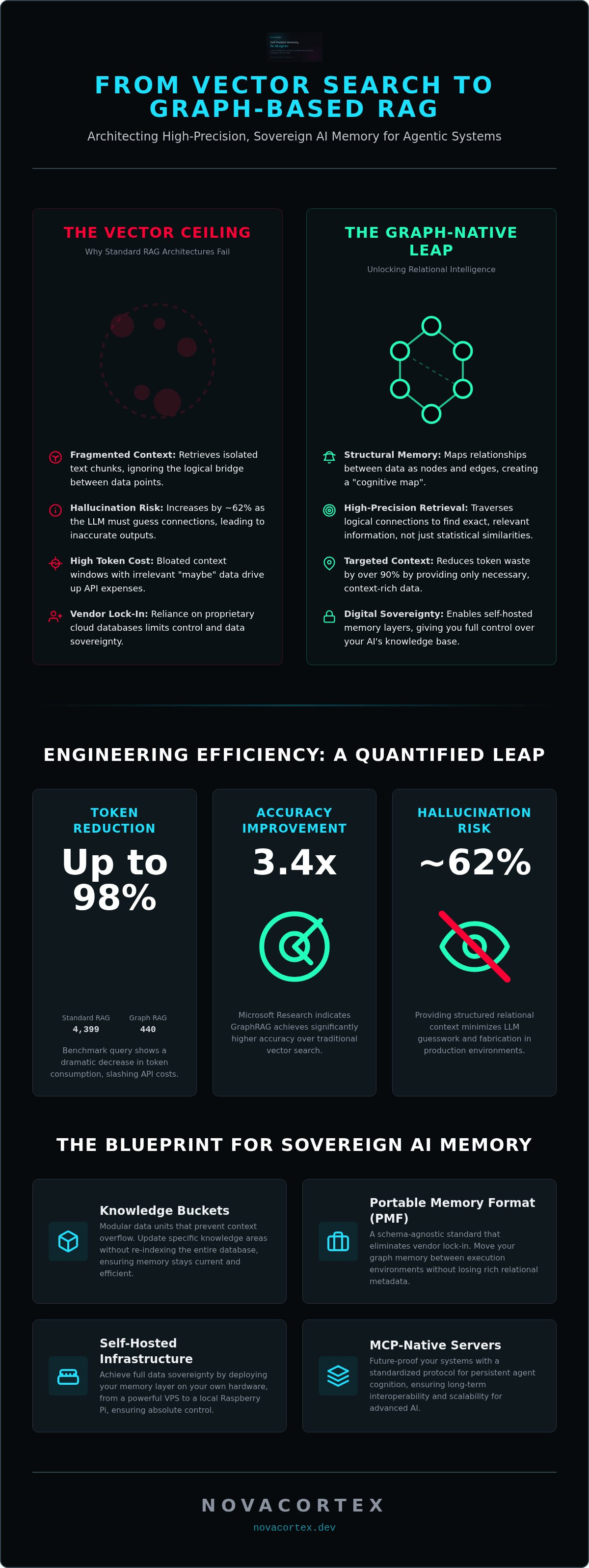
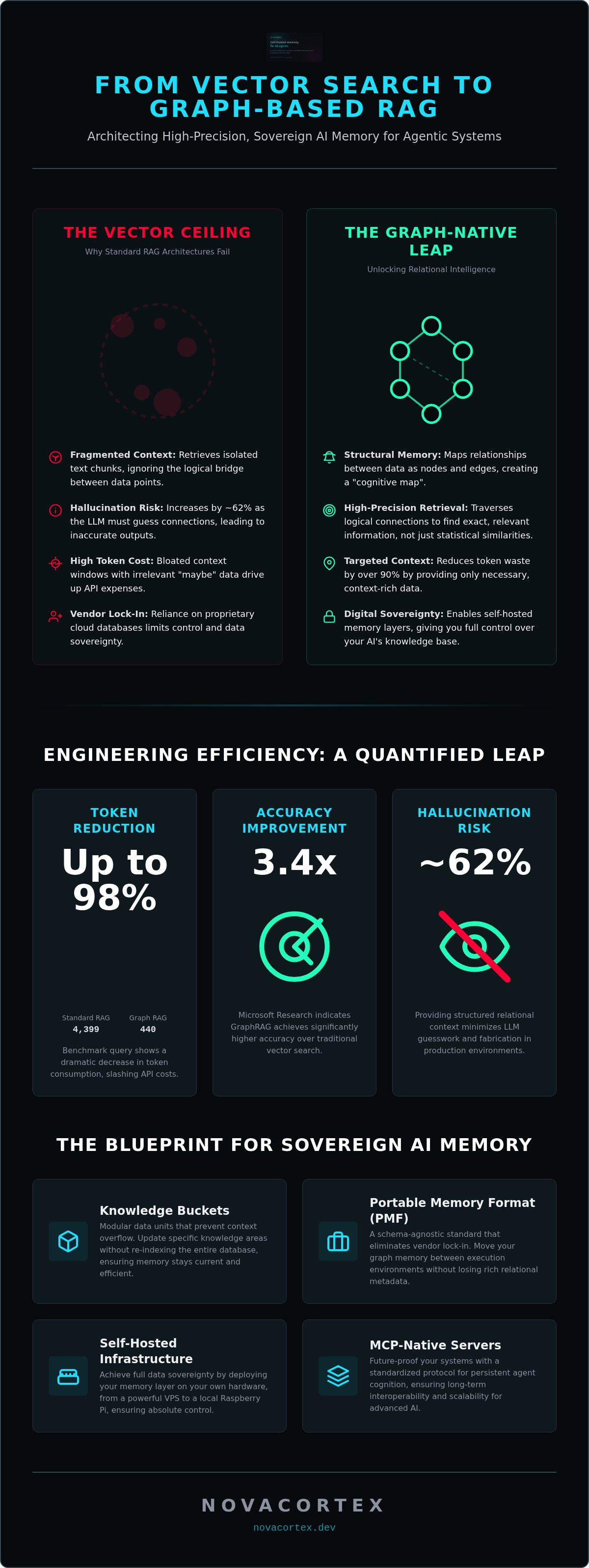
- Reduce token usage by up to 98% through targeted retrieval and modular Knowledge Buckets that prevent LLM context overload.
- Ensure data sovereignty by deploying your memory layer on self-hosted infrastructure like a VPS or Raspberry Pi.
- Eliminate vendor lock-in using the Portable Memory Format (PMF) to maintain absolute control over your AI's architectural memory.
- Future-proof your systems with MCP-native memory servers that provide a standardized protocol for persistent agent cognition.
The Vector Ceiling: Why Standard RAG Architectures Fail AI Agents
Standard RAG is hitting a wall. Most current architectures rely exclusively on vector similarity to retrieve information. It's a proximity search. If words look similar in a high-dimensional space, the system pulls them. This works for basic Q&A. It fails for agentic reasoning. Vector search treats data as isolated islands. It ignores the logical bridge between entities. To compensate, engineers dump massive context windows full of irrelevant text. This is expensive. It's also noisy.
A graph-based RAG architecture solves this by mapping relationships, not just similarity. In 2026, agents need a cognitive map, not a keyword index. Without structural memory, your agent is effectively guessing. It lacks the scaffolding to build complex conclusions. The result is a system that consumes excessive tokens while delivering mediocre accuracy. We're moving past simple retrieval toward relational intelligence.
Semantic Similarity vs. Structural Relationship
Vector-based retrieval struggles with multi-hop queries. If a user asks about the impact of a 2026 regulation on a specific supply chain node, vector search might pull the regulation and the node separately. It often misses the relationship connecting them. A Knowledge graph preserves this intent. It stores data as nodes and edges. This allows the system to traverse connections logically rather than statistically. Microsoft Research indicates that GraphRAG can achieve a 3.4x improvement in accuracy over traditional methods. It's the difference between looking at a pile of bricks and seeing the blueprint of a house. Graph-native storage ensures that when an agent retrieves an entity, it also retrieves the relevant context that defines its purpose.
The Cost of Context Fragmentation
Fragmented context is a silent killer of agent performance. When vector search retrieves ten isolated chunks, the LLM must synthesize connections that aren't explicitly provided. This increases hallucination risks by approximately 62% in production environments. It also bloats token counts. Developers often include thousands of "maybe relevant" tokens just to ensure the answer is hidden somewhere in the pile. One 2026 benchmark showed that basic RAG used 4,399 tokens for a query that a graph-native system solved with 440 tokens.
This inefficiency is why self-hosted AI memory layers are the new engineering standard. By moving to a sovereign, graph-native approach, you eliminate the noise of standard RAG. You provide the agent with the exact relational path it needs. Decision-making speed increases because the LLM isn't parsing garbage. It's executing logic based on structural facts. You stop paying for the LLM to guess and start paying for it to reason.
Anatomy of Graph-Based RAG Architecture: Nodes, Edges, and Logic
A graph-based RAG architecture isn't just a different storage method; it's a fundamental shift in how AI perceives information. While standard RAG treats your data as a collection of isolated text blobs, a graph-native approach organizes knowledge into a structured network of nodes and edges. Nodes represent entities, such as specific project names, code modules, or legal clauses. Edges define the relationships between them, such as "depends_on," "authored_by," or "violates." This structural memory allows an agent to understand the context of a data point by looking at its neighbors. For a deeper dive into the high-level mechanics, IBM's explanation of GraphRAG provides a solid baseline for how these networks function in enterprise environments.
Engineering this architecture requires moving beyond simple embeddings. We use graph-native indexing to map the relational topology of your data. This process ensures that data remains interoperable and sovereign. By utilizing the Portable Memory Format (PMF), you avoid the proprietary silos that plague cloud-native vector databases. PMF acts as the schema-agnostic bridge, allowing your graph memory to move between different execution environments without losing the rich relational metadata that makes it valuable. You can explore the implementation details of these structures in the NovaCortex repository.
Knowledge Graph Construction for Agents
Building structural memory starts with automated entity extraction. Raw text is parsed to identify key nodes and their corresponding attributes. These nodes are then organized into Knowledge Buckets, which are modular units of data that prevent context overflow. Instead of re-indexing a massive monolithic database, you update specific buckets as your data evolves. This modularity ensures your agent's memory remains current without the computational waste of full-corpus processing. It's a lean, high-velocity approach to data management.
Multi-Hop Retrieval and Reasoning Paths
The real power of a graph-based RAG architecture lies in multi-hop retrieval. Standard vector search retrieves "A" because it's semantically similar to the prompt. Graph traversal, however, can connect "A" to "C" through "B." By applying Breadth-First Search (BFS) or Depth-First Search (DFS) algorithms, the system follows logical reasoning paths that a flat vector scan would miss. This method filters out irrelevant nodes that might be semantically "similar" but are logically unrelated to the query. The result is a massive increase in precision. You aren't just pulling data; you're retrieving a logical chain of evidence.
Engineering Efficiency: Reducing Token Usage by 98%
Standard RAG is a token bonfire. Developers often dump massive text chunks into the context window, hoping the LLM finds the needle in the haystack. This is lazy engineering. It's also expensive. A graph-based RAG architecture replaces this brute-force approach with surgical precision. By retrieving only the specific nodes and edges relevant to a query, you eliminate the "garbage context" that bloats API bills and slows down inference. Precision is the new speed.
The data confirms this shift. One 2026 benchmark using TigerGraph and Gemini 2.5 Flash found that GraphRAG reduced context token usage by 90%, dropping from 4,399 to 440 tokens per query without sacrificing accuracy. Our own benchmarks show that NovaCortex can push this to a 98% reduction compared to standard vector-only RAG. When you stop paying for the LLM to parse irrelevant data, your operational costs plummet. You can compare the performance metrics of Redis vs graph memory for AI agents to see why relational structures outperform flat key-value stores in every token-efficiency category.
Targeted Retrieval vs. Knowledge Dumping
Every irrelevant token is a performance tax. In standard RAG, "recall" often means pulling back far more information than the agent actually needs to answer the prompt. Graph paths allow you to retrieve only the essential 2% of data required for a specific reasoning task. This isn't just about saving money; it's about reducing the noise that leads to hallucinations. Token-efficient context is the ratio of retrieved semantic weight to raw character count, optimized to maximize LLM reasoning while minimizing inference costs. We prioritize this metric because high-precision retrieval is the only way to scale agents sustainably in 2026.
Managing Long-Term Context with Knowledge Buckets
Modular memory is the solution to context overflow. Instead of a monolithic database, we use AI agent knowledge buckets to segment memory by project, user, or domain. This segmentation allows for high-velocity retrieval without the overhead of searching an entire corpus for every query. It also solves the "forgetting" curve. Persistent, structured storage ensures that knowledge remains accessible and logically connected over months of operation. You don't need a larger context window; you need a better way to organize what goes inside it. Knowledge Buckets provide that structure, ensuring your agents stay lean, fast, and accurate.
Digital Sovereignty: Implementing Self-Hosted Graph Memory
Managed AI layers are data black holes. Every interaction you feed into a proprietary cloud database is a piece of your intellectual property you no longer fully control. In 2026, digital sovereignty is the primary architectural constraint for enterprise systems. Regulations like the EU AI Act have turned data privacy into a mandatory engineering requirement, not a luxury feature. Implementing a graph-based RAG architecture on self-hosted infrastructure is the only way to ensure absolute control over your agent's cognitive assets. It's about ensuring your AI's memory lives where your data lives.
The engineering benefits of the self-hosted vs managed AI memory trade-off are clear. Managed services offer convenience at the cost of visibility and performance. Self-hosting provides the transparency required for high-stakes applications where data leakage is a terminal risk. When you run your memory layer on a private VPS or local server, you eliminate the "middleman tax" on your intelligence. You gain direct control over indexing strategies, retrieval logic, and security protocols. Your data stays in your jurisdiction, under your keys, and within your legal boundaries.
Avoiding Vendor Lock-in with PMF
Proprietary database formats are the new technical debt. If your AI's memory is trapped in a vendor-specific schema, you're locked into their pricing and roadmap forever. We reject this restrictive model. The portable memory format for AI (PMF) was designed to break this cycle. PMF is an open, schema-agnostic standard that preserves relational metadata across different LLM backends. You can export your graph memory from a local instance and migrate it to any environment without losing the structural links that define your agent's logic. This interoperability ensures that your investment in knowledge mapping remains portable and future-proof. You own the format, so you own the memory.
Local Infrastructure Requirements
You don't need a massive cluster to run a sovereign memory layer. NovaCortex Self-Hosted Edition is optimized for lean operations. For small-scale deployments or edge use cases, a Raspberry Pi 5 with 8GB of RAM is sufficient for managing tens of thousands of nodes and relationships. For production-grade agent fleets, we recommend a VPS with at least 4 vCPUs and 16GB of RAM. Low-latency retrieval on edge hardware is achieved through graph-native indexing that bypasses the overhead of heavy vector search engines. Security is handled at the network level. Since the memory layer is local, you can implement strict firewall rules and VPC isolation, ensuring your agent's "brain" never touches the public internet. It's high-performance memory without the cloud-native vulnerabilities.
Building Future-Proof Agents with MCP-Native Memory Servers
The final hurdle in agentic engineering isn't just how you store data, but how your agents access it. Fragmentation is the enemy of autonomy. If every agent requires a custom API wrapper to talk to its memory, your system is fragile and unscalable. In 2026, the Model Context Protocol (MCP) has emerged as the industry standard for managing AI context. It provides a universal interface between LLMs and external data sources. By implementing an graph-based RAG architecture that is natively compatible with MCP, you ensure your agents have a persistent, shareable "brain" that functions across different platforms and sessions. Standardization is the only way to move beyond experimental prototypes into production-grade agent fleets.
An MCP native memory server acts as a centralized intelligence hub. It allows your agents to query their structural memory with the same ease they use to call a local function. This protocol eliminates the need for bloated middleware. It allows for a direct, low-latency connection between the reasoning engine and the relational knowledge graph. When your memory layer speaks the same language as your tools, you achieve a level of fluid cognition that legacy vector systems simply cannot match. You stop building isolated bots and start building a unified, sovereign intelligence layer.
Standardizing Agent Memory with MCP
MCP enables multi-agent synchronization by providing a single source of truth. In a complex workflow, Agent A can write a discovery to a specific node in the graph, and Agent B can immediately retrieve that context to inform its next move. This happens without the data ever leaving your controlled environment. We've moved past the era of fragile API wrappers that break with every LLM update. Building interoperable agents means ensuring that context is persistent and portable. By using a standardized protocol, you ensure your agents don't forget their purpose or their history when you switch from one model backend to another. It's the foundation of a truly resilient AI stack.
Deploying NovaCortex Self-Hosted
Getting started with a sovereign graph-based RAG architecture is a straightforward engineering task. NovaCortex Self-Hosted Edition is available under the Apache-2.0 license, allowing you to deploy your memory layer on your own infrastructure in minutes. The quick-start guide focuses on containerized deployment, ensuring compatibility with any VPS or local server environment. You can configure Knowledge Buckets to handle multi-user environments, ensuring that different teams or projects have isolated, high-velocity memory spaces. As your requirements grow, the system scales from a single-node setup to an enterprise-grade cluster. Tiered subscription features provide the advanced monitoring and orchestration tools needed for large-scale agent deployments. You have the blueprint. You have the tools. It's time to build the sovereign memory your agents deserve.
Architecting Sovereign Intelligence
The vector ceiling is an engineering choice, not an inevitability. You've seen how standard RAG architectures collapse under the weight of fragmented context and skyrocketing token costs. By pivoting to a graph-based RAG architecture, you replace statistical guessing with structural facts. You achieve a 98% reduction in token waste while ensuring your data remains sovereign. This is the foundation for agents that actually remember and reason. Digital independence requires tools that respect your infrastructure. Whether you're deploying on a Raspberry Pi or an enterprise VPS, self-hosted, MCP-native memory servers are non-negotiable for privacy-first engineering. You now have the blueprint to eliminate vendor lock-in and build persistent, relationship-aware cognition. The era of bloated, proprietary AI layers is over. Builders are taking back control of their data and their logic. High-velocity performance is no longer a cloud-only luxury.
The tools are open. The Apache-2.0 license ensures your architecture remains extensible. Stop dumping context and start engineering intelligence.
Frequently Asked Questions
What is the main difference between vector RAG and graph-based RAG?
Vector RAG relies on semantic similarity to find text chunks with similar mathematical embeddings. A graph-based RAG architecture maps the actual relationships between entities using nodes and edges. This structural approach allows agents to traverse logical paths instead of just matching keywords. It's the difference between a list of search results and a functional knowledge map.
How does graph-based RAG architecture reduce token usage?
It eliminates context bloat by retrieving only the essential data required for a specific reasoning task. Standard RAG "dumps" massive chunks to ensure accuracy, which skyrockets costs. Graph-native systems use targeted paths to pull specific nodes. This surgical precision has been shown to reduce token usage by up to 98% in production environments compared to standard vector-only retrieval.
Can I run a graph-based RAG system on a Raspberry Pi?
Yes, NovaCortex Self-Hosted Edition is optimized for lean operations on edge hardware. A Raspberry Pi 5 with 8GB of RAM can efficiently manage tens of thousands of relational nodes. This deployment model ensures full data sovereignty by keeping your agent's memory off the public cloud. It's high-performance memory for decentralized, private AI stacks that doesn't require massive server clusters.
What is the Model Context Protocol (MCP) and why does it matter for RAG?
MCP is a universal protocol that standardizes how AI agents query external memory sources. It matters because it eliminates the need for fragile, custom API wrappers for every database. An MCP-native server allows different agents to share a unified "brain" across platforms. This creates a more resilient and interoperable context management layer that functions natively with modern LLM interfaces.
Is graph-based RAG harder to implement than vector RAG?
Implementation is more complex because it requires automated entity extraction and relationship mapping during the indexing phase. Vector RAG is simpler to start but harder to scale due to noise and cost. The upfront engineering investment in a graph-based RAG architecture pays off through massive token savings and superior reasoning capabilities. It's a move from brute force to structural logic.
How does the Portable Memory Format (PMF) prevent vendor lock-in?
PMF is a schema-agnostic standard that preserves the relational links between your data points. Most vector databases trap your data in proprietary silos that make migration difficult. PMF allows you to export your entire graph memory and move it to different LLM backends or execution environments. This ensures that your investment in knowledge mapping remains portable and entirely under your control.
Does graph-based RAG improve the accuracy of AI agent responses?
Yes, it significantly improves accuracy by providing the agent with a logical chain of evidence. Research indicates that GraphRAG can achieve a 3.4x improvement in accuracy over traditional vector methods. By following explicit relationships, agents avoid the hallucinations that occur when they have to "guess" the connections between fragmented text chunks retrieved via simple similarity search.
What are Knowledge Buckets in the context of AI memory?
Knowledge Buckets are modular segments used to organize memory by project, user, or domain. Instead of searching a monolithic database for every query, the agent queries specific buckets relevant to the current task. This prevents context overflow and ensures high-velocity retrieval. It's a lean data management strategy that keeps agent cognition fast, focused, and computationally efficient.
FAQ
What is the main difference between vector RAG and graph-based RAG?
Vector RAG relies on semantic similarity to find text chunks with similar mathematical embeddings. A graph-based RAG architecture maps the actual relationships between entities using nodes and edges. This structural approach allows agents to traverse logical paths instead of just matching keywords. It's the difference between a list of search results and a functional knowledge map.
How does graph-based RAG architecture reduce token usage?
It eliminates context bloat by retrieving only the essential data required for a specific reasoning task. Standard RAG "dumps" massive chunks to ensure accuracy, which skyrockets costs. Graph-native systems use targeted paths to pull specific nodes. This surgical precision has been shown to reduce token usage by up to 98% in production environments compared to standard vector-only retrieval.
Can I run a graph-based RAG system on a Raspberry Pi?
Yes, NovaCortex Self-Hosted Edition is optimized for lean operations on edge hardware. A Raspberry Pi 5 with 8GB of RAM can efficiently manage tens of thousands of relational nodes. This deployment model ensures full data sovereignty by keeping your agent's memory off the public cloud. It's high-performance memory for decentralized, private AI stacks that doesn't require massive server clusters.
What is the Model Context Protocol (MCP) and why does it matter for RAG?
MCP is a universal protocol that standardizes how AI agents query external memory sources. It matters because it eliminates the need for fragile, custom API wrappers for every database. An MCP-native server allows different agents to share a unified "brain" across platforms. This creates a more resilient and interoperable context management layer that functions natively with modern LLM interfaces.
Is graph-based RAG harder to implement than vector RAG?
Implementation is more complex because it requires automated entity extraction and relationship mapping during the indexing phase. Vector RAG is simpler to start but harder to scale due to noise and cost. The upfront engineering investment in a graph-based RAG architecture pays off through massive token savings and superior reasoning capabilities. It's a move from brute force to structural logic.
How does the Portable Memory Format (PMF) prevent vendor lock-in?
PMF is a schema-agnostic standard that preserves the relational links between your data points. Most vector databases trap your data in proprietary silos that make migration difficult. PMF allows you to export your entire graph memory and move it to different LLM backends or execution environments. This ensures that your investment in knowledge mapping remains portable and entirely under your control.
Does graph-based RAG improve the accuracy of AI agent responses?
Yes, it significantly improves accuracy by providing the agent with a logical chain of evidence. Research indicates that GraphRAG can achieve a 3.4x improvement in accuracy over traditional vector methods. By following explicit relationships, agents avoid the hallucinations that occur when they have to "guess" the connections between fragmented text chunks retrieved via simple similarity search.
What are Knowledge Buckets in the context of AI memory?
Knowledge Buckets are modular segments used to organize memory by project, user, or domain. Instead of searching a monolithic database for every query, the agent queries specific buckets relevant to the current task. This prevents context overflow and ensures high-velocity retrieval. It's a lean data management strategy that keeps agent cognition fast, focused, and computationally efficient.