Graph-Native AI Memory: Engineering Persistent Context and Token Efficiency

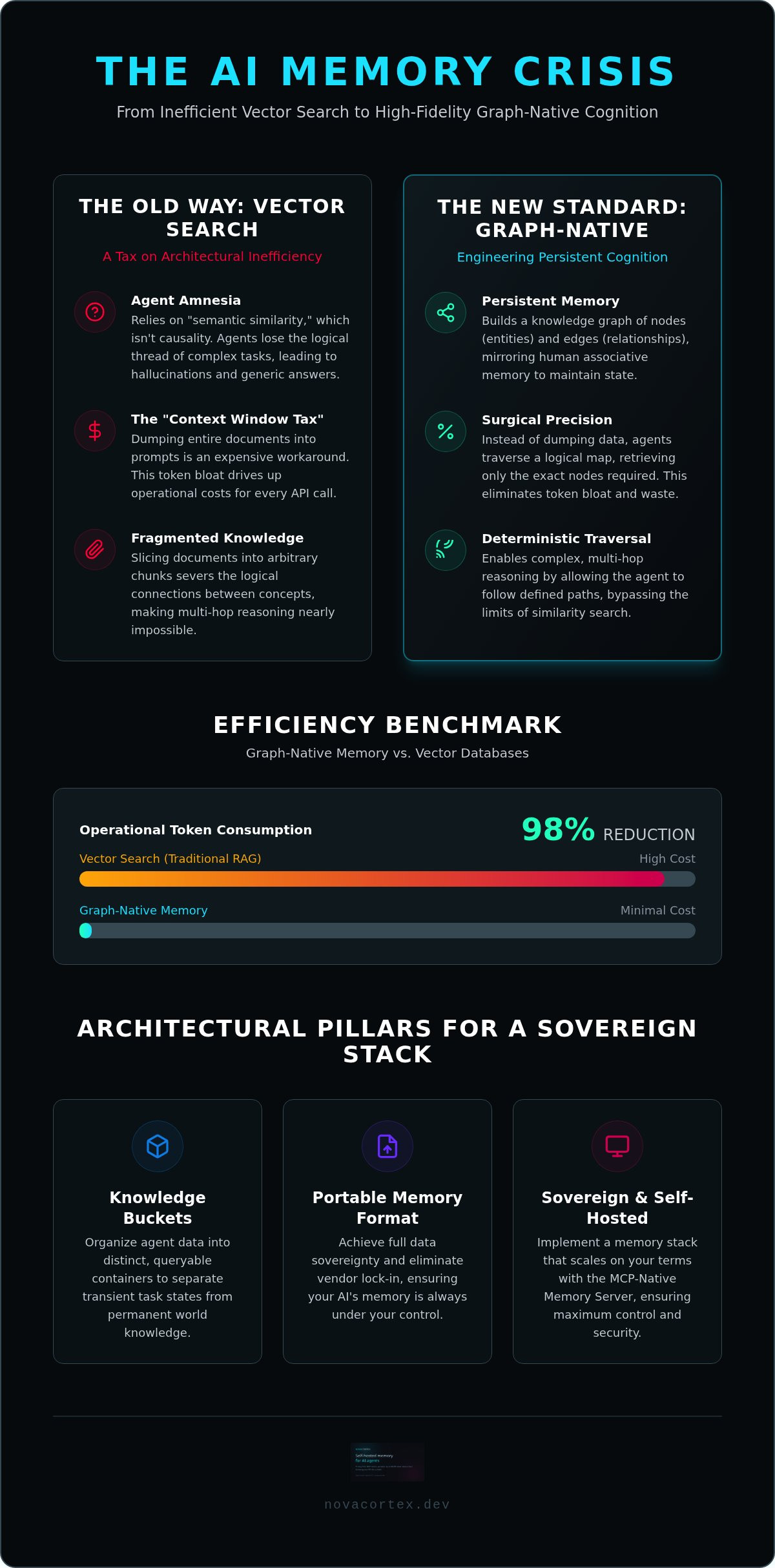
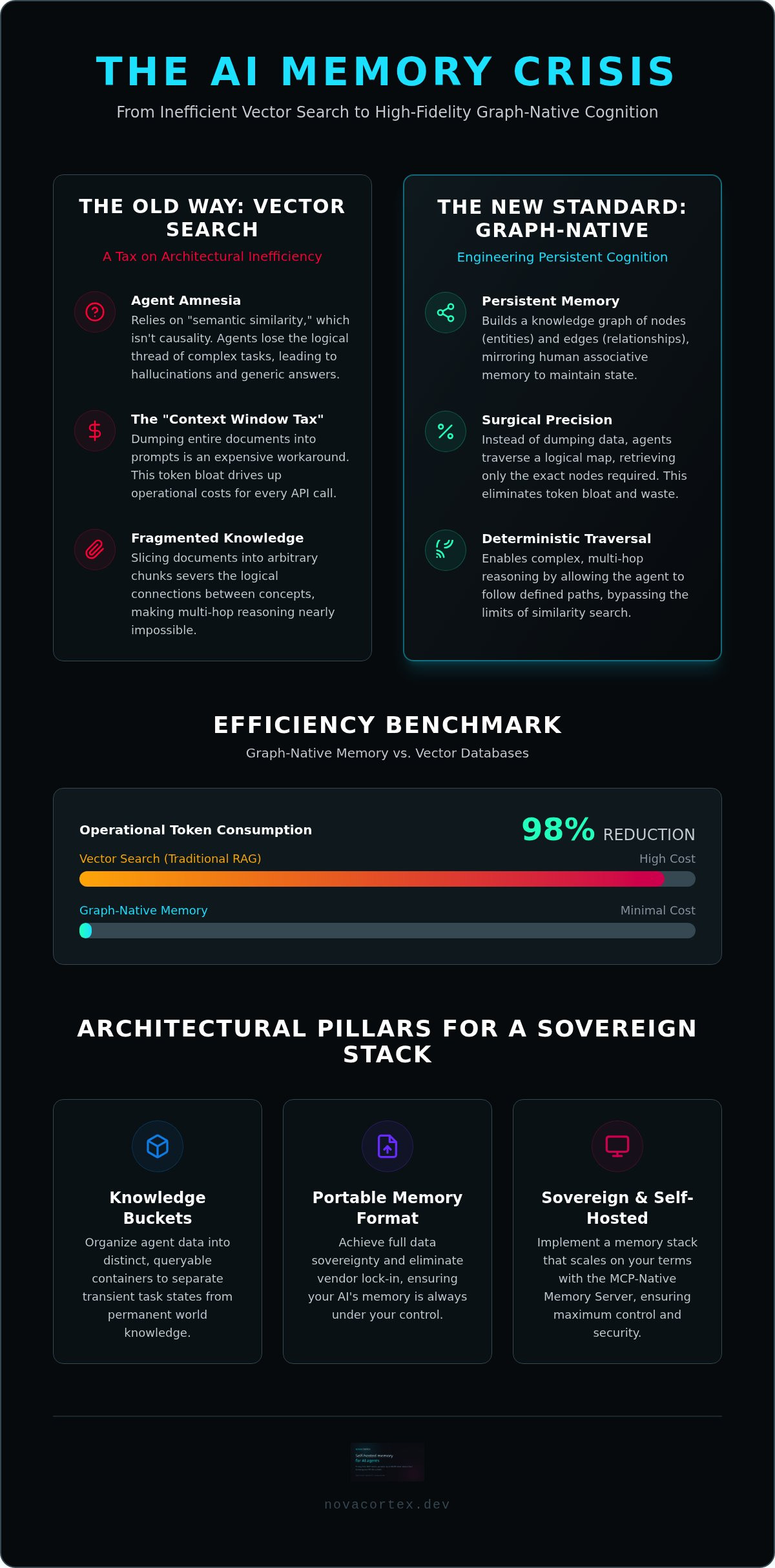
Vector search is a blunt instrument for a world that requires surgical precision. Dumping your entire knowledge base into a prompt isn't engineering; it's an expensive tax on architectural inefficiency that drains your budget. Most developers accept agent amnesia as an inevitable trade-off of scale. They're wrong. By shifting to a graph-native AI memory architecture, you treat context as a traversable relationship rather than a simple similarity score. This isn't just about better recall. It's about engineering a system that reduces token costs by up to 98% while maintaining absolute state across complex, long-running tasks.
You've likely struggled with the bloat of managed vector databases and the creeping threat of vendor lock-in. You want a persistent memory layer that scales on your terms. This article details the engineering requirements for building a sovereign memory stack. We'll examine how to implement NovaCortex Self-Hosted Edition and the MCP-Native Memory Server to achieve deterministic retrieval. You'll learn how to leverage Knowledge Buckets and the Portable Memory Format (PMF) to eliminate amnesia. It's time to stop feeding the LLM providers' bottom line and start building lean, high-velocity agents that actually remember.
Key Takeaways
- Understand why semantic similarity is insufficient for agent cognition and how logical relationships solve the persistent amnesia crisis.
- Learn to treat data as interconnected entities rather than arbitrary chunks to enable deterministic context traversal across long-running tasks.
- Achieve architectural efficiency by implementing graph-native AI memory to reduce operational token consumption by up to 98%.
- Maintain full data sovereignty using the Portable Memory Format (PMF) and self-hosted deployments to eliminate vendor lock-in.
The AI Amnesia Crisis: Why Vector Search Isn’t Enough for Agents
Vector search is failing your agents. Most developers treat Retrieval-Augmented Generation (RAG) as a simple search problem. They're wrong. Standard RAG relies on vector databases to find semantically similar text chunks. But similarity is not causality; it isn't a logical relationship. This architectural gap leads to agent amnesia, where an AI loses the logical thread of a complex task despite having the data in its context window. You've seen the result: agents that provide generic answers or hallucinate connections that don't exist because they can't distinguish between a minor detail and a core constraint.
Graph-native AI memory is a structured storage layer where information is stored as nodes and edges. It mirrors human associative memory. Instead of treating your data as a pile of flat text blocks, it builds a Knowledge graph that allows an agent to traverse facts logically. When an agent understands how Entity A influences Entity B, it doesn't just "retrieve" data. It reasons through it. Dumping entire documents into prompts is an engineering failure. It's a lazy workaround for a broken memory model that forces the LLM to do the heavy lifting of organization every single time you hit the API.
The Mathematical Wall of Vector Embeddings
Cosine similarity is a blunt tool. It excels at finding related topics but fails at multi-hop reasoning. If your agent needs to connect three disparate facts to reach a conclusion, vector search usually returns the first two and misses the third. This creates the "lost in the middle" phenomenon where critical context is buried or ignored. High-dimensional vector spaces are great for fuzzy matching; they're terrible for deterministic traversal. Graph-native memory is the evolution of RAG for 2026. By explicitly defining relationships, you bypass the mathematical limitations of similarity search and give your agent a map instead of a search bar.
Token Bloat and the Cost of Inefficiency
Every redundant fact in a prompt is a dollar wasted. Traditional RAG forces models to re-process known facts repeatedly because the retrieval system can't filter for relevance based on logical state. This "Context Window Tax" is the primary driver of high operational costs for LLM agents. We need a shift from simple retrieval to structured context management. Graph-native AI memory ensures that agents only pull the exact nodes required for the current task. This precision eliminates token bloat. You stop paying for the LLM to ignore 90% of the context you provided. In an engineering environment where efficiency equals survival, flat data structures are a liability you can no longer afford.
Anatomy of a Graph-Native AI Memory Layer
Standard RAG systems treat data as a collection of arbitrary text chunks. This is a fundamental mistake. When you slice a document into 500-token fragments, you sever the logical threads that hold the information together. A graph-native AI memory layer replaces these fragile chunks with entities and relationships. In this architecture, information is stored as nodes (entities) and edges (relationships). A knowledge graph is a foundational asset for AI because it structures information as a network of verifiable facts rather than a chaotic pile of strings. This structural shift allows for deterministic traversal; the agent doesn't just guess what's relevant, it follows a defined path from one concept to the next.
Persistence in this model isn't just about disk storage. It's about maintaining state across session resets. While a standard agent might forget its objective after a few turns due to context window saturation, a graph-based system keeps the core mission and its related constraints as high-priority nodes. Traversal moves beyond simple Top-K retrieval. Instead of just pulling the most similar results, the system performs pathfinding to find facts that are logically connected to the query, even if they don't share semantic keywords. This is the difference between a keyword search and a professional briefing.
The Role of Knowledge Buckets in State Management
Engineering a reliable memory layer requires modularity. Knowledge Buckets allow you to organize agent data into distinct, queryable containers. This separation is critical for distinguishing between transient task states and permanent world knowledge. By isolating these data streams, you prevent short-term noise from polluting your agent's core logic. Implementing this level of organization is essential for AI agent long term memory. It ensures that when an agent restarts, it can instantly re-attach to the specific bucket containing its operational history without re-scanning the entire knowledge base.
GraphRAG: Improving Precision via Relationship Mapping
Hallucinations often occur when an agent makes a leap between two unrelated chunks of text. GraphRAG eliminates this by grounding the agent in a formal ontology. If a relationship doesn't exist in the graph, the agent doesn't invent it. This mapping provides a level of precision that vector-only systems cannot match. Secure reasoning depends on graph-native AI storage to ensure that every retrieved fact is anchored to a verified entity. To see how these relationships are defined in a production environment, you can explore the NovaCortex repository and examine the schema implementation.
Graph-Native Memory vs. Vector Databases: The Efficiency Benchmark
Vector databases are expensive context dumpers. They operate on brute-force semantic similarity, which is an inefficient way to manage intelligence. When you query a vector store, you retrieve "Top-K" chunks that might be related to your prompt but often lack logical coherence. This forces you to flood the LLM context window with redundant data, driving up your operational costs. In contrast, graph-native AI memory provides a surgical retrieval mechanism. By storing data as a network of entities, the system only pulls the exact facts required to complete a logical chain. This architectural precision is the primary driver behind the 98% reduction in token usage observed when moving away from standard RAG. It’s the difference between reading an entire library to find a quote and simply turning to the right page.
The performance gap becomes even more visible when evaluating multi-hop reasoning. In a study titled Graph-Native Cognitive Memory for AI Agents, researchers demonstrated that graph-based architectures maintain high retrieval accuracy even as the complexity of the query increases. Vector search struggles here because it lacks the "connective tissue" between data points. While a vector scan is a high-dimensional calculation, a graph traversal is a logical operation. This makes graph-native systems fundamentally faster and more accurate for any task requiring the resolution of complex relationships or entity chains.
Benchmarking Multi-Hop Retrieval Performance
The industry debate regarding Redis vs graph memory for AI agents highlights the limitations of traditional key-value and vector stores. Redis is exceptional for simple, high-speed lookups, but it fails at complex entity resolution because it cannot traverse relationships without multiple round-trips or massive prompt bloat. Case studies in agentic workflows show significant precision gains when switching to graph structures, particularly in legal and technical auditing. Graph-native systems avoid the "Top-K noise" problem by ignoring semantically similar but logically irrelevant data, ensuring the agent only sees what actually matters.
Scaling Memory Without Scaling Costs
Vector search costs scale linearly with the size of your database. More vectors mean more compute for every similarity calculation. Graph traversal potential is logarithmic, allowing you to scale your knowledge base without a corresponding explosion in hardware requirements. You don't need a massive GPU cluster to manage persistent cognition. You can run a sophisticated graph memory layer on a Raspberry Pi. This efficiency enables the deployment of "thinner" agents—smaller, faster models that punch above their weight because they're supported by a smarter, high-velocity memory substrate. You stop paying for raw compute and start investing in architectural intelligence.
Interoperability and the Portable Memory Format (PMF)
Managed memory providers are building cognitive jails. They offer convenient APIs that mask proprietary data structures, making it nearly impossible to migrate your knowledge base once it reaches production scale. This is a strategic liability. A graph-native AI memory architecture is only as valuable as its portability. If your agent's learned experiences are trapped in a vendor's black box, you don't own the intelligence you've built; you're just renting it. Digital sovereignty requires an open standard for state management that exists independently of any single provider or model. You need the ability to move your agent's context across different platforms without losing a single edge or node in your knowledge graph.
Engineering for the Model Context Protocol (MCP)
The Model Context Protocol (MCP) is the necessary correction to the current fragmented AI middleware landscape. It establishes a universal interface between LLMs and data storage layers, effectively commoditizing the connection. Implementing MCP native memory servers allows for true plug-and-play cognition. You can swap underlying models or agent frameworks without rebuilding your entire retrieval pipeline from scratch. This standard eliminates the bloated, fragile glue code—those custom Python scripts and brittle API wrappers—typically required to bridge disparate systems. It treats memory as a modular service that any agent can subscribe to, provided they speak the protocol. This is how you build an infrastructure that survives the next model update.
The Case for a Vendor-Neutral Knowledge Layer
Enterprise sovereignty depends on the ability to move data across heterogeneous environments. The portable memory format for AI (PMF) addresses this by providing a rigid JSON-based specification for agent identity and operational parameters. Since the release of these standards on March 19, 2026, PMF has enabled developers to export and sync complex graph structures between local development environments and cloud-scale deployments. Your agent's learned data shouldn't be a casualty of a provider's pricing change or a service outage. By grounding your graph-native AI memory in open formats like PMF and the PAM protocol released on May 10, 2026, you ensure that your investment in agent training remains a permanent, auditable asset under your absolute control.
NovaCortex: The Self-Hosted Standard for Graph-Native AI Memory
Digital sovereignty isn't a buzzword; it's an engineering requirement. If your agent's memory lives in a third-party cloud, you've outsourced your intelligence. NovaCortex Self-Hosted Edition returns control to the builder. It's a local-first cognition layer designed for high-stakes environments where privacy and reliability are non-negotiable. By implementing graph-native AI memory on your own infrastructure, you eliminate the risk of data leaks while slashing operational overhead. You stop being a tenant in someone else's ecosystem and start owning the cognitive state of your agents.
The 98% token reduction isn't a theoretical projection. It's the byproduct of precise relationship mapping. Standard RAG systems are greedy; they pull as much data as the context window allows, hoping the model finds the answer. NovaCortex is lean. It uses its graph structure to pinpoint exact nodes, ignoring the semantic noise that plagues vector-only systems. This efficiency allows for remarkable deployment flexibility. You can run persistent cognition on a Raspberry Pi for edge applications or scale to an enterprise VPS for global operations. You don't need a server farm to maintain state. You just need a better architecture.
Privacy-First Architecture for Sensitive Knowledge
Compliance is the death of many AI projects. Sending sensitive proprietary data to external vector databases creates a massive security surface that most legal teams won't approve. Keeping local knowledge local is the only way to satisfy modern audit requirements. This is why self-hosted AI memory layers are non-negotiable for 2026. NovaCortex ensures your agent's "learned" data stays within your firewall, providing a secure reasoning environment that doesn't compromise on performance or speed.
Getting Started with NovaCortex
We've built NovaCortex on an Apache-2.0 open-source foundation because we believe in engineering transparency. It's a tool for developers who reject the "black box" approach to AI memory. You can start today by implementing modular Knowledge Buckets to manage specific agent states without the friction of managed databases. There's no complex onboarding or proprietary gatekeeping. This is a call to action for builders who value independence. Join the movement toward sovereign AI infrastructure. Build memory that you own, on hardware you control, using a graph-native AI memory stack designed for the next decade of agentic engineering.
Engineering Sovereign Cognition
Standard RAG is a legacy approach that prioritizes convenience over architectural integrity. Relying on semantic similarity alone creates a ceiling for agent performance and a floor for operational waste. Shifting to a graph-native AI memory architecture is a structural necessity for building persistent, reliable agents that actually understand context. You've seen how relationship mapping eliminates amnesia and how open standards like PMF protect your data sovereignty. This shift isn't just about efficiency; it's about reclaiming control over the cognitive state of your infrastructure.
By deploying a self-hosted memory layer, you gain a privacy-first environment that operates with surgical precision. This approach delivers a 98% token reduction while ensuring your "learned" data remains an auditable asset under your absolute control. The era of renting intelligence from proprietary black boxes is over. It's time to build on a foundation of engineering transparency and digital independence. NovaCortex provides the Apache-2.0 open-source framework required to scale your agents without scaling your costs.
Take the lead in the transition toward lean, high-velocity AI systems that remember what matters.
Frequently Asked Questions
What is the difference between a vector database and graph-native AI memory?
Vector databases rely on brute-force semantic similarity to find related text chunks. This process often lacks logical coherence. In contrast, graph-native AI memory structures data as interconnected nodes and edges. This allows agents to perform deterministic traversal of facts. Instead of guessing relevance based on high-dimensional distances, the system follows explicit logical paths. This architectural shift provides the precision needed for complex reasoning that flat vector stores cannot match.
How does graph-native memory reduce token usage by 98%?
Traditional RAG systems often flood the context window with redundant data to ensure the LLM finds the answer. Graph-native structures eliminate this Context Window Tax by retrieving only the exact entities and relationships required for a task. By using surgical retrieval instead of bulk context dumping, you stop paying for the model to process irrelevant noise. Benchmarks show this precision allows for up to a 98% reduction in token consumption per query.
Is graph-native memory compatible with existing RAG frameworks?
Yes, it integrates with existing workflows through standardized protocols. While the storage layer is different, you can bridge it to standard RAG pipelines using the MCP-Native Memory Server. This middleware acts as a universal interface between your agent framework and the graph storage. It replaces brittle, custom retrieval logic with a modular system that works alongside your current LLM providers and development tools without requiring a full infrastructure rewrite.
Can I run NovaCortex on my own local hardware?
You can deploy the NovaCortex Self-Hosted Edition on any local infrastructure you control. The system is designed for efficiency, meaning it doesn't require a massive GPU cluster to operate. It runs effectively on a Raspberry Pi, a local server, or a private VPS. This local-first approach ensures that your agent's memory remains private and performant while giving you full control over the hardware substrate and data sovereignty.
What is the Model Context Protocol (MCP) and why does it matter for memory?
The Model Context Protocol (MCP) is an open standard that creates a universal interface between AI models and their data sources. It matters because it eliminates the need for custom glue code for every new agent integration. By using an MCP-Native Memory Server, you ensure your memory layer is plug-and-play with any model that supports the protocol. It commoditizes the connection, allowing you to swap models without rebuilding your memory architecture.
How does the Portable Memory Format (PMF) prevent vendor lock-in?
The Portable Memory Format (PMF) is a JSON-based specification that defines an agent's identity and learned knowledge. It prevents vendor lock-in by making your data interoperable across different platforms and models. Instead of your agent's state being trapped in a proprietary database, PMF allows you to export, sync, and migrate your graph-native AI memory at will. You own the learned data as a portable asset that exists independently of any service provider.
Does graph-native memory improve the reasoning capabilities of my AI agent?
It fundamentally enhances reasoning by providing a map of logical connections. Standard LLMs are stateless and struggle with multi-hop logic when using flat data structures. Graph memory grounds the agent in a verifiable ontology of facts and relationships. This allows the agent to traverse complex entity chains deterministically. By providing a structured knowledge base, you reduce hallucinations and enable the agent to solve problems that require connecting disparate pieces of information.
Is NovaCortex open source?
Yes, NovaCortex is open source under the Apache-2.0 license. This ensures that developers have full transparency into the codebase and the freedom to modify or extend the system as needed. The open-source foundation supports digital sovereignty, allowing you to build, host, and maintain your AI infrastructure without relying on restrictive proprietary licenses. It's built for engineers who value independence and architectural clarity in their production-ready agentic stacks.
FAQ
What is the difference between a vector database and graph-native AI memory?
Vector databases rely on brute-force semantic similarity to find related text chunks. This process often lacks logical coherence. In contrast, graph-native AI memory structures data as interconnected nodes and edges. This allows agents to perform deterministic traversal of facts. Instead of guessing relevance based on high-dimensional distances, the system follows explicit logical paths. This architectural shift provides the precision needed for complex reasoning that flat vector stores cannot match.
How does graph-native memory reduce token usage by 98%?
Traditional RAG systems often flood the context window with redundant data to ensure the LLM finds the answer. Graph-native structures eliminate this Context Window Tax by retrieving only the exact entities and relationships required for a task. By using surgical retrieval instead of bulk context dumping, you stop paying for the model to process irrelevant noise. Benchmarks show this precision allows for up to a 98% reduction in token consumption per query.
Is graph-native memory compatible with existing RAG frameworks?
Yes, it integrates with existing workflows through standardized protocols. While the storage layer is different, you can bridge it to standard RAG pipelines using the MCP-Native Memory Server. This middleware acts as a universal interface between your agent framework and the graph storage. It replaces brittle, custom retrieval logic with a modular system that works alongside your current LLM providers and development tools without requiring a full infrastructure rewrite.
Can I run NovaCortex on my own local hardware?
You can deploy the NovaCortex Self-Hosted Edition on any local infrastructure you control. The system is designed for efficiency, meaning it doesn't require a massive GPU cluster to operate. It runs effectively on a Raspberry Pi, a local server, or a private VPS. This local-first approach ensures that your agent's memory remains private and performant while giving you full control over the hardware substrate and data sovereignty.
What is the Model Context Protocol (MCP) and why does it matter for memory?
The Model Context Protocol (MCP) is an open standard that creates a universal interface between AI models and their data sources. It matters because it eliminates the need for custom glue code for every new agent integration. By using an MCP-Native Memory Server, you ensure your memory layer is plug-and-play with any model that supports the protocol. It commoditizes the connection, allowing you to swap models without rebuilding your memory architecture.
How does the Portable Memory Format (PMF) prevent vendor lock-in?
The Portable Memory Format (PMF) is a JSON-based specification that defines an agent's identity and learned knowledge. It prevents vendor lock-in by making your data interoperable across different platforms and models. Instead of your agent's state being trapped in a proprietary database, PMF allows you to export, sync, and migrate your graph-native AI memory at will. You own the learned data as a portable asset that exists independently of any service provider.
Does graph-native memory improve the reasoning capabilities of my AI agent?
It fundamentally enhances reasoning by providing a map of logical connections. Standard LLMs are stateless and struggle with multi-hop logic when using flat data structures. Graph memory grounds the agent in a verifiable ontology of facts and relationships. This allows the agent to traverse complex entity chains deterministically. By providing a structured knowledge base, you reduce hallucinations and enable the agent to solve problems that require connecting disparate pieces of information.
Is NovaCortex open source?
Yes, NovaCortex is open source under the Apache-2.0 license. This ensures that developers have full transparency into the codebase and the freedom to modify or extend the system as needed. The open-source foundation supports digital sovereignty, allowing you to build, host, and maintain your AI infrastructure without relying on restrictive proprietary licenses. It's built for engineers who value independence and architectural clarity in their production-ready agentic stacks.