Graph RAG vs Vector RAG: Engineering Persistent AI Memory in 2026
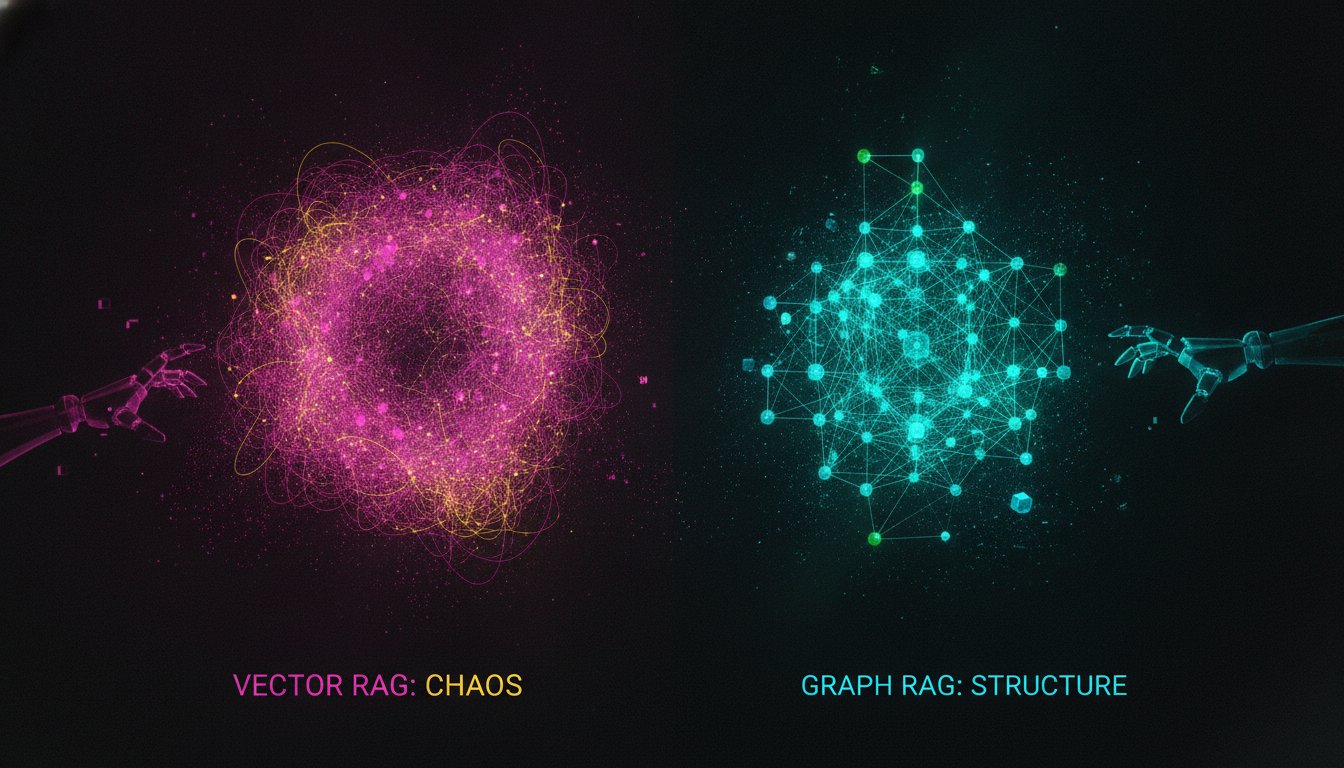
Vector search is a semantic map, but your agents need a cognitive architecture. Relying solely on distance metrics for complex reasoning is an engineering dead end that leads to bloated context windows and spiraling costs. The industry debate over graph RAG vs vector RAG has shifted from experimental to essential as Blackwell GPU rental prices hit $4.00 per hour. You can't afford to retrieve "similar" data when your agent requires precise, structured relationships.
It's frustrating to watch your LLM burn through tokens because a vector database dumped irrelevant noise into the prompt. You want digital sovereignty and lean operations, not a mounting bill from a black-box cloud provider. We'll show you how graph-native memory is replacing traditional search to reduce token waste by 98% while improving accuracy by over 3x in enterprise scenarios. This article provides a technical roadmap for implementing persistent AI memory and a clear decision framework to help you choose the superior architecture for your next build.
Key Takeaways
- Analyze why semantic similarity is a bottleneck for reasoning and how relational context provides the missing "why" in data retrieval.
- Compare the architectural mechanics of graph RAG vs vector RAG, specifically how EAV triples outperform N-dimensional embeddings in precision.
- Implement a 98% reduction in token waste by transitioning from context dumping to precise, graph-native retrieval.
- Deploy a modular implementation framework using Knowledge Buckets for structured, schema-less agent memory.
- Secure digital sovereignty with a self-hosted memory layer and Portable Memory Format (PMF) to eliminate vendor lock-in.
Beyond Semantic Similarity: The Evolution of RAG Architectures
The architecture of Retrieval-Augmented Generation (RAG) is undergoing a fundamental shift. In the early days of LLM integration, vector databases were the default. They provided a simple way to find "similar" text based on mathematical proximity. But similarity is not intelligence. As we move into 2026, the industry is realizing that semantic overlap often fails when an agent needs to perform complex, multi-step reasoning. This is where the debate of graph RAG vs vector RAG becomes critical for any engineer building production-grade systems.
Graph RAG is a retrieval method that traverses explicit entities and relationships rather than just calculating distances in vector space. It doesn't just find a document; it understands the logical web connecting disparate data points. This allows agents to move beyond merely finding documents and start navigating knowledge. The goal is no longer just to provide context; it's to provide the right context with surgical precision.
The Limitations of Vector-Only Search
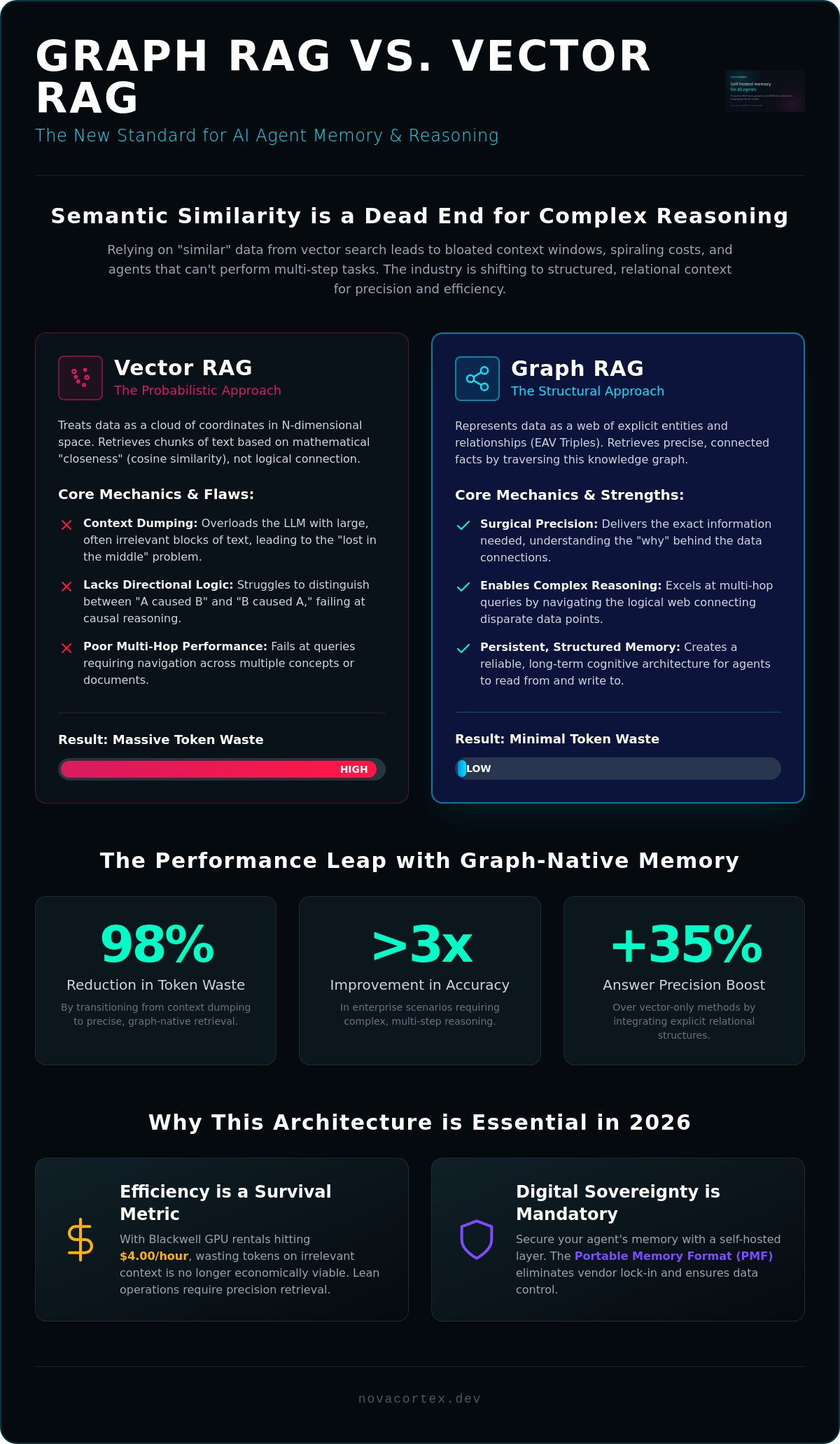
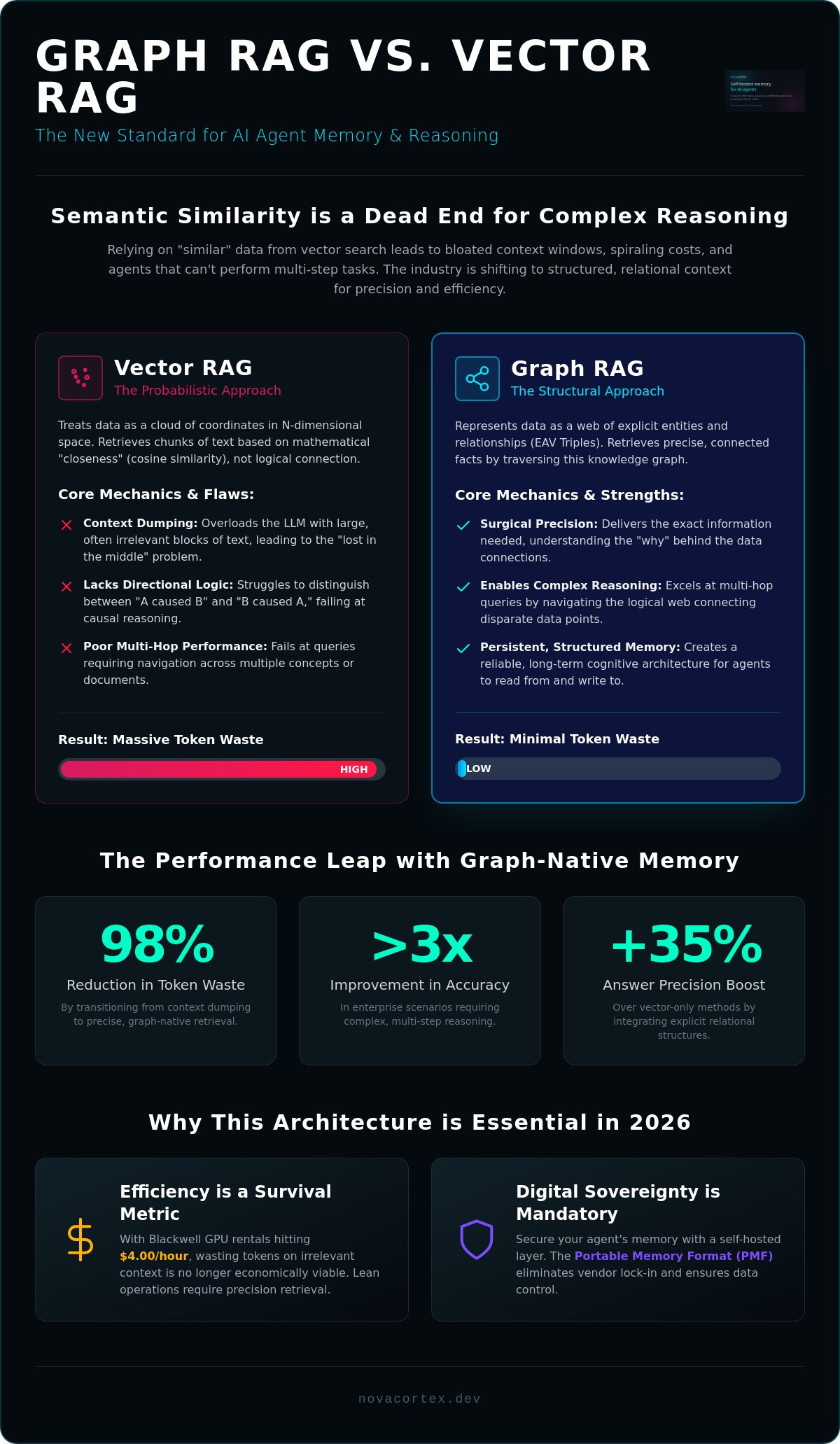
Vector-only retrieval is often hit-or-miss. It relies on embeddings that represent text as coordinates in N-dimensional space. If two concepts appear in the same paragraph, they are mathematically close, but they might not be logically related for a specific task. This leads to the "lost in the middle" phenomenon. When you dump 100k tokens of similar text into a context window, the LLM often ignores the most relevant data tucked in the center. Semantic overlap does not equal logical relevance in agent workflows.
Multi-hop queries are the ultimate stress test. A vector search can find "who is the CEO of Company X," but it struggles to find "how the CEO's previous strategy at Company Y impacts our current supply chain." Vector search lacks the relational pointers to jump across these connections. Industry data shows that integrating graph-based structures can improve answer precision by up to 35% over vector-only methods. Without a graph, your agent is essentially guessing based on vibes.
Why 2026 Demands Graph-Native Memory
The landscape has changed. We are no longer building simple chatbots. We are building multi-agent systems that require shared, structured state. These agents need to read from and write to a persistent memory layer that maintains its integrity over time. Relying on third-party vector clouds creates a massive security risk and deep vendor lock-in. Digital sovereignty is now a requirement, not a feature.
Efficiency is a survival metric in 2026. With Blackwell GPU rental prices jumping to $4.00 per hour, you can't afford to waste tokens on irrelevant context. The transition toward a portable memory format for AI is the only logical path forward. It ensures your agent's memory is self-hosted, interoperable, and logical. By evaluating graph RAG vs vector RAG, you're choosing an architecture designed for the cognitive demands of modern autonomous systems.
Mechanics of Retrieval: Vector Embeddings vs Graph-Native Triples
The fundamental difference between these two architectures lies in how they represent reality. Vector RAG is probabilistic. It treats data as a cloud of coordinates in N-dimensional space. You take raw text, break it into chunks, and pass it through an embedding model to generate vectors. At query time, the system performs a mathematical search using cosine similarity or Euclidean distance. If the math says two chunks are close, they get pulled into the context window. This is the core of the graph RAG vs vector RAG dilemma: choosing between statistical probability and structural integrity.
How Vector RAG Processes Context
Chunking strategies define the resolution of your retrieval. Small chunks preserve detail but lose narrative flow; large chunks dilute the semantic signal. Even in 2026, embedding models struggle to distinguish between "A caused B" and "B caused A" because they lack explicit directional logic. They see the words, but they don't see the mechanics. For a deeper look at these architectural trade-offs, consult this guide on Vector Databases vs. Graph RAG. Vector search remains a blunt instrument for complex reasoning.
How Graph RAG Enables Reasoning
Graph RAG replaces coordinates with Entity-Attribute-Value (EAV) triples. It doesn't care about "closeness" in a vector space. It cares about connectivity. When an agent queries a graph, it traverses explicit edges. If "Entity A" is "Owned By" "Entity B," the relationship is a hard fact, not a statistical guess. This process starts with automated entity extraction, turning unstructured text into a structured knowledge graph where every edge has a defined meaning.
This structural traversal allows agents to "walk" the graph to find non-obvious answers that multi-hop vector searches consistently miss. NovaCortex utilizes graph-native storage to bypass the limitations of flat vector databases. By organizing agent state into Knowledge Buckets, we ensure that every retrieval is grounded in a persistent knowledge web rather than a noisy document dump. This architecture is built for agents that need to remember facts, not just find files.
If you're ready to move beyond the limitations of cloud-locked vector search, you can explore the NovaCortex implementation on GitHub to see how graph-native memory handles complex state.
Hybrid approaches are the current gold standard for high-performance systems. They use semantic search for broad discovery and graph traversal for surgical precision. This combination ensures your agent has the breadth of a search engine and the logic of a database. By engineering persistent memory with EAV triples, you're building a system that actually understands its data. You aren't just retrieving text; you're navigating a cognitive map.
The Token Efficiency Crisis: Why Vector RAG Fails at Scale
The industry is hitting a wall. Early RAG implementations focused on feasibility, but the 2026 reality is focused on sustainability. Vector RAG is inherently wasteful. It operates by "context dumping," retrieving entire chunks of text that happen to be semantically similar to a query. This often results in sending 100k tokens to an LLM when only 2k are actually relevant to the answer. In an era where Blackwell GPU costs have surged to $4.00 per hour, this architectural inefficiency is a financial leak you can't ignore. The graph RAG vs vector RAG debate is no longer about which is "cooler"; it's about which is affordable at scale.
This push for efficiency isn't limited to software; in physical production, services like CNC Cut to Size provide the same level of precision to minimize material waste, much as graph RAG minimizes token waste in AI models.
The original RAG research paper established the foundation for augmenting LLMs with external data, but it didn't account for the massive noise-to-signal ratio inherent in flat vector searches. When an agent receives a document dump, its reasoning performance degrades. It has to sift through paragraphs of fluff to find the one logical connection that matters.
Quantifying the Token Tax
Retrieval noise is more than just a cost issue; it's a performance killer. Every irrelevant token in your context window is a distraction for the model's attention mechanism. NovaCortex benchmarks demonstrate that switching to a graph-native architecture can achieve up to a 98% reduction in token usage. Graph-native storage isolates only the required entities for a prompt, stripping away the semantic noise that plagues vector-only systems. This precision translates directly into higher ROI by lowering API bills and increasing the reliability of agentic outputs.
For developers weighing their infrastructure options, the choice between Redis vs graph memory for AI agents highlights the shift toward efficiency. While Redis offers speed, it lacks the relational depth needed to prune context effectively. You need a system that understands the connections, not just the keywords. Architectural waste is no longer just a line item; it's a barrier to building autonomous agents that can think for more than five minutes without blowing the budget.
Self-Hosting as a Performance Multiplier
Digital sovereignty is the ultimate performance hack. Moving your memory layer to local infrastructure or a private VPS eliminates the API latency associated with managed vector clouds. Managed services like Pinecone or Milvus offer convenience but at the cost of high long-term TCO and potential privacy leaks. When you self-host your memory layer using the NovaCortex Self-Hosted Edition, you retain 100% ownership of your data. This isn't just about security; it's about building a lean, high-velocity system that doesn't rely on a third-party's uptime or pricing whims.
Privacy is a feature, not an afterthought. Keeping sensitive knowledge on your own server ensures that your proprietary logic doesn't become training data for a cloud provider. In 2026, the most successful agents will be those that run on sovereign, efficient, and graph-native memory layers that prioritize precision over proximity.
Implementing Graph-Based RAG: A Technical Framework for Agents
Constructing a cognitive layer requires more than a simple vector index. It demands a rigorous engineering roadmap. While vector RAG is often marketed as a plug-and-play solution, it lacks the structural integrity needed for autonomous reasoning. The choice between graph RAG vs vector RAG is ultimately a decision between building a basic search tool or a sophisticated reasoning engine. Implementation follows a four-phase framework designed for precision and scalability.
- Phase 1: Automated Entity Extraction. Use specialized models to parse raw data into Entity-Attribute-Value (EAV) triples. This turns unstructured noise into a web of verifiable facts.
- Phase 2: Defining Knowledge Buckets. Organize these triples into modular, schema-less containers. This prevents cross-contamination between different agent tasks.
- Phase 3: MCP Integration. Connect your storage layer to the Model Context Protocol (MCP) to ensure your agents can read and write memory across diverse toolsets.
- Phase 4: Retrieval Loop. Deploy graph-aware prompts that instruct the model to navigate specific nodes and edges rather than scanning a flat document list.
Structuring Data with Knowledge Buckets
Modular storage is the antidote to context bloat. By using Knowledge Buckets, you can isolate agent state and domain knowledge into logical units. This is essential for effective AI agent state management during long-term sessions. Version control for memory becomes a reality. You can roll back specific buckets or update them without re-indexing your entire corpus. This granular control ensures your agent's memory remains lean and relevant over time. It transforms a chaotic document dump into a structured, navigable workspace.
Leveraging MCP for Memory Access
Interoperability is no longer optional. The MCP native memory server has emerged as the industry standard for 2026, providing a unified interface for memory access. It standardizes how agents interact with the graph layer, eliminating the need for custom, brittle integration code. By utilizing the Portable Memory Format (PMF), you ensure your data remains vendor-neutral. You own the graph. You own the logic. This architecture rejects the bloated, restrictive systems of the past in favor of digital sovereignty and high-velocity performance.
Building this framework from scratch is a significant investment. You can accelerate your development by using the NovaCortex repository on GitHub to deploy a production-ready graph memory layer today.
NovaCortex: The Self-Hosted Standard for Graph-Native AI Memory
NovaCortex Self-Hosted Edition provides the definitive answer to the structural inefficiencies of legacy retrieval systems. While much of the industry remains trapped in the graph RAG vs vector RAG debate, we've built the tool that settles it. Engineering for efficiency is the core of our architecture. We deliver a built-in 98% reduction in token usage by replacing noisy semantic search with precise graph traversal. You don't need to over-provision context when your memory layer understands exactly what your agent needs. Similarity is a guess. Connection is a fact.
Deployment is a matter of architectural choice, not a technical hurdle. NovaCortex runs anywhere from a Raspberry Pi at the edge to an enterprise-grade VPS in your private cloud. The Apache-2.0 license ensures total transparency and rejects the restrictive nature of proprietary alternatives. You aren't just using a tool; you're owning your agent's cognitive infrastructure. There are no black boxes. Just clean, high-velocity engineering designed for digital sovereignty.
Privacy-First Architecture
Digital sovereignty is the foundation of our philosophy, not a marketing buzzword. Your knowledge should never leave your infrastructure. Zero-trust memory means your proprietary data stays behind your firewall, protected from the prying eyes of third-party cloud providers. NovaCortex is the self-hosted AI memory layer built for the demands of 2026. We reject vendor lock-in. We embrace local-first performance that scales without compromising security.
Getting Started with NovaCortex
Deploying your first MCP-native memory server takes minutes, not months. We provide a streamlined quickstart guide to get your first Knowledge Bucket online immediately. If you're currently managing legacy vector databases, migrating to our Portable Memory Format (PMF) is a straightforward transition. PMF ensures your data remains interoperable and future-proof. Stop paying the token tax and start building with structural precision. Deploy NovaCortex Self-Hosted Edition today and give your agents the persistent memory they deserve.
Future-Proof Your Agent Architecture
The era of context dumping is over. Engineering persistent AI memory in 2026 requires a shift from semantic proximity to relational precision. Vector search was a necessary first step, but it lacks the structural integrity needed for autonomous reasoning. The decision between graph RAG vs vector RAG isn't just about accuracy; it's about building a lean, self-hosted infrastructure that respects your data and your budget. You're moving beyond probabilistic guesses and toward verifiable logic.
By adopting an MCP-native architecture and utilizing Knowledge Buckets, you eliminate the "lost in the middle" phenomenon and achieve a 98% reduction in token waste. You're building for digital sovereignty. You're ensuring your agents have a cognitive layer that is as resilient as it is efficient. Stop relying on bloated cloud services that lock your knowledge behind a proprietary wall. Take control of your agent's memory with an Apache-2.0 open-source engine built for builders.
Secure your AI memory with NovaCortex Self-Hosted Edition
It's time to build memory that actually understands its data.
Frequently Asked Questions
What is the main difference between Graph RAG and Vector RAG?
The primary distinction lies in how data is retrieved: Vector RAG relies on semantic proximity while Graph RAG utilizes explicit relational logic. Vector search calculates mathematical distance between embeddings in a flat space. Graph RAG traverses defined edges between entities to understand the context of "why" information is connected. This structural approach replaces probabilistic guesses with hard facts, providing a superior architecture for agents performing multi-hop reasoning.
Can Graph RAG and Vector RAG be used together?
Hybrid architectures are the dominant trend in 2026 because they leverage the strengths of both systems. Most enterprise systems use a query classifier to route simple semantic lookups to a vector index and complex, relationship-based queries to a knowledge graph. This combination ensures high recall for broad searches and surgical precision for deep logical tasks. It's the most cost-effective way to manage a diverse range of agentic workloads.
How does Graph RAG reduce token usage for AI agents?
Graph RAG eliminates "context dumping" by isolating only the specific entities and relationships required for a prompt. Traditional vector retrieval often pulls in entire paragraphs of noise that happen to be semantically similar to the query. By traversing a graph, the system identifies the exact nodes relevant to the answer, which can reduce token usage by up to 98%. This precision lowers API costs and prevents the "lost in the middle" phenomenon.
Is Graph RAG slower than Vector RAG for retrieval?
Retrieval speed depends on the complexity of the query, but graph traversal is often more efficient for structured reasoning tasks. While vector search is fast for single-shot lookups, it requires expensive re-ranking steps for complex queries. Graph RAG excels at multi-hop navigation where a vector system would need multiple sequential calls. In 2026, optimized graph-native engines provide sub-millisecond latency for relationship-based retrieval, making them competitive with traditional vector databases.
Do I need a specific database to implement Graph RAG?
You need a storage layer capable of handling Entity-Attribute-Value (EAV) triples or a dedicated graph-native structure. While some vector databases have added graph extensions, they often lack the performance of specialized engines. Implementing graph RAG vs vector RAG effectively requires a system designed for connectivity rather than just proximity. NovaCortex uses Knowledge Buckets to organize these triples into a modular, self-hosted memory layer that avoids the overhead of traditional relational systems.
Is Graph RAG better for small or large datasets?
Graph RAG provides the most value when data complexity is high, regardless of the corpus size. For small, high-density datasets, it ensures that logical nuances aren't lost in a sea of embeddings. For large-scale enterprise data, it acts as a map that prevents agents from getting overwhelmed by irrelevant search results. The choice depends on whether your agent needs to find "similar" documents or navigate a complex web of interconnected facts.
How does NovaCortex handle privacy compared to cloud vector databases?
NovaCortex prioritizes digital sovereignty through a self-hosted architecture that keeps your memory layer entirely behind your own firewall. Cloud-based vector databases require you to send sensitive embeddings and raw text to third-party infrastructure. This creates vendor lock-in and security risks. By running a local-first memory engine, you ensure that proprietary knowledge never leaves your VPS or server, fulfilling the zero-trust requirements of modern engineering teams.
What is the Model Context Protocol (MCP) and why does it matter for RAG?
The Model Context Protocol (MCP) is the industry standard for 2026 that enables interoperability between AI models and memory servers. It provides a unified interface for agents to read from and write to different data sources without custom integration code. Using an MCP-native memory server ensures your RAG implementation is future-proof and vendor-neutral. It allows you to swap models or storage layers while maintaining a consistent, structured context for your agents.
FAQ
What is the main difference between Graph RAG and Vector RAG?
The primary distinction lies in how data is retrieved: Vector RAG relies on semantic proximity while Graph RAG utilizes explicit relational logic. Vector search calculates mathematical distance between embeddings in a flat space. Graph RAG traverses defined edges between entities to understand the context of "why" information is connected. This structural approach replaces probabilistic guesses with hard facts, providing a superior architecture for agents performing multi-hop reasoning.
Can Graph RAG and Vector RAG be used together?
Hybrid architectures are the dominant trend in 2026 because they leverage the strengths of both systems. Most enterprise systems use a query classifier to route simple semantic lookups to a vector index and complex, relationship-based queries to a knowledge graph. This combination ensures high recall for broad searches and surgical precision for deep logical tasks. It's the most cost-effective way to manage a diverse range of agentic workloads.
How does Graph RAG reduce token usage for AI agents?
Graph RAG eliminates "context dumping" by isolating only the specific entities and relationships required for a prompt. Traditional vector retrieval often pulls in entire paragraphs of noise that happen to be semantically similar to the query. By traversing a graph, the system identifies the exact nodes relevant to the answer, which can reduce token usage by up to 98%. This precision lowers API costs and prevents the "lost in the middle" phenomenon.
Is Graph RAG slower than Vector RAG for retrieval?
Retrieval speed depends on the complexity of the query, but graph traversal is often more efficient for structured reasoning tasks. While vector search is fast for single-shot lookups, it requires expensive re-ranking steps for complex queries. Graph RAG excels at multi-hop navigation where a vector system would need multiple sequential calls. In 2026, optimized graph-native engines provide sub-millisecond latency for relationship-based retrieval, making them competitive with traditional vector databases.
Do I need a specific database to implement Graph RAG?
You need a storage layer capable of handling Entity-Attribute-Value (EAV) triples or a dedicated graph-native structure. While some vector databases have added graph extensions, they often lack the performance of specialized engines. Implementing graph RAG vs vector RAG effectively requires a system designed for connectivity rather than just proximity. NovaCortex uses Knowledge Buckets to organize these triples into a modular, self-hosted memory layer that avoids the overhead of traditional relational systems.
Is Graph RAG better for small or large datasets?
Graph RAG provides the most value when data complexity is high, regardless of the corpus size. For small, high-density datasets, it ensures that logical nuances aren't lost in a sea of embeddings. For large-scale enterprise data, it acts as a map that prevents agents from getting overwhelmed by irrelevant search results. The choice depends on whether your agent needs to find "similar" documents or navigate a complex web of interconnected facts.
How does NovaCortex handle privacy compared to cloud vector databases?
NovaCortex prioritizes digital sovereignty through a self-hosted architecture that keeps your memory layer entirely behind your own firewall. Cloud-based vector databases require you to send sensitive embeddings and raw text to third-party infrastructure. This creates vendor lock-in and security risks. By running a local-first memory engine, you ensure that proprietary knowledge never leaves your VPS or server, fulfilling the zero-trust requirements of modern engineering teams.
What is the Model Context Protocol (MCP) and why does it matter for RAG?
The Model Context Protocol (MCP) is the industry standard for 2026 that enables interoperability between AI models and memory servers. It provides a unified interface for agents to read from and write to different data sources without custom integration code. Using an MCP-native memory server ensures your RAG implementation is future-proof and vendor-neutral. It allows you to swap models or storage layers while maintaining a consistent, structured context for your agents.