High-Performance AI Memory: Engineering the Software Layer for Agent Speed

The "memory wall" isn't just a hardware limitation; it's an architectural choice that's bankrupting your token budget. While the industry fixates on HBM4 mass production to solve processing bottlenecks, the real friction lies in how we bridge the gap between LLMs and long-term context. To build agents that actually scale, you must engineer a high-performance AI memory layer that moves beyond the crude inefficiency of context dumping. Context dumping is a tax on innovation. It turns sophisticated agents into bloated, forgetful systems that prioritize waste over intelligence.
You've likely watched your API bills soar while your RAG pipelines struggle with multi-second latency. It's a systemic failure. This guide shows you how to architect a software-defined memory layer that slashes token usage by more than 90% while achieving sub-second context retrieval. We'll break down the transition to MCP-native memory servers and Knowledge Buckets that ensure your data remains sovereign. You'll learn to implement a Portable Memory Format (PMF) that eliminates retrieval lag and turns "forgetfulness" into a solved engineering problem. High-velocity performance is no longer optional; it's the new baseline for agentic architecture.
Key Takeaways
- Identify why the "memory wall" is an architectural software failure and how to optimize throughput beyond physical hardware limitations.
- Replace inefficient vector databases with graph-native storage to enable high-velocity reasoning and better context for complex AI agents.
- Engineer a high-performance AI memory layer to reduce token consumption by up to 98% and eliminate exorbitant API waste.
- Secure your digital sovereignty using the Portable Memory Format (PMF) to maintain total control over long-term context across any environment.
- Deploy an MCP-native memory server to achieve sub-second retrieval speeds while keeping sensitive data entirely self-hosted and private.
The Performance Bottleneck: Beyond Silicon and HBM
The industry is currently obsessed with silicon. Manufacturers like SK hynix and Samsung are racing toward HBM4 mass production, targeting bandwidths up to 2 TB/s per stack. But raw hardware speed is a red herring for AI agent performance. You can't solve a logic problem with more electricity. True high-performance AI memory isn't just about how fast data moves from DRAM to a GPU. It's about how effectively that data is retrieved, filtered, and injected into an LLM's context window. Silicon provides the bandwidth, but software provides the throughput. Without an efficient software layer, your expensive hardware is just idling at high speed.
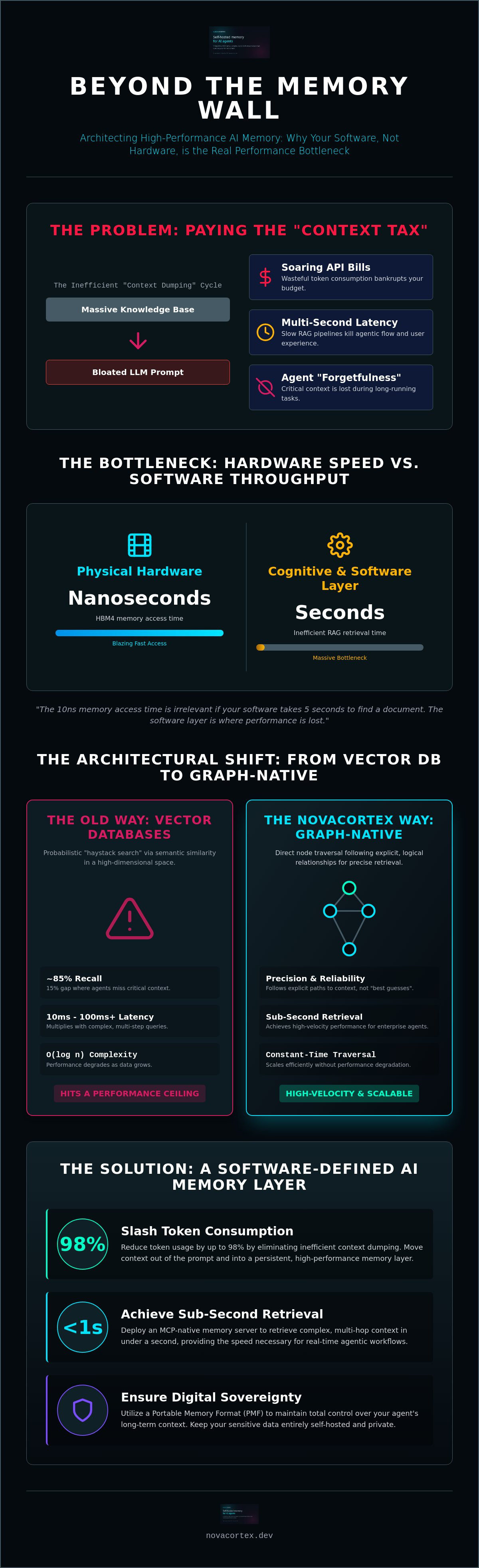
Most developers currently pay what we call a "Context Tax." They dump massive knowledge bases into a prompt and hope the model finds the needle. This approach is a performance killer. It bloats token costs and introduces massive latency. It's the primary cause of agent "forgetfulness" during long-running tasks. Architectural efficiency offers a far better ROI than raw hardware scaling. If your software layer is broken, 100 H100s won't save your agent from stalling. High-performance AI memory requires a fundamental rethink of how we bridge the gap between physical storage and cognitive retrieval. We must move context from the prompt to a persistent, external structure.
Hardware vs. Cognitive Latency
Physical access times are measured in nanoseconds. HBM4 is undeniably fast. However, agent reasoning takes seconds. This massive discrepancy is where most AI systems fail. Inefficient context retrieval creates a bottleneck that no GPU can fix. If your RAG pipeline takes five seconds to find a relevant document, the 10ms memory access time becomes irrelevant. Memory middleware must bridge this silicon-cognition gap. It acts as a high-velocity filter. It ensures the LLM only receives the exact data it needs to reason effectively. This reduces the cognitive load on the model and slashes the time-to-first-token. Speed isn't just about moving bits; it's about moving the right bits.
Software-Defined AI Memory
We are witnessing a shift toward persistent, external memory layers. The era of "stateless" LLM calls is ending. High-performance agents require stateful cognition. This means moving context management out of the prompt and into a dedicated, self-managed memory layer. The industry is moving away from default reliance on bloated vector databases. Instead, we are seeing a "memory-first" architecture. This approach stores context in version-controlled, human-readable files. It's about building a system that remembers, reasons, and retrieves with surgical precision. This software-defined approach ensures agents remain fast, lean, and cost-effective. It's a necessary correction to the current market's reliance on wasteful, brute-force context dumping.
Graph-Native Memory vs. Vector Databases: Architecture for Speed
Vector databases are the industry's current blunt instrument. They operate on probabilistic "best guesses" through semantic similarity. This approach is acceptable for basic document retrieval, but it's catastrophic for complex agent reasoning. As your context grows, vector search hits a hard performance ceiling. High-dimensional spaces require intensive compute for re-ranking and filtering. This creates a structural lag that kills agentic flow. True high-performance AI memory requires a shift from proximity to precision.
Graph-native storage is the superior alternative for high-velocity environments. It replaces the "haystack search" of vector indices with direct node traversal. Instead of calculating distances between millions of points, the system follows explicit relationships. This architectural choice changes the retrieval complexity from O(log n) or worse to constant-time traversal for related entities. You don't search for context; you follow the path to it. This is how you achieve the reliability needed for enterprise-grade agents.
The Vector Search Ceiling
Vector databases typically exhibit query latencies between 10ms and 100ms. While this sounds fast, it represents a significant bottleneck when an agent requires multiple retrieval steps to answer a single prompt. Standard RAG approaches only achieve approximately 85% recall. This leaves a 15% gap where your agent simply "forgets" or misses critical context. Semantic similarity often fails to capture logical hierarchies. It might find "contract" and "legal," but it won't understand the multi-hop dependency between a specific clause and a 2026 delivery date. The performance cost of re-ranking these results adds unnecessary overhead to your stack.
Engineering Graph-Native Retrieval
Graph-based methods achieve roughly 92% recall and 88% precision. This precision advantage directly reduces hallucinations by providing the LLM with relevant, logically connected data rather than just "similar" text chunks. By organizing data into localized knowledge clusters, agents can perform multi-hop reasoning without scanning the entire database. You can examine graph-native implementations on GitHub to see how localized traversal outpaces broad vector search in production environments.
Building high-performance AI memory requires this shift from "finding similar things" to "traversing known facts." Direct node traversal ensures that when an agent needs a specific relationship, it follows a pre-defined edge. It doesn't guess. It knows. This deterministic approach provides the reliability needed for sovereign AI systems. It's the difference between an agent that guesses and an agent that executes with surgical accuracy.
Benchmarking Efficiency: Token Usage and Retrieval Latency
Efficiency isn't a suggestion. It's a survival requirement for production agents. Current RAG implementations are notoriously wasteful. They rely on context stuffing, which forces LLMs to process thousands of irrelevant tokens. This bloat doesn't just increase costs; it degrades model performance. A high-performance AI memory layer solves this by implementing surgical retrieval. It ensures the model only sees the data it needs to execute the current task.
Memory Tiering is the strategic placement of context across different storage mediums to optimize for access speed and cost. By tiering data, we ensure that frequently accessed "hot" context is immediately available, while "cold" archival data remains in cheaper, persistent storage. This prevents the context window from becoming a dumping ground for unstructured data. Strategic tiering is the difference between a responsive system and one that chokes on its own history.
Cutting LLM Token Costs
The mathematics of context optimization are straightforward. If you send 100k tokens to an LLM to answer a simple query, you're paying for noise. Efficient memory layers filter this noise before it reaches the API. By reducing AI agent token usage, you directly increase system throughput. You aren't just saving money. You're making the agent smarter by narrowing its focus.
Consider a standard reasoning task. A bloated RAG pipeline might ingest 100,000 tokens of raw documentation to find a single relationship. A graph-native memory layer extracts the specific relational nodes required for that logic. This reduces the payload to 2,000 tokens. That represents a 98% reduction in token consumption. Over millions of requests, this efficiency saves thousands in API fees and keeps the model focused entirely on the signal. Less waste equals more intelligence.
Latency Metrics for Autonomous Agents
For autonomous agents, Time to First Token (TTFT) is the only metric that matters. Standard RAG pipelines often suffer from high latency due to network round-trips to managed cloud databases. These delays break the agentic loop. A high-performance AI memory layer must be localized to minimize this overhead. Speed is an architectural feature, not a hardware byproduct.
Self-hosted memory layers eliminate the unpredictability of managed services. When retrieval happens on the same local network or edge hardware as the agent, latency drops significantly. You move from hundreds of milliseconds of network lag to sub-second response times for the entire pipeline. This real-time optimization is what allows agents to interact naturally. It eliminates the "thinking" delays that plague cloud-dependent systems. We don't just want the agent to be smart. We want it to be fast enough to be useful.
Implementing a High-Performance Memory Layer: A Technical Framework
Stop theorizing. Start building. A high-performance AI memory layer is a deliberate engineering project, not a default feature of your LLM provider. Most developers fail because they treat memory as a sidecar rather than a core infrastructure component. To achieve sub-second retrieval and data sovereignty, you must own the stack. This begins with selecting a deployment environment that matches your latency requirements. Whether you utilize a private VPS, a local dedicated server, or edge hardware like a Raspberry Pi 5, the goal remains the same: minimize the distance between the agent and its context.
Architectural independence is your primary defense against vendor lock-in. You should standardize on a portable memory format for AI to ensure your data remains interoperable. If you switch from Claude to a local Llama-3 instance, your agent's long-term memory shouldn't vanish. Furthermore, you must implement Knowledge Buckets to isolate and prioritize context. Don't let your agent ingest every scrap of data at once. Use buckets to partition knowledge by project, client, or security clearance. This ensures the model only processes relevant signal, maintaining the 98% token reduction we discussed earlier.
The MCP-Native Advantage
The MCP native memory server is the new standard for agentic interoperability. It provides a clean, standardized interface for models to query external context. By adopting the Model Context Protocol, you eliminate the need for custom, brittle middleware. It allows for direct integration with Claude, GPT-4, and local frameworks. This protocol reduces overhead by providing a unified language for context retrieval. It turns your memory layer into a first-class citizen in the AI stack. It's fast. It's lean. It works.
Self-Hosting for Data Sovereignty
Sovereignty is a technical requirement, not a buzzword. Deploying a self-hosted AI memory layer on private infrastructure ensures that sensitive knowledge stays behind your firewall. You cannot build a secure agent on a third-party managed vector cloud. When configuring your hardware, prioritize NVMe storage over traditional SSDs. The high random-access speeds of NVMe are essential for the localized graph traversal required for high-performance AI memory. High-velocity performance demands high-velocity hardware.
Ready to move beyond context dumping? You can clone the reference implementation on GitHub to begin engineering your own persistent memory layer today.
NovaCortex: Engineering the Future of Self-Hosted AI Memory
Architectural flaws require architectural solutions. NovaCortex isn't another wrapper around a legacy vector database. It's the industry's first privacy-first, graph-native memory layer built to solve the "memory wall" at the software level. By treating context as a relational structure rather than a flat list of embeddings, NovaCortex provides the backbone for truly autonomous agents. It transforms the AI interaction from a series of disconnected, stateless calls into a continuous, stateful cognitive process. The NovaCortex Self-Hosted Edition delivers enterprise-grade performance by keeping your high-performance AI memory where it belongs: under your direct control and behind your own firewall.
A future-proof AI infrastructure demands more than just raw speed. It requires total digital sovereignty. Knowledge Buckets and the Portable Memory Format (PMF) ensure that your agent's cognition isn't tied to a specific model provider or a brittle, proprietary API. You own the data. You own the retrieval logic. You own the history. This level of independence is foundational to building agents that don't just react to the last prompt but reason over long, complex time horizons. It's time to stop bleeding tokens on context dumping and start engineering for long-term efficiency.
Architectural Superiority
Waste is the enemy of high-velocity performance. NovaCortex achieves a 98% token reduction through intelligent pruning and localized graph traversal. Instead of overwhelming the context window with "similar" noise, it identifies the exact relational nodes required for the current execution step. This isn't a "best guess" like standard vector search; it's deterministic state management. Because NovaCortex is built on an open-source foundation (Apache-2.0), developers maintain absolute sovereignty over their stack. You aren't just using a tool. You're building on a standard-setting architecture designed specifically for high-performance AI memory and low-latency reasoning.
Getting Started with NovaCortex
Deployment is immediate and designed for builders. You can download the NovaCortex Self-Hosted Edition to secure your agent's memory on private infrastructure today. For teams that require low-maintenance scaling without sacrificing the precision of graph-native retrieval, our managed infrastructure options provide a high-velocity alternative. Join a community of engineers who have rejected bloated, restrictive systems in favor of architectural precision and lean operations. Build faster. Build leaner. Build with NovaCortex. The transition from wasteful context dumping to precise, persistent agent cognition starts with a single command.
Architect for Sovereignty and Speed
Brute-force context dumping is an engineering failure. Relying solely on HBM4 and silicon scaling ignores the structural inefficiencies of modern RAG pipelines. To build agents that scale without bankrupting your token budget, you must implement a high-performance AI memory layer that prioritizes relational precision over semantic proximity. Transitioning to a graph-native architecture ensures your agents maintain stateful cognition while slashing latency. This isn't just about saving costs; it's about reclaiming digital sovereignty through specialized, self-hosted infrastructure. You shouldn't settle for bloated systems that prioritize vendor lock-in over performance.
NovaCortex provides the blueprint for this transition. With a graph-native architecture and Apache-2.0 open-source transparency, it enables a 98% reduction in token usage by pruning context with surgical accuracy. Stop fighting the memory wall and start building on a foundation designed for high-velocity reasoning. Deploy NovaCortex Self-Hosted Edition today to eliminate retrieval lag and secure your agent's long-term intelligence. The future of agentic speed belongs to those who own their memory stack. It's time to build smarter.
Frequently Asked Questions
What is high-performance AI memory?
It is the specialized software layer that optimizes the interplay between physical storage and cognitive retrieval. Unlike raw hardware like HBM4, high-performance AI memory focuses on context throughput and surgical data injection into the LLM. It transforms a stateless model into a stateful agent by managing long-term context with minimal latency.
How does graph-native memory differ from a vector database?
Vector databases rely on probabilistic proximity and high-dimensional semantic search. Graph-native memory utilizes deterministic relational nodes to follow explicit paths between data points. This architecture replaces "best guess" retrieval with constant-time traversal. It provides the precision required for multi-hop reasoning that standard RAG pipelines often miss.
Can software really reduce my LLM token costs by 98%?
Yes. By implementing intelligent pruning, the system identifies the exact relational signal required for a task rather than dumping entire documents into the prompt. Moving from a 100,000-token context dump to a 2,000-token precise injection represents a 98% reduction in overhead. This efficiency eliminates the "context tax" that bloats API bills.
Is it better to self-host AI memory or use a managed service?
Self-hosting is the only way to ensure digital sovereignty and sub-second retrieval speeds. Managed services introduce unpredictable network round-trip lag and expose sensitive knowledge to third-party providers. A self-hosted AI memory layer keeps your data behind your own firewall and eliminates external dependency bottlenecks.
What hardware do I need for a high-performance AI memory server?
Prioritize random-access speed over raw capacity. NVMe storage is essential for the high-velocity node traversal required in graph-native systems. While your GPU handles inference, the high-performance AI memory layer relies on fast I/O and sufficient RAM to maintain localized knowledge clusters in an active state.
How does the Model Context Protocol (MCP) affect memory performance?
MCP standardizes the communication between the AI agent and the memory server. It eliminates the need for custom, high-latency middleware wrappers that often break during model updates. By providing a unified interface, MCP-native memory servers reduce computational overhead and ensure seamless context integration across different LLM environments.
Why is a portable memory format (PMF) important for AI agents?
PMF prevents vendor lock-in by making agent context independent of the underlying model. It ensures that your agent's long-term history and reasoning patterns can migrate between different LLMs or deployment environments. Without a portable format, your agent's "intelligence" is trapped within a proprietary provider's ecosystem.
How do knowledge buckets improve agent retrieval speed?
They partition unstructured data into isolated, prioritized clusters. Instead of scanning an entire database for every query, the system only searches relevant buckets. This logical isolation improves the signal-to-noise ratio and ensures the agent retrieves context with surgical precision. Partitioning is a fundamental requirement for high-velocity agentic flow.

FAQ
Hardware vs. Cognitive Latency
Physical access times are measured in nanoseconds. HBM4 is undeniably fast. However, agent reasoning takes seconds. This massive discrepancy is where most AI systems fail. Inefficient context retrieval creates a bottleneck that no GPU can fix. If your RAG pipeline takes five seconds to find a relevant document, the 10ms memory access time becomes irrelevant. Memory middleware must bridge this silicon-cognition gap. It acts as a high-velocity filter. It ensures the LLM only receives the exact data it needs to reason effectively. This reduces the cognitive load on the model and slashes the time-to-first-token. Speed isn't just about moving bits; it's about moving the right bits.
Software-Defined AI Memory
We are witnessing a shift toward persistent, external memory layers. The era of "stateless" LLM calls is ending. High-performance agents require stateful cognition. This means moving context management out of the prompt and into a dedicated, self-managed memory layer. The industry is moving away from default reliance on bloated vector databases. Instead, we are seeing a "memory-first" architecture. This approach stores context in version-controlled, human-readable files. It's about building a system that remembers, reasons, and retrieves with surgical precision. This software-defined approach ensures agents remain fast, lean, and cost-effective. It's a necessary correction to the current market's reliance on wasteful, brute-force context dumping. Vector databases are the industry's current blunt instrument. They operate on probabilistic "best guesses" through semantic similarity. This approach is acceptable for basic document retrieval, but it's catastrophic for complex agent reasoning. As your context grows, vector search hits a hard performance ceiling. High-dimensional spaces require intensive compute for re-ranking and filtering. This creates a structural lag that kills agentic flow. True high-performance AI memory requires a shift from proximity to precision. Graph-native storage is the superior alternative for high-velocity environments. It replaces the "haystack search" of vector indices with direct node traversal. Instead of calculating distances between millions of points, the system follows explicit relationships. This architectural choice changes the retrieval complexity from O(log n) or worse to constant-time traversal for related entities. You don't search for context; you follow the path to it. This is how you achieve the reliability needed for enterprise-grade agents.
The Vector Search Ceiling
Vector databases typically exhibit query latencies between 10ms and 100ms. While this sounds fast, it represents a significant bottleneck when an agent requires multiple retrieval steps to answer a single prompt. Standard RAG approaches only achieve approximately 85% recall. This leaves a 15% gap where your agent simply "forgets" or misses critical context. Semantic similarity often fails to capture logical hierarchies. It might find "contract" and "legal," but it won't understand the multi-hop dependency between a specific clause and a 2026 delivery date. The performance cost of re-ranking these results adds unnecessary overhead to your stack.
Engineering Graph-Native Retrieval
Graph-based methods achieve roughly 92% recall and 88% precision. This precision advantage directly reduces hallucinations by providing the LLM with relevant, logically connected data rather than just "similar" text chunks. By organizing data into localized knowledge clusters, agents can perform multi-hop reasoning without scanning the entire database. You can examine graph-native implementations on GitHub to see how localized traversal outpaces broad vector search in production environments. Building high-performance AI memory requires this shift from "finding similar things" to "traversing known facts." Direct node traversal ensures that when an agent needs a specific relationship, it follows a pre-defined edge. It doesn't guess. It knows. This deterministic approach provides the reliability needed for sovereign AI systems. It's the difference between an agent that guesses and an agent that executes with surgical accuracy. Efficiency isn't a suggestion. It's a survival requirement for production agents. Current RAG implementations are notoriously wasteful. They rely on context stuffing, which forces LLMs to process thousands of irrelevant tokens. This bloat doesn't just increase costs; it degrades model performance. A high-performance AI memory layer solves this by implementing surgical retrieval. It ensures the model only sees the data it needs to execute the current task. Memory Tiering is the strategic placement of context across different storage mediums to optimize for access speed and cost. By tiering data, we ensure that frequently accessed "hot" context is immediately available, while "cold" archival data remains in cheaper, persistent storage. This prevents the context window from becoming a dumping ground for unstructured data. Strategic tiering is the difference between a responsive system and one that chokes on its own history.
Cutting LLM Token Costs
The mathematics of context optimization are straightforward. If you send 100k tokens to an LLM to answer a simple query, you're paying for noise. Efficient memory layers filter this noise before it reaches the API. By reducing AI agent token usage, you directly increase system throughput. You aren't just saving money. You're making the agent smarter by narrowing its focus. Consider a standard reasoning task. A bloated RAG pipeline might ingest 100,000 tokens of raw documentation to find a single relationship. A graph-native memory layer extracts the specific relational nodes required for that logic. This reduces the payload to 2,000 tokens. That represents a 98% reduction in token consumption. Over millions of requests, this efficiency saves thousands in API fees and keeps the model focused entirely on the signal. Less waste equals more intelligence.
Latency Metrics for Autonomous Agents
For autonomous agents, Time to First Token (TTFT) is the only metric that matters. Standard RAG pipelines often suffer from high latency due to network round-trips to managed cloud databases. These delays break the agentic loop. A high-performance AI memory layer must be localized to minimize this overhead. Speed is an architectural feature, not a hardware byproduct. Self-hosted memory layers eliminate the unpredictability of managed services. When retrieval happens on the same local network or edge hardware as the agent, latency drops significantly. You move from hundreds of milliseconds of network lag to sub-second response times for the entire pipeline. This real-time optimization is what allows agents to interact naturally. It eliminates the "thinking" delays that plague cloud-dependent systems. We don't just want the agent to be smart. We want it to be fast enough to be useful. Stop theorizing. Start building. A high-performance AI memory layer is a deliberate engineering project, not a default feature of your LLM provider. Most developers fail because they treat memory as a sidecar rather than a core infrastructure component. To achieve sub-second retrieval and data sovereignty, you must own the stack. This begins with selecting a deployment environment that matches your latency requirements. Whether you utilize a private VPS, a local dedicated server, or edge hardware like a Raspberry Pi 5, the goal remains the same: minimize the distance between the agent and its context. Architectural independence is your primary defense against vendor lock-in. You should standardize on a portable memory format for AI to ensure your data remains interoperable. If you switch from Claude to a local Llama-3 instance, your agent's long-term memory shouldn't vanish. Furthermore, you must implement Knowledge Buckets to isolate and prioritize context. Don't let your agent ingest every scrap of data at once. Use buckets to partition knowledge by project, client, or security clearance. This ensures the model only processes relevant signal, maintaining the 98% token reduction we discussed earlier.
The MCP-Native Advantage
The MCP native memory server is the new standard for agentic interoperability. It provides a clean, standardized interface for models to query external context. By adopting the Model Context Protocol, you eliminate the need for custom, brittle middleware. It allows for direct integration with Claude, GPT-4, and local frameworks. This protocol reduces overhead by providing a unified language for context retrieval. It turns your memory layer into a first-class citizen in the AI stack. It's fast. It's lean. It works.
Self-Hosting for Data Sovereignty
Sovereignty is a technical requirement, not a buzzword. Deploying a self-hosted AI memory layer on private infrastructure ensures that sensitive knowledge stays behind your firewall. You cannot build a secure agent on a third-party managed vector cloud. When configuring your hardware, prioritize NVMe storage over traditional SSDs. The high random-access speeds of NVMe are essential for the localized graph traversal required for high-performance AI memory. High-velocity performance demands high-velocity hardware. Ready to move beyond context dumping? You can clone the reference implementation on GitHub to begin engineering your own persistent memory layer today. Architectural flaws require architectural solutions. NovaCortex isn't another wrapper around a legacy vector database. It's the industry's first privacy-first, graph-native memory layer built to solve the "memory wall" at the software level. By treating context as a relational structure rather than a flat list of embeddings, NovaCortex provides the backbone for truly autonomous agents. It transforms the AI interaction from a series of disconnected, stateless calls into a continuous, stateful cognitive process. The NovaCortex Self-Hosted Edition delivers enterprise-grade performance by keeping your high-performance AI memory where it belongs: under your direct control and behind your own firewall. A future-proof AI infrastructure demands more than just raw speed. It requires total digital sovereignty. Knowledge Buckets and the Portable Memory Format (PMF) ensure that your agent's cognition isn't tied to a specific model provider or a brittle, proprietary API. You own the data. You own the retrieval logic. You own the history. This level of independence is foundational to building agents that don't just react to the last prompt but reason over long, complex time horizons. It's time to stop bleeding tokens on context dumping and start engineering for long-term efficiency.
Architectural Superiority
Waste is the enemy of high-velocity performance. NovaCortex achieves a 98% token reduction through intelligent pruning and localized graph traversal. Instead of overwhelming the context window with "similar" noise, it identifies the exact relational nodes required for the current execution step. This isn't a "best guess" like standard vector search; it's deterministic state management. Because NovaCortex is built on an open-source foundation (Apache-2.0), developers maintain absolute sovereignty over their stack. You aren't just using a tool. You're building on a standard-setting architecture designed specifically for high-performance AI memory and low-latency reasoning.
Getting Started with NovaCortex
Deployment is immediate and designed for builders. You can download the NovaCortex Self-Hosted Edition to secure your agent's memory on private infrastructure today. For teams that require low-maintenance scaling without sacrificing the precision of graph-native retrieval, our managed infrastructure options provide a high-velocity alternative. Join a community of engineers who have rejected bloated, restrictive systems in favor of architectural precision and lean operations. Build faster. Build leaner. Build with NovaCortex. The transition from wasteful context dumping to precise, persistent agent cognition starts with a single command. Brute-force context dumping is an engineering failure. Relying solely on HBM4 and silicon scaling ignores the structural inefficiencies of modern RAG pipelines. To build agents that scale without bankrupting your token budget, you must implement a high-performance AI memory layer that prioritizes relational precision over semantic proximity. Transitioning to a graph-native architecture ensures your agents maintain stateful cognition while slashing latency. This isn't just about saving costs; it's about reclaiming digital sovereignty through specialized, self-hosted infrastructure. You shouldn't settle for bloated systems that prioritize vendor lock-in over performance. NovaCortex provides the blueprint for this transition. With a graph-native architecture and Apache-2.0 open-source transparency, it enables a 98% reduction in token usage by pruning context with surgical accuracy. Stop fighting the memory wall and start building on a foundation designed for high-velocity reasoning. Deploy NovaCortex Self-Hosted Edition today to eliminate retrieval lag and secure your agent's long-term intelligence. The future of agentic speed belongs to those who own their memory stack. It's time to build smarter.
What is high-performance AI memory?
It is the specialized software layer that optimizes the interplay between physical storage and cognitive retrieval. Unlike raw hardware like HBM4, high-performance AI memory focuses on context throughput and surgical data injection into the LLM. It transforms a stateless model into a stateful agent by managing long-term context with minimal latency.
How does graph-native memory differ from a vector database?
Vector databases rely on probabilistic proximity and high-dimensional semantic search. Graph-native memory utilizes deterministic relational nodes to follow explicit paths between data points. This architecture replaces "best guess" retrieval with constant-time traversal. It provides the precision required for multi-hop reasoning that standard RAG pipelines often miss.
Can software really reduce my LLM token costs by 98%?
Yes. By implementing intelligent pruning, the system identifies the exact relational signal required for a task rather than dumping entire documents into the prompt. Moving from a 100,000-token context dump to a 2,000-token precise injection represents a 98% reduction in overhead. This efficiency eliminates the "context tax" that bloats API bills.
Is it better to self-host AI memory or use a managed service?
Self-hosting is the only way to ensure digital sovereignty and sub-second retrieval speeds. Managed services introduce unpredictable network round-trip lag and expose sensitive knowledge to third-party providers. A self-hosted AI memory layer keeps your data behind your own firewall and eliminates external dependency bottlenecks.
What hardware do I need for a high-performance AI memory server?
Prioritize random-access speed over raw capacity. NVMe storage is essential for the high-velocity node traversal required in graph-native systems. While your GPU handles inference, the high-performance AI memory layer relies on fast I/O and sufficient RAM to maintain localized knowledge clusters in an active state.
How does the Model Context Protocol (MCP) affect memory performance?
MCP standardizes the communication between the AI agent and the memory server. It eliminates the need for custom, high-latency middleware wrappers that often break during model updates. By providing a unified interface, MCP-native memory servers reduce computational overhead and ensure seamless context integration across different LLM environments.
Why is a portable memory format (PMF) important for AI agents?
PMF prevents vendor lock-in by making agent context independent of the underlying model. It ensures that your agent's long-term history and reasoning patterns can migrate between different LLMs or deployment environments. Without a portable format, your agent's "intelligence" is trapped within a proprietary provider's ecosystem.
How do knowledge buckets improve agent retrieval speed?
They partition unstructured data into isolated, prioritized clusters. Instead of scanning an entire database for every query, the system only searches relevant buckets. This logical isolation improves the signal-to-noise ratio and ensures the agent retrieves context with surgical precision. Partitioning is a fundamental requirement for high-velocity agentic flow.