How to Reduce LLM Context Window Costs: Engineering Token-Efficient AI Agents

Your AI agent is leaking capital through every prompt. Most developers treat the context window like a junk drawer, cramming in massive payloads and hoping the model finds the signal in the noise. It's a failing strategy. Costs scale exponentially while performance degrades due to "lost-in-the-middle" issues. You're paying a premium for systemic inefficiency, effectively subsidizing cloud providers with every redundant token sent over the wire.
We agree that the current trajectory of LLM API billing is unsustainable for production-scale agents. This guide provides the architectural blueprint to reduce LLM context window costs by up to 98% using graph-native memory structures. We'll move past bloated vector-only RAG and explore how the NovaCortex Self-Hosted Edition uses the Portable Memory Format (PMF) to achieve high-precision retrieval. You'll learn to engineer lean, sovereign agents that leverage MCP-native memory servers to maintain state without the overhead. We'll break down the transition from wasteful knowledge dumping to precision-indexed Knowledge Buckets that prioritize accuracy and digital sovereignty.
Key Takeaways
- Identify why long-context windows function as a financial trap and how to escape the "Context Window Tax" through architectural efficiency.
- Discover how graph-native memory architectures allow you to reduce LLM context window costs by up to 98% compared to standard vector-only RAG.
- Shift from wasteful knowledge dumping to high-precision injection using the Portable Memory Format (PMF) for stateful agent memory.
- Implement tiered retrieval and modular Knowledge Buckets to eliminate irrelevant data and prevent "lost-in-the-middle" performance degradation.
- Deploy MCP-native memory servers to maintain low-latency, self-hosted data sovereignty while slashing recurring API overhead.
The Context Window Tax: Why LLM Token Costs Are Spiraling
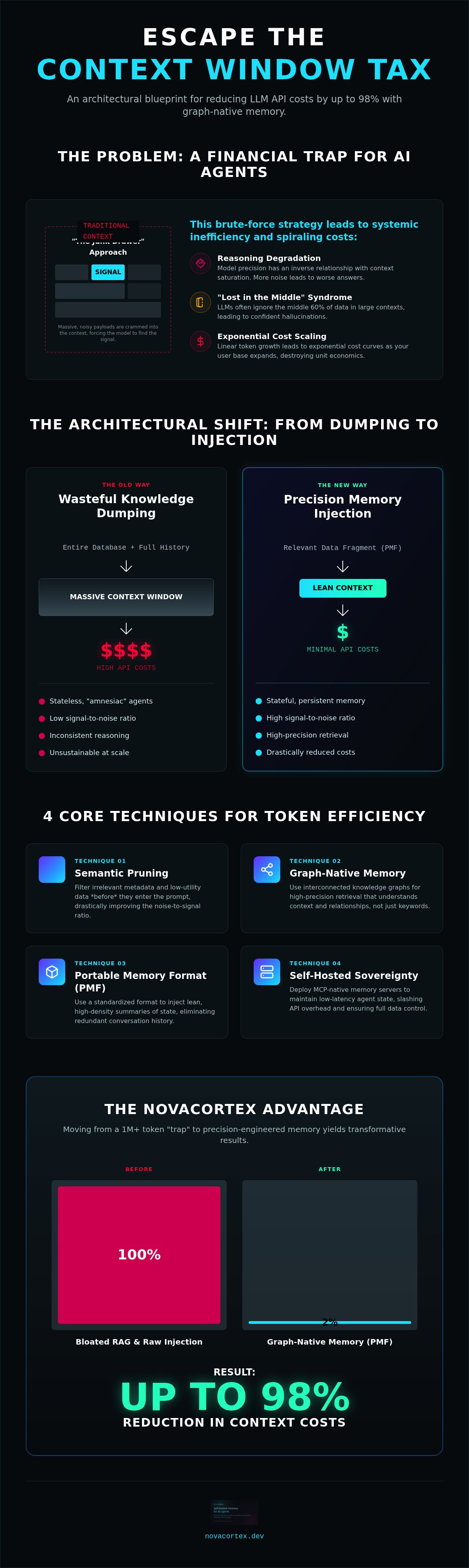
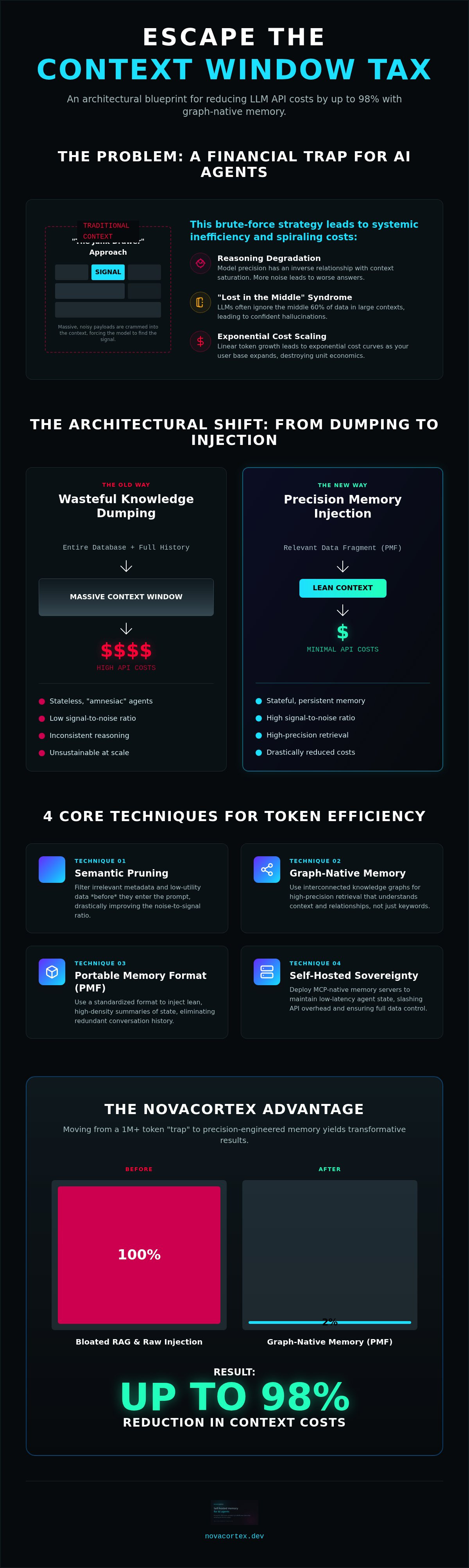
The Context Window Tax is the cost-inefficiency of brute-force data injection. It represents the financial penalty paid by teams who substitute engineering precision with raw token volume. As agents scale, the habit of dumping entire databases into a prompt becomes a terminal drain on resources, making it impossible to reduce LLM context window costs without a fundamental change in strategy. You aren't just paying for the answer; you're paying for the model to sift through mountains of irrelevant noise.
Long-context models with 1M+ token capacities are a financial trap for production environments. While they offer the convenience of "infinite" memory, they destroy your unit economics. In 2026, the overhead of managing these massive windows outweighs the perceived benefits of simplicity. Relying on the model to "find the needle" is a gamble that results in inconsistent reasoning and ballooning API bills.
- Reasoning Degradation: There is a measurable, inverse relationship between context saturation and model precision.
- Contextual Noise: Excessive tokens dilute the attention mechanism, leading to ignored system prompts.
- Financial Scaling: Linear token growth leads to exponential cost curves as user bases expand.
The Hidden Price of 'Lost in the Middle'
Excessive context doesn't just cost money; it creates hallucinations. When an LLM processes massive payloads, it frequently suffers from "lost-in-the-middle" syndrome, where it ignores the middle 60% of the provided data. This leads to agents providing confident but incorrect answers based on partial information. Beyond accuracy, you're paying to re-transmit the same static documentation in every single turn. This token bloat creates massive latency spikes that degrade the user experience and drive up infrastructure requirements.
Why Long-Context Models Aren't a Cost-Saving Solution
Comparing a 128k window to a 1M window reveals a stark reality: the larger window is often an architectural crutch. The fallacy of "letting the model handle it" ignores the fact that engineering the context is the only way to reduce LLM context window costs effectively. Sophisticated builders avoid the 1M token trap by implementing AI agent long term memory systems. This persistent cognition allows agents to retrieve specific, high-precision fragments rather than entire datasets, ensuring you only pay for the intelligence you actually use. High-velocity performance requires lean operations, not bloated prompts.
Beyond Token Dumping: The Architecture of Efficient Retrieval
Lazy engineering relies on knowledge dumping. Precise engineering relies on memory injection. The transition from stateless API calls to state-aware agent systems is the only viable path to reduce LLM context window costs at scale. When you treat the context window as a static buffer, you're paying for redundant data processing with every single request. Efficient retrieval architecture demands that we stop sending the library when the agent only needs a single page.
Semantic pruning is the first line of defense against token bloat. It involves filtering out irrelevant metadata and low-utility data points before they ever reach the LLM. By implementing strict relevance thresholds, you ensure that only the most pertinent fragments enter the prompt. This drastically improves the noise-to-signal ratio, allowing the model to focus its limited attention on high-value information rather than sifting through architectural debris.
Semantic Pruning vs. Raw Data Injection
Raw data injection is a brute-force tactic that yields diminishing returns. Instead, use summarization techniques to compress long-term interaction history into compact context blocks. If a conversation spans fifty turns, don't send fifty turns. Send a high-density summary of the state and only the last three messages. This approach minimizes token overhead while maintaining the agent's functional awareness. Precision-indexed retrieval ensures that your signal remains clear even as your dataset grows.
The Role of Stateful Memory in Token Conservation
Stateless agents are amnesiacs. They require you to re-upload the entire conversation history with every new turn, which is the primary driver of spiraling costs. Stateful memory layers solve this by maintaining the agent's context locally or in a dedicated memory server. When evaluating self-hosted vs managed AI memory, the self-hosted route wins on both cost and sovereignty. It eliminates the per-token markup of third-party memory providers and reduces latency by keeping data closer to the execution logic.
Persistent memory layers act as the backbone of token-efficient agents. By using a modular approach, you can inject specific Knowledge Buckets into the prompt only when the current task requires them. This selective injection keeps the context window lean and the response times fast. For developers looking to build these systems today, exploring the open-source NovaCortex repository provides a practical starting point for implementing state-aware architectures.
Graph-Native Memory vs. Vector Search: Engineering Precision
Flat vector search is a blunt instrument. It remains the primary driver of token waste in Retrieval-Augmented Generation (RAG). By relying on semantic similarity alone, developers often flood the prompt with "neighboring" data that shares a similar embedding space but lacks logical utility. This inefficiency makes it nearly impossible to reduce LLM context window costs as the knowledge base grows. Graph-native memory is a structured knowledge layer for AI that replaces probabilistic proximity with deterministic relationships.
Limitations of Flat Vector Embeddings
The "Top-K" retrieval pattern is inherently wasteful. When an agent requests information, a vector database returns the top most similar chunks. In practice, this often means retrieving 2,000 tokens of text to extract a single 50-token fact. This 90% waste is a direct result of vector similarity failing to capture logical relationships. Chunks are treated as isolated islands. If the answer requires connecting two distant concepts, vector search forces you to retrieve massive amounts of intermediate data. This leads to "hallucinated relevance" where the model processes tokens that are semantically close but logically useless.
How Graph Structures Eliminate Context Noise
Graph-native storage shifts the paradigm from searching for "similar things" to traversing "known paths." By representing data as a network of nodes and edges, agents can pinpoint the exact information needed for a specific query. This surgical precision allows for multi-hop reasoning without the context bloat typical of flat RAG systems. Instead of loading every document related to a topic, the agent follows a relationship path to find the specific answer. It's the difference between browsing a whole library and following a direct citation.
This architectural shift is the most effective way to reduce LLM context window costs in complex production environments. While flat databases serve simple key-value needs, they lack the structural depth required for high-precision agent memory. You can read more about Redis vs graph memory for AI agents to understand how structural indexing outperforms simple caching. By retrieving only the necessary edges, you eliminate the Context Window Tax and ensure the LLM receives a high-density signal. Precision is the ultimate cost-saver.
Strategic Implementation: 4 Techniques to Reduce LLM Context Window Costs
Optimization isn't a suggestion. It's a requirement for survival in production. Engineering-led strategies are the only way to reduce LLM context window costs without sacrificing agent intelligence. If you're still relying on "letting the model handle it," you're burning capital on architectural laziness. High-velocity agents require a lean, precision-indexed approach to data handling.
Modularizing Knowledge with Knowledge Buckets
Global context leakage is a silent killer. When an agent has access to every document in your system, it attempts to process every document. Knowledge Buckets allow you to segment data into discrete, functional domains. This ensures the agent only searches relevant scopes. For example, a customer support agent shouldn't process the entire developer API documentation when a user asks about shipping status. Scoping prevents the LLM from touching 90% of your total knowledge base, slashing overhead immediately and improving response accuracy.
Implementing Tiered Retrieval Strategies
Efficient systems don't treat every query as a high-cost reasoning task. They use tiers to balance speed and token cost. This hierarchical approach ensures you only use the most expensive resources when absolutely necessary. Consider this structure:
- Tier 1: Local Cache. This handles immediate context and repeated queries at zero token cost.
- Tier 2: Graph-Native Memory. This retrieves specific facts with minimal token injection.
- Tier 3: Full LLM Reasoning. This is the "expensive" fallback, used only when the first two tiers fail to provide a definitive answer.
Most cloud-managed RAG systems force you to send raw, unoptimized data. A self-hosted AI memory layer allows for local pre-processing. You can strip metadata, summarize conversation histories, and prune noise before the first byte hits the LLM API. This moves the heavy lifting to your own infrastructure. It preserves your token budget for actual generation rather than data cleaning. It's a fundamental shift toward digital sovereignty and lean operations.
Not all data is permanent. Transient agent data, such as temporary session variables or intermediate reasoning steps, should have a mandatory expiration date. Automating context expiration ensures your active context remains lean and focused. Stale data is just expensive noise. By purging it systematically, you keep the signal clear and the costs low.
NovaCortex: Cutting Token Usage by 98% with Self-Hosted Memory
NovaCortex isn't just another RAG wrapper. It's a fundamental rebuild of how agents store and retrieve knowledge. By utilizing graph-native storage instead of flat vector lists, it achieves a 98% reduction in token usage compared to standard knowledge dumping. This efficiency isn't just about saving money. It's about reclaiming performance. When you reduce LLM context window costs through surgical retrieval, you also eliminate the latency overhead that kills user engagement. High-precision indexing turns your context from a junk drawer into a structured library.
The core of this architectural superiority lies in how NovaCortex handles relationships. Standard vector databases treat every chunk as an isolated vector. NovaCortex connects them. This means when an agent queries for information, it doesn't just get "similar" text; it follows a deterministic path of logic. This precision is what allows for such drastic token savings. You send exactly what the model needs to see. Nothing more. Nothing less.
Deploying an MCP-Native Memory Server
Integration shouldn't be a bottleneck for production-ready agents. The Model Context Protocol (MCP) has emerged as the industry standard for agent-to-tool communication. By using an MCP native memory server, developers can standardize memory management across any model or framework. This eliminates the need for heavy middleware layers. It allows for direct, low-latency context injection that feels native to the agent's reasoning loop. You can integrate NovaCortex into existing workflows using open-source tools today, ensuring your agent has persistent state without the bloat of custom, brittle integration code.
Achieving Digital Sovereignty with PMF
Vendor lock-in is a silent tax that grows as your data grows. Most managed memory providers trap your information in proprietary formats, making it prohibitively expensive to migrate or switch models. The Portable Memory Format (PMF) is our direct correction to this systemic flaw. It acts as a permanent hedge against rising API prices. With PMF, you can move your AI knowledge base between different LLM providers without incurring massive re-indexing or re-embedding costs. This flexibility is essential for any builder looking to reduce LLM context window costs while maintaining strategic independence.
Digital sovereignty is the ultimate cost-reduction strategy for AI startups. By moving to the NovaCortex Self-Hosted Edition, you stop paying the premium associated with managed cloud services. You gain full control over your Knowledge Buckets and retrieval logic. This independence is foundational. It ensures your agent remains lean, fast, and financially viable as your user base scales. Stop subsidizing cloud provider waste. Deploy NovaCortex to regain control of your AI costs and build the high-velocity systems the industry demands.
Engineer Leaner AI Operations
Efficient retrieval is the difference between a viable product and a financial liability. Transitioning from flat vector search to graph-native memory is the only way to stop overpaying for token bloat. Precise retrieval through Knowledge Buckets and stateful memory servers eliminates the "Context Window Tax" while improving model reliability. Digital sovereignty isn't just a philosophy; it's a financial necessity for scaling production agents. Implementing these architectural shifts is the most direct path to reduce LLM context window costs while maintaining high-velocity performance.
The roadmap is clear. Move away from bloated cloud dependencies and embrace a lean, sovereign memory layer. With Apache-2.0 open-source licensing and an MCP-native architecture, you have the tools to build systems that are both powerful and sustainable. It's time to stop subsidizing inefficiency and start engineering for precision.
Take control of your architecture. Build agents that remember more while costing less.
Frequently Asked Questions
How exactly does a graph-native memory layer reduce LLM costs?
Graph-native memory reduces costs by replacing probabilistic vector search with deterministic relationship traversal. Instead of injecting the top 10 most "similar" chunks, which often contain 80% noise, a graph structure retrieves the exact path of information required. This surgical precision ensures that every token sent to the LLM is high-utility. By eliminating irrelevant "neighbor" data, you directly reduce LLM context window costs without sacrificing the depth of the agent's knowledge base.
Can I use NovaCortex with proprietary models like GPT-4o or Claude 3.5?
Yes, NovaCortex is model-agnostic and integrates with any proprietary or open-source LLM. It functions as a specialized memory layer that processes data before it reaches the model's context window. By using the MCP-native memory server, you can inject refined context into prompts for GPT-4o, Claude 3.5, or local Llama models. This setup preserves your digital sovereignty while utilizing the reasoning power of top-tier cloud providers without the associated token waste.
Does reducing context window size impact the quality of AI responses?
Reducing context window size through precision indexing actually improves response quality. Large windows often lead to "lost-in-the-middle" issues where models ignore critical instructions or facts hidden in the noise. By engineering token-efficient prompts, you provide a higher signal-to-noise ratio. This allows the model to focus its attention mechanism on relevant data, which reduces hallucinations and increases the accuracy of complex multi-hop reasoning tasks in production environments.
What is the difference between standard RAG and NovaCortex's 98% efficiency?
Standard RAG relies on flat vector embeddings that frequently retrieve redundant or irrelevant context. NovaCortex achieves 98% efficiency by using graph-native storage to index the logical relationships between data points. While standard RAG "dumps" semantically similar text, NovaCortex "injects" only the specific nodes and edges necessary for the query. This architectural shift transforms context management from a brute-force search into a high-precision retrieval operation, slashing recurring API overhead.
Is it difficult to migrate from a vector database like Pinecone to NovaCortex?
Migration is straightforward thanks to the Portable Memory Format (PMF). Unlike locked-in vector databases like Pinecone, NovaCortex uses an open-source, interoperable structure under the Apache-2.0 license. Transitioning involves re-indexing your existing datasets to capture the relationships between entities rather than just their semantic embeddings. This one-time architectural update prevents future vendor lock-in and provides a permanent framework for managing agent memory across different providers and models.
How much can a typical enterprise save by implementing token-efficient context management?
Enterprises can achieve a 98% reduction in token overhead by implementing these strategies. For agents processing thousands of daily interactions, this translates to massive operational savings. By moving away from "context dumping" and utilizing Knowledge Buckets, you effectively reduce LLM context window costs from an exponential growth curve to a predictable, linear expense. This shift makes production-scale AI agents financially viable by ensuring you only pay for the intelligence you actually consume.
What hardware is required to self-host the NovaCortex memory layer?
The NovaCortex Self-Hosted Edition is designed for lean, high-velocity performance on standard hardware. It doesn't require massive GPU clusters; a typical Linux-based server or a modern local development machine is sufficient to run the MCP-native memory server. Because the heavy lifting of graph traversal is computationally efficient, you can maintain a persistent memory layer without significant infrastructure overhead. This allows startups to maintain digital sovereignty without investing in specialized, high-cost hardware.
FAQ
How exactly does a graph-native memory layer reduce LLM costs?
Graph-native memory reduces costs by replacing probabilistic vector search with deterministic relationship traversal. Instead of injecting the top 10 most "similar" chunks, which often contain 80% noise, a graph structure retrieves the exact path of information required. This surgical precision ensures that every token sent to the LLM is high-utility. By eliminating irrelevant "neighbor" data, you directly reduce LLM context window costs without sacrificing the depth of the agent's knowledge base.
Can I use NovaCortex with proprietary models like GPT-4o or Claude 3.5?
Yes, NovaCortex is model-agnostic and integrates with any proprietary or open-source LLM. It functions as a specialized memory layer that processes data before it reaches the model's context window. By using the MCP-native memory server, you can inject refined context into prompts for GPT-4o, Claude 3.5, or local Llama models. This setup preserves your digital sovereignty while utilizing the reasoning power of top-tier cloud providers without the associated token waste.
Does reducing context window size impact the quality of AI responses?
Reducing context window size through precision indexing actually improves response quality. Large windows often lead to "lost-in-the-middle" issues where models ignore critical instructions or facts hidden in the noise. By engineering token-efficient prompts, you provide a higher signal-to-noise ratio. This allows the model to focus its attention mechanism on relevant data, which reduces hallucinations and increases the accuracy of complex multi-hop reasoning tasks in production environments.
What is the difference between standard RAG and NovaCortex's 98% efficiency?
Standard RAG relies on flat vector embeddings that frequently retrieve redundant or irrelevant context. NovaCortex achieves 98% efficiency by using graph-native storage to index the logical relationships between data points. While standard RAG "dumps" semantically similar text, NovaCortex "injects" only the specific nodes and edges necessary for the query. This architectural shift transforms context management from a brute-force search into a high-precision retrieval operation, slashing recurring API overhead.
Is it difficult to migrate from a vector database like Pinecone to NovaCortex?
Migration is straightforward thanks to the Portable Memory Format (PMF). Unlike locked-in vector databases like Pinecone, NovaCortex uses an open-source, interoperable structure under the Apache-2.0 license. Transitioning involves re-indexing your existing datasets to capture the relationships between entities rather than just their semantic embeddings. This one-time architectural update prevents future vendor lock-in and provides a permanent framework for managing agent memory across different providers and models.
How much can a typical enterprise save by implementing token-efficient context management?
Enterprises can achieve a 98% reduction in token overhead by implementing these strategies. For agents processing thousands of daily interactions, this translates to massive operational savings. By moving away from "context dumping" and utilizing Knowledge Buckets, you effectively reduce LLM context window costs from an exponential growth curve to a predictable, linear expense. This shift makes production-scale AI agents financially viable by ensuring you only pay for the intelligence you actually consume.
What hardware is required to self-host the NovaCortex memory layer?
The NovaCortex Self-Hosted Edition is designed for lean, high-velocity performance on standard hardware. It doesn't require massive GPU clusters; a typical Linux-based server or a modern local development machine is sufficient to run the MCP-native memory server. Because the heavy lifting of graph traversal is computationally efficient, you can maintain a persistent memory layer without significant infrastructure overhead. This allows startups to maintain digital sovereignty without investing in specialized, high-cost hardware.