How to Reduce LLM Context Window Costs: Engineering Token-Efficient AI Agents

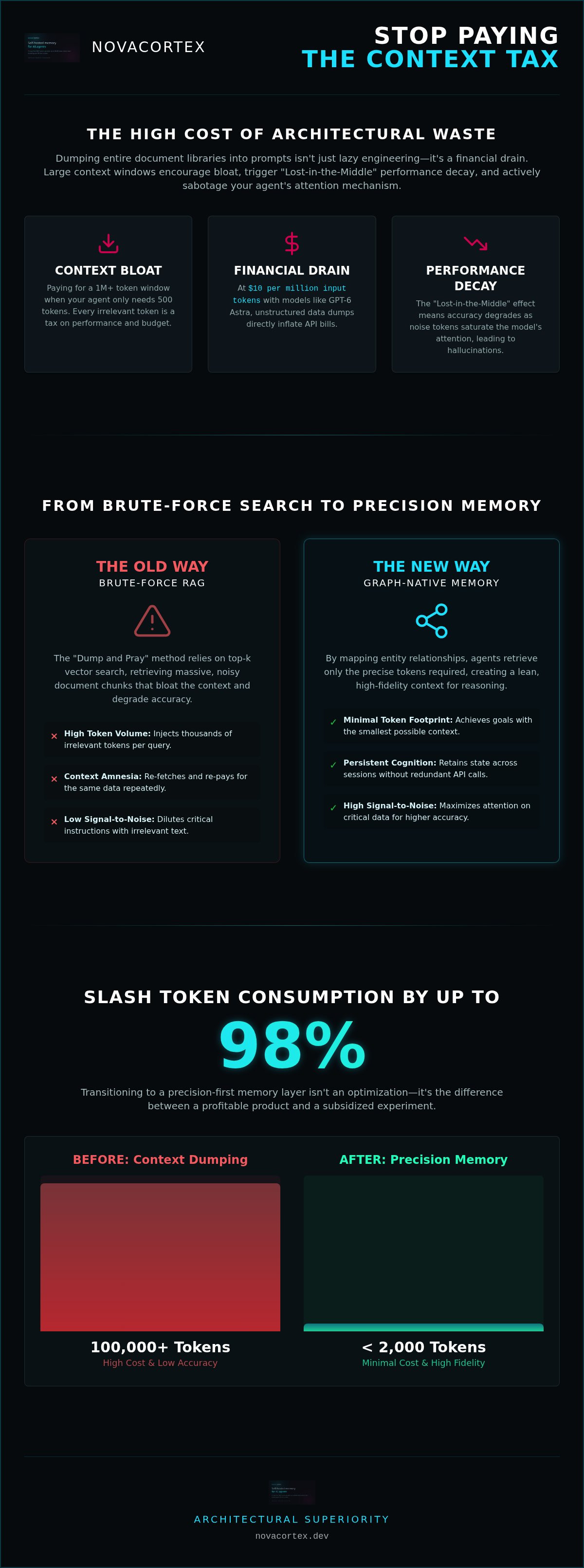
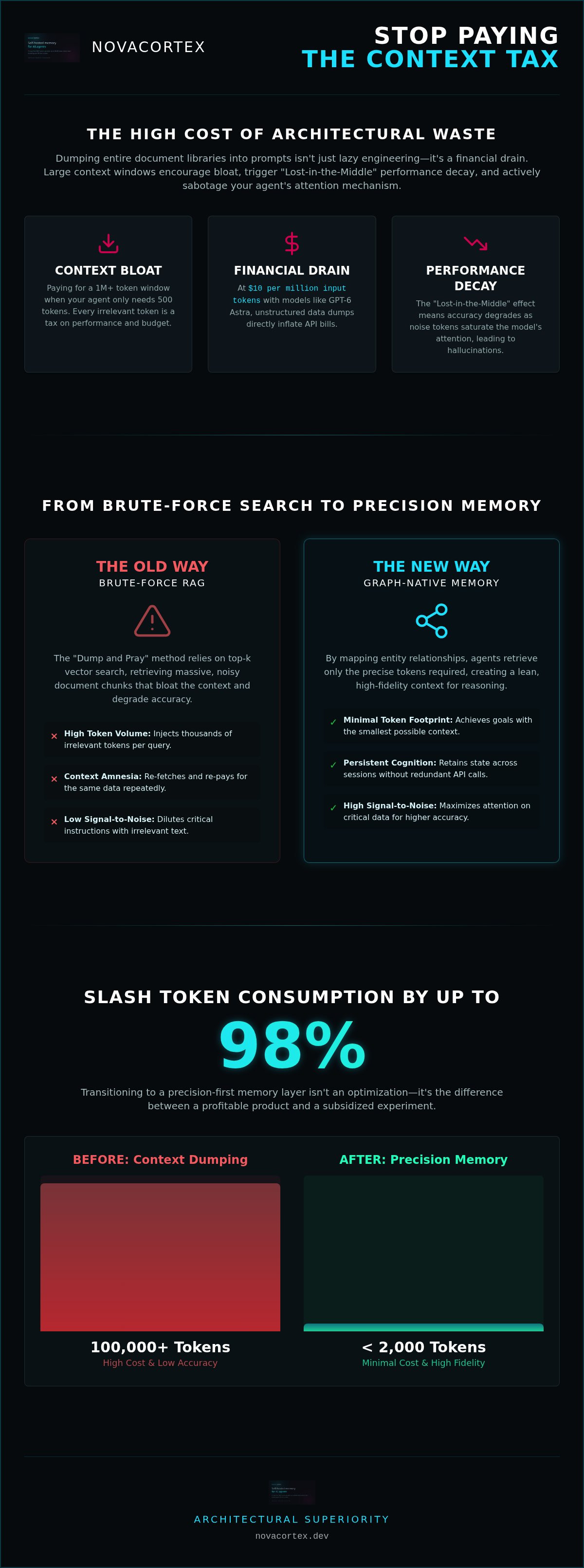
Why are you paying for a 1.05 million token context window when your agent only needs 500 tokens to actually solve the task? With GPT-6 Astra and Claude 5.1 charging $10 per million input tokens, dumping entire document libraries into a prompt isn't just lazy engineering; it's a financial drain. You've likely watched your API bills balloon as context bloat triggers "Lost-in-the-Middle" performance decay, leaving your agents confused and your budget depleted. The industry standard has become a race to waste, yet the most effective way to reduce LLM context window costs is to stop treating the prompt like a landfill.
We agree that the current trajectory of "more context is better" is a lie sold by providers to increase consumption. You deserve architectural superiority and predictable infrastructure. This guide promises a clear framework to slash your token volume by up to 98% using precision context management and graph-native storage. We'll preview how to implement high-velocity memory layers, leverage Portable Memory Format (PMF), and transition to self-hosted infrastructure for true digital sovereignty.
Key Takeaways
- Eliminate the "Context Tax" by moving beyond lazy, brute-force prompting. Learn how to reduce LLM context window costs through a precision-first engineering framework that prioritizes signal over noise.
- Transition from standard vector search to graph-native storage. By mapping entity relationships instead of simple proximity, you ensure your agents only process the specific tokens required for the task.
- Architect leaner agents using Knowledge Buckets and tiered memory. This modular approach separates immediate task context from long-term intelligence, preventing context window bloat and attention decay.
- Deploy NovaCortex Self-Hosted Edition to slash token consumption by up to 98%. Reclaim digital sovereignty and stop the budget leak by managing your agent's memory on your own infrastructure.
The Unit Economics of AI: Why Context Windows are Budget Killers
The context window is no longer a technical constraint; it's a financial liability. In 2026, frontier models like GPT-6 Astra and Claude Fable 5.1 offer horizons exceeding 1 million tokens, yet this abundance is an architectural trap. For every million input tokens processed, you're burning $10. This is the "Context Tax." When you treat the prompt like a landfill for unstructured data, you aren't just paying for intelligence. You're paying for noise. To reduce LLM context window costs, you must reject the "dump and pray" mentality that defines early-stage RAG implementations.
Massive context windows encourage lazy engineering. It's easier to inject a 50-page technical manual than to architect a precise retrieval system. However, research into the "Lost-in-the-Middle" phenomenon confirms that accuracy doesn't scale with volume. LLMs are most effective when critical information sits at the extreme ends of the prompt. When you bury the signal in the middle of a 100,000-token dump, you're paying a premium for lower accuracy and degraded performance. The goal is minimalist context injection: achieving high-fidelity reasoning with the smallest possible token footprint.
Anatomy of an Expensive Prompt
Redundant knowledge base dumps are the primary drivers of budget bloat. Many developers include static company documentation or entire conversation histories in every recurring API call. If your system prompt is 2,000 tokens of bloated instructions, you're paying for that "fixed cost" every time the agent breathes. Visualizing the ROI of a 90% reduction in input tokens reveals a stark reality. For a high-volume agentic workflow, precision context management isn't just a optimization; it's the difference between a profitable product and a subsidized experiment.
Token Waste vs. Cognitive Load
Irrelevant tokens actively sabotage the transformer attention mechanism. Every "noise" token competes for the model's limited attention, diluting the importance of the actual task instructions. This saturation leads to hallucinations and missed constraints. There's also a hidden latency cost. Processing 500,000 tokens takes significantly longer than processing 500, introducing friction into real-time agentic workflows. In the world of 2026 AI, "more data" rarely equals "better answers." It usually just means a slower, more expensive, and less reliable agent.
Architectural Waste: The Hidden Inefficiency of Context Dumping
Context dumping is the technical debt of the generative era. Early Retrieval-Augmented Generation (RAG) implementations relied on a "Dump and Pray" anti-pattern: retrieving massive document chunks and shoving them into the prompt without filtering. While this brute-force method works for simple queries, it fails at scale. In 2026, the cost of processing redundant data has become a primary bottleneck for AI deployment. To reduce LLM context window costs, engineers must transition from high-volume searching to precision-based persistent cognition.
Standard RAG systems often suffer from context amnesia. They fetch the same foundational data repeatedly across multiple turns of a conversation, forcing you to pay for the same input tokens over and over. This repetition isn't just an architectural flaw; it's a budget leak. Instead of treating every prompt as a fresh start, advanced agents require a memory layer that persists across sessions. This shift from "Search" to "Memory" allows agents to maintain state without bloating the context window with redundant knowledge base fragments.
Vector Databases: The Precision Problem
Vector databases are often sold as the ultimate retrieval solution, but they possess a significant precision problem in cost-sensitive environments. Top-K retrieval is a blunt instrument. It returns the "closest" results based on semantic similarity, which frequently includes expensive, irrelevant token clusters that don't contribute to the final answer. Researchers have attempted to mitigate this through the SkillReducer framework to optimize agent instructions, but the core issue remains the noise-to-signal ratio of standard embeddings. Manual prompt pruning is a temporary fix for a systemic problem. Real efficiency requires a retrieval mechanism that understands entity relationships, not just vector proximity.
Attention Decay and Token Burn
Transformer-based models exhibit a clear bias toward information placed at the beginning and end of the prompt. As the context window expands, the "middle" becomes a graveyard for data. Paying for a 128,000-token context when the model only "attends" to the first and last 10% is a financial absurdity. Attention Decay is a financial liability where you pay full price for tokens the model effectively discards during the inference pass. If you're building high-velocity agents, you can't afford to subsidize ignored data. Exploring leaner, graph-native architectures on GitHub provides a path toward reclaiming that wasted budget through modular memory management.
Precision Retrieval: Graph-Native Memory vs. Brute-Force Vector Search
Vector databases are the brute-force tools of a transitional era. They rely on semantic proximity, which is essentially a high-dimensional guess rather than a deterministic fact. When your agent queries a vector store, it retrieves "similar" chunks of text that often include 80% noise and 20% signal. You're paying for that noise. To reduce LLM context window costs, you must shift from similarity-based search to relationship-based memory. Graph-native storage allows you to map actual entities and their interactions, ensuring that every token injected into the prompt serves a functional purpose.
Entity-based retrieval is the antidote to context bloat. Instead of fetching a 512-token paragraph because it contains a specific keyword, a graph-native system follows defined edges to retrieve only the relevant facts. This precision links related concepts before the model even sees the prompt. By resolving relationships at the storage layer, you offload the "reasoning" work from the LLM's attention mechanism to your own infrastructure. This architectural shift significantly shrinks the token footprint required for complex, multi-step agentic tasks.
The Efficiency of Graph Traversal
Navigating complex agent state requires more than a simple similarity score. Knowledge graphs allow for deterministic navigation through deeply nested data. Unlike flat vector lists that force the model to parse through "Irrelevant Chunks," graph memory provides surgical access to specific data points. This distinction is critical for performance. Our detailed Redis vs graph memory for AI agents comparison highlights how traditional key-value stores or vector-only approaches fail to maintain the relational depth necessary for low-token reasoning.
Benchmarking Precision: Vector vs. Graph
Multi-hop reasoning tasks reveal the true financial cost of vector search. To connect three disparate facts, a vector-based agent often needs to fetch dozens of large text fragments to ensure the model has enough "context" to find the links. This results in massive token burn. A graph-native agent follows the edges directly between those three facts, fetching only a few hundred tokens. This precision transforms the prompt into a recyclable execution workspace where only active, verified logic resides. For enterprise AI, the total cost of ownership (TCO) drops as you move from paying for "contextual guesses" to paying for "relational facts."
Engineering the Lean Context: 4 Strategies for Minimalist Prompting
Engineering token efficiency requires moving away from monolithic prompts. You don't need the entire library; you need the right page. To reduce LLM context window costs, you must implement a dynamic retrieval pipeline that treats the context window as a transient scratchpad rather than a permanent storage volume. This is about precision, not volume. Brute-force prompting is a relic of the past. Modern agents require a surgical approach to data injection that prioritizes signal over raw capacity.
Tiered memory architecture is your first line of defense against budget bloat. By maintaining a high-speed short-term cache for immediate session variables and a graph-native layer for deep historical retrieval, you ensure the LLM never sees more than it needs. Context pruning reinforces this by stripping non-essential tokens, such as boilerplate instructions or redundant metadata, before the API call occurs. This automated stripping ensures that every byte sent to the provider is functional and necessary.
Modularizing Knowledge with Buckets
Knowledge Buckets allow you to organize agent state into logical, fetchable segments. Instead of an agent retrieving a massive, unstructured blob of "User Data," it fetches specific, high-intent modules like a "Billing Bucket" or a "Project Roadmap Bucket." This modularity restricts the active context window to the immediate task requirements. It stops the bleeding. By isolating data into these discrete units, you can scale your agent's total knowledge base without scaling the recurring token bill. In production environments, this strategy allows builders to maintain agent precision while keeping input token volume static regardless of how much total data the system manages. It's the difference between carrying a whole library and holding a single index card.
MCP-Native Architecture for Cost Control
The Model Context Protocol (MCP) provides the necessary standard for high-velocity, efficient data flow. Integrating MCP native memory servers allows you to decouple memory from the model logic entirely. This architectural shift means the agent doesn't "hold" information; it requests it. Using protocol-native tools, the agent fetches context only on demand, ensuring surgical precision during the inference pass. This is the antidote to the "dump and pray" RAG model. It ensures you never pay for a token that doesn't contribute to the final output. You move from a state of constant token burn to a model of just-in-time intelligence. This architecture prevents the "context swamp" where agents drown in their own history, reducing latency and cost simultaneously.
NovaCortex: Deploying a High-Performance, Low-Token Memory Layer
NovaCortex Self-Hosted Edition is the architectural response to ballooning API bills. By utilizing graph-native storage, it targets a 98% reduction in token usage compared to standard RAG implementations. This isn't a suggestion; it's a benchmark. When you reduce LLM context window costs this aggressively, you transform the economic feasibility of your agentic workflows. You stop paying for the provider's infrastructure and start investing in your own. Moving from managed RAG to a high-velocity memory server is the only way to maintain performance as agent complexity increases. It's time to stop treating memory as an expensive afterthought.
The Self-Hosted Advantage
Managed vector databases like Pinecone or Weaviate introduce unnecessary latency and recurring fees that scale with your data volume, not your utility. Deploying NovaCortex on private infrastructure eliminates these third-party bottlenecks. You gain total data sovereignty while slashing the Total Cost of Ownership (TCO). Local hosting means your memory layer operates at the speed of your network, not the speed of a vendor's API. It's about engineering independence. By hosting your own memory layer, you ensure that sensitive agent state never leaves your controlled environment. You own the hardware. You own the logic. You own the results.
Future-Proofing with PMF
Vendor lock-in is a silent killer of AI innovation. The portable memory format for AI (PMF) serves as the ultimate hedge against predatory pricing shifts. PMF ensures your agent's cognition remains interoperable across environments, whether you're running on a local Raspberry Pi or an enterprise-grade cloud VPS. It ends the cycle of high exit fees and proprietary silos. This format allows for a seamless migration of Knowledge Buckets between different models and providers. It’s the only way to reduce LLM context window costs while maintaining long-term architectural flexibility. Deploy NovaCortex today and reclaim your AI budget from the grip of inefficient managed services.
Reclaim Your AI Infrastructure
Brute-force context dumping is a legacy approach that no longer fits the unit economics of 2026. You've seen how standard RAG setups burn budget on noise while degrading agent accuracy through attention decay. The path to architectural superiority requires a shift toward precision retrieval and modular memory management. By implementing graph-native storage and tiered architectures, you effectively reduce LLM context window costs without sacrificing reasoning quality. You move from a model of wasted tokens to a model of high-fidelity, just-in-time intelligence.
Digital sovereignty is the ultimate hedge against vendor lock-in and volatile API pricing. Transitioning to a self-hosted memory layer allows you to manage persistent agent cognition on your own terms. It's time to stop subsidizing inefficient provider systems and start building lean, high-velocity AI infrastructure. With Apache-2.0 open-source flexibility and graph-native precision, you can reclaim your data and your budget simultaneously. Your architecture should be a competitive advantage, not a financial drain.
Build for performance. Build for independence. Your budget and your agents will thank you.
Frequently Asked Questions
How much can I realistically save on LLM costs by using a memory layer?
You can achieve a reduction in token usage of up to 98% compared to traditional RAG implementations. This architectural shift significantly helps to reduce LLM context window costs by ensuring you only pay for the specific tokens required for reasoning. Instead of subsidizing model providers with redundant data dumps, you leverage precision retrieval to keep input volume static. This efficiency transforms expensive agentic workflows into sustainable systems with predictable infrastructure costs.
Does reducing the context window affect the quality of the AI's answers?
Precision retrieval actually improves answer quality by eliminating the "Lost-in-the-Middle" phenomenon. When you inject only the most relevant signal into the prompt, you prevent the transformer attention mechanism from becoming saturated with noise. Large context windows often lead to hallucinations or missed constraints because the model struggles to prioritize data. Minimalist context injection ensures the agent remains focused on the task, delivering higher accuracy and lower latency for every inference pass.
What is the difference between a vector database and NovaCortex's graph memory?
Vector databases rely on semantic proximity, which is essentially an educated guess about data similarity. NovaCortex uses graph-native storage to map deterministic relationships between entities. This difference is critical for multi-hop reasoning. While a vector search might return irrelevant text chunks that happen to share keywords, graph memory follows defined edges to retrieve exact facts. You move from paying for "contextual guesses" to paying for "relational facts," drastically shrinking your token footprint.
Is NovaCortex compatible with frameworks like LangChain or CrewAI?
NovaCortex integrates seamlessly with major agentic frameworks through its MCP-Native Memory Server. Because it adheres to the Model Context Protocol (MCP), it functions as a standardized data layer that tools like LangChain or CrewAI can query on demand. This decoupling of memory from the agent logic allows you to maintain a lean context window. You don't need custom adapters for every framework; you simply connect to the server and fetch what's necessary for the current task.
How does self-hosting a memory layer improve data privacy?
Self-hosting ensures that your sensitive agent state and proprietary knowledge never leave your controlled environment. Unlike managed vector databases that require you to upload data to third-party clouds, the NovaCortex Self-Hosted Edition keeps everything on your local infrastructure or private VPS. This approach provides true digital sovereignty. You eliminate the risk of vendor data leaks and ensure that your most valuable intellectual property remains under your own security protocols and governance.
What are 'Knowledge Buckets' and how do they reduce token usage?
Knowledge Buckets are modular segments of data organized by intent or domain. Instead of treating your knowledge base as a single unstructured blob, you partition it into logical units like "Technical Specs" or "User History." During a query, the system only fetches the specific Bucket required for the task. This modularity prevents the system from injecting irrelevant data into the prompt, which is a primary strategy to reduce LLM context window costs effectively.
Can I use NovaCortex with local LLMs to eliminate API costs entirely?
Absolutely. NovaCortex is built for local deployment on hardware ranging from Raspberry Pis to enterprise-grade private servers. When you pair this memory layer with local models like Llama 3 or Mistral, you eliminate third-party API costs entirely. This setup creates a fully sovereign AI ecosystem where intelligence and memory are hosted locally. It's the ultimate architecture for developers who demand high-velocity performance without being tethered to a provider's pricing whims or usage limits.
How difficult is it to migrate my existing RAG setup to NovaCortex?
Migration is highly efficient thanks to the Portable Memory Format (PMF). You can transition from managed RAG providers or flat vector stores by mapping your existing data into graph-native structures. PMF was specifically engineered to end vendor lock-in, allowing you to move your agent's cognition between different environments without high exit fees. The process is designed for engineers who need to pivot from bloated legacy systems to a high-performance, low-token memory architecture.
FAQ
How much can I realistically save on LLM costs by using a memory layer?
You can achieve a reduction in token usage of up to 98% compared to traditional RAG implementations. This architectural shift significantly helps to reduce LLM context window costs by ensuring you only pay for the specific tokens required for reasoning. Instead of subsidizing model providers with redundant data dumps, you leverage precision retrieval to keep input volume static. This efficiency transforms expensive agentic workflows into sustainable systems with predictable infrastructure costs.
Does reducing the context window affect the quality of the AI's answers?
Precision retrieval actually improves answer quality by eliminating the "Lost-in-the-Middle" phenomenon. When you inject only the most relevant signal into the prompt, you prevent the transformer attention mechanism from becoming saturated with noise. Large context windows often lead to hallucinations or missed constraints because the model struggles to prioritize data. Minimalist context injection ensures the agent remains focused on the task, delivering higher accuracy and lower latency for every inference pass.
What is the difference between a vector database and NovaCortex's graph memory?
Vector databases rely on semantic proximity, which is essentially an educated guess about data similarity. NovaCortex uses graph-native storage to map deterministic relationships between entities. This difference is critical for multi-hop reasoning. While a vector search might return irrelevant text chunks that happen to share keywords, graph memory follows defined edges to retrieve exact facts. You move from paying for "contextual guesses" to paying for "relational facts," drastically shrinking your token footprint.
Is NovaCortex compatible with frameworks like LangChain or CrewAI?
NovaCortex integrates seamlessly with major agentic frameworks through its MCP-Native Memory Server. Because it adheres to the Model Context Protocol (MCP), it functions as a standardized data layer that tools like LangChain or CrewAI can query on demand. This decoupling of memory from the agent logic allows you to maintain a lean context window. You don't need custom adapters for every framework; you simply connect to the server and fetch what's necessary for the current task.
How does self-hosting a memory layer improve data privacy?
Self-hosting ensures that your sensitive agent state and proprietary knowledge never leave your controlled environment. Unlike managed vector databases that require you to upload data to third-party clouds, the NovaCortex Self-Hosted Edition keeps everything on your local infrastructure or private VPS. This approach provides true digital sovereignty. You eliminate the risk of vendor data leaks and ensure that your most valuable intellectual property remains under your own security protocols and governance.
What are 'Knowledge Buckets' and how do they reduce token usage?
Knowledge Buckets are modular segments of data organized by intent or domain. Instead of treating your knowledge base as a single unstructured blob, you partition it into logical units like "Technical Specs" or "User History." During a query, the system only fetches the specific Bucket required for the task. This modularity prevents the system from injecting irrelevant data into the prompt, which is a primary strategy to reduce LLM context window costs effectively.
Can I use NovaCortex with local LLMs to eliminate API costs entirely?
Absolutely. NovaCortex is built for local deployment on hardware ranging from Raspberry Pis to enterprise-grade private servers. When you pair this memory layer with local models like Llama 3 or Mistral, you eliminate third-party API costs entirely. This setup creates a fully sovereign AI ecosystem where intelligence and memory are hosted locally. It's the ultimate architecture for developers who demand high-velocity performance without being tethered to a provider's pricing whims or usage limits.
How difficult is it to migrate my existing RAG setup to NovaCortex?
Migration is highly efficient thanks to the Portable Memory Format (PMF). You can transition from managed RAG providers or flat vector stores by mapping your existing data into graph-native structures. PMF was specifically engineered to end vendor lock-in, allowing you to move your agent's cognition between different environments without high exit fees. The process is designed for engineers who need to pivot from bloated legacy systems to a high-performance, low-token memory architecture.