How to Stop AI Forgetting: Engineering Persistent Agent Memory in 2026
Your AI agent isn't actually smart if it develops amnesia every time the context window hits its limit. Learning how to stop AI forgetting is the only way to escape the trap of context dumping, where engineers burn through tokens just to keep agents from losing the thread. This cycle is expensive. It is inefficient. It leads to hallucinations that break production systems. If you're tired of vendor lock-in and bloated vector databases, you need a better way to manage state. This isn't a model limitation. It's a transport layer failure.
We're going to show you how to shift from fragile RAG implementations to graph-native, persistent agent memory. You'll learn how to build a memory layer that never forgets, utilizing the Portable Memory Format (PMF) to ensure your data stays under your control. We will explore the transition from leaky context windows to MCP-native memory servers that can achieve a 98% token reduction while maintaining true digital sovereignty. It is time to stop patching leaks and start engineering for persistence.
Key Takeaways
- Stop paying the "Context Tax" and learn how to stop AI forgetting by engineering a persistent memory layer that outlives the current session.
- Ditch similarity-based vector search for graph-native storage that preserves the structural relationships and logic behind your data points.
- Implement modular Knowledge Buckets to organize agent memory into high-performance units for user preferences, task history, and core knowledge.
- Reclaim digital sovereignty with a self-hosted memory layer that eliminates the privacy risks of sending internal knowledge bases to third-party APIs.
- Scale efficiently by utilizing the Portable Memory Format (PMF) to reach a 98% token reduction while maintaining zero vendor lock-in.
The AI Amnesia Problem: Why Context Windows Aren't Memory
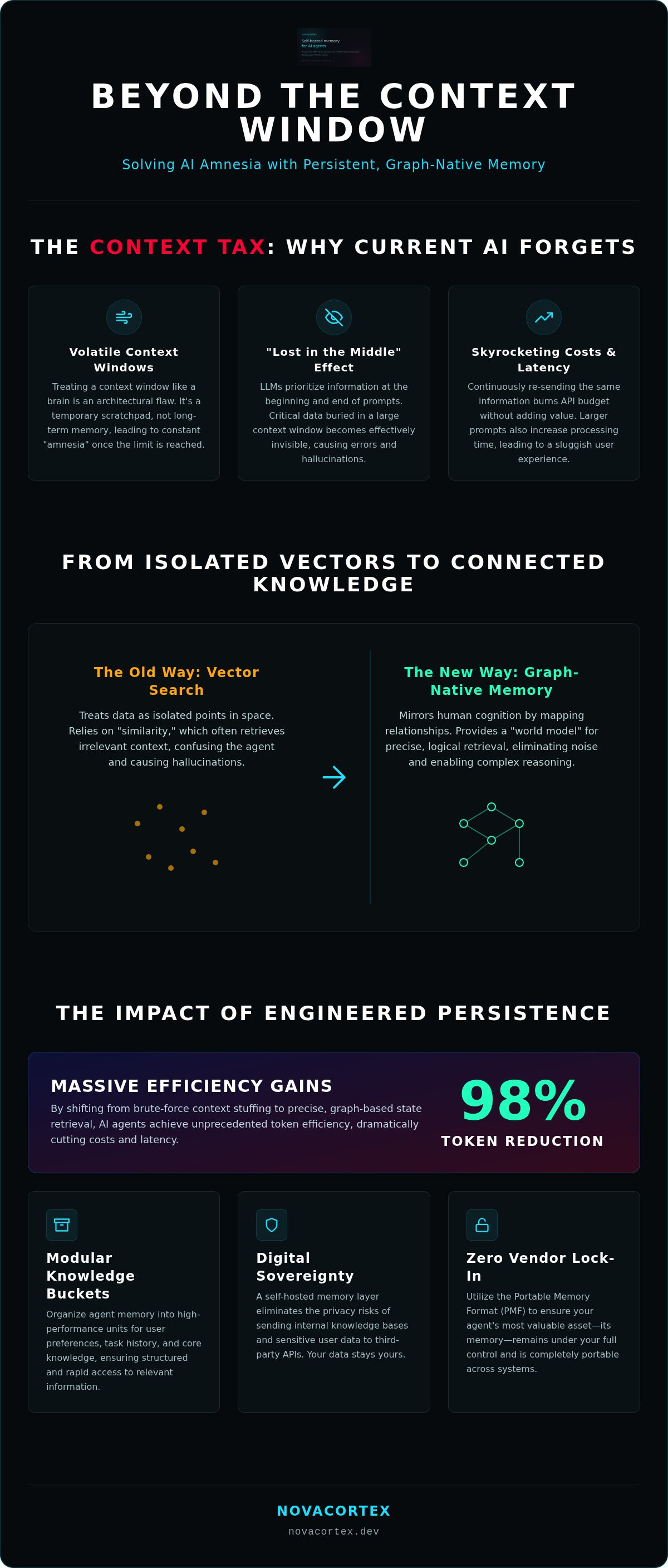
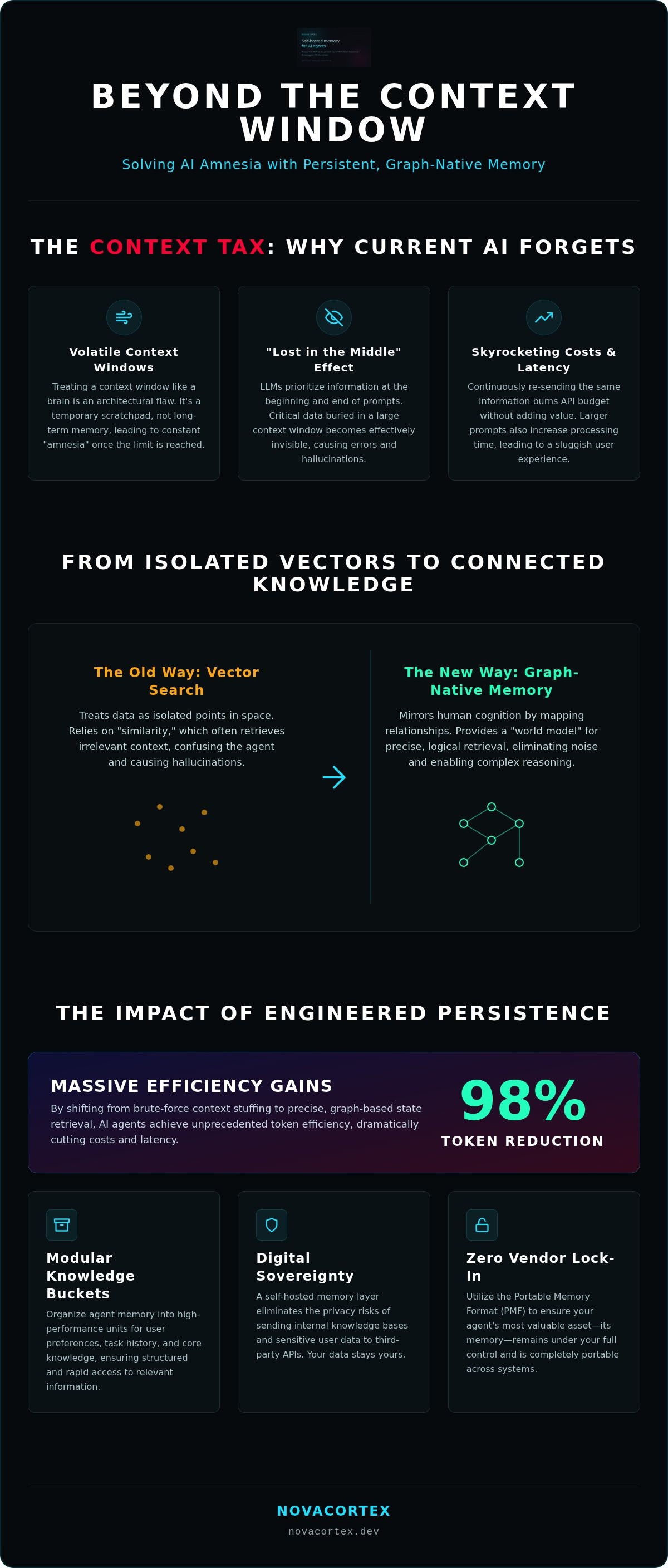
Context windows are a temporary workspace, not a storage solution. Developers often mistake a 128k or 1M token window for a persistent brain, but this is an architectural delusion. Appending chat history to every prompt is a brute-force tactic that fails as soon as agent complexity scales. This approach creates a "Context Tax" where you pay exponentially for the same information repeatedly. Understanding how to stop AI forgetting requires moving past the idea that "more tokens" equals "better memory."
There is a fundamental divide between short-term context and long-term memory. Short-term context is the active scratchpad used for immediate reasoning. Long-term memory is the persistent, structured state that survives across sessions. While older recurrent architectures relied on Long short-term memory (LSTM) to maintain sequence data, modern Transformers are stateless by design. They don't "remember" anything; they only process what is currently in the buffer. When that buffer fills up, the agent begins to lose its grip on reality.
This leads to the "Lost in the Middle" phenomenon. Research confirms that LLMs prioritize information at the extreme beginning and end of a prompt. Data buried in the middle of a massive context window is effectively invisible. If your agent relies on a bloated history file, it will eventually ignore the very instructions or facts that define its mission. Simple history appending is not a strategy. It's a recipe for hallucination.
The Architecture of Forgetting
Transformers treat tokens as transient signals. Once the forward pass is complete, the attention weights for those specific tokens vanish unless they are explicitly cached or stored. The computational overhead of attention mechanisms means that as the context window grows, the processing time and memory requirements spike. You aren't building a smarter agent by giving it a bigger window; you're just building a slower, more expensive one. Brute force cannot solve a structural data problem. How to stop AI forgetting is a question of storage architecture, not window size.
The Economic and Performance Toll
The financial cost of context dumping is a dead end for production-grade agents. Every interaction that re-sends a 50,000-word knowledge base burns through your API budget without adding new value. Latency also suffers. Larger prompts require more time for the model to "warm up" and compute attention, leading to sluggish response times that break user experience. Agent Amnesia is a failure of state persistence. If your agent cannot recall a user preference without re-reading the entire transcript, your architecture is fundamentally broken.
Beyond Vector Search: Why Graph-Native Memory is the Solution
Vector RAG is a retrieval mechanism, not a cognitive state. It treats data as isolated points in high-dimensional space, relying on mathematical proximity to find "related" content. This approach is a blunt instrument. It lacks the logical connective tissue required for complex reasoning. If you want to know how to stop AI forgetting, you have to move beyond simple similarity search and toward relational connectivity. Graph-native storage is the only way to preserve the "why" and "how" behind your agent's data.
The Limitations of Similarity Search
Semantic similarity is often a black box. A vector database might retrieve a chunk of text that sounds like your query but is factually irrelevant or logically disconnected. This happens because high-dimensional distance does not equal semantic truth. Traditional systems often pull in noise that confuses the agent. This is why the debate of Redis vs graph memory for AI agents is so critical for modern engineering. Key-value stores and standard vector databases lack the native ability to map complex dependencies between entities. They offer lookups, but they don't offer understanding.
Engineering Relational Context
Graph structures mirror the way human cognition actually works. We don't store facts as isolated strings; we store them as nodes in a web of associations. By mapping entity relationships, you provide your agent with a functional "world model." This allows for precise node retrieval instead of broad, wasteful chunks. When an agent can traverse a graph to find a specific relationship, it avoids the hallucinations caused by irrelevant context. Structured memory is the foundation of multi-step reasoning. It ensures the agent knows exactly how Fact A impacts Fact B.
A true Memory OS of AI Agent doesn't just find a document. It navigates a map of facts. This architectural shift allows for a 98% reduction in token usage because the agent only receives the precise data points it needs, rather than a "best guess" from a vector search. You're building a system that understands context through structure, not just probability. If you're ready to implement this architecture, you can explore the NovaCortex repository to see a graph-native memory server in action. It's a cleaner, faster, and more sovereign way to manage agent state.
Implementing Knowledge Buckets for Persistent Agent State
Engineering a practical solution for how to stop AI forgetting requires a modular approach to data storage. You cannot treat agent memory as a single, flat file or a massive, unorganized vector store. Instead, you must implement Knowledge Buckets. These are discrete, specialized units of storage that allow for surgical retrieval. By segmenting data into functional categories, you ensure the agent only accesses what is strictly necessary for the current task. This isn't just about storage; it's about active state management. It's the difference between a cluttered attic and a high-speed retrieval system.
We categorize memory into three primary tiers: User Preferences, Task History, and Core Knowledge. User Preferences store persistent traits like tone, preferred formats, and historical constraints. Task History tracks recent logic chains, tool outputs, and execution results. Core Knowledge contains the specialized domain data the agent was built to navigate. This structure moves us away from the question of whether an agent is just a chatbot and toward the research-backed inquiry: Is Agent Memory a Database? The answer is that it must function as a high-velocity, graph-native state machine that survives the lifecycle of a single prompt.
Modular State Management
Effective memory management follows a three-step pipeline. First, the system segments incoming data at the point of ingestion, routing it to the appropriate Knowledge Bucket. Second, the data is indexed using a graph-native memory layer to preserve relationships between entities. Third, the system dynamically injects only the necessary bucket into the LLM context. This selective injection is the primary mechanism for how to stop AI forgetting without overwhelming the model's attention. You don't need a larger context window; you need better filters.
Optimizing the Retrieval Loop
Low-latency context fetching is the benchmark for production-grade agents. By retrieving only the relevant Knowledge Bucket, you achieve a 98% reduction in token usage compared to standard RAG implementations. This precision prevents "Context Drift," a common failure where an agent loses focus because its prompt is cluttered with irrelevant history or redundant facts. For a deeper dive into the technical stack required for these systems, see our guide on AI agent long term memory. Persistent cognition is an infrastructure win, not a model feature. It's time to build memory that scales with your agent's complexity.
The Case for a Self-Hosted, Privacy-First Memory Layer
Digital sovereignty isn't a luxury; it's a technical requirement. If your agent's long-term memory lives on a third-party managed database, you don't own the agent's cognition. You've outsourced its brain to a vendor who can change their API, update their terms, or leak your data. Engineering a persistent state layer is fundamentally about control. If you are researching how to stop AI forgetting, you must first decide where that memory lives. Managed services are a security liability for sensitive knowledge bases. A self-hosted memory layer ensures that your proprietary data never leaves your Virtual Private Server (VPS).
Privacy-first RAG eliminates the risk of sending internal documentation to external inference providers. By keeping the memory server local to your agent's environment, you also strip away the latency of the public internet. Local retrieval is faster, more secure, and cheaper at scale. You aren't just protecting your data; you're optimizing the performance of the entire system. When the memory layer is on your own metal, you control the indexing, the retrieval logic, and the lifecycle of every node in your knowledge graph.
Ending Vendor Lock-in with PMF
The industry is currently plagued by proprietary storage formats that trap your data within specific ecosystems. This is where the Portable Memory Format for AI becomes essential. PMF allows you to export and import agent state across different LLM providers and hosting environments. It ensures that the memory you build today remains valid even if you switch models tomorrow. Interoperability is the only way to future-proof your architecture. By using a standardized format, you ensure that your agent's history and core knowledge remain a portable asset rather than a sunk cost.
Deploying on Private Infrastructure
Self-hosting agent memory is more accessible than most engineers realize. You can deploy a persistent memory layer on anything from a high-end Enterprise VPS to a localized edge device. Efficient memory management is even more critical now that hardware costs have shifted. For instance, the surge in DDR5 RAM prices in 2026, with some 32GB kits hitting $459, makes lean, graph-native storage a financial necessity. Utilizing MCP-native servers allows for standardized memory access across various tools and interfaces. To understand the full stack, explore our guide on The Self-Hosted AI Memory Layer. It's time to build memory that stays under your roof. How to stop AI forgetting starts with where you choose to store the truth.
Future-Proofing AI Memory with NovaCortex
NovaCortex isn't just another tool. It is the architectural correction to an industry currently drowning in token waste and transient state. By providing a unified, graph-native memory layer, NovaCortex establishes the standard for persistent agent cognition. It solves the fundamental problem of how to stop AI forgetting by replacing leaky context windows with a structured, durable brain. You get a 98% reduction in token costs, 100% data privacy, and 0% vendor lock-in. This is the infrastructure required for the next generation of autonomous systems. It's time to build agents that actually learn.
The MCP-native advantage ensures that your memory server integrates directly with your existing agentic workflows. There is no need for custom middleware or fragile API bridges. By utilizing the Model Context Protocol, NovaCortex allows agents to query their own long-term memory as easily as they execute a local tool. This seamless interoperability is why NovaCortex is the preferred choice for engineers who prioritize digital sovereignty. You own the code, you own the data, and you own the memory.
The NovaCortex Self-Hosted Advantage
We built NovaCortex on open-source foundations under the Apache-2.0 license. This ensures your architecture remains independent of any single provider's roadmap. The NovaCortex Self-Hosted Edition includes enterprise-grade management features designed for multi-user environments, allowing you to scale memory across entire teams without compromising security. Getting started is a matter of minutes. Deploy the server, initialize your Knowledge Buckets, and give your agents the ability to retain every interaction. How to stop AI forgetting is no longer a research question. It is a deployment step.
Architecting for 2026 and Beyond
The industry is shifting from simple chatbots to autonomous agents with deep, persistent memory. In this new era, structured memory is the absolute prerequisite for AGI-like performance. An agent without a world model is just a calculator; an agent with NovaCortex is a collaborator. We're moving toward a future where agents possess a continuous identity and an evolving knowledge base. Adopting a persistent context layer is no longer optional for production-grade engineering. Join the open-source memory revolution and start building systems that never lose their thread.
Engineering a Permanent Brain
Context windows are a temporary patch for a structural data problem. True intelligence requires a durable state machine. You've seen why graph-native memory outperforms vector search and how Knowledge Buckets organize agent cognition. By implementing an MCP-native architecture, you achieve a 98% reduction in context token usage while maintaining complete digital sovereignty. This isn't just about efficiency; it's about building agents that evolve with every interaction. Ephemeral signals are for toys; structured graphs are for tools.
Learning how to stop AI forgetting is the prerequisite for moving from simple chatbots to autonomous systems. Managed databases are a liability that compromises your privacy and locks you into bloated ecosystems. Apache-2.0 open-source infrastructure provides the only path toward a truly persistent AI brain. It's time to stop re-sending history and start engineering for long-term persistence. Reclaim your data and optimize your agentic stack for the demands of 2026.
The era of ephemeral AI is over. Build a system that remembers.
Frequently Asked Questions
What is the difference between RAG and persistent AI memory?
RAG is a retrieval mechanism; persistent memory is a cognitive state. Traditional RAG pulls document chunks based on mathematical similarity, which often lacks logical coherence. Persistent memory maintains a structured, graph-native world model that survives across sessions. This architectural shift is the fundamental method for how to stop AI forgetting in production environments. It moves beyond simple lookups to active state management.
How does a graph-native memory layer reduce token costs?
Graph-native memory reduces token usage by up to 98% because it retrieves specific nodes and relationships rather than broad text fragments. Vector search often forces you to inject large, irrelevant document chunks into the context window to find a single fact. By targeting only the relevant entities within a Knowledge Bucket, you keep the prompt lean and the reasoning focused. Precision eliminates the need for context dumping.
Can I use NovaCortex with existing LLMs like GPT-4 or Claude?
NovaCortex works with any LLM that supports tool calling or context injection. It functions as an external memory server, providing the model with relevant facts via a standardized interface. You can integrate it with GPT-4, Claude, or local models like Llama 3. This setup provides these models with a durable, long-term memory layer that persists indefinitely beyond the active session.
What is a Portable Memory Format (PMF)?
Portable Memory Format (PMF) is an open standard designed to ensure agent memory remains interoperable across different platforms. It prevents vendor lock-in by allowing you to export your knowledge graphs and re-import them into other systems. This format treats memory as a portable asset. It ensures your data isn't trapped in a proprietary managed database or a specific model provider's ecosystem.
Is self-hosting an AI memory layer difficult to maintain?
Maintaining the NovaCortex Self-Hosted Edition is straightforward for any engineer familiar with Docker or VPS management. The system is built on lean, graph-native storage, so it doesn't require the massive hardware overhead of a traditional enterprise vector database. It is designed to run efficiently on standard infrastructure. This provides a high-velocity memory layer with minimal operational friction and zero reliance on third-party uptime.
How does MCP-native integration improve agent performance?
MCP-native integration allows agents to access their memory server through a standardized protocol, which significantly reduces latency. By using the Model Context Protocol, the agent can treat its long-term memory as a local tool. This direct connection is a critical component in how to stop AI forgetting, as it streamlines the transport layer between storage and inference. It makes memory access feel like a native function.
Why is privacy a concern for AI agent memory?
Privacy is a concern because managed memory services require you to send sensitive knowledge bases to third-party APIs. This creates a massive security perimeter and a potential point of failure for proprietary data. A self-hosted memory layer ensures that your agent's history and internal documentation stay on your own metal. This approach provides 100% data sovereignty and eliminates the risk of sensitive data leaks.
Does NovaCortex support multi-agent memory synchronization?
NovaCortex supports multi-agent synchronization by serving as a centralized, graph-native source of truth. Multiple agents can read from and write to shared Knowledge Buckets, allowing them to maintain a consistent state during collaborative tasks. This shared memory architecture prevents information silos. It ensures that every agent in your stack operates with the same updated context, regardless of which agent performed the last action.
FAQ
What is the difference between RAG and persistent AI memory?
RAG is a retrieval mechanism; persistent memory is a cognitive state. Traditional RAG pulls document chunks based on mathematical similarity, which often lacks logical coherence. Persistent memory maintains a structured, graph-native world model that survives across sessions. This architectural shift is the fundamental method for how to stop AI forgetting in production environments. It moves beyond simple lookups to active state management.
How does a graph-native memory layer reduce token costs?
Graph-native memory reduces token usage by up to 98% because it retrieves specific nodes and relationships rather than broad text fragments. Vector search often forces you to inject large, irrelevant document chunks into the context window to find a single fact. By targeting only the relevant entities within a Knowledge Bucket, you keep the prompt lean and the reasoning focused. Precision eliminates the need for context dumping.
Can I use NovaCortex with existing LLMs like GPT-4 or Claude?
NovaCortex works with any LLM that supports tool calling or context injection. It functions as an external memory server, providing the model with relevant facts via a standardized interface. You can integrate it with GPT-4, Claude, or local models like Llama 3. This setup provides these models with a durable, long-term memory layer that persists indefinitely beyond the active session.
What is a Portable Memory Format (PMF)?
Portable Memory Format (PMF) is an open standard designed to ensure agent memory remains interoperable across different platforms. It prevents vendor lock-in by allowing you to export your knowledge graphs and re-import them into other systems. This format treats memory as a portable asset. It ensures your data isn't trapped in a proprietary managed database or a specific model provider's ecosystem.
Is self-hosting an AI memory layer difficult to maintain?
Maintaining the NovaCortex Self-Hosted Edition is straightforward for any engineer familiar with Docker or VPS management. The system is built on lean, graph-native storage, so it doesn't require the massive hardware overhead of a traditional enterprise vector database. It is designed to run efficiently on standard infrastructure. This provides a high-velocity memory layer with minimal operational friction and zero reliance on third-party uptime.
How does MCP-native integration improve agent performance?
MCP-native integration allows agents to access their memory server through a standardized protocol, which significantly reduces latency. By using the Model Context Protocol, the agent can treat its long-term memory as a local tool. This direct connection is a critical component in how to stop AI forgetting, as it streamlines the transport layer between storage and inference. It makes memory access feel like a native function.
Why is privacy a concern for AI agent memory?
Privacy is a concern because managed memory services require you to send sensitive knowledge bases to third-party APIs. This creates a massive security perimeter and a potential point of failure for proprietary data. A self-hosted memory layer ensures that your agent's history and internal documentation stay on your own metal. This approach provides 100% data sovereignty and eliminates the risk of sensitive data leaks.
Does NovaCortex support multi-agent memory synchronization?
NovaCortex supports multi-agent synchronization by serving as a centralized, graph-native source of truth. Multiple agents can read from and write to shared Knowledge Buckets, allowing them to maintain a consistent state during collaborative tasks. This shared memory architecture prevents information silos. It ensures that every agent in your stack operates with the same updated context, regardless of which agent performed the last action.