How to Stop AI Forgetting: Engineering Persistent Cognition for Agents

Your AI agent is suffering from digital dementia, and your skyrocketing API bill is the tax you pay for its amnesia. Most developers treat context window limitations as a law of physics. You've watched agents drift from their personas or ignore core instructions because the memory was nothing more than a bloated, volatile buffer of previous messages. This is an architectural failure. It forces a binary choice between intelligence and insolvency.
You need a way to move beyond these leaky buckets. This guide demonstrates how to stop AI forgetting by engineering a graph-native, self-hosted memory layer. We'll show you how to implement a system where agents retain state permanently without dumping your entire database into every prompt. You'll learn to use the NovaCortex Self-Hosted Edition and the Portable Memory Format (PMF) to slash token usage by over 90 percent. It's time to stop renting temporary context and start building permanent agent intelligence on your own infrastructure. We're moving from volatile prompts to persistent, sovereign cognition.
Key Takeaways
- Stop treating the context window as a storage solution. It is a volatile buffer designed for processing, not long-term retention.
- Learn how to stop AI forgetting by moving beyond simple vector similarity to relationship-aware, graph-native cognition.
- Slash API overhead by 98 percent. Externalizing agent state eliminates the need for expensive, repetitive knowledge dumping.
- Adopt MCP-native architecture to build interoperable agents that maintain state across different models and platforms.
- Ensure digital sovereignty with the Portable Memory Format (PMF). Own your agent's knowledge layer instead of renting it from managed providers.
The Architecture of Amnesia: Why AI Agents Forget
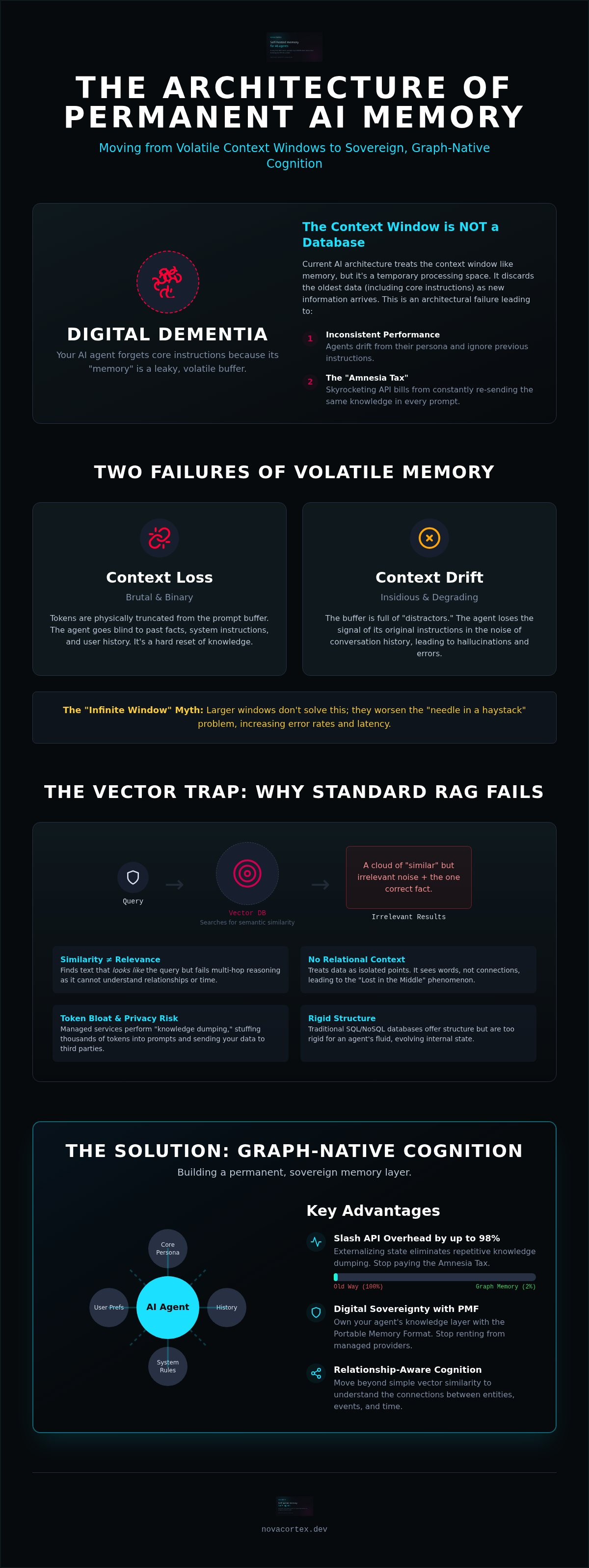
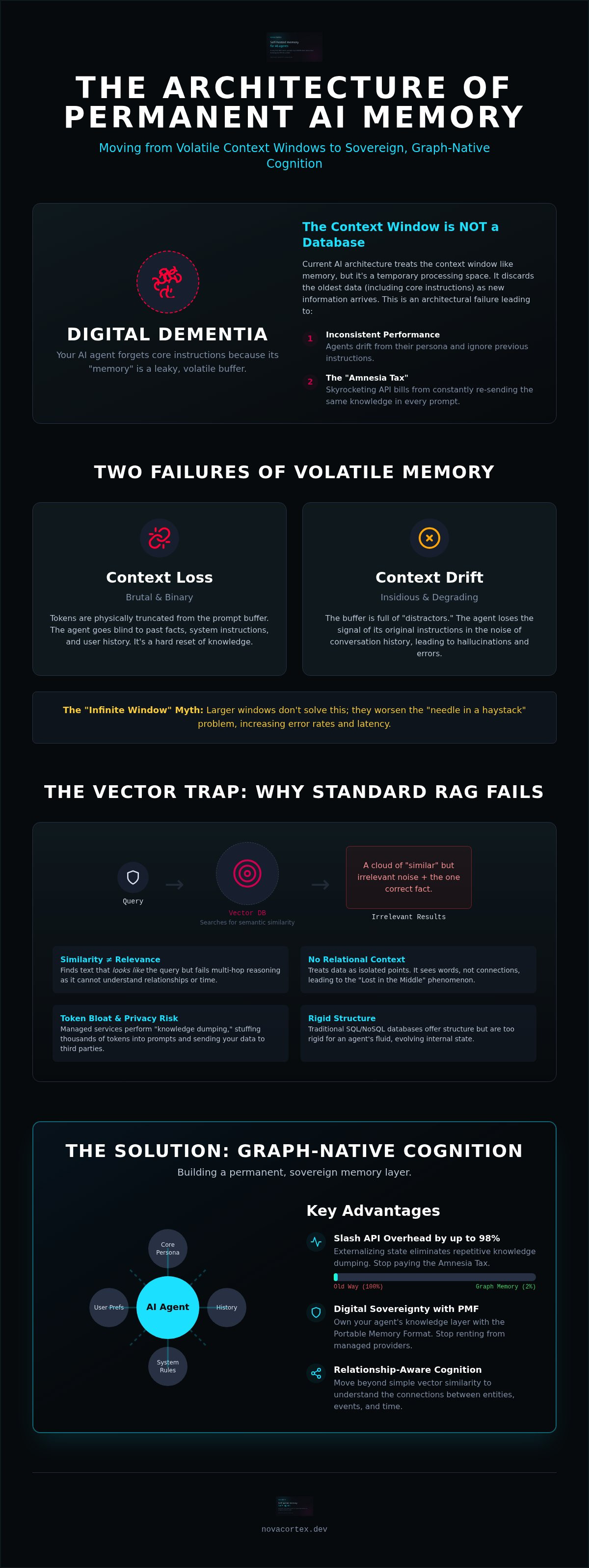
The context window is not a database. It is a volatile, short-term buffer. It discards information the moment the limit is reached. Current architectures rely on a First-In, First-Out (FIFO) stack. As new conversation turns enter the window, the oldest data is purged to make room for the new. This often includes the core system instructions or persona definitions that anchor the agent's behavior. When you search for how to stop AI forgetting, you are looking for a way to break this cycle of architectural amnesia.
This phenomenon is a specialized form of catastrophic interference. New information effectively overwrites the activation states of the model's immediate attention. The result is an agent that starts strong but collapses into a loop of hallucinations and repetitive errors. It is a failure of persistence, not a lack of intelligence.
Context Loss vs. Context Drift
Context loss is binary and brutal. It happens when tokens are physically truncated from the start of the buffer, leaving the agent blind to previous facts. Context drift is more insidious. It occurs when the buffer remains within limits, but the accumulation of distractors causes the model to lose the signal of its original instructions. Understanding how to stop AI forgetting requires moving beyond the myth of the "infinite window." Larger windows actually increase the "needle in a haystack" problem. They lead to higher error rates and degraded reasoning as the model struggles to prioritize relevant data over noisy conversation history.
The Economic Impact of Forgetful AI
Forgetfulness has a literal price tag. Every time an agent forgets a user's preference or a project's constraints, you pay an "Amnesia Tax." This involves re-sending the same massive knowledge blocks in every API call just to maintain consistency. It is a massive waste of resources. High-bandwidth memory (HBM) costs rose to 63 percent of total AI chip spending by late 2025. Wasting this capacity on redundant context is engineering malpractice. Bloated windows also introduce significant latency. They drag down agent responsiveness and inflate your operational costs. Context engineering is the management of information flow to ensure accuracy across infinite turns.
Why Standard RAG and Vector DBs Aren’t Enough
Many developers assume that adding a vector database solves the memory problem. It doesn't. Vector databases are search engines, not cognitive layers. They rely on semantic similarity, which is a blunt instrument for high-stakes reasoning. When you're figuring out how to stop AI forgetting, you'll quickly discover the "Vector Trap." Similarity search finds text that looks like the query, but it cannot understand the underlying logic or the temporal sequence of events.
Vector databases lack relational context. They treat data as isolated points in a high-dimensional space. They see words, but they don't see connections. This leads to the "Lost in the Middle" phenomenon. As your database grows, retrieval precision drops. The model gets overwhelmed by "similar" but irrelevant noise, causing it to ignore the actual needle in the haystack. Traditional SQL and NoSQL databases offer more structure, but they are too rigid. They can't adapt to the fluid, evolving nature of an agent's internal state.
The Limitations of Semantic Similarity
Similarity is not relevance. If an agent needs to answer "What did the lead engineer say about the API delay last month?", a vector search might return every document containing "lead engineer" or "API delay." It fails at multi-hop reasoning because it can't navigate the relationships between entities and time. Research into the Nested Learning paradigm suggests that models need better ways to integrate new information without forgetting the old, yet standard RAG architectures remain stuck in a flat, non-relational world. You need graph-native memory to map these complex attributes effectively.
Token Bloat in Managed RAG Services
Managed RAG services often hide their inefficiency through "knowledge dumping." They retrieve massive chunks of text and shove them into the prompt. This wastes thousands of tokens per turn and creates a massive privacy risk. You're effectively sending your entire knowledge base to a third-party provider every time an agent needs a single fact. This is why many engineers are moving toward more efficient architectures. You can compare the efficiency of different stacks in our guide on Redis vs graph memory for AI agents: engineering token-efficient context. For those building local-first systems, you can explore our open-source memory server to see how to handle state without the managed service tax.
Engineering Persistent Context: The Graph-Native Approach
The industry obsession with prompt engineering is a distraction from the real architectural fix. If you want to know how to stop AI forgetting, you must stop thinking in blocks of text and start thinking in knowledge structures. Graph-native storage transforms agent memory from a flat list of strings into an interconnected web of nodes and edges. Each node represents a specific entity or concept, while the edges define the logical relationships between them. This mirrors human cognitive mapping far more effectively than a simple vector list ever could.
By externalizing memory into a graph, agents move from searching for similar words to traversing actual logic paths. This architectural shift addresses the core issue of What is Catastrophic Forgetting? by ensuring new information doesn't simply overwrite the old. Instead, it integrates into an existing network of intelligence. You aren't just retrieving text; you're activating a specific knowledge structure that persists across every session.
Mapping Agent Cognition with Knowledge Buckets
We organize persistent memory using Knowledge Buckets. These are modular containers that allow for granular control over different types of agent state. Instead of one giant context dump, you segment data into buckets for user preferences, project-specific history, and global facts. This isolation prevents cross-contamination and ensures the agent retrieves only what is relevant to the current task. You can explore the deeper architecture of AI agent long term memory: engineering persistent cognition in 2026 to see how this segmentation scales in production environments. It turns memory from a liability into a structured asset.
98% Token Reduction: The Efficiency of Precision Retrieval
Standard RAG systems are inherently wasteful. They retrieve entire paragraphs or chunks of text, most of which is filler that clogs the context window and inflates costs. Graph-native memory allows for precision retrieval of specific nodes. NovaCortex enables agents to pull the exact relationship needed for a query without the surrounding noise. Our benchmarks demonstrate that this precision leads to a 98 percent reduction in token usage compared to traditional knowledge dumping. Graph-native memory eliminates the need to dump entire documents into the context window. This efficiency directly impacts both cost and latency, making high-performance agents viable on local, self-hosted infrastructure.
Technical Strategies to Implement AI Memory
Implementing a memory server isn't just about storage. It's about decoupling cognition from the inference engine. Most ranking content suggests re-summarization as a fix for how to stop AI forgetting. This is a mistake. Summarization is lossy. It introduces recursive errors that degrade the agent's logic over time. Instead, you must externalize state management to a dedicated memory layer that persists regardless of the session context.
The technical implementation follows a clear hierarchy. First, externalize state management from the LLM to a dedicated memory server. Second, implement the Model Context Protocol (MCP) to ensure interoperability across different models. Third, adopt a Portable Memory Format (PMF) to maintain data ownership and avoid vendor lock-in. This format allows you to move your agent's cognitive history between different hosting environments without losing the complex graph relationships. Fourth, deploy this stack on private infrastructure like a VPS or Raspberry Pi for maximum data sovereignty. Finally, configure automated memory pruning and consolidation. This isn't just about deleting old data. It is a process of semantic merging where the system identifies redundant nodes and consolidates them into a single, high-fidelity knowledge structure.
The Power of MCP-Native Memory Servers
The Model Context Protocol (MCP) is the emerging standard for AI context management. It provides a universal interface for agents to interact with external data sources. By using an MCP native memory server: engineering persistent context for AI agents, you build vendor-neutral systems. Your agent isn't locked into a specific LLM provider. If a better model drops tomorrow, your agent keeps its memory and simply points to the new inference endpoint. This interoperability is foundational for agents that need to survive the rapid lifecycle of modern AI models. You own the cognition; the LLM just provides the reasoning.
Self-Hosting for Privacy and Performance
Real digital sovereignty requires self-hosting. Managed memory services are a privacy nightmare. They force you to send your entire cognitive history to a third-party cloud, creating a massive security liability. Deploying the self-hosted AI memory layer: engineering persistent cognition on your own VPS or local server keeps your data under your control. This also slashes network latency. By keeping the memory layer physically close to the compute, you ensure that retrieval doesn't become a bottleneck for agent responsiveness. It's the only way to build high-velocity, private agents that actually remember every detail of their user's history without asking for permission from a big-tech gatekeeper.
NovaCortex: The Sovereign Memory Layer for AI Agents
NovaCortex is the architectural correction to the industry's reliance on volatile context. It provides a specialized, graph-native engine designed for one purpose: persistent agent intelligence. When you implement NovaCortex Self-Hosted Edition, you are no longer asking how to stop AI forgetting. You are actively engineering a system where memory is a permanent, queryable asset rather than a temporary buffer. This isn't a managed "black box" service where your data is trapped in a provider's ecosystem. It's a sovereign layer that you control entirely.
Deploy anywhere. NovaCortex is designed for flexibility, running efficiently on everything from enterprise-grade VPS clusters to a Raspberry Pi. This versatility ensures that your agent's cognition stays close to its compute, reducing latency and maintaining privacy. By utilizing an open-source framework under the Apache-2.0 license, we ensure that the foundation of your agent's memory is transparent and auditable. You don't have to trust a vendor with your most sensitive cognitive data; you just have to trust your own infrastructure.
Achieving 98% Token Efficiency with NovaCortex
Real-world benchmarks prove the superiority of this approach. Standard RAG systems suffer from massive context bloat, often retrieving thousands of irrelevant tokens for a single query. NovaCortex uses graph-native precision to achieve a 98 percent reduction in token usage compared to traditional knowledge dumping. We utilize Knowledge Buckets to segment memory into logical containers. This prevents context drift, especially in complex multi-agent workflows where agents must share specific states without inheriting unrelated noise. Our builder-to-builder philosophy means we skip the marketing fluff. We focus on high-velocity performance and engineering excellence that scales with your agent's growth.
Ending Vendor Lock-in with PMF
Your agent's memory is its most valuable asset. It should be as portable as your source code. Most providers lock you into proprietary storage formats, making it impossible to move your agent's history to a new model or host. We solve this with the Portable Memory Format (PMF). This open standard ensures that your graph-native knowledge structures remain interoperable. You can learn more about how we are using the Portable memory format for AI: breaking the vendor lock-in cycle to understand how this protects your long-term cognitive investments. Don't rent your agent's intelligence when you can own the infrastructure.
Deploy NovaCortex Self-Hosted Edition today
Engineering Sovereign Cognitive Persistence
The transition from volatile context windows to persistent cognition is an architectural necessity. You've seen why relying on standard RAG and vector similarity search leads to a dead end of amnesia and ballooning costs. By implementing a graph-native memory layer, you ensure your agents maintain state across infinite sessions without the risk of context drift. This is how to stop AI forgetting while maintaining full control over your data.
NovaCortex provides the tools to build this reality today. Our graph-native storage allows for high-precision retrieval that reduces token usage by up to 98 percent compared to traditional knowledge dumping. Because the system is open source under an Apache-2.0 license, you retain total digital sovereignty over your agent's knowledge. You aren't just building a bot; you're engineering a permanent cognitive asset on your own infrastructure.
It's time to stop renting temporary intelligence and start owning your agent's memory. The future of autonomous systems belongs to those who build for persistence. Start deploying today and give your agents the memory they deserve.
Frequently Asked Questions
How does an external memory layer stop AI from forgetting?
An external memory layer decouples knowledge from the volatile context window. Instead of relying on a short-term buffer that purges data once full, the agent queries a persistent database for relevant facts. This is how to stop AI forgetting by ensuring core instructions and user history remain accessible across every session. It transforms temporary prompts into a permanent cognitive asset stored on your own sovereign infrastructure.
Is a graph-native memory better than a vector database for AI agents?
Graph-native memory is superior because it understands relationships, not just word similarity. Vector databases find text that looks like your query but often fail at complex reasoning. Graph-native memory maps entities as nodes and connections as edges. This allows agents to navigate logic paths and temporal sequences that flat vector lists miss. It provides the relational context necessary for high-stakes, multi-step agent workflows.
What is the Model Context Protocol (MCP) and why does it matter for memory?
MCP is a universal interface that standardizes how agents interact with external data sources. It matters because it prevents vendor lock-in. An MCP-Native Memory Server allows your agent to maintain its cognitive history while switching between different LLM providers. You own the context layer. The model becomes a replaceable reasoning engine while your agent's memory remains sovereign and interoperable across the entire AI ecosystem.
Can I self-host my AI memory layer on a Raspberry Pi?
You can. NovaCortex Self-Hosted Edition is engineered for lean, high-velocity performance on local hardware. Deploying on a Raspberry Pi or a private VPS keeps your data physically close to your compute. This setup slashes network latency and ensures that your agent's cognitive history never leaves your control. It is a pragmatic choice for builders prioritizing privacy, independence, and hardware efficiency.
How does NovaCortex reduce token usage by 98%?
It replaces massive "knowledge dumping" with precision retrieval. Standard RAG systems shove entire documents into the prompt, wasting thousands of tokens per turn. NovaCortex uses graph-native precision to pull only the specific nodes and relationships required for the query. This efficiency allows you to maintain deep context without the bloated API bills or the latency penalties associated with traditional context window management.
What happens to the AI context window when I use an external memory server?
The context window becomes a focused workspace rather than a storage bin. Instead of filling the buffer with repetitive history, you use it only for the current task's active reasoning. The external memory server feeds the agent precise data as needed. This prevents context drift. It ensures the model follows core instructions more accurately because the signal-to-noise ratio remains high throughout the conversation.
Is the Portable Memory Format (PMF) compatible with different LLMs?
It is. PMF is an open standard designed specifically for cross-platform interoperability. It ensures your agent's memory is as portable as your source code. You can move your graph-native knowledge structures between different models and hosting environments without losing the complex relationships you've built. It treats memory as a sovereign asset rather than a proprietary byproduct of a specific LLM provider's ecosystem.
Why is data sovereignty important for AI agent memory?
Memory contains your most sensitive operational data and user history. Renting this intelligence from a managed cloud provider creates a massive security liability and inevitable vendor lock-in. Data sovereignty ensures you own the knowledge your agents generate. By using NovaCortex, you keep your cognitive layer on private infrastructure. This protects your intellectual property and ensures your agents remain functional even if a third-party provider changes its terms.
FAQ
How does an external memory layer stop AI from forgetting?
An external memory layer decouples knowledge from the volatile context window. Instead of relying on a short-term buffer that purges data once full, the agent queries a persistent database for relevant facts. This is how to stop AI forgetting by ensuring core instructions and user history remain accessible across every session. It transforms temporary prompts into a permanent cognitive asset stored on your own sovereign infrastructure.
Is a graph-native memory better than a vector database for AI agents?
Graph-native memory is superior because it understands relationships, not just word similarity. Vector databases find text that looks like your query but often fail at complex reasoning. Graph-native memory maps entities as nodes and connections as edges. This allows agents to navigate logic paths and temporal sequences that flat vector lists miss. It provides the relational context necessary for high-stakes, multi-step agent workflows.
What is the Model Context Protocol (MCP) and why does it matter for memory?
MCP is a universal interface that standardizes how agents interact with external data sources. It matters because it prevents vendor lock-in. An MCP-Native Memory Server allows your agent to maintain its cognitive history while switching between different LLM providers. You own the context layer. The model becomes a replaceable reasoning engine while your agent's memory remains sovereign and interoperable across the entire AI ecosystem.
Can I self-host my AI memory layer on a Raspberry Pi?
You can. NovaCortex Self-Hosted Edition is engineered for lean, high-velocity performance on local hardware. Deploying on a Raspberry Pi or a private VPS keeps your data physically close to your compute. This setup slashes network latency and ensures that your agent's cognitive history never leaves your control. It is a pragmatic choice for builders prioritizing privacy, independence, and hardware efficiency.
How does NovaCortex reduce token usage by 98%?
It replaces massive "knowledge dumping" with precision retrieval. Standard RAG systems shove entire documents into the prompt, wasting thousands of tokens per turn. NovaCortex uses graph-native precision to pull only the specific nodes and relationships required for the query. This efficiency allows you to maintain deep context without the bloated API bills or the latency penalties associated with traditional context window management.
What happens to the AI context window when I use an external memory server?
The context window becomes a focused workspace rather than a storage bin. Instead of filling the buffer with repetitive history, you use it only for the current task's active reasoning. The external memory server feeds the agent precise data as needed. This prevents context drift. It ensures the model follows core instructions more accurately because the signal-to-noise ratio remains high throughout the conversation.
Is the Portable Memory Format (PMF) compatible with different LLMs?
It is. PMF is an open standard designed specifically for cross-platform interoperability. It ensures your agent's memory is as portable as your source code. You can move your graph-native knowledge structures between different models and hosting environments without losing the complex relationships you've built. It treats memory as a sovereign asset rather than a proprietary byproduct of a specific LLM provider's ecosystem.
Why is data sovereignty important for AI agent memory?
Memory contains your most sensitive operational data and user history. Renting this intelligence from a managed cloud provider creates a massive security liability and inevitable vendor lock-in. Data sovereignty ensures you own the knowledge your agents generate. By using NovaCortex, you keep your cognitive layer on private infrastructure. This protects your intellectual property and ensures your agents remain functional even if a third-party provider changes its terms.