LangChain Memory vs Graph Memory: Engineering Persistent AI Cognition

Dumping your entire conversation history into an LLM prompt isn't memory. It's architectural waste. You've likely felt the sting of escalating token costs or watched an agent lose the thread of a critical session because its context window reached its limit. When evaluating LangChain memory vs graph memory, the decision defines your agent's cognitive ceiling. Linear message buffers are a prototype-stage crutch. Production-grade systems require a graph-native approach to achieve persistent cognition without the bloat.
We agree that the current standard of "forgetting" after a few thousand tokens is unacceptable for serious engineering. This article decodes the structural differences between simple message history and graph-native knowledge storage. You'll learn how to build agents that maintain high recall precision while slashing token usage by up to 98%. We provide a clear decision framework for memory architecture; we move from basic LangGraph checkpointers to self-hosted, portable memory formats that ensure data sovereignty and eliminate vendor lock-in.
Key Takeaways
- Understand the structural divide in LangChain memory vs graph memory to transition from fragile session states to a permanent, relational knowledge base.
- Eliminate the "token tax" by replacing bloated message histories with selective graph traversal. This architecture reduces overhead by up to 98% in production environments.
- Discover why relationship-based Graph RAG outperforms distance-based vector search. It effectively solves the "lost in the middle" retrieval problem that plagues standard vector databases.
- Implement a self-hosted memory layer to maintain digital sovereignty. Use portable formats to ensure your agent's cognition remains independent of specific cloud vendors.
- Deploy a precise decision framework to choose the right memory architecture. Build agents capable of high-recall precision across long-running conversational threads.
Beyond Message Buffers: Defining LangChain Memory vs Graph Memory
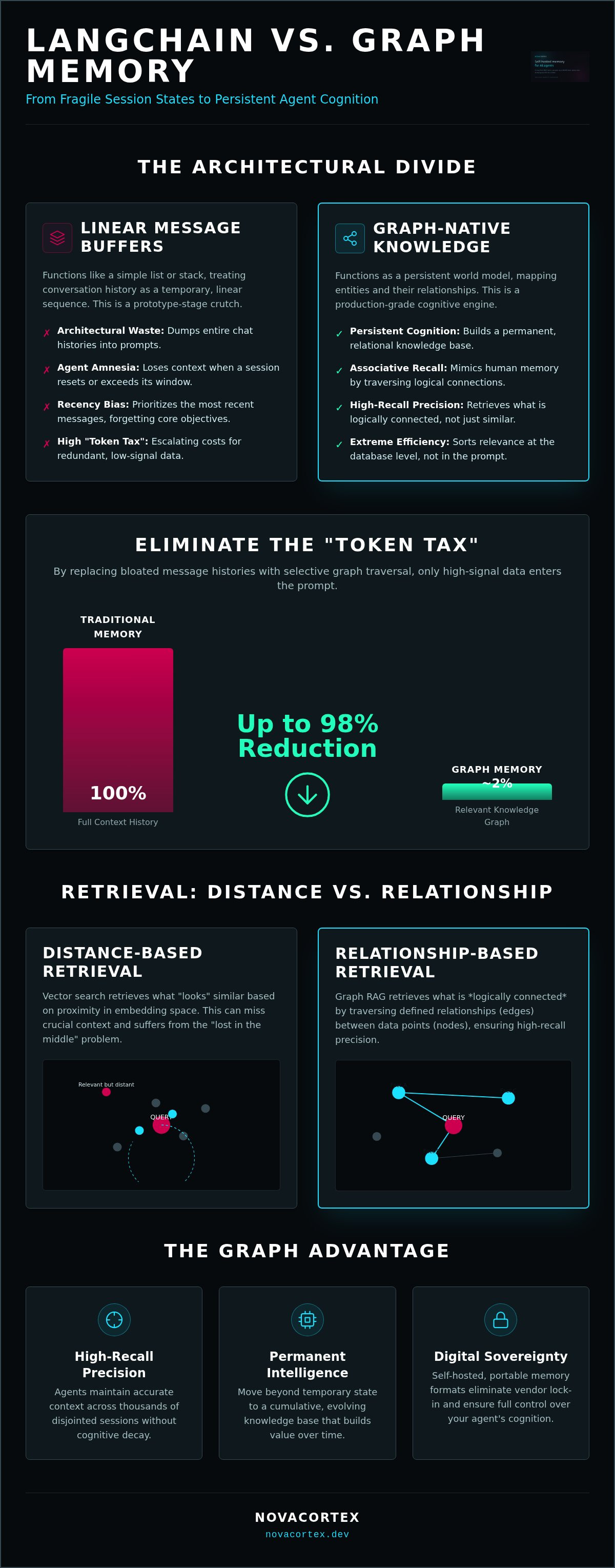
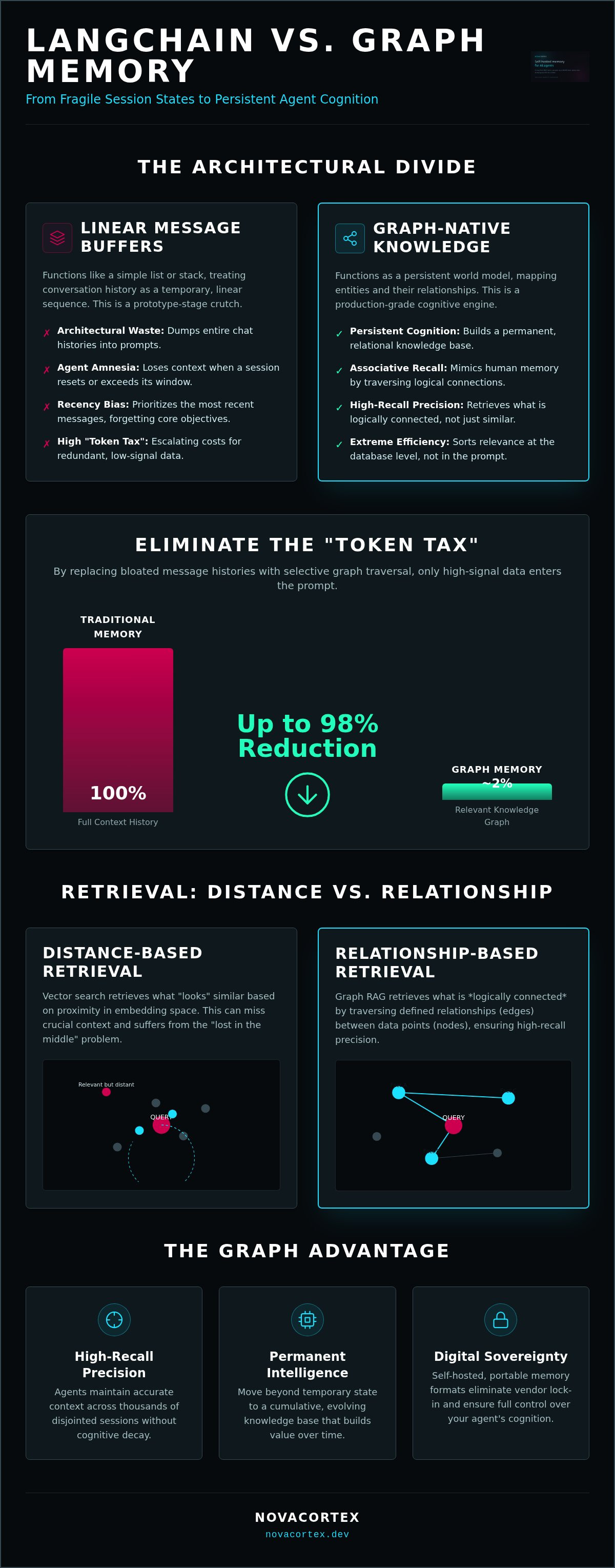
Traditional AI development treats memory like a stack. You push messages in. You pop them out. Eventually, the stack overflows. This is the fundamental divide in LangChain memory vs graph memory. LangChain memory acts as a framework-level abstraction. It manages state within a specific execution thread. It is essentially a list. Graph memory is a structural representation of knowledge. It maps entities and their relationships. It is a network. This shift from short-term threads to long-term cognition requires an architectural pivot. You can't solve persistent memory by simply increasing context windows. That is an expensive, brute-force solution to a structural problem.
Engineering persistent cognition isn't about storage capacity. It's about retrieval logic. Linear buffers force the LLM to do the heavy lifting of sorting through noise. Graph memory does the sorting at the database level. This reduces the cognitive load on the model. It ensures that only relevant, high-signal data enters the prompt. You need a system that categorizes, links, and prunes data autonomously to maintain performance at scale.
The Limitations of Thread-Scoped Memory
Standard implementations like ConversationBufferMemory are built for ephemeral interactions. They function by appending every interaction to a linear message history. As your context window grows, this approach becomes a liability. You pay a heavy token tax for every redundant greeting and filler sentence. Recency bias is a natural byproduct of this linear structure. The agent prioritizes the most recent messages while losing track of core objectives established earlier in the session. This architectural flaw results in "agent amnesia." When a thread resets, your agent loses its history. It is a clean slate that drains resources without building cumulative value.
Graph Memory: The Knowledge Engine
Graph memory functions as a persistent world model. It moves beyond raw text storage by extracting entities and predicates to construct a Knowledge Graph. This methodology mimics human associative memory. When an agent recalls a specific fact, it doesn't just calculate vector distance. It traverses logical relationships between nodes. This is why graph memory is the logical successor to standard RAG. Vector search is often imprecise; it retrieves what "looks" similar. Graph memory retrieves what is logically connected. It provides the high recall precision necessary for agents that must operate across thousands of disjointed sessions without losing their cognitive edge. The choice between LangChain memory vs graph memory is ultimately a choice between temporary state and permanent intelligence.
LangChain’s Architectural Approach: Short-Term State and Long-Term Stores
LangChain doesn't store data; it orchestrates it. Its memory architecture is a patchwork of framework-level abstractions that delegate persistence to external infrastructure. When comparing LangChain memory vs graph memory, you must distinguish between managing a conversation's state and managing an agent's knowledge. LangChain excels at the former but often struggles with the latter without significant custom engineering. You're left managing the plumbing of PostgreSQL or Redis instead of refining the agent's cognition.
LangGraph Checkpointers and Thread State
LangGraph manages short-term memory through a checkpointer system. This mechanism snapshots the agent's state at every node in the graph. It persists this data to a database, allowing a session to resume at any time. While effective for thread persistence, this method carries a high serialization cost. Every interaction requires saving and loading large state objects. In complex, multi-agent environments, this overhead scales poorly. You aren't just storing facts. You're storing the entire operational context. This leads to bloated databases where critical knowledge is buried under layers of transient execution data. If a thread resumes after a long delay, the agent must parse through this serialized ghost of previous logic. This often results in latency spikes and increased compute costs.
The LangChain Long-Term Store Interface
To address persistence across different user sessions, LangChain utilizes the Store interface. This acts as the bridge to long-term memory. However, it remains primarily a key-value or semantic search implementation. It lacks the relational depth of a native graph. You can retrieve a document based on embedding similarity, but you can't easily traverse the logical connections between disparate pieces of information. This is a common bottleneck highlighted in this academic paper on LangChain and knowledge graphs, which examines the friction of mapping framework-bound state to structured knowledge models.
Framework-bound stores also create a subtle form of vendor lock-in. Your agent's cognition becomes inseparable from the specific database drivers and serialization formats of the framework. This makes it difficult to migrate your knowledge base or maintain true data sovereignty. For developers seeking a more robust, independent solution, starting with an open-source, graph-native memory layer offers a path toward architectural independence. Managing state is a framework problem; managing knowledge is a data problem. Confusing the two is the fastest way to build a system that is both expensive and forgetful.
The Graph Advantage: Why Relational Context Beats Vector Search
Vector search is a blunt instrument. It relies on mathematical proximity in a high-dimensional space. Distance-based retrieval assumes that because two text chunks are semantically close, they are contextually relevant. This assumption fails in complex logic. In the debate of LangChain memory vs graph memory, the winner is determined by how you handle relationships. Graph RAG (Retrieval-Augmented Generation) uses explicit logical connections. It doesn't just find similar words; it follows the path of a specific entity. It understands how a user, a project, and a specific technical constraint are linked. Vector search only knows they are in the same neighborhood.
Standard vector retrieval often triggers the "lost in the middle" phenomenon. When you dump ten retrieved chunks into a prompt, the LLM prioritizes the beginning and the end. The critical context in the middle is ignored. Graph traversal solves this by identifying the non-obvious connections that vector search misses. It identifies the shortest path between nodes of information. This precision allows you to provide the agent with a surgical context rather than a thematic dump. You get better recall with fewer tokens. It's the difference between handing an agent a map and handing it a stack of unrelated photos.
Beyond Semantic Similarity
Similarity is not relevance. You can have two vectors that are mathematically adjacent but logically unrelated for a specific task. Graphs provide explicit reasoning paths. According to The Alan Turing Institute on Knowledge Graphs, these structures are critical for adding context and facilitating explainability in AI. They allow for multi-hop queries where an agent must link disparate facts across different documents to reach a conclusion. Vector search requires multiple round trips or complex re-ranking to achieve what a single graph traversal does in milliseconds. It turns a probabilistic search into a deterministic retrieval.
Structured Memory for Autonomous Agents
Autonomous agents need more than a list of past messages. They need a world model. Managing an agent's "state of mind" requires structured memory that persists across threads. This is where graph-native AI storage becomes essential. It provides a relational backbone that prevents data fragmentation. When agents operate in a multi-agent system, they must synchronize their knowledge. Instead of agents shouting into a shared vector index and retrieving noisy results, they read from a unified knowledge base. This ensures that every agent in the stack has a consistent, structured view of the truth. Precision beats volume. Every time.
Engineering Token Efficiency: Reducing Context Bloat via Graph Traversal
Every irrelevant message in a linear buffer is a micro-transaction draining your budget. In the LangChain memory vs graph memory debate, efficiency is the primary metric for production readiness. Linear history is a lazy engineering choice. It forces the LLM to process noise, increasing latency and cost. Engineering persistent cognition isn't just a technical achievement; it's a financial necessity. You must move from dumping data to traversing logic.
The Cost of Dumping Knowledge Bases
Sending irrelevant history to an LLM is like paying for a full-page ad to print a single phone number. This "Token Tax" accumulates rapidly in long-running sessions. When you compare standard RAG to graph-native retrieval, the ROI becomes clear. Benchmarks show that reducing AI agent token usage by up to 98% is achievable through selective graph traversal. This isn't just about saving money. It's about scale. By pruning dead context and only retrieving the minimum necessary entities, you keep the context window lean. High-performance agents don't need the whole book; they need the right page. Reducing AI agent token usage allows you to maintain high recall precision without the architectural waste of raw context dumping.
Context Optimization Techniques
Effective memory management requires a tiered approach. Short-term state handles the immediate conversation flow, while a long-term graph manages persistent knowledge. We utilize Knowledge Buckets to organize these data points into modular, retrievable units. This prevents context window saturation. Instead of a flat list of messages, the agent queries the graph for specific relationships. This identifies the most relevant context across disjointed sessions. Token-efficient context is defined as the ratio of relevant entities to total tokens consumed. This metric should guide your architectural decisions as you move away from bloated framework abstractions toward lean, graph-native systems.
Implementing NovaCortex: A Self-Hosted, Graph-Native Memory Layer
Frameworks like LangChain provide the interface. NovaCortex provides the engine. While LangChain simplifies the orchestration of agentic workflows, it leaves the heavy lifting of production-grade memory to the developer. This is where the choice between LangChain memory vs graph memory becomes an implementation reality. NovaCortex acts as the bridge. It combines framework ease with the efficiency of a graph-native architecture. You don't have to choose between developer velocity and system performance. You can have both by decoupling the memory layer from the application logic.
Implementing a MCP native memory server ensures that your agents remain interoperable. This architecture utilizes the Model Context Protocol to provide a standardized way for agents to read and write to their knowledge base. It eliminates the friction of custom database drivers. It turns memory into a first-class citizen of your AI stack. This is the necessary correction to the fragmented state of current AI engineering.
Digital Sovereignty and Privacy-First Memory
Enterprise AI demands local control. Cloud-based vector databases are black boxes; they offer convenience at the cost of data sovereignty. A self-hosted AI memory layer allows you to maintain absolute authority over your agent's cognition. You can deploy NovaCortex on a private VPS or even a Raspberry Pi. This ensures that sensitive relational data never leaves your infrastructure. Privacy isn't a feature; it's a foundation. By hosting your own graph memory, you avoid the security risks and latency of managed cloud services. You own the nodes. You own the edges. You own the intelligence.
Future-Proofing with Portable Memory
Vendor lock-in is the enemy of innovation. If your agent's memory is trapped in a proprietary framework format, you're building on borrowed time. The portable memory format for AI (PMF) solves this by ensuring long-term data utility. PMF allows you to export and migrate your knowledge base across different models and frameworks without losing the rich relational context you've built. It makes your AI stack framework-agnostic.
Integrating NovaCortex with existing LangChain and LangGraph workflows is straightforward. It replaces the standard, bloated message buffers with a lean, graph-native alternative. Your agents gain persistent cognition that survives thread resets and model migrations. This isn't just about building a better agent today. It's about ensuring your data remains valuable and accessible as the AI landscape evolves. Stop building ephemeral prototypes. Start engineering persistent intelligence.
Master Persistent Agent Cognition
Linear history is an engineering dead end. The architectural debate of LangChain memory vs graph memory isn't just about framework preference; it's about the cognitive ceiling of your agents. You've seen how graph-native storage enables associative recall that vector search simply cannot match. By moving to a relational model, you eliminate the "lost in the middle" problem and ensure your agents maintain a consistent world model across thousands of threads. This transition is the difference between a prototype that forgets and a production system that learns.
Efficiency is the ultimate validator. Shifting to a self-hosted, graph-native layer allows you to reduce token usage by up to 98%. This isn't just about cost; it's about building lean, high-velocity systems that respect data sovereignty. With the Portable Memory Format, you ensure zero vendor lock-in and keep your knowledge base framework-agnostic. It's time to stop managing transient state and start engineering permanent intelligence. Build on infrastructure that scales with your logic, not your invoice.
Build the future of persistent AI on your own terms. Your agents deserve a memory that never fades and a knowledge base that stays under your control.
Frequently Asked Questions
What is the main difference between LangChain memory and graph memory?
LangChain memory is a framework abstraction that manages linear message history as a simple stack. Graph memory is a structural data model that maps entities and relationships as a network. While LangChain focuses on thread-specific state, graph memory builds a persistent world model. This architectural shift is the core of the LangChain memory vs graph memory comparison. It moves your agent from short-term buffers to long-term associative cognition.
How does graph memory reduce LLM token costs?
Graph memory slashes costs by replacing brute-force context dumping with selective retrieval. Instead of sending the entire conversation history, the system traverses the graph to identify the minimum necessary context. This precision can reduce token usage by up to 98% in production environments. You stop paying for redundant greetings and filler text. You only pay for high-signal entities and logical relationships that directly answer the current prompt.
Can I use NovaCortex with existing LangChain agents?
Yes. NovaCortex is designed to integrate with standard LangChain and LangGraph workflows. It functions as an external memory layer that replaces or augments built-in stores. Because it is an MCP-native memory server, it provides a standardized interface for your agents to read and write knowledge. You keep your existing agent logic while upgrading the underlying storage to a graph-native format that prevents architectural bloat and state fragmentation.
Is graph memory more complex to set up than a vector database?
Implementation requires a shift in how you model data, but the operational complexity is comparable. Vector databases require managing embeddings and distance metrics. Graph memory requires defining entities and predicates. While initial schema design takes more thought, the long-term maintenance is lower. You avoid the "black box" issues of vector search. NovaCortex simplifies this by providing a self-hosted environment that handles the graph-native storage logic for you.
What is the "Token Tax" in AI agent development?
The Token Tax is the cumulative cost of sending irrelevant or redundant history to the LLM. Every filler word and repeated instruction in a linear buffer is a micro-transaction. Over thousands of interactions, this waste becomes a significant financial liability. It also degrades performance by saturating the context window. High-performance agents avoid this tax by using graph traversal to provide surgical context rather than thematic dumps of unstructured text.
Why is self-hosting my AI memory layer important for data privacy?
Self-hosting ensures absolute data sovereignty over your agent's knowledge base. Managed cloud vector services are often black boxes where your data resides on third-party infrastructure. By deploying the NovaCortex Self-Hosted Edition, you keep sensitive relational data on your own VPS or hardware. This prevents vendor access and ensures compliance with strict privacy requirements. Your agent's cognition remains your property, independent of external cloud providers or proprietary frameworks.
Does graph memory work for unstructured data?
Graph memory excels at turning unstructured data into structured knowledge. It uses extraction layers to identify entities and relationships within raw text. These are then stored as nodes and edges in the graph. This process creates a relational map that is far more useful for reasoning than raw text chunks. It allows the agent to link facts across different documents, enabling multi-hop queries that standard vector search often fails to resolve.
What is the Model Context Protocol (MCP) and why does it matter for memory?
The Model Context Protocol (MCP) is an open standard that enables seamless interoperability between AI agents and data sources. Our MCP-native memory server allows any compliant agent to access its knowledge base without custom database drivers. This prevents framework lock-in and ensures your memory layer is future-proof. It turns memory into a modular component. You can swap agents or models while your core knowledge remains accessible, structured, and under your control.
FAQ
What is the main difference between LangChain memory and graph memory?
LangChain memory is a framework abstraction that manages linear message history as a simple stack. Graph memory is a structural data model that maps entities and relationships as a network. While LangChain focuses on thread-specific state, graph memory builds a persistent world model. This architectural shift is the core of the LangChain memory vs graph memory comparison. It moves your agent from short-term buffers to long-term associative cognition.
How does graph memory reduce LLM token costs?
Graph memory slashes costs by replacing brute-force context dumping with selective retrieval. Instead of sending the entire conversation history, the system traverses the graph to identify the minimum necessary context. This precision can reduce token usage by up to 98% in production environments. You stop paying for redundant greetings and filler text. You only pay for high-signal entities and logical relationships that directly answer the current prompt.
Can I use NovaCortex with existing LangChain agents?
Yes. NovaCortex is designed to integrate with standard LangChain and LangGraph workflows. It functions as an external memory layer that replaces or augments built-in stores. Because it is an MCP-native memory server, it provides a standardized interface for your agents to read and write knowledge. You keep your existing agent logic while upgrading the underlying storage to a graph-native format that prevents architectural bloat and state fragmentation.
Is graph memory more complex to set up than a vector database?
Implementation requires a shift in how you model data, but the operational complexity is comparable. Vector databases require managing embeddings and distance metrics. Graph memory requires defining entities and predicates. While initial schema design takes more thought, the long-term maintenance is lower. You avoid the "black box" issues of vector search. NovaCortex simplifies this by providing a self-hosted environment that handles the graph-native storage logic for you.
What is the "Token Tax" in AI agent development?
The Token Tax is the cumulative cost of sending irrelevant or redundant history to the LLM. Every filler word and repeated instruction in a linear buffer is a micro-transaction. Over thousands of interactions, this waste becomes a significant financial liability. It also degrades performance by saturating the context window. High-performance agents avoid this tax by using graph traversal to provide surgical context rather than thematic dumps of unstructured text.
Why is self-hosting my AI memory layer important for data privacy?
Self-hosting ensures absolute data sovereignty over your agent's knowledge base. Managed cloud vector services are often black boxes where your data resides on third-party infrastructure. By deploying the NovaCortex Self-Hosted Edition, you keep sensitive relational data on your own VPS or hardware. This prevents vendor access and ensures compliance with strict privacy requirements. Your agent's cognition remains your property, independent of external cloud providers or proprietary frameworks.
Does graph memory work for unstructured data?
Graph memory excels at turning unstructured data into structured knowledge. It uses extraction layers to identify entities and relationships within raw text. These are then stored as nodes and edges in the graph. This process creates a relational map that is far more useful for reasoning than raw text chunks. It allows the agent to link facts across different documents, enabling multi-hop queries that standard vector search often fails to resolve.
What is the Model Context Protocol (MCP) and why does it matter for memory?
The Model Context Protocol (MCP) is an open standard that enables seamless interoperability between AI agents and data sources. Our MCP-native memory server allows any compliant agent to access its knowledge base without custom database drivers. This prevents framework lock-in and ensures your memory layer is future-proof. It turns memory into a modular component. You can swap agents or models while your core knowledge remains accessible, structured, and under your control.