Lightweight Self-Hosted AI Memory: Build a Lean, Private Stack

A lightweight self-hosted AI memory stack can store and retrieve useful context without running an LLM on the same machine. The memory layer retains knowledge and supplies relevant details when an agent needs them. The model server handles inference. Since these components do different jobs, you can size and deploy them separately.
Self-hosting can seem expensive or complicated, especially when hardware needs are unclear. Those needs depend on the model, workload, data volume, and retrieval design. Treating every part as one oversized AI system can add unnecessary infrastructure. A lean setup starts by deciding what data stays under your control, what the agent needs to remember, and how it will find that information.
This guide breaks down the components and resource drivers behind a self-hosted memory deployment, then shows how to compare architecture choices with your agent’s needs and available infrastructure. You’ll learn what to assess in retrieval, portability, and data control. NovaCortex Self-Hosted Edition is a privacy-first memory layer with graph-native storage, Portable Memory Format, and MCP-native integration. It handles memory, not LLM inference. The goal is a focused stack that keeps memory useful without adding infrastructure you don’t need.
Key Takeaways
- Choose a memory design that matches the agent’s needs, from simple persistence to vector or graph-native retrieval.
- Trace how the agent retrieves and selects context to see why relevant records can be leaner than resending a full knowledge base.
- Right-size infrastructure by mapping the workload, setting data boundaries, and measuring resource use before scaling.
- Compare lightweight self-hosted AI memory options by privacy, portability, retrieval needs, integration effort, and maintenance.
- Assess NovaCortex through its graph-native storage, Portable Memory Format, MCP-native integration, and Apache-2.0 licensing.
What Makes Self-Hosted AI Memory Lightweight?
Lightweight self-hosted AI memory is persistent context for an AI agent, stored and retrieved on infrastructure controlled by the operator. It retains knowledge that may be useful across interactions and supplies relevant pieces when needed. “Lightweight” means the system is sized for this role. It doesn’t require running the AI model on the same machine.
Memory is related to, but distinct from, prompt history and a vector index. Prompt history records conversation turns. Memory selects and retains information intended to remain useful across sessions. A vector index can support similarity search, but an index alone doesn’t define what to remember, how to organize it, or how the agent retrieves it. Memory is also not a complete agent stack: tools, orchestration, and inference may be separate components.
AI memory layer versus LLM server
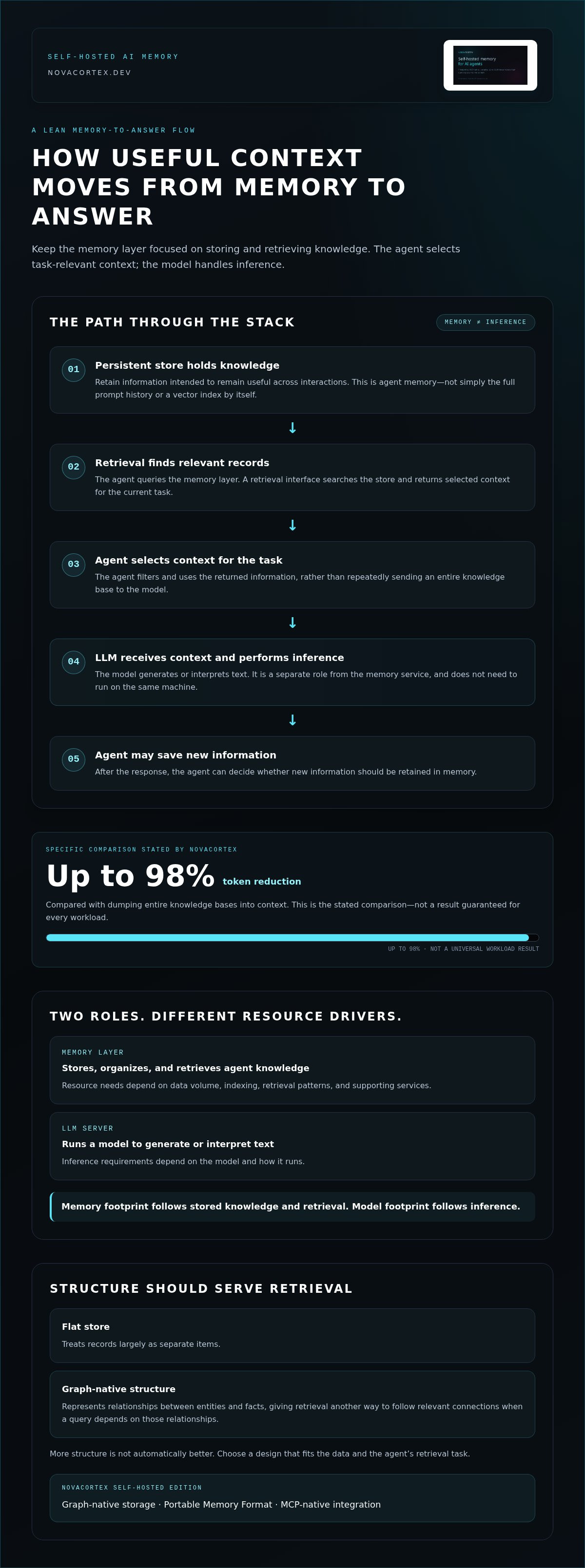
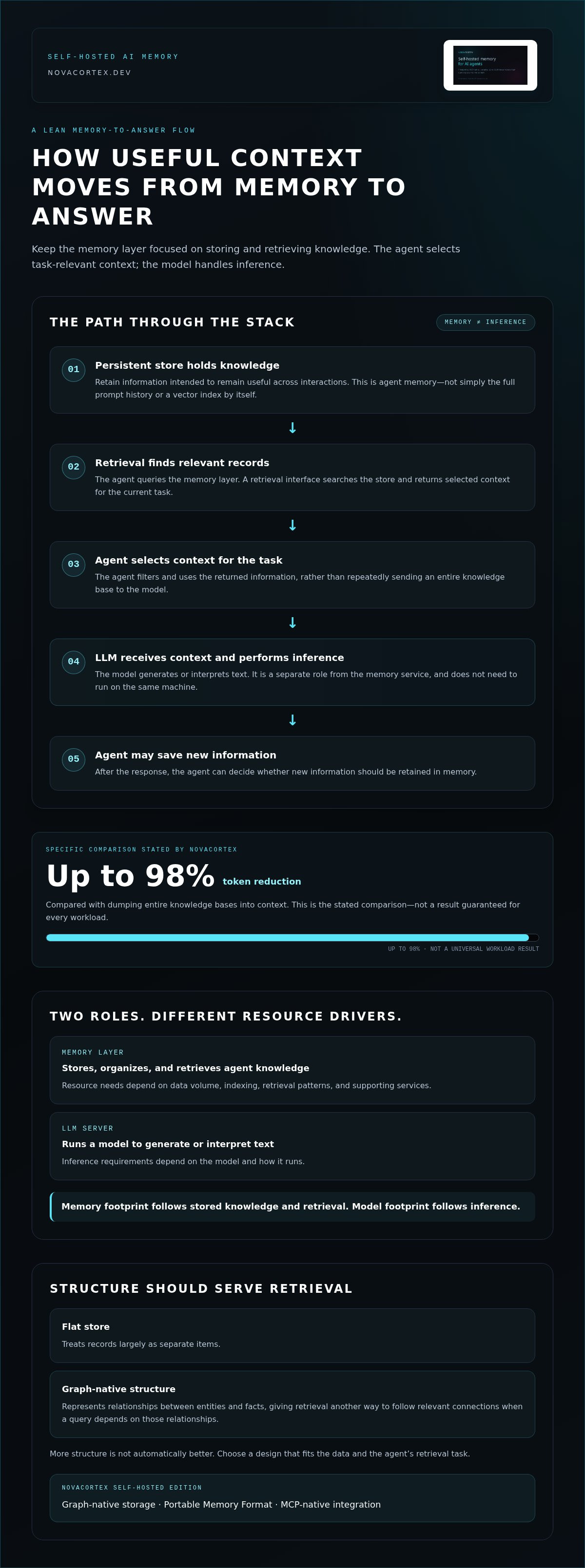
The memory layer stores, organizes, and retrieves agent knowledge. An LLM server executes a model to generate or interpret text. In a typical flow, the agent requests relevant memories, selects context for the task, and passes that context to a model for inference. Retrieval-augmented generation (RAG) describes this broader pattern of bringing external information into an LLM’s context.
These layers have different resource profiles. Inference requirements depend on the model and how it runs. Memory requirements depend on data volume, indexing, retrieval patterns, and supporting services. Sizing the memory host as if it must also execute a large model can add unnecessary infrastructure. Keep the roles separate, then size each for its workload.
What lightweight means in practice
Lightweight means choosing the simplest architecture that meets the agent’s persistence, retrieval, and privacy needs. A small workload may need only a narrow set of stored facts and a retrieval mechanism. More complex knowledge may call for richer organization. Each added component brings configuration and maintenance, so add complexity only when it serves the use case.
The memory footprint is driven by stored knowledge and retrieval; the model footprint is driven by inference. Servers, VPS instances, and Raspberry Pi devices are possible environments to consider, not promises of equivalent performance. Measure the workload, including how much data is retained and how often it’s queried. NovaCortex Self-Hosted Edition follows this memory-layer approach, with graph-native storage, Portable Memory Format, and MCP-native integration for user-controlled infrastructure.
How a Lean Self-Hosted AI Memory Stack Works
A lean stack doesn’t put an entire knowledge base into every prompt. It retrieves the context needed for the current task, keeping memory and inference distinct while giving the agent a way to carry useful knowledge across interactions.
Storage, retrieval, and agent connection
Think of the stack as three connected roles: a persistent store holds knowledge, a retrieval interface finds relevant records, and the agent requests and uses the results. When the agent makes a query, the memory layer searches its store and returns selected context. The agent supplies that context to an LLM, which generates a response. The agent can then decide whether new information should be saved to memory.
MCP can provide a defined connection between compatible agents and memory tools. This keeps the integration boundary explicit rather than embedding storage logic in every agent. For a closer look at that pattern, see the MCP-native memory server guide.
Why data structure affects context efficiency
A flat store treats records largely as separate items. A graph-native structure can represent relationships between entities and facts, giving retrieval another way to follow relevant connections. This can help when a query depends on how details relate, though the right structure depends on the data and retrieval task. More structure isn’t automatically better; it should support the agent’s actual use case.
In practice, the agent searches for useful information, filters the results, and passes selected context to the model. This avoids repeatedly transmitting unrelated records. NovaCortex states token reduction of up to 98% compared with dumping entire knowledge bases into context. That figure describes this specific comparison, not every workload. At model scale, data movement is also a distinct systems concern, often discussed as the 'memory wall' problem.
This design gives information a clear path from storage to answer without making the memory service responsible for model execution. NovaCortex combines graph-native storage with Portable Memory Format and MCP-native integration for self-hosted use. To review the implementation, see the NovaCortex source repository.
Compare Lightweight AI Memory Designs Before You Deploy
The right memory design depends on what the agent needs to retrieve, not on which architecture sounds most advanced. A lightweight self-hosted AI memory setup might use a simple key-value store, a vector index, or a graph-native system. Compare each option against your data relationships, privacy boundary, portability needs, and operational capacity.
| Workload | Strengths | Trade-offs | Operational fit |
|---|---|---|---|
| Small, predictable facts or settings | File or key-value persistence is direct and easy to inspect. | Limited support for fuzzy discovery and complex relationships; retrieval logic may need to be built around the store. | Good for narrow, stable memory with low integration and maintenance overhead. |
| Searching notes or documents by meaning | Vector retrieval can find semantically similar content even when the query uses different wording. | Embeddings are an index for similarity, not a complete memory model. You still need to manage source records, metadata, updates, and access boundaries. | Useful when similarity-based discovery is central and the agent can work with retrieved passages. |
| Facts connected through entities and relationships | Graph-native memory can represent links between people, projects, events, or concepts. | Modeling relationships adds design and maintenance work. A graph may be unnecessary for isolated facts or simple lookups. | Fits agents whose questions depend on how information connects, rather than on similarity alone. |
Match retrieval to the task
Vector search ranks content by similarity; it doesn’t mean every memory must be reduced to embeddings. A record can retain structured fields or source text alongside an embedding, while graph relationships capture connections that similarity scores may not express directly. If an agent needs to find a passage like a user’s question, vector retrieval may fit. If it must trace how a project relates to people, decisions, and events, graph structure may be useful. See this Redis versus graph memory comparison for a focused look at the trade-offs.
Keep data portable
Self-hosting gives you control over where memory runs, but portability depends on whether you can move stored knowledge, not just redeploy the service. Consider how records, relationships, and metadata can be exported and restored in another environment. An explicit portable format can reduce dependence on a single storage implementation. NovaCortex uses Portable Memory Format for portable data; its portable memory format guide explores the design considerations.
Before choosing, map the agent’s queries to the simplest design that can answer them reliably. Then account for access controls, backups, integrations, and maintenance. The leanest architecture meets the retrieval need without creating infrastructure you’ll have to maintain unnecessarily.
How to Right-Size and Deploy Self-Hosted AI Memory
Deploy the memory layer for the work it must do, then measure before adding capacity or components. A lightweight self-hosted AI memory deployment starts with the workload and data boundaries, not a guessed hardware specification. Use this five-step workflow to move from requirements to a tested service.
- Map agent use. Record what the agent needs to remember, how much data it may store, how often it will retrieve memories, and how many agents will use the service. Include representative query types and identify sensitive data.
- Set the data boundary. Decide which knowledge can be stored, where it must reside, and which agents or processes need access. Align permissions with the data instead of making the whole store available by default.
- Select infrastructure. Choose a server, VPS, Raspberry Pi, or similar environment based on the workload and deployment constraints. These are possible hosting environments, not performance guarantees. Capacity depends on software configuration, data volume, indexing, and request patterns, so determine it through measurement rather than assumptions.
- Integrate the agent. Connect the memory service through its supported interface. Verify that the agent can retrieve relevant records and handle failures or empty results. Keep memory integration separate from model execution where the architecture allows.
- Test before expanding. Run representative queries against realistic data. Check retrieval relevance, response time, storage growth, and resource consumption under expected use. Expand only when test results show a bottleneck or a clear workload need.
Keep the deployment maintainable
A small host still needs operational care. Set a backup schedule for persistent memory data and test that you can restore it, not just create a backup file. Restrict service access, keep the memory software and its dependencies updated, and monitor service health, storage growth, and resource use. Record configuration changes so recovery and troubleshooting don’t depend on guesswork.
Hosting a memory layer on local infrastructure is an architectural choice. The hardware that fits your agent, the retrieval quality it achieves, and its performance under load depend on the workload. Modest infrastructure doesn’t remove maintenance or guarantee performance. A staged rollout keeps the system lean: start with a representative workload, measure, then adjust.
Where NovaCortex Fits in a Lightweight AI Memory Stack
NovaCortex Self-Hosted Edition provides the memory layer of an AI system. It stores and retrieves persistent knowledge on infrastructure you control; it doesn’t run an LLM or provide a managed model API. Your agent and inference setup remain separate parts of the stack. Evaluate the memory layer on its own needs, including data control, retrieval behavior, and integration.
When NovaCortex matches the workload
Consider NovaCortex when your design calls for locally stored agent knowledge, portable data, and retrieval that can account for relationships between facts. Its graph-native storage represents connected information, while Portable Memory Format (PMF) supports moving memory data across environments. MCP-native integration provides a defined connection for compatible agents. The project is open source under Apache-2.0.
The Self-Hosted Edition is designed to run on user-controlled infrastructure, including servers and VPS environments. This suits deployments where keeping memory within an environment you manage is a priority. It doesn’t establish a universal hardware requirement: actual capacity and performance depend on configuration, data volume, and workload, so test against your use case.
NovaCortex states token reduction of up to 98% compared with dumping entire knowledge bases into context. Treat that as a specific comparison, not a guaranteed result for every agent or query. The practical benefit of selective retrieval depends on the knowledge being stored and how effectively the system returns relevant context.
Evaluate fit, then inspect the implementation
Self-hosting gives you control over where memory lives and how it connects to your agent. It also means you’re responsible for deployment, access management, backups, updates, and monitoring. PMF and Apache-2.0 licensing may matter if portability and inspectability are priorities. Graph-native storage may suit knowledge with meaningful relationships, while MCP integration is relevant when the agent’s connection pattern supports it.
Use this checklist to assess fit:
- Data control: Does the memory need to remain on infrastructure you manage?
- Retrieval shape: Do agent queries rely on relationships among facts?
- Portability: Is moving stored memory between environments important?
- Integration: Does MCP fit the agent connection you plan to use?
- Operations: Can you maintain and monitor the self-hosted service?
Review the repository and architecture, then test the memory layer with representative data and queries. This gives you a practical way to assess how NovaCortex fits your stack and workload.
Build Your Memory Layer Around the Workload
A lean stack starts with a clear boundary: persistent memory stores and retrieves agent knowledge, while an LLM server handles inference. Choose storage and retrieval around the agent’s real queries, then size infrastructure using measured workload rather than assumptions. Include backups, access controls, updates, and monitoring in the deployment plan.
NovaCortex Self-Hosted Edition is designed for deployment on user-controlled infrastructure. It combines graph-native storage and Portable Memory Format, and is open source under Apache-2.0. Evaluate it if your lightweight self-hosted AI memory priorities include local data control, connected knowledge, and portability. Self-hosting still means operating and maintaining the service yourself.
Start with a focused workload, test retrieval using representative data, and expand only when measurements show a need. A well-sized memory layer can support capable agents without turning the whole stack into unnecessary infrastructure.
Frequently Asked Questions
What is lightweight self-hosted AI memory?
Lightweight self-hosted AI memory is persistent context for an AI agent, stored and retrieved on infrastructure the operator controls. It helps an agent access relevant knowledge across interactions without treating the full conversation history or knowledge base as its memory. The memory layer handles storage and retrieval; an LLM server handles model inference. Keeping those responsibilities separate lets you size and operate each part for its own workload.
Can AI memory run on a Raspberry Pi or small VPS?
It can, depending on the software configuration, data volume, retrieval pattern, and workload. NovaCortex is designed for deployment on user-controlled infrastructure, including servers, VPS instances, and Raspberry Pi devices. Those options aren’t performance guarantees or universal hardware recommendations. Test with representative data and queries, then measure resource use and retrieval quality before expanding or relying on a particular host for production use.
Does self-hosted AI memory run the LLM too?
Not necessarily. A self-hosted memory layer stores and retrieves knowledge, while an LLM server executes a model to generate responses. They can run on separate machines or be combined in one environment, depending on the architecture. Don’t assume the memory host needs the compute required for inference. Evaluate storage, indexing, and retrieval needs separately from model size and execution requirements.
How is graph memory different from vector memory?
Vector memory supports similarity-oriented retrieval, finding records or passages related in meaning to a query. Graph memory represents entities and their relationships, which can help when an answer depends on connections among people, events, or facts. These approaches address different retrieval patterns, and they can be combined. Choose based on the queries your agent must answer, rather than assuming either structure is universally better.
Is self-hosted AI memory private by default?
No. Self-hosting gives you control over where memory data is stored, but privacy also depends on how the service is configured and operated. Restrict access to authorized agents and users, secure the host and its connections, and define backup and retention practices. Review what information enters persistent memory and who can retrieve it. User-controlled infrastructure supports data ownership, but it doesn’t replace security controls or ongoing oversight.
How does persistent AI memory reduce token usage?
Persistent memory can reduce token use by retrieving a relevant subset of stored knowledge instead of placing an entire knowledge base in every prompt. The actual reduction depends on the data, retrieval quality, and workload. NovaCortex states a reduction of up to 98% compared with dumping entire knowledge bases into context. That figure applies to that comparison, not as a universal result for every agent or interaction.
What should I compare when choosing a self-hosted AI memory layer?
Compare the design against your agent’s workload: retrieval needs, data sensitivity, privacy boundary, and number of agents. Assess how it represents relationships, how agents connect to it, and whether stored knowledge can move between environments. Include integration effort and operational work such as backups, updates, access control, and monitoring. Test with representative queries and measure resource use before settling on an architecture or scaling deployment.
FAQ
What is lightweight self-hosted AI memory?
Lightweight self-hosted AI memory is persistent context for an AI agent, stored and retrieved on infrastructure the operator controls. It helps an agent access relevant knowledge across interactions without treating the full conversation history or knowledge base as its memory. The memory layer handles storage and retrieval; an LLM server handles model inference. Keeping those responsibilities separate lets you size and operate each part for its own workload.
Can AI memory run on a Raspberry Pi or small VPS?
It can, depending on the software configuration, data volume, retrieval pattern, and workload. NovaCortex is designed for deployment on user-controlled infrastructure, including servers, VPS instances, and Raspberry Pi devices. Those options aren’t performance guarantees or universal hardware recommendations. Test with representative data and queries, then measure resource use and retrieval quality before expanding or relying on a particular host for production use.
Does self-hosted AI memory run the LLM too?
Not necessarily. A self-hosted memory layer stores and retrieves knowledge, while an LLM server executes a model to generate responses. They can run on separate machines or be combined in one environment, depending on the architecture. Don’t assume the memory host needs the compute required for inference. Evaluate storage, indexing, and retrieval needs separately from model size and execution requirements.
How is graph memory different from vector memory?
Vector memory supports similarity-oriented retrieval, finding records or passages related in meaning to a query. Graph memory represents entities and their relationships, which can help when an answer depends on connections among people, events, or facts. These approaches address different retrieval patterns, and they can be combined. Choose based on the queries your agent must answer, rather than assuming either structure is universally better.
Is self-hosted AI memory private by default?
No. Self-hosting gives you control over where memory data is stored, but privacy also depends on how the service is configured and operated. Restrict access to authorized agents and users, secure the host and its connections, and define backup and retention practices. Review what information enters persistent memory and who can retrieve it. User-controlled infrastructure supports data ownership, but it doesn’t replace security controls or ongoing oversight.
How does persistent AI memory reduce token usage?
Persistent memory can reduce token use by retrieving a relevant subset of stored knowledge instead of placing an entire knowledge base in every prompt. The actual reduction depends on the data, retrieval quality, and workload. NovaCortex states a reduction of up to 98% compared with dumping entire knowledge bases into context. That figure applies to that comparison, not as a universal result for every agent or interaction.
What should I compare when choosing a self-hosted AI memory layer?
Compare the design against your agent’s workload: retrieval needs, data sensitivity, privacy boundary, and number of agents. Assess how it represents relationships, how agents connect to it, and whether stored knowledge can move between environments. Include integration effort and operational work such as backups, updates, access control, and monitoring. Test with representative queries and measure resource use before settling on an architecture or scaling deployment.