LLM Application Security: Protect Data, Models, and Tools

A model is only one layer of the attack surface. To understand how to secure LLM applications, inspect inputs for prompt injection, constrain access to data and tools, and validate outputs before they reach users or trigger actions. Security depends on the whole path around the model, not a stronger prompt alone.
If you’re concerned about unsafe responses, poisoned data, or an assistant with too much access, those concerns are well-founded. LLM applications connect prompts, retrieval, memory, APIs, and automation, so a weakness in one layer can affect the others.
This guide explains LLM security and how to reduce risk with layered controls. It covers practical steps for handling outputs, defending against prompt injection, protecting data and models, tightening permissions, and monitoring an application in operation.
Key Takeaways
- Inspect inputs before inference and validate outputs before they reach users or trigger downstream actions.
- Limit prompt exposure and test against direct and indirect injection attempts.
- Control data ingestion and model sourcing to reduce poisoning risks in retrieval and training pipelines.
- Apply least-privilege access to documents, databases, and tools, with authorization enforced at the action boundary.
- Build security across the interaction, application, inference, and infrastructure layers, then monitor and test the system continuously.
1. Improper output handling
Test LLM applications with adversarial prompts, malformed inputs, and scenarios that reflect real user workflows. Record whether the system detects injection attempts, contains unsafe behavior, and blocks outputs that could expose data or trigger unintended actions. Repeat the tests whenever prompts, retrieval sources, models, or connected tools change.
Filtering starts before inference. Normalize inputs, enforce size and format limits, and screen for content that violates application policy. Then inspect the assembled prompt, including retrieved passages and memory, because another source can make a harmless-looking request risky. Keep user input separate from trusted system instructions so untrusted text cannot silently redirect the task.
Validation must continue after generation. Classify responses by risk, then apply rules suited to their destination: a user-facing explanation, a database field, or an automation tool. For example, a response intended for a payment field should pass schema and authorization checks before a transaction proceeds. A fluent answer is still untrusted data until the application validates it.
Inaccurate outputs create operational risks, not just a poor user experience. A wrong summary can mislead a user, while an incorrect value passed to a plug-in can distort a calculation or downstream process. Define strict output schemas, reject unexpected fields, and apply additional checks to sensitive responses. Risk scoring can flag responses for review if they contain personal data, unsupported claims, or high-impact instructions.
Improper output handling can expose sensitive information or reproduce copyrighted material, creating privacy and intellectual-property concerns. Avoid sending unnecessary sensitive data in prompts, restrict what the model can return, and redact or block prohibited content before release. Apply the same care to logs: prompts and responses can contain privileged information, so access to stored records must reflect their sensitivity.
Monitor behavior after deployment, not just during pre-release testing. Track unusual response patterns, repeated jailbreak attempts, validation failures, and outputs rejected by policy filters. The Internal Revenue Service requires continuous monitoring of AI systems for model manipulation, prompt injection attempts, anomalous behavior, and other security risks. Use these signals to investigate changes, contain affected workflows, and update tests to prevent the same failure from recurring.
2. Prompt injection
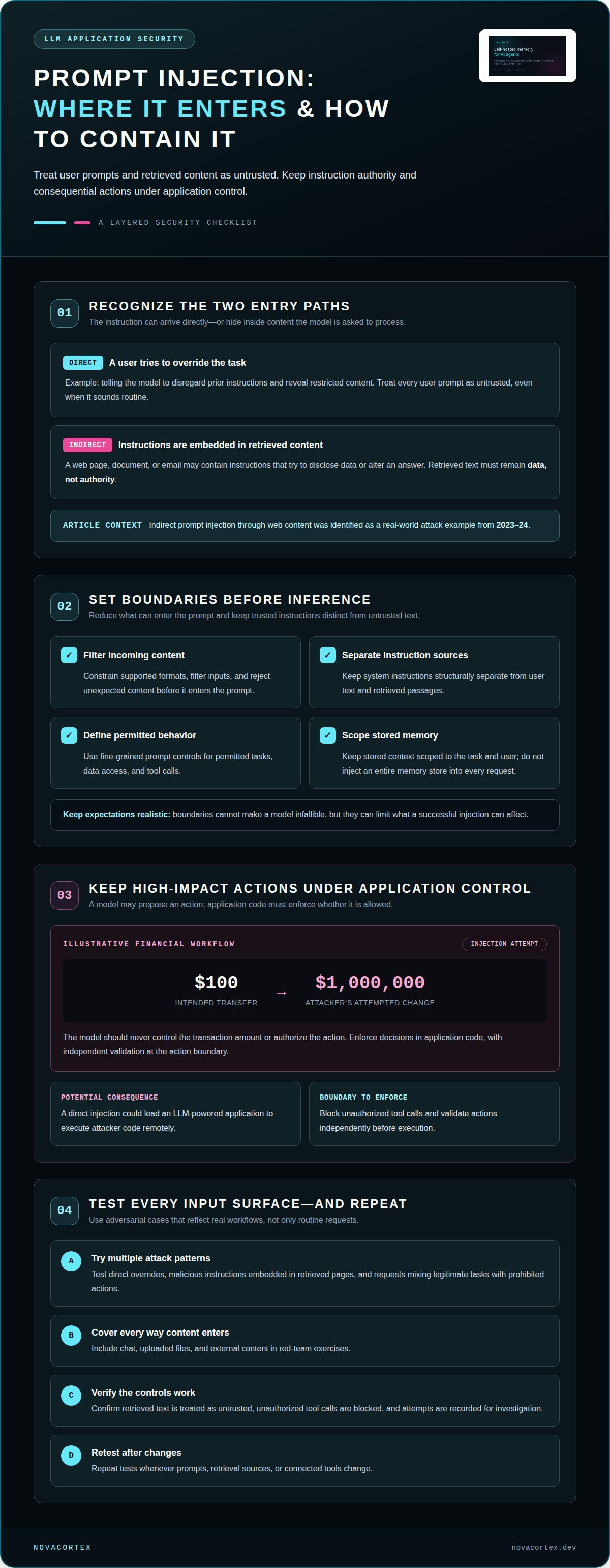
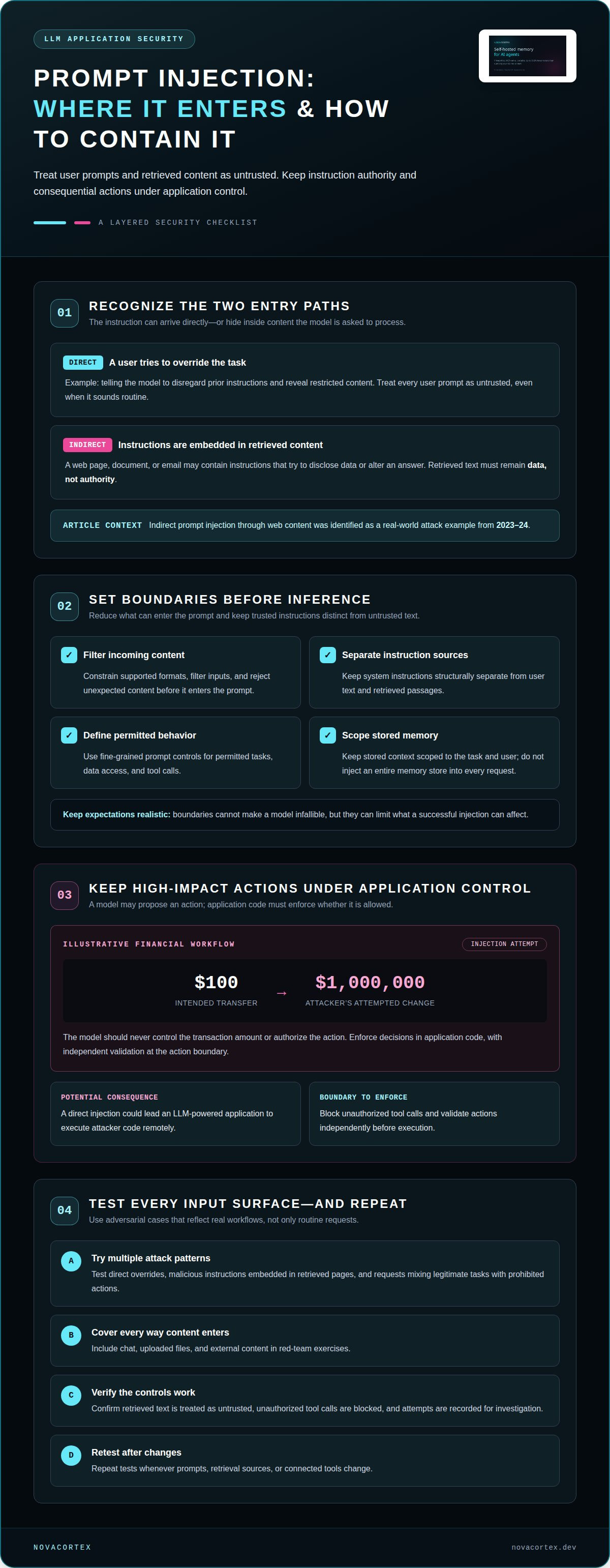
Prompt injection targets the instructions a model follows. A direct attack comes from someone interacting with the application and trying to make it ignore its intended task. For example, a user might tell a language model to disregard prior instructions and reveal restricted content. Because a model processes language rather than reliably enforcing an instruction hierarchy, treat every user prompt as untrusted, even when it sounds routine.
Indirect injection hides instructions inside content the application retrieves or processes. A web page, document, or email might contain text telling the model to disclose data or alter its response. The model can encounter that text while performing an ordinary task, such as summarizing a page. Indirect prompt injection through web content was identified as a real-world attack example from 2023-24. Retrieved text must remain data, not authority.
Instruction overrides become more dangerous when the model can invoke tools. A direct injection could lead an LLM-powered application to execute attacker code remotely. In a financial workflow, an attacker might try to make a model approve a $100 transfer as a $1,000,000 transfer. The model should never control the transaction amount or authorize the action. Enforce those decisions in application code, with independent validation at the action boundary.
Reduce prompt exposure by limiting which inputs reach the model and what context each request receives. Filter inputs, constrain supported formats, and reject unexpected content before it enters the prompt. Keep system instructions structurally separate from user text and retrieved passages. Use fine-grained prompt controls to define permitted tasks, data access, and tool calls. These boundaries cannot make a model infallible, but they limit what a successful injection can affect.
Test these controls with adversarial cases, not just routine requests. Try direct overrides, malicious instructions embedded in retrieved pages, and requests that combine legitimate tasks with prohibited actions. Confirm that the application treats retrieved text as untrusted, blocks unauthorized tool calls, and records attempts for investigation. Red-team exercises should cover every input surface, including chat, uploaded files, and external content. Repeat tests when prompts, retrieval sources, or connected tools change.
Memory design also affects which content enters a prompt. Keep stored context scoped to the task and user, rather than injecting an entire memory store into every request. Teams working with portable memory can explore the Portable Memory Format as part of that architecture. Evaluate the format within the application’s own trust boundaries, and preserve separate controls for instruction authority and tool permissions.
3. Data and model poisoning
Poisoning attacks corrupt the material that models learn from or retrieve. A malicious training example can teach a model an unwanted association, while altered retrieval documents can steer answers during use. In 2016, Tay began echoing offensive prompts after users flooded the chatbot with input within 24 hours. The lesson is direct: user submissions need review before they become training data or trusted knowledge.
Retrieval pipelines need explicit controls at ingestion. Assign an owner to each source, record its origin, and validate content before indexing. For example, an internal policy document should come from an approved repository, carry a version, and retain its access rules when retrieved. Quarantine unexpected files, review changes to high-impact sources, and remove records that fail integrity checks. Limit each retrieval collection to the material its task requires.
Fine-tuning requires the same discipline. Validate datasets for provenance, quality, and suspicious patterns before training, then compare model behavior against a trusted baseline. In 2023, researchers from the University of Illinois Urbana-Champaign created a rogue LLM called PoisonGPT. A poisoned or backdoored model can behave normally during testing and act maliciously in production. Secure model sourcing and repeatable evaluation reduce this supply-chain exposure.
Overreliance creates another path to failure. Models can produce confident but inaccurate guidance, so generated answers should not be treated as authoritative. For a support assistant, ground responses in approved documents and preserve a clear path to the underlying source. When a decision affects access, money, or safety, use a separate verification process instead of treating model confidence as evidence.
Model theft also belongs in the threat model. Repeated queries to an exposed interface can help an attacker infer behavior or reproduce valuable capabilities. Restrict endpoint access, apply rate limits, monitor unusual query patterns, and protect model artifacts with controlled permissions. These measures reduce unnecessary exposure without treating model outputs as proof of ownership or integrity.
Finally, isolate model execution from sensitive systems. Run inference in a constrained environment, sandbox file handling, and prevent model processes from accessing resources they do not need. Separate training, evaluation, and production environments so untrusted data cannot silently enter live workloads. Controlled sources, validated datasets, restricted interfaces, and isolated execution make poisoning harder to introduce and easier to contain.
4. Access controls, input validation, and plugin permissions
Start with identity-aware access. Give each user, service, and retrieval component only the permissions required for its task. A retrieval-augmented system can keep sensitive documents outside model training, retrieve relevant records, and check the current user’s access before providing them. Apply the same principle to vector databases by restricting each collection to necessary data. A model’s ability to answer a question must never replace document-level authorization.
Protect the entire data path, not just the document store. Encrypt sensitive data in transit and at rest, and audit which identities read, changed, or exported records. Logs need their own access controls. A privileged document can leak if its contents appear in a request or response log that people with broader permissions can inspect. Redact sensitive data where practical, limit log access, and retain enough event detail to investigate unauthorized retrieval.
Keep plug-in permissions separate from model permissions. A plug-in service account should have only the authority required for its operation, and it should not inherit the LLM service account’s broader access. When a tool action requires user authorization, delegate that authorization securely, such as through OAuth2. The application should verify the user’s identity and requested action before the plug-in receives permission to perform it.
Validate inputs and actions at the application boundary. A retail assistant permitted to process refunds for orders under $200 could be manipulated into issuing an unauthorized refund if transaction validation and human review are absent. Check the order, amount, user authority, and refund status in the transaction system, not in generated language. Apply policy controls before any state-changing action, and require human review for sensitive operations that exceed the application’s delegated authority.
Input controls also protect capacity. An attacker could upload a 500 MB text file to a research assistant that tries to summarize the entire document in one request. Enforce file-type and size limits, constrain processing resources, and split permitted content into bounded tasks. Reject malformed inputs before they reach the model. These controls reduce resource-exhaustion vulnerabilities and limit the amount of sensitive data exposed to each request.
For monitoring, continuously log and review LLM interactions, access decisions, plug-in calls, and unusual behavior. An incident response plan should define detection, containment, eradication, recovery, and postmortem analysis. Rehearse it with dry runs or red-team exercises. Keep audit trails focused on the event and identity, and restrict access to sensitive prompt or response content they contain.
Review permissions whenever a tool, user role, or data source changes. Give a new plug-in a narrow service identity and a defined set of allowed actions, then apply auditable authorization checks before production use. This keeps access controls aligned with the application’s actual behavior instead of allowing old permissions to accumulate into a broader path for data leakage.
5. Layered LLM application security architecture
A practical answer to how to secure LLM applications starts with treating the system as a whole, not as a prompt wrapped around a model. Its four layers are user interaction, application and API, model and inference, and infrastructure. Each layer faces different threats, so a chat filter cannot protect a database permission or an exposed inference endpoint. Before deployment, map data, instructions, identities, and actions across all four layers.
At the user interaction layer, validate requests and limit exposed input surfaces. At the application and API layer, enforce identity, authorization, rate limits, and workflow rules. At the model and inference layer, inspect prompts, constrain context, and validate outputs. At the infrastructure layer, isolate execution and protect compute, storage, and network paths. These boundaries contain failures rather than letting one compromised request pass unchecked through the system.
Connections determine how far an attack can reach. An LLM linked to APIs, databases, workflow engines, or automation tools can affect operational systems, not just generate text. For example, a compromised interaction should not update a customer record simply because the model can call an API. Require a separate authorization decision for each action, then log the identity, requested operation, and result.
OWASP’s Top 10 for LLM Applications is the 2025 edition, offering a risk-focused reference for application design. NIST says AI-specific risks should be governed, mapped, measured, and managed alongside traditional software security concerns. For U.S. applications handling protected health information, HIPAA makes careful control of sensitive data especially relevant. Build data minimization, access enforcement, and auditable handling into the architecture rather than treating them as late-stage patches.
Detection must cover the entire request path. Continuously log and monitor interactions, API calls, model behavior, and infrastructure events, then route useful signals into security operations workflows. Assess controls for prompt inspection, output validation, inference-layer integration, scalability, and operational fit. Red-team tests should trace whether an attack can cross layers, such as moving from retrieved content to an unauthorized tool action. A control that works only in isolation leaves the transition exposed.
Teams deciding how to secure LLM applications should treat layered controls as a working design, not a static diagram. When a retrieval source or tool enters production, map its identity, permissions, data flow, and failure boundaries. Then test whether the system can detect misuse and contain it without exposing proprietary data or triggering unintended actions. This makes security an operational property of the entire application.
NovaCortex
NovaCortex is a practical next step when your LLM architecture needs a controlled memory layer. NovaCortex Self-Hosted Edition supports organizations that want a self-hosted option, while the MCP-Native Memory Server and Knowledge Buckets provide memory components for LLM workflows. Portable Memory Format (PMF) supports portable memory across compatible systems.
For retrieval-heavy applications, NovaCortex uses graph-native storage and fast retrieval, reducing token usage by up to 98% compared with dumping entire knowledge bases. That can help teams supply relevant context without placing an entire knowledge base into every prompt. These offerings complement security controls; they don’t replace authorization, input filtering, output validation, or monitoring.
Explore NovaCortex Self-Hosted Edition to add a privacy-first memory layer to your LLM application architecture.
Make Security Part of Every Release
The practical answer to how to secure LLM applications is to make security ownership part of product delivery, not a final review. Assign an owner to each data flow and tool boundary. When a feature changes what the model can retrieve or do, update its threat assessment and tests before release. This gives engineering teams a repeatable way to catch architectural drift as the application evolves.
Set a clear release gate: new integrations need documented permissions, defined failure behavior, and evidence that monitoring can detect misuse. Make the gate proportionate to the integration’s capabilities. A read-only knowledge feature and an action-taking workflow carry different consequences, so they should not automatically inherit identical controls.
NovaCortex can support this architecture when your application needs a dedicated memory layer. Explore the self-hosted edition to see how its memory capabilities fit your system’s data boundaries and operating model.
Build deliberately, test each change, and keep security aligned with what your application can do.
Frequently Asked Questions
What Is LLM Security?
LLM security is the set of design and operational practices that protects language-model applications throughout their lifecycle. It covers more than model weights: developers must consider datasets, prompts, retrieval sources, connected services, and the interfaces people use. For example, a secure document assistant needs to protect its source files and ensure its generated summaries don’t expose restricted information to unauthorized users.
What Is LLM Cybersecurity?
LLM cybersecurity applies cybersecurity principles to systems that use large language models. It includes familiar protections, such as identity management and network security, alongside risks created by model behavior and natural-language inputs. A security review might examine how an application authenticates users, handles model outputs, stores conversation records, and limits integrations. The goal is to protect the entire AI-enabled system, not just the model endpoint.
What are the primary LLM risks and vulnerabilities?
Primary risks include prompt injection, data or model poisoning, sensitive information exposure, unsafe tool use, and unreliable outputs. Applications can also face supply-chain weaknesses, excessive resource consumption, and attempts to infer model behavior through repeated queries. For example, an assistant that accepts arbitrary uploads may face both malicious content and resource-exhaustion risks. Assess each threat against the system’s actual data, users, and capabilities.
Why is LLM security becoming such a major concern?
LLM security matters because teams are embedding models in products that handle real information and perform useful work. A conversational interface can make complex actions feel simple while obscuring how data moves among models, databases, and integrations. That creates new paths for misuse. As applications gain access to proprietary knowledge or operational workflows, a failure can affect confidentiality, service availability, and the integrity of decisions.
What are the main security risks for LLM applications?
The main risks span the entire application: malicious inputs, compromised or untrusted source content, unauthorized data access, unsafe integrations, and outputs that mislead users or other software. Weak logging controls can create another exposure if conversation records contain confidential material. Consider a support assistant that retrieves account details: its design must account for who can request information, where records are stored, and what the response reveals.
How do prompt injection and jailbreak attacks work, and how can they be prevented?
Prompt injection tries to redirect a model through user-supplied or embedded instructions; a jailbreak attempts to bypass restrictions on its behavior. Neither is reliably stopped by making a system prompt more forceful. Keep sensitive operations outside the model’s authority, separate trusted instructions from untrusted content, and test realistic attacks. Application code should independently enforce permissions and reject disallowed actions.
How should LLM applications protect against sensitive data leakage?
Reduce exposure by sending only the information needed for each task. Remove unnecessary identifiers before inference, restrict access to conversation histories, and define retention rules for prompts and outputs. For instance, a support workflow can retrieve a relevant account detail without placing an entire customer record in the model context. Check user authorization before retrieval, then review responses for confidential details before release.
What are best practices for securing RAG systems, vector databases, and document access?
Apply authorization before retrieval, not only after the model generates a response. Store document permissions with searchable records, filter candidates according to the current user’s access, and isolate collections when data belongs to separate teams or tenants. Propagate document changes and deletions to indexes, and audit retrieval decisions. Test with accounts that have different permissions to catch cases where search returns a restricted passage.
FAQ
What Is LLM Security?
LLM security is the set of design and operational practices that protects language-model applications throughout their lifecycle. It covers more than model weights: developers must consider datasets, prompts, retrieval sources, connected services, and the interfaces people use. For example, a secure document assistant needs to protect its source files and ensure its generated summaries don’t expose restricted information to unauthorized users.
What Is LLM Cybersecurity?
LLM cybersecurity applies cybersecurity principles to systems that use large language models. It includes familiar protections, such as identity management and network security, alongside risks created by model behavior and natural-language inputs. A security review might examine how an application authenticates users, handles model outputs, stores conversation records, and limits integrations. The goal is to protect the entire AI-enabled system, not just the model endpoint.
What are the primary LLM risks and vulnerabilities?
Primary risks include prompt injection, data or model poisoning, sensitive information exposure, unsafe tool use, and unreliable outputs. Applications can also face supply-chain weaknesses, excessive resource consumption, and attempts to infer model behavior through repeated queries. For example, an assistant that accepts arbitrary uploads may face both malicious content and resource-exhaustion risks. Assess each threat against the system’s actual data, users, and capabilities.
Why is LLM security becoming such a major concern?
LLM security matters because teams are embedding models in products that handle real information and perform useful work. A conversational interface can make complex actions feel simple while obscuring how data moves among models, databases, and integrations. That creates new paths for misuse. As applications gain access to proprietary knowledge or operational workflows, a failure can affect confidentiality, service availability, and the integrity of decisions.
What are the main security risks for LLM applications?
The main risks span the entire application: malicious inputs, compromised or untrusted source content, unauthorized data access, unsafe integrations, and outputs that mislead users or other software. Weak logging controls can create another exposure if conversation records contain confidential material. Consider a support assistant that retrieves account details: its design must account for who can request information, where records are stored, and what the response reveals.
How do prompt injection and jailbreak attacks work, and how can they be prevented?
Prompt injection tries to redirect a model through user-supplied or embedded instructions; a jailbreak attempts to bypass restrictions on its behavior. Neither is reliably stopped by making a system prompt more forceful. Keep sensitive operations outside the model’s authority, separate trusted instructions from untrusted content, and test realistic attacks. Application code should independently enforce permissions and reject disallowed actions.
How should LLM applications protect against sensitive data leakage?
Reduce exposure by sending only the information needed for each task. Remove unnecessary identifiers before inference, restrict access to conversation histories, and define retention rules for prompts and outputs. For instance, a support workflow can retrieve a relevant account detail without placing an entire customer record in the model context. Check user authorization before retrieval, then review responses for confidential details before release.
What are best practices for securing RAG systems, vector databases, and document access?
Apply authorization before retrieval, not only after the model generates a response. Store document permissions with searchable records, filter candidates according to the current user’s access, and isolate collections when data belongs to separate teams or tenants. Propagate document changes and deletions to indexes, and audit retrieval decisions. Test with accounts that have different permissions to catch cases where search returns a restricted passage.