LLM Context Compression: A Practical 2026 Guide

More context can make an LLM less reliable, not more. Long prompts use more of the context budget and add processing overhead, while important details can get buried. That’s why context compression techniques for LLMs should do more than shorten text: they should preserve the information the task depends on.
If you’ve tried summarizing a conversation or document, you’ve seen the trade-off. The prompt gets smaller, but exact details, relationships, or instructions can disappear. The goal isn’t maximum compression. It’s keeping the right information available for the task.
This guide explains how context compression works, compares the main technique families, and shows how to choose an approach based on task, fidelity, and operating constraints. We’ll cover selective retrieval, summarization, sliding windows, and structured pruning, including where each method can lose important context. You’ll also learn how to evaluate quality and efficiency together, so token savings don’t come at the cost of useful answers.
Key Takeaways
- Choose context compression techniques for LLMs by how they transform information: retrieval selects relevant content, while summarization rewrites it more compactly.
- Compare methods across fidelity, compactness, latency, implementation effort, and workload before committing to one.
- Test compression against a baseline using representative long inputs, edge cases, and critical constraints, then revise based on quality and efficiency results.
- Use persistent memory for knowledge that must be retrieved across sessions or agents. It complements compression of the active context rather than replacing it.
- Distinguish prompt-level methods from KV-cache compression, which targets a different part of model processing and has different implementation trade-offs.
Why context compression techniques for LLMs matter in long prompts
A model can only process the context provided for a given inference. That context may include instructions, conversation turns, retrieved documents, and tool results. A Large language model uses this input to generate its response, but a larger prompt isn’t automatically a better one. Irrelevant material can compete with task-critical details, and poorly organized information can make those details harder to locate and use.
Context compression is the task-aware reduction of a prompt’s representation while preserving the information needed to complete the task. Deleting old messages alone is not compression. That distinction matters. Removing history may discard a key decision, while a carefully chosen representation can reduce redundancy and keep essential facts, relationships, and instructions available.
There are two separate constraints. A context-window limit sets an upper bound on what a model can accept in one pass. Quality can degrade before that boundary if the input is noisy, repetitive, or difficult to navigate. Limits and performance vary by model, task, and context structure, so treat capacity as a model-specific constraint, not a universal target.
Every method makes trade-offs. Shorter prompts can reduce input processing, but aggressive rewriting or selection can damage fidelity. More elaborate compression may add preprocessing latency and system complexity. The useful target is not the smallest prompt. It’s the smallest representation that retains what the task needs.
What gets compressed: prompt, history, or model state?
Conversation history is what a user or application stores and displays. The final context is the subset and arrangement of information actually sent to the model, which may be transformed without changing the visible transcript. Key-value (KV) cache compression is different again: it targets inference state used during token generation, not necessarily the prompt text itself. These techniques share the word “compression,” but operate on different data and solve different engineering problems.
When does an LLM workflow need compression?
Long conversations accumulate repeated instructions and decisions. Document-heavy tasks can bring in more source material than a response needs. Multi-step agents may append tool outputs and intermediate state at each turn. Look for repeated context, irrelevant detail, rising input size, or prompts approaching a model’s limit. These are practical signs to investigate, not a reason to compress everything automatically.
Don’t compress by default. If retrieval can supply only the relevant passages, or pruning can remove stale tool output, those may solve the problem with less fidelity risk. Compression becomes useful when the context still needs to carry substantial information, but its current representation is too bulky or inefficient for the task.
Four context compression techniques for LLMs, explained clearly
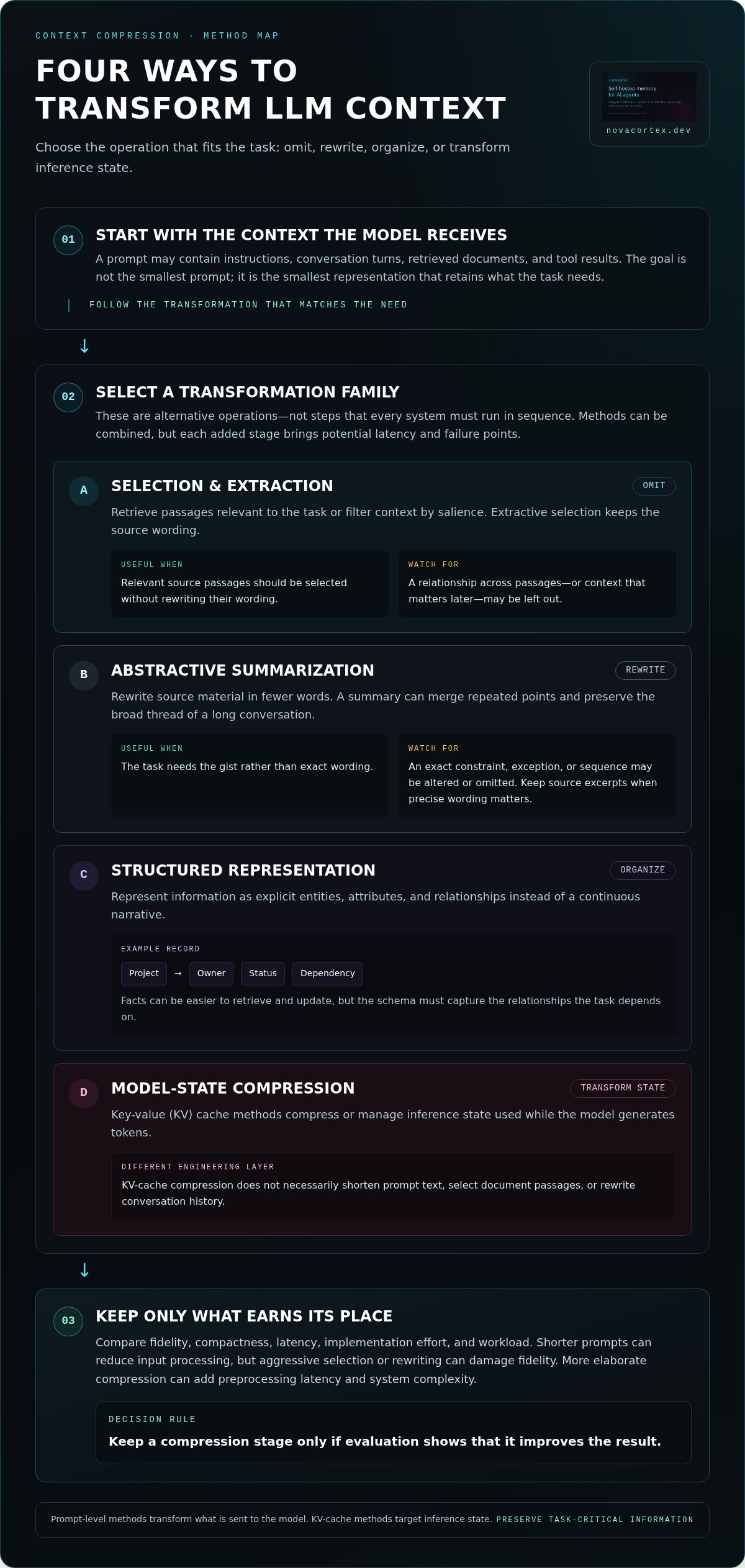
Technique names vary across papers and tools, so classify a method by what it transforms. Some methods select what enters the prompt. Others rewrite text, encode information in a structure, or reduce model state during inference. These operations can be combined, but every extra stage adds latency and potential failure points. Keep a stage only if evaluation shows that it improves the result.
The four core families are selection, abstractive summarization, structured representation, and model-state compression: they respectively omit, rewrite, organize, or transform information used during inference. This taxonomy separates retrieval from compression in the narrower sense. Retrieving fewer passages reduces the material sent to the model; rewriting a passage changes how that information is represented.
Selection and extraction
Query-based retrieval finds passages relevant to the current task, while salience filters can rank or remove less useful context. Extractive methods preserve the selected source wording, which helps retain exact language and details. But selection can still miss a relationship spread across passages, or discard context that seems unimportant until the task changes. For example, selecting a statement about a project’s status without the passage describing its dependency may leave the answer incomplete.
Abstractive summaries
A summary rewrites source material into fewer words. It can merge repeated points and preserve the broad thread of a long conversation, but it may alter phrasing or omit an exact constraint, exception, or sequence. Use summaries when the task needs the gist. Keep source excerpts available when precise wording matters, such as when answering a question about a specific requirement.
Structured representations
Structured memory stores information as explicit entities, attributes, and relationships, rather than as a continuous narrative. A record might associate a project with its owner, status, and dependency. This can make facts easier to retrieve and update, but the schema must represent the relationships the task depends on. For long-horizon agent workflows, ACON: Optimizing Context Compression for Long-horizon LLM Agents is a useful research reference on preserving relevant context over extended tasks.
Model-state compression
Key-value (KV) cache methods compress or manage inference state used as a model generates tokens. They don’t necessarily shorten prompt text, select document passages, or rewrite conversation history. That makes them a distinct engineering layer: useful for managing inference memory, but not a substitute for choosing what information belongs in the context.
A practical pipeline might retrieve relevant passages, summarize older turns, then structure durable facts for later use. Give each step a clear job: retrieval narrows the source material, summarization condenses narrative context, and structured memory makes reusable facts and relationships explicit. To explore how a self-hosted memory layer can support retrieval across tasks, review this open-source memory implementation.
How the main LLM context compression methods compare
No method wins across every workload. The practical trade-off depends on what must survive compression: exact source wording, a coherent narrative, explicit relationships, or inference state. Use this comparison to narrow the options, then validate them on your own model, task, and context shape. These are typical tendencies, not guaranteed performance results.
| Method | Fidelity | Compactness | Latency | Implementation effort | Suitable workload |
|---|---|---|---|---|---|
| Extractive selection | High for retained passages; omitted evidence is lost | Moderate to high, depending on selection | Retrieval or ranking adds a stage | Low to moderate | Exact quotations, identifiers, and source-grounded answers |
| Abstractive summaries | Variable; wording and details can change | High when source material is repetitive | Summarization adds processing time | Low to moderate | Recurring narrative context where small losses are acceptable |
| Structured memory | High for encoded fields and relations; depends on schema coverage | High for reusable facts, less so for nuanced prose | Extraction and retrieval add stages | Moderate to high | Facts, entities, attributes, and relationships reused across tasks |
| KV-cache compression | Depends on method and model-state handling | Reduces inference-state footprint, not necessarily prompt text | May affect generation speed; measure end to end | High | Systems constrained by inference memory or long generation state |
Match method to workload
Favor extraction when exact wording, IDs, or source evidence matter. Consider summaries for repeated conversation context if modest detail loss is tolerable. Use structured memory when facts and their relationships must remain explicit and reusable. KV-cache compression belongs in a different decision path: it addresses model state, not which source passages enter the prompt. The Adaptive Context Compression Techniques for LLMs paper is one example of research combining selection and budget allocation rather than treating compression as a single operation.
Measure quality and cost
Shorter is not automatically better. Over-compression can drop a constraint, exception, or evidence needed to justify an answer. Compare each method with an uncompressed baseline on the same evaluation cases. Track answer correctness and retrieval recall alongside prompt-token reduction. Also measure compression-stage latency and total inference latency, not token counts alone.
Include checks for instruction retention, provenance, and critical exceptions. Results vary with the model, task, context shape, and evaluation setup, so avoid naming a universal winner. The right context compression techniques for LLMs are the ones that meet the workload’s fidelity requirements while producing a measured efficiency gain.
A practical workflow for testing context compression
Compression needs a test loop, not a token-count target. Compare the same production tasks with and without compression, then measure what changed in answer quality, input size, and end-to-end performance. The rule is simple: token reduction is useful only when task quality remains acceptable.
- 1. Establish a baseline. Run representative tasks with the current, uncompressed context. Record outputs, token counts, task-specific quality scores, and total latency.
- 2. Select a method. Choose retrieval, extraction, summarization, structured memory, or another approach based on the information each task must preserve.
- 3. Compress. Apply the method consistently and save the resulting representation alongside the original context.
- 4. Test. Compare compressed and baseline outputs against expected answers. Track correctness, retrieval recall, and critical detail retention.
- 5. Revise. Adjust selection rules, summary prompts, or thresholds when errors appear. Rerun the same cases after each change.
Build a production-shaped test set
Include long inputs, edge cases, exact-fact questions, multi-step reasoning, and tasks that require recovering an earlier detail. Record the original context, compressed representation, model output, and expected answer so failures can be traced to the compression step or the model. Use public benchmarks only when their tasks reflect your real workload; a high score on a mismatched benchmark won’t validate your system.
Set explicit guardrails
Define what must survive: system instructions, named entities, constraints, provenance, and critical exceptions. Test for retrieval misses and summary drift, including across repeated compression cycles. Set task-specific acceptance thresholds before deployment. If retrieval confidence falls below its threshold, or a required constraint is missing, trigger a fallback such as re-retrieval or sending the relevant source passage.
Account for the whole pipeline. A compressor call or retrieval operation may add latency and overhead even as it reduces prompt tokens. Measure compression-stage time and total inference latency, and compare them with the baseline. Keep the original source available during evaluation so you can inspect whether a wrong answer followed from omitted evidence, altered wording, or a model error. These checks make comparisons between context compression techniques for LLMs useful beyond a token-savings chart.
When compression needs persistent memory instead
Compression reshapes the active context for a task. Persistent memory stores knowledge so it can be retrieved in later prompts, sessions, or agent workflows. If an agent repeatedly needs the same project decisions, user preferences, or reference facts, compressing the conversation again and again still leaves it dependent on what was carried forward. Memory separates durable knowledge from the temporary prompt.
Combine retrieval with compression
Start by retrieving only the knowledge relevant to the current task. If that subset still makes the active prompt too large, compress it then. Selection reduces what enters the prompt; compression changes how selected information is represented. They solve related but distinct problems.
Preserve source references or provenance when a summary rewrites stored knowledge. That lets a workflow trace a fact back to its origin, or retrieve the original passage when exact wording matters. For related implementation guidance, see the article on optimizing AI context windows.
Use memory beyond one prompt
A self-hosted memory layer can keep knowledge on user-controlled infrastructure and retrieve relevant material when an agent needs it. NovaCortex is designed for this role. It stores knowledge in the Portable Memory Format (PMF), supports graph-native storage for connected information, and provides MCP-native access through its memory server. These capabilities support retrieval across tasks instead of repeatedly sending an entire knowledge base.
This is complementary to context compression techniques for LLMs, not a replacement for them. Retrieval supplies a task-relevant subset from persistent knowledge; compression can then reduce that subset for the active prompt. The NovaCortex Self-Hosted Edition is open source under Apache-2.0. Learn more about self-hosted AI memory architecture and the Portable Memory Format to understand how persistent storage and interoperability fit into a system design.
NovaCortex can reduce token usage by up to 98% compared with dumping entire knowledge bases into context. The comparison is specific to that use case: the outcome depends on the workload and the amount of knowledge otherwise included in the prompt.
Build a context pipeline that keeps what matters
The right context compression techniques for LLMs depend on what your task must preserve. Select or extract when exact evidence matters, summarize when a compact narrative is enough, and use structured representations when facts and relationships need to stay explicit. Then test against real workloads. Token savings count only when answer quality remains acceptable and the full pipeline performs well.
Compression reshapes the active prompt; persistent memory makes useful knowledge available across sessions. NovaCortex brings these ideas together through a self-hosted memory layer stored on your infrastructure, with Portable Memory Format and graph-native storage. Its Self-Hosted Edition is open source under Apache-2.0.
Start with one workflow, measure what your system preserves, and refine from there. Explore NovaCortex on GitHub to see how a self-hosted memory layer can support task-relevant retrieval across sessions.
Frequently Asked Questions
What are context compression techniques for LLMs?
Context compression techniques for LLMs reduce or restructure information sent to a language model while preserving what a task needs. Common approaches select relevant passages, summarize conversation history, store facts in structured memory, or compress inference state. These methods aren’t interchangeable. Selection can omit relevant evidence, summaries can lose exact details, and model-state compression affects a different system layer. Choose based on the information that must survive and the workload’s fidelity, latency, and implementation requirements.
How does context compression work in an LLM?
A system identifies which information matters to the current task, then selects, removes, summarizes, restructures, or encodes less essential material. The model receives the resulting context in a more compact form. Some systems transform text before inference; others retrieve a smaller subset from external memory. For example, a document question-answering workflow might retrieve a few relevant passages rather than include every document. The right method depends on whether exact wording, relationships, or narrative continuity must remain available.
Does context compression reduce LLM answer quality?
It can, if compression removes a constraint, exception, source detail, or relationship needed to answer correctly. It can also help by removing distracting repetition and irrelevant content. Compare compressed and uncompressed outputs on representative tasks, checking correctness and preservation of critical details alongside token use. Don’t assume a shorter prompt is better, or that quality is unchanged. Set an acceptable quality threshold for your workload, then use it to determine whether the compression method is safe to keep.
What is the difference between context compression and RAG?
Context compression reduces or restructures information already selected for a model call. Retrieval-augmented generation (RAG) searches an external source for information relevant to a query, then adds selected results to the context. They work well together: retrieve a task-relevant subset first, then compress it if the active prompt still needs to be smaller. Neither method guarantees accuracy. Evaluate whether retrieval finds the right evidence and whether compression preserves it, including source references when provenance matters.
Can LLM context be compressed without summarizing it?
Yes. A system can select original passages, remove redundant sections, retrieve a smaller set of facts, or represent information in a structured format. These methods can retain exact wording better than abstractive summaries, but selection can still exclude something the task needs. Choose based on the requirement: source fidelity favors retaining relevant excerpts, while reusable relationships may suit structured records. If the goal is reducing inference-state memory, KV-cache compression operates separately from rewriting prompt text.
How do you measure whether LLM context compression is effective?
Compare task quality with an uncompressed baseline, then track prompt-token reduction, compression or retrieval latency, and total end-to-end latency. Include production-shaped cases that test exact facts, critical constraints, and details from earlier interactions. Record expected answers and inspect failures to find whether evidence was omitted or transformed. Compression is useful only if it reduces the resource you’re targeting while keeping task quality within an explicitly defined acceptable range.
Is KV-cache compression the same as context compression?
No. Text-context compression selects or changes the input sent to a model. KV-cache compression targets key-value representations used during inference, which can affect memory use and serving performance. They operate at different system layers and need different measurements. A tool or paper may use “context compression” broadly, so identify whether it refers to prompt text, conversation history, or model state before comparing methods or interpreting reported results.
When should an AI agent use persistent memory instead of context compression?
Use persistent memory when knowledge should remain available across sessions, tasks, or repeated model calls. Compression reshapes information for the current context; persistent memory stores knowledge externally and retrieves it when needed. An agent may retrieve a project decision in a later session, then compress the retrieved information to fit its active prompt. NovaCortex is a self-hosted memory layer designed to store knowledge on user infrastructure and retrieve relevant information for AI agents.
FAQ
What gets compressed: prompt, history, or model state?
Conversation history is what a user or application stores and displays. The final context is the subset and arrangement of information actually sent to the model, which may be transformed without changing the visible transcript. Key-value (KV) cache compression is different again: it targets inference state used during token generation, not necessarily the prompt text itself. These techniques share the word “compression,” but operate on different data and solve different engineering problems.
When does an LLM workflow need compression?
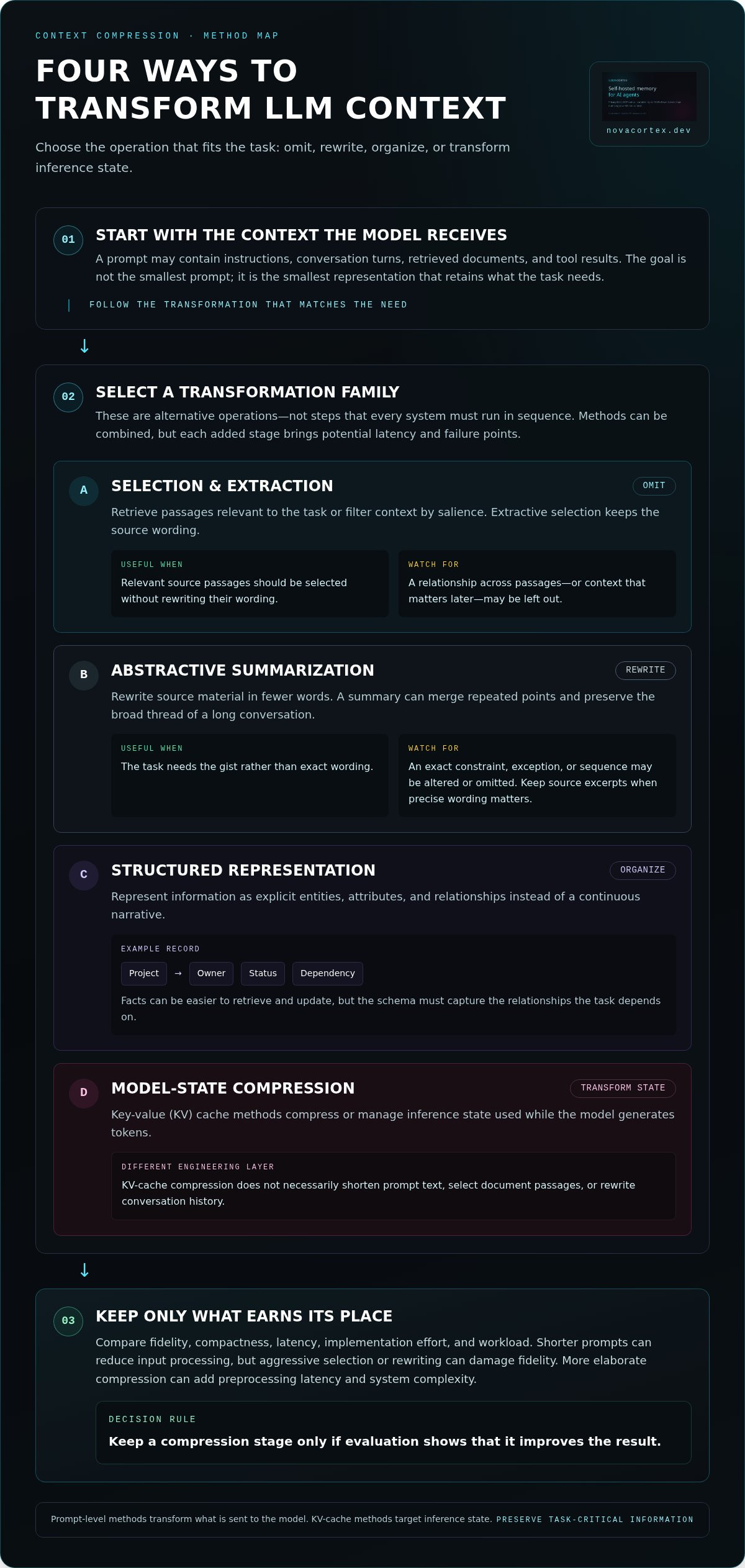
Long conversations accumulate repeated instructions and decisions. Document-heavy tasks can bring in more source material than a response needs. Multi-step agents may append tool outputs and intermediate state at each turn. Look for repeated context, irrelevant detail, rising input size, or prompts approaching a model’s limit. These are practical signs to investigate, not a reason to compress everything automatically. Don’t compress by default. If retrieval can supply only the relevant passages, or pruning can remove stale tool output, those may solve the problem with less fidelity risk. Compression becomes useful when the context still needs to carry substantial information, but its current representation is too bulky or inefficient for the task. Technique names vary across papers and tools, so classify a method by what it transforms. Some methods select what enters the prompt. Others rewrite text, encode information in a structure, or reduce model state during inference. These operations can be combined, but every extra stage adds latency and potential failure points. Keep a stage only if evaluation shows that it improves the result. The four core families are selection, abstractive summarization, structured representation, and model-state compression: they respectively omit, rewrite, organize, or transform information used during inference. This taxonomy separates retrieval from compression in the narrower sense. Retrieving fewer passages reduces the material sent to the model; rewriting a passage changes how that information is represented.
What are context compression techniques for LLMs?
Context compression techniques for LLMs reduce or restructure information sent to a language model while preserving what a task needs. Common approaches select relevant passages, summarize conversation history, store facts in structured memory, or compress inference state. These methods aren’t interchangeable. Selection can omit relevant evidence, summaries can lose exact details, and model-state compression affects a different system layer. Choose based on the information that must survive and the workload’s fidelity, latency, and implementation requirements.
How does context compression work in an LLM?
A system identifies which information matters to the current task, then selects, removes, summarizes, restructures, or encodes less essential material. The model receives the resulting context in a more compact form. Some systems transform text before inference; others retrieve a smaller subset from external memory. For example, a document question-answering workflow might retrieve a few relevant passages rather than include every document. The right method depends on whether exact wording, relationships, or narrative continuity must remain available.
Does context compression reduce LLM answer quality?
It can, if compression removes a constraint, exception, source detail, or relationship needed to answer correctly. It can also help by removing distracting repetition and irrelevant content. Compare compressed and uncompressed outputs on representative tasks, checking correctness and preservation of critical details alongside token use. Don’t assume a shorter prompt is better, or that quality is unchanged. Set an acceptable quality threshold for your workload, then use it to determine whether the compression method is safe to keep.
What is the difference between context compression and RAG?
Context compression reduces or restructures information already selected for a model call. Retrieval-augmented generation (RAG) searches an external source for information relevant to a query, then adds selected results to the context. They work well together: retrieve a task-relevant subset first, then compress it if the active prompt still needs to be smaller. Neither method guarantees accuracy. Evaluate whether retrieval finds the right evidence and whether compression preserves it, including source references when provenance matters.
Can LLM context be compressed without summarizing it?
Yes. A system can select original passages, remove redundant sections, retrieve a smaller set of facts, or represent information in a structured format. These methods can retain exact wording better than abstractive summaries, but selection can still exclude something the task needs. Choose based on the requirement: source fidelity favors retaining relevant excerpts, while reusable relationships may suit structured records. If the goal is reducing inference-state memory, KV-cache compression operates separately from rewriting prompt text.
How do you measure whether LLM context compression is effective?
Compare task quality with an uncompressed baseline, then track prompt-token reduction, compression or retrieval latency, and total end-to-end latency. Include production-shaped cases that test exact facts, critical constraints, and details from earlier interactions. Record expected answers and inspect failures to find whether evidence was omitted or transformed. Compression is useful only if it reduces the resource you’re targeting while keeping task quality within an explicitly defined acceptable range.
Is KV-cache compression the same as context compression?
No. Text-context compression selects or changes the input sent to a model. KV-cache compression targets key-value representations used during inference, which can affect memory use and serving performance. They operate at different system layers and need different measurements. A tool or paper may use “context compression” broadly, so identify whether it refers to prompt text, conversation history, or model state before comparing methods or interpreting reported results.
When should an AI agent use persistent memory instead of context compression?
Use persistent memory when knowledge should remain available across sessions, tasks, or repeated model calls. Compression reshapes information for the current context; persistent memory stores knowledge externally and retrieves it when needed. An agent may retrieve a project decision in a later session, then compress the retrieved information to fit its active prompt. NovaCortex is a self-hosted memory layer designed to store knowledge on user infrastructure and retrieve relevant information for AI agents.