Local Vector Database Alternative: Why Graph-Native Memory Wins

Vector databases are a brute-force solution to a structural problem. They treat your agent's memory like a flat list of coordinates rather than a coherent web of knowledge. You've likely felt the waste of context dumping. You're paying for thousands of tokens just to feed an LLM basic facts it should already grasp. If you are hunting for a local vector database alternative, you're probably tired of vendor lock-in and the privacy risks of cloud-hosted knowledge bases.
You deserve architectural superiority. Discover why traditional vector formats fail at long-term agent memory and how graph-native alternatives provide precise, private context. We'll show you how to reduce token usage by up to 98% by filtering context more intelligently. This guide breaks down how to maintain 100% data sovereignty on your own infrastructure while building interoperable memory that works across different agents. It's time to replace bloated systems with lean, sovereign engineering that respects your data and your budget.
Key Takeaways
- Understand why flat vector search fails at complex reasoning and how graph-native structures provide the relational context agents actually need.
- Deploy NovaCortex Self-Hosted Edition as a high-performance local vector database alternative to maintain 100% data sovereignty on your own infrastructure.
- Slash token usage by up to 98% through intelligent context filtering that delivers only the most relevant knowledge to your LLM.
- Leverage the Portable Memory Format (PMF) and MCP-Native Memory Servers to build an interoperable memory layer that works across any agentic framework.
- Engineer a modular memory stack using Knowledge Buckets to organize private data for high-velocity retrieval and specialized agent tasks.
Beyond Vector Search: The Memory Crisis
The AI industry is hitting a wall. We've relied on simple semantic retrieval for too long, and the cracks are showing. A local vector database alternative isn't just a different storage engine; it's a fundamental pivot toward structured, graph-native context. Most developers start with a standard vector database to power Retrieval-Augmented Generation (RAG). It works for basic Q&A, but it fails the moment you need persistent agentic memory. We're moving from a world of simple lookups to one of actual cognition.
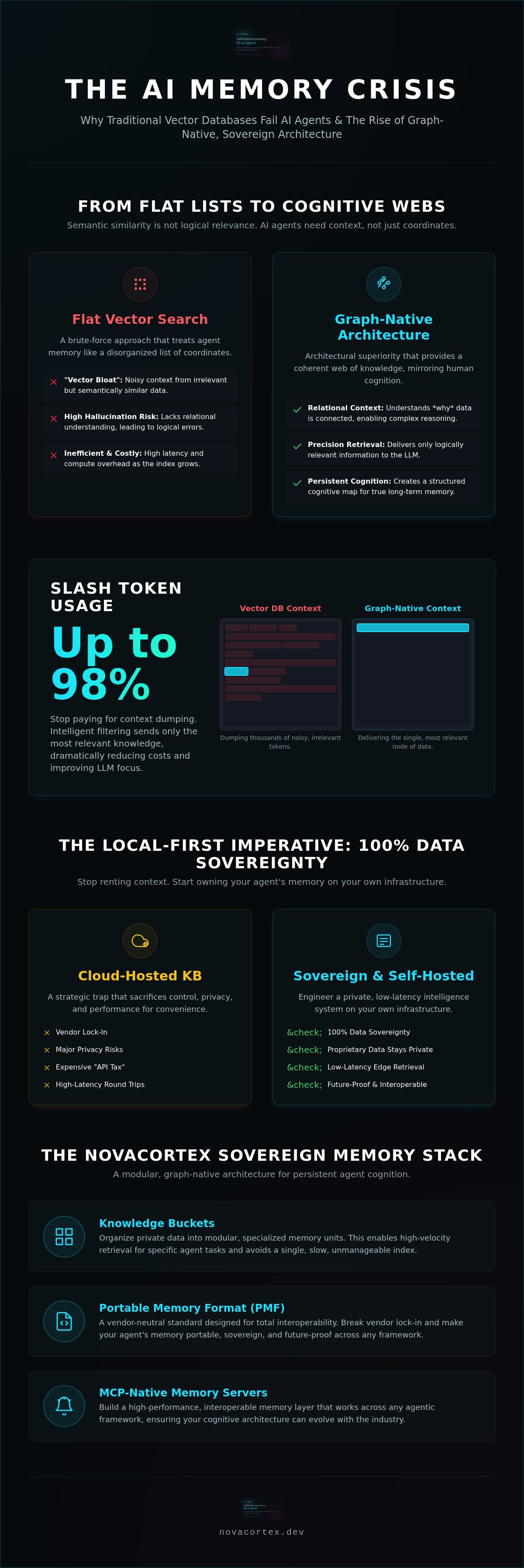
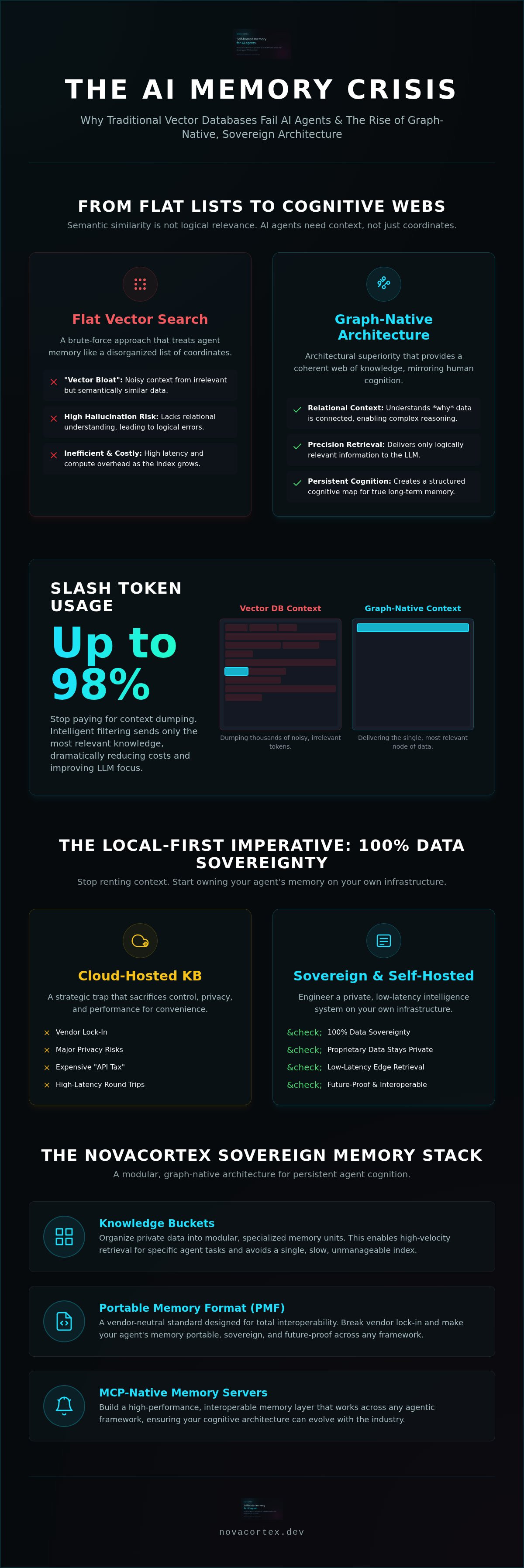
We're seeing the rise of "Vector Bloat." This occurs when you dump thousands of embeddings into a flat index without a relational hierarchy. The result is a noisy context window. Your agent receives chunks of data that are semantically similar but logically irrelevant. This isn't just inefficient; it's the primary driver of hallucinations in complex workflows. Digital sovereignty requires a better path. You need to own the structure of your data, not just its coordinates.
Why Flat Vectors Fail
Semantic similarity is not logical relevance. In a high-stakes engineering workflow, an agent needs to understand the relationship between a variable and its function, not just find sentences that sound similar. Flat vector stores ignore these connections. The hidden cost of high-dimensionality is staggering. You face increased latency and massive compute overhead as your index grows. Even with a massive 1M token context window, agents still "forget" or lose the thread because they lack a cognitive map. Without a graph-native structure, your agent is just guessing based on proximity.
Local First Imperative
Privacy is a functional requirement. If your knowledge base lives in a cloud-hosted provider, you've already lost control. You're paying an "API tax" to vendors while sacrificing data sovereignty. A true local vector database alternative keeps your memory layer on private infrastructure. This ensures low-latency retrieval at the edge. It eliminates the round-trip delay of cloud lookups. More importantly, it guarantees that your proprietary data never leaves your environment. You aren't just building an app; you're engineering a sovereign intelligence system that functions without a third-party umbilical cord. Stop renting context. Start owning memory.
Graph-Native Memory Architecture
Flat vector stores are essentially lists of floating-point numbers. They lack inherent logic. They rely on semantic proximity, which is a weak proxy for understanding. Graph-native architecture is different. It's a web of semantic relationships that mirrors how human cognition actually functions. We don't store facts in isolation; we store associations. This structural advantage makes graph-native systems the superior local vector database alternative for engineers who prioritize precision over simple proximity.
We use Knowledge Buckets to organize this agent state. Instead of one giant, unmanageable index that grows more expensive with every query, buckets allow for modular, specialized memory units. This precision results in a staggering 98% reduction in token usage. You stop feeding the LLM irrelevant context. You send only the exact nodes required for the specific task. If you're building for scale, you can audit our open-source implementation to see how this architecture handles complex state without the bloat.
Engineering Persistent Cognition
Most agents struggle with multi-hop reasoning. They can't follow a trail of evidence across disjointed data chunks because their memory layer doesn't understand "why" two pieces of information are linked. By storing knowledge as entities and relationships rather than isolated text chunks, you enable your agent to traverse the graph logically. This is the core of AI agent long term memory. You aren't just retrieving text; you're providing a structured cognitive map. This eliminates the "lost in the middle" problem where agents ignore critical data buried in a massive context window.
Portable Memory Format (PMF)
Proprietary vector formats are a strategic trap. They create vendor lock-in that's difficult and expensive to break once your dataset reaches scale. The Portable Memory Format for AI is the technical antidote. It's a vendor-neutral standard designed for total interoperability. PMF ensures your agent's memory isn't tied to a specific cloud provider or a restricted database engine. It makes your memory layer portable, sovereign, and future-proof. You can move your entire knowledge base between different local environments or agent frameworks without re-indexing or losing the relational metadata that makes your agent smart.
Comparing Local Vector Alternatives
Building a local stack requires choosing the right primitive. Redis and Chroma are common starting points for many developers. Redis offers blistering in-memory speed for basic semantic lookups. Chroma provides a simplified entry point for engineers who want to get a local vector index running in minutes. However, these tools share a common flaw: they treat your agent's memory as a flat list. NovaCortex serves as the specialized local vector database alternative that introduces graph-native precision to the local environment, allowing for complex associative reasoning that flat stores cannot replicate.
Deployment flexibility is a major differentiator. You can deploy these local alternatives on a standard VPS or even a Raspberry Pi 5 at the edge. The total cost of ownership (TCO) over a 12-month period for local infrastructure is predictable and lean. While managed vector providers often hide costs behind egress fees and tiered seat pricing, a self-hosted instance costs only the flat monthly compute fee. This makes the local vector database alternative the only viable path for builders who refuse to let their infrastructure costs scale linearly with their data volume.
Redis vs Graph Memory
Redis is a world-class cache, but it's a poor memory layer for autonomous agents. When your agent needs to maintain long-term state across disparate sessions, a simple key-value store or flat vector index falls apart. You encounter "context drift" where the agent loses the logical thread of a multi-step project. Deciding between Redis vs Graph Memory for AI Agents is a question of architectural intent. If you only need fast similarity search, Redis works. If you need engineering-grade persistent state, you need the relational depth of a graph.
The Self-Hosted RAG Advantage
Local execution destroys cloud-based latency. Cloud RAG introduces a network round-trip that typically adds 200ms to 500ms of delay per retrieval step. Running your memory server on optimized local hardware brings that latency down to sub-50ms levels. This speed is critical for agents performing real-time tasks where every millisecond counts. Security benefits are equally absolute. By keeping knowledge bases within your own firewall, you eliminate the risk of proprietary data leakage to third-party providers. Knowledge Buckets further enhance this by providing a modular scalability path. You can synchronize specific segments of knowledge across multiple agents without the overhead of duplicating an entire index. This ensures your stack remains high-velocity as your data grows.
Engineering Local Sovereignty
Deploying a local vector database alternative requires more than just a storage engine. It requires a standardized protocol for agent communication. While many developers attempt to hack together DIY solutions using basic relational databases, these setups often lack the specialized interface needed for agentic reasoning. True digital sovereignty is achieved by implementing a dedicated memory layer that communicates through the Model Context Protocol (MCP). This ensures your local data remains interoperable with any agentic framework, from LangChain to AutoGPT, without requiring custom glue code for every integration.
Managing Knowledge Buckets in production demands a disciplined approach to data isolation. You should scope buckets to specific agent roles or project domains to prevent cross-contamination of context. This modularity allows you to hot-swap memory segments as project requirements evolve. It's the difference between a cluttered, monolithic index and a high-performance cognitive stack. Production-ready local memory doesn't just store data; it manages the lifecycle of knowledge to ensure your agents remain sharp and responsive over months of operation.
Deploying the MCP Memory Server
The technical requirements for running NovaCortex on private infrastructure are intentionally lean. You can host the MCP Native Memory Server as a lightweight Docker container or a standalone binary on any Linux-based VPS. The setup process involves defining secure paths between your AI agents and your local data volumes. This architecture ensures that your agent's memory is physically located on hardware you control. You're not just avoiding cloud latency; you're building a fortress around your proprietary knowledge. Once the server is live, agents connect via standard MCP prompts, making the retrieval process as seamless as a local function call.
Optimizing Context Retrieval
Precision is the enemy of waste. To maximize efficiency, implement tiered retrieval strategies that prioritize graph-native relationships over simple semantic similarity. Graph-based RAG allows the agent to pull in "neighbor" nodes that provide necessary background info without bloating the prompt. This structural awareness is what makes a graph-native local vector database alternative so effective for multi-step reasoning tasks. Context pruning reduces prompt noise by up to 90% while maintaining the semantic integrity required for complex decision-making. By filtering out the irrelevant "similarity" hits that plague flat vector stores, you preserve your context window for the data that actually matters.
NovaCortex: The Sovereign Alternative
NovaCortex isn't just another tool in the stack. It's a fundamental correction to a broken industry standard. While cloud providers trap your data in proprietary silos, we provide the tools for total digital independence. NovaCortex Self-Hosted Edition is the definitive local vector database alternative for engineers who refuse to compromise on architectural integrity. It replaces bloated, flat-index systems with a lean, graph-native memory layer designed for high-velocity performance and absolute privacy.
We've engineered this system to be privacy-first and vendor-neutral from the ground up. You own the infrastructure. You own the memory. You own the results. Our tiered subscription model provides advanced management features for enterprise-grade deployments, ensuring you have the specialized tools required for complex, multi-agent synchronization. This is more than a database; it's a sovereign intelligence layer that functions wherever you choose to deploy it.
Why NovaCortex is Non-Negotiable
The cycle of vendor lock-in ends here. By utilizing the Portable Memory Format (PMF), we ensure your agent's knowledge remains fluid and interoperable. You're no longer tethered to a specific provider's embedding format or retrieval logic. This is Why Self-Hosting Your AI Memory Layer is Non-Negotiable in a market that prioritizes extraction over engineering. You achieve 98% token efficiency out of the box. You stop paying for the "context tax" imposed by inefficient, flat vector search. NovaCortex delivers the precise nodes your LLM needs, drastically reducing your API overhead while increasing the accuracy of your agent's reasoning.
Getting Started with NovaCortex
Deploying your local vector database alternative is a streamlined process. You can spin up a NovaCortex instance on any Linux server or VPS in minutes. Our quickstart guide provides the configuration paths needed to bridge your existing agents with a graph-native memory server. We invite you to join the open-source movement under the Apache-2.0 license. Contribute to the memory layer standard and help us build an ecosystem where data sovereignty is the default, not an afterthought. The era of bloated, restrictive AI infrastructure is over. It's time to build on solid ground.
Secure your infrastructure. Deploy NovaCortex Self-Hosted Edition today.
Engineer Sovereign Intelligence
Flat semantic search is a legacy methodology. It's a brute-force approach to a structural problem. Move beyond the limitations of high-dimensional coordinates and adopt a structure that mirrors human reasoning. By implementing a graph-native local vector database alternative, you eliminate the noise of flat indices and provide your agents with the relational depth they need for multi-step tasks. This shift doesn't just improve performance; it secures your infrastructure against vendor lock-in and escalating API costs.
NovaCortex delivers architectural superiority through a 98% token usage reduction and a fully Apache-2.0 open-source framework. You gain the ability to manage persistent cognition on your own terms. Keep proprietary knowledge within your firewall. Avoid the "context tax" of bloated systems. The future of AI isn't in the cloud; it's in sovereign, local memory layers that respect your data and your engineering standards. It's time to build a stack that actually scales.
Take control of your agent's memory. Start engineering for persistence.
Frequently Asked Questions
What is the best local alternative to Pinecone for AI agents?
NovaCortex Self-Hosted Edition is the premier alternative for agents requiring structured memory. Unlike Pinecone's managed cloud service, it provides a graph-native architecture that handles complex relationships rather than just flat semantic similarity. It offers 100% data sovereignty and eliminates the API tax associated with cloud-hosted providers. This local vector database alternative ensures your agent's cognition remains private and high-velocity on your own infrastructure.
Can I run a vector database on a Raspberry Pi?
Yes, you can run optimized local memory servers on a Raspberry Pi 5. While high-dimensionality indices often struggle on limited hardware, NovaCortex is engineered for lean operations. By using Knowledge Buckets to segment data, you keep the compute overhead manageable. This makes it possible to deploy a sophisticated memory layer at the edge without needing expensive server-grade hardware or constant cloud connectivity.
How does graph-native memory reduce LLM token costs?
Graph-native memory reduces costs by delivering only the most logically relevant context to the model. Traditional RAG often dumps thousands of irrelevant tokens into the prompt because it relies on simple proximity search. NovaCortex uses graph traversal to identify precise relationships, which can reduce token usage by up to 98%. You stop paying for noisy context and start feeding the LLM only the specific nodes required for the task.
Is NovaCortex compatible with LangChain and LlamaIndex?
NovaCortex is fully compatible with major frameworks via the MCP-Native Memory Server. Because it uses the Model Context Protocol, it acts as a standardized bridge between your local data and any agentic framework. You don't need to write custom integration code for LangChain or LlamaIndex. It functions as a plug-and-play memory layer that provides persistent context across different sessions and diverse agent architectures.
What is the difference between a vector database and a memory layer?
A vector database is a storage engine for semantic search; a memory layer is a cognitive system for state management. Vector stores treat data as isolated points in a high-dimensional space. A memory layer like NovaCortex uses graph-native structures to understand how those points relate to one another. It enables multi-hop reasoning and long-term context retention that a flat vector index simply cannot support in complex agentic workflows.
How do I migrate my data from a managed vector DB to NovaCortex?
Migration is handled through the Portable Memory Format (PMF). You can export your existing embeddings and metadata into this vendor-neutral standard to avoid lock-in. Once converted, the data is ingested into your local NovaCortex instance where it is transformed into a graph-native structure. This process ensures that your hard-earned knowledge base remains interoperable and sovereign, moving from restricted cloud silos to your private, self-hosted infrastructure.
Does self-hosted AI memory require high-end GPU hardware?
No, high-end GPUs are not a requirement for hosting the NovaCortex memory layer. While GPUs accelerate the initial embedding generation, the actual retrieval and graph traversal processes are highly efficient on standard CPU architectures. You can run a sophisticated local vector database alternative on a basic VPS or consumer-grade hardware. The focus is on architectural precision and lean data structures rather than throwing massive compute at a bloated index.
What is the Model Context Protocol (MCP) and why does it matter for memory?
MCP is an open standard that enables seamless communication between AI models and local data sources. It matters because it eliminates the need for proprietary connectors that lead to vendor lock-in. By using an MCP-Native Memory Server, your agent can access its long-term memory through a standardized interface. This ensures that your memory layer remains future-proof and compatible with the evolving ecosystem of LLMs and agentic tools.
FAQ
What is the best local alternative to Pinecone for AI agents?
NovaCortex Self-Hosted Edition is the premier alternative for agents requiring structured memory. Unlike Pinecone's managed cloud service, it provides a graph-native architecture that handles complex relationships rather than just flat semantic similarity. It offers 100% data sovereignty and eliminates the API tax associated with cloud-hosted providers. This local vector database alternative ensures your agent's cognition remains private and high-velocity on your own infrastructure.
Can I run a vector database on a Raspberry Pi?
Yes, you can run optimized local memory servers on a Raspberry Pi 5. While high-dimensionality indices often struggle on limited hardware, NovaCortex is engineered for lean operations. By using Knowledge Buckets to segment data, you keep the compute overhead manageable. This makes it possible to deploy a sophisticated memory layer at the edge without needing expensive server-grade hardware or constant cloud connectivity.
How does graph-native memory reduce LLM token costs?
Graph-native memory reduces costs by delivering only the most logically relevant context to the model. Traditional RAG often dumps thousands of irrelevant tokens into the prompt because it relies on simple proximity search. NovaCortex uses graph traversal to identify precise relationships, which can reduce token usage by up to 98%. You stop paying for noisy context and start feeding the LLM only the specific nodes required for the task.
Is NovaCortex compatible with LangChain and LlamaIndex?
NovaCortex is fully compatible with major frameworks via the MCP-Native Memory Server. Because it uses the Model Context Protocol, it acts as a standardized bridge between your local data and any agentic framework. You don't need to write custom integration code for LangChain or LlamaIndex. It functions as a plug-and-play memory layer that provides persistent context across different sessions and diverse agent architectures.
What is the difference between a vector database and a memory layer?
A vector database is a storage engine for semantic search; a memory layer is a cognitive system for state management. Vector stores treat data as isolated points in a high-dimensional space. A memory layer like NovaCortex uses graph-native structures to understand how those points relate to one another. It enables multi-hop reasoning and long-term context retention that a flat vector index simply cannot support in complex agentic workflows.
How do I migrate my data from a managed vector DB to NovaCortex?
Migration is handled through the Portable Memory Format (PMF). You can export your existing embeddings and metadata into this vendor-neutral standard to avoid lock-in. Once converted, the data is ingested into your local NovaCortex instance where it is transformed into a graph-native structure. This process ensures that your hard-earned knowledge base remains interoperable and sovereign, moving from restricted cloud silos to your private, self-hosted infrastructure.
Does self-hosted AI memory require high-end GPU hardware?
No, high-end GPUs are not a requirement for hosting the NovaCortex memory layer. While GPUs accelerate the initial embedding generation, the actual retrieval and graph traversal processes are highly efficient on standard CPU architectures. You can run a sophisticated local vector database alternative on a basic VPS or consumer-grade hardware. The focus is on architectural precision and lean data structures rather than throwing massive compute at a bloated index.
What is the Model Context Protocol (MCP) and why does it matter for memory?
MCP is an open standard that enables seamless communication between AI models and local data sources. It matters because it eliminates the need for proprietary connectors that lead to vendor lock-in. By using an MCP-Native Memory Server, your agent can access its long-term memory through a standardized interface. This ensures that your memory layer remains future-proof and compatible with the evolving ecosystem of LLMs and agentic tools.