Long-Term Memory vs Context Window: Engineering Token-Efficient AI in 2026

In 2026, a 10-million token context window isn't an engineering achievement; it is a liability. Brute-force scaling is a trap. It is expensive. It is slow. It is architecturally lazy. You're likely watching your API bills explode as agents hallucinate through the "lost-in-the-middle" fog of bloated prompts. The debate of long-term memory vs context window has shifted from a theoretical discussion to a survival necessity for lean engineering teams who refuse to overpay for performance.
You've likely felt the sting of sending sensitive knowledge bases to managed clouds only to receive inaccurate, high-latency responses. It's a waste of resources and a direct threat to your data sovereignty. This guide shows you how to reclaim control. You will learn to architect a persistent memory layer that uses surgical retrieval to slash token costs by 98%. We are moving beyond the era of volatile context dumping and into the era of self-hosted, graph-native storage that ensures your agents remember what matters without the redundant overhead.
Key Takeaways
- Stop treating volatile context windows like persistent databases. Master the architectural divide between long-term memory vs context window to eliminate redundant data dumping and agent hallucinations.
- Slash API overhead by 98% through surgical context injection. Replace bloated, million-token prompts with precision-engineered retrieval that keeps reasoning sharp and costs sustainable.
- Abandon unreliable vector search for graph-native relational storage. Learn how preserving entity relationships prevents semantic drift and ensures your agents never lose the "needle" in the haystack.
- Implement Dynamic State Pruning to maintain a lean execution environment. Prune redundant observations and inject only mission-critical data to solve the "lost-in-the-middle" density problem.
- Reclaim data sovereignty by deploying NovaCortex Self-Hosted Edition. Utilize an MCP-native memory server to secure your knowledge base and eliminate reliance on restrictive, managed vector clouds.
The Token Bloat Crisis: Why Context Windows Fail at Scale
In 2026, the 1-million-token prompt is often marketed as the ultimate solution for AI agents. It's a lie. Engineering teams are discovering that volume does not equal intelligence. The context window is a volatile execution environment, not a database. When you treat it like a storage layer, you're not building a smarter agent; you're building a more expensive one. Brute-forcing context is architecturally lazy and financially unsustainable.
The "Lost in the Middle" phenomenon remains a persistent obstacle. Even with flagship models like GPT-5.5 or Gemini 3.1 Pro, accuracy degrades as the haystack grows. Information buried in the center of a massive prompt is frequently ignored or misinterpreted. This density problem leads to agent hallucinations and instruction-following failures. Beyond accuracy, the latency trade-offs are severe. Time-to-first-token (TTFT) increases significantly as the model parses millions of tokens. For high-velocity agentic workflows, these delays destroy the user experience.
The Hidden Cost of "Infinite" Context
API bills are the first casualty of the context arms race. Processing a 1-million-token input on GPT-5.5 costs $5.00. In a multi-turn agentic loop, these costs compound exponentially. You're paying for the same redundant data over and over. This leads to context saturation, where the model's reasoning capabilities are spread too thin across irrelevant noise. Token Bloat is the engineering bottleneck of 2026, where redundant context data consumes compute resources without delivering proportional reasoning accuracy.
Working Memory vs. Persistent Storage
Understanding the architectural distinction is critical. The context window is the agent's RAM; it's fast, volatile, and expensive. Long-term memory is the SSD; it's persistent, structured, and cost-effective. Relying on the window for long-term state is a recipe for agent amnesia. Once the session ends or the token limit is reached, the agent's "history" vanishes. If you don't separate execution from storage, your agents will never truly learn from their environment.
The shift between long-term memory vs context window isn't just about saving money. It's about precision. By offloading static knowledge to a persistent layer, you keep the context window lean for what it does best: immediate reasoning and task execution. Check out The Context Window Fallacy: Myth-Busting LLM API Cost Reduction for a deeper dive into the economics of this transition. Precision-engineered retrieval is the only way to scale without going broke.
Long-Term Memory vs Context Window: The Architectural Divide
Efficiency in 2026 requires a hard separation of concerns. You must stop treating the prompt as a catch-all bucket for data. The long-term memory vs context window divide is the difference between a system that reasons and a system that merely repeats. A context window is a transient execution environment. It is optimized for immediate reasoning, logic application, and short-term instruction following. It is not designed for storage. When you force it to behave like a database, you introduce noise that degrades the model's cognitive output.
The memory layer serves as a high-fidelity filter. It pre-processes and structures data before a single token reaches the LLM. This architectural shift is supported by recent research into The Foundation of AI Self-Evolution, which highlights how persistent storage allows models to evolve beyond their initial training weights. Instead of a massive knowledge dump, you implement selective context injection. This ensures the model receives only the specific "needles" required for the current task. If you are looking to build truly autonomous systems, you can explore our open-source memory server to see this architecture in practice.
Episodic vs. Semantic Memory Layers
A robust memory architecture requires two distinct layers: episodic and semantic. Episodic memory captures the agent's history, tracking specific interactions, user preferences, and past mistakes. Semantic memory stores world knowledge and entity relationships. Without this structure, agents suffer from session-based amnesia. They forget who the user is the moment the context window resets. By offloading these states to a persistent layer, you create a stable agent identity. Learn more about AI Agent Long Term Memory: Engineering Persistent Cognition in 2026 to understand how to maintain state across millions of sessions.
Precision Retrieval: The 98% Token Reduction Metric
The "context tax" is the primary bottleneck for scaling AI. Every redundant token sent to an API is wasted capital. Traditional "Top-k" vector search often fails here; it returns chunks that are semantically similar but contextually irrelevant. The move toward graph-native retrieval allows for surgical precision. By querying relationships rather than just keyword proximity, you can achieve a 98% reduction in token usage. This isn't just a cost-saving measure. It is a performance requirement. Smaller, more relevant prompts result in higher accuracy and faster response times. The long-term memory vs context window debate ends when you realize that precision always beats volume.
Why Graph-Native Memory Beats Vector Search for Context
Vector search is a blunt instrument. It relies on mathematical proximity in a high-dimensional space; it assumes that because two chunks of text are semantically similar, they are logically relevant. This is the "Semantic Drift" problem. In production, your agent might retrieve a paragraph that looks like the answer but lacks the specific relational logic required for the task. This results in prompt noise and wasted tokens. To achieve architectural superiority, you must move beyond flat embeddings and embrace graph-native storage.
Graph-native memory preserves the relationships between entities. It doesn't just store "User A" and "Project B" as isolated vectors; it stores the specific edge that connects them. When the agent queries its history, it performs a structured Knowledge Graph traversal. This allows for surgical precision. Instead of dumping every "similar" result into the prompt, the system follows the relational path to find the exact "needle" required. This is the only way to balance long-term memory vs context window constraints effectively. You gain high-fidelity retrieval without the bloat of traditional RAG systems.
The Relational Advantage
Context fragmentation is the death of multi-agent systems. If your agents are operating on flat data structures, they lose the hierarchical nuances of complex projects. Graph-native memory maintains a single, relational source of truth that all agents can traverse. This structure is particularly vital for managing complex, hierarchical data where the "who, what, and why" are inextricably linked. For a technical comparison of how this stacks up against traditional key-value stores, read Redis vs Graph Memory for AI Agents: Engineering Token-Efficient Context.
Implementing Knowledge Buckets
Modularity is the antidote to the "everything everywhere" prompt. Knowledge Buckets allow you to segment agent state into portable, retrievable units. This prevents your long-term memory vs context window strategy from devolving into a messy context dump. By using Knowledge Buckets, you can toggle specific memory segments on or off based on the agent's current mission. The Portable Memory Format (PMF) ensures these buckets remain interoperable across different models and environments.
To segment your memory into PMF-compliant buckets, follow this engineering workflow:
- Define Schema: Identify the core entity types (e.g., UserPreferences, TaskHistory) that require persistence.
- Map Relational Edges: Explicitly define how these entities relate to one another to prevent context loss during retrieval.
- Serialize to PMF: Export the segmented data into a PMF-compliant JSON structure. This ensures your knowledge base is not locked into a specific vendor's vector cloud.
This approach transforms your agent's memory from a chaotic pile of text into a high-velocity relational engine. You aren't just fitting more data into the window; you're ensuring only the right data ever gets there.
5 Techniques to Optimize AI Context Windows
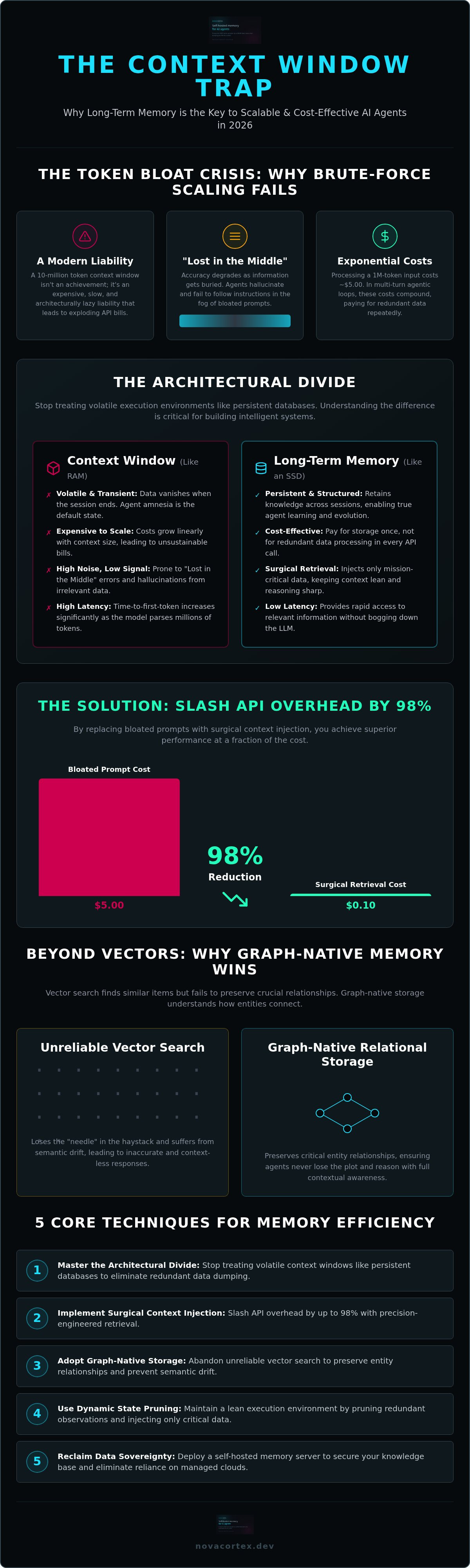
Optimization is a game of subtraction. In the battle of long-term memory vs context window, the winner is the engineer who sends the smallest, most relevant prompt. Brute-forcing a million-token window is a failure of architecture. You must implement precision-engineered techniques to maintain high-velocity performance without the context tax. Efficiency isn't just about saving money; it is about ensuring the model's attention is focused on the data that actually moves the needle.
- Dynamic State Pruning: Your agent doesn't need to see every intermediate thought or redundant observation. Prune stale data points and temporary variables before they hit the prompt to maintain a clean execution environment.
- Selective Context Injection: Use graph-native queries to retrieve only the specific entity relationships required for the current task. This eliminates the "lost-in-the-middle" fog and keeps reasoning sharp.
- Portable Memory Formats (PMF): Standardize your data using PMF. This reduces the token overhead caused by inconsistent JSON schemas or bloated Markdown formatting, allowing more room for actual logic.
- MCP-Native Integration: Adopt the Model Context Protocol for low-latency memory access. This decouples the memory layer from the model provider, ensuring your agent can access its history in sub-10ms intervals.
- Self-Hosted Indexing: Move the heavy lifting of retrieval to local infrastructure. This ensures full data sovereignty and removes the round-trip latency inherent in managed vector clouds.
Standardizing with MCP
The Model Context Protocol (MCP) is the "USB-C" of AI memory. It provides a universal interface between your agents and their knowledge bases. By using an MCP-native memory server, you build interoperable systems that aren't locked into a single model provider's ecosystem. You can swap memory layers or upgrade your LLM without rewriting a single line of retrieval code. This is the foundation of architectural independence in 2026.
Context Pruning and Compression
Lossy summarization is an outdated relic that strips away the nuance your agents need for complex reasoning. The industry is shifting toward lossless surgical retrieval. You must rank context relevance with mathematical precision before prompt construction. This ensures that every token in the window earns its place. By ranking observations based on relational importance rather than just keyword frequency, you solve the density problem once and for all. For a deep dive into these ranking algorithms, see Context Management for AI Agents: Engineering Persistent Memory in 2026.
Reclaiming Sovereignty: Deploying NovaCortex for Memory Efficiency
Managed vector clouds are the new rent-seekers of the AI stack. They promise ease of use but deliver vendor lock-in, high latency, and significant security risks. Sending your entire organizational knowledge base to a third-party managed service is a strategic liability. To achieve true performance, you must reclaim your infrastructure. The long-term memory vs context window trade-off is best resolved on hardware you control. Self-hosting is the only path to digital sovereignty.
Deploying the NovaCortex Self-Hosted Edition on your local infrastructure eliminates the round-trip latency of managed clouds. It provides a dedicated, graph-native memory layer that sits directly alongside your agentic workflows. By using the MCP-native memory server, you establish a high-speed, standardized link between your agents and their persistent state. This isn't just about privacy; it is about architectural velocity. Local retrieval is faster, more secure, and infinitely more cost-effective than proprietary alternatives.
The results in production are undeniable. When you move retrieval to a self-hosted graph layer, you stop the "context dumping" habit that inflates API bills. Benchmarks in high-concurrency environments show a 98% reduction in token overhead. You aren't just saving money. You're building a system that is more resilient to the "lost-in-the-middle" failures that plague bloated prompts. Sovereignty pays for itself in both security and system performance.
Ending Vendor Lock-in
Proprietary vector databases want to keep your data behind their walled gardens. They use opaque formats that make migration a nightmare. We reject this. The Portable Memory Format (PMF) ensures that your knowledge base remains yours. It is a standardized, open schema that allows you to move your memory buckets between different models and environments without friction. Moving from a proprietary cloud to open-source graph memory is the first step toward building a future-proof AI stack.
Next Steps for Builders
The era of wasteful AI architecture is ending. Sovereign engineers are moving away from brute-force context scaling and toward precision-engineered memory layers. You can access the NovaCortex open-source repository today to start building. Join a community of developers who prioritize lean operations, data ownership, and high-velocity performance. The tools for independence are ready. It is time to stop overpaying for inefficient context and start building smarter, sovereign agents.
Architecting the Sovereign AI Future
The era of bloated context is dead. Engineering for 2026 demands a fundamental shift from transient prompts to persistent, graph-native intelligence. You've seen the data. Brute-force scaling is a financial trap that leads to hallucinations and instruction failure. By mastering the divide of long-term memory vs context window, you reclaim control over your data and your budget. It's the difference between a temporary workspace and a permanent knowledge engine.
Precision retrieval isn't just a cost-saving measure; it's a performance requirement for any production-grade agent. Moving to an MCP-native memory server ensures your agents remain interoperable and sovereign across any LLM provider. You can slash token usage by 98% while ensuring full data privacy through an Apache-2.0 licensed, self-hosted architecture. This is how you build for scale without sacrificing security or speed. Stop renting your agent's memory from restrictive, managed clouds.
Take the lead in this architectural correction. Build systems that actually learn, retain, and evolve. The tools for digital sovereignty are ready for deployment.
Frequently Asked Questions
How does long-term memory differ from a large context window?
Long-term memory is persistent, structured storage that survives session resets, while a context window is volatile working memory that clears once the session ends or the token limit is reached. The architectural shift between long-term memory vs context window is about moving from execution to persistence. Instead of dumping every data point into the prompt, you store state in a relational layer and inject only the specific context required for the current task.
Can I use NovaCortex to reduce my OpenAI or Anthropic API bills?
Yes, NovaCortex reduces API costs by eliminating redundant context dumping and "lost-in-the-middle" bloat. Instead of sending a million tokens of history to OpenAI or Anthropic for every turn, you utilize surgical retrieval to send only the specific nodes required. This approach reduces input token counts by up to 98% in production environments, directly slashing your monthly inference spend.
What is the Model Context Protocol (MCP) and why is it important for memory?
The Model Context Protocol (MCP) is the universal interface for low-latency memory access between AI agents and data sources. It is critical because it decouples your agent's reasoning from its storage layer. By using an MCP-Native Memory Server, you build interoperable systems that allow you to swap LLM providers or upgrade models without rebuilding your entire memory infrastructure or losing persistent state.
How does graph-native storage improve AI agent retrieval precision?
Graph-native storage preserves the relational edges between entities rather than just their mathematical similarity in a vector space. Traditional vector search often returns semantically similar but contextually irrelevant "noise." By traversing a knowledge graph, agents identify the exact relationships required for a query, ensuring higher precision and fewer hallucinations in complex, hierarchical reasoning tasks.
What is a Portable Memory Format (PMF) and how does it prevent lock-in?
The Portable Memory Format (PMF) is an open-standard schema that ensures your data remains independent of any specific model or cloud provider. It allows you to move your Knowledge Buckets between different platforms and local environments with zero friction. PMF is the engineering solution to vendor lock-in, ensuring you own the data, the schema, and the infrastructure permanently.
Is self-hosting an AI memory layer difficult for a small engineering team?
No, the NovaCortex Self-Hosted Edition is designed for rapid deployment on standard local infrastructure. It is an Apache-2.0 open-source project built for lean engineering teams who prioritize privacy and cost control over managed service convenience. You don't need a dedicated DevOps department to maintain a high-performance, sovereign memory layer.
How much can I actually save on tokens by using a dedicated memory layer?
You can achieve a 98% reduction in token overhead by moving from brute-force context dumping to precision-engineered retrieval. In the long-term memory vs context window architecture, you stop paying for the same redundant data in every multi-turn interaction. You only pay for the reasoning tokens and the exact context "needle" required for the specific execution turn.
Does NovaCortex work with existing RAG pipelines?
Yes, NovaCortex integrates with existing RAG pipelines as an architectural enhancement to improve retrieval logic. While traditional RAG relies on flat vector search, NovaCortex adds a graph-native layer to preserve entity relationships and hierarchy. It acts as the necessary correction that makes your existing agentic workflows more efficient, accurate, and cost-effective.
FAQ
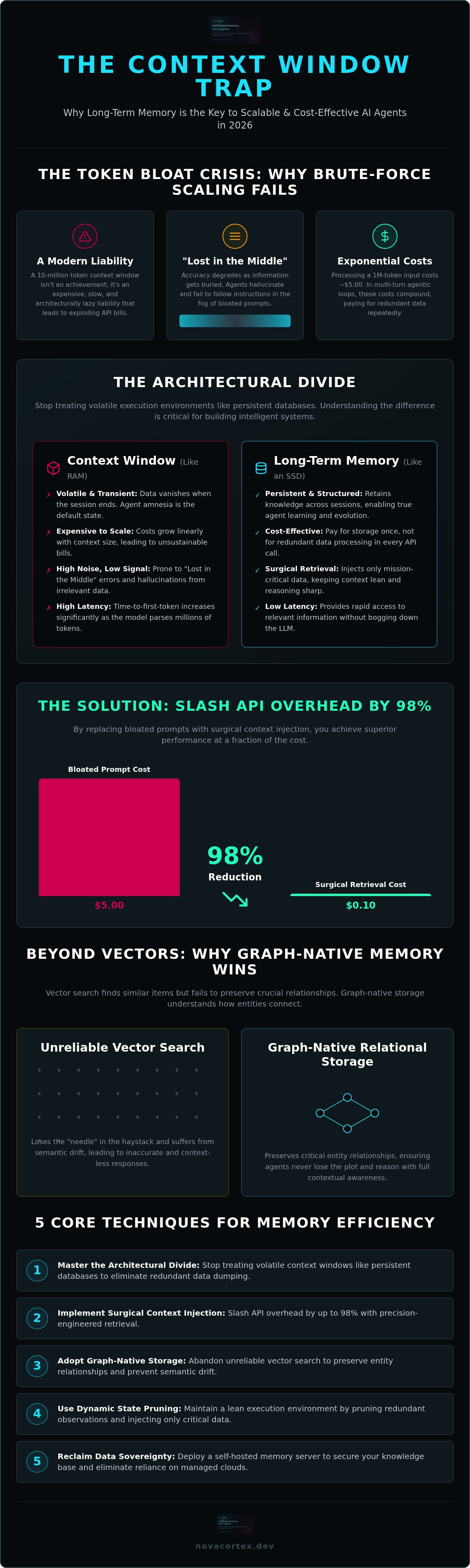
How does long-term memory differ from a large context window?
Long-term memory is persistent, structured storage that survives session resets, while a context window is volatile working memory that clears once the session ends or the token limit is reached. The architectural shift between long-term memory vs context window is about moving from execution to persistence. Instead of dumping every data point into the prompt, you store state in a relational layer and inject only the specific context required for the current task.
Can I use NovaCortex to reduce my OpenAI or Anthropic API bills?
Yes, NovaCortex reduces API costs by eliminating redundant context dumping and "lost-in-the-middle" bloat. Instead of sending a million tokens of history to OpenAI or Anthropic for every turn, you utilize surgical retrieval to send only the specific nodes required. This approach reduces input token counts by up to 98% in production environments, directly slashing your monthly inference spend.
What is the Model Context Protocol (MCP) and why is it important for memory?
The Model Context Protocol (MCP) is the universal interface for low-latency memory access between AI agents and data sources. It is critical because it decouples your agent's reasoning from its storage layer. By using an MCP-Native Memory Server, you build interoperable systems that allow you to swap LLM providers or upgrade models without rebuilding your entire memory infrastructure or losing persistent state.
How does graph-native storage improve AI agent retrieval precision?
Graph-native storage preserves the relational edges between entities rather than just their mathematical similarity in a vector space. Traditional vector search often returns semantically similar but contextually irrelevant "noise." By traversing a knowledge graph, agents identify the exact relationships required for a query, ensuring higher precision and fewer hallucinations in complex, hierarchical reasoning tasks.
What is a Portable Memory Format (PMF) and how does it prevent lock-in?
The Portable Memory Format (PMF) is an open-standard schema that ensures your data remains independent of any specific model or cloud provider. It allows you to move your Knowledge Buckets between different platforms and local environments with zero friction. PMF is the engineering solution to vendor lock-in, ensuring you own the data, the schema, and the infrastructure permanently.
Is self-hosting an AI memory layer difficult for a small engineering team?
No, the NovaCortex Self-Hosted Edition is designed for rapid deployment on standard local infrastructure. It is an Apache-2.0 open-source project built for lean engineering teams who prioritize privacy and cost control over managed service convenience. You don't need a dedicated DevOps department to maintain a high-performance, sovereign memory layer.
How much can I actually save on tokens by using a dedicated memory layer?
You can achieve a 98% reduction in token overhead by moving from brute-force context dumping to precision-engineered retrieval. In the long-term memory vs context window architecture, you stop paying for the same redundant data in every multi-turn interaction. You only pay for the reasoning tokens and the exact context "needle" required for the specific execution turn.
Does NovaCortex work with existing RAG pipelines?
Yes, NovaCortex integrates with existing RAG pipelines as an architectural enhancement to improve retrieval logic. While traditional RAG relies on flat vector search, NovaCortex adds a graph-native layer to preserve entity relationships and hierarchy. It acts as the necessary correction that makes your existing agentic workflows more efficient, accurate, and cost-effective.