Low-Latency AI Memory: Engineering High-Velocity Context for Agents

Your current vector database is a bottleneck masquerading as an infrastructure solution. While cloud-based providers promise scalability, they often deliver high-latency round trips and bloated context windows that hemorrhage tokens. You've likely felt the friction of an agent that pauses for seconds just to remember a simple user preference. This isn't just a minor delay. It's a systemic failure of architectural efficiency that creates vendor lock-in and erodes your data sovereignty. True low-latency AI memory requires a fundamental shift away from these restrictive, slow-moving systems.
We agree that the status quo is unsustainable for high-performance engineering. You shouldn't have to choose between agent intelligence and operational speed. This article demonstrates how to eliminate architectural bottlenecks to achieve sub-millisecond retrieval and reduce API costs by up to 98% through extreme token efficiency. We will examine the transition from centralized vector stores to self-hosted, graph-native architectures. You'll discover how the Model Context Protocol (MCP) and Portable Memory Formats (PMF) eliminate the memory tax and return complete control to the builder. It's time to stop overpaying for slow context and start engineering for high-velocity performance.
Key Takeaways
- Identify the "latency tax" in agentic workflows and learn why total time to context integration is the only metric that matters for autonomy.
- Analyze why graph-native architectures outperform traditional vector search by enabling direct relationship traversal for high-cardinality data.
- Eliminate cloud-induced bottlenecks by deploying low-latency AI memory layers locally, bypassing the speed-of-light limitations of managed API services.
- Standardize context delivery with MCP-native memory servers to strip away middleware bloat and ensure high-velocity agent response times.
- Achieve complete data sovereignty and slash token waste by 98% using Portable Memory Formats (PMF) and modular Knowledge Buckets.
Defining Low-Latency AI Memory: Beyond Network Speed
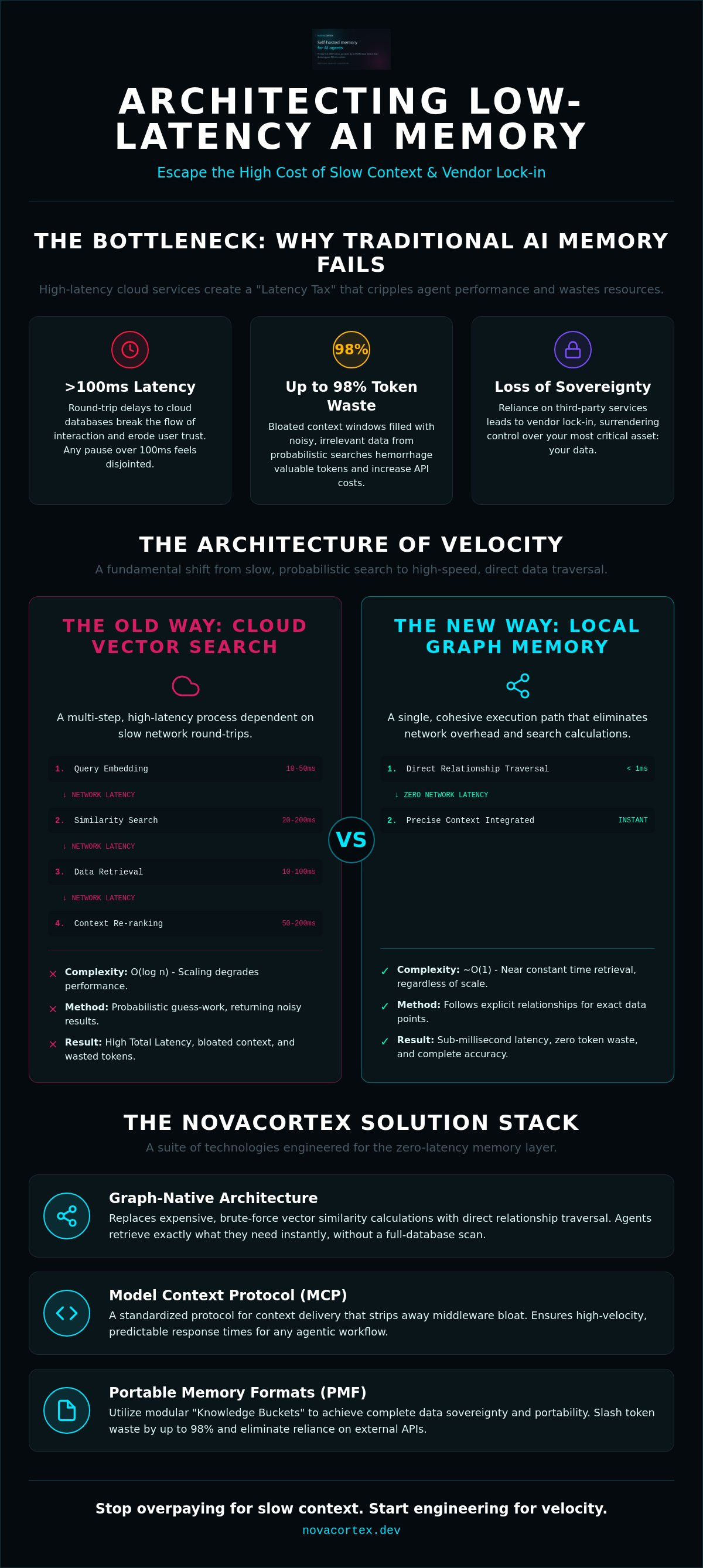
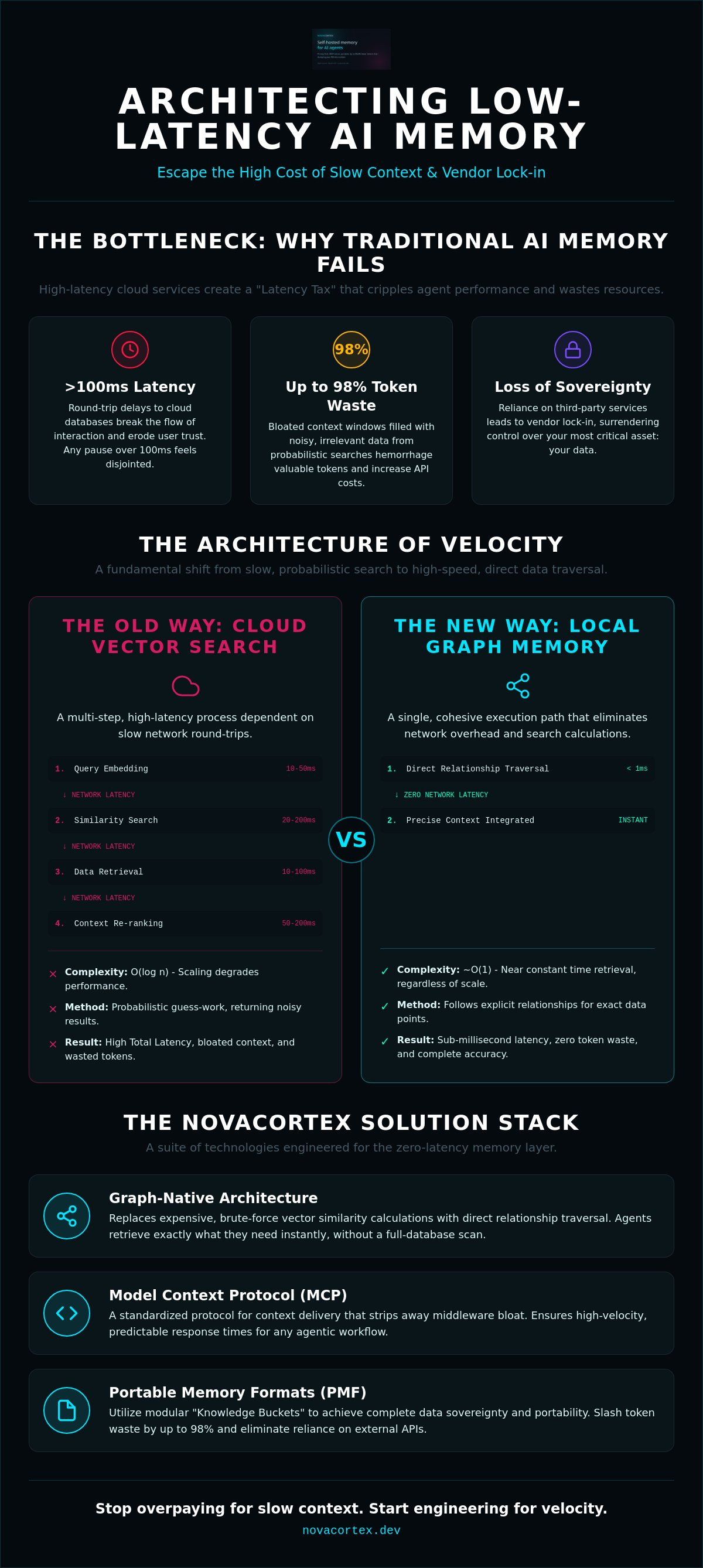
Performance is often reduced to a single network ping. This is a mistake. In the context of agentic systems, low-latency AI memory represents the total elapsed time from the moment an agent issues a query to the exact millisecond that context is integrated into the model's inference window. It's an end-to-end metric. If your vector database responds in 20ms but your re-ranking logic takes 200ms, your agent is effectively blind during that window. This delay is the "Latency Tax." It's a compound interest of inefficiency that kills agent autonomy by forcing models to wait on data rather than acting upon it.
We must distinguish between Time to First Token (TTFT) and Context Retrieval Latency (CRL). While the industry obsesses over how fast an LLM starts talking, CRL determines how much the LLM actually knows when it starts. A fast TTFT with a slow CRL results in confident hallucinations based on stale or missing data. High-velocity agents require CRLs that match the speed of thought. Achieving this means moving beyond the 100ms+ round-trips inherent in cloud-based vector stores. Physical distance matters. Forging a path to sub-millisecond speeds requires local, optimized infrastructure that treats Memory latency as a primary architectural constraint rather than a secondary concern.
The Anatomy of a Memory Request
Every memory request follows a rigid lifecycle. It begins with query embedding, followed by a similarity search, data retrieval, and finally, re-ranking for relevance. Standard RAG architectures fail because they treat these as disconnected steps. Network overhead between the embedding model and the database is the first bottleneck. Unoptimized indexing is the second. Architectural latency is the cumulative delay introduced by the structural design of the data retrieval pipeline, independent of the underlying hardware's raw processing power. To build low-latency AI memory, you must collapse these layers into a single, cohesive execution path.
Why Real-Time Agents Demand Sub-100ms Retrieval
Latency is a silent killer of user trust. When a human interacts with an agent, any delay over 100ms feels disjointed. It breaks the flow of collaboration. In multi-agent systems, the stakes are even higher. Slow memory causes "context drift." This occurs when an agent makes a decision based on data that has already been superseded by another agent's action. Speed isn't just about user experience; it's about decision-making accuracy. Faster retrieval allows for more frequent state checks and tighter feedback loops. If an agent can't remember the last three seconds of a conversation in under 50ms, it isn't an assistant. It's a bottleneck.
Graph-Native vs. Vector Search: The Architecture of Velocity
Vector databases are often marketed as the ultimate memory solution for AI. They aren't. They're search engines built on probabilistic guesses. While vector search is excellent for broad semantic matching, it fails as a foundation for low-latency AI memory when agents require precise, relational context. Searching through high-dimensional space is essentially a brute-force operation. As your dataset grows, the computational cost of calculating cosine similarity across millions of embeddings scales poorly. You're left with a choice: sacrifice speed for accuracy or accept "noisy" results that bloat your context window with irrelevant data.
Graph-native storage replaces these expensive calculations with direct relationship traversal. Instead of scanning a massive index to find "similar" items, a graph-native architecture allows an agent to follow a specific edge from one data point to the next. This shifts the retrieval pattern from O(log n) complexity to near O(1). NovaCortex utilizes these graph structures to bypass the brute-force math that slows down traditional RAG pipelines. By treating memory as a web of connected entities rather than a flat list of vectors, agents can retrieve exactly what they need without the overhead of a full-database scan.
The Vector Bottleneck: Why Embedding Search Slows Down
The primary cost of vector search isn't just the initial query; it's the inevitable re-ranking step. Because vector space is often crowded with semantically similar but contextually irrelevant noise, developers must pull hundreds of results and use a secondary model to filter them. This adds massive architectural latency. Every re-ranking operation is another model call, another network hop, and another 100ms delay. When you rely on bloated context to compensate for poor retrieval, you aren't just paying in time. You're paying in tokens. A system that retrieves 5,000 words of "maybe" is always slower than a system that retrieves 50 words of "exactly."
Graph-Native Advantages for Agentic Cognition
Agents don't just need to find similar text. They need to follow logic. Research into the neural mechanisms of working memory suggests that biological systems rely on structured, active pathways rather than exhaustive searches. By implementing high-performance AI memory that maps complex knowledge dependencies, you allow your agents to "follow" a thought across nodes. If an agent is querying a specific user preference, it shouldn't search the entire history. It should traverse the "User" node directly to the "Preference" node. This structured approach reduces the need for massive context injections, keeping your prompts lean and your response times fast. To see how this architecture functions in a live environment, you can explore the NovaCortex implementation on GitHub.
Self-Hosting and Local Retrieval: Eliminating Cloud Overhead
Physical distance is the final frontier of system performance. You can optimize your code for weeks, but you cannot outrun the speed of light. Cloud-managed vector databases introduce unavoidable network latency, often adding 100ms or more per request simply due to the geographic gap between your agent and the data center. For a complex agent performing five memory lookups per turn, that's a half-second of dead air. Deploying a self-hosted AI memory layer brings the data directly to the compute. It eliminates unnecessary hops across the public internet. This isn't just about raw speed. It's about engineering digital sovereignty.
The "Privacy-Speed Tradeoff" is a false choice. Traditional wisdom suggests that managed services offer convenience at the cost of latency and data privacy. Self-hosting solves both simultaneously. By running your memory stack on a local VPS or even a Raspberry Pi at the edge, you keep sensitive data within your own perimeter while achieving low-latency AI memory performance that cloud providers cannot match. You own the hardware. You own the data. You own the velocity. Local retrieval ensures that your agent's cognition is as private as it is fast.
Benchmarking Cloud vs. Local Latency
Managed instances of cloud vector stores typically face latencies ranging from 50ms to 200ms depending on region and traffic load. In contrast, local graph databases operating on the same network or machine drop this figure to sub-10ms. In multi-turn agent conversations, these milliseconds compound. A three-agent swarm communicating over a cloud memory layer becomes sluggish and prone to desynchronization as they wait for state updates. Moving your memory architecture to the edge reduces end-to-end retrieval latency by up to 90% compared to cloud-only RAG pipelines. It transforms a stuttering agent into a real-time collaborator.
Reducing Token Waste to Accelerate Inference
System speed is a function of data volume. Massive context injections slow down LLM processing times and drain your budget. NovaCortex implements a mechanism that achieves a 98% token usage reduction by retrieving only the most relevant, high-density knowledge nodes rather than dumping entire documents into the prompt. Smaller context windows don't just save money. They accelerate inference. When the model has 200 tokens to process instead of 10,000, the time it takes to generate a response drops significantly. Token efficiency is the engine of system velocity. Lean context leads to instant action.
MCP-Native Memory: Standardizing Speed with Protocol Efficiency
Middlewares are the silent killers of system performance. Most RAG implementations are held together by brittle, high-latency glue code that translates agent queries into database-specific syntax. This translation layer is pure architectural bloat. The Model Context Protocol (MCP) acts as a speed multiplier by standardizing how models interact with external data sources. By deploying an MCP native memory server, you strip away the unnecessary translation layers and establish a direct, low-latency pipe between the LLM and its long-term storage. This architectural collapse is essential for achieving true low-latency AI memory. Standardized protocols ensure that your memory stack remains vendor-neutral, preventing the performance decay associated with proprietary, black-box APIs that prioritize their own ecosystem over your agent's velocity.
Current industry standards often force developers to build complex adapters for every new agentic framework. This is a waste of engineering resources. Standardizing on MCP allows for a "write once, retrieve anywhere" approach to memory. It creates a unified interface that treats memory as a first-class citizen of the AI stack rather than a secondary attachment. When the model and the memory speak the same language, the friction of data exchange disappears. You're no longer fighting the infrastructure; you're leveraging it for maximum throughput.
Implementing MCP for Instant Context Injection
Configuring an MCP-native server is a pragmatic move toward architectural leanness. It removes the massive serialization and deserialization overhead that plagues traditional memory transfers. Instead of converting data through multiple intermediate formats, MCP allows for a streamlined flow of information directly into the agent's context window. This protocol-level efficiency also enables agents to maintain a consistent state across different frameworks without the need for expensive re-indexing or re-fetching of data. You aren't just moving bits. You're optimizing the path they take to ensure that context arrives exactly when the model needs it.
Knowledge Buckets: Modularizing Memory for Speed
Scanning an entire database for every query is a primitive approach to retrieval. Knowledge Buckets allow you to modularize your memory layer, enabling agents to query specific segments rather than the whole corpus. If an agent only needs technical documentation for a specific task, it shouldn't be forced to sift through gigabytes of unrelated chat logs. This modularity allows for parallelized retrieval across multiple buckets, drastically reducing the total time to context. When combined with vendor-neutral AI storage, Knowledge Buckets provide a scalable foundation for high-speed, sovereign data management. You gain the ability to hot-swap memory modules based on the agent's current task, ensuring that low-latency AI memory remains a reality even as your dataset expands to an enterprise scale.
NovaCortex: Engineering the Zero-Latency Memory Layer
NovaCortex Self-Hosted Edition is the architectural correction the industry requires. It's built for engineers who refuse to compromise on velocity. By utilizing a graph-native storage engine, NovaCortex eliminates the computational overhead inherent in traditional vector search. It doesn't just find data; it maps it. The Portable Memory Format (PMF) ensures your data remains liquid and your infrastructure stays independent. No vendor lock-in. No proprietary black boxes. Just raw, low-latency AI memory engineered for the edge. Whether you're deploying on an enterprise VPS or local hardware like a Raspberry Pi, the performance profile remains consistent: fast, lean, and sovereign.
Our engineering philosophy is simple: reject bloat. We prioritize high-velocity performance over marketing-driven feature creep. NovaCortex is a specialized tool for a specific problem. It provides the persistent, high-density context necessary for agents to function as true autonomous partners. By moving memory to the edge and utilizing the MCP-native protocol, we've collapsed the distance between thought and action. This is the new benchmark for agentic infrastructure.
The NovaCortex Performance Stack
The core of NovaCortex is a graph-native storage engine designed for direct relationship traversal. It bypasses the brute-force math of cosine similarity. This architecture allows for sub-millisecond retrieval on local infrastructure, effectively zeroing out the architectural latency that plagues cloud-based RAG. Integration is seamless. NovaCortex supports popular agent frameworks like LangChain and CrewAI through its MCP-native interface. You get the power of a specialized graph database with the ease of a standard protocol. It's high-velocity context without the integration friction.
Future-Proofing Agent Speed
Persistent context is the next frontier for agentic systems. As agents evolve from simple task-runners to long-term collaborators, their memory must be both permanent and instant. Digital sovereignty is the ultimate performance hack. When you own the memory layer, you control the latency. You aren't at the mercy of a cloud provider's noisy neighbors or fluctuating API response times. Reclaim your agent's speed. Rebuild your stack on a foundation of low-latency AI memory. The future of AI is local, lean, and lightning-fast. Stop waiting for the cloud and start engineering for velocity.
Reclaim Your Agent's Velocity
Infrastructure should never be the bottleneck for intelligence. By shifting from probabilistic vector search to deterministic, graph-native retrieval, you eliminate the noise that slows down agentic decision-making. Standardizing on MCP-native architectures and local deployments effectively zeroes out the "latency tax" of the cloud. You've seen the data. A 98% reduction in token usage isn't just a cost-saving measure. It's a performance mandate that directly accelerates model inference by providing leaner, high-density context windows.
Achieving low-latency AI memory is a matter of engineering discipline. It requires a firm rejection of bloated, managed services that prioritize vendor lock-in over raw throughput. NovaCortex provides the Apache-2.0 open-source foundation you need to build sovereign, high-velocity memory layers. You now have the blueprint to bypass 100ms network round-trips and achieve sub-millisecond context retrieval. Stop settling for stuttering agents and start engineering for instant context.
The tools are ready. The architecture is proven. It's time to build for speed.
Frequently Asked Questions
What is the difference between latency and throughput in AI memory?
Latency measures the time elapsed for a single memory request to complete. Throughput measures the total volume of requests processed in a given window. For agentic systems, latency is the critical bottleneck. High throughput matters for batch processing, but an agent that waits three seconds for a response is broken regardless of how many other queries the system can handle simultaneously.
How does graph-native memory achieve lower latency than vector databases?
Graph-native memory achieves lower latency by replacing probabilistic vector math with direct relationship traversal. Vector databases require exhaustive similarity calculations across high-dimensional space, which scales poorly as datasets grow. In contrast, graph structures allow agents to follow specific pointers between data nodes. This architectural shift moves retrieval from an expensive search operation to a near-instant lookup.
Can I run a low-latency AI memory server on a Raspberry Pi?
You can absolutely run a memory server on a Raspberry Pi or similar edge hardware. NovaCortex is engineered for lean, local deployments that bypass the overhead of cloud infrastructure. By hosting memory on the same local network as your agent, you eliminate the 100ms+ network round-trips inherent in managed services. This makes edge-AI a viable reality for high-performance applications.
Does reducing token usage by 98% actually improve response speed?
Reducing token usage by 98% significantly improves response speed by minimizing the model's processing load. LLMs generate output faster when they aren't forced to parse thousands of irrelevant tokens. By delivering high-density context, you shorten the pre-fill stage of inference. This results in a faster Time to First Token and lower overall operational costs.
What is the Model Context Protocol (MCP) and why does it matter for speed?
The Model Context Protocol (MCP) is an open standard that enables direct communication between LLMs and data sources. It matters for speed because it removes the middleware bloat found in custom RAG implementations. By using an low-latency AI memory stack compatible with MCP, you establish a standardized, high-velocity pipe that eliminates serialization delays and brittle translation layers.
How do I measure the retrieval latency of my current RAG system?
Measure your system's Context Retrieval Latency (CRL) by logging the timestamp from the initial memory query to the moment context is injected into the prompt. Don't confuse this with the model's generation time. You must isolate the retrieval, re-ranking, and injection phases to identify the true architectural bottleneck. Use specialized profiling tools to track these milliseconds across your entire data pipeline.
Is self-hosted memory always faster than cloud-managed AI memory?
Self-hosted memory is almost always faster than cloud-managed alternatives because it eliminates geographic distance. Even the fastest cloud provider is limited by the speed of light across the public internet. Local deployments provide dedicated resources without the "noisy neighbor" issues or rate-limiting common in multi-tenant cloud environments. It's the only way to guarantee sub-millisecond retrieval.
How does the Portable Memory Format (PMF) affect retrieval performance?
The Portable Memory Format (PMF) is designed for high-velocity read and write operations. It avoids the proprietary overhead that slows down data exchange in locked-in ecosystems. By using a standardized format, low-latency AI memory systems can ingest and retrieve data without expensive transformation steps. This ensures that your agent's cognition remains fast even as you migrate between different hardware environments.
FAQ
What is the difference between latency and throughput in AI memory?
Latency measures the time elapsed for a single memory request to complete. Throughput measures the total volume of requests processed in a given window. For agentic systems, latency is the critical bottleneck. High throughput matters for batch processing, but an agent that waits three seconds for a response is broken regardless of how many other queries the system can handle simultaneously.
How does graph-native memory achieve lower latency than vector databases?
Graph-native memory achieves lower latency by replacing probabilistic vector math with direct relationship traversal. Vector databases require exhaustive similarity calculations across high-dimensional space, which scales poorly as datasets grow. In contrast, graph structures allow agents to follow specific pointers between data nodes. This architectural shift moves retrieval from an expensive search operation to a near-instant lookup.
Can I run a low-latency AI memory server on a Raspberry Pi?
You can absolutely run a memory server on a Raspberry Pi or similar edge hardware. NovaCortex is engineered for lean, local deployments that bypass the overhead of cloud infrastructure. By hosting memory on the same local network as your agent, you eliminate the 100ms+ network round-trips inherent in managed services. This makes edge-AI a viable reality for high-performance applications.
Does reducing token usage by 98% actually improve response speed?
Reducing token usage by 98% significantly improves response speed by minimizing the model's processing load. LLMs generate output faster when they aren't forced to parse thousands of irrelevant tokens. By delivering high-density context, you shorten the pre-fill stage of inference. This results in a faster Time to First Token and lower overall operational costs.
What is the Model Context Protocol (MCP) and why does it matter for speed?
The Model Context Protocol (MCP) is an open standard that enables direct communication between LLMs and data sources. It matters for speed because it removes the middleware bloat found in custom RAG implementations. By using an low-latency AI memory stack compatible with MCP, you establish a standardized, high-velocity pipe that eliminates serialization delays and brittle translation layers.
How do I measure the retrieval latency of my current RAG system?
Measure your system's Context Retrieval Latency (CRL) by logging the timestamp from the initial memory query to the moment context is injected into the prompt. Don't confuse this with the model's generation time. You must isolate the retrieval, re-ranking, and injection phases to identify the true architectural bottleneck. Use specialized profiling tools to track these milliseconds across your entire data pipeline.
Is self-hosted memory always faster than cloud-managed AI memory?
Self-hosted memory is almost always faster than cloud-managed alternatives because it eliminates geographic distance. Even the fastest cloud provider is limited by the speed of light across the public internet. Local deployments provide dedicated resources without the "noisy neighbor" issues or rate-limiting common in multi-tenant cloud environments. It's the only way to guarantee sub-millisecond retrieval.
How does the Portable Memory Format (PMF) affect retrieval performance?
The Portable Memory Format (PMF) is designed for high-velocity read and write operations. It avoids the proprietary overhead that slows down data exchange in locked-in ecosystems. By using a standardized format, low-latency AI memory systems can ingest and retrieve data without expensive transformation steps. This ensures that your agent's cognition remains fast even as you migrate between different hardware environments.