MCP Native Memory Server: Engineering Persistent Context for AI Agents

Most AI deployments are bleeding capital through a cycle of repetitive context dumping. It's an engineering failure. Every time you re-upload a knowledge base to maintain a session, you're paying a tax on architectural debt. This statelessness is a massive privacy risk. You shouldn't have to choose between agent performance and data sovereignty. An MCP native memory server solves this by providing a persistent, graph-native layer for agent state.
You're right to be skeptical of third-party memory providers that demand access to your sensitive knowledge. This article shows you how to eliminate AI amnesia and slash token usage by 90% using a vendor-neutral storage model. We'll examine the shift toward local-first architectures and the technical path to building a memory layer that respects your intelligence and your budget. It's time to stop renting context and start owning your agent's cognition. We'll move rapidly from identifying these systemic inefficiencies to providing a technical resolution that scales.
Key Takeaways
- Eliminate the "goldfish memory" problem by replacing inefficient context dumping with persistent, graph-native state management.
- Understand the architectural requirements of a production-grade MCP native memory server to ensure scalability beyond simple reference implementations.
- Slash LLM API costs by 90% through intelligent context pruning and logically relevant retrieval mechanisms.
- Achieve total data sovereignty and eliminate vendor lock-in by leveraging the Portable Memory Format (PMF) within self-hosted environments.
- Deploy NovaCortex to establish a privacy-first, high-velocity memory layer that keeps sensitive knowledge bases under your direct control.
The Statelessness Crisis: Why Standard RAG Fails AI Agents
Current LLM workflows suffer from a fundamental architectural defect: inherent statelessness. Every request is a clean slate. This "goldfish memory" forces developers to re-upload the same world-state with every prompt. It's a brute-force approach to a nuanced problem. While Standard RAG provided a temporary bridge for static document retrieval, it's collapsing under the weight of autonomous agent requirements. Agents don't just need data. They need history, intent, and cross-session continuity.
Dumping entire knowledge bases into a context window is an engineering anti-pattern. It's wasteful. It's slow. Most importantly, it's unreliable. As context windows expand, models face reasoning drift. The signal of the current task is drowned out by the noise of irrelevant history. An MCP native memory server moves the burden of state from the prompt to a persistent, specialized layer. This isn't just about storage. It's about engineering a sovereign cognitive core for your AI.
Token Bloat Economics
Statelessness carries a heavy tax. When agents lack a dedicated memory layer, engineers compensate by prefixing every prompt with massive context blocks. This creates an exponential cost curve. You're paying to process the same tokens over and over. In production environments, this repetitive data processing accounts for a massive chunk of total LLM expenditure. A dedicated memory layer provides a clear ROI by slashing these redundant costs. It replaces the pay-per-recall model with a lean, high-velocity retrieval system that only serves what's necessary for the current step.
Relational Memory Requirements
Vector databases are built for similarity, not logic. They're flat structures. If an agent needs to remember that a specific project was paused because of a budget constraint, a standard vector search might return a dozen irrelevant documents about budgets without connecting the causal link. Semantic similarity is not the same as logical recall. Agents require relational context to maintain multi-step reasoning. Transitioning from simple search to true cognition requires an architecture that understands relationships, not just word embeddings. This shift is the foundation of the MCP native memory server, turning fragmented data into a cohesive, persistent world-model.
Defining the MCP Native Memory Server Architecture
An MCP native memory server is not a glorified API wrapper. It is a fundamental architectural shift. Most developers treat memory as an external database call. They wrap a vector store in a REST endpoint and call it a day. This is a mistake. A native implementation integrates directly into the MCP architecture, operating as a protocol-compliant server that provides resources, tools, and prompts to the host application. It speaks the language of the agent. This direct integration eliminates the translation overhead that plagues standard RAG systems.
The lifecycle of a memory request is precise. When an agent needs context, it doesn't just "search." It queries the server through the MCP transport layer. The server then traverses a graph-native storage engine to retrieve logically linked entities. It doesn't just return text chunks. It returns a structured state. This response is then formatted according to the MCP specification. It ensures the host application can inject it directly into the agent's reasoning loop without additional parsing. It's a closed-loop system designed for speed.
The Protocol Layer: Standardizing Recall
MCP standardizes how agents interact with their own history. It uses a stateless core to scale across standard HTTP infrastructure. This removes the need for complex handshake sessions that slow down execution. By standardizing resources and tools, an MCP native memory server allows different agents to share a unified memory layer. You're no longer locked into a single provider's proprietary SDK. Compliance with the protocol ensures your data remains portable and your architecture remains lean. If you're building for production, you can examine a protocol-compliant implementation to see how these layers interact in real-world environments.
The Storage Layer: Graph-Native Advantage
Flat embeddings are a bottleneck. They lose the relational context that drives complex decision-making. Graph-native storage preserves the "why" behind agent actions by mapping nodes and edges between entities. When an agent retrieves a memory, it sees the connections between a project, a stakeholder, and a specific constraint. This structural awareness is why graph-native systems can reduce token usage by up to 98%. You aren't dumping a whole document. You're serving the exact logical fragment required. It's the difference between reading an entire encyclopedia and looking up a specific cross-referenced fact. This precision is the only way to maintain agent reasoning at scale.
Reference Implementations vs. Production-Grade Memory Layers
Most developers start their journey by cloning the official SDK examples. It's a dangerous shortcut. Reference servers are educational toys designed to demonstrate protocol handshakes, not to survive the rigors of a production environment. They lack the persistence, concurrency controls, and security hardening required for autonomous agent workflows. If your memory layer lives entirely in RAM and wipes itself every time a process restarts, you haven't built a cognitive core. You've built a temporary buffer. A true MCP native memory server must be engineered as a resilient piece of infrastructure, not a weekend experiment.
Educational examples fail at scale because they don't account for the complexity of multi-agent environments. When three different agents attempt to update a shared knowledge bucket simultaneously, reference implementations typically suffer from race conditions or data corruption. Building a production-grade layer requires moving beyond the "hello world" of MCP and implementing a robust storage engine that treats memory as a mission-critical database.
Architectural Requirements for Production Agents
Production agents demand more than just a connection. They require architectural stability. Consider these three pillars of production memory:
- Persistence: Memory must survive server crashes and restarts. This requires a durable storage backend, such as a graph database or a structured document store, that ensures data integrity across sessions.
- Concurrency: In multi-agent systems, simultaneous memory writes are the norm. Your server must implement sophisticated locking mechanisms or atomic operations to prevent context collisions.
- Latency: Context retrieval must happen in sub-100ms intervals. If an agent has to wait seconds for a memory recall, the entire reasoning loop grinds to a halt.
Security and Multi-Tenancy in Memory Servers
Security isn't an afterthought. It's the foundation of digital sovereignty. While cloud-managed memory providers offer convenience, they introduce significant privacy risks by requiring you to send sensitive knowledge bases to third-party servers. A self-hosted MCP native memory server keeps the data within your perimeter, but it still requires rigorous internal security.
Isolation is critical. You must prevent context leakage between different agent tasks. If Agent A is working on sensitive financial data and Agent B is handling public marketing copy, their memory buckets must remain strictly segregated. Furthermore, production servers require robust authentication for every MCP endpoint and a clear audit trail. You need to know exactly how and when an agent modified its own knowledge base. This level of auditability is the only way to ensure your AI systems remain predictable and secure as they scale.
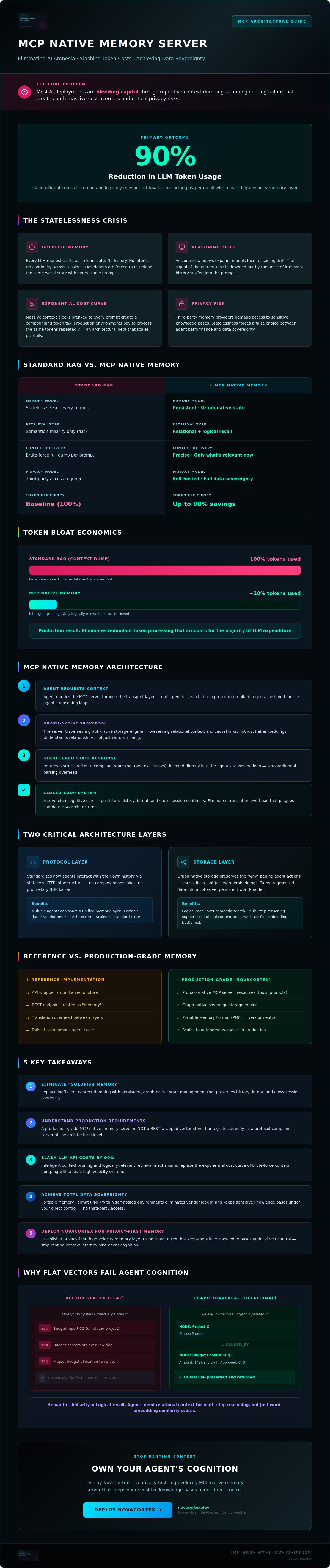
Slashing Token Waste: How MCP-Native Retrieval Optimizes Context
Token waste is not an inevitable cost of AI. It is a symptom of poor architecture. Most agent implementations rely on context dumping, an engineering anti-pattern where the developer stuffs every possible relevant fact into a massive prompt. This approach is lazy and expensive. An MCP native memory server replaces this brute-force method with precision context pruning. By retrieving only what is logically relevant to the current task, you transform the context window from a cluttered storage bin into a high-velocity reasoning space. You stop paying for the noise and start investing in the signal.
Large context windows are often a liability. Models frequently suffer from the "lost in the middle" phenomenon, where critical information buried in the center of a 100k token prompt is ignored or misinterpreted. Graph-native memory solves this by delivering structured, relational fragments. Instead of a 100k token dump, the agent receives a 2k token precision injection of the exact entities and relationships it needs. This 98% reduction in context size doesn't just save money; it dramatically improves reasoning accuracy by keeping the model focused on the objective.
The Science of Context Compaction
Effective memory management requires a shift from simple storage to active state optimization. This involves a dual strategy of summarization and extraction. Old, redundant session data is compacted into high-level summaries, while critical facts are extracted as permanent nodes in a knowledge graph. Automated pruning then removes outdated or contradictory states to prevent reasoning drift. Context compaction is the surgical removal of irrelevant tokens to maximize LLM reasoning density. This process ensures that every token in your prompt is pulling its weight. To implement these optimization strategies in your own stack, you can deploy a production-grade memory server today.
Measuring Retrieval Precision
Benchmarking proves that graph-native recall consistently outperforms flat vector similarity in complex agent workflows. Vector search is great for finding similar-sounding text, but it fails at logical follow-through. If an agent needs to recall a specific decision made three sessions ago regarding a project constraint, a graph-based MCP native memory server traverses the explicit links between those events. It provides grounded relational facts. This precision reduces hallucinations by providing a verifiable chain of context. The result is an agent that stays on task, remembers its constraints, and executes multi-step plans without losing the thread of the conversation.
NovaCortex: Deploying a Sovereign MCP Memory Server
Context management shouldn't require a third-party gatekeeper. It's an engineering liability. NovaCortex establishes the standard for a self-hosted, privacy-first AI memory layer. By deploying an MCP native memory server within your own perimeter, you reclaim control over your agent's cognitive history. It's a firm rejection of the "memory-as-a-service" model that compromises data integrity for the sake of convenience. You don't need a managed cloud to have a smart agent. You need a better architecture.
NovaCortex is built for the builder. It leverages the Portable Memory Format (PMF) to ensure your data remains interoperable and accessible. Vendor lock-in is a relic of bloated, restrictive systems. With PMF, your agent's state is no longer trapped in a proprietary silo. You can migrate, backup, and restore memory across different environments with absolute confidence. It's about digital sovereignty. You own the model, you own the prompt, and now, you finally own the memory.
The Sovereignty Advantage
Self-hosting isn't just a preference. It's a compliance necessity. Sending sensitive knowledge bases to a public cloud is an architectural risk that most enterprises can't afford. Data ownership is binary. You either have it, or you don't. NovaCortex ensures 100% data ownership by keeping the memory layer local. You aren't just storing bits. You're building a self-hosted AI memory layer that scales with your specific security requirements. This approach keeps your sensitive knowledge bases off the public cloud while providing the low-latency performance that production agents demand.
Getting Started with NovaCortex
Deploying NovaCortex is an exercise in efficiency. The system is lightweight enough to run on a Raspberry Pi for local development, yet it's robust enough for an enterprise VPS. The deployment process focuses on modularity through Knowledge Buckets. These buckets allow you to segregate agent state by project, client, or specific task. This isolation prevents the context leakage that plagues simpler implementations. It ensures that Agent A never hallucinates using the history of Agent B.
Once the server is live, integration is seamless. NovaCortex speaks native MCP, meaning it plugs directly into any compliant agent framework without custom glue code. You define your buckets, point your agent to the endpoint, and the statelessness crisis ends. It's time to stop renting context and start engineering persistent cognition. Your final step is to deploy NovaCortex on your own infrastructure and establish true cognitive sovereignty for your AI stack.
Architecting Sovereign Agent Cognition
Statelessness is a choice. It's an expensive one. Engineering a persistent context layer is the only way to escape the cycle of repetitive context dumping and soaring API costs. By implementing an MCP native memory server, you replace bloated, unreliable prompts with a lean, graph-native storage layer. This shift doesn't just improve reasoning; it fundamentally changes the economics of AI deployment. Transitioning to a structured, relational memory model reduces token usage by up to 98% while ensuring your sensitive data remains within your own perimeter.
NovaCortex provides the production-grade foundation for this transformation. It's Apache-2.0 open source and built for high-precision retrieval that flat vector databases simply cannot match. It's time to stop paying for redundant context and start building a cognitive core that scales with your ambition. Take command of your agent's memory layer and establish true digital sovereignty today. Star NovaCortex on GitHub to build your sovereign memory layer and join the movement toward efficient, independent AI infrastructure. Your agents deserve a memory that lasts.
Frequently Asked Questions
What is an MCP native memory server?
An MCP native memory server is a specialized infrastructure component that implements the Model Context Protocol to provide persistent, shared state for AI agents. It moves context management out of the prompt and into a standardized layer. This architecture allows agents to store and retrieve history, facts, and relational data across multiple sessions without losing the logical thread of their tasks.
How does an MCP memory server reduce token costs?
It reduces costs by replacing massive context dumps with high-precision retrieval. Instead of prefixing every prompt with your entire knowledge base, the server delivers only the specific, logically relevant fragments required for the current step. In production environments, this surgical precision can slash token usage by up to 98%, eliminating the repetitive processing of redundant data.
Can I use an MCP memory server with any LLM?
Yes, as long as your host application or agent framework supports the Model Context Protocol. Major industry leaders like Anthropic, OpenAI, and Google DeepMind have adopted MCP, making it a vendor-neutral standard. This interoperability ensures you can switch between different models while maintaining a consistent and sovereign memory layer for your agents.
What is the difference between a vector database and a graph-native memory server?
Vector databases rely on semantic similarity, but graph-native servers preserve logical relationships and causal links. While a vector search finds text that sounds similar, a graph traversal identifies how entities are connected. This structural awareness is critical for complex reasoning, as it prevents the "lost in the middle" phenomenon and ensures agents follow-through on multi-step logic.
Is it possible to self-host an MCP memory server for better privacy?
Self-hosting is the standard for maintaining true data sovereignty. An MCP native memory server like NovaCortex is designed for deployment on your own private infrastructure, from local machines to enterprise VPS. This keeps your sensitive knowledge bases within your perimeter, ensuring 100% data ownership and eliminating the privacy risks associated with third-party cloud memory providers.
How does NovaCortex handle agent memory persistence?
NovaCortex utilizes Knowledge Buckets to store agent state in a durable, graph-native engine. Unlike volatile reference implementations that wipe data upon restart, NovaCortex ensures your agent's cognitive history survives server crashes and system reboots. This persistence is foundational for building reliable autonomous workflows that require long-term memory and consistent identity across weeks or months of operation.
Does using an MCP memory server increase latency?
No, it usually results in a net reduction of total system latency. While there is a sub-100ms overhead for the memory retrieval call, the resulting prompt is significantly smaller and more focused. Smaller context windows process faster at the LLM level, leading to quicker response times and more efficient reasoning loops compared to bloated, stateless prompt architectures.
What is the Portable Memory Format (PMF) used by NovaCortex?
PMF is an open, interoperable standard that ensures your agent's knowledge remains portable and accessible. It prevents vendor lock-in by allowing you to export, backup, or migrate your Knowledge Buckets between different environments without losing the underlying relational structure. This format guarantees that your cognitive data remains your property, regardless of which specific tools or models you use.

FAQ
Token Bloat Economics
Statelessness carries a heavy tax. When agents lack a dedicated memory layer, engineers compensate by prefixing every prompt with massive context blocks. This creates an exponential cost curve. You're paying to process the same tokens over and over. In production environments, this repetitive data processing accounts for a massive chunk of total LLM expenditure. A dedicated memory layer provides a clear ROI by slashing these redundant costs. It replaces the pay-per-recall model with a lean, high-velocity retrieval system that only serves what's necessary for the current step.
Relational Memory Requirements
Vector databases are built for similarity, not logic. They're flat structures. If an agent needs to remember that a specific project was paused because of a budget constraint, a standard vector search might return a dozen irrelevant documents about budgets without connecting the causal link. Semantic similarity is not the same as logical recall. Agents require relational context to maintain multi-step reasoning. Transitioning from simple search to true cognition requires an architecture that understands relationships, not just word embeddings. This shift is the foundation of the MCP native memory server, turning fragmented data into a cohesive, persistent world-model. An MCP native memory server is not a glorified API wrapper. It is a fundamental architectural shift. Most developers treat memory as an external database call. They wrap a vector store in a REST endpoint and call it a day. This is a mistake. A native implementation integrates directly into the MCP architecture, operating as a protocol-compliant server that provides resources, tools, and prompts to the host application. It speaks the language of the agent. This direct integration eliminates the translation overhead that plagues standard RAG systems. The lifecycle of a memory request is precise. When an agent needs context, it doesn't just "search." It queries the server through the MCP transport layer. The server then traverses a graph-native storage engine to retrieve logically linked entities. It doesn't just return text chunks. It returns a structured state. This response is then formatted according to the MCP specification. It ensures the host application can inject it directly into the agent's reasoning loop without additional parsing. It's a closed-loop system designed for speed.
The Protocol Layer: Standardizing Recall
MCP standardizes how agents interact with their own history. It uses a stateless core to scale across standard HTTP infrastructure. This removes the need for complex handshake sessions that slow down execution. By standardizing resources and tools, an MCP native memory server allows different agents to share a unified memory layer. You're no longer locked into a single provider's proprietary SDK. Compliance with the protocol ensures your data remains portable and your architecture remains lean. If you're building for production, you can examine a protocol-compliant implementation to see how these layers interact in real-world environments.
The Storage Layer: Graph-Native Advantage
Flat embeddings are a bottleneck. They lose the relational context that drives complex decision-making. Graph-native storage preserves the "why" behind agent actions by mapping nodes and edges between entities. When an agent retrieves a memory, it sees the connections between a project, a stakeholder, and a specific constraint. This structural awareness is why graph-native systems can reduce token usage by up to 98%. You aren't dumping a whole document. You're serving the exact logical fragment required. It's the difference between reading an entire encyclopedia and looking up a specific cross-referenced fact. This precision is the only way to maintain agent reasoning at scale. Most developers start their journey by cloning the official SDK examples. It's a dangerous shortcut. Reference servers are educational toys designed to demonstrate protocol handshakes, not to survive the rigors of a production environment. They lack the persistence, concurrency controls, and security hardening required for autonomous agent workflows. If your memory layer lives entirely in RAM and wipes itself every time a process restarts, you haven't built a cognitive core. You've built a temporary buffer. A true MCP native memory server must be engineered as a resilient piece of infrastructure, not a weekend experiment. Educational examples fail at scale because they don't account for the complexity of multi-agent environments. When three different agents attempt to update a shared knowledge bucket simultaneously, reference implementations typically suffer from race conditions or data corruption. Building a production-grade layer requires moving beyond the "hello world" of MCP and implementing a robust storage engine that treats memory as a mission-critical database.
Architectural Requirements for Production Agents
Production agents demand more than just a connection. They require architectural stability. Consider these three pillars of production memory:
Security and Multi-Tenancy in Memory Servers
Security isn't an afterthought. It's the foundation of digital sovereignty. While cloud-managed memory providers offer convenience, they introduce significant privacy risks by requiring you to send sensitive knowledge bases to third-party servers. A self-hosted MCP native memory server keeps the data within your perimeter, but it still requires rigorous internal security. Isolation is critical. You must prevent context leakage between different agent tasks. If Agent A is working on sensitive financial data and Agent B is handling public marketing copy, their memory buckets must remain strictly segregated. Furthermore, production servers require robust authentication for every MCP endpoint and a clear audit trail. You need to know exactly how and when an agent modified its own knowledge base. This level of auditability is the only way to ensure your AI systems remain predictable and secure as they scale. Token waste is not an inevitable cost of AI. It is a symptom of poor architecture. Most agent implementations rely on context dumping, an engineering anti-pattern where the developer stuffs every possible relevant fact into a massive prompt. This approach is lazy and expensive. An MCP native memory server replaces this brute-force method with precision context pruning. By retrieving only what is logically relevant to the current task, you transform the context window from a cluttered storage bin into a high-velocity reasoning space. You stop paying for the noise and start investing in the signal. Large context windows are often a liability. Models frequently suffer from the "lost in the middle" phenomenon, where critical information buried in the center of a 100k token prompt is ignored or misinterpreted. Graph-native memory solves this by delivering structured, relational fragments. Instead of a 100k token dump, the agent receives a 2k token precision injection of the exact entities and relationships it needs. This 98% reduction in context size doesn't just save money; it dramatically improves reasoning accuracy by keeping the model focused on the objective.
The Science of Context Compaction
Effective memory management requires a shift from simple storage to active state optimization. This involves a dual strategy of summarization and extraction. Old, redundant session data is compacted into high-level summaries, while critical facts are extracted as permanent nodes in a knowledge graph. Automated pruning then removes outdated or contradictory states to prevent reasoning drift. Context compaction is the surgical removal of irrelevant tokens to maximize LLM reasoning density. This process ensures that every token in your prompt is pulling its weight. To implement these optimization strategies in your own stack, you can deploy a production-grade memory server today.
Measuring Retrieval Precision
Benchmarking proves that graph-native recall consistently outperforms flat vector similarity in complex agent workflows. Vector search is great for finding similar-sounding text, but it fails at logical follow-through. If an agent needs to recall a specific decision made three sessions ago regarding a project constraint, a graph-based MCP native memory server traverses the explicit links between those events. It provides grounded relational facts. This precision reduces hallucinations by providing a verifiable chain of context. The result is an agent that stays on task, remembers its constraints, and executes multi-step plans without losing the thread of the conversation. Context management shouldn't require a third-party gatekeeper. It's an engineering liability. NovaCortex establishes the standard for a self-hosted, privacy-first AI memory layer. By deploying an MCP native memory server within your own perimeter, you reclaim control over your agent's cognitive history. It's a firm rejection of the "memory-as-a-service" model that compromises data integrity for the sake of convenience. You don't need a managed cloud to have a smart agent. You need a better architecture. NovaCortex is built for the builder. It leverages the Portable Memory Format (PMF) to ensure your data remains interoperable and accessible. Vendor lock-in is a relic of bloated, restrictive systems. With PMF, your agent's state is no longer trapped in a proprietary silo. You can migrate, backup, and restore memory across different environments with absolute confidence. It's about digital sovereignty. You own the model, you own the prompt, and now, you finally own the memory.
The Sovereignty Advantage
Self-hosting isn't just a preference. It's a compliance necessity. Sending sensitive knowledge bases to a public cloud is an architectural risk that most enterprises can't afford. Data ownership is binary. You either have it, or you don't. NovaCortex ensures 100% data ownership by keeping the memory layer local. You aren't just storing bits. You're building a self-hosted AI memory layer that scales with your specific security requirements. This approach keeps your sensitive knowledge bases off the public cloud while providing the low-latency performance that production agents demand.
Getting Started with NovaCortex
Deploying NovaCortex is an exercise in efficiency. The system is lightweight enough to run on a Raspberry Pi for local development, yet it's robust enough for an enterprise VPS. The deployment process focuses on modularity through Knowledge Buckets. These buckets allow you to segregate agent state by project, client, or specific task. This isolation prevents the context leakage that plagues simpler implementations. It ensures that Agent A never hallucinates using the history of Agent B. Once the server is live, integration is seamless. NovaCortex speaks native MCP, meaning it plugs directly into any compliant agent framework without custom glue code. You define your buckets, point your agent to the endpoint, and the statelessness crisis ends. It's time to stop renting context and start engineering persistent cognition. Your final step is to deploy NovaCortex on your own infrastructure and establish true cognitive sovereignty for your AI stack. Statelessness is a choice. It's an expensive one. Engineering a persistent context layer is the only way to escape the cycle of repetitive context dumping and soaring API costs. By implementing an MCP native memory server, you replace bloated, unreliable prompts with a lean, graph-native storage layer. This shift doesn't just improve reasoning; it fundamentally changes the economics of AI deployment. Transitioning to a structured, relational memory model reduces token usage by up to 98% while ensuring your sensitive data remains within your own perimeter. NovaCortex provides the production-grade foundation for this transformation. It's Apache-2.0 open source and built for high-precision retrieval that flat vector databases simply cannot match. It's time to stop paying for redundant context and start building a cognitive core that scales with your ambition. Take command of your agent's memory layer and establish true digital sovereignty today. Star NovaCortex on GitHub to build your sovereign memory layer and join the movement toward efficient, independent AI infrastructure. Your agents deserve a memory that lasts.
What is an MCP native memory server?
An MCP native memory server is a specialized infrastructure component that implements the Model Context Protocol to provide persistent, shared state for AI agents. It moves context management out of the prompt and into a standardized layer. This architecture allows agents to store and retrieve history, facts, and relational data across multiple sessions without losing the logical thread of their tasks.
How does an MCP memory server reduce token costs?
It reduces costs by replacing massive context dumps with high-precision retrieval. Instead of prefixing every prompt with your entire knowledge base, the server delivers only the specific, logically relevant fragments required for the current step. In production environments, this surgical precision can slash token usage by up to 98%, eliminating the repetitive processing of redundant data.
Can I use an MCP memory server with any LLM?
Yes, as long as your host application or agent framework supports the Model Context Protocol. Major industry leaders like Anthropic, OpenAI, and Google DeepMind have adopted MCP, making it a vendor-neutral standard. This interoperability ensures you can switch between different models while maintaining a consistent and sovereign memory layer for your agents.
What is the difference between a vector database and a graph-native memory server?
Vector databases rely on semantic similarity, but graph-native servers preserve logical relationships and causal links. While a vector search finds text that sounds similar, a graph traversal identifies how entities are connected. This structural awareness is critical for complex reasoning, as it prevents the "lost in the middle" phenomenon and ensures agents follow-through on multi-step logic.
Is it possible to self-host an MCP memory server for better privacy?
Self-hosting is the standard for maintaining true data sovereignty. An MCP native memory server like NovaCortex is designed for deployment on your own private infrastructure, from local machines to enterprise VPS. This keeps your sensitive knowledge bases within your perimeter, ensuring 100% data ownership and eliminating the privacy risks associated with third-party cloud memory providers.
How does NovaCortex handle agent memory persistence?
NovaCortex utilizes Knowledge Buckets to store agent state in a durable, graph-native engine. Unlike volatile reference implementations that wipe data upon restart, NovaCortex ensures your agent's cognitive history survives server crashes and system reboots. This persistence is foundational for building reliable autonomous workflows that require long-term memory and consistent identity across weeks or months of operation.
Does using an MCP memory server increase latency?
No, it usually results in a net reduction of total system latency. While there is a sub-100ms overhead for the memory retrieval call, the resulting prompt is significantly smaller and more focused. Smaller context windows process faster at the LLM level, leading to quicker response times and more efficient reasoning loops compared to bloated, stateless prompt architectures.
What is the Portable Memory Format (PMF) used by NovaCortex?
PMF is an open, interoperable standard that ensures your agent's knowledge remains portable and accessible. It prevents vendor lock-in by allowing you to export, backup, or migrate your Knowledge Buckets between different environments without losing the underlying relational structure. This format guarantees that your cognitive data remains your property, regardless of which specific tools or models you use.