MCP Native Memory Server: Engineering Persistent Context for AI Agents

Your AI agents are suffering from expensive, systemic amnesia. Every time you dump the same context into a prompt window, you are paying a high-interest tax on architectural inefficiency. Implementing an MCP native memory server is the only way to stop this cycle of context bloat and astronomical token costs. You already know that agents must remember history across sessions; you shouldn't have to pay proprietary cloud APIs to rent back your own data.
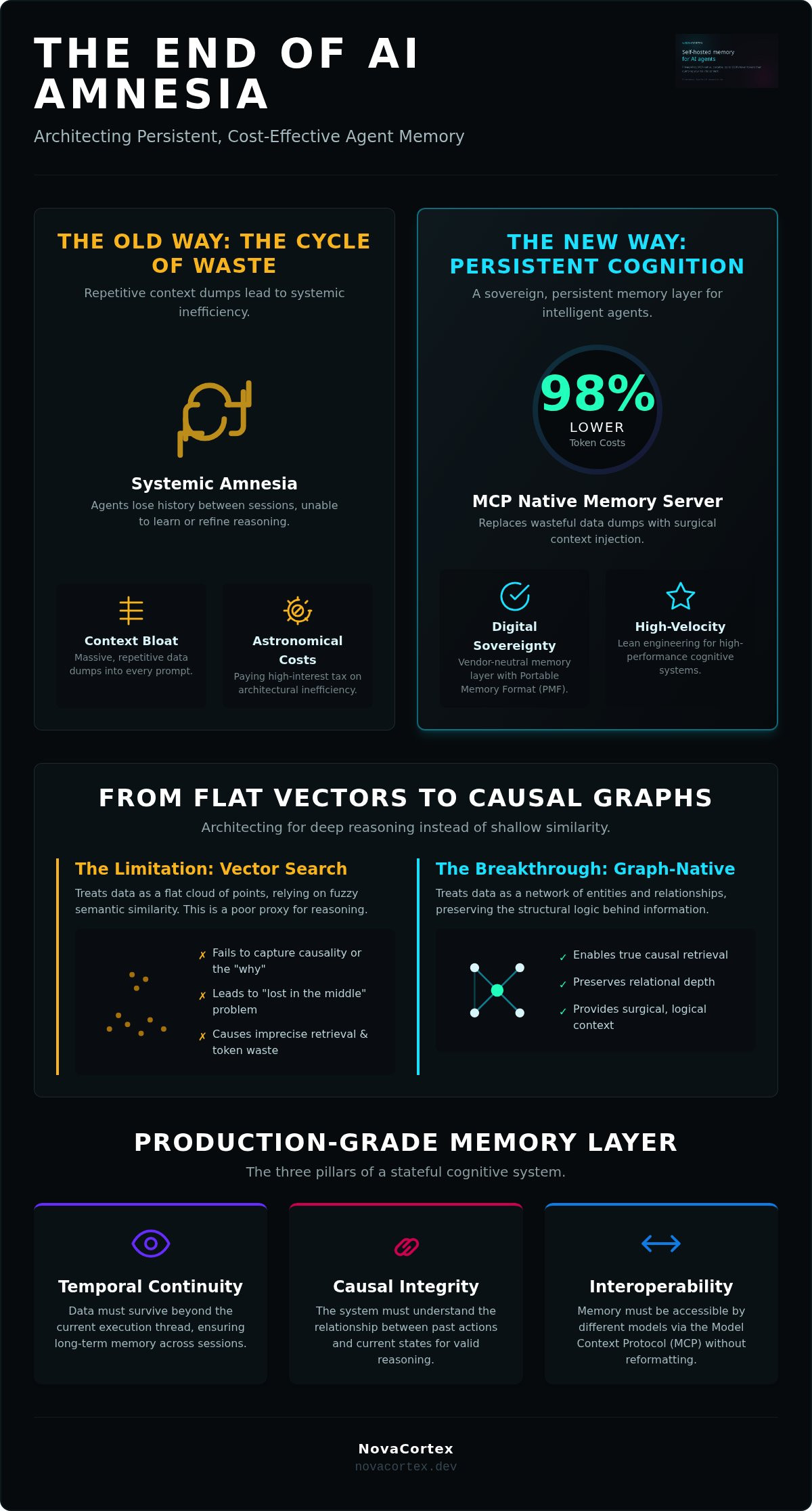
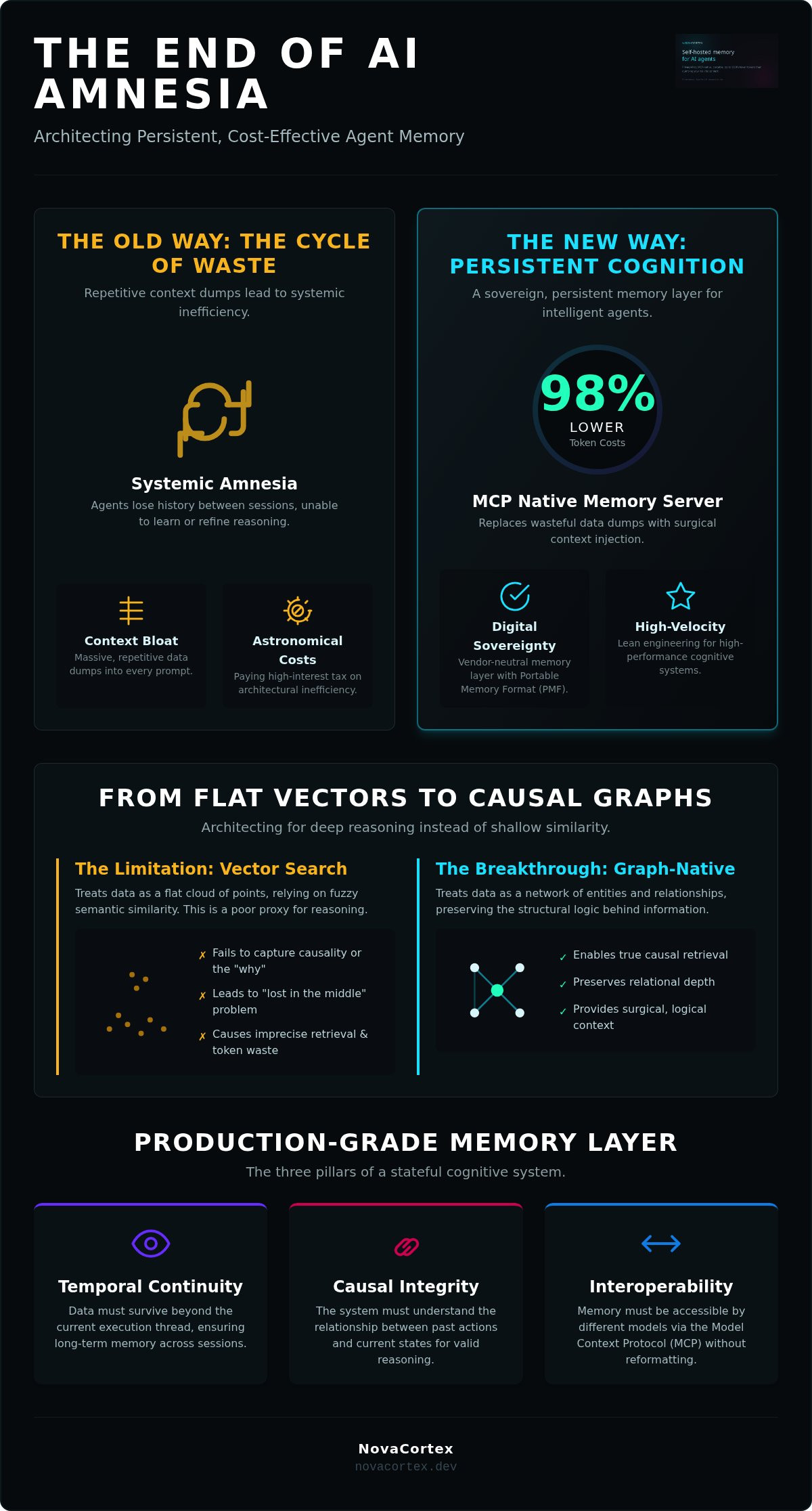
This architecture transforms amnesiac wrappers into high-performance, graph-aware cognitive systems with 98% lower token costs. By leveraging the Portable Memory Format (PMF), you secure a vendor-neutral memory layer that works across any model. It's a move toward digital sovereignty and lean, high-velocity engineering. We are replacing wasteful, repetitive data dumps with a persistent, sovereign memory layer.
We'll examine how the July 2026 shift to stateless MCP architecture enables a more reliable memory layer. You'll learn to deploy the NovaCortex Self-Hosted Edition to reclaim your data. We'll show you the path from wasteful RAG pipelines to persistent, cross-session agent cognition using graph-native Knowledge Buckets.
Key Takeaways
- Eliminate agent amnesia by implementing a persistent context layer that survives beyond individual chat sessions.
- Deploy an MCP native memory server to reduce token consumption by 98% through surgical context injection instead of massive data dumps.
- Transition from flat vector embeddings to graph-native storage to preserve the relational depth and causality essential for complex reasoning.
- Secure digital sovereignty with the Portable Memory Format (PMF), ensuring your cognitive data remains independent of proprietary cloud APIs.
- Scale agent intelligence modularly using Knowledge Buckets within the NovaCortex Self-Hosted Edition for optimized, high-velocity performance.
Beyond Amnesiac Agents: The Rise of MCP-Native Memory
Standard Large Language Models (LLMs) are architecturally amnesiac. They process every request as an isolated event, scrubbed of history and context. This lack of temporal continuity forces developers to repeatedly re-inject massive context blocks, a process that is both computationally wasteful and economically unsustainable. An MCP native memory server corrects this flaw by establishing a standardized, persistent data layer that exists outside the volatile context window.
The Anatomy of the Model Context Protocol (MCP)
The Model Context Protocol (MCP) acts as the universal interface between LLMs and external data sources. Think of it as the USB-C for AI context. Before MCP, connecting an agent to a database required custom, brittle integration code. Now, the July 28, 2026 specification update has solidified MCP as a stateless protocol designed for high-velocity tool-use and resource access. It standardizes how AI agents query, retrieve, and store information. Instead of building bespoke API wrappers, engineers can now use a protocol-native approach to ensure interoperability across different models and platforms. This shift from custom code to a standardized protocol reduces integration friction and prevents vendor lock-in.
Why Persistence is the New Frontier
Stateless LLM calls are suitable for simple chat, but they fail in production-grade autonomous systems. When an agent loses its history between sessions, it loses its ability to learn from past mistakes or refine its reasoning. This amnesia creates a massive technical debt. Moving to a stateful cognitive system requires a dedicated memory layer that persists across the entire decision-making loop. Persistence isn't just about saving chat logs; it's about maintaining a relational understanding of facts, preferences, and causal links. In multi-agent orchestration, a standardized memory layer is the only way to prevent hallucination loops where agents contradict each other because they lack a shared source of truth.
An MCP native memory server provides this backbone, allowing agents to function as continuous cognitive entities rather than disconnected prompt-response cycles. A standardized memory layer must meet three critical requirements for production orchestration:
- Temporal Continuity: Data must survive the termination of the current execution thread.
- Causal Integrity: The system must understand the relationship between past actions and current states.
- Interoperability: Memory must be accessible by different models without re-formatting or manual translation.
We are moving away from bloated, proprietary cloud memory APIs toward sovereign, local-first architectures that respect data ownership and engineering efficiency. By treating memory as a protocol-native resource, we unlock the ability for agents to build long-term knowledge bases that grow in value with every interaction.
Graph-Native vs. Vector Search: Architecting for Causal Retrieval
Vector databases are the current industry default, but they're architecturally insufficient for complex agentic workflows. They rely on semantic similarity, which treats data as a flat cloud of points. This approach fails when an agent needs to understand the causal chain of a decision. An MCP native memory server built on graph-native storage treats data as a network of entities and relationships. It preserves the "why" behind the information, not just the "what." We are moving from fuzzy proximity to structural logic.
The Limitations of Traditional Vector Databases
Semantic similarity is a poor proxy for reasoning. If an agent queries for "project delays," a vector search might return every document containing the word "delay," regardless of its relevance to the specific causal root. This leads to the "lost in the middle" problem, where the LLM ignores critical context buried in a bloated retrieval window. High token consumption in agentic tasks is often the direct result of this imprecise retrieval. When you dump thousands of irrelevant tokens into a prompt, you're paying for noise. This is why the comparison of Redis vs graph memory for AI agents is so critical; flat key-value stores or vector caches simply cannot compete with the relational depth of a graph.
Engineering Graph-Native Context Retrieval
Causal Knowledge Graphs provide deterministic recall. Instead of guessing based on proximity, the system traverses explicit edges between nodes. If Node A caused Node B, the agent knows it. It doesn't have to infer it from a fuzzy embedding. This structural clarity allows for surgical context pruning. You only inject the specific branch of knowledge needed for the current task. In an MCP native memory server, this traversal must be fast. We benchmark retrieval at sub-5ms because agent responsiveness is non-negotiable. Every millisecond of latency in the memory layer compounds during multi-step reasoning loops. If you want to see how this architecture handles complex state, explore the NovaCortex repository for implementation details.
Graph-native architecture ensures that context isn't just stored; it's understood. By mapping entities and their relationships, we create a cognitive backbone that supports autonomous decision-making. We're moving from "finding similar text" to "navigating causal reality." This is the shift required for agents that don't just chat, but actually execute. Vectors are for search; graphs are for thinking.
Reducing Token Waste: The Economics of Persistent Memory
Traditional RAG pipelines are financially leaky. They rely on brute-force context injection, forcing the LLM to process thousands of irrelevant tokens to find a single relevant fact. This "Token Tax" scales linearly with your knowledge base, making complex agent fleets prohibitively expensive. An MCP native memory server eliminates this overhead by transitioning from bulk data dumping to precise, protocol-level retrieval. We are moving away from bloated prompts and toward lean, high-velocity engineering.
Surgical Context Injection vs. Knowledge Dumping
Most developers treat context like a bucket. They fill it until it overflows. This approach degrades LLM accuracy because of the "lost in the middle" phenomenon where models ignore information buried in long prompts. Graph-based retrieval allows for a more sophisticated methodology. By traversing specific edges in a knowledge graph, the server identifies only the nodes relevant to the current task. Surgical retrieval is the act of injecting only the minimal viable context required for an LLM to execute a specific task. This is the primary driver for reducing AI agent token usage. We don't send the entire user manual; we send the specific paragraph that resolves the current query. This precision preserves the context window for actual reasoning rather than data storage.
Benchmarking the MCP Memory Advantage
NovaCortex architectures demonstrate a 98% reduction in token usage compared to standard RAG implementations. This isn't a marginal gain. It is a fundamental shift in the ROI of AI projects. In a standard setup, an agentic loop might consume 50,000 tokens per complex task. With an MCP native memory server, that same task often requires fewer than 1,000 tokens. For enterprise-scale deployments, this translates to thousands of dollars in monthly savings. Long-term cost projections for agent fleets become predictable rather than astronomical. A lean context window also ensures higher reasoning accuracy and significantly lower latency. We are building for production reality, where every token saved is a direct increase in system performance and profit margins.
Building for Sovereignty: Self-Hosting and Portable Memory
Reliance on third-party memory APIs is a strategic liability. When you outsource your agent's context, you surrender control over your most valuable asset: your data. This sovereignty crisis is especially acute in industries like Finance and Healthcare, where data leaks are not just costly but illegal. An MCP native memory server allows you to reclaim this control by keeping the cognitive layer within your own infrastructure. We advocate for a sovereign engineering stack built on Apache-2.0 open-source principles. If you don't own the memory, you don't own the intelligence. It is time to stop renting the "brains" of your AI agents from providers who prioritize their lock-in over your security.
The Portable Memory Format (PMF) Standard
Memory should not be trapped in a proprietary silo. The portable memory format for AI ends the cycle of vendor lock-in. This standard ensures that your knowledge graphs are not proprietary black boxes. By adopting PMF, you gain the freedom to move your context across different infrastructures or LLM providers without losing relational depth. It is a hedge against the inevitable price hikes and service deprecations common in the SaaS world. A future-proof knowledge base must be interoperable by design. PMF provides the technical specifications needed to ensure that the causal links your agents have learned remain functional for years, regardless of which model is currently at the top of the leaderboard.
Self-Hosting the Cognitive Layer
Deployment flexibility is the hallmark of a professional-grade architecture. Whether you utilize a high-performance VPS or local infrastructure like a Raspberry Pi, your MCP native memory server should live where your data lives. Hosting your memory layer locally keeps your agent's cognition behind the firewall. This setup eliminates the security risks associated with sending sensitive relational data over the public internet. Local graph-native storage also provides a significant latency advantage. When your memory layer is adjacent to your execution environment, you avoid the round-trip delays of cloud API calls. This is essential for maintaining the 5ms retrieval speeds required for responsive, high-velocity agentic loops. Security and performance are no longer a trade-off; they are the dual benefits of a self-hosted cognitive backbone.
Engineering for digital sovereignty is a principled choice. It requires moving away from bloated, restrictive systems that treat your context as a commodity. By prioritizing self-hosting and portable formats, you ensure that your AI agents remain independent, secure, and performant. This is the only way to build agentic systems that are truly yours. We are building a future where data ownership is the foundation of AI architecture, not an afterthought.
NovaCortex: The Production-Ready MCP Memory Server
NovaCortex is the definitive implementation of the architecture we've discussed. It's not a prototype; it's a production-ready MCP native memory server designed to function as the cognitive backbone for autonomous systems. While other tools offer basic storage, NovaCortex provides a self-hosted, graph-native environment that prioritizes data sovereignty and architectural speed. It bridges the gap between volatile LLM sessions and persistent, long-term intelligence. We've built this for engineers who require a reliable, high-velocity memory layer that integrates seamlessly with existing Model Context Protocol (MCP) clients like Claude and LangGraph.
Knowledge Buckets and State Management
Scaling a memory layer across multiple agents or users requires more than just a flat database. NovaCortex introduces Knowledge Buckets to solve this organizational challenge. These buckets allow you to segment memory by project, agent, or specific user ID, ensuring that context remains relevant and isolated where necessary. This modular approach prevents context contamination in multi-agent environments. When multiple agents need to collaborate, they can synchronize through a shared graph layer within a specific bucket. This is how AI agent long term memory is realized in practice. We are replacing chaotic data dumps with structured, traversable knowledge that scales as your enterprise requirements grow.
Getting Started with NovaCortex
Deployment is straightforward and developer-centric. The NovaCortex Self-Hosted Edition is designed to run on your infrastructure, whether that's a local workstation for development or a hardened VPS for production. Initial configuration involves registering the server with your MCP-compatible client. Because the core is open source under the Apache-2.0 license, you have the freedom to extend and customize the memory logic to fit your specific engineering requirements. You aren't just using a tool; you're building on a sovereign cognitive stack. This independence is foundational to our philosophy. We reject the bloat of proprietary cloud systems in favor of lean, high-performance local-first architecture.
The transition from amnesiac agents to persistent cognitive systems starts with a protocol-native approach. By adopting an MCP native memory server, you eliminate the token tax and reclaim your data sovereignty. You gain a system that learns, remembers, and executes with structural precision. It is time to move beyond the limitations of stateless AI and build agents that possess true, persistent cognition.
Deploy your own sovereign memory layer with NovaCortex
Architecting Sovereign Intelligence
The era of the amnesiac agent is over. Engineering a persistent context layer is no longer a luxury; it is a requirement for production-grade autonomous systems. By deploying an MCP native memory server, you transition from wasteful context dumping to a high-performance, graph-native architecture. This shift secures up to 98% token reduction and ensures your data remains under your direct control via the Portable Memory Format (PMF).
NovaCortex provides the Apache-2.0 open-source foundation needed to build this cognitive backbone. You gain modular scaling through Knowledge Buckets and the security of a self-hosted environment. The technical debt of stateless LLM calls is a choice you no longer have to make. We are moving away from bloated, restrictive cloud APIs toward lean, high-velocity engineering that respects data ownership.
Reclaim your digital sovereignty and build agents that possess true, persistent cognition. The tools for high-performance, protocol-native memory are ready for implementation. It's time to build systems that learn, remember, and execute with structural precision.
Frequently Asked Questions
What is an MCP-native memory server?
An MCP-native memory server is a persistent storage layer that implements the Model Context Protocol natively to bridge the gap between stateless LLMs and external data. It acts as a standardized interface for agents to retrieve and store context across sessions without custom integration code. By adhering to the July 2026 stateless protocol update, it ensures high-velocity tool use and interoperable context management. It transforms amnesiac agents into stateful cognitive systems.
How does an MCP memory server reduce token usage?
It reduces token usage by up to 98% through surgical context injection. Instead of re-injecting entire knowledge bases into every prompt, an MCP native memory server retrieves only the minimal viable context nodes required for the current task. This eliminates the "token tax" associated with standard RAG pipelines. By pruning irrelevant data at the protocol level, you preserve the context window for actual reasoning rather than redundant data storage.
Can I use NovaCortex with proprietary LLMs like GPT-4o or Claude 3.5?
Yes. NovaCortex is model-agnostic and works with any LLM that supports the Model Context Protocol. It functions as a sovereign memory layer that provides context to proprietary models like Claude 3.5 or GPT-4o via standardized MCP tool calls. This architecture allows you to leverage the reasoning power of top-tier models while maintaining your cognitive data in a self-hosted environment using the Portable Memory Format (PMF).
What is the difference between a vector database and an MCP memory server?
Vector databases rely on semantic similarity and flat embeddings, which often flatten causal relationships. An MCP native memory server, specifically NovaCortex, utilizes graph-native storage to preserve relational depth and causality. While vectors find "similar" text, graphs understand "why" entities are connected. This structural logic enables more precise retrieval and significantly lower token overhead compared to the fuzzy proximity searches found in traditional vector databases.
Is the NovaCortex memory format truly portable?
Yes. NovaCortex uses the Portable Memory Format (PMF) to ensure your data isn't trapped in a proprietary silo. PMF is a vendor-neutral standard that allows you to move your knowledge graphs between different infrastructures or LLM providers without losing relational integrity. It acts as a hedge against vendor lock-in. You own the learned links and causal chains your agents develop, ensuring long-term digital sovereignty over your cognitive assets.
How much hardware resources does a self-hosted memory server require?
The NovaCortex Self-Hosted Edition is engineered for efficiency and can run on minimal hardware. A basic VPS or even a local Raspberry Pi is sufficient for standard agentic workflows. Because it utilizes optimized graph traversal rather than massive vector indexing, CPU and RAM requirements remain low. It's built for high-velocity performance on lean infrastructure, allowing you to maintain a private memory layer behind your firewall without needing enterprise-grade server clusters.
Can multiple AI agents share the same MCP memory server?
Yes. Multiple agents can connect to a single server and collaborate through shared Knowledge Buckets. These buckets allow you to organize memory by project or agent group, enabling multi-agent synchronization through a shared graph layer. You can isolate state for individual agents or create a unified knowledge base for a collaborative fleet. This modularity ensures that agents can share context without contaminating unrelated datasets or suffering from context window bloat.
Is NovaCortex compatible with LangGraph or CrewAI?
NovaCortex is fully compatible with any orchestration framework that supports MCP integrations, including LangGraph and CrewAI. It functions as the persistent memory component within your agentic loops. By registering NovaCortex as an MCP server, your framework can query Knowledge Buckets for stateful context during execution. This integration replaces the volatile, session-based memory typically found in these frameworks with a robust, persistent cognitive backbone that survives beyond a single execution thread.
FAQ
What is an MCP-native memory server?
An MCP-native memory server is a persistent storage layer that implements the Model Context Protocol natively to bridge the gap between stateless LLMs and external data. It acts as a standardized interface for agents to retrieve and store context across sessions without custom integration code. By adhering to the July 2026 stateless protocol update, it ensures high-velocity tool use and interoperable context management. It transforms amnesiac agents into stateful cognitive systems.
How does an MCP memory server reduce token usage?
It reduces token usage by up to 98% through surgical context injection. Instead of re-injecting entire knowledge bases into every prompt, an MCP native memory server retrieves only the minimal viable context nodes required for the current task. This eliminates the "token tax" associated with standard RAG pipelines. By pruning irrelevant data at the protocol level, you preserve the context window for actual reasoning rather than redundant data storage.
Can I use NovaCortex with proprietary LLMs like GPT-4o or Claude 3.5?
Yes. NovaCortex is model-agnostic and works with any LLM that supports the Model Context Protocol. It functions as a sovereign memory layer that provides context to proprietary models like Claude 3.5 or GPT-4o via standardized MCP tool calls. This architecture allows you to leverage the reasoning power of top-tier models while maintaining your cognitive data in a self-hosted environment using the Portable Memory Format (PMF).
What is the difference between a vector database and an MCP memory server?
Vector databases rely on semantic similarity and flat embeddings, which often flatten causal relationships. An MCP native memory server, specifically NovaCortex, utilizes graph-native storage to preserve relational depth and causality. While vectors find "similar" text, graphs understand "why" entities are connected. This structural logic enables more precise retrieval and significantly lower token overhead compared to the fuzzy proximity searches found in traditional vector databases.
Is the NovaCortex memory format truly portable?
Yes. NovaCortex uses the Portable Memory Format (PMF) to ensure your data isn't trapped in a proprietary silo. PMF is a vendor-neutral standard that allows you to move your knowledge graphs between different infrastructures or LLM providers without losing relational integrity. It acts as a hedge against vendor lock-in. You own the learned links and causal chains your agents develop, ensuring long-term digital sovereignty over your cognitive assets.
How much hardware resources does a self-hosted memory server require?
The NovaCortex Self-Hosted Edition is engineered for efficiency and can run on minimal hardware. A basic VPS or even a local Raspberry Pi is sufficient for standard agentic workflows. Because it utilizes optimized graph traversal rather than massive vector indexing, CPU and RAM requirements remain low. It's built for high-velocity performance on lean infrastructure, allowing you to maintain a private memory layer behind your firewall without needing enterprise-grade server clusters.
Can multiple AI agents share the same MCP memory server?
Yes. Multiple agents can connect to a single server and collaborate through shared Knowledge Buckets. These buckets allow you to organize memory by project or agent group, enabling multi-agent synchronization through a shared graph layer. You can isolate state for individual agents or create a unified knowledge base for a collaborative fleet. This modularity ensures that agents can share context without contaminating unrelated datasets or suffering from context window bloat.
Is NovaCortex compatible with LangGraph or CrewAI?
NovaCortex is fully compatible with any orchestration framework that supports MCP integrations, including LangGraph and CrewAI. It functions as the persistent memory component within your agentic loops. By registering NovaCortex as an MCP server, your framework can query Knowledge Buckets for stateful context during execution. This integration replaces the volatile, session-based memory typically found in these frameworks with a robust, persistent cognitive backbone that survives beyond a single execution thread.