Model Context Protocol Memory Server: Architecture and Implementation Guide

Expanding context windows to a million tokens didn't solve agent amnesia; it just made failure outrageously expensive. If you orchestrate production agents, you know the pain of dumping raw message logs into every prompt. It inflates inference latency, burns operational budgets, and fractures context across isolated user sessions. Chaining hosted vector databases rarely fixes the problem, often swapping token bloat for proprietary vendor lock-in. Deploying a dedicated Model Context Protocol memory server solves this architecture trap at the root.
You shouldn't have to choose between deep relational recall and lean infrastructure. In this guide, you will master the mechanics, architectural patterns, and production deployment of persistent MCP memory servers on your own private infrastructure. You'll learn how to slash token overhead by up to 98% against brute-force context dumps, enforce complete data sovereignty, and eliminate fragmented agent state. We'll examine graph-native storage schemas, transport protocols, and the practical implementation steps required to run low-latency, persistent agent memory in production.
Key Takeaways
- Decouple agent runtimes from ephemeral chat histories by implementing a dedicated Model Context Protocol memory server.
- Master the initialization handshake and dynamic tool schema patterns that govern persistent agent read/write operations.
- Ditch flat vector search in favor of graph-native structures to maintain precise entity relationships without contextual hallucination.
- Deploy persistent memory stores across your own private infrastructure using lightweight Docker containers to secure total data sovereignty.
- Eliminate expensive prompt re-injection and slash context token overhead by up to 98% using structured Knowledge Buckets.
What Is a Model Context Protocol Memory Server?
Modern agent architectures collapse under stateless design. LLM execution runtimes discard context the moment an inference call resolves. A Model Context Protocol memory server bridges this gap, establishing a dedicated, standardized state layer between disparate language models and persistent backend storage. Rather than hardcoding proprietary SDK calls for every agent framework, developers expose a unified protocol interface that handles state persistence out of the box.
Anthropic open-sourced the Model Context Protocol (MCP) in November 2024 to solve fragmentation across client interfaces and data backends. Within agent cognition, an MCP memory server turns ephemeral sessions into continuous execution loops. It exposes standardized endpoints for bi-directional read-write operations: agents query past decisions to inform immediate reasoning, extract salient outcomes, and write updated state back to disk without human intervention.
The Core Architecture of MCP-Based State
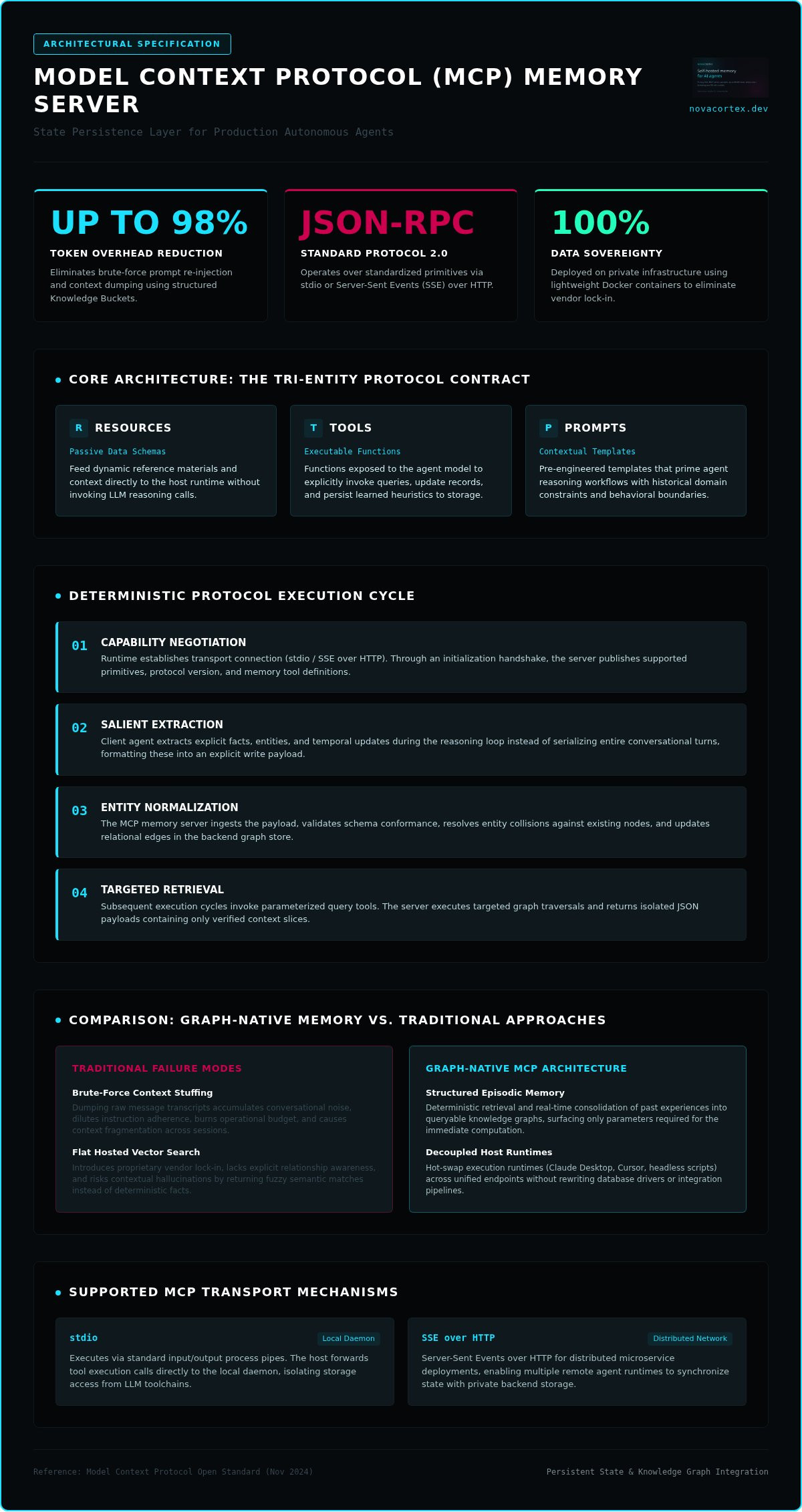
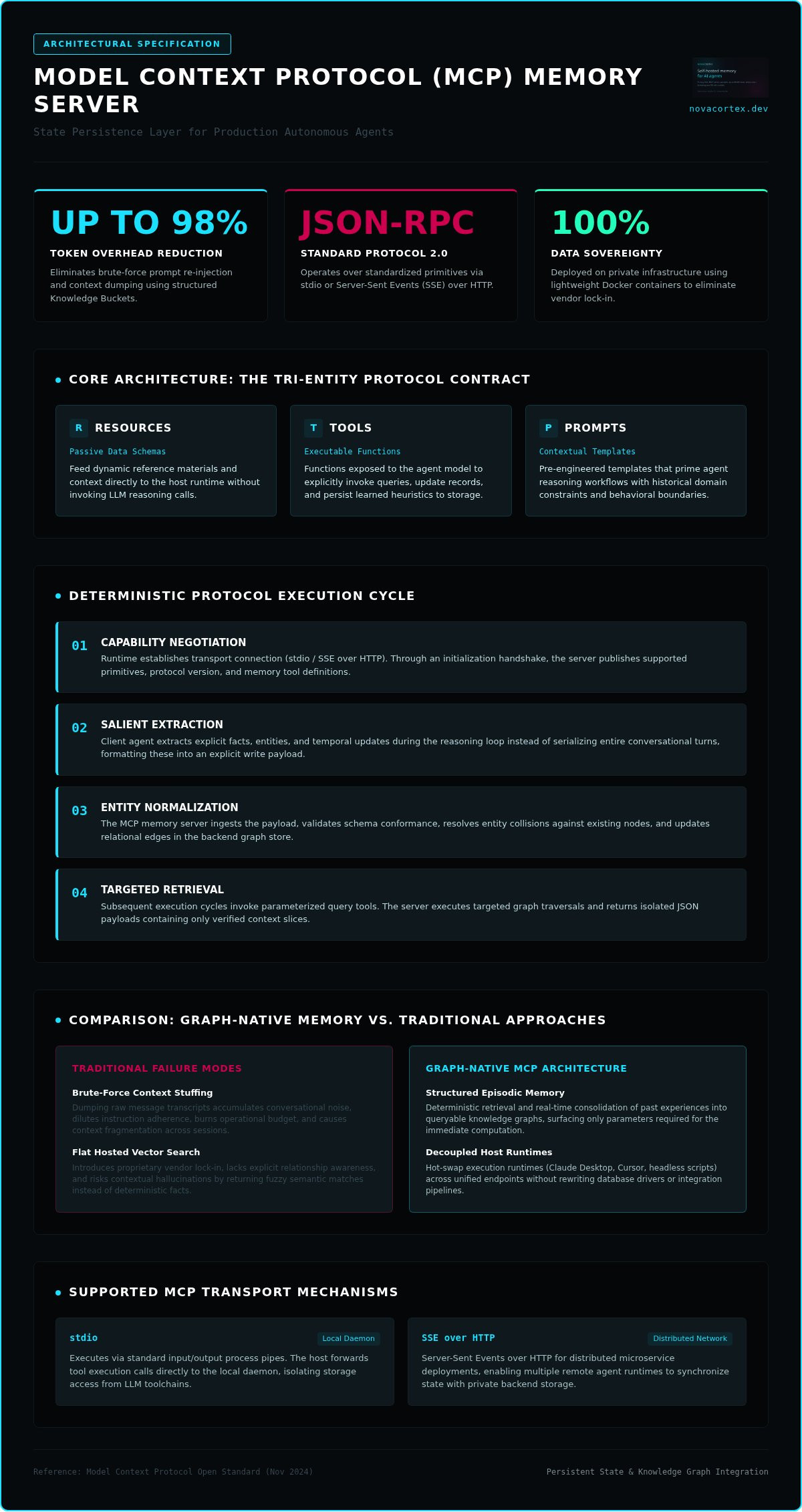
The system operates over JSON-RPC 2.0 primitives, defining a clean contract across three core entities:
- Resources: Passive contextual data schemas that feed dynamic reference materials directly to the host runtime.
- Tools: Executable functions exposed to the agent model, allowing it to explicitly invoke queries, update records, and persist learned heuristics.
- Prompts: Pre-engineered contextual templates that prime agent reasoning workflows with historical domain constraints.
Decoupling client reasoning from backend storage allows developers to hot-swap host runtimes. Whether you orchestrate logic through Claude Desktop, Cursor, or headless autonomous scripts, a standardized knowledge graph or contextual store behind an MCP interface guarantees cross-client interoperability without rewriting integration pipelines.
Transient Chat History vs. Persistent Episodic Memory
Dumping entire conversation transcripts into prompt templates is an architectural failure mode. Brute-force chat histories accumulate conversational noise, dilute instruction adherence, and aggressively consume finite context budgets. True episodic memory operates selectively. It surfaces only the exact entities, historical parameters, and relational heuristics necessary for the immediate computational turn.
In autonomous agent design, episodic memory retention functions as the deterministic retrieval and real-time consolidation of past experiences into structured, queryable knowledge graphs. This selective caching slashes operational overhead, preventing runaways while maintaining strict execution fidelity across multi-session agent workflows.
Protocol Mechanics: How MCP Memory Servers Manage Context
Context persistence through an MCP memory server relies on a deterministic state loop rather than passive logging. While raw context stuffing degrades inference performance over extended interactions, structured state management operates through four discrete protocol steps:
- Capability Negotiation: The host runtime establishes a transport connection with the Model Context Protocol memory server. Through the initialization handshake, the server publishes its supported primitives, protocol version, and specific memory management tool definitions.
- Salient Extraction: As the autonomous reasoning loop processes user intent, the client agent extracts explicit facts, entities, and temporal updates instead of serializing entire conversational turns. It formats these into an explicit write invocation.
- Entity Normalization: The memory server ingests the payload, validates the schema, resolves entity collisions against existing nodes, and updates relational edges within the underlying data layer.
- Targeted Retrieval: During subsequent execution cycles, the agent invokes query tools with parameterized constraints. The server executes targeted graph traversals and returns only the verified context slices necessary for immediate inference.
Tool Call Workflows and JSON-RPC Transport
Execution relies on two supported transport mechanisms: standard input/output (stdio) for local daemon execution, or Server-Sent Events (SSE) over HTTP for distributed network setups. All messages conform strictly to JSON-RPC 2.0 specifications. During runtime, the host forwards tool execution calls directly to the memory server's process pipe. The server processes the mutation or query, returning isolated JSON payloads containing structured context rather than bloated natural language summaries.
This protocol boundary isolates storage access from LLM toolchains. Developers no longer write custom database drivers or manage fragmented API keys across disparate agent libraries. Inspecting an open-source MCP-native memory server implementation reveals how this uniform layer decouples database internals from client orchestration runtimes.
Eliminating Context Window Waste via Selective Retrieval
Dumping exhaustive dialogue histories into prompt buffers produces catastrophic token consumption. If every user prompt pulls 10,000 tokens of uncurated history, inference costs scale linearly while reasoning fidelity deteriorates due to attention dilution. Research into any effective long-term memory framework highlights that selective, query-specific retrieval is mandatory for stable multi-step cognition.
Brute-force context dumps force language models to hunt through conversational static, while selective MCP retrieval delivers verified facts directly to the reasoning engine on demand. By retrieving isolated context nodes precisely when needed, agents retain deep contextual continuity while bypassing the computational drag of bloated interaction logs.
Architectural Comparison: Graph-Native Memory vs. Vector Databases
Vector databases dominate naive Retrieval-Augmented Generation stacks, yet they fail as autonomous cognitive backends. Vector indexes excel at semantic proximity. They identify text snippets with similar embeddings, but proximity is not logic. An autonomous agent needs to know not just that two entities are related, but exactly how they relate, who owns what, and what states changed. Implementing a Model Context Protocol memory server backed by a graph architecture replaces fuzzy similarity with deterministic traversal.
A hybrid topology that pairs vector indexing for initial entity discovery with graph structures for relational traversal yields superior factual accuracy. Research into augmenting conversations with structured memory demonstrates that structured relation mapping prevents contextual drift over extended interactions. When evaluated against purely key-value or cache architectures, our breakdown of Redis vs graph memory for AI agents illustrates how explicit graph topologies protect inference budgets while preserving deep relational context.
Handling Relational Complexity and Temporal Evolution
State is volatile. User constraints change, task definitions shift, and previous variables get deprecated across operational sessions. Vector distance metrics break down when handling contradictory statements across time; embedding models calculate near-identical similarity scores for both an original premise and its direct invalidation, confusing the agent. Knowledge graphs resolve this friction by attaching temporal metadata and explicit state flags directly to entity edges, allowing systems to prune outdated assertions dynamically.
Token Consumption and Retrieval Precision Metrics
Deploying a graph-native Model Context Protocol memory server eliminates the bloated "chunk walls" common to flat vector databases. When an agent queries a vector store, it typically retrieves top-k chunks of 500 to 1,000 tokens each, flooding the prompt buffer with irrelevant surrounding prose. Graphs alter this payload dynamic entirely:
- Precise Subgraph Extraction: Queries isolate specific nodes and interconnecting edges, returning compact structural facts rather than uncurated text blocks.
- Reduced Context Footprints: Eliminating extraneous narrative fluff drastically shrinks prompt size per reasoning step.
- Deterministic Relation Paths: Multi-hop reasoning traces explicit links between disparate entities without relying on fuzzy embedding matches.
While vector retrieval forces an LLM to consume expansive 500-token paragraphs to extract a single fact, graph nodes return dense relational triples that convey the exact same heuristic in under twenty tokens.
Deploying a Self-Hosted MCP Memory Server
Cloud-hosted vector APIs extract heavy data taxes while creating dangerous privacy liabilities. When your AI agents process internal software architecture, proprietary business metrics, or customer interactions, routing state records through third-party platforms breaches basic compliance boundaries. Self-hosting your Model Context Protocol memory server establishes hard infrastructure perimeter defenses. Your agent experiences stay entirely on your bare-metal machines or private virtual servers.
Running your own infrastructure eliminates external network hops, slashing round-trip latency during iterative agent reasoning loops. Our breakdown of the self-hosted AI memory layer details the architectural primitives required to lock down persistent cognitive state while maximizing execution throughput.
Docker Deployment and Storage Volume Configuration
Containerization isolates the memory engine from fragile host dependencies while providing reproducible execution across staging and production clusters. To prevent data corruption during container restarts or system updates, bind-mount a dedicated persistent volume to host the underlying graph store. Configure your container runtime with strict CPU and RAM limits to guarantee predictable response times under heavy read-write bursts.
Connecting to Client Runtimes via STDIO and SSE
Integrating your server requires matching the transport mechanism to your operational environment. Desktop developer tools connect locally via standard input/output (stdio), configured through simple JSON runtime definitions:
- Local STDIO: The agent host launches the containerized server as a direct child process, exchanging protocol messages across standard I/O pipes.
- Remote SSE Transport: Multi-agent container fleets communicate across an isolated internal Docker bridge or private overlay network using Server-Sent Events over HTTP.
- Handshake Validation: Standard MCP inspector utilities query the transport listener, confirming available tools and graph persistence health before launching active agent loops.
Structuring Multi-Domain Knowledge with Buckets
A single, unsegmented memory pool leads to contextual pollution. If an autonomous coding agent pulls customer support policies while refactoring database migrations, execution fails. Structuring your self-hosted instance with logical Knowledge Buckets prevents cross-domain contamination:
- Engineering Buckets: Isolate API contracts, system schemas, and technical implementation decisions from transient conversational logs.
- Operational Buckets: Store user preferences, project delivery constraints, and multi-session historical context separately.
- Granular ACLs: Restrict agent access tokens to specific bucket namespaces, ensuring agents only query or mutate data within their designated domain.
Engineering Long-Term Context with NovaCortex
Context rot degrades autonomous agent performance. When engineering teams build multi-turn agents on generic cloud APIs, they run directly into unpredictable latency, steep token overhead, and opaque data handling. NovaCortex delivers an open-source, Apache-2.0 licensed, graph-native Model Context Protocol memory server engineered specifically to eradicate these bottlenecks. By ditching brute-force message replay in favor of structured relational graphs, the architecture slashes agent token usage by up to 98% against naive context dumps.
Engineering long-term agent state requires treating context as an active, queryable index rather than a passive append-only log. Teams deploy the NovaCortex Self-Hosted Edition directly onto their private virtual machines or on-premise clusters. It pairs seamlessly with any MCP-compliant client runtime, acting as the reference standard for local, low-latency agent memory persistence without transmitting a single byte of internal memory data to third-party providers.
Eliminating Vendor Lock-in via Portable Memory Format (PMF)
Hosted vector vendors thrive on proprietary silos. Once you inject thousands of agent operational hours into a managed platform, extracting that state becomes intentionally punitive. NovaCortex breaks this capture model through the open Portable Memory Format (PMF). PMF provides a structured, platform-agnostic schema that lets you export, snapshot, and migrate entire agent graphs between runtimes in seconds.
Read our breakdown of the portable memory format for AI to see how standardizing state persistence preserves complete ownership over your intellectual property. You don't have to rebuild agent knowledge from scratch when switching LLMs or migrating infrastructure; simply export the PMF package and hydrate a new environment instantly.
Production Readiness on Private Infrastructure
Enterprise agents require deterministic performance and absolute compliance controls. The NovaCortex MCP-Native Memory Server executes efficiently across diverse computing hardware, running smoothly on low-power devices like a Raspberry Pi, standard cloud VPS nodes, or bare-metal production clusters:
- Full Data Sovereignty: Every entity node, relationship edge, and episodic memory record remains securely hosted inside your private network boundary.
- Configurable Governance: Implement granular encryption at rest, comprehensive query audit trails, and strict node retention policies.
- Unified Knowledge Buckets: Organize agent cognition across isolated operational domains to prevent cross-project hallucination while preserving sub-millisecond retrieval speeds.
Maintaining high-velocity agent execution no longer requires sacrificing infrastructure security or budget efficiency. NovaCortex gives engineering organizations sovereign, graph-native episodic memory built to scale under production workloads.
Scale Autonomous Agents with Sovereign Context
Dumping conversational logs into prompt windows is an unsustainable engineering compromise. Persistent agent cognition demands structured, graph-native state layers that preserve entity relationships without exploding compute costs. Deploying an open-source Model Context Protocol memory server directly decouples your reasoning runtimes from brittle proprietary silos, ensuring immediate sub-millisecond retrieval and permanent data sovereignty.
NovaCortex delivers this reference architecture today under the Apache-2.0 license. By utilizing the open Portable Memory Format (PMF) and structured Knowledge Buckets, you secure total ownership over your agent's evolving knowledge base while reducing token overhead by up to 98% against brute-force context dumps. Take complete control of your production memory layer and build resilient agent systems designed to last.
Frequently Asked Questions
How does an MCP memory server differ from a standard vector database?
A Model Context Protocol memory server exposes standardized protocol tools for bi-directional state reads and writes, whereas vector databases act strictly as text embedding indexes. Vector engines rely on mathematical proximity, often retrieving noisy paragraphs that blow up token usage. Graph-native MCP servers isolate exact entities and relationships, returning dense subgraphs directly to agent reasoning engines.
Can I use an MCP memory server with Claude Desktop and Cursor simultaneously?
Yes, you can bind multiple client interfaces to a shared memory instance. Because MCP uses an open JSON-RPC standard, both desktop environments execute read and write tools against the same persistent storage daemon. When Claude Desktop records a technical preference during interactive planning, Cursor retrieves that exact context during an autonomous coding session.
What network transport protocols do MCP memory servers support in production?
Production deployments rely on standard input/output (stdio) or Server-Sent Events (SSE). Local configurations favor stdio, launching the memory process directly as a sub-process of the client. Multi-agent clusters or distributed remote teams deploy persistent memory daemons behind authenticated SSE endpoints over HTTP, enabling networked agents to coordinate state across isolated virtual machines.
How much can a persistent memory server reduce LLM API token consumption?
Structuring memory through a dedicated server slashes token overhead by up to 98% compared to brute-force context dumps. Instead of stuffing thousands of lines of raw interaction transcripts into every inference prompt, the agent queries specific subgraphs on demand. It ingests only the exact parameters and historical decisions required for the current execution cycle.
What happens when an agent records conflicting facts in its memory graph?
Graph-native architectures resolve state collisions through explicit edge versioning and temporal metadata. When a new write contradicts a previous assertion, the memory server doesn't average the vectors together. Instead, it marks previous relational links as inactive or updates state properties, ensuring the agent evaluates only currently valid heuristics.
Is self-hosting an MCP memory server complex to configure and maintain?
Deploying a self-hosted Model Context Protocol memory server requires minimal maintenance when run as a containerized service. Using Docker, developers mount a local volume for persistent storage and expose standard stdio pipes or network ports. The lightweight architecture runs reliably on resource-constrained environments, including low-cost VPS instances and local Raspberry Pis.
How does the Portable Memory Format prevent vendor lock-in for AI agents?
The Portable Memory Format (PMF) standardizes memory export into a transparent, platform-agnostic schema. Proprietary cloud memory tools trap your historical state in managed silos, but PMF allows instant data backup, migration, and restoration. You maintain total ownership over your accumulated cognitive graphs across model updates and infrastructure changes.
FAQ
How does an MCP memory server differ from a standard vector database?
A Model Context Protocol memory server exposes standardized protocol tools for bi-directional state reads and writes, whereas vector databases act strictly as text embedding indexes. Vector engines rely on mathematical proximity, often retrieving noisy paragraphs that blow up token usage. Graph-native MCP servers isolate exact entities and relationships, returning dense subgraphs directly to agent reasoning engines.
Can I use an MCP memory server with Claude Desktop and Cursor simultaneously?
Yes, you can bind multiple client interfaces to a shared memory instance. Because MCP uses an open JSON-RPC standard, both desktop environments execute read and write tools against the same persistent storage daemon. When Claude Desktop records a technical preference during interactive planning, Cursor retrieves that exact context during an autonomous coding session.
What network transport protocols do MCP memory servers support in production?
Production deployments rely on standard input/output (stdio) or Server-Sent Events (SSE). Local configurations favor stdio, launching the memory process directly as a sub-process of the client. Multi-agent clusters or distributed remote teams deploy persistent memory daemons behind authenticated SSE endpoints over HTTP, enabling networked agents to coordinate state across isolated virtual machines.
How much can a persistent memory server reduce LLM API token consumption?
Structuring memory through a dedicated server slashes token overhead by up to 98% compared to brute-force context dumps. Instead of stuffing thousands of lines of raw interaction transcripts into every inference prompt, the agent queries specific subgraphs on demand. It ingests only the exact parameters and historical decisions required for the current execution cycle.
What happens when an agent records conflicting facts in its memory graph?
Graph-native architectures resolve state collisions through explicit edge versioning and temporal metadata. When a new write contradicts a previous assertion, the memory server doesn't average the vectors together. Instead, it marks previous relational links as inactive or updates state properties, ensuring the agent evaluates only currently valid heuristics.
Is self-hosting an MCP memory server complex to configure and maintain?
Deploying a self-hosted Model Context Protocol memory server requires minimal maintenance when run as a containerized service. Using Docker, developers mount a local volume for persistent storage and expose standard stdio pipes or network ports. The lightweight architecture runs reliably on resource-constrained environments, including low-cost VPS instances and local Raspberry Pis.
How does the Portable Memory Format prevent vendor lock-in for AI agents?
The Portable Memory Format (PMF) standardizes memory export into a transparent, platform-agnostic schema. Proprietary cloud memory tools trap your historical state in managed silos, but PMF allows instant data backup, migration, and restoration. You maintain total ownership over your accumulated cognitive graphs across model updates and infrastructure changes.