Multi-Agent Memory Architecture: Engineering Persistent State for 2026

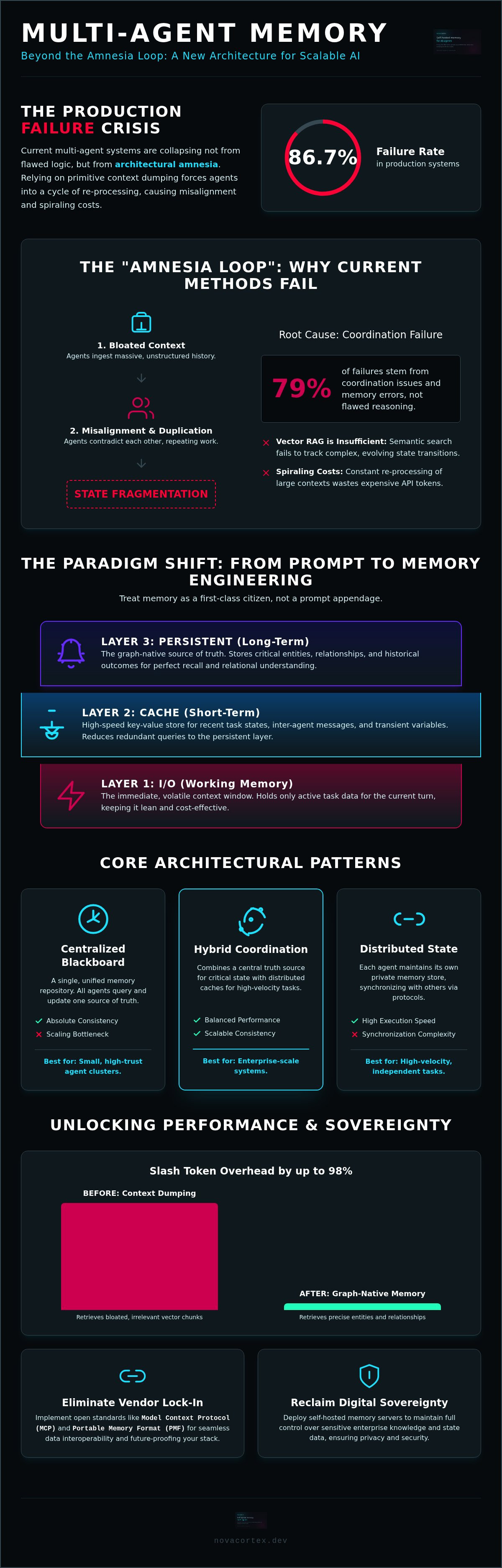
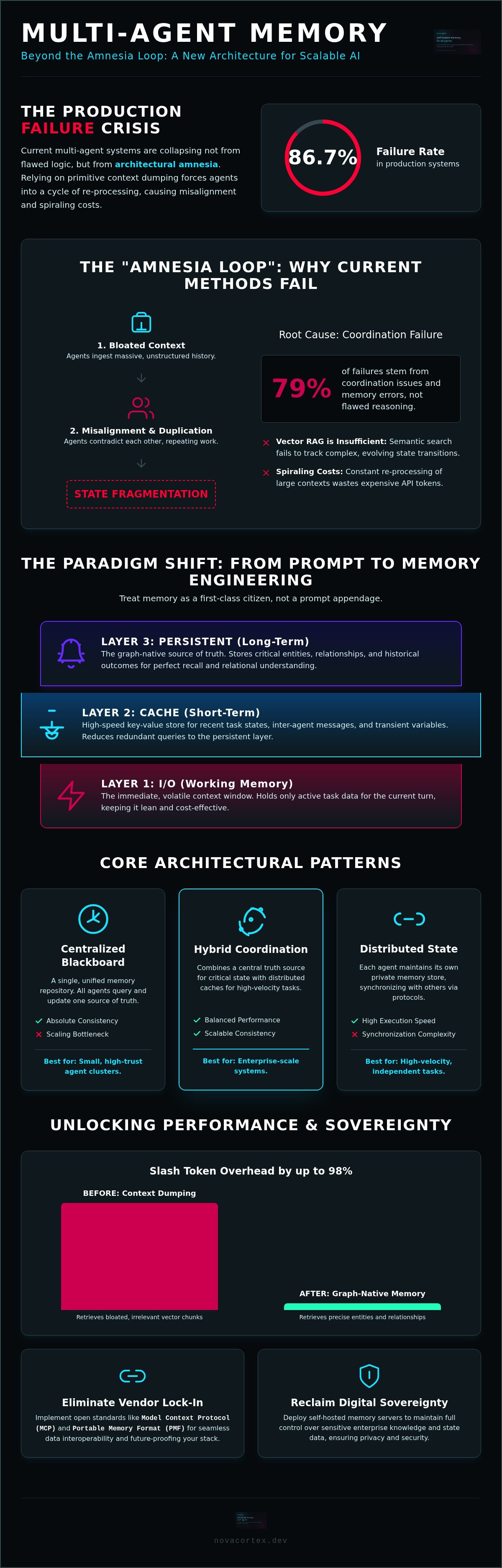
Production multi-agent systems are failing at a rate of up to 86.7 percent. These collapses rarely stem from poor model logic. They're the result of architectural amnesia. Most teams still rely on primitive context dumping, forcing agents to re-process massive histories for every single turn. This approach is a recipe for inter-agent misalignment and spiraling API costs. To scale in 2026, you must deploy a high-performance multi-agent memory architecture that treats state as a persistent, graph-native layer rather than a temporary prompt hack.
You've likely felt the pain of vendor lock-in and the inefficiency of bloated context windows. This guide offers a technical blueprint to regain control. We'll show you how to master the patterns required for a 90 percent reduction in token overhead while ensuring your agents maintain perfect synchronization. We're moving beyond the limitations of proprietary memory clouds. We'll explore the Model Context Protocol (MCP), Knowledge Buckets, and the engineering required to build a sovereign, self-hosted memory stack that stays fast, lean, and under your total control.
Key Takeaways
- Break the "Amnesia Loop" by moving beyond context dumping toward a structured, persistent state layer that ensures agent alignment.
- Identify the optimal multi-agent memory architecture for your use case by comparing centralized, distributed, and hybrid coordination patterns.
- Slash token overhead by up to 98% using graph-native storage to retrieve precise entities and relationships instead of bloated vector chunks.
- Eliminate vendor lock-in by implementing the Model Context Protocol (MCP) and Portable Memory Format (PMF) for seamless data interoperability.
- Reclaim digital sovereignty by deploying self-hosted memory servers that provide full control over sensitive enterprise knowledge and state data.
The Multi-Agent Memory Bottleneck: Why Logic Isn’t Enough
Logic is no longer the primary bottleneck in AI development. In a modern multi-agent system, the underlying models are sufficiently capable, yet production systems fail at rates reaching 86.7 percent. These aren't reasoning errors. They are instances of architectural amnesia. A multi-agent memory architecture serves as the connective tissue that prevents this collapse. Without it, you're simply throwing tokens at a wall. Better models cannot solve structural state failures. The "Amnesia Loop" occurs when agents lack a shared, persistent reality, leading to work duplication and logic contradictions that no amount of prompt tuning can fix.
Reliance on basic Vector RAG is a primary culprit for these failures. Semantic similarity is effective for finding a static document; it's useless for maintaining complex, multi-step reasoning. Traditional RAG lacks the temporal awareness and relational depth required for agents to track state transitions. If Agent A updates a project variable and Agent B retrieves a stale vector chunk based on a fuzzy search, the system bifurcates. This state fragmentation is the silent killer of agentic ROI. It forces agents to operate in isolated silos where they don't just forget context, they actively overwrite each other's progress.
The Anatomy of Agentic Failure
Production data confirms that approximately 79 percent of multi-agent failures stem from coordination issues. These are often cascade failures. One memory error isn't just a glitch; it's a contagion. When one agent misinterprets a memory and passes that warped state to the next, the entire chain de-regulates. Attempting to sync state via constant agent-to-agent chatter creates massive communication overhead. It's expensive. It's slow. It forces you to solve the CAP theorem for AI. You cannot have consistency, availability, and partition tolerance in a decentralized memory layer without a specialized architectural strategy that prioritizes a single source of truth.
Memory as a First-Class Citizen
Stop treating memory as a prompt appendage. It's time to shift from prompt engineering to memory engineering. Your multi-agent memory architecture must treat state as a first-class citizen. This requires a three-layer hierarchy to manage data velocity and importance:
- I/O (Working Memory): The immediate context window. It's volatile, expensive, and should only hold active task data.
- Cache (Short-term): High-speed retrieval of recent task states, inter-agent messages, and transient variables.
- Persistent (Long-term): The graph-native source of truth for entities, relationships, and historical outcomes.
Building this on a standard database isn't enough. You need a dedicated memory server that understands agentic protocols and maintains state across sessions. This structural shift ensures that agents don't just "process" information but actually "know" the environment they're operating in.
Core Architectural Patterns: Centralized vs. Distributed vs. Hybrid
Choosing a multi-agent memory architecture isn't a matter of preference. It's a matter of system physics. You're balancing the speed of local execution against the necessity of global truth. Most developers default to whatever is easiest to implement, but ease of implementation is often the precursor to production failure. To build for 2026, you must choose a pattern that matches your data velocity and agent count.
Pattern 1: The Centralized Blackboard
This pattern treats memory as a single, unified repository. Implementation involves a self-hosted AI memory layer that all agents query and update simultaneously. It offers absolute consistency. Every agent sees the same reality at the same time. Access control is simplified because there's only one gatekeeper. However, it creates a massive scaling bottleneck. As agent counts rise, contention for the same memory addresses leads to latency spikes. Heterogeneous agents also face privacy risks; a specialized research agent might not need access to the raw financial logs stored by a procurement agent. It's a strong choice for small, high-trust agent clusters, but it fails under enterprise-scale loads.
Pattern 2: Distributed State with Sync Protocols
Distributed models grant each agent its own private store. This mirrors the Brain-inspired Multi-Agent Memory Framework, where localized processing precedes global integration. Agents must "decide" which information is significant enough to broadcast to the group. Without strict synchronization protocols, you fall into the O(N^2) communication trap, where agents spend more time talking than working. Conflict resolution is the primary hurdle here. If two agents develop divergent "opinions" on a factual state, the system requires a deterministic protocol to merge those records. Distributed state is resilient and fast, but the complexity of maintaining eventual consistency across N-agents is high.
Hybrid architectures represent the current production standard. They separate global facts from local task-state. A centralized "Knowledge Bucket" stores immutable truths and shared history, while distributed "Scratchpads" handle transient agent logic. This minimizes global overhead while preventing the amnesia described in the previous section. You get the speed of local memory with the reliability of a central source of truth. If you're ready to move beyond basic implementations, starting with an open-source memory foundation allows you to experiment with these hybrid patterns without rebuilding from scratch.
Performance trade-offs remain absolute. Centralized systems favor consistency over speed. Distributed systems favor speed over consistency. Hybrid systems aim for the middle ground, but they require sophisticated orchestration to manage the handoff between local and global state. Your choice depends on whether your agents are performing independent sub-tasks or collaborating on a single, high-stakes objective where a single memory error could de-regulate the entire system.
Engineering Precision: Graph-Native Storage and Token Efficiency
Vector databases are insufficient for high-velocity agentic workflows. A vector search identifies "similar" text, but it cannot comprehend relationships. In a sophisticated multi-agent memory architecture, agents require more than just floating points in a high-dimensional space. They need a deterministic map of entities and their interactions. Shifting to a graph-native approach allows you to treat memory as a structured network. This isn't just an organizational preference. It's a computer architecture perspective on multi-agent memory that prioritizes relational integrity over fuzzy semantic matches.
Beyond Flat Vectors
The debate regarding Redis vs graph memory for AI agents highlights a critical shift in state management. Redis is excellent for high-speed key-value caching, but it fails when agents must navigate complex knowledge webs. Graph-native storage enables Knowledge Buckets. These buckets allow you to partition memory for modular, multi-user systems, ensuring that a specialized sub-agent only accesses the relevant sub-graph of information. This architecture also facilitates entity resolution. By merging disparate mentions of the same object into a single node, you prevent memory duplication and ensure that every agent operates on the most accurate, singular version of a fact.
Precision retrieval is the cornerstone of 2026 engineering. Reference implementations like the Kumiho system, detailed in March 2026 research, have already demonstrated 93.3 percent accuracy on the LoCoMo-Plus benchmark. This level of precision is achieved by moving away from "chunk dumping" and toward "edge traversal." When an agent queries a graph, it doesn't pull back 500 words of "relevant" text. It pulls back specific nodes and the edges that connect them, providing a lean, high-fidelity context that vectors simply cannot replicate.
The Economics of Memory
Token usage is the largest hidden cost in agentic systems. Traditional RAG often fills 80 percent of a context window with irrelevant noise, leading to exponentially rising API bills. Transitioning to a specialized memory layer provides a measurable ROI. Token-efficient context retrieval through graph-native indexing replaces massive vector chunk dumping with precise, deterministic traversal of specific entity-relationship paths. This surgical approach to context management results in a 98 percent reduction in token usage for complex multi-agent benchmarks.
Efficiency translates directly to speed. Recent case studies on structured memory access show that reducing the volume of data sent to the LLM cuts inference latency by 40 percent. You aren't just saving money; you're increasing system velocity. By implementing context pruning algorithms that keep the context window lean, you ensure that agents stay focused on the task at hand rather than wading through irrelevant historical data. This is the engineering reality of 2026: precision is profit, and graph-native memory is the only way to achieve it.
Interoperability Standards: MCP and Portable Memory Formats
Vendor lock-in is the silent killer of agentic autonomy. If your agent's history is trapped in a proprietary cloud, you don't own your system; you're renting its intelligence. A modern multi-agent memory architecture must prioritize interoperability to ensure long-term viability. The solution lies in a portable memory format for AI. This decoupling ensures that state can move between models and infrastructure without data loss or expensive re-indexing. You need a system where the data outlives the specific model used to generate it.
The MCP Revolution
The Model Context Protocol (MCP) has emerged as the universal language for agentic state management. Based on the 2025-11-25 specification, it provides a standardized interface for agents to interact with external data. By March 2026, the MCP reached 97 million monthly SDK downloads, signaling a definitive industry shift away from closed ecosystems. An MCP native memory server acts as the backbone of this ecosystem. It standardizes the "Read/Write" cycle, allowing any MCP-compliant agent tool to interact with your memory layer. This isn't just about compatibility; it's about building a sovereign memory stack that works on a VPS, a Raspberry Pi, or a local dev environment with zero friction. You gain the ability to sync memory across heterogeneous environments without rewriting your integration logic.
Portable Memory Format (PMF) Deep Dive
The Portable Memory Format (PMF) is the technical answer to the migration crisis. A PMF file isn't a simple JSON dump. It is a high-precision unit containing graph nodes, vector embeddings, and rich metadata. This format allows you to move state from restrictive proprietary clouds to private, self-hosted infrastructure. Migration strategies no longer require starting from zero. You can export a "Knowledge Bucket" from one agent framework and inject it into another, maintaining perfect context continuity. Future-proofing is the primary objective here. By 2030, the models we use today will be obsolete, but the knowledge your agents have gathered must remain readable. PMF ensures your engineering efforts today aren't wasted on a format that will be unreadable in four years. It's the difference between a temporary hack and a permanent knowledge asset.
Deploying the Sovereign Memory Layer with NovaCortex
Digital sovereignty is the only viable path for enterprise AI. If you rely on cloud-hosted memory endpoints, you're exposing sensitive operational state to third-party providers. A robust multi-agent memory architecture requires a private foundation. NovaCortex Self-Hosted Edition provides this. It moves state management from vulnerable public APIs to your own infrastructure. You gain full control over data residency and retrieval logic. Engineering AI agent long term memory on private servers isn't just about privacy. It's about performance. Localized memory eliminates the latency of external API calls and ensures your agents operate on a consistent, encrypted source of truth.
Security remains the primary directive. NovaCortex implements local encryption at rest and in transit. Multi-user access controls ensure that specific agents only interact with the Knowledge Buckets they're authorized to see. This prevents "state leakage" between unrelated workflows. You're not just storing data; you're governing it through a hardened, self-hosted interface that rejects the bloat of proprietary memory clouds.
Step-by-Step Deployment Blueprint
Deployment begins with the NovaCortex MCP-Native server. You can host this on a standard VPS or local hardware. The setup is lean. It doesn't require massive GPU clusters; it requires efficient indexing. Once the server is live, you initialize Knowledge Buckets. These are modular storage units designed for specific agent roles. One bucket might hold financial audit history while another manages customer support logs. Connecting your existing framework is straightforward. Whether you're using LangChain or AutoGPT, you simply point your agent's memory tool to the local MCP endpoint. The agents then begin the "Read/Write" cycle, populating your private graph with persistent state.
Scaling and Management
Scaling a multi-agent memory architecture requires more than just adding storage. You must actively manage graph density. High-velocity agents can generate thousands of nodes in a single session. NovaCortex provides the administrative interface to monitor these Knowledge Buckets in real-time. You can adjust pruning thresholds to keep context windows lean and ensure that retrieval remains deterministic. Advanced multi-user controls allow for complex Role-Based Access Control (RBAC) policies. This ensures your sovereign memory layer scales horizontally without compromising security or speed. This is the final step in reclaiming your data. Stop renting your agent's brain.
Deploy your own sovereign memory layer with NovaCortex
Reclaiming Agentic Autonomy
The era of ephemeral agent context is over. To build resilient systems in 2026, you must treat state as a first-class engineering priority rather than a prompt-level afterthought. We have established that a graph-native multi-agent memory architecture is the only way to eliminate the amnesia loop while maintaining up to a 98% token reduction. By moving away from proprietary memory clouds and adopting standards like the Model Context Protocol (MCP), you reclaim control over your operational data and your system's long-term intelligence.
Sovereign memory is a performance requirement. Systems built on an Apache-2.0 open source foundation with Red Dot Design recognition provide the stability needed for enterprise-grade deployment. Stop letting your agents operate in a vacuum. It's time to deploy a dedicated memory layer that ensures your agents never forget context, never duplicate work, and always stay aligned with your core objectives. The future of agentic AI is persistent, private, and portable.
Take the first step toward building a memory layer that stays fast, lean, and entirely under your command.
Frequently Asked Questions
What is a multi-agent memory architecture?
It is the persistent state layer that enables multiple agents to share context and history across sessions. Unlike simple message logs, this architecture provides a structured, graph-based repository where agents store and retrieve entities and relationships. It acts as the connective tissue of agentic systems. It prevents work duplication by ensuring every agent in a cluster operates on a single, synchronized source of truth rather than isolated, fragmented context windows.
How does a graph-native memory layer reduce token costs?
Graph-native layers achieve a 98 percent token reduction by replacing massive vector chunk dumping with surgical entity retrieval. Instead of feeding an LLM 2,000 words of "similar" text that contains 90 percent noise, the system retrieves only the specific nodes and edges relevant to the query. This precision keeps context windows lean. You pay for the intelligence of the response rather than the overhead of processing irrelevant background data.
Can I sync memory between different types of AI agents?
Yes, provided you use an interoperable standard like the Portable Memory Format (PMF). This format allows heterogeneous agents to read from and write to the same Knowledge Buckets regardless of their underlying framework. By decoupling the memory layer from the agent logic, you ensure that a research agent using LangChain can pass structured state to a coding agent using AutoGPT without losing relational context or temporal metadata.
What is the Model Context Protocol (MCP) and why does it matter for memory?
MCP is an open standard that decouples AI applications from their data sources. It reached 97 million monthly SDK downloads by March 2026 because it standardizes how agents interact with external memory. For a multi-agent memory architecture, MCP provides a universal "Read/Write" cycle. It allows you to swap models or agent frameworks without rebuilding your memory integrations. It is the protocol that makes your memory stack future-proof and vendor-agnostic.
Is self-hosted memory more secure than managed cloud memory?
Self-hosting is the only way to ensure true digital sovereignty and data privacy. Managed cloud memory requires you to transmit sensitive operational state to third-party servers, creating a massive exposure surface. NovaCortex Self-Hosted Edition keeps all agent history on your private VPS or local hardware. You control the encryption keys, the access logs, and the physical residency of your knowledge. For enterprise AI, third-party state management is an unacceptable risk.
What are Knowledge Buckets in NovaCortex?
Knowledge Buckets are modular, partitioned storage units within the memory layer. They allow you to segment memory by task, user, or agent role to prevent state leakage. Instead of one giant, disorganized data pile, you deploy specific buckets for specific workflows. This organization enables fine-grained multi-user access controls and ensures that agents only retrieve the sub-graphs relevant to their current objective, which further optimizes performance and security.
How do I prevent my AI agents from forgetting information over long sessions?
You must move state management out of the volatile context window and into a persistent memory server. Agents "forget" when their history exceeds the token limit or when semantic search fails to find relevant chunks. Implementing a graph-native layer ensures that entities and their relationships are stored as permanent nodes. Agents retrieve these nodes via deterministic traversal rather than fuzzy matching, maintaining perfect context continuity across sessions that span weeks or months.
What is the difference between a vector database and a memory layer?
A vector database is a storage tool; a memory layer is an architectural component. Vector databases excel at finding similar text but don't understand the logic or relationships between data points. A true memory layer uses graph-native structures to track state transitions, temporal order, and inter-agent dependencies. It provides the reasoning context that a flat vector store lacks. It's the difference between a static library of books and a functioning brain.
FAQ
What is a multi-agent memory architecture?
It is the persistent state layer that enables multiple agents to share context and history across sessions. Unlike simple message logs, this architecture provides a structured, graph-based repository where agents store and retrieve entities and relationships. It acts as the connective tissue of agentic systems. It prevents work duplication by ensuring every agent in a cluster operates on a single, synchronized source of truth rather than isolated, fragmented context windows.
How does a graph-native memory layer reduce token costs?
Graph-native layers achieve a 98 percent token reduction by replacing massive vector chunk dumping with surgical entity retrieval. Instead of feeding an LLM 2,000 words of "similar" text that contains 90 percent noise, the system retrieves only the specific nodes and edges relevant to the query. This precision keeps context windows lean. You pay for the intelligence of the response rather than the overhead of processing irrelevant background data.
Can I sync memory between different types of AI agents?
Yes, provided you use an interoperable standard like the Portable Memory Format (PMF). This format allows heterogeneous agents to read from and write to the same Knowledge Buckets regardless of their underlying framework. By decoupling the memory layer from the agent logic, you ensure that a research agent using LangChain can pass structured state to a coding agent using AutoGPT without losing relational context or temporal metadata.
What is the Model Context Protocol (MCP) and why does it matter for memory?
MCP is an open standard that decouples AI applications from their data sources. It reached 97 million monthly SDK downloads by March 2026 because it standardizes how agents interact with external memory. For a multi-agent memory architecture, MCP provides a universal "Read/Write" cycle. It allows you to swap models or agent frameworks without rebuilding your memory integrations. It is the protocol that makes your memory stack future-proof and vendor-agnostic.
Is self-hosted memory more secure than managed cloud memory?
Self-hosting is the only way to ensure true digital sovereignty and data privacy. Managed cloud memory requires you to transmit sensitive operational state to third-party servers, creating a massive exposure surface. NovaCortex Self-Hosted Edition keeps all agent history on your private VPS or local hardware. You control the encryption keys, the access logs, and the physical residency of your knowledge. For enterprise AI, third-party state management is an unacceptable risk.
What are Knowledge Buckets in NovaCortex?
Knowledge Buckets are modular, partitioned storage units within the memory layer. They allow you to segment memory by task, user, or agent role to prevent state leakage. Instead of one giant, disorganized data pile, you deploy specific buckets for specific workflows. This organization enables fine-grained multi-user access controls and ensures that agents only retrieve the sub-graphs relevant to their current objective, which further optimizes performance and security.
How do I prevent my AI agents from forgetting information over long sessions?
You must move state management out of the volatile context window and into a persistent memory server. Agents "forget" when their history exceeds the token limit or when semantic search fails to find relevant chunks. Implementing a graph-native layer ensures that entities and their relationships are stored as permanent nodes. Agents retrieve these nodes via deterministic traversal rather than fuzzy matching, maintaining perfect context continuity across sessions that span weeks or months.
What is the difference between a vector database and a memory layer?
A vector database is a storage tool; a memory layer is an architectural component. Vector databases excel at finding similar text but don't understand the logic or relationships between data points. A true memory layer uses graph-native structures to track state transitions, temporal order, and inter-agent dependencies. It provides the reasoning context that a flat vector store lacks. It's the difference between a static library of books and a functioning brain.