Multi-Agent Memory Architecture: Engineering Shared Cognition in 2026

Ninety percent of your token budget is currently being incinerated by redundant context loops. As multi-agent systems move from experimental scripts to production-ready frameworks like Microsoft Agent Framework 1.0, the old way of flat vector retrieval is hitting a wall. You are likely fighting data silos and the inevitable amnesia that plagues complex, long-running tasks. This isn't a limitation of the LLM. It is a failure of the underlying multi-agent memory architecture. Building shared cognition is impossible when every agent operates as an isolated island.
We agree that the current industry standard is bloated and restrictive. This article shows you how to master the architectural shift from simple vector search to graph-native, shared memory layers that enable seamless coordination without the overhead. You will learn to engineer a system that prioritizes relationship-based retrieval and local sovereignty. We will cover the implementation of a scalable memory layer that achieves a 90% reduction in token usage and ensures vendor-neutral data portability through Knowledge Buckets and the Portable Memory Format (PMF). It is time to move past wasteful cloud dependencies and build for engineering-grade performance.
Key Takeaways
- Shift from brute-force context dumping to a decentralized persistence layer. Stop the amnesia and data silos inherent in isolated agent loops.
- Transition to a graph-native multi-agent memory architecture. Replace simple semantic similarity with relational reasoning to solve complex, multi-hop queries.
- Slash token consumption by 98% through surgical retrieval. Move beyond wasteful RAG patterns by leveraging modular Knowledge Buckets for state management.
- Standardize agent coordination via MCP-native memory servers. Resolve state conflicts and maintain a canonical context across heterogeneous frameworks with ease.
- Secure digital sovereignty with the Portable Memory Format (PMF). Eliminate vendor lock-in and the "memory tax" associated with proprietary cloud databases.
The Multi-Agent Memory Crisis: Beyond Context Windows
Context windows are getting larger, but they aren't getting smarter. In 2026, many engineers still try to solve coordination problems by dumping massive amounts of raw data into an LLM prompt. This brute-force approach is engineering malpractice. A true multi-agent memory architecture is not just a collection of vector embeddings. It is a shared persistence layer designed for state management and knowledge retrieval across a multi-agent system. Without this layer, agents exist in a state of perpetual "Agent Amnesia." They lose the thread of long-running tasks the moment the context window shifts or a new agent enters the loop.
The industry is hitting a wall where larger windows don't translate to better reasoning. When you force multiple agents to process the same 100k tokens of context independently, you aren't building intelligence. You are building technical debt. Context windows are temporary workspaces; memory is the permanent cognitive substrate for autonomous systems. To scale, we must move beyond stateless interactions and toward a unified, stateful architecture that survives the lifecycle of a single API call.
The Token Cost of Memory Inefficiency
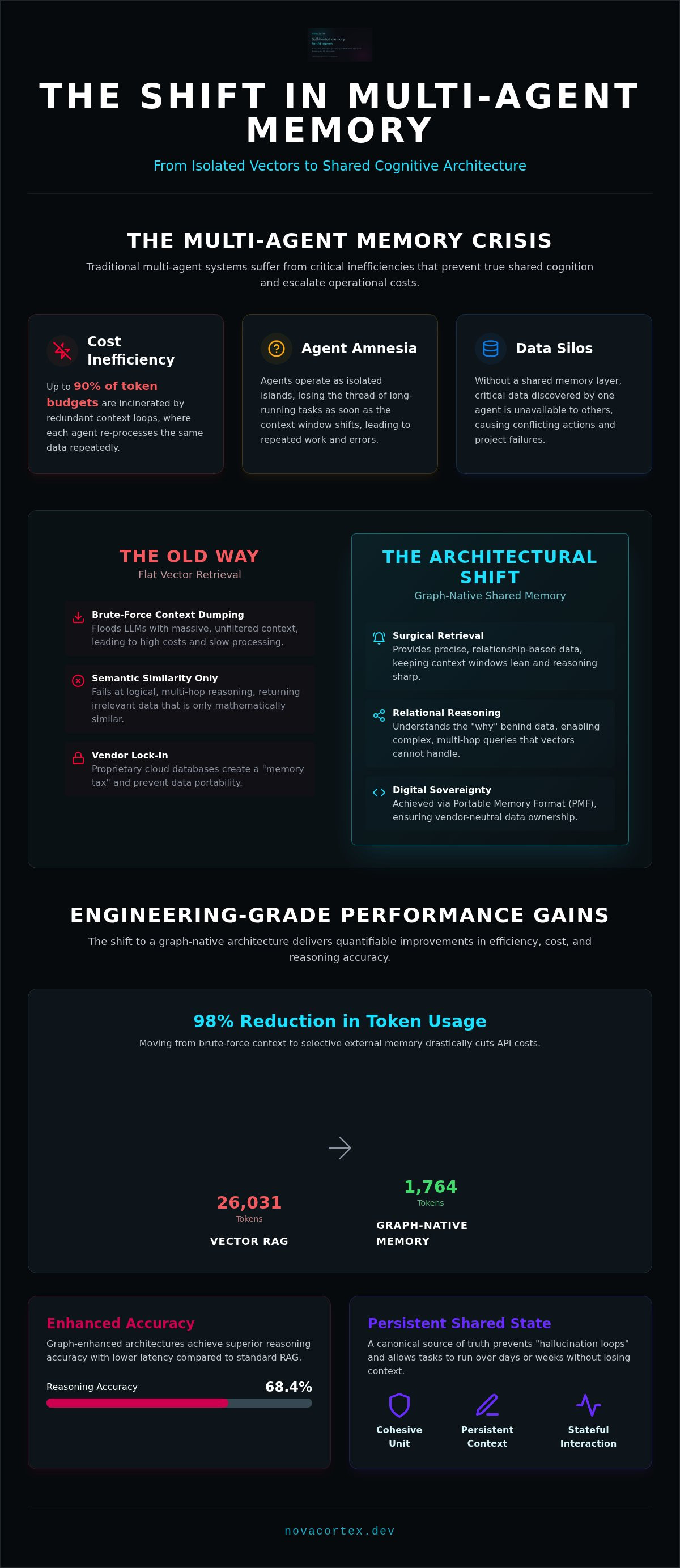
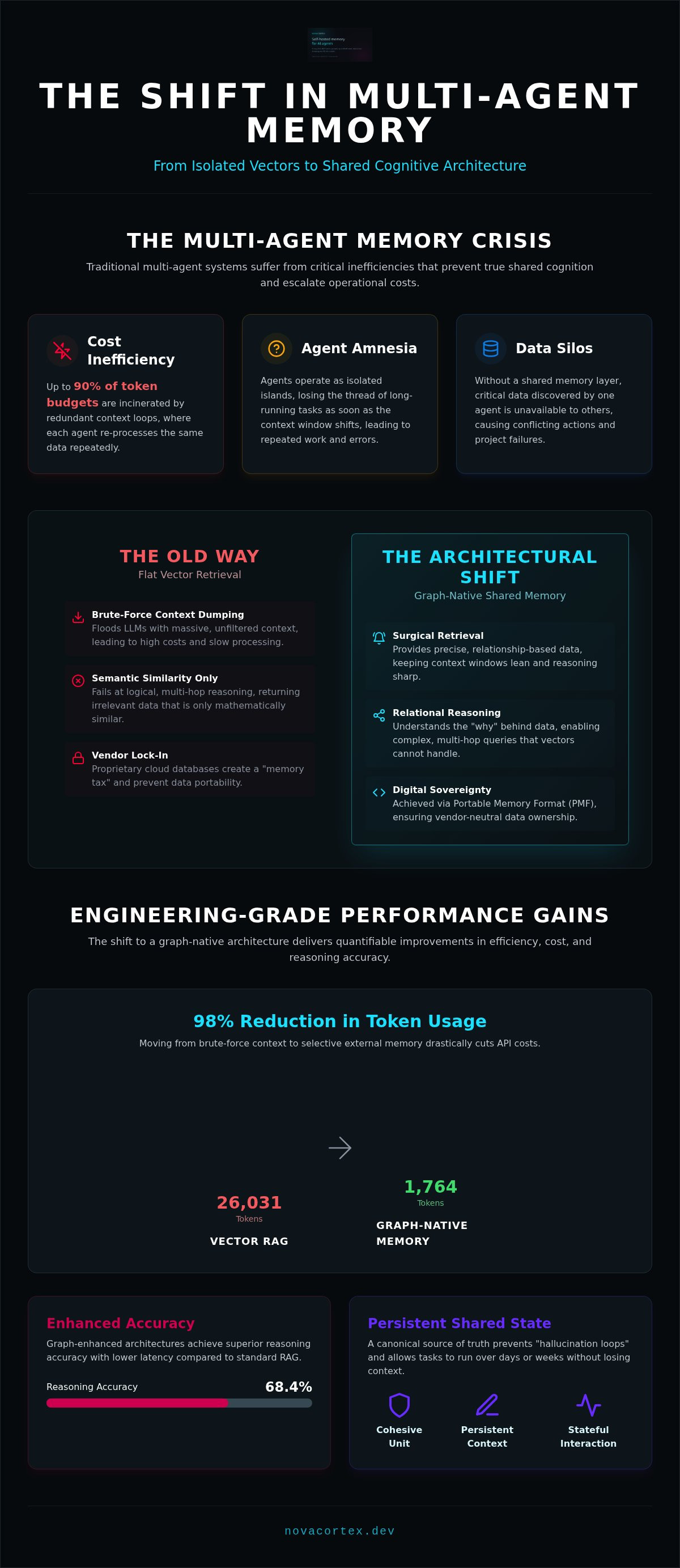
Stateless agents are expensive. In a standard multi-agent loop, every agent often re-processes the entire conversation history to understand its next move. This leads to exponential growth in API costs. Research indicates that selective external memory can lead to a 90% reduction in token usage, dropping costs from approximately 26,031 tokens per conversation to just 1,764. Traditional RAG (Retrieval-Augmented Generation) patterns often fail here because they are too slow for real-time coordination. A high-velocity system requires a memory layer that can handle concurrent updates and surgical retrieval without the latency of a standard cloud vector database.
Shared State vs. Isolated Agent Memory
Isolated memory creates data silos. If Agent A discovers a critical constraint but cannot write it to a shared substrate, Agent B will inevitably hallucinate a conflicting solution. These "hallucination loops" account for a significant portion of multi-agent failures. Shared memory provides a canonical source of truth that prevents agents from working at cross-purposes. By moving to a multi-agent memory architecture, you enable persistent context. This allows a team of agents to execute tasks over days or weeks without losing the core objectives or the nuanced state of the project. It transforms a group of disconnected bots into a cohesive, cognitive unit.
Multi-Agent Memory Architecture: Graph-Native vs. Vector-Only
Vector databases excel at semantic similarity. They fail at logical reasoning. In a complex multi-agent memory architecture, relying on similarity scores is a liability. If Agent A needs to know the specific rationale behind a 2024 architectural pivot, a vector search might return a high-ranking but irrelevant document from 2026 simply because the embeddings are mathematically close. A graph-native approach eliminates this guesswork. It doesn't just find related text; it traverses the explicit edges of an entity-relationship model to recover the "why" behind every system state.
The industry is moving away from flat vector stores for a reason. Research indicates that graph-enhanced memory architectures achieve 68.4% accuracy with significantly lower latency than standard RAG patterns. By mapping data as a network of interconnected nodes, you enable agents to perform multi-hop reasoning. They can understand that "Project X" is blocked by "Resource Y," which is currently assigned to "Agent Z." This is structural intelligence. It is the difference between a bot that searches and a system that understands.
The Graph-Native Advantage for Agent Logic
Graph structures preserve the provenance of agent decisions. When multiple agents collaborate, they need to trace the lineage of a task across different execution loops. Entity-relationship traversal allows an agent to move beyond keyword matching and into relationship mapping. This reduces retrieval noise. Instead of returning the top five most "similar" chunks, a graph-native layer returns the exact node connected to the current execution context. It provides a precise filter that keeps the context window lean and the reasoning sharp.
Implementing Knowledge Buckets for Modular State
Knowledge Buckets solve the problem of global state bloat. Instead of forcing every agent to ingest a single, massive memory pool, you assign scoped environments tailored to specific roles. This modularity is foundational for performance. You can assign a "Security Bucket" to a compliance agent while a "Codebase Bucket" remains the primary substrate for a developer agent. This prevents cross-agent data pollution and ensures that sensitive information remains localized.
This architectural shift is key to achieving a 98% token usage reduction. By synchronizing state across these buckets without duplicating the underlying data, you maintain a lean operation. If you are ready to implement these structures, you can view the NovaCortex implementation to see graph-native memory in practice. Establishing a robust AI agent long term memory is the only way to build systems that don't just react, but actually evolve with your project requirements.
Engineering Shared State: Coordination and Conflict Resolution
Managing 10+ agents writing to the same memory space is a recipe for corruption. Most developers treat this as a standard database locking problem; they are wrong. Multi-agent coordination is a protocol problem, not just a storage problem. In a high-velocity multi-agent memory architecture, the primary challenge is preventing "context drift." This occurs when agents operate on outdated or conflicting states because the memory layer cannot keep pace with the execution loop. You need coordination boundaries that define exactly who can write to a Knowledge Bucket and when.
Without a standardized protocol, your agents become a disorganized mob. They overwrite each other's observations and create feedback loops that lead to system-wide failure. Engineering a shared state requires a move away from "dumb" storage and toward an intelligent coordination layer. This layer must enforce consistency without introducing the latency that kills agentic performance. It is the difference between a collection of independent scripts and a unified cognitive system.
The Model Context Protocol (MCP) in Multi-Agent Memory
The Model Context Protocol (MCP) has emerged as the necessary standard for interoperability. Without it, you are locked into a single framework. An MCP native memory server acts as a universal translator. It allows an AutoGPT agent to understand the state changes made by a LangChain agent. This reduces integration friction significantly. It ensures that your multi-agent memory architecture remains framework-agnostic. By standardizing the interface between the LLM and the memory layer, you eliminate the need for custom glue code. This is how you build a future-proof stack that survives the rapid release cycles of production-ready frameworks like Microsoft Agent Framework 1.0.
Conflict Resolution Strategies for Agent Swarms
Simultaneous updates require more than a simple "last-write-wins" logic. That approach leads to data loss and systemic amnesia. Semantic merging is the superior alternative. In this model, the memory layer analyzes the intent of conflicting updates and merges them based on the current global objective. You can also deploy "observer" agents. These specialized agents audit the memory stream to resolve contradictions before they propagate to the rest of the swarm. For hierarchical systems, priority-based updates ensure that a "Manager Agent" can override a "Worker Agent" without creating a hallucination loop. Misalignment causes 37% of multi-agent failures according to industry research; robust conflict resolution is the only cure. You are building a cognitive unit, not just a shared disk.
Optimizing for Token Efficiency and Data Sovereignty
The "memory tax" is the single greatest barrier to scaling autonomous systems in 2026. If your agents rely on proprietary cloud vector databases, you are paying a premium for inefficiency. Every time an agent "dumps" its context window to stay relevant, you incur massive API costs and latency. A decentralized multi-agent memory architecture solves this by moving intelligence to the edge. By hosting your memory layer on local infrastructure like a VPS or even a Raspberry Pi, you regain control over your data and your budget. Self-hosting isn't just about privacy; it is a calculated move to maximize ROI by eliminating the middleman.
Data sovereignty is not a luxury. It is a structural requirement for enterprise-grade AI. Relying on external providers for your agents' long-term state creates a fragile dependency. If the provider changes their API or pricing, your entire system breaks. Engineering for sovereignty means building a system where the memory lives with the logic. This architectural independence ensures that your agents remain functional and secure, regardless of the shifting cloud landscape.
The Portable Memory Format (PMF) Specification
Developers must avoid the "Pinecone Trap." Proprietary vector clouds lock your data into silos that are nearly impossible to migrate. The solution is the portable memory format for AI (PMF). This specification allows you to export and migrate multi-agent state across different LLM providers without losing the relational metadata that defines your system's intelligence. PMF ensures that your agents' shared cognition is a portable asset, not a leased commodity. It provides the standardized structure needed to move from one model to another as better, cheaper alternatives emerge.
Surgical Retrieval: Cutting Token Waste
Standard RAG setups are blunt instruments. They use Top-K retrieval to grab chunks of text that might be relevant, often flooding the context window with noise. Surgical retrieval is different. By leveraging a graph-native multi-agent memory architecture, you can perform context-aware traversal. This method retrieves only the exact nodes and relationships required for the current task.
This approach enables "memory distillation," keeping the context window lean and focused. Benchmarks show that NovaCortex achieves a 98% token usage reduction compared to traditional RAG. Instead of sending 20,000 tokens of "maybe" to the LLM, you send 400 tokens of "exactly." This efficiency doesn't just save money; it improves reasoning accuracy by removing the distractors that lead to model drift.
NovaCortex: The Self-Hosted Standard for Multi-Agent Memory
Cloud-hosted memory is a liability. When you trust a third-party provider with your agents' long-term state, you surrender both privacy and performance. Most enterprise solutions push cloud-native platforms because they want to capture your data and your subscription fees. NovaCortex Self-Hosted Edition is the necessary correction. It provides a robust, graph-native infrastructure for a multi-agent memory architecture that lives on your hardware. It is Apache-2.0 licensed, MCP-ready, and designed for engineers who demand digital sovereignty.
A self-hosted AI memory layer eliminates the latency and security risks of external API dependencies. By keeping the cognitive substrate local, you ensure that your agents operate at the speed of your own network, not the speed of a congested cloud gateway. This is engineering reality: speed and security are inseparable from ownership. If you don't own the memory, you don't own the agent.
Privacy-First Architecture for Enterprise AI
Local knowledge storage is non-negotiable for sensitive data. In sectors like finance or healthcare, sending proprietary logic to a cloud vector database is a compliance nightmare. NovaCortex keeps every node and edge of your graph within your firewall. Our commitment to open standards means you aren't locked into a proprietary ecosystem. You can leverage the Portable Memory Format (PMF) to ensure your data remains accessible and migratable. We've built this system for builders who value independence over convenience.
Getting Started with NovaCortex Self-Hosted
Deployment is straightforward. You don't need a massive DevOps team to establish a high-performance multi-agent memory architecture. NovaCortex is designed to run efficiently on a VPS or dedicated local hardware. You can have an MCP-native memory server operational in minutes, ready to interface with any framework that supports the protocol. Once deployed, configuring your first Knowledge Buckets allows you to partition state logically between different agent teams, ensuring that your swarm stays organized and efficient.
- Pull the NovaCortex Docker image or build from the Apache-2.0 source.
- Initialize the MCP-native server on your local network.
- Define your Knowledge Buckets to scope agent memory.
- Connect your agents via the standardized PMF interface.
The roadmap for NovaCortex includes advanced multi-user controls and enterprise-grade security features to support larger engineering teams. We're building the foundation for the next decade of autonomous systems. It's time to stop renting your intelligence and start building on a standard that respects your sovereignty.
Deploy NovaCortex Self-Hosted Edition today
Engineering the Future of Autonomous Swarms
The transition from isolated vector stores to a cohesive multi-agent memory architecture is no longer optional for production-grade engineering. You've seen how brute-force context dumping incinerates budgets and creates systemic amnesia. By implementing graph-native storage and standardized protocols like MCP, you eliminate the data silos and conflict resolution bottlenecks that cripple autonomous swarms. This shift transforms a collection of disconnected scripts into a unified cognitive unit capable of long-term task execution.
Digital sovereignty is the only sustainable path forward. Leveraging the Portable Memory Format (PMF) ensures your system's intelligence remains an asset you own, not a service you rent. With a documented 98% reduction in token usage and the transparency of an Apache-2.0 open-source license, you now have the blueprint to build lean, high-velocity agentic loops on your own infrastructure. It's time to stop fighting context limits and start engineering for shared cognition.
The era of wasteful cloud dependencies is ending. Take control of your architectural state and build something that truly scales.
Frequently Asked Questions
Standard RAG vs. Multi-Agent Memory?
Standard RAG is a read-only retrieval mechanism for static data. Multi-agent memory is a dynamic, read-write substrate for shared cognition. It manages the evolving state of a project as agents interact. While RAG fetches documents, this architecture maintains a persistent context that allows agents to coordinate actions and avoid redundant processing across complex execution loops.
Reducing Tokens with Graph-Native Layers?
Graph-native layers replace blunt Top-K similarity searches with precise relationship traversal. Vector databases often flood the context window with similar but irrelevant noise. A graph follows explicit entity edges to retrieve only the nodes required for the current reasoning step. This surgical precision is what enables the 98% reduction in token usage compared to traditional, unoptimized RAG setups.
Sharing Memory Between Different LLMs?
Yes, a framework-agnostic multi-agent memory architecture decouples cognition from the LLM provider. By leveraging the Model Context Protocol (MCP), agents like GPT-4 and Claude can interact with the same underlying Knowledge Buckets. This interoperability ensures that your swarm maintains a canonical state, regardless of which models you choose for specific sub-tasks within the workflow.
Self-Hosting vs. Cloud Vector Costs?
No, self-hosting is a strategic move to eliminate recurring cloud "memory taxes." While cloud vector databases charge for storage, compute, and egress, self-hosting on a VPS or local hardware has a flat, predictable cost. When combined with surgical retrieval patterns, the ROI is immediate. You stop paying for the inefficiency of cloud providers and start investing in your own infrastructure.
Handling Multi-Agent Data Conflicts?
Conflicts are resolved through semantic merging and strict coordination boundaries. Simple database locks are insufficient for agentic workflows. Semantic merging analyzes the intent of conflicting updates to maintain a logical state. Coordination boundaries within Knowledge Buckets further restrict which agents can modify specific data points. This prevents the context drift that leads to hallucination loops in unmanaged systems.
The Importance of MCP for Memory?
MCP is the universal interface that connects AI agents to external memory servers. It standardizes how models read and write data, preventing the need for custom glue code between different frameworks. It is critical because it ensures your memory layer is future-proof. By using an MCP-native server, you can swap agents or models without re-engineering your entire persistence layer.
PMF and Avoiding Vendor Lock-in?
PMF prevents lock-in by standardizing the storage of relational metadata and agent state. Most cloud databases trap your data in proprietary formats that are impossible to export. PMF ensures that your agent's long-term memory is portable. You can migrate your entire cognitive history between different providers or local systems, maintaining full ownership of your system's intelligence.
Running NovaCortex on Raspberry Pi?
Yes, NovaCortex is designed for high-velocity performance on edge hardware. It doesn't require the massive GPU clusters used by cloud-scale vector databases. The graph-native architecture is lean enough to run on a Raspberry Pi or a standard VPS. This efficiency allows you to maintain a high-performance multi-agent memory architecture without the overhead of enterprise-grade server racks.
FAQ
Standard RAG vs. Multi-Agent Memory?
Standard RAG is a read-only retrieval mechanism for static data. Multi-agent memory is a dynamic, read-write substrate for shared cognition. It manages the evolving state of a project as agents interact. While RAG fetches documents, this architecture maintains a persistent context that allows agents to coordinate actions and avoid redundant processing across complex execution loops.
Reducing Tokens with Graph-Native Layers?
Graph-native layers replace blunt Top-K similarity searches with precise relationship traversal. Vector databases often flood the context window with similar but irrelevant noise. A graph follows explicit entity edges to retrieve only the nodes required for the current reasoning step. This surgical precision is what enables the 98% reduction in token usage compared to traditional, unoptimized RAG setups.
Sharing Memory Between Different LLMs?
Yes, a framework-agnostic multi-agent memory architecture decouples cognition from the LLM provider. By leveraging the Model Context Protocol (MCP), agents like GPT-4 and Claude can interact with the same underlying Knowledge Buckets. This interoperability ensures that your swarm maintains a canonical state, regardless of which models you choose for specific sub-tasks within the workflow.
Self-Hosting vs. Cloud Vector Costs?
No, self-hosting is a strategic move to eliminate recurring cloud "memory taxes." While cloud vector databases charge for storage, compute, and egress, self-hosting on a VPS or local hardware has a flat, predictable cost. When combined with surgical retrieval patterns, the ROI is immediate. You stop paying for the inefficiency of cloud providers and start investing in your own infrastructure.
Handling Multi-Agent Data Conflicts?
Conflicts are resolved through semantic merging and strict coordination boundaries. Simple database locks are insufficient for agentic workflows. Semantic merging analyzes the intent of conflicting updates to maintain a logical state. Coordination boundaries within Knowledge Buckets further restrict which agents can modify specific data points. This prevents the context drift that leads to hallucination loops in unmanaged systems.
The Importance of MCP for Memory?
MCP is the universal interface that connects AI agents to external memory servers. It standardizes how models read and write data, preventing the need for custom glue code between different frameworks. It is critical because it ensures your memory layer is future-proof. By using an MCP-native server, you can swap agents or models without re-engineering your entire persistence layer.
PMF and Avoiding Vendor Lock-in?
PMF prevents lock-in by standardizing the storage of relational metadata and agent state. Most cloud databases trap your data in proprietary formats that are impossible to export. PMF ensures that your agent's long-term memory is portable. You can migrate your entire cognitive history between different providers or local systems, maintaining full ownership of your system's intelligence.
Running NovaCortex on Raspberry Pi?
Yes, NovaCortex is designed for high-velocity performance on edge hardware. It doesn't require the massive GPU clusters used by cloud-scale vector databases. The graph-native architecture is lean enough to run on a Raspberry Pi or a standard VPS. This efficiency allows you to maintain a high-performance multi-agent memory architecture without the overhead of enterprise-grade server racks.