Open Source Memory for Claude: Engineering Persistent Agent Cognition in 2026

Your million-token context window is a leaky bucket, not a database. Relying on massive prompts to maintain project continuity is an architectural failure that guarantees "Claude amnesia" and astronomical API bills. You've likely felt the frustration of re-explaining complex system requirements to Claude Opus 5 just because a session ended. This is a systemic waste of engineering time and capital.
We agree that persistent cognition must be an architectural requirement for sovereignty, not just a plugin feature. This guide shows you how to build a high-performance, open source memory for Claude that restores long-term intelligence without sending your private data to a third-party cloud. You'll master the deployment of a self-hosted memory layer that eliminates the need for redundant context loading.
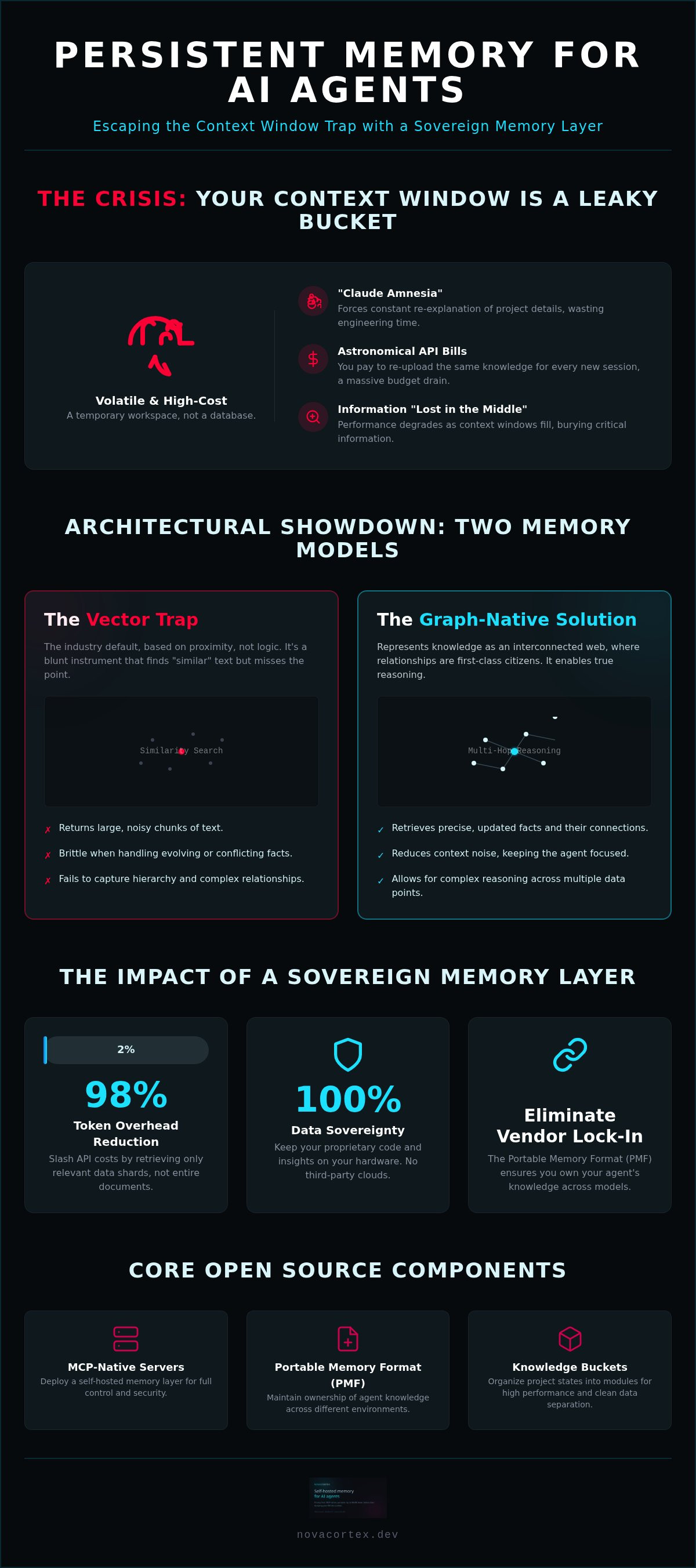
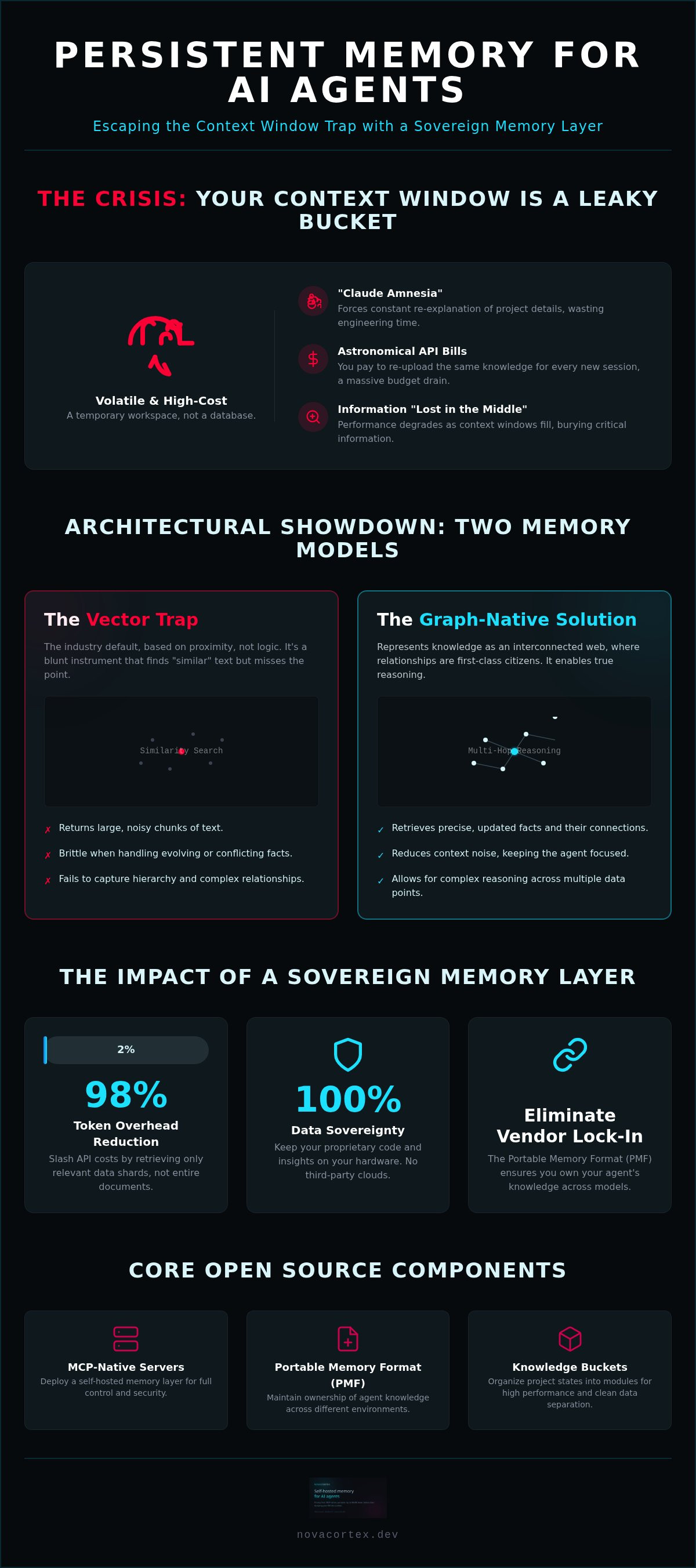
We'll explore the technical implementation of MCP-native memory servers, graph-native storage for complex relationship retrieval, and the Portable Memory Format (PMF). By the end, you'll have a system that slashes token overhead by up to 98% and keeps your agent knowledge under your total control.
Key Takeaways
- Stop treating context windows like databases. Persistent memory is an architectural requirement for long-running engineering projects, not an optional plugin.
- Move beyond the vector trap. Graph-native storage is superior to basic similarity search because it captures complex entity relationships rather than just keyword proximity.
- Deploying open source memory for Claude via an MCP-native server slashes token consumption by up to 98% while ensuring 100% data sovereignty.
- Eliminate vendor lock-in using the Portable Memory Format (PMF) to maintain ownership of agent knowledge across different environments.
- Organize project states into modular Knowledge Buckets to maintain high-velocity performance and clean data separation across diverse workflows.
The Context Window Crisis: Why Claude Needs Open Source Memory
Stop treating the context window like a storage solution. It isn't. An LLM context window is volatile, high-cost, and architecturally limited. When you rely on it for project continuity, you're building on sand. Claude forgets the nuance of your codebase or the specific logic of your business rules the moment the session expires. This "Amnesia Problem" forces developers into a cycle of redundant data injection that is both inefficient and expensive. It's a technical debt that scales linearly with your project's complexity.
From Ephemeral Chats to Persistent Agent Cognition
Session-based interaction is the primary bottleneck for autonomous workflows. To move beyond simple Q&A, agents require a dedicated state layer. Think of the context window as RAM; it's fast but temporary. True AI agent long term memory functions like a hard drive. It provides a stable, persistent memory layer that lives outside the inference cycle. By decoupling state from the model core, you allow Claude to retrieve only the relevant shards of data needed for the current task. This architecture transforms Claude from a stateless predictor into a cognitive agent capable of multi-week project execution.
The Limitations of Native Anthropic Memory
Native memory features within the Anthropic ecosystem often fail to meet the rigors of professional engineering. While Claude 3.5 and 5 series models offer massive context windows, performance degrades as those windows fill. Information "lost in the middle" is a documented reality. Beyond performance, the economic impact is staggering. With Claude 4.6 Sonnet pricing at $3 per million input tokens, re-uploading massive knowledge bases for every new session is a budget drain. You're paying to teach the model the same facts repeatedly.
Relying on hosted memory layers introduces unacceptable privacy risks and vendor lock-in. Your agent's "brain" shouldn't be a proprietary black box controlled by a third party. Implementing an open source memory for Claude is the only way to maintain 100% data sovereignty. It ensures your proprietary code and strategic insights remain on your hardware, not in a hosted database. Open source architectures provide the transparency required for security audits and the flexibility to swap models without losing years of accumulated agent knowledge. Ownership is the only path to true agentic autonomy.
Architecting Cognition: Vector Search vs. Graph-Native Memory
Vector search is the industry's default. It's also an architectural dead end for persistent cognition. While semantic search identifies related strings, it lacks the structural logic required for complex engineering tasks. Similarity is not understanding. If you want an open source memory for Claude that actually works, you must move beyond the "vector trap" and embrace a relationship-first model. Similarity search is a blunt instrument that captures the vibe of a document but misses the logic of the system.
Why Traditional Vector Databases Fail at Long-Term Context
Vector databases operate on proximity, not hierarchy. This leads to the "Lost in the Middle" phenomenon where the most critical context is buried or ignored by the model's attention mechanism. Vector retrieval is notoriously brittle when handling evolving facts. If a project requirement changes, a vector database often returns stale, conflicting information because the old and new data share semantic space. When comparing Redis vs graph memory for AI agents, the limitation is clear: Redis-style vector search returns chunks of text, while graph structures return precise, updated facts. This prevents the cognitive dissonance that occurs when Claude receives two "similar" but contradictory instructions.
The Engineering Advantage of Graph-Native Storage
Graph-native memory represents knowledge as an interconnected web of facts. In this architecture, relationships are first-class citizens. This allows Claude to perform multi-hop reasoning, traversing from a specific variable to its parent class and then to its deployment environment in a single retrieval step. You aren't just pulling a broad "chunk" of text; you're retrieving the exact node and its relevant edges. This precision reduces the amount of noise injected into the context window, keeping Claude focused and your token costs low. Graph-native memory for AI is a relationship-first data structure that prioritizes the semantic links between entities over simple keyword proximity.
Efficiency is the ultimate metric for agent performance. While a vector-based RAG system might dump 2,000 tokens of "relevant" text into your prompt, a graph-native system delivers the specific 50-token fact that solves the problem. This massive reduction in noise is why deploying a graph-native architecture is the only viable path for scaling complex AI agents. It's the difference between a library full of unorganized books and a perfectly indexed database. For any developer building open source memory for Claude, the graph is the non-negotiable foundation for persistent, high-velocity intelligence.
Self-Hosted vs. Managed Memory: Comparing Sovereignty and Cost
Managed memory platforms sell convenience at the cost of your digital autonomy. While a cloud-based API might offer a five-minute setup, it creates a permanent umbilical cord to a third-party server. For engineering teams, this is a non-starter. You wouldn't host your proprietary core logic on a public pastebin; you shouldn't host your agent's long-term memory there either. Implementing an open source memory for Claude ensures that your data stays within your perimeter, effectively killing the risk of corporate espionage or vendor-side data leaks.
The Cost of Privacy: Self-Hosted RAG vs. Managed Services
The long-term subscription costs of hosted memory platforms are deceptively high. Cognee, for instance, charges $2.50 per million tokens after its free tier. While this seems marginal, the compounding cost of persistent agent state across multiple projects quickly eclipses the overhead of local infrastructure. The debate over self-hosted vs managed AI memory is the defining architectural choice for 2026. Centralized memory hubs represent a single point of failure and a massive security liability. If their platform goes down, your agent loses its history. If their database is breached, your entire project context is exposed.
Self-hosting allows you to deploy on local hardware, from a dedicated VPS to a Raspberry Pi. This approach provides absolute data sovereignty. You control the retention policies, the encryption keys, and the retrieval logic. You aren't just renting a brain; you're building a private knowledge asset that appreciates in value as your agent learns.
Benchmarking Token Efficiency and System Performance
Efficiency is not just about cost; it's about performance. Standard RAG systems often flood the context window with irrelevant noise, driving up latency and degrading Claude's reasoning capabilities. NovaCortex Self-Hosted Edition solves this through precise, graph-native retrieval. By delivering only the exact nodes required for a query, it reduces token usage by up to 98% compared to naive vector search. This precision slashes your API overhead and keeps your context window clean for the actual task at hand.
Performance latency also favors the self-hosted model. Retrieving memory from a local VPS or a co-located server eliminates the cloud-to-cloud round-trip delays that plague managed services. High token efficiency directly correlates to agent speed because smaller, more relevant prompts result in faster model inference times. By minimizing the "noise" Claude has to process, you enable high-velocity performance that managed platforms simply cannot match. For developers building open source memory for Claude, the ROI is clear: lower costs, higher speed, and total ownership.
Implementation Guide: Setting Up an MCP-Native Memory Server
Persistent cognition isn't a theory; it's a configuration. To stop Claude's session-based amnesia, you must deploy a dedicated bridge between the model and your storage layer. The Model Context Protocol (MCP) has emerged as the industry standard for this integration. It provides a clean, schema-driven way for Claude to read and write to your private knowledge base. Setting up an open source memory for Claude ensures that this bridge remains under your direct control, bypassing the risks of proprietary cloud endpoints.
Before deployment, verify your environment. You'll need Docker for containerized stability, Node.js (v20+) for the runtime, and your Claude API credentials. NovaCortex Self-Hosted Edition is designed to run in a modular fashion, allowing you to scale the memory server independently of your agent's inference engine. Once your environment is ready, the installation is a straightforward container pull and configuration step.
Integrating Claude via Model Context Protocol (MCP)
An MCP native memory server is the new interoperability standard that prevents vendor lock-in. To connect Claude, you must edit your claude_desktop_config.json file to include the NovaCortex server details. This configuration allows Claude to see memory as a set of callable tools. You aren't just giving Claude a file; you're giving it the ability to add_knowledge, search_memory, and update_state in real-time. This active participation in its own memory management is what enables true agentic behavior.
Deploying on Private Infrastructure
Hardware choice depends on your project scale. A Raspberry Pi 5 is sufficient for individual developer logs, but an Enterprise VPS is recommended for team-wide codebase indexing. The critical factor is latency. High-velocity performance requires the memory server to be as close to the agent as possible. If your retrieval takes seconds, the cognitive flow is broken. Maintenance is minimal, but you should establish an automated backup strategy for your graph database nodes. Losing your memory layer is equivalent to a lobotomy for your agent.
Testing the integration is the final step. Start a conversation with a unique project fact. Close the session entirely. Open a new session and ask Claude to retrieve that fact. When the logs show an MCP tool call and Claude returns the correct data, you've successfully engineered persistent cognition. You've moved from a leaky context window to a reliable, open source memory for Claude that scales with your needs.
NovaCortex: The Sovereign Memory Layer for Claude Agents
NovaCortex is the definitive solution for open source memory for Claude. It's a firm rejection of the "black box" model of agent cognition. Built under the Apache-2.0 license, it provides the transparency and security that enterprise engineering requires. You don't just use NovaCortex; you own the intelligence it helps Claude accumulate. This architecture ensures that your data remains a private asset, not a training data point for a third-party cloud provider.
The implementation of Knowledge Buckets introduces a level of modularity missing from standard RAG implementations. You can compartmentalize state for different clients, projects, or technical domains. This ensures that Claude remains highly focused, retrieving only what's necessary for the specific task at hand. It's about maintaining a high signal-to-noise ratio in every session. Whether you're a solo developer managing local logs or a team indexing a massive enterprise codebase, NovaCortex scales to meet the demand without sacrificing speed.
Future-Proofing AI with Portable Memory
Model lock-in is a strategic liability. If your agent's "brain" is tied to a specific API or a proprietary storage format, your project's longevity is at the mercy of a single vendor. The portable memory format for AI (PMF) solves this by creating a vendor-agnostic standard for cognition. PMF allows you to extract your agent's knowledge and inject it into any compliant LLM. Whether you're moving from Claude to an internal model or a different commercial provider, your data remains intact and actionable. Open standards are the backbone of digital sovereignty in the age of persistent agents.
Getting Started with NovaCortex
Building a sovereign memory layer is the first step toward true agentic autonomy. NovaCortex provides the tools to move from ephemeral chats to persistent, high-velocity intelligence. Access the repository to explore the MCP-native server implementation and start organizing your agent's knowledge today. We've built the foundation; we now invite you to contribute to the open-source memory movement. Sovereignty isn't given; it's engineered.
Engineering Sovereign Intelligence
The era of ephemeral context is over. Persistent cognition is now an architectural requirement for any serious engineering workflow. You've seen how graph-native storage outperforms brittle vector search and how self-hosting eliminates the privacy risks of centralized hubs. By implementing an open source memory for Claude, you move beyond the "Lost in the Middle" trap of semantic search and embrace the precision of relationship-first data structures.
NovaCortex provides the Apache-2.0 foundation you need to maintain 100% data sovereignty. Its MCP-native integration slashes token overhead by 98% while ensuring your proprietary data never leaves your perimeter. This is a strategic correction to the waste and vulnerability of managed memory platforms. Stop subsidizing the inefficiencies of hosted layers and start building agentic systems that actually learn from their environment. Reclaim your digital sovereignty today.
The path to persistent, high-velocity intelligence is now open. We look forward to seeing what you build with a truly sovereign cognitive stack.
Frequently Asked Questions
Is open source memory for Claude really more private than hosted options?
Self-hosting is fundamentally more private because it eliminates the third-party data processor from your architecture. Hosted solutions require you to send proprietary context to their cloud, creating a permanent security liability. With an open source memory for Claude, your data never leaves your perimeter. You maintain total control over encryption and retention policies, ensuring your agent's knowledge remains a private corporate asset rather than a liability on a managed server.
How does NovaCortex reduce Claude token usage by 98%?
NovaCortex achieves this by moving beyond the "chunk and retrieve" model of traditional RAG. Instead of injecting 2,000 tokens of similar text, the system identifies the exact graph node and its relevant edges needed for the query. This relationship-first retrieval delivers the specific 50-token fact Claude requires. By filtering out the noise inherent in semantic search, you maximize the efficiency of every API call and slash input costs.
Can I run a self-hosted memory server on a Raspberry Pi?
You can run NovaCortex on a Raspberry Pi 5 or any local hardware with 8GB of RAM. The graph-native architecture is engineered for high-velocity performance with minimal hardware overhead. This allows you to maintain a persistent memory layer without the need for expensive, GPU-accelerated databases. It's a pragmatic choice for individual developers who want to experiment with agentic cognition on private, low-cost infrastructure.
What is the Model Context Protocol (MCP) and why does Claude use it?
The Model Context Protocol (MCP) is an open standard that enables LLMs to interact with external data sources as tools. Claude uses it to bridge the gap between inference and state. By implementing an open source memory for Claude via an MCP-native server, you allow the model to autonomously search, update, and organize its own context. This protocol ensures interoperability across the agent ecosystem without the need for proprietary integration code.
Does NovaCortex support multi-agent memory synchronization?
Multi-agent synchronization is handled through modular Knowledge Buckets. You can configure multiple Claude agents to read from and write to the same bucket, creating a shared cognitive state for collaborative tasks. This prevents information silos and ensures that every agent in your pipeline has access to the most current project context. It's the foundation for building complex, multi-agent swarms that operate on a unified knowledge base.
What happens if I want to switch from Claude to another LLM later?
Switching models is seamless thanks to the Portable Memory Format (PMF). Unlike proprietary formats that lock your data into a specific platform, PMF is a vendor-agnostic standard for agent cognition. You can export your accumulated memory from Claude and import it into any other LLM provider that supports the format. This architectural choice prevents vendor lock-in and ensures that your agent's long-term intelligence remains a portable, durable asset.
Is there a commercial license available for enterprise deployments?
NovaCortex is released under the Apache-2.0 license, which is highly permissive for commercial use. This allows you to integrate the memory layer into proprietary enterprise applications without restrictive copyleft requirements. For organizations needing specific service level agreements or dedicated support, enterprise-grade extensions for the Self-Hosted Edition are available. This licensing model provides the transparency of open source with the reliability required for production-scale deployments.
How does graph-native memory differ from a standard vector database?
Vector databases rely on semantic similarity, which often returns irrelevant noise that happens to share keyword vibes. Graph-native memory prioritizes relationships and hierarchy. It allows Claude to perform multi-hop reasoning, such as identifying how a specific variable in one file impacts a deployment script in another. While vectors provide a flat list of potential matches, graphs provide a structured, logical map of your data, resulting in far higher retrieval precision.
FAQ
Is open source memory for Claude really more private than hosted options?
Self-hosting is fundamentally more private because it eliminates the third-party data processor from your architecture. Hosted solutions require you to send proprietary context to their cloud, creating a permanent security liability. With an open source memory for Claude, your data never leaves your perimeter. You maintain total control over encryption and retention policies, ensuring your agent's knowledge remains a private corporate asset rather than a liability on a managed server.
How does NovaCortex reduce Claude token usage by 98%?
NovaCortex achieves this by moving beyond the "chunk and retrieve" model of traditional RAG. Instead of injecting 2,000 tokens of similar text, the system identifies the exact graph node and its relevant edges needed for the query. This relationship-first retrieval delivers the specific 50-token fact Claude requires. By filtering out the noise inherent in semantic search, you maximize the efficiency of every API call and slash input costs.
Can I run a self-hosted memory server on a Raspberry Pi?
You can run NovaCortex on a Raspberry Pi 5 or any local hardware with 8GB of RAM. The graph-native architecture is engineered for high-velocity performance with minimal hardware overhead. This allows you to maintain a persistent memory layer without the need for expensive, GPU-accelerated databases. It's a pragmatic choice for individual developers who want to experiment with agentic cognition on private, low-cost infrastructure.
What is the Model Context Protocol (MCP) and why does Claude use it?
The Model Context Protocol (MCP) is an open standard that enables LLMs to interact with external data sources as tools. Claude uses it to bridge the gap between inference and state. By implementing an open source memory for Claude via an MCP-native server, you allow the model to autonomously search, update, and organize its own context. This protocol ensures interoperability across the agent ecosystem without the need for proprietary integration code.
Does NovaCortex support multi-agent memory synchronization?
Multi-agent synchronization is handled through modular Knowledge Buckets. You can configure multiple Claude agents to read from and write to the same bucket, creating a shared cognitive state for collaborative tasks. This prevents information silos and ensures that every agent in your pipeline has access to the most current project context. It's the foundation for building complex, multi-agent swarms that operate on a unified knowledge base.
What happens if I want to switch from Claude to another LLM later?
Switching models is seamless thanks to the Portable Memory Format (PMF). Unlike proprietary formats that lock your data into a specific platform, PMF is a vendor-agnostic standard for agent cognition. You can export your accumulated memory from Claude and import it into any other LLM provider that supports the format. This architectural choice prevents vendor lock-in and ensures that your agent's long-term intelligence remains a portable, durable asset.
Is there a commercial license available for enterprise deployments?
NovaCortex is released under the Apache-2.0 license, which is highly permissive for commercial use. This allows you to integrate the memory layer into proprietary enterprise applications without restrictive copyleft requirements. For organizations needing specific service level agreements or dedicated support, enterprise-grade extensions for the Self-Hosted Edition are available. This licensing model provides the transparency of open source with the reliability required for production-scale deployments.
How does graph-native memory differ from a standard vector database?
Vector databases rely on semantic similarity, which often returns irrelevant noise that happens to share keyword vibes. Graph-native memory prioritizes relationships and hierarchy. It allows Claude to perform multi-hop reasoning, such as identifying how a specific variable in one file impacts a deployment script in another. While vectors provide a flat list of potential matches, graphs provide a structured, logical map of your data, resulting in far higher retrieval precision.