Open Source Memory for Claude: Engineering Persistent Context with NovaCortex

Feeding Claude the same 20,000 tokens of documentation every time you start a new session isn't just inefficient; it's architectural malpractice. You've felt the sting of context window bloat and the mounting API bills that come with repeating yourself. Cloud-hosted memory solutions promise a fix but often trade your data privacy for convenience, locking you into yet another proprietary silo. This guide demonstrates how to deploy open source memory for Claude using NovaCortex to slash token costs by 98% while maintaining absolute sovereignty over your knowledge base.
We'll explore how the MCP-Native Memory Server and Portable Memory Format (PMF) replace wasteful context stuffing with precise, graph-native retrieval. You'll learn to engineer a persistent context layer that lives on your infrastructure, ensuring your AI agents grow smarter without bloating your overhead. We're moving beyond simple vector search into a structured, self-hosted ecosystem that treats memory as a first-class citizen. It's time to stop renting intelligence and start owning the architecture that powers it.
Key Takeaways
- Slash token overhead by 98% by replacing wasteful context-stuffing with a high-precision, graph-native retrieval layer.
- Reclaim digital sovereignty using NovaCortex Self-Hosted Edition, ensuring sensitive data remains on your infrastructure under the Apache-2.0 license.
- Deploy open source memory for Claude to eliminate session amnesia without the privacy risks or recurring costs of proprietary cloud storage.
- Leverage the MCP-Native Memory Server to establish a seamless, persistent connection between Claude and your private Knowledge Buckets.
- Utilize the Portable Memory Format (PMF) to maintain absolute control over your knowledge storage and eliminate the threat of vendor lock-in.
The Claude Context Crisis: Why Standard RAG Fails
Developers often mistake a large context window for a total solution. It is a trap. Loading 100k tokens of project history into every API call is a fast way to burn through your budget and increase latency. This is the "Token Tax." It is inefficient. It is slow. It represents a failure to architect a proper memory layer. True open source memory for Claude isn't about how much you can cram into the prompt; it's about how little you can send while maintaining perfect recall.
AI memory is not a passive storage bin. It is a high-velocity, structured retrieval system. If your agent treats every interaction as a fresh start, you aren't building a tool; you're managing a recurring cost. Dumping raw knowledge bases into prompts is architectural suicide for production systems. Open source memory provides the only viable path to digital sovereignty, allowing you to decouple your organizational intelligence from the LLM provider's infrastructure.
Proprietary Context Limits
Features like Claude Projects offer a glimpse of persistence. They are functional but fundamentally restrictive. You operate within a black box. Your data lives on someone else's infrastructure, subject to their pricing tiers and privacy policies. This vendor lock-in creates a fragile foundation for any enterprise. When you move to a self-hosted model, you eliminate the risk of being de-platformed from your own knowledge. You gain complete control over how information is stored, accessed, and purged.
Beyond the Vector Database
Most developers reach for a vector database first. This is a mistake for complex reasoning tasks. Vector similarity measures proximity in a latent space, not logical relationships. It produces noise. It misses nuance. Claude requires a higher fidelity memory layer that understands entities and their specific connections. A graph-native approach provides this precision, turning a pile of documents into a navigable knowledge map. This is why open source memory for Claude must move beyond simple semantic search to provide the structured context required for sophisticated agentic workflows. You don't need more data; you need better relationships between the data you already have.
Graph-Native Memory: The Engineering Edge
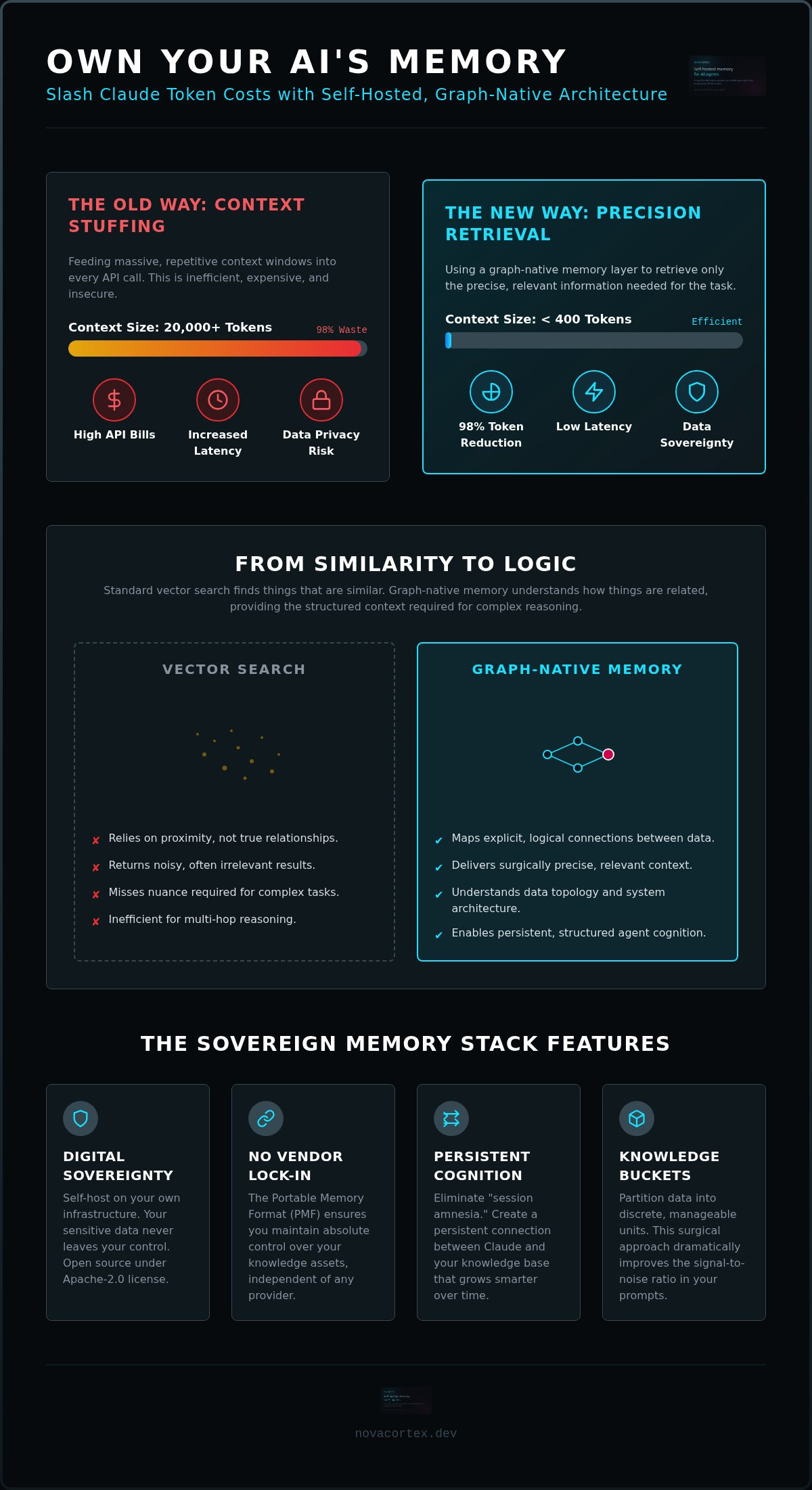
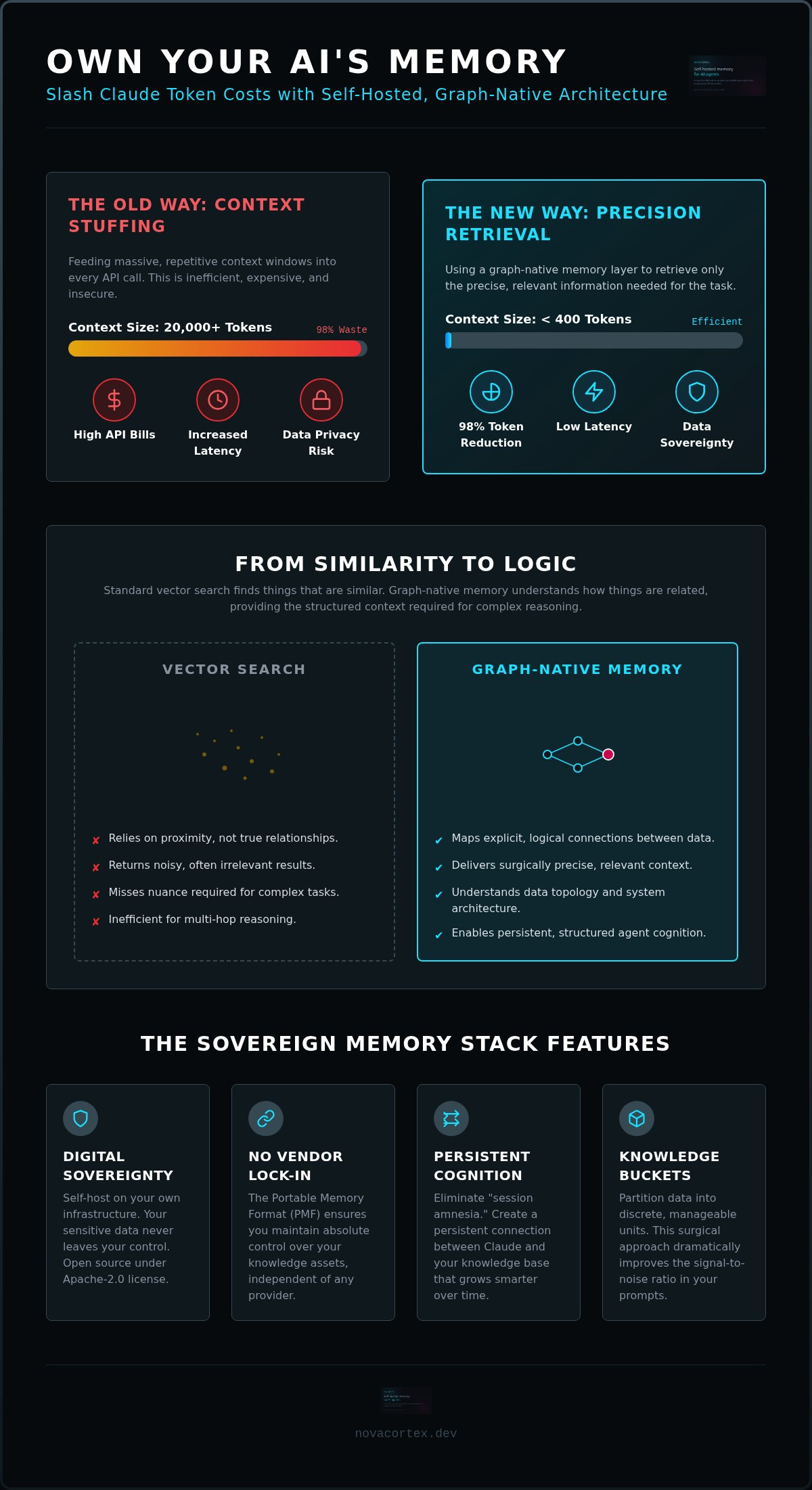
Vector databases are built for similarity, not logic. Similarity is not understanding. They rely on cosine similarity or Euclidean distance within a latent vector space. This works for recommendation engines but fails for architectural reasoning. A graph-native approach uses nodes and edges to define explicit relationships. If Claude needs to understand how a specific API endpoint interacts with a database schema, a vector search might return unrelated documentation that happens to use similar keywords. A graph returns the exact schema-to-endpoint mapping. This level of precision is the cornerstone of effective open source memory for Claude. It transforms the AI from a pattern matcher into a system that understands data topology.
Engineering Persistent Cognition
Human memory is inherently associative. We don't recall facts in isolation; we recall them through their connections to other concepts. A self-hosted AI memory layer enables this same pattern for Claude. By storing information as a network of interconnected nodes, NovaCortex creates a digital "long-term memory" that persists across sessions. This architecture prevents context drift, where the agent slowly loses the original intent of a project as the conversation grows. Instead, every new interaction strengthens the existing graph, ensuring the agent’s cognition remains grounded in established facts. Context is preserved. This is how you move from stateless chatbots to persistent AI engineers.
The 98% Token Reduction Formula
Efficiency in AI engineering is measured by the signal-to-noise ratio. Traditional RAG systems often overwhelm the context window with redundant information. Knowledge Buckets solve this by partitioning data into discrete, manageable units. It works. When a query is executed, NovaCortex retrieves only the specific nodes necessary to answer the prompt. This surgical precision results in a 98% token reduction compared to brute-force context stuffing. You aren't just saving money; you're improving the model's ability to reason by removing distracting irrelevant data. This method ensures that the most critical information always fits within the primary context window without sacrificing depth.
The technical trade-offs are evident when comparing Redis vs graph memory for AI agents. While Redis offers low latency for simple lookups, it cannot handle the multi-hop traversals required for deep reasoning. Graph memory allows Claude to traverse relationships in a single operation, such as identifying how a code change impacts downstream dependencies. This capability is essential for building autonomous agents that can manage their own state and history. For teams ready to implement high-performance open source memory for Claude, you can audit the graph schemas to understand how NovaCortex structures these persistent connections.
Open Source vs. Proprietary: Choosing Your Memory Layer
Digital sovereignty is not a luxury; it is a technical requirement for enterprise-grade AI. Choosing open source memory for Claude means rejecting the black box approach of proprietary vendors. Proprietary memory layers often treat your data as fuel for their own model improvements. By contrast, an Apache-2.0 licensed solution ensures you own every byte of your knowledge base. You aren't renting intelligence. You are building an asset. Local infrastructure remains the only safe harbor for sensitive data, providing a level of security that cloud-hosted "walled gardens" cannot replicate.
The Portable Memory Format (PMF) Standard
Walled gardens are designed to keep you trapped. When your memory layer uses a proprietary schema, switching models becomes a migration nightmare. The portable memory format for AI breaks this cycle. It decouples your structured knowledge from the LLM provider. This means if you decide to pivot your stack, your graph-native memory remains intact and functional. You are future-proofing your infrastructure against the inevitable shifts in the model landscape. It is about architectural freedom.
Self-Hosted vs Managed AI Memory
Managed services charge a "Privacy Tax." You trade your data's location for a dashboard. In reality, self-hosting is no longer a high-barrier endeavor. You can run NovaCortex on anything from a dedicated Raspberry Pi to an enterprise-grade VPS. Comparing self-hosted vs managed AI memory reveals that managed solutions often introduce latency and security vulnerabilities that local infrastructure avoids. Self-hosting provides the low-latency response times required for real-time agentic workflows while keeping your data behind your own firewall.
Total Cost of Ownership (TCO) is the final metric. Managed cloud memory fees scale linearly with your usage. This is a trap. A self-hosted VPS has a fixed cost regardless of how many millions of nodes your graph contains. By implementing open source memory for Claude, you move from an unpredictable Opex model to a stable, scalable infrastructure. You gain performance. You gain privacy. Most importantly, you gain independence from the restrictive pricing tiers of proprietary providers.
Implementing MCP-Native Memory for Claude
Claude is a reasoning engine without a hard drive. The Model Context Protocol (MCP) changes that. It acts as the standardized bridge between the LLM and your local infrastructure. By implementing open source memory for Claude, you enable the model to query its own history using native tool-calling. This isn't a workaround. It is an architectural standard. It allows you to treat your knowledge base as a live resource rather than a static attachment. You are essentially giving Claude the ability to manage its own long-term recall through a structured protocol.
Architecting the Memory Server
Deployment begins on your private infrastructure. Whether you use a local machine or a cloud-based VPS, the setup remains consistent. You must first establish an MCP native memory server to handle incoming retrieval requests. This server acts as the gatekeeper for your graph-native storage. Configuration requires a clear path from local execution to Claude Desktop integration:
- Server Deployment: Launch the NovaCortex binary on your local machine or secure VPS.
- MCP Configuration: Add the server executable path and required environmental variables to your Claude Desktop configuration file.
- Schema Mapping: Define the JSON-RPC methods that Claude will use to read from and write to your graph-native storage.
This structure ensures that Claude has a high-fidelity map of your data. It eliminates the ambiguity of vector-only search. Retrieval becomes a deterministic process based on the schemas you've engineered. Your agent doesn't just guess where information is; it follows a protocol to find it.
Optimizing Agent State Management
Effective memory management requires segregation. You don't want a coding assistant hallucinating details from your financial planning sessions. Knowledge Buckets provide the necessary isolation. By mapping specific buckets to Claude's tool-calling capabilities, you ensure the agent only pulls from relevant data streams. This is vital for maintaining the integrity of open source memory for Claude in multi-agent environments. It prevents context contamination and ensures each agent stays focused on its specific domain.
Syncing memory across multiple instances happens in real-time. Because the storage is graph-native and local, you can manage AI agent long term memory without the latency spikes associated with cloud retrieval. The result is a seamless experience where Claude "remembers" project details across sessions as if they were part of its native training. You are building a persistent cognitive layer that scales with your project complexity.
NovaCortex: The Sovereign Memory Solution
NovaCortex is the architectural correction to AI amnesia. It replaces the fragile, cloud-dependent memory of standard LLM interactions with a robust, graph-native layer. You've seen the data. A 98% token reduction isn't a projection; it's a benchmark. By deploying the NovaCortex Self-Hosted Edition, you're not just solving a technical problem. You're establishing a foundation for digital sovereignty. This is the definitive open source memory for Claude, engineered for developers who refuse to compromise on performance or data ownership. While proprietary systems treat your data as a commodity, we treat it as your most valuable architectural asset.
A Developer-First Philosophy
We don't do marketing fluff. We build tools for engineers who understand that data residency is a non-negotiable security requirement. Our core product is independence. While competitors focus on cloud-hosted recurring revenue, we focus on the builder. We provide direct, builder-to-builder support. This ensures your implementation is grounded in engineering reality, not corporate sales cycles. We reject bloated, restrictive systems in favor of lean, high-velocity performance. Beyond the Apache-2.0 license, we offer enterprise support for teams requiring specialized management and high-availability configurations. It is about providing the freedom to build without licensing anxiety or hidden costs.
Getting Started with NovaCortex
Deployment is straightforward. Whether you're running on a local development environment or a production VPS, the process remains consistent. You can transition from a stateless agent to a persistent cognitive system in minutes. The quickstart guide covers the essential steps for environment configuration and bucket initialization. This move toward open source memory for Claude is a shift toward a more resilient AI ecosystem. You're joining a community that values interoperability and digital rights. It’s time to stop letting your AI’s intelligence evaporate at the end of every session. Own your memory. Scale your agents. Maintain your sovereignty.
Deploy NovaCortex Self-Hosted Edition
Own Your Agent's Intelligence
Context stuffing is a technical debt that scales poorly and drains budgets. Graph-native structures and Knowledge Buckets replace wasteful amnesia with high-precision recall. Transitioning to open source memory for Claude isn't just a cost-saving measure; it's a strategic move toward building an architectural foundation that respects data privacy and system performance. You are no longer renting a context window. You are owning a cognitive layer.
By adopting an MCP-native architecture, you decouple your organizational knowledge from proprietary black boxes. This ensures your AI agents remain functional and sovereign regardless of provider shifts. The 98% token usage reduction and Apache-2.0 licensing provide the freedom to scale without friction. It's time to stop managing amnesia and start engineering persistence.
Build something that remembers. Your infrastructure is ready for a professional memory layer that works as hard as your agents do.
Frequently Asked Questions
How do I give Claude long-term memory using open source tools?
Deploy the NovaCortex Self-Hosted Edition on your private infrastructure to establish a persistent context layer. It functions as a graph-native storage engine that records and retrieves entities across multiple chat sessions. This architecture ensures your AI doesn't lose project history when you close a tab. It's the most effective implementation of open source memory for Claude for developers who prioritize data residency and engineering precision over cloud convenience.
Why should I choose a self-hosted memory layer over proprietary cloud solutions?
NovaCortex offers a level of digital sovereignty that cloud-based memory layers cannot match. By hosting your own memory layer under the Apache-2.0 license, you eliminate the risk of vendor lock-in and opaque data usage policies. It is about architectural control. You maintain the freedom to manage your knowledge base on your own terms without being subject to the shifting pricing tiers or restrictive terms of proprietary providers.
What is the Model Context Protocol (MCP) and how does it work with Claude?
The Model Context Protocol (MCP) is an open standard that allows Claude to interact with local data sources through tool-calling. It acts as a bridge between the model's reasoning and your private knowledge. By using an MCP-Native Memory Server, you give Claude a standardized way to query its own history. This protocol replaces fragile, custom-coded integrations with a reliable, architectural standard that scales across different AI agents and environments.
Can I run NovaCortex on a Raspberry Pi or a local VPS?
You can run NovaCortex on a wide range of hardware, from a Raspberry Pi to an enterprise-grade VPS. The system is engineered for high-velocity performance with minimal resource footprints. This lean architecture ensures low-latency retrieval even on modest hardware profiles. You don't need expensive cloud compute to maintain a persistent memory layer. It provides the flexibility to host your AI's "brain" wherever your security requirements demand.
How does graph-native memory reduce AI token costs?
Graph-native memory slashes token costs by 98% through precise, node-based retrieval. Standard RAG often stuffs entire document chunks into the context window, creating massive token waste. NovaCortex traverses relationships to find only the specific facts required for a query. This surgical approach eliminates the "Token Tax" of repeating information. It ensures the signal-to-noise ratio remains high while keeping your API bills manageable for production-scale deployments.
Does NovaCortex work with Claude Desktop and Claude API?
NovaCortex integrates seamlessly with both Claude Desktop and the Claude API. For desktop users, you simply add the MCP-Native Memory Server to your local configuration file. For developers using the API, the server provides a structured endpoint for high-fidelity context injection. This ensures a consistent open source memory for Claude across all your workflows. You can maintain a single, unified knowledge base that follows you from the chat interface to custom applications.
Is my data encrypted when using a self-hosted memory layer?
Security is a foundational feature of the self-hosted model. Because your memory layer lives on your own infrastructure, you have total control over encryption at rest and in transit. You aren't outsourcing your sensitive data to a proprietary cloud provider's black box. You can implement your own firewall rules and access controls. This architecture provides a safe harbor for proprietary intelligence that managed services can't legally or technically guarantee.
What is the Portable Memory Format (PMF)?
The Portable Memory Format (PMF) is a vendor-neutral standard for storing AI knowledge. It ensures your memory graph isn't locked into a specific storage engine or LLM provider. If you switch models or update your stack, your data remains fully portable and readable. This format protects you from the vendor lock-in cycle. It treats your organizational memory as an independent, permanent asset rather than a temporary extension of a cloud subscription.
FAQ
How do I give Claude long-term memory using open source tools?
Deploy the NovaCortex Self-Hosted Edition on your private infrastructure to establish a persistent context layer. It functions as a graph-native storage engine that records and retrieves entities across multiple chat sessions. This architecture ensures your AI doesn't lose project history when you close a tab. It's the most effective implementation of open source memory for Claude for developers who prioritize data residency and engineering precision over cloud convenience.
Why should I choose a self-hosted memory layer over proprietary cloud solutions?
NovaCortex offers a level of digital sovereignty that cloud-based memory layers cannot match. By hosting your own memory layer under the Apache-2.0 license, you eliminate the risk of vendor lock-in and opaque data usage policies. It is about architectural control. You maintain the freedom to manage your knowledge base on your own terms without being subject to the shifting pricing tiers or restrictive terms of proprietary providers.
What is the Model Context Protocol (MCP) and how does it work with Claude?
The Model Context Protocol (MCP) is an open standard that allows Claude to interact with local data sources through tool-calling. It acts as a bridge between the model's reasoning and your private knowledge. By using an MCP-Native Memory Server, you give Claude a standardized way to query its own history. This protocol replaces fragile, custom-coded integrations with a reliable, architectural standard that scales across different AI agents and environments.
Can I run NovaCortex on a Raspberry Pi or a local VPS?
You can run NovaCortex on a wide range of hardware, from a Raspberry Pi to an enterprise-grade VPS. The system is engineered for high-velocity performance with minimal resource footprints. This lean architecture ensures low-latency retrieval even on modest hardware profiles. You don't need expensive cloud compute to maintain a persistent memory layer. It provides the flexibility to host your AI's "brain" wherever your security requirements demand.
How does graph-native memory reduce AI token costs?
Graph-native memory slashes token costs by 98% through precise, node-based retrieval. Standard RAG often stuffs entire document chunks into the context window, creating massive token waste. NovaCortex traverses relationships to find only the specific facts required for a query. This surgical approach eliminates the "Token Tax" of repeating information. It ensures the signal-to-noise ratio remains high while keeping your API bills manageable for production-scale deployments.
Does NovaCortex work with Claude Desktop and Claude API?
NovaCortex integrates seamlessly with both Claude Desktop and the Claude API. For desktop users, you simply add the MCP-Native Memory Server to your local configuration file. For developers using the API, the server provides a structured endpoint for high-fidelity context injection. This ensures a consistent open source memory for Claude across all your workflows. You can maintain a single, unified knowledge base that follows you from the chat interface to custom applications.
Is my data encrypted when using a self-hosted memory layer?
Security is a foundational feature of the self-hosted model. Because your memory layer lives on your own infrastructure, you have total control over encryption at rest and in transit. You aren't outsourcing your sensitive data to a proprietary cloud provider's black box. You can implement your own firewall rules and access controls. This architecture provides a safe harbor for proprietary intelligence that managed services can't legally or technically guarantee.
What is the Portable Memory Format (PMF)?
The Portable Memory Format (PMF) is a vendor-neutral standard for storing AI knowledge. It ensures your memory graph isn't locked into a specific storage engine or LLM provider. If you switch models or update your stack, your data remains fully portable and readable. This format protects you from the vendor lock-in cycle. It treats your organizational memory as an independent, permanent asset rather than a temporary extension of a cloud subscription.