Optimize AI Agent Retrieval: Engineering High-Performance Memory Architectures

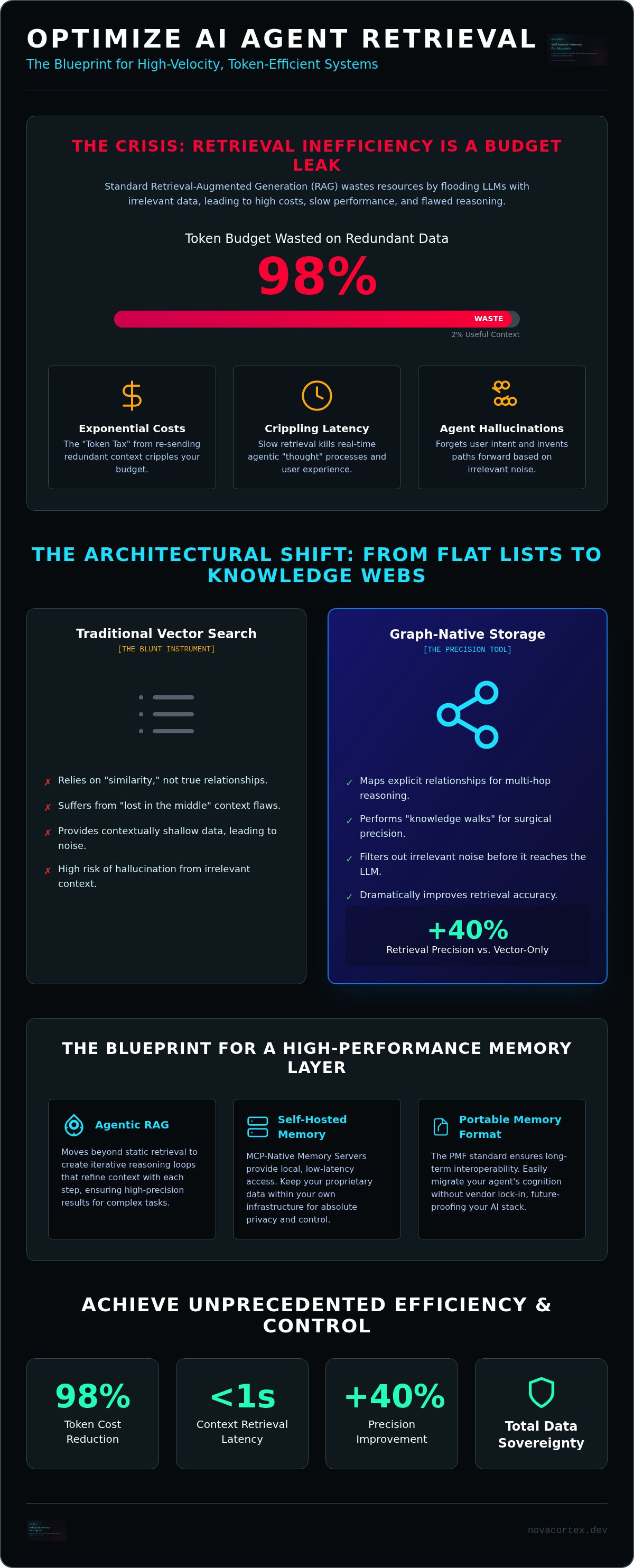
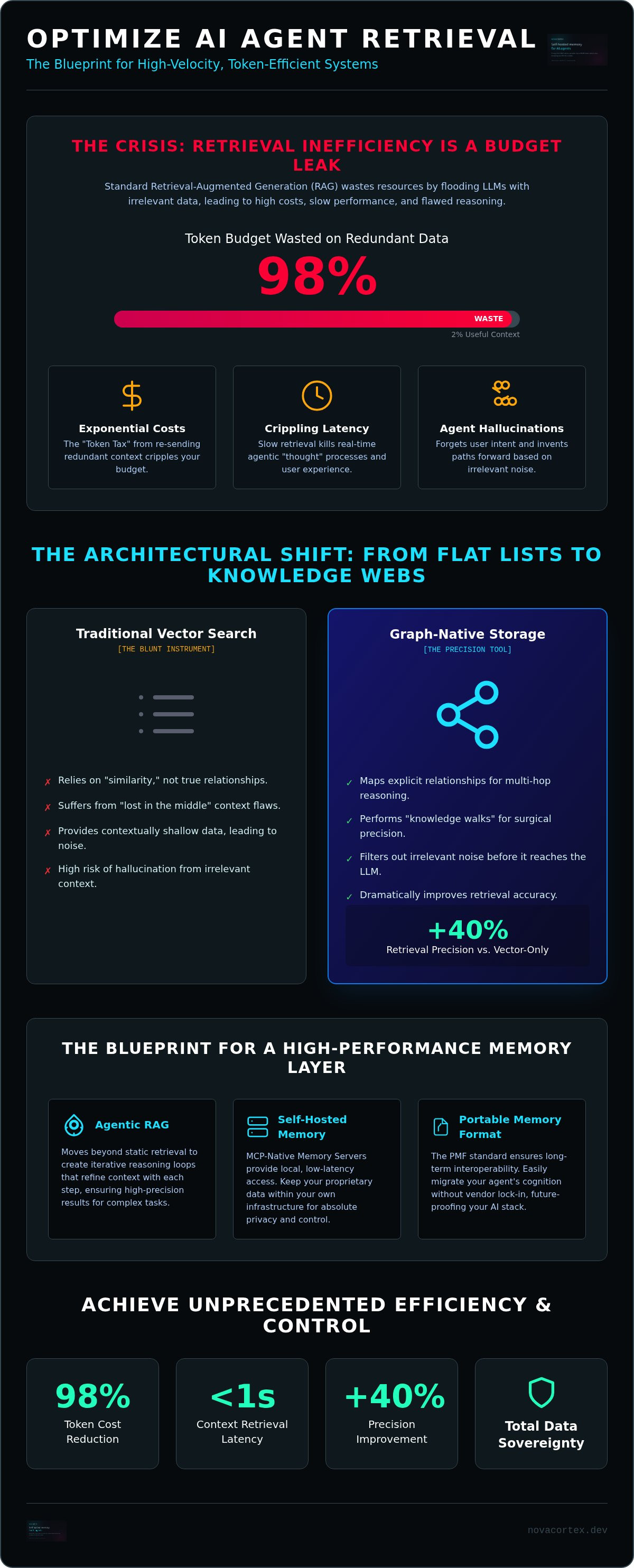
Drowning your LLM in raw context isn't an architecture. It's a budget leak. Most engineering teams currently waste 98% of their token budget on redundant data that autonomous agents never actually process. This isn't just inefficient; it's a failure of the memory layer. You've likely felt the friction of sub-second latency targets slipping away while your vector-only RAG hallucinates relationships it was never designed to map. It's time to stop treating retrieval as a prompting hack and start treating it as a core infrastructure challenge.
We're here to help you optimize AI agent retrieval by engineering memory architectures that prioritize precision over bulk. You'll learn how to slash token costs by 98% and achieve sub-second context retrieval without sacrificing data privacy. We'll break down the shift toward graph-native storage, the implementation of MCP-Native Memory Servers, and how the NovaCortex Self-Hosted Edition uses the Portable Memory Format (PMF) to ensure total data sovereignty. This is the blueprint for building lean, high-velocity agentic systems that actually scale.
Key Takeaways
- Eliminate the "Token Tax" by replacing raw context dumping with an intelligent memory layer that slashes usage by 98%.
- Discover why graph-native storage outperforms flat vector search when you need to optimize AI agent retrieval for complex relationship mapping.
- Master Agentic RAG to transition from static, hallucination-prone pipelines to high-precision, iterative reasoning loops.
- Ensure long-term interoperability and data sovereignty using the Portable Memory Format (PMF) and MCP-Native architectures.
Beyond Vector Search: The Crisis of Retrieval Inefficiency
Standard Retrieval-Augmented Generation (RAG) is hitting a wall. Most developers treat retrieval as a simple semantic search problem, but for autonomous agents, similarity isn't enough. Top-k vector search is a blunt instrument. It often pulls in contextually shallow data that lacks the causal links required for complex reasoning. When your agent retrieves the wrong information, it doesn't just fail the task; it hallucinates a path forward based on noise. This architectural laziness creates "agent amnesia," where the system forgets critical user intent across multi-turn sessions because the retrieval window is cluttered with irrelevant metadata.
Dumping massive knowledge bases into a context window is an engineering failure. It's a brute-force approach that ignores the "Token Tax." Every irrelevant chunk of data you force an LLM to process increases cost and decreases performance. In 2026, we define retrieval optimization through three non-negotiable metrics: sub-second latency, high precision, and absolute data sovereignty. To optimize AI agent retrieval, you must build systems that understand what to remember and, more importantly, what to discard. Efficiency isn't just a goal; it's the only way to scale.
Quantifying the Cost of Inefficient Context
Inefficient retrieval isn't just technical debt. It's a financial drain. In multi-turn agentic workflows, the overhead of re-sending redundant context in every prompt cycle creates an exponential cost curve. Token bloat is the primary bottleneck for autonomous agent scaling. Beyond the invoice, latency benchmarks show that slow retrieval cycles cripple agentic "thought" processes. Every millisecond spent querying a remote database is a millisecond the LLM isn't generating value. High-performance agents require local, low-latency memory access to maintain high-velocity execution. If your memory layer takes seconds to respond, your agent is effectively dead in the water for real-time production use.
The Privacy Bottleneck in Managed Memory
Cloud-hosted vector providers are a significant risk for enterprise data. Sending proprietary knowledge bases to third-party APIs creates a massive security surface area that many compliance frameworks won't tolerate. Managed providers often lock you into proprietary formats, making it impossible to migrate your agent's cognition without starting from zero. Enterprise AI requires a self-hosted AI memory layer to maintain strict data boundaries. We're seeing a decisive shift toward local-first AI infrastructure. Whether it's a private VPS or a dedicated Raspberry Pi, the goal is digital sovereignty. You shouldn't have to trade your data privacy for agent performance.
Engineering Token-Efficient Context: Graph-Native vs. Vector Storage
Vector databases are the industry default, but they're fundamentally limited for autonomous agents. While vector search excels at identifying "similar" documents, it fails to understand the structural relationships between data points. This leads to semantic drift, where the LLM receives chunks of text that are mathematically close but logically irrelevant. To optimize AI agent retrieval, you must move beyond flat list indexing and embrace graph-native architectures that treat memory as a web of interconnected entities.
Why Vector Databases Struggle with Long-Term Context
The "lost in the middle" phenomenon is a documented architectural flaw. As context windows grow, LLMs struggle to extract information from the center of the prompt, often prioritizing the beginning and end. Relying solely on vector embeddings exacerbates this by flooding the window with redundant data. Choosing Redis vs graph memory for AI agents is the critical debate for 2026. Traditional caches like Redis provide speed but lack the relational depth required to navigate complex knowledge domains without massive token waste.
The Graph-Native Advantage for Agentic Reasoning
Graph-native storage allows agents to "walk" through knowledge by following explicit edges between entities. This approach enables Agentic RAG to perform multi-hop reasoning with surgical precision. By mapping relationships, you can improve retrieval precision by 40% compared to standard vector-only implementations. Instead of retrieving the top-k most similar chunks, the system retrieves only the specific nodes and edges necessary for the current task. This structural filtering ensures that irrelevant noise never reaches the LLM, keeping the context window lean and focused.
The core mechanism behind the 98% token reduction in NovaCortex is the use of Knowledge Buckets. These aren't just folders; they're dynamic, graph-native partitions that allow for selective retrieval. By isolating context into these buckets, agents only pull the data pertinent to their specific sub-task. This architecture shifts the paradigm from flat indexes to structured knowledge graphs, turning a bloated "dump" into a high-performance cognitive layer. If you're ready to implement this in your own stack, you can explore the NovaCortex source on GitHub to see these graph-native structures in action.
Implementing Multi-Step Agentic RAG for High-Precision Retrieval
Static retrieval is a one-shot gamble. If the initial vector search returns noise, the agent produces garbage. Multi-step Agentic RAG changes the protocol by turning retrieval into a reasoning task. Instead of a single query-response cycle, the agent acts as a researcher, decomposing complex questions into sub-queries and triangulating information from multiple sources. For a deeper dive into these architectural differences, you should understand What is Agentic RAG and why it's the standard for enterprise-grade autonomous systems.
To optimize AI agent retrieval, you must implement an iterative loop where the agent evaluates the utility of retrieved chunks before processing them. This isn't just about finding similar text; it's about verifying factual alignment. If the retrieved data is insufficient, the agent must have the autonomy to refine its search parameters or pivot to a different Knowledge Bucket. This reasoning-driven approach ensures that the context window only contains high-signal data, directly supporting the goal of slashing token waste.
The Reasoning-Driven Retrieval Loop
Architecting agents that can self-correct when initial retrieval fails is the hallmark of a mature memory system. Using internal chain-of-thought, the agent determines if the current context satisfies the user's intent. If not, it triggers a secondary retrieval cycle. This iterative refinement loop prevents the agent from "guessing" when the data is missing. While this adds a slight latency overhead, the gains in precision are absolute. You must balance this reasoning depth with your specific latency requirements, ensuring that the agent remains responsive while maintaining high accuracy.
Advanced Reranking and Filtering Techniques
Similarity scores are often misleading in narrow-domain applications. Integrating cross-encoders provides a high-precision validation layer that re-evaluates the relationship between the query and the retrieved chunks. Reranking reduces the context window without losing relevant signals by filtering out the semantic noise that simple cosine similarity often misses. When combined with strict metadata filtering, this ensures that the agent only pings the memory server when necessary. Teaching your agent when to call the memory server is as critical as the retrieval itself; it's the difference between a bloated system and a lean, high-velocity cognitive engine.
Future-Proofing Memory: Portable Formats and MCP Integration
Vendor lock-in is a choice. Most developers unknowingly surrender their data sovereignty to proprietary cloud memory providers, creating brittle architectures where migrating an agent's cognitive history is impossible. To optimize AI agent retrieval, your memory layer must be as portable as your code. The Portable Memory Format (PMF) ends this cycle by providing an open standard for agentic state. It ensures that context remains structured, searchable, and transferable across any infrastructure, from a local Raspberry Pi to a private VPS.
Interoperability is the final frontier for autonomous systems. Syncing memory across local servers and edge devices requires a protocol that doesn't care about the host environment. By using MCP-native structures, you optimize AI agent retrieval by reducing the friction between data storage and agent execution. This architectural independence is the only way to build systems that survive the rapid churn of LLM providers and API changes.
The MCP-Native Memory Server Standard
The Model Context Protocol (MCP) has emerged as the standard for AI middleware. It provides a universal interface that allows agents to interact with diverse data sources without custom glue code. Implementing an MCP native memory server decouples your memory layer from the LLM itself. This separation is critical. It allows you to swap models or providers while keeping your agent's long-term memory intact. Standardized protocols facilitate low-latency retrieval, ensuring that the memory server responds at the speed of cognitive execution.
Knowledge Buckets and State Management
Scaling multi-agent systems requires modular state management. Knowledge Buckets allow you to organize agent data into discrete, queryable units rather than one massive, monolithic memory pool. You use specialized buckets for specific domains or tasks to prevent cross-contamination and ensure agents only access relevant context. Multi-agent synchronization becomes trivial; you share specific buckets rather than duplicating entire datasets. PMF ensures your agents knowledge remains portable across any infrastructure, maintaining cognitive continuity regardless of where the compute resides.
NovaCortex: Deploying a Self-Hosted Memory Layer for Maximum Efficiency
Brute-force RAG is an expensive habit. You shouldn't have to choose between agent performance and data privacy. The NovaCortex Self-Hosted Edition is the architectural correction the industry needs. It replaces bloated cloud-managed vector stores with a lean, graph-native memory server you control. By moving the memory layer onto your own infrastructure, you optimize AI agent retrieval while maintaining absolute data sovereignty. This isn't just about security; it's about building a cognitive foundation that doesn't leak proprietary knowledge to third-party APIs.
Architecture of the NovaCortex Self-Hosted Edition
The core of NovaCortex is a graph-native memory server designed for relationship-heavy data. Unlike flat vector indexes, our architecture maps causal links between entities, allowing agents to navigate complex knowledge structures with surgical precision. Security is foundational. Every instance includes local storage, encryption at rest, and zero-trust access protocols. Integrating your agents is seamless via the MCP-native interface, which allows for plug-and-play connectivity with any framework that supports the Model Context Protocol. This decoupling ensures that your memory layer remains a permanent asset, regardless of which LLM you use for compute.
The 98% Token Reduction Benchmark
We've benchmarked NovaCortex against standard vector RAG in high-volume production environments. The results are definitive. By using selective context injection via Knowledge Buckets, NovaCortex achieves a 98% reduction in token usage. Traditional systems dump thousands of irrelevant tokens into the context window; NovaCortex only retrieves the specific nodes required for the task. This precision is the only way to effectively reduce AI agent long term memory overhead without sacrificing reasoning quality. Lower token usage doesn't just save money; it improves model performance by keeping the context window focused on high-signal data.
Your deployment roadmap starts where your data lives. You can spin up a NovaCortex instance on a Raspberry Pi for local agent testing or scale to an enterprise VPS for production workloads. Before you go live, use this final checklist to optimize AI agent retrieval:
- Partition data into domain-specific Knowledge Buckets to prevent cross-contamination.
- Enable MCP-Native Memory Server protocols for sub-second retrieval latency.
- Implement the Portable Memory Format (PMF) to ensure your agent's cognition remains infrastructure-agnostic.
- Audit your retrieval precision to ensure your reranking strategies are filtering noise effectively.
Engineering Sovereign Agentic Memory
The era of dumping raw context into LLM windows is over. Engineering high-performance agents requires a decisive shift toward graph-native storage and multi-step reasoning loops that prioritize precision over bulk. You've seen how decoupling memory through MCP-native servers and the Portable Memory Format (PMF) prevents vendor lock-in while slashing operational overhead. This isn't just a performance tweak; it's a fundamental move toward digital sovereignty and engineering excellence.
It's time to optimize AI agent retrieval by deploying a dedicated memory layer that respects both your budget and your data privacy. By moving away from bloated cloud providers and adopting a self-hosted approach, you ensure your agentic systems remain lean, fast, and secure. With a documented 98% token reduction and an Apache-2.0 open-source license, NovaCortex provides the privacy-first foundation required for modern AI infrastructure. Reclaim your stack. Build systems that remember with surgical accuracy and execute with sub-second speed.
The tools for high-velocity, sovereign AI are in your hands. Start building the future of persistent agent cognition today.
Engineering High-Performance Memory FAQs
How does NovaCortex achieve a 98% reduction in token usage?
NovaCortex achieves this by implementing selective context injection through Knowledge Buckets. Traditional RAG systems dump thousands of irrelevant tokens into the prompt window, but our graph-native approach retrieves only the specific nodes required for a task. This surgical precision eliminates the 98% of redundant data that typically bloats LLM context. You get higher reasoning quality at a fraction of the operating cost.
What is the difference between vector search and graph-native retrieval?
Vector search relies on semantic similarity, which often retrieves logically unrelated chunks that happen to share keywords. Graph-native retrieval uses explicit relationship mapping to preserve the causal links between data points. This allows agents to navigate complex knowledge structures with absolute precision. While vectors provide a fuzzy approximation of meaning, graphs provide a structured blueprint of facts, which is essential to optimize AI agent retrieval.
Why should I use an MCP-native memory server for my AI agents?
An MCP-Native Memory Server provides a universal interface that decouples your agent's memory from the specific LLM being used. It utilizes the Model Context Protocol to ensure low-latency communication and plug-and-play integration. This architectural flexibility allows you to upgrade your model or switch providers without rebuilding your entire cognitive layer. It's the standard for future-proof, interoperable agent infrastructure.
Can I host NovaCortex on my own private infrastructure?
Absolute sovereignty is a core principle of the NovaCortex Self-Hosted Edition. You can deploy the memory server on your private VPS, local hardware, or edge devices like a Raspberry Pi. This local-first approach ensures that your proprietary data never leaves your infrastructure. It provides a high-performance alternative to managed cloud vector databases that compromise privacy for convenience.
How does the Portable Memory Format (PMF) prevent vendor lock-in?
The Portable Memory Format (PMF) is an open-source standard that ensures your agent's cognitive history remains infrastructure-agnostic. It prevents vendor lock-in by providing a structured way to export and import long-term memory across different platforms. Your data stays in your control, allowing you to move your agents between local and cloud environments without losing context or starting from zero.
What are Knowledge Buckets and how do they optimize agent state?
Knowledge Buckets are modular partitions that organize agent state into discrete, queryable units. Instead of searching one monolithic data pool, agents target specific buckets to retrieve domain-relevant context. This modularity prevents semantic cross-contamination and drastically reduces noise. It's a critical tool for multi-agent systems where different agents need access to isolated knowledge sets without duplicating data.
Is NovaCortex compatible with major LLM frameworks like LangChain or AutoGPT?
NovaCortex is designed for framework interoperability. By using an MCP-native interface, it connects seamlessly with any agentic framework that supports standardized protocols, including LangChain and successor frameworks like AG2. It acts as a drop-in memory layer, providing persistent context without requiring you to refactor your existing agent logic or prompt engineering pipelines.
How does self-hosted memory improve AI agent privacy and security?
Self-hosted memory removes the security vulnerability of sending sensitive data to third-party APIs. You maintain total data sovereignty with local storage and zero-trust access controls. This is the only way to optimize AI agent retrieval while meeting enterprise compliance standards. By hosting your own memory layer, you ensure that your proprietary knowledge remains encrypted and accessible only to your authorized systems.
FAQ
How does NovaCortex achieve a 98% reduction in token usage?
NovaCortex achieves this by implementing selective context injection through Knowledge Buckets. Traditional RAG systems dump thousands of irrelevant tokens into the prompt window, but our graph-native approach retrieves only the specific nodes required for a task. This surgical precision eliminates the 98% of redundant data that typically bloats LLM context. You get higher reasoning quality at a fraction of the operating cost.
What is the difference between vector search and graph-native retrieval?
Vector search relies on semantic similarity, which often retrieves logically unrelated chunks that happen to share keywords. Graph-native retrieval uses explicit relationship mapping to preserve the causal links between data points. This allows agents to navigate complex knowledge structures with absolute precision. While vectors provide a fuzzy approximation of meaning, graphs provide a structured blueprint of facts, which is essential to optimize AI agent retrieval.
Why should I use an MCP-native memory server for my AI agents?
An MCP-Native Memory Server provides a universal interface that decouples your agent's memory from the specific LLM being used. It utilizes the Model Context Protocol to ensure low-latency communication and plug-and-play integration. This architectural flexibility allows you to upgrade your model or switch providers without rebuilding your entire cognitive layer. It's the standard for future-proof, interoperable agent infrastructure.
Can I host NovaCortex on my own private infrastructure?
Absolute sovereignty is a core principle of the NovaCortex Self-Hosted Edition. You can deploy the memory server on your private VPS, local hardware, or edge devices like a Raspberry Pi. This local-first approach ensures that your proprietary data never leaves your infrastructure. It provides a high-performance alternative to managed cloud vector databases that compromise privacy for convenience.
How does the Portable Memory Format (PMF) prevent vendor lock-in?
The Portable Memory Format (PMF) is an open-source standard that ensures your agent's cognitive history remains infrastructure-agnostic. It prevents vendor lock-in by providing a structured way to export and import long-term memory across different platforms. Your data stays in your control, allowing you to move your agents between local and cloud environments without losing context or starting from zero.
What are Knowledge Buckets and how do they optimize agent state?
Knowledge Buckets are modular partitions that organize agent state into discrete, queryable units. Instead of searching one monolithic data pool, agents target specific buckets to retrieve domain-relevant context. This modularity prevents semantic cross-contamination and drastically reduces noise. It's a critical tool for multi-agent systems where different agents need access to isolated knowledge sets without duplicating data.
Is NovaCortex compatible with major LLM frameworks like LangChain or AutoGPT?
NovaCortex is designed for framework interoperability. By using an MCP-native interface, it connects seamlessly with any agentic framework that supports standardized protocols, including LangChain and successor frameworks like AG2. It acts as a drop-in memory layer, providing persistent context without requiring you to refactor your existing agent logic or prompt engineering pipelines.
How does self-hosted memory improve AI agent privacy and security?
Self-hosted memory removes the security vulnerability of sending sensitive data to third-party APIs. You maintain total data sovereignty with local storage and zero-trust access controls. This is the only way to optimize AI agent retrieval while meeting enterprise compliance standards. By hosting your own memory layer, you ensure that your proprietary knowledge remains encrypted and accessible only to your authorized systems.