Optimizing AI Agent Memory Retrieval: A Practical Engineering Guide

A high similarity score doesn’t prove an agent found the right memory. Optimizing AI agent memory retrieval means treating retrieval as a pipeline, not a vector-search setting. Even plausible results can be stale, irrelevant, or too large to fit efficiently into the context window.
If your agent pulls in outdated preferences or buries a useful detail under loosely related memories, retrieving more is unlikely to solve the problem. Every extra token adds cost and latency, while a poor match can steer the agent away from the task.
This guide shows you how to trace the retrieval pipeline and identify where relevance, freshness, and context size break down. You’ll learn practical ways to combine semantic and keyword retrieval, apply scope and time-aware checks, rank and trim results, and evaluate quality against realistic agent tasks. You’ll also see which trade-offs to measure before deployment, including retrieval accuracy, latency, and context efficiency.
Key Takeaways
- Trace retrieval failures to the stage where they occur instead of treating every miss as a search problem.
- Combine embeddings with reliable metadata filters to find candidates that match both task meaning and relevant constraints.
- Compare retrieval strategies across precision, recall, freshness, latency, and context size. No single metric tells the whole story.
- Make optimizing AI agent memory retrieval a repeatable process: label real task examples, log misses, change one stage, and retest.
- Assess memory layers for retrieval control, portability, deployment ownership, and observability before choosing an implementation.
Why AI Agent Memory Retrieval Fails Before the Search Begins
Memory retrieval is the selection of stored information that may help an agent complete its current task. Optimizing AI agent memory retrieval starts by separating that selection step from three related concerns: whether useful information was stored, whether it was summarized accurately, and how much context the model can accept. These problems interact, but they need different fixes.
Retrieval relevance is about choosing the right evidence, not collecting the most evidence. A larger context window can hold more records, but it can’t make irrelevant or outdated memories useful. Improving storage won’t help if the agent forms a weak query or ranks the wrong candidates first.
What does memory retrieval do in an AI agent?
An agent turns a request into a query against persistent memory. If a user asks, “What did I decide about onboarding?”, the query may need to capture the decision, the onboarding topic, and any relevant project or time period. Retrieval systems, including those used in Retrieval-augmented generation (RAG), use that query to select candidate records. The agent then supplies selected records as evidence or context for a subsequent model call.
That handoff is not a truth check. Retrieval can surface a relevant-looking record without confirming that it’s current or correct, and the model can still misinterpret sound evidence. Finding useful context is one step toward a good answer, not a guarantee of factuality or task completion.
Which retrieval failures damage agent responses?
Some failures happen before search. A query that omits a person’s name, project, or another key entity may miss the right record. Ambiguous intent can also send the search in the wrong direction: “the launch plan” might refer to more than one launch. These are false negatives: the needed memory exists but doesn’t make it into the candidate set.
Other failures happen in the returned results. A semantically similar record may be irrelevant to the specific task. Duplicate records can crowd out distinct evidence, and an old preference or decision can conflict with a newer one. The agent may then produce a weak answer despite retrieving something that looks plausible.
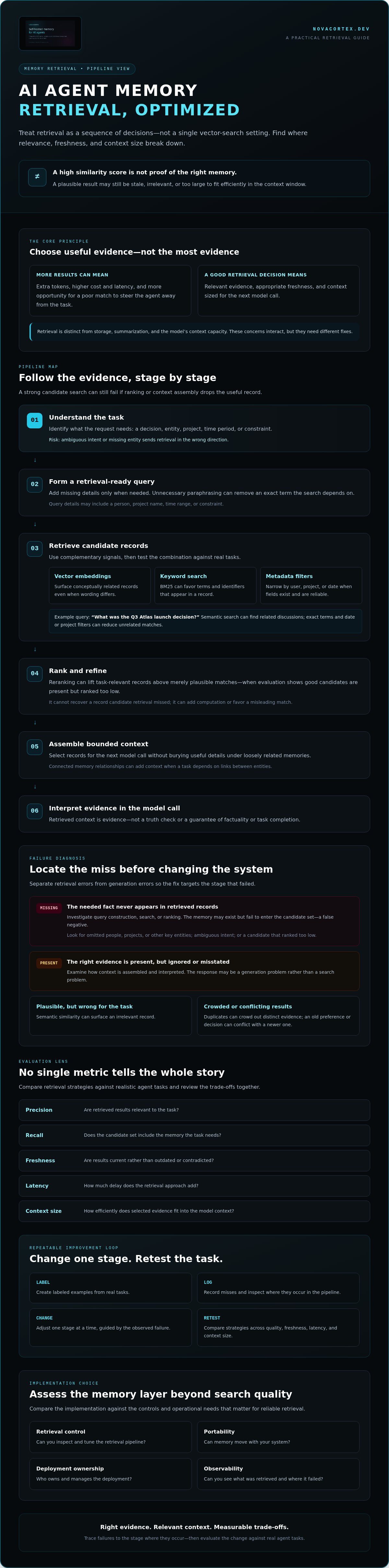
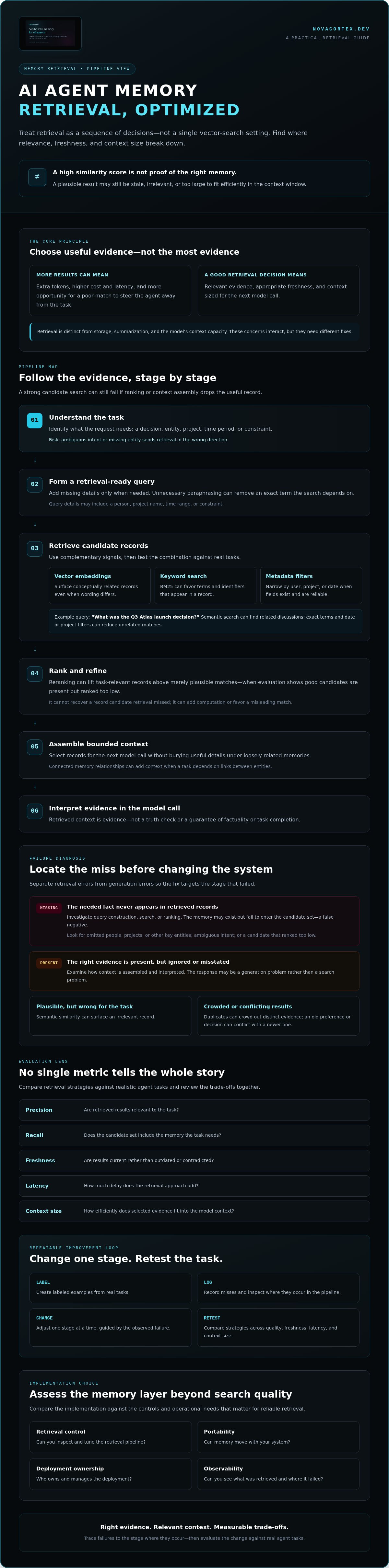
Separate retrieval errors from generation errors when diagnosing a response. If the needed fact never appears in the retrieved records, investigate query construction, search, or ranking. If the right evidence is present but the model ignores or misstates it, examine how context is assembled and interpreted. That distinction keeps debugging focused instead of prompting the model to compensate for a broken retrieval stage.
How an AI Agent Memory Retrieval Pipeline Selects Context
A retrieval pipeline turns a task into a bounded set of evidence for the model. Each stage makes a different decision: what the task requires, how to express that need as a query, which records are candidates, how to order them, and what to place in the next model call. Optimizing AI agent memory retrieval means measuring those stages separately. A strong candidate search can still fail if ranking or context assembly discards the useful record.
How do query design and candidate retrieval work together?
Start with the user’s request. Rewrite it only when it lacks retrieval-ready details, such as an entity, project name, time range, or constraint needed to find the right memory. Don’t paraphrase automatically: unnecessary rewriting can remove an exact term the search depends on.
Candidate retrieval methods bring different signals. Vector embeddings can surface conceptually related records even when wording differs. Keyword search, including BM25, can favor terms and identifiers that appear in a record. Metadata filters can narrow candidates by fields such as user, project, or date, when those fields exist and are reliable. For “What was the Q3 Atlas launch decision?”, semantic search may find related launch discussions, while exact terms and date or project filters can reduce unrelated matches. Test these techniques against your own tasks rather than assuming one combination will always work.
When should an agent rerank or traverse memory relationships?
Reranking reorders retrieved candidates by how well each fits the task, helping useful evidence rise above merely plausible matches. It can’t recover a record that candidate retrieval missed, and it can add computation or rank a misleading match too highly. Use it when evaluation shows that relevant records appear in the candidate set but land too low in the final results.
Relationship traversal can add context when a task depends on connections between entities. If a memory links a project to a decision and a decision to its owner, following those links may supply evidence that a flat similarity search would not rank together. But neighboring records can also add noise. Traverse only relationships relevant to the task, then check whether the added context improves answers without bloating the payload.
Context assembly is a separate stage. It selects and formats ranked records for the model, subject to the task’s token budget. A useful result can be lost if assembly truncates it, while oversized snippets can crowd out more relevant evidence. Preserve enough source detail to interpret a memory, remove redundant content, and inspect the final context the model actually receives.
For an implementation reference, the NovaCortex memory project provides an example of a graph-native memory approach. Evaluate any architecture against your own task examples and retrieval requirements.
How to Compare Retrieval Strategies Without Guessing
A retrieval strategy is useful only if it works on the queries your agent actually receives. Comparing methods against a handful of convenient examples can reward a system that looks strong in a demo but misses real task requirements. Build a small, representative evaluation set before changing the retrieval stack.
Which retrieval method fits each memory query?
Match the retrieval signal to the information need. Semantic search is useful when the request paraphrases a stored idea or asks for a concept-level match. Keyword search, including BM25, is better suited to literal terms such as names, identifiers, and exact phrases. Metadata filters can constrain results by recency, source, user, or scope when those fields are available and trustworthy.
Hybrid retrieval combines signals, which can help when a query needs both conceptual matching and exact terms. Added complexity is not automatically better, though. Compare each method on the same examples, and check whether filters exclude valid records or keyword matching misses paraphrased requests.
What should an agent memory retrieval benchmark measure?
For each test task, record the user request, the expected facts, and the memory records that contain relevant evidence. Include varied cases: paraphrases, exact entity lookups, time-sensitive questions, and requests where no suitable memory exists. Label what counts as relevant before running tests. Results depend on those labels, the quality and freshness of stored memories, and the queries used, so benchmark scores aren’t universal rankings.
Measure separate dimensions instead of collapsing performance into a single similarity score:
- Candidate recall: Did retrieval include the records needed to answer the task?
- Selection precision: How much of the retrieved context was actually relevant?
- Freshness: Did the selected evidence reflect the current fact or decision?
- Task support: Could the agent produce the expected outcome from the context it received?
- Latency and token payload: How long did retrieval take, and how much context did it send?
Candidate recall catches records missed by search; selection precision exposes noisy results. Task-level review shows whether the final context supported a correct response. Track latency and token count alongside those quality measures: a method that retrieves relevant evidence may still be a poor fit if it adds delay or floods the prompt.
Use the same task set and memory snapshot to compare semantic, keyword, filtered, and hybrid approaches. When optimizing AI agent memory retrieval, change one variable at a time and inspect the examples behind any score shift. A result is meaningful only when you know which queries, records, and evaluation labels produced it.
A Practical Workflow for Optimizing AI Agent Memory Retrieval
Make retrieval changes traceable. Start with a small, labeled evaluation set drawn from real agent tasks, including cases that currently fail and cases that work. For each task, record the expected facts and relevant memory records. This gives you a baseline and helps distinguish genuine improvement from a change that merely shifts which examples fail.
How should developers diagnose retrieval misses?
Log the user request, generated query, candidate records, ranking, and final context supplied to the model. Label each failure by its likely stage: query, indexing, filtering, ranking, freshness, or context assembly. Protect sensitive content by minimizing what you retain, restricting access to diagnostic logs, and following your deployment’s privacy policy.
How can retrieval improvements be tested safely?
Change one pipeline variable at a time, such as a query rule, candidate count, or context limit. Retest the cases that failed, then run representative successful tasks to catch regressions. Compare task quality with retrieval latency, memory access behavior, and token payload. A larger candidate set may recover missed evidence, but it can also increase processing time and crowd the final context.
Tune candidate count and context limits together, but assess their effects separately. First check whether relevant records appear among the candidates. Then check whether the assembled context includes the evidence needed for the task without redundant or stale material. Keep a limit only if it preserves task performance within your latency and token budgets. Don’t optimize for a smaller payload alone if the agent loses essential evidence.
Before changing infrastructure, run this checklist:
- Do test cases reflect real requests, including ambiguous and time-sensitive tasks?
- Are the expected facts and relevant memory records labeled clearly?
- Can logs show where the retrieval pipeline lost or misranked useful evidence?
- Are sensitive details minimized and protected in diagnostic data?
- Will the retest cover both past failures and known successes?
- Are task quality, latency, memory access, and token payload tracked independently?
Keep the loop disciplined: log failures, classify the cause, change one stage, and retest against the same task set. This makes optimizing AI agent memory retrieval an evidence-driven engineering process, not a series of blind parameter tweaks. Move to infrastructure changes only when evaluation shows the current design cannot meet your requirements.
Explore the NovaCortex memory project as one reference when reviewing memory-layer options.
Choosing an Agent Memory Layer for Reliable Retrieval
Retrieval quality depends on more than the search algorithm. The memory layer determines how much control you have over candidate selection, where records live, whether data can move between systems, and how clearly you can inspect retrieval behavior. Compare those capabilities against your evaluation results before changing infrastructure. Optimizing AI agent memory retrieval means choosing an architecture that meets your operational constraints as well as its quality and latency targets.
- Retrieval control: Can you inspect or adjust how memories are selected and organized?
- Portability: Can you export or move memory in a usable format?
- Deployment ownership: Who controls the environment, updates, and operational responsibilities?
- Observability: Can you diagnose what the system retrieved and why?
A managed service may suit a team that prioritizes reduced infrastructure maintenance and is comfortable with its deployment model, data handling, and available controls. Self-hosting may suit teams that need local control or want to own the deployment environment. It isn’t automatically the better choice: operating the system also means taking responsibility for deployment and maintenance.
When does a self-hosted memory layer make sense?
Weigh privacy requirements and infrastructure ownership against your team’s operational skills and portability needs. Confirm who handles updates, backups, monitoring, and recovery before committing. A self-hosted AI memory layer can give an operator more direct control over where memory runs, but that control comes with responsibility. Teams without the capacity to maintain the environment may prefer a managed option.
How does NovaCortex fit a retrieval architecture?
NovaCortex is an open-source memory layer under the Apache-2.0 license. Its offerings include graph-native storage, an MCP-native memory server, Knowledge Buckets, and the Portable Memory Format (PMF). Graph-native storage supports organizing knowledge through relationships as well as retrieving it through similarity, though the right approach depends on the task and should be validated against your evaluation set. PMF is relevant when memory portability matters.
The NovaCortex Self-Hosted Edition can be deployed on a server, VPS, Raspberry Pi, or similar environment. It’s an option to assess if you want to operate the memory layer in an environment you control. NovaCortex also states that its memory layer can reduce token usage by up to 98% compared with dumping entire knowledge bases. Check the project documentation for deployment requirements and retrieval details, then test the system against your labeled tasks before adopting it.
Inspect the NovaCortex open-source project and compare its approach with your retrieval requirements.
Build Retrieval You Can Trust
Reliable memory retrieval comes from treating context selection as an engineering system, not a single search call. Use real agent tasks to find where evidence gets lost, then adjust one stage and test the trade-offs in answer support, freshness, latency, and token use. That keeps optimizing AI agent memory retrieval grounded in results rather than intuition.
Choose a memory layer that fits your requirements for control, portability, deployment ownership, and observability. NovaCortex is an open-source, Apache-2.0, self-hosted, graph-native memory layer designed for AI agents. Assess it against your own workload and evaluation criteria.
Start with a small evaluation set and refine it as agent tasks evolve. Better retrieval is built one measured improvement at a time, making context more useful without making it heavier.
Frequently Asked Questions
How do you optimize AI agent memory retrieval?
Optimize it by testing the full path from request to final context, then fixing the stage responsible for misses. Start with real agent tasks and label the memories that should support each answer. Inspect query construction, candidate selection, ranking, freshness, and context assembly. Change one variable at a time, then compare task quality, latency, and token payload so optimizing AI agent memory retrieval produces measurable gains.
What is the difference between vector search and hybrid retrieval for agents?
Vector search uses embeddings to find records with similar meaning, even when the query and memory use different wording. Hybrid retrieval combines semantic search with signals such as keyword matches or metadata filters. For example, an agent can use semantic similarity to find discussions of a decision while matching an exact project identifier. Hybrid methods can improve coverage for mixed queries, but validate them on your tasks.
When should an AI agent use reranking for memory retrieval?
Use reranking when relevant memories appear among the initial candidates but aren’t consistently placed near the top. A reranker scores those candidates against the specific task and changes their order before context assembly. It can’t recover evidence that the initial search missed, and it may add processing overhead. Compare results with and without reranking, checking whether task support improves enough to justify the added latency.
How do you measure the accuracy of AI agent memory retrieval?
Build a labeled set of representative agent tasks, with expected facts and supporting memory records for each. Check whether retrieval includes the needed records, whether selected context actually supports the task, and whether outdated or irrelevant results crowd it out. Track precision and recall separately, then evaluate the agent’s outcome. Record latency and token payload too, since retrieval quality alone doesn’t show the system’s full cost.
Can an AI agent retrieve memories without sending the full knowledge base to the model?
Yes. A memory layer can search stored information, select a relevant subset, and pass only that context to the model. The agent doesn’t need to receive the entire knowledge base in its prompt. Retrieval still needs to be checked for missed evidence and excessive results. NovaCortex is a self-hosted memory layer designed for AI agents, with graph-native storage for structured memory retrieval.
What causes an AI agent to retrieve outdated or irrelevant memories?
Weak query wording, ambiguous entities, broad similarity matches, and incomplete metadata can all lead to poor results. Stale records may persist when updates aren’t reflected in memory or when search doesn’t distinguish older facts from current ones. Duplicates can also crowd out useful evidence. Diagnose the failure by checking the query, candidates, ranking, record dates, and final context rather than assuming the model alone caused the problem.
Is graph-based memory retrieval always better than vector search?
No. Graph-based retrieval can help when a task depends on relationships between entities, such as connecting a project, decision, and owner. Vector search can be effective for finding conceptually similar memories without explicit links. The right choice depends on the task, data structure, and evaluation results. Some systems may combine approaches, but extra structure or retrieval stages are useful only when they improve outcomes on representative tasks.
FAQ
What does memory retrieval do in an AI agent?
An agent turns a request into a query against persistent memory. If a user asks, “What did I decide about onboarding?”, the query may need to capture the decision, the onboarding topic, and any relevant project or time period. Retrieval systems, including those used in Retrieval-augmented generation (RAG), use that query to select candidate records. The agent then supplies selected records as evidence or context for a subsequent model call. That handoff is not a truth check. Retrieval can surface a relevant-looking record without confirming that it’s current or correct, and the model can still misinterpret sound evidence. Finding useful context is one step toward a good answer, not a guarantee of factuality or task completion.
Which retrieval failures damage agent responses?
Some failures happen before search. A query that omits a person’s name, project, or another key entity may miss the right record. Ambiguous intent can also send the search in the wrong direction: “the launch plan” might refer to more than one launch. These are false negatives: the needed memory exists but doesn’t make it into the candidate set. Other failures happen in the returned results. A semantically similar record may be irrelevant to the specific task. Duplicate records can crowd out distinct evidence, and an old preference or decision can conflict with a newer one. The agent may then produce a weak answer despite retrieving something that looks plausible. Separate retrieval errors from generation errors when diagnosing a response. If the needed fact never appears in the retrieved records, investigate query construction, search, or ranking. If the right evidence is present but the model ignores or misstates it, examine how context is assembled and interpreted. That distinction keeps debugging focused instead of prompting the model to compensate for a broken retrieval stage. A retrieval pipeline turns a task into a bounded set of evidence for the model. Each stage makes a different decision: what the task requires, how to express that need as a query, which records are candidates, how to order them, and what to place in the next model call. Optimizing AI agent memory retrieval means measuring those stages separately. A strong candidate search can still fail if ranking or context assembly discards the useful record.
How do query design and candidate retrieval work together?
Start with the user’s request. Rewrite it only when it lacks retrieval-ready details, such as an entity, project name, time range, or constraint needed to find the right memory. Don’t paraphrase automatically: unnecessary rewriting can remove an exact term the search depends on. Candidate retrieval methods bring different signals. Vector embeddings can surface conceptually related records even when wording differs. Keyword search, including BM25, can favor terms and identifiers that appear in a record. Metadata filters can narrow candidates by fields such as user, project, or date, when those fields exist and are reliable. For “What was the Q3 Atlas launch decision?”, semantic search may find related launch discussions, while exact terms and date or project filters can reduce unrelated matches. Test these techniques against your own tasks rather than assuming one combination will always work.
When should an agent rerank or traverse memory relationships?
Reranking reorders retrieved candidates by how well each fits the task, helping useful evidence rise above merely plausible matches. It can’t recover a record that candidate retrieval missed, and it can add computation or rank a misleading match too highly. Use it when evaluation shows that relevant records appear in the candidate set but land too low in the final results. Relationship traversal can add context when a task depends on connections between entities. If a memory links a project to a decision and a decision to its owner, following those links may supply evidence that a flat similarity search would not rank together. But neighboring records can also add noise. Traverse only relationships relevant to the task, then check whether the added context improves answers without bloating the payload. Context assembly is a separate stage. It selects and formats ranked records for the model, subject to the task’s token budget. A useful result can be lost if assembly truncates it, while oversized snippets can crowd out more relevant evidence. Preserve enough source detail to interpret a memory, remove redundant content, and inspect the final context the model actually receives. For an implementation reference, the NovaCortex memory project provides an example of a graph-native memory approach. Evaluate any architecture against your own task examples and retrieval requirements. A retrieval strategy is useful only if it works on the queries your agent actually receives. Comparing methods against a handful of convenient examples can reward a system that looks strong in a demo but misses real task requirements. Build a small, representative evaluation set before changing the retrieval stack.
Which retrieval method fits each memory query?
Match the retrieval signal to the information need. Semantic search is useful when the request paraphrases a stored idea or asks for a concept-level match. Keyword search, including BM25, is better suited to literal terms such as names, identifiers, and exact phrases. Metadata filters can constrain results by recency, source, user, or scope when those fields are available and trustworthy. Hybrid retrieval combines signals, which can help when a query needs both conceptual matching and exact terms. Added complexity is not automatically better, though. Compare each method on the same examples, and check whether filters exclude valid records or keyword matching misses paraphrased requests.
What should an agent memory retrieval benchmark measure?
For each test task, record the user request, the expected facts, and the memory records that contain relevant evidence. Include varied cases: paraphrases, exact entity lookups, time-sensitive questions, and requests where no suitable memory exists. Label what counts as relevant before running tests. Results depend on those labels, the quality and freshness of stored memories, and the queries used, so benchmark scores aren’t universal rankings. Measure separate dimensions instead of collapsing performance into a single similarity score: Candidate recall catches records missed by search; selection precision exposes noisy results. Task-level review shows whether the final context supported a correct response. Track latency and token count alongside those quality measures: a method that retrieves relevant evidence may still be a poor fit if it adds delay or floods the prompt. Use the same task set and memory snapshot to compare semantic, keyword, filtered, and hybrid approaches. When optimizing AI agent memory retrieval, change one variable at a time and inspect the examples behind any score shift. A result is meaningful only when you know which queries, records, and evaluation labels produced it. Make retrieval changes traceable. Start with a small, labeled evaluation set drawn from real agent tasks, including cases that currently fail and cases that work. For each task, record the expected facts and relevant memory records. This gives you a baseline and helps distinguish genuine improvement from a change that merely shifts which examples fail.
How should developers diagnose retrieval misses?
Log the user request, generated query, candidate records, ranking, and final context supplied to the model. Label each failure by its likely stage: query, indexing, filtering, ranking, freshness, or context assembly. Protect sensitive content by minimizing what you retain, restricting access to diagnostic logs, and following your deployment’s privacy policy.
How can retrieval improvements be tested safely?
Change one pipeline variable at a time, such as a query rule, candidate count, or context limit. Retest the cases that failed, then run representative successful tasks to catch regressions. Compare task quality with retrieval latency, memory access behavior, and token payload. A larger candidate set may recover missed evidence, but it can also increase processing time and crowd the final context. Tune candidate count and context limits together, but assess their effects separately. First check whether relevant records appear among the candidates. Then check whether the assembled context includes the evidence needed for the task without redundant or stale material. Keep a limit only if it preserves task performance within your latency and token budgets. Don’t optimize for a smaller payload alone if the agent loses essential evidence. Before changing infrastructure, run this checklist: Keep the loop disciplined: log failures, classify the cause, change one stage, and retest against the same task set. This makes optimizing AI agent memory retrieval an evidence-driven engineering process, not a series of blind parameter tweaks. Move to infrastructure changes only when evaluation shows the current design cannot meet your requirements. Explore the NovaCortex memory project as one reference when reviewing memory-layer options. Retrieval quality depends on more than the search algorithm. The memory layer determines how much control you have over candidate selection, where records live, whether data can move between systems, and how clearly you can inspect retrieval behavior. Compare those capabilities against your evaluation results before changing infrastructure. Optimizing AI agent memory retrieval means choosing an architecture that meets your operational constraints as well as its quality and latency targets. A managed service may suit a team that prioritizes reduced infrastructure maintenance and is comfortable with its deployment model, data handling, and available controls. Self-hosting may suit teams that need local control or want to own the deployment environment. It isn’t automatically the better choice: operating the system also means taking responsibility for deployment and maintenance.
When does a self-hosted memory layer make sense?
Weigh privacy requirements and infrastructure ownership against your team’s operational skills and portability needs. Confirm who handles updates, backups, monitoring, and recovery before committing. A self-hosted AI memory layer can give an operator more direct control over where memory runs, but that control comes with responsibility. Teams without the capacity to maintain the environment may prefer a managed option.
How does NovaCortex fit a retrieval architecture?
NovaCortex is an open-source memory layer under the Apache-2.0 license. Its offerings include graph-native storage, an MCP-native memory server, Knowledge Buckets, and the Portable Memory Format (PMF). Graph-native storage supports organizing knowledge through relationships as well as retrieving it through similarity, though the right approach depends on the task and should be validated against your evaluation set. PMF is relevant when memory portability matters. The NovaCortex Self-Hosted Edition can be deployed on a server, VPS, Raspberry Pi, or similar environment. It’s an option to assess if you want to operate the memory layer in an environment you control. NovaCortex also states that its memory layer can reduce token usage by up to 98% compared with dumping entire knowledge bases. Check the project documentation for deployment requirements and retrieval details, then test the system against your labeled tasks before adopting it. Inspect the NovaCortex open-source project and compare its approach with your retrieval requirements. Reliable memory retrieval comes from treating context selection as an engineering system, not a single search call. Use real agent tasks to find where evidence gets lost, then adjust one stage and test the trade-offs in answer support, freshness, latency, and token use. That keeps optimizing AI agent memory retrieval grounded in results rather than intuition. Choose a memory layer that fits your requirements for control, portability, deployment ownership, and observability. NovaCortex is an open-source, Apache-2.0, self-hosted, graph-native memory layer designed for AI agents. Assess it against your own workload and evaluation criteria. Start with a small evaluation set and refine it as agent tasks evolve. Better retrieval is built one measured improvement at a time, making context more useful without making it heavier.
How do you optimize AI agent memory retrieval?
Optimize it by testing the full path from request to final context, then fixing the stage responsible for misses. Start with real agent tasks and label the memories that should support each answer. Inspect query construction, candidate selection, ranking, freshness, and context assembly. Change one variable at a time, then compare task quality, latency, and token payload so optimizing AI agent memory retrieval produces measurable gains.
What is the difference between vector search and hybrid retrieval for agents?
Vector search uses embeddings to find records with similar meaning, even when the query and memory use different wording. Hybrid retrieval combines semantic search with signals such as keyword matches or metadata filters. For example, an agent can use semantic similarity to find discussions of a decision while matching an exact project identifier. Hybrid methods can improve coverage for mixed queries, but validate them on your tasks.
When should an AI agent use reranking for memory retrieval?
Use reranking when relevant memories appear among the initial candidates but aren’t consistently placed near the top. A reranker scores those candidates against the specific task and changes their order before context assembly. It can’t recover evidence that the initial search missed, and it may add processing overhead. Compare results with and without reranking, checking whether task support improves enough to justify the added latency.
How do you measure the accuracy of AI agent memory retrieval?
Build a labeled set of representative agent tasks, with expected facts and supporting memory records for each. Check whether retrieval includes the needed records, whether selected context actually supports the task, and whether outdated or irrelevant results crowd it out. Track precision and recall separately, then evaluate the agent’s outcome. Record latency and token payload too, since retrieval quality alone doesn’t show the system’s full cost.
Can an AI agent retrieve memories without sending the full knowledge base to the model?
Yes. A memory layer can search stored information, select a relevant subset, and pass only that context to the model. The agent doesn’t need to receive the entire knowledge base in its prompt. Retrieval still needs to be checked for missed evidence and excessive results. NovaCortex is a self-hosted memory layer designed for AI agents, with graph-native storage for structured memory retrieval.
What causes an AI agent to retrieve outdated or irrelevant memories?
Weak query wording, ambiguous entities, broad similarity matches, and incomplete metadata can all lead to poor results. Stale records may persist when updates aren’t reflected in memory or when search doesn’t distinguish older facts from current ones. Duplicates can also crowd out useful evidence. Diagnose the failure by checking the query, candidates, ranking, record dates, and final context rather than assuming the model alone caused the problem.
Is graph-based memory retrieval always better than vector search?
No. Graph-based retrieval can help when a task depends on relationships between entities, such as connecting a project, decision, and owner. Vector search can be effective for finding conceptually similar memories without explicit links. The right choice depends on the task, data structure, and evaluation results. Some systems may combine approaches, but extra structure or retrieval stages are useful only when they improve outcomes on representative tasks.