Persistent AI Agent Knowledge: Architecting Sovereign Long-Term Memory in 2026

Brute-force vector dumps are choking your production models. Naive RAG retrieval floods context windows with irrelevant noise, burning millions of tokens while your systems drop state between execution loops. If you want genuine persistent AI agent knowledge, relying on proprietary cloud memory layers guarantees compounding infrastructure costs and catastrophic vendor lock-in.
You already know that context rot destroys production unit economics. Watching an agent hallucinate because flat vector search surfaced five noisy chunks isn't just frustrating; it halts autonomous execution. You shouldn't have to surrender operational control or leak sensitive telemetry to external platforms just to maintain basic workflow continuity.
In this guide, you'll learn how to architect sovereign, token-efficient long-term memory using graph-native storage patterns and self-hosted infrastructure. We'll examine how open standards like the Model Context Protocol (MCP) and portable memory schemas slash context window token consumption by up to 98%, delivering low-latency execution across multi-agent workflows without third-party dependencies.
Key Takeaways
- Establishing deterministic recall across disconnected execution loops transforms volatile model interactions into persistent AI agent knowledge that compounds over time.
- Moving from flat vector indices to multi-hop graph structures captures relational context and eliminates hallucination-inducing retrieval noise.
- Implementing an MCP-native memory server unifies state across diverse agent frameworks without writing brittle, custom glue code.
- Isolating project, user, and execution state into modular Knowledge Buckets slashes context token consumption by up to 98%.
- Adopting open standards like the Portable Memory Format (PMF) secures complete data sovereignty and eliminates dependence on closed cloud platforms.
What Is Persistent AI Agent Knowledge and Why Naive RAG Fails
Persistent AI agent knowledge is deterministic, stateful recall that survives across disconnected execution sessions. It allows an intelligent agent to retain learned workflows, environmental constraints, and user preferences indefinitely. Without it, you are running expensive amnesiac scripts. As system complexity increases, this architectural foundation becomes mandatory: Persistent agent memory transforms stateless LLMs into evolving cognitive systems that compound knowledge over time.
Naive Retrieval-Augmented Generation (RAG) fails at this fundamental requirement. Most architectures simply query an embedded index using top-k vector similarity, pulling arbitrary text chunks into the prompt. This creates brittle systems. Flat vector retrieval lacks state awareness, cannot track chronological mutations, and treats critical operational rules identically to passing conversational noise. The result is context rot, high latency, and degraded reliability.
The Limitations of Stateless LLM Execution
Context injection breaks down quickly. As conversation histories expand linearly, developers blindly append chat buffers into system prompts. This practice triggers severe cognitive degradation: attention heads struggle to locate key directives within bloated prompts, leading directly to hallucinations. Re-ingesting thousands of static tokens on every single execution loop also creates an unsustainable economic penalty. You pay recurring API fees to process identical historical state repeatedly, wasting resources while latency climbs.
Why Flat Vector Similarity Misses Relational Truth
Cosine distance measures semantic closeness. It cannot determine structural causality, state hierarchies, or chronological sequence. If a user sets an operational preference on Monday and inverts it on Friday, flat embeddings view both chunks as semantically relevant. The model then retrieves conflicting data points without a temporal reconciliation layer, causing unpredictable outputs.
Solving this failure mode requires native entity graphs rather than isolated semantic coordinates. When you structure AI agent long term memory around interconnected relationships, you transition from blind similarity lookups to deterministic state traversal. Understanding this distinction is the first step toward robust agent design:
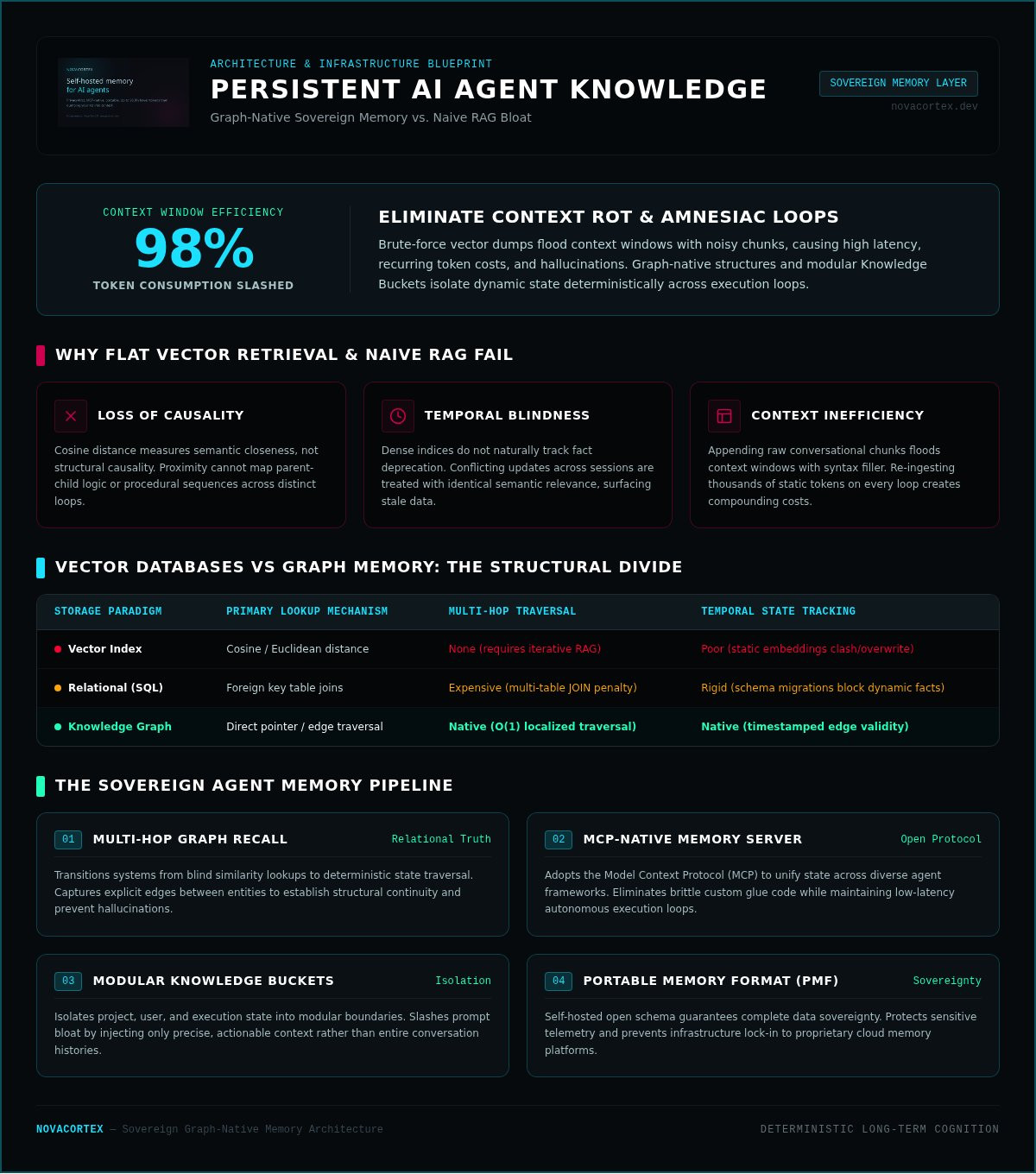
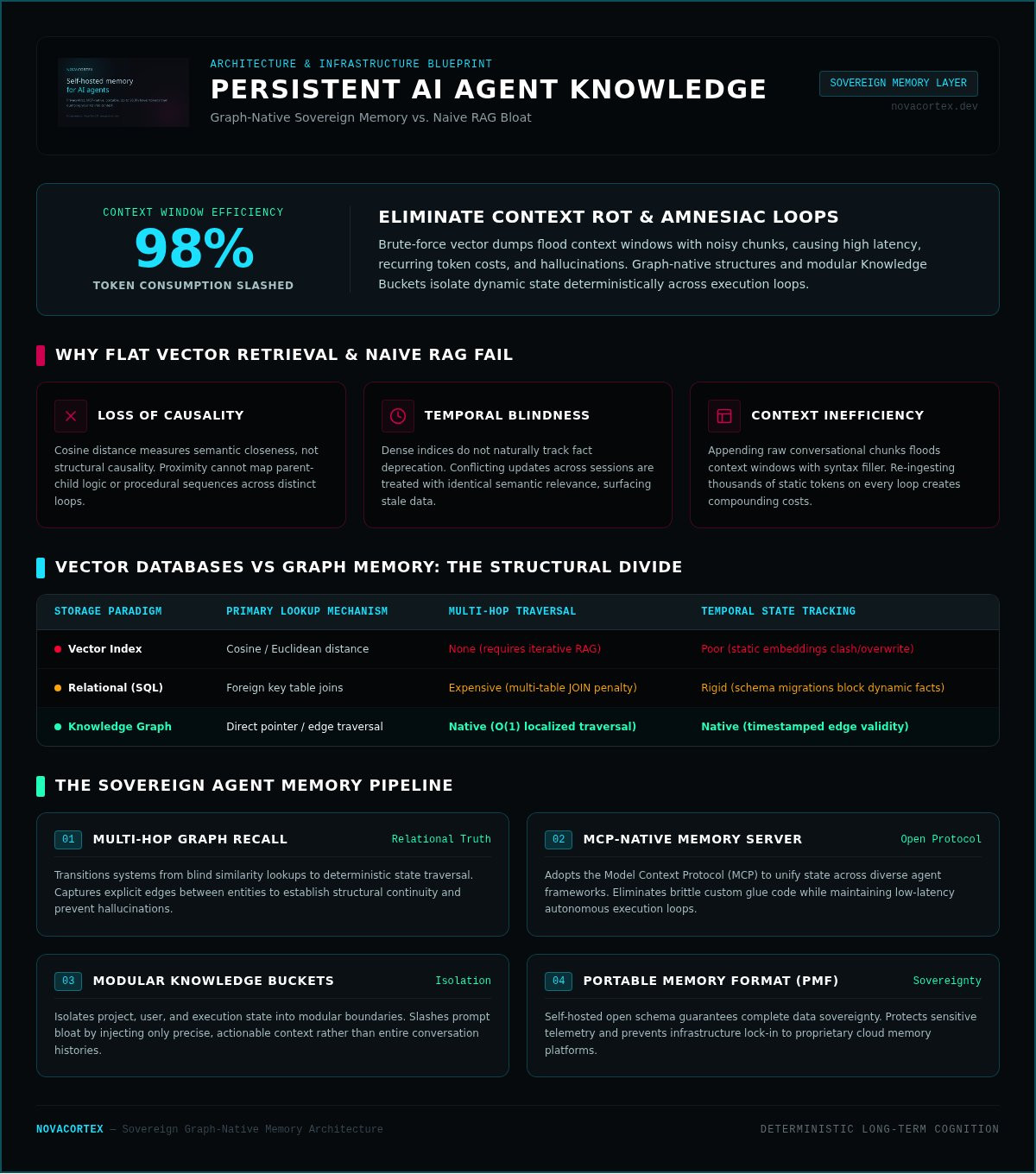
- Loss of Causality: Vector proximity cannot map parent-child logic or procedural sequences across different execution loops.
- Temporal Blindness: Dense indices do not track fact deprecation naturally, frequently serving stale variables alongside live updates.
- Context Inefficiency: Injecting entire conversational chunks floods the window with filler syntax rather than precise, actionable state.
True persistent AI agent knowledge demands an architecture that updates dynamic state deterministically while discarding linguistic bloat entirely.
Vector Databases vs Graph Memory: The Structural Divide
Vector databases index semantic proximity, but they cannot represent structured relationships. When building persistent AI agent knowledge, treating your memory layer as a massive flat index leads directly to degraded reasoning. True cognitive continuity requires explicit edges between evolving entities. Hardware researchers at DARPA recognized this bottleneck at the silicon level with compute-in-memory (CIM) accelerators, and software architectures require an identical shift away from flat storage bottlenecks.
| Storage Paradigm | Primary Lookup Mechanism | Multi-Hop Traversal | Temporal State Tracking |
|---|---|---|---|
| Vector Index | Cosine / Euclidean distance | None (requires iterative RAG) | Poor (static embeddings overwrite or clash) |
| Relational (SQL) | Foreign key table joins | Expensive (multi-table JOIN penalty) | Rigid (schema migrations block dynamic facts) |
| Knowledge Graph | Direct pointer / edge traversal | Native (O(1) localized traversal) | Native (timestamped edge validity) |
Multi-Hop Reasoning Across Interconnected Entities
Production queries are rarely atomic. An agent tasked with infrastructure remediation must connect services, deployment dependencies, permissions, and recent incident logs. Flat vector stores retrieve fragments based solely on keyword embeddings, missing the causal chain entirely. Graph topologies resolve this by navigating explicit nodes and edges. Exploring Redis vs graph memory for AI agents highlights this structural divergence clearly: key-value lookups provide speed, but graphs provide connective context without bloating the active prompt.
Temporal Reconciliation: Tracking State and Fact Changes
Facts expire. If an engineer updates a database credential or revokes an API token, an agent must reflect that change instantly. In a vector setup, older embeddings persist alongside newer ones, creating conflicting context vectors that trigger unpredictable outputs.
Graph architectures resolve this by appending timestamped metadata to edges:
- Edge Invalidation: Nodes maintain relationship history while flagging obsolete connections as inactive.
- Conflict Resolution: Incoming observations reconcile with existing nodes using deterministic lineage rules rather than fuzzy similarity scores.
- Deterministic Provenance: Every decision path maps back to traceable node traversals, removing black-box uncertainty.
Structuring persistent AI agent knowledge around temporal graphs preserves historical truth while serving only current facts to your models. You can test these principles locally by inspecting the open-source codebase on NovaCortex's GitHub repository.
How to Build a Persistent Memory Pipeline with Model Context Protocol
Proprietary software development kits enforce brittle integration patterns. When you tether an autonomous agent to platform-specific client libraries, changing backends means refactoring core execution loops. Adopting an open communication standard solves this friction. By implementing an MCP native memory server, developers decouple cognitive state from underlying LLM orchestrators entirely. This standardized approach creates the necessary conceptual foundation for agentic intelligence, enabling persistent AI agent knowledge across heterogeneous frameworks without custom glue code.
The Model Context Protocol establishes a clean client-host-server taxonomy. Instead of writing proprietary database adapters for each agent framework, your memory engine exposes uniform tools: read state, commit relation, and invalidate edge. Standardizing these interactions delivers true interoperability across local nodes and sovereign server clusters.
Step 1 & 2: Establishing the Protocol and Ingestion Engine
Deploy the transport layer first. Configure standard JSON-RPC communication over stdio or local SSE transports to link your host runtime with your storage daemon. Next, structure the ingestion pipeline. Unfiltered conversational turns cannot flow directly into long-term tables. Your ingestion worker must distill raw execution logs into discrete semantic triples containing subjects, predicates, and objects. Strict schema validation blocks conversational filler, preventing operational telemetry from degrading into unstructured conversational debris.
Step 3 & 4: Contextual Retrieval and Memory Consolidation
Runtime execution requires dynamic discovery. Agents shouldn't blindly receive injected system prompts; they must use MCP tool calls to pull target entities right before triggering an action. This keeps initial context overhead minimal. Decouple memory processing by running asynchronous background tasks to consolidate nodes, prune dead-end leaves, and merge identical entities.
Executing this four-step deployment lifecycle creates a dependable memory pipeline:
- Protocol Initialization: Bind the MCP transport layer locally, guaranteeing sub-millisecond communication between execution loops and storage.
- Entity Distillation: Extract structured facts into validated entity nodes, discarding conversational syntax before write operations.
- Dynamic Tool Calling: Register memory read and mutation functions directly inside the host runtime for on-demand queries.
- Asynchronous Consolidation: Recompute graph weights and merge duplicate entities via background workers without blocking execution loops.
Deploying this decoupled architecture ensures your persistent AI agent knowledge remains portable, auditable, and completely independent of proprietary cloud infrastructure.
Eliminating Context Bloat: Token Reduction via Knowledge Buckets
Context stuffing is an engineering failure. Shoveling hundreds of past dialogue turns into an active context window degrades model reasoning and destroys unit economics at scale. Real persistent AI agent knowledge does not require re-reading every raw conversation string. By isolating operational state into modular Knowledge Buckets and dynamically pruning subgraphs, systems reduce token consumption by up to 98% compared to naive document dumps.
Selective retrieval replaces brute-force context windows. Instead of exposing an LLM to an entire knowledge repository, an agent pulls only the precise semantic neighborhood required to resolve an immediate task. Pruning extraneous nodes prevents prompt bloat, keeps inference latency low, and ensures predictable downstream execution.
Modular Scoping with Knowledge Buckets
Memory must be partitioned into explicit namespaces. Knowledge Buckets create isolated operational zones that separate project rules, user preferences, and transient session context into protected tiers. This prevents cross-tenant contamination during execution loops. Multi-agent fleets can query shared, read-only institutional buckets while writing volatile session telemetry into private, ephemeral scratchpads. Unrelated facts stay segregated, eliminating context pollution entirely.
High-Efficiency In-Memory Graph Indexing
Fact compression preserves semantic fidelity. A 2,000-word debugging exchange compresses into four deterministic triples: (Service_A, depends_on, Redis_Cluster_01), (Port_6379, status, deprecated), (Migration_Target, set_to, Node_04), and (Config_Hash, verified_by, SecOps). Caching these high-frequency clusters in an in-memory graph index enables sub-millisecond lookups on local hardware. System economics stabilize because agents never burn tokens processing redundant conversational filler across recursive operational calls.
Deploying structured context isolation delivers immediate structural advantages:
- Context Hygiene: Eliminates cross-contamination by scoping queries strictly to task-relevant buckets.
- Extreme Compression: Replaces noisy chat strings with dense relational triples, trimming prompt overhead by up to 98%.
- Deterministic Traversal: Traverses pre-filtered subgraphs rather than running unconstrained semantic scans across full datasets.
- Local In-Memory Speed: Pulls operational state from local node caches without introducing recurring third-party API latency.
Architecting persistent AI agent knowledge with scoped partitions protects your context budget while sustaining high-velocity autonomous workflows.
Engineering Sovereign Agent Memory: The NovaCortex Approach
Sovereign infrastructure is non-negotiable for enterprise autonomy. Handing mission-critical state to third-party endpoints creates unacceptable security vectors, unmanaged downtime, and platform lock-in. When a cloud vendor alters its API or sunsets an engine, your operational history evaporates. NovaCortex Self-Hosted Edition addresses this vulnerability directly, providing an open-source, Apache-2.0 licensed memory engine that runs entirely within your infrastructure perimeter. It delivers persistent AI agent knowledge without sending a single byte outside your private network.
Control your data layer completely. By combining an MCP-Native Memory Server with local execution, NovaCortex ensures you own the entire cognitive pipeline from disk to inference loop.
Data Sovereignty and Zero Third-Party Leaks
Air-gapped and private environments demand local execution. Running memory operations inside your virtual private cloud or on bare-metal hardware eliminates external egress, effortlessly satisfying strict regulatory mandates. Implementing the self-hosted AI memory layer protects proprietary intellectual property, user telemetry, and operational logic from public model training sets or opaque SaaS logging practices.
The Portable Memory Format (PMF)
Storage mechanisms evolve, but cognitive state should remain perpetual. NovaCortex introduces the Portable Memory Format (PMF), an open, schema-standardized serialization format for agent knowledge graphs. Understanding how portable memory format for AI decouples state from underlying database engines allows engineers to snapshot, version-control, and migrate relational graphs across development nodes, local testing sandboxes, and production clusters effortlessly.
Deploying NovaCortex in Production
Deployment takes minutes, not weeks. The core engine deploys seamlessly via Docker, Kubernetes, or standalone bare-metal binaries on local machines and Linux VPS nodes. Once the container spins up, native MCP clients connect instantly to expose persistent memory tools to your existing agent fleets.
The sovereign architecture delivers immediate operational control:
- Hardware Flexibility: Runs efficiently on standard developer hardware, dedicated VPS instances, or sovereign on-premises clusters.
- Standardized Interoperability: Exposes native Model Context Protocol interfaces for zero-code integration with leading agent frameworks.
- Vendor Neutrality: Serializes persistent AI agent knowledge into open PMF artifacts, ensuring zero platform capture.
- Open Governance: Released under Apache-2.0, guaranteeing perpetual visibility into memory indexing and traversal logic.
Do not let external vendors capture your agentic intelligence. Take control of your infrastructure and deploy NovaCortex from GitHub to start running sovereign long-term memory today.
Reclaim Sovereign Agent Memory
Flat vector similarity and brute-force context stuffing belong in early prototypes, not production environments. Establishing reliable persistent AI agent knowledge requires deterministic graph topologies, temporal edge validation, and modular state isolation. Decoupling your storage via the Model Context Protocol eliminates brittle vendor SDKs while cutting token consumption by up to 98% compared to dumping raw context.
True operational sovereignty means owning your state layer entirely. Running an Apache-2.0 open-source engine on self-hosted infrastructure with native MCP compliance out of the box ensures you don't surrender telemetry or institutional intelligence to closed third-party clouds. You now have the architectural blueprint to eliminate context bloat and state loss permanently.
Take the sovereign path today. Start deploying lean, low-latency agent architectures that eliminate context decay and compound intelligence across every single execution loop.
Frequently Asked Questions
What is persistent AI agent knowledge and how does it differ from working memory?
Persistent AI agent knowledge is deterministic state stored externally that outlives individual context windows and execution sessions. Working memory is transient; it vanishes the moment an inference loop finishes or context overflows. While working memory holds conversational syntax and intermediate scratchpad variables, persistent knowledge indexes distilled entity relationships, validated preferences, and operational rules in a structured graph for perpetual retrieval across future agent executions.
How much token usage can a graph-native memory layer actually save?
A graph-native memory layer cuts token consumption by up to 98% compared to naive RAG or context window stuffing. Instead of blindly injecting thousands of raw conversational tokens or multi-page documentation dumps into the prompt, the engine traverses specific entity edges. It extracts only the relevant subgraph triples required to answer an immediate query, keeping active prompts lean and eliminating recurring API fees on duplicate tokens.
Can I run persistent agent memory locally on a VPS or private server?
Yes. Solutions like NovaCortex Self-Hosted Edition are built under the Apache-2.0 license specifically for private deployment. You can run the memory engine directly on bare metal, a standard Linux VPS, local workstation nodes, or even single-board environments like a Raspberry Pi. Memory processing and graph traversals execute locally inside your security perimeter, preventing sensitive operational telemetry from leaking to third-party endpoints.
Why is a graph-native memory layer superior to a standard vector database?
Vector databases rely on semantic proximity, which cannot track chronological changes, parent-child hierarchies, or structural causality. They frequently retrieve obsolete facts that share lexical similarity with a query. Graph-native layers map explicit entities and relationship edges, allowing agents to execute multi-hop reasoning across complex workflows. Graphs deliver deterministic, traceable lineage for every retrieval, drastically minimizing hallucinations compared to flat vector lookups.
What happens if two agent sessions generate conflicting facts about a user?
Graph memory engines resolve conflicting data using temporal reconciliation and timestamped edge invalidation. When a newer observation contradicts an existing fact, the system doesn't create duplicate embeddings. Instead, it updates the valid relationship edge with an updated timestamp while deprecating the obsolete connection. The system maintains historical lineage for auditing, but runtime queries only traverse active edges, preventing outdated constraints from overriding live production logic.
Is the Model Context Protocol (MCP) required to implement persistent agent memory?
MCP isn't strictly mandatory, but it represents the most robust standard for decoupling memory from agent frameworks. Without an open protocol, developers must maintain custom, brittle API integrations for every framework or tool. Deploying an MCP-native memory server unifies tool discovery and state manipulation under a standardized specification, letting diverse multi-agent architectures read and mutate memory without framework-specific rewrites.
How does the Portable Memory Format (PMF) prevent AI infrastructure vendor lock-in?
The Portable Memory Format (PMF) serializes graph state into an open, vendor-neutral schema independent of proprietary databases. Many managed services lock your agent history into closed cloud formats, making migration impossible. PMF ensures your persistent AI agent knowledge remains completely portable. You can snapshot, export, and import entire entity graphs between local test nodes, development sandboxes, and production infrastructure without losing relationship hierarchies or metadata.
FAQ
What is persistent AI agent knowledge and how does it differ from working memory?
Persistent AI agent knowledge is deterministic state stored externally that outlives individual context windows and execution sessions. Working memory is transient; it vanishes the moment an inference loop finishes or context overflows. While working memory holds conversational syntax and intermediate scratchpad variables, persistent knowledge indexes distilled entity relationships, validated preferences, and operational rules in a structured graph for perpetual retrieval across future agent executions.
How much token usage can a graph-native memory layer actually save?
A graph-native memory layer cuts token consumption by up to 98% compared to naive RAG or context window stuffing. Instead of blindly injecting thousands of raw conversational tokens or multi-page documentation dumps into the prompt, the engine traverses specific entity edges. It extracts only the relevant subgraph triples required to answer an immediate query, keeping active prompts lean and eliminating recurring API fees on duplicate tokens.
Can I run persistent agent memory locally on a VPS or private server?
Yes. Solutions like NovaCortex Self-Hosted Edition are built under the Apache-2.0 license specifically for private deployment. You can run the memory engine directly on bare metal, a standard Linux VPS, local workstation nodes, or even single-board environments like a Raspberry Pi. Memory processing and graph traversals execute locally inside your security perimeter, preventing sensitive operational telemetry from leaking to third-party endpoints.
Why is a graph-native memory layer superior to a standard vector database?
Vector databases rely on semantic proximity, which cannot track chronological changes, parent-child hierarchies, or structural causality. They frequently retrieve obsolete facts that share lexical similarity with a query. Graph-native layers map explicit entities and relationship edges, allowing agents to execute multi-hop reasoning across complex workflows. Graphs deliver deterministic, traceable lineage for every retrieval, drastically minimizing hallucinations compared to flat vector lookups.
What happens if two agent sessions generate conflicting facts about a user?
Graph memory engines resolve conflicting data using temporal reconciliation and timestamped edge invalidation. When a newer observation contradicts an existing fact, the system doesn't create duplicate embeddings. Instead, it updates the valid relationship edge with an updated timestamp while deprecating the obsolete connection. The system maintains historical lineage for auditing, but runtime queries only traverse active edges, preventing outdated constraints from overriding live production logic.
Is the Model Context Protocol (MCP) required to implement persistent agent memory?
MCP isn't strictly mandatory, but it represents the most robust standard for decoupling memory from agent frameworks. Without an open protocol, developers must maintain custom, brittle API integrations for every framework or tool. Deploying an MCP-native memory server unifies tool discovery and state manipulation under a standardized specification, letting diverse multi-agent architectures read and mutate memory without framework-specific rewrites.
How does the Portable Memory Format (PMF) prevent AI infrastructure vendor lock-in?
The Portable Memory Format (PMF) serializes graph state into an open, vendor-neutral schema independent of proprietary databases. Many managed services lock your agent history into closed cloud formats, making migration impossible. PMF ensures your persistent AI agent knowledge remains completely portable. You can snapshot, export, and import entire entity graphs between local test nodes, development sandboxes, and production infrastructure without losing relationship hierarchies or metadata.