Persistent AI Memory Snapshots: Engineering Continuity for Autonomous Agents
Your autonomous agent is likely burning through 98% of its compute budget just to remember what it did five minutes ago. Redundant context re-loading isn't just an efficiency leak. It's a structural failure that forces developers into expensive vendor lock-in with proprietary vector databases. You're likely tired of watching token waste climb while your multi-tool agents struggle with latency. Integrating persistent AI memory snapshots stops this cycle of waste. It's time to move beyond flat RAG systems that lose structural context and stall production-grade deployment.
Implementing these snapshots changes the architecture from a leaky bucket to a versioned, portable cognitive state. You'll learn to build a system where memory survives session resets without re-loading the entire knowledge base from scratch. This article demonstrates how to eliminate agent amnesia and achieve a 90% or higher reduction in token usage. We'll explore the transition to graph-native, self-hosted memory layers using NovaCortex Self-Hosted Edition, the Portable Memory Format (PMF), and Knowledge Buckets to ensure your agents maintain continuity across any LLM without the bloat of managed services.
Key Takeaways
- Eliminate the "amnesia loop" by replacing redundant context re-loading with versioned, graph-native cognitive states.
- Implement persistent AI memory snapshots to slash token usage by up to 98% while maintaining high-velocity reasoning continuity.
- Utilize the Portable Memory Format (PMF) to ensure technical independence and seamless interoperability across different LLM providers.
- Deploy MCP-native memory servers and modular Knowledge Buckets to achieve superior retrieval precision on private, self-hosted infrastructure.
- Establish digital sovereignty by hosting a lean memory layer with NovaCortex Self-Hosted Edition, bypassing the high costs of managed vector databases.
The Context Collapse: Why AI Agents Fail Without Persistent Memory
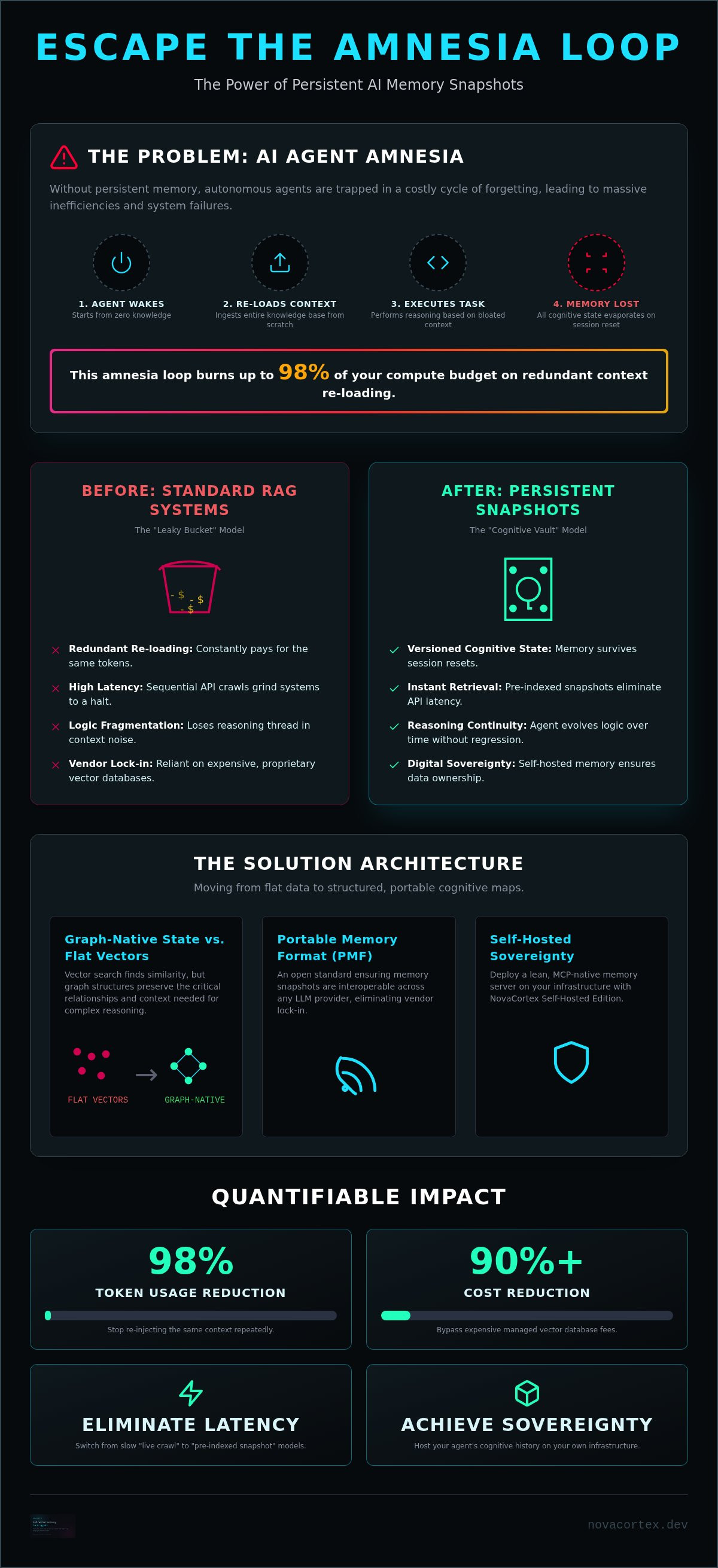
The "Amnesia Loop" is a silent killer for autonomous agents. Every session reset acts as a lobotomy. The agent resets. The memory evaporates. The reasoning breaks. Without persistent AI memory snapshots, the agent starts from zero, forcing a complete re-sync of the environment every time it wakes up. This isn't just an inconvenience; it's a regression that prevents agents from performing complex, multi-day tasks.
There is a fundamental difference between short-term context and the agent's actual cognitive state. Context is the transient noise of the current conversation. Cognitive state is the long-term memory that allows an agent to evolve and refine its logic over time. Without a way to preserve this state, your agent is essentially a goldfish in a high-performance compute environment.
The Cost of Context Window Bloat
Context collapse is the architectural bottleneck where autonomous systems lose reasoning integrity as redundant data saturates the processing window.
Standard RAG implementations are often the primary culprits. They repeatedly inject massive chunks of the same documentation or logs into the context window. This leads to several systemic failures:
- Information drowning: LLMs often ignore critical data buried in the center of massive prompt windows.
- Financial bleed: You pay for the same tokens repeatedly across every turn of the conversation.
- Logic fragmentation: The model loses the thread of the original objective as the window fills with noise.
The financial cost of this bloat is staggering. By using persistent AI memory snapshots, you can freeze the agent's knowledge state and stop the re-injection cycle. You slash costs by up to 98% because the agent already knows the baseline context without needing it re-explained in every prompt.
Latency and Rate Limit Barriers
Live API crawls destroy responsiveness. When an agent has to wait for multiple sequential data retrievals to form a single thought, the user experience dies. This latency is compounded in multi-agent workflows. If three agents are competing for the same rate-limited API to refresh their context, the entire system grinds to a halt. You can't build high-velocity systems on top of unstable, sequential fetching models.
Switching from "live crawl" models to "pre-indexed snapshot" models is the only way to scale. You shouldn't be fetching the same data every time the agent wakes up. You should be loading a pre-validated state. This transition ensures your agents stay synchronized and responsive without hitting architectural walls or provider-imposed rate limits.
Defining Persistent AI Memory Snapshots: Beyond Basic Backups
A snapshot isn't a simple database export. It's a versioned, graph-native representation of an agent's knowledge at a specific point in execution. While traditional backups are passive archives, persistent AI memory snapshots are active architectural components. They encapsulate the AI agent memory, including episodic events, semantic knowledge, and procedural logic, into a single restorable state. This ensures that when an agent wakes up, it doesn't just have access to data; it has access to its own previous reasoning chains.
Sovereignty remains the primary engineering objective. Storing these snapshots on third-party managed clouds creates a "data tax" and introduces systemic risk. By keeping memory on your own infrastructure, you ensure that the agent's logic remains your property. It's the foundation of digital sovereignty in the agentic era. You shouldn't trust a black-box provider with the cognitive history of your autonomous systems.
Graph-Native State vs. Flat Text Files
Flat vector embeddings are insufficient for complex reasoning. They provide similarity but lack relationship. A vector database might tell you that "A" is similar to "B," but it cannot explain how they are linked or why that link matters for a specific task. Graph-native storage preserves these vital connections. It maps the hierarchy and relational dependencies of your data. This precision allows an agent to navigate multi-step logic without hallucinating connections that don't exist. Traditional vector stores are often just glorified search engines; graph-native snapshots are cognitive maps.
The Portable Memory Format (PMF) Advantage
Vendor lock-in is a choice, not a necessity. Most platforms want your agent's memory trapped in their proprietary silos. The Portable Memory Format (PMF) breaks this cycle. It defines a standardized, interoperable structure for memory that works across different LLM providers. If a model becomes obsolete or a provider hikes prices, you move the state, not just the raw data. You aren't rebuilding from scratch; you're just pointing a new model at an existing PMF file.
Structured storage is no longer optional for enterprise-grade agents. Using persistent AI memory snapshots encoded in PMF allows you to hot-swap models while keeping the agent's personality and learned behaviors intact. It's the only way to build systems that outlast the current model hype cycle. You can explore the open-source implementation of these standards to begin decoupling your agent state from restrictive cloud vendors.
Snapshots vs. Vector Databases: Choosing the Right Persistence Strategy
Vector search is a retrieval tool. Memory is an architecture. Most developers treat them as interchangeable. They aren't. A vector database returns similar text based on mathematical proximity; it doesn't understand the relationship between those fragments. Relying solely on vector search for agent continuity is like trying to build a brain out of a filing cabinet. You get the documents, but you lose the logic that connects them.
Keyword and vector search often fail in complex agentic workflows because they lack the relational mapping found in graph-native snapshots. When you implement persistent AI memory snapshots, you aren't just querying data. You are restoring a structured cognitive state. This architectural choice is explored further in our analysis of Redis vs graph memory for AI agents, where we detail why traditional key-value stores fall short of token-efficient context management.
Why Vector Search Loses Structural Context
Flat retrieval is a compromise that strips away the nuance of agent experience. A vector database tells you "what" data is similar, but it ignores the "why" behind the interaction. Vector distance is a poor proxy for cognitive relevance because it treats every token as an isolated point in space. Snapshots preserve these links. They maintain the hierarchy of information, ensuring the agent retrieves context that is structurally sound. You stop guessing based on similarity and start reasoning based on established relationships.
Versioning Agentic Cognition
Snapshots allow for version control of an agent's mind. You can't roll back a standard vector database without complex filtering logic. With versioned persistent AI memory snapshots, you can A/B test different behavioral states. If an agent enters a hallucination loop or suffers from context drift, you simply revert to a previous, validated state. This capability is essential for multi-agent synchronization. Shared snapshot repositories allow multiple agents to operate from a single, unified source of truth, ensuring consistency across a distributed autonomous system without the overhead of managed cloud vectors.
Implementing Snapshots: A Roadmap for AI Architects
Building a resilient agent architecture requires moving beyond simple script-based memory. You need a dedicated infrastructure layer that treats memory as a primary citizen. Implementing persistent AI memory snapshots involves a four-step engineering roadmap designed to maximize retrieval precision while minimizing token overhead. Don't settle for bloated cloud wrappers. Own your stack by deploying a structured memory environment that scales with your agent fleet.
Setting Up an MCP-Native Memory Server
The Model Context Protocol (MCP) is the new standard for AI memory servers. It decouples the memory layer from the LLM, providing a unified interface for agents to interact with complex data stores. By deploying NovaCortex on private infrastructure, you achieve sub-millisecond context retrieval through direct MCP integration. This setup bypasses the latency of public cloud gateways. It keeps your cognitive data under your absolute control. Low-latency retrieval is the difference between a responsive agent and a stalled process.
Managing Knowledge Buckets for Multi-Agent Sync
Partition your memory into modular Knowledge Buckets. This isn't just about organization; it's about isolation. Use separate buckets for different agent personas or specific project domains to reduce the risk of cross-talk and reasoning interference. In production, Knowledge Buckets allow you to synchronize state across distributed agent fleets. Every node has access to the same versioned truth. Best practices for state management dictate that you should treat these buckets as immutable save points, ensuring consistency across even the most complex multi-agent workflows.
Establish your snapshot frequency and versioning logic based on execution milestones. Don't snapshot every token. Instead, trigger persistent AI memory snapshots after significant reasoning steps or tool executions. This creates a logical save point you can revert to if the agent's logic drifts. Versioning these states allows for rigorous A/B testing of agent behaviors under different memory configurations. It transforms memory from a passive log into a version-controlled asset.
Finally, integrate this memory layer with frameworks like AutoGPT or LangChain. Most frameworks support custom memory providers. Point them at your MCP-native server. This integration ensures your agents aren't just reading text. They're interacting with a structured, persistent cognitive state that evolves with every interaction. It's the only way to build agents that actually learn from their environment without hitting a context wall.
Future-Proofing with NovaCortex: Sovereignty in Every Snapshot
Nova Cognitive Systems operates on a singular engineering philosophy: memory must be lean, fast, and sovereign. The current market is flooded with bloated, managed vector stores that prioritize recurring revenue over architectural integrity. NovaCortex Self-Hosted Edition rejects this model. It provides a privacy-first memory layer that ensures your autonomous agents never forget while keeping your data off third-party servers. Integrating persistent AI memory snapshots into your local stack isn't just about performance. It's about maintaining digital independence in an increasingly centralized AI landscape.
You shouldn't have to choose between agent intelligence and data ownership. By adopting the Portable Memory Format (PMF), you ensure that your agent's state remains interoperable. You aren't just building for today's model; you're building a persistent cognitive asset that can migrate as the industry evolves. This commitment to interoperability is the antidote to vendor lock-in.
Reducing Token Usage by 98%
The math behind token waste is simple but devastating. Standard RAG systems often dump entire knowledge bases into context windows, hoping the model finds what it needs. This brute force retrieval is expensive and slow. NovaCortex uses intelligent snapshot retrieval to provide only the relevant graph-native state. By loading a specific persistent AI memory snapshot instead of re-injecting raw logs, you can reduce token usage by up to 98%. This efficiency gain is verified in enterprise AI deployments where context windows are optimized for reasoning rather than redundant data storage. You stop paying for repeated context and start investing in higher-quality agent logic.
Deploying Self-Hosted Memory Layers
Flexibility is a requirement, not a feature. NovaCortex is designed to run on everything from a Raspberry Pi for edge applications to an enterprise-grade VPS for distributed agent fleets. This low-overhead architecture ensures that you don't need a massive hardware budget to maintain a sophisticated memory layer. Because NovaCortex is open source under the Apache-2.0 license, corporate developers can build and scale without the threat of vendor lock-in or licensing surprises. You get the power of a dedicated memory server without the cloud tax.
Explore NovaCortex Self-Hosted Edition
Architecting Cognitive Sovereignty
The era of stateless agents is over. Implementing persistent AI memory snapshots transforms your autonomous systems from disposable scripts into evolving cognitive assets. You've seen the architectural limits of flat vector databases and the financial drain of redundant context re-loading. By shifting to a graph-native, self-hosted memory layer, you reclaim control over your data and your compute budget. This isn't just a minor tweak to your RAG pipeline; it's a fundamental re-engineering of how agents retain logic across sessions.
Achieving a 98% token reduction isn't just an optimization. It's a structural necessity for any production-scale deployment. NovaCortex provides the specialized tools to build this continuity without the bloated cloud tax. With graph-native performance and an Apache-2.0 Open Source license, you have the foundation to engineer agents that actually learn. It's time to stop re-injecting context and start building permanent intelligence on your own terms.
Take the first step toward high-velocity, sovereign AI infrastructure today.
Frequently Asked Questions
What is the Model Context Protocol (MCP) and why does it matter for memory?
MCP is an open standard that decouples the memory layer from the LLM. It provides a unified interface for agents to interact with complex data stores without fragile, custom connectors. This protocol matters because it enables low-latency, direct integration between the agent and its memory server. By standardizing how context is served, MCP allows developers to swap models or databases without re-engineering the entire memory architecture.
How do persistent AI memory snapshots reduce LLM API costs?
They eliminate the expensive cycle of re-injecting entire knowledge bases into the context window for every request. By loading persistent AI memory snapshots, the agent retrieves only the specific, graph-native state relevant to its current task. This targeted approach prevents context window bloat and can slash token usage by up to 98%. You stop paying for redundant data and start investing in higher-quality reasoning cycles.
Can I migrate my existing vector database to a Portable Memory Format (PMF)?
Yes. PMF is a vendor-neutral structure designed specifically for agent state interoperability. You can extract raw embeddings and relational data from existing vector databases and encode them into the PMF. This migration ends the cycle of vendor lock-in. It allows you to move your agent's cognitive history across different LLM providers and self-hosted environments without losing learned behaviors or structural context.
What is the difference between Knowledge Buckets and standard data partitions?
Standard partitions are simple logical divisions in a database. Knowledge Buckets are modular, isolated memory environments engineered for multi-agent synchronization. They prevent cross-talk and reasoning interference by ensuring agents only access relevant domains. Unlike flat partitions, these buckets maintain the graph-native relationships necessary for high-precision retrieval. They act as immutable save points that guarantee consistency across distributed agent fleets in production environments.
Is self-hosting an AI memory layer more secure than using a cloud vector store?
Self-hosting with NovaCortex Self-Hosted Edition provides superior security by keeping sensitive cognitive data on your own infrastructure. This removes the privacy risks and "data tax" associated with third-party cloud providers. You maintain absolute digital sovereignty over the agent's history and reasoning logic. It's a necessary requirement for meeting enterprise compliance standards and protecting proprietary intellectual property from being used to train third-party models.
How does graph-native storage improve agent reasoning accuracy?
Graph-native storage preserves the structural relationships between data points, whereas flat vector embeddings only measure mathematical similarity. By mapping how information is linked, the agent can navigate multi-step logic and complex hierarchies without hallucinating non-existent connections. This relational mapping ensures that the context retrieved is cognitively relevant to the agent's specific reasoning chain. It transforms the memory layer from a simple search engine into a cognitive map.
What happens if two agents try to access the same memory snapshot simultaneously?
The MCP-Native Memory Server handles concurrent access through robust state management protocols. Because snapshots are versioned and can be partitioned into Knowledge Buckets, multiple agents can read from the same validated truth simultaneously without causing data corruption. This architecture is built for high-velocity multi-agent workflows. It ensures that every node in a fleet stays synchronized with the latest cognitive state without hitting performance bottlenecks or locking issues.
Does NovaCortex support real-time memory updates without downtime?
Yes. NovaCortex is engineered for high-velocity performance and supports asynchronous updates to Knowledge Buckets. You can trigger new persistent AI memory snapshots as an agent learns or completes tasks without interrupting its current reasoning cycle. This ensures that the memory layer evolves in real-time. It provides a continuous and up-to-date knowledge base for autonomous operations, allowing agents to refine their logic during active execution.
FAQ
What is the Model Context Protocol (MCP) and why does it matter for memory?
MCP is an open standard that decouples the memory layer from the LLM. It provides a unified interface for agents to interact with complex data stores without fragile, custom connectors. This protocol matters because it enables low-latency, direct integration between the agent and its memory server. By standardizing how context is served, MCP allows developers to swap models or databases without re-engineering the entire memory architecture.
How do persistent AI memory snapshots reduce LLM API costs?
They eliminate the expensive cycle of re-injecting entire knowledge bases into the context window for every request. By loading persistent AI memory snapshots, the agent retrieves only the specific, graph-native state relevant to its current task. This targeted approach prevents context window bloat and can slash token usage by up to 98%. You stop paying for redundant data and start investing in higher-quality reasoning cycles.
Can I migrate my existing vector database to a Portable Memory Format (PMF)?
Yes. PMF is a vendor-neutral structure designed specifically for agent state interoperability. You can extract raw embeddings and relational data from existing vector databases and encode them into the PMF. This migration ends the cycle of vendor lock-in. It allows you to move your agent's cognitive history across different LLM providers and self-hosted environments without losing learned behaviors or structural context.
What is the difference between Knowledge Buckets and standard data partitions?
Standard partitions are simple logical divisions in a database. Knowledge Buckets are modular, isolated memory environments engineered for multi-agent synchronization. They prevent cross-talk and reasoning interference by ensuring agents only access relevant domains. Unlike flat partitions, these buckets maintain the graph-native relationships necessary for high-precision retrieval. They act as immutable save points that guarantee consistency across distributed agent fleets in production environments.
Is self-hosting an AI memory layer more secure than using a cloud vector store?
Self-hosting with NovaCortex Self-Hosted Edition provides superior security by keeping sensitive cognitive data on your own infrastructure. This removes the privacy risks and "data tax" associated with third-party cloud providers. You maintain absolute digital sovereignty over the agent's history and reasoning logic. It's a necessary requirement for meeting enterprise compliance standards and protecting proprietary intellectual property from being used to train third-party models.
How does graph-native storage improve agent reasoning accuracy?
Graph-native storage preserves the structural relationships between data points, whereas flat vector embeddings only measure mathematical similarity. By mapping how information is linked, the agent can navigate multi-step logic and complex hierarchies without hallucinating non-existent connections. This relational mapping ensures that the context retrieved is cognitively relevant to the agent's specific reasoning chain. It transforms the memory layer from a simple search engine into a cognitive map.
What happens if two agents try to access the same memory snapshot simultaneously?
The MCP-Native Memory Server handles concurrent access through robust state management protocols. Because snapshots are versioned and can be partitioned into Knowledge Buckets, multiple agents can read from the same validated truth simultaneously without causing data corruption. This architecture is built for high-velocity multi-agent workflows. It ensures that every node in a fleet stays synchronized with the latest cognitive state without hitting performance bottlenecks or locking issues.
Does NovaCortex support real-time memory updates without downtime?
Yes. NovaCortex is engineered for high-velocity performance and supports asynchronous updates to Knowledge Buckets. You can trigger new persistent AI memory snapshots as an agent learns or completes tasks without interrupting its current reasoning cycle. This ensures that the memory layer evolves in real-time. It provides a continuous and up-to-date knowledge base for autonomous operations, allowing agents to refine their logic during active execution.