Portable AI Agent Memory: Keep Context Across Agents and Environments

An agent can retain memory and still be trapped. If its knowledge is bound to one provider, runtime, or data model, changing environments can leave decisions, facts, and preferences behind. Portable AI agent memory is designed to keep useful context accessible as the work moves between sessions and systems.
This problem is familiar to anyone who has had to rebuild context after a session reset or deployment change. Persistent memory helps an agent retain information over time, but persistence alone doesn’t make that information transferable. Portability also doesn’t mean a decentralized network. These distinctions help you choose a memory architecture that fits your needs.
This article explains the design properties that support portability, from how memory is represented and stored to whether different agents can retrieve it outside the original runtime. You’ll learn how to evaluate retrieval, conflict handling, and cross-session recall with practical tests. NovaCortex provides a self-hosted example, with a Portable Memory Format designed to avoid vendor lock-in. Use the guidance here to assess the memory layer and distinguish data ownership, persistence, and decentralization.
Key Takeaways
- Learn how portable AI agent memory helps preserve useful knowledge across sessions and environments.
- Trace the memory lifecycle from capturing and structuring knowledge to retrieving and reusing it.
- Distinguish portability, persistence, self-hosting, and decentralization by what each property actually changes.
- Use practical checks for data ownership, memory representation, retrieval, deployment, and migration.
- See how NovaCortex’s self-hosted architecture and Portable Memory Format apply these principles in practice.
What portable AI agent memory solves when context disappears
An agent may make a sound decision today and still fail to use it tomorrow. The reasoning, preferences, and project facts were present in one run, but never made it into a form the next run could access. This is context loss: the agent starts again, and someone has to supply the missing background again.
Portable AI agent memory is selected knowledge designed to remain usable across sessions or environments. The word “designed” matters. Portability describes the ability to carry or access knowledge beyond its original setting. It doesn’t guarantee that the knowledge persists, transfers cleanly, or works with another agent. Those outcomes depend on storage, representation, and retrieval.
An AI agent can use information while pursuing a task, but its working context and longer-term memory aren’t the same thing. A context window holds information available to the model during a particular interaction. Conversation context is the active exchange and may be available only while that session or its history remains accessible. Persistent memory is an external layer that can retain selected knowledge for later use.
How agent memory differs from a context window
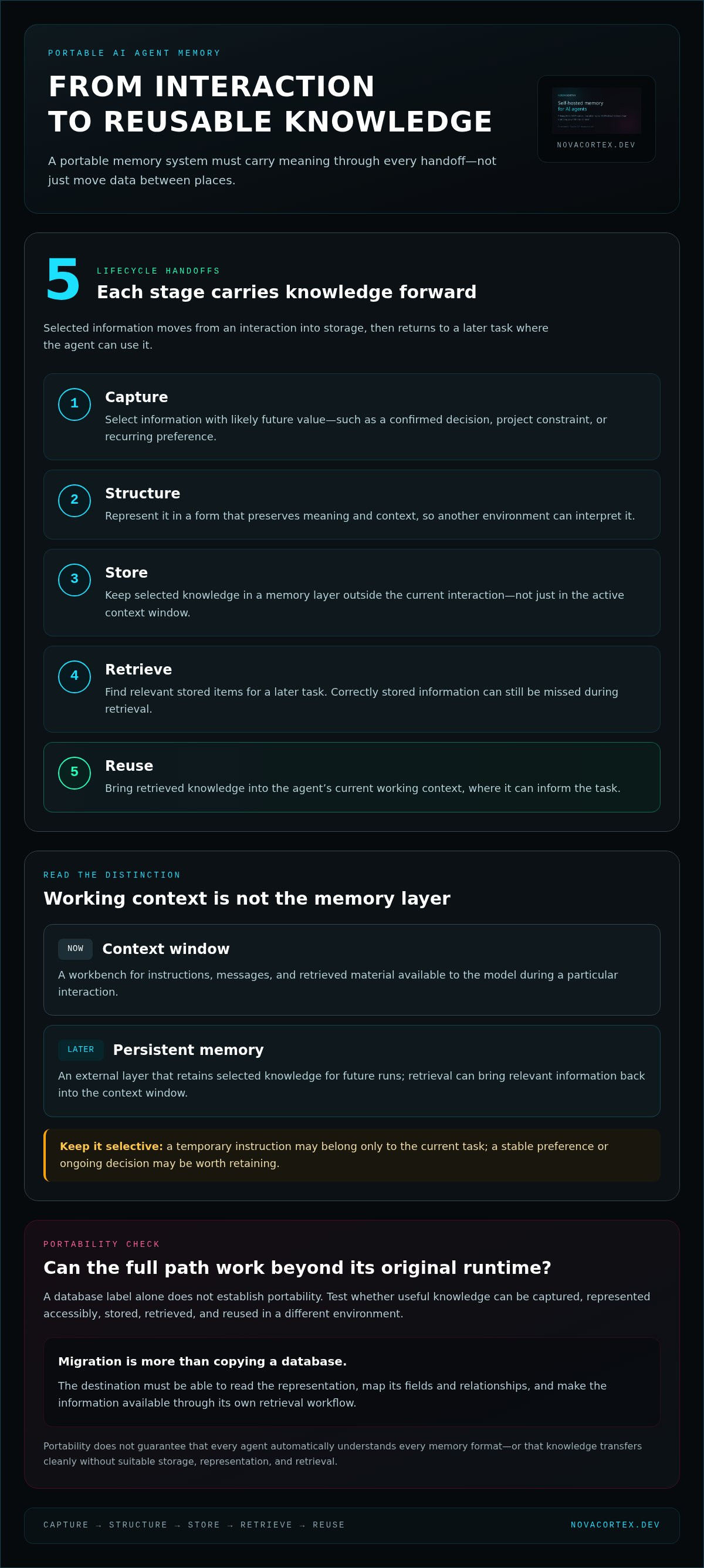
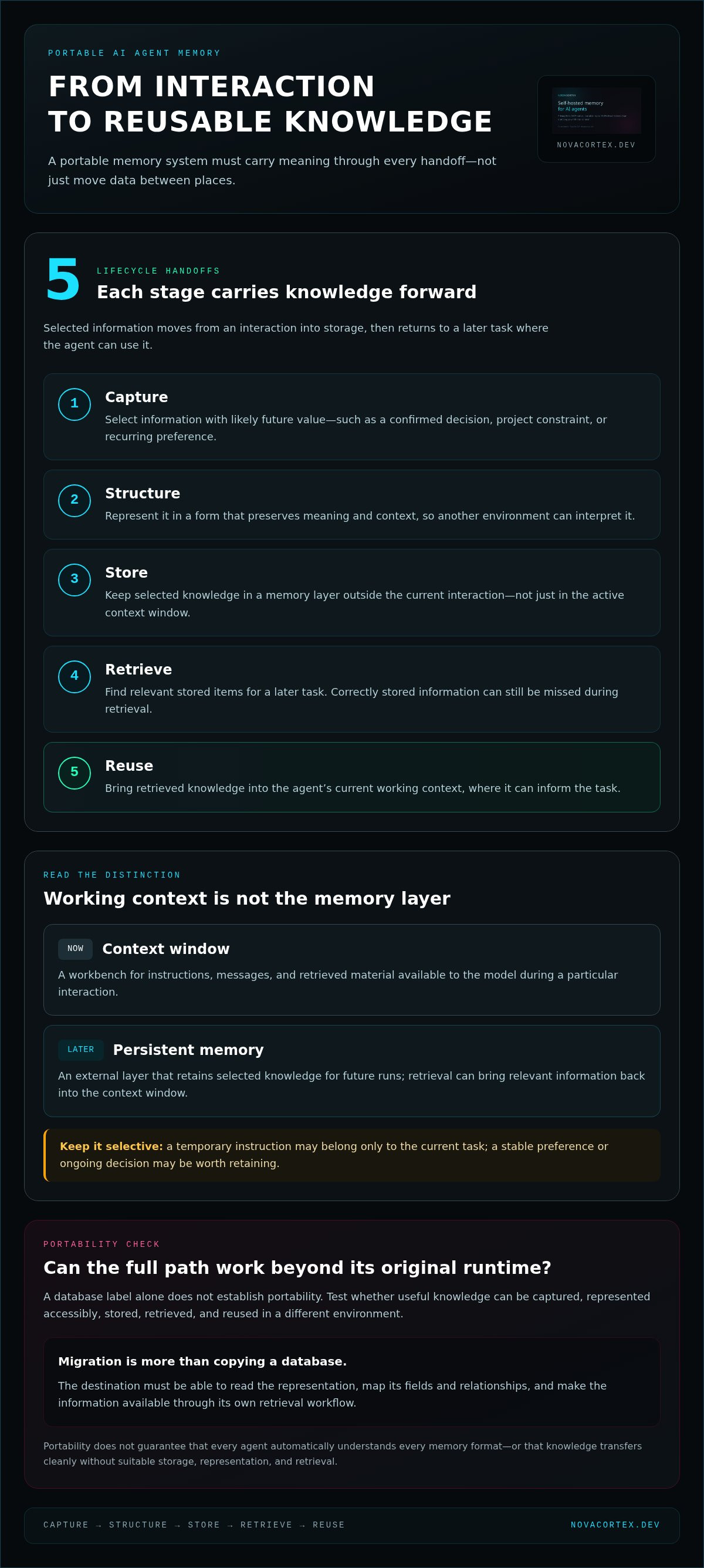
Think of the context window as a workbench, not a filing system. It contains the instructions, messages, and retrieved material available to the model now. A memory layer is closer to a maintained record: it stores selected information outside the immediate interaction. On a later run, retrieval can bring relevant stored knowledge back into the context window, where the model can use it. Whether the right information returns depends on the retrieval system’s design and accuracy.
Not every message belongs in long-term storage. A temporary instruction may matter only for the current task; a stable preference or a decision that shapes ongoing work may be worth retaining. Decide what qualifies for storage and how it will be updated. This keeps persistent memory from becoming an indiscriminate transcript archive.
Why context loss becomes an architecture problem
Repeated rediscovery has a direct operational cost. An agent may need to be reminded of a decision, reconstruct a project’s constraints, or repeat research because useful facts weren’t available in a later session. Re-sending long histories or entire knowledge collections can consume context and tokens. Leaving them out, on the other hand, risks missing details.
The problem deepens when memory is tied to one runtime’s proprietary storage or data model. Changing the agent, framework, or deployment can turn accumulated knowledge into an extraction and conversion project. Portability raises an architectural question: can information be represented and accessed beyond its first environment? It doesn’t mean every agent can interpret every memory format automatically. To assess portability, trace how knowledge moves through the memory system, from capture to reuse.
How portable AI agent memory moves knowledge beyond one runtime
Portability is a data-flow property, not a database type. A vector store, graph database, relational system, or file can hold memory, but the label alone doesn’t determine whether another agent can use it. Test the full path: can useful knowledge be captured, represented in an accessible form, stored, retrieved when needed, and reused in a different environment?
Persistent memory supports later agent runs by storing selected knowledge outside the current interaction, so a retrieval process can supply it to a future run. The memory layer is separate from the model that reasons over it, the agent framework that coordinates tasks, and the inference provider that runs the model. These parts can change independently when the memory layer and surrounding workflow can still exchange information.
Memory systems can organize information in different ways, including episodic records of events, semantic facts, or procedural knowledge. IBM’s overview of AI agent memory describes these distinctions. Whatever the category, portability depends on what the system preserves and how another environment can interpret it, not simply where the data sits.
From interaction to reusable memory
A conversation is input, not automatically durable memory. A useful system selects information likely to matter later, such as a confirmed decision, a project constraint, or a recurring preference. It structures that information so retrieval can target a relevant item instead of replaying an entire transcript. The selection method varies, but the goal is the same: preserve useful knowledge without making every exchange permanent baggage.
A simple lifecycle makes the handoffs visible:
- Capture information with likely future value.
- Structure it in a form that preserves meaning and context.
- Store it in the chosen memory layer.
- Retrieve relevant items for a later task.
- Reuse those items in the agent’s current working context.
Each step can fail independently. A fact may be captured but stored without enough context to interpret it, or stored correctly but missed during retrieval. Portability requires the whole workflow to carry meaning forward, not just move bytes.
From stored knowledge to another environment
When changing runtimes, migration means more than copying a database. The destination must be able to read the representation, map its fields and relationships, and make the information available through its own retrieval workflow. A portable format can reduce dependence on one vendor’s storage arrangement, but it doesn’t create universal compatibility. The receiving system still needs a way to understand and use that format.
That’s the practical difference between data movement and interoperability. Before adopting portable AI agent memory, trace what would happen if the model, framework, or storage engine changed. Identify which knowledge can be exported, what meaning could be lost, and what work would be needed to restore retrieval. The NovaCortex project repository offers a concrete starting point for examining a portable-memory approach.
Portable memory versus decentralized AI agent networks
These terms describe different parts of an architecture. Portability concerns whether memory can be moved or used outside its original environment. Persistence concerns whether selected knowledge remains available over time. Self-hosting describes where software or data runs. Decentralization describes how control or system components are distributed. These properties can work together, but none automatically implies the others.
Portability
What moves: Memory data between supported environments.
Storage control: Depends on where the memory layer runs.
Agent coordination: Not required.
Persistence
What remains: Selected knowledge across sessions or runs.
Storage control: Depends on the storage design.
Agent coordination: Not required.
Self-hosting
What runs: The memory system on infrastructure controlled by its operator.
Storage control: The operator manages the hosting environment.
Agent coordination: Not required.
Decentralization
What is distributed: Control, data, or system components across multiple participants or nodes.
Storage control: Shared or distributed according to the network design.
Agent coordination: May be supported, but isn’t inherent to memory portability.
What portability guarantees, and what it does not
Portable AI agent memory is designed to reduce dependence on a single vendor’s storage arrangement or proprietary data model. That creates a path for migration, not a promise of effortless transfer. The destination must support the memory representation, preserve relevant structure, and connect it to a retrieval workflow. A file that can be exported but not meaningfully interpreted is technically movable, yet of limited practical use.
Portability alone also says nothing conclusive about privacy or security. Those depend on where data is stored, who can access it, and how the system is operated. Treat portability as an architecture property, then assess access controls, deployment, format compatibility, and migration effort separately.
When decentralization is a separate design choice
A decentralized network distributes some aspect of control or operation across participants or nodes, rather than placing it under one central operator. A self-hosted memory service, by contrast, can run on infrastructure controlled by one organization and remain centrally managed. Self-hosted doesn’t mean decentralized, just as distributed coordination doesn’t guarantee that memory can be transferred into another system.
The right topology depends on the workload. A team may need one controlled memory layer shared by its agents; another system may require agents to coordinate across independently operated nodes. Neither pattern makes memory portable by itself. NovaCortex illustrates the distinction: it provides a self-hosted memory layer with a Portable Memory Format, not a decentralized agent network. Evaluate the storage and format separately from any networking or coordination layer.
How to evaluate portable AI agent memory before adopting it
A portability claim is useful only if you can test it. Trace a real memory item from its original environment into a second one, then check whether its meaning and usefulness survive the move. Use this checklist to evaluate working capabilities, not just labels such as “interoperable” or “vendor-neutral.”
- Data ownership: Identify where memory is stored, who can access it, and who operates the infrastructure. Self-hosting gives you direct control over where data resides, but also puts infrastructure operation in your hands. Portability alone doesn’t establish privacy or security.
- Representation: Find out how memories are encoded and whether the format is documented. Check whether records preserve the context and relationships needed to interpret them outside the original system. A vendor-specific structure can become a migration dependency even when data export is available.
- Retrieval: Test whether the system returns the relevant facts for a task, rather than an oversized transcript or knowledge dump. Confirm that retrieval works in the target environment, not only in the original runtime.
- Deployment: Map the components involved: memory store, agent framework, model, and inference provider. Note which can change independently and which remain coupled to a particular service or runtime.
- Migration: Document what export and import involve. Consider format conversion, lost relationships, access configuration, and the work required to restore retrieval. “Exportable” is not the same as seamlessly usable elsewhere.
Questions that expose portability limits
Make the evaluation concrete. Can a second runtime access the stored knowledge without relying on the original service? Is the representation documented well enough to interpret and map? What steps would migration require, and what would have to be rebuilt? Record dependencies on a vendor, framework, or deployment alongside any successful transfer. These answers show where portability works in practice and where the architecture still has a tether.
For a closer look at the storage-control trade-off, NovaCortex explains the self-hosted AI memory layer. Its discussion of the portable memory format for AI also relates directly to representation and vendor dependence.
Balance control, retrieval, and operating effort
Self-hosted memory gives an organization control over the infrastructure where it runs, while requiring that organization to operate and maintain the environment. A managed deployment shifts some operational responsibility elsewhere, but changes who controls the underlying infrastructure. Weigh data requirements against your team’s operational capacity to decide which arrangement fits.
Then test retrieval under realistic tasks. Does the agent receive a focused set of relevant memories, or must it consume a large body of context to find them? Protocol access matters too: the MCP-native memory server article explores that integration angle. Evaluate claims against observable behavior, documented formats, and a migration test.
NovaCortex as a self-hosted example of portable AI agent memory
With the architecture and evaluation criteria in view, NovaCortex offers a concrete example of portable AI agent memory. It provides a memory layer, not an AI agent or an LLM API. Its Self-Hosted Edition stores knowledge on user infrastructure, separating the memory layer from the model or agent runtime that uses it. Hosting control is an operational choice; portability depends on how knowledge is represented and accessed.
Where NovaCortex fits in the memory architecture
NovaCortex combines a Portable Memory Format (PMF) with graph-native storage. PMF is designed to avoid vendor lock-in by providing a portable representation; graph-native storage represents knowledge as connected information. Together, these attributes address two practical questions: can memory be represented beyond one vendor-specific arrangement, and can the memory layer organize relationships between items? Neither attribute alone guarantees that every destination system can read or retrieve the data, so compatibility still matters.
Self-hosting places the memory system on user infrastructure, giving the operator control over that hosting environment. Infrastructure operation remains a separate consideration from portability. A portable format doesn’t determine who can access stored information, and self-hosting doesn’t automatically make data portable. These are distinct properties that can reinforce user control when designed together.
Explore the implementation
NovaCortex is open source under the Apache-2.0 license. The project states that it can reduce token usage by up to 98% compared with dumping entire knowledge bases into a prompt. This is a product-specific comparison, not a universal result: actual token use depends on the system and comparison conditions. The architectural point is that a memory layer can supply selected knowledge instead of requiring an agent to include an entire collection in each interaction.
For a practical evaluation, inspect the project’s documented format and storage approach, then compare them with your requirements for data ownership, retrieval, and future migration. Focus on what the system represents, where it runs, and how its design addresses vendor dependence. Assess compatibility, security, and setup effort against your own deployment needs.
Make portability a design decision
Make memory portability part of your architecture before a provider or runtime change forces the issue. Define a migration test now: choose representative knowledge, move it into a separate environment, and check whether it remains understandable and retrievable. This turns portable AI agent memory from a label into an engineering criterion your team can revisit as systems evolve.
NovaCortex gives builders an implementation to inspect: a self-hosted memory layer designed for user infrastructure, Portable Memory Format, graph-native storage, and open-source licensing under Apache-2.0. Review how those choices map to your requirements, then assess the project on its documented design and fit for your deployment.
Each deliberate step toward transferable context gives your agents a stronger foundation for working across changing environments. Explore NovaCortex’s self-hosted memory layer and Portable Memory Format, then test how they fit your portability requirements.
Frequently Asked Questions
What is portable AI agent memory?
Portable AI agent memory is knowledge designed to remain usable beyond a single conversation or runtime. For example, a project decision could be stored with its date and source, then made available to a later task. That differs from temporary information in the model’s active context. Portability doesn’t guarantee that another system can interpret the record, so check the format and test a real transfer.
How does an AI agent remember information between sessions?
An AI agent can retain selected information in an external memory store, then retrieve relevant items when a new session begins. A practical setup might preserve a confirmed preference while leaving transient requests in the conversation history. Decide what deserves retention, how outdated facts are corrected, and how retrieved items are included in a prompt. Stored information won’t help if a later workflow doesn’t retrieve it.
Is portable AI memory the same as decentralized AI?
No. Portable AI memory concerns whether stored knowledge can be reused in another environment; decentralization concerns how a system’s control or components are distributed. A team could run one memory service on its own infrastructure and still operate it centrally. Conversely, a distributed network may store information in formats that are difficult to transfer. Treat network topology and memory movement as separate design decisions.
Can AI agent memory work across different models or frameworks?
Yes, if the destination can interpret the memory representation and access it through a compatible workflow. For instance, a team changing its agent framework may need to map stored fields or adapt retrieval before the new agent can use them. Test with representative records, including structured facts and their context. Don’t assume that changing the model alone makes the memory layer compatible.
What happens if an AI agent’s memory is tied to one provider?
Moving to another provider may require more than exporting records. The retrieval logic, management tools, or data structure may also depend on provider-specific components. Before a migration, identify what can be exported in a readable form and what needs replacement or conversion. A small trial with a representative set of memories can reveal hidden dependencies before they affect a broader deployment.
Does self-hosted AI memory automatically make agent data private?
No. Self-hosting gives an organization control over where the memory service runs, but privacy also depends on who can access it and how data flows through the wider system. For example, stored knowledge may be hosted internally while prompts are processed by a separate model provider. Map those data paths, permissions, and operational responsibilities to assess privacy for your specific use case.
How can developers reduce token use with persistent agent memory?
Use retrieval to supply task-relevant knowledge instead of placing an entire knowledge base in every prompt. Measure the tokens sent for comparable tasks, and check whether the retrieved context contains enough evidence for accurate responses. NovaCortex states reductions of up to 98% compared with dumping entire knowledge bases. That is a product-specific comparison, not a general benchmark or guaranteed result.
FAQ
What is portable AI agent memory?
Portable AI agent memory is knowledge designed to remain usable beyond a single conversation or runtime. For example, a project decision could be stored with its date and source, then made available to a later task. That differs from temporary information in the model’s active context. Portability doesn’t guarantee that another system can interpret the record, so check the format and test a real transfer.
How does an AI agent remember information between sessions?
An AI agent can retain selected information in an external memory store, then retrieve relevant items when a new session begins. A practical setup might preserve a confirmed preference while leaving transient requests in the conversation history. Decide what deserves retention, how outdated facts are corrected, and how retrieved items are included in a prompt. Stored information won’t help if a later workflow doesn’t retrieve it.
Is portable AI memory the same as decentralized AI?
No. Portable AI memory concerns whether stored knowledge can be reused in another environment; decentralization concerns how a system’s control or components are distributed. A team could run one memory service on its own infrastructure and still operate it centrally. Conversely, a distributed network may store information in formats that are difficult to transfer. Treat network topology and memory movement as separate design decisions.
Can AI agent memory work across different models or frameworks?
Yes, if the destination can interpret the memory representation and access it through a compatible workflow. For instance, a team changing its agent framework may need to map stored fields or adapt retrieval before the new agent can use them. Test with representative records, including structured facts and their context. Don’t assume that changing the model alone makes the memory layer compatible.
What happens if an AI agent’s memory is tied to one provider?
Moving to another provider may require more than exporting records. The retrieval logic, management tools, or data structure may also depend on provider-specific components. Before a migration, identify what can be exported in a readable form and what needs replacement or conversion. A small trial with a representative set of memories can reveal hidden dependencies before they affect a broader deployment.
Does self-hosted AI memory automatically make agent data private?
No. Self-hosting gives an organization control over where the memory service runs, but privacy also depends on who can access it and how data flows through the wider system. For example, stored knowledge may be hosted internally while prompts are processed by a separate model provider. Map those data paths, permissions, and operational responsibilities to assess privacy for your specific use case.
How can developers reduce token use with persistent agent memory?
Use retrieval to supply task-relevant knowledge instead of placing an entire knowledge base in every prompt. Measure the tokens sent for comparable tasks, and check whether the retrieved context contains enough evidence for accurate responses. NovaCortex states reductions of up to 98% compared with dumping entire knowledge bases. That is a product-specific comparison, not a general benchmark or guaranteed result.