Portable AI Knowledge Base: Engineering Sovereign Agent Memory in 2026
If your AI agent's long-term memory is trapped in a proprietary cloud vector database, you don't own your intelligence. You're renting it. With Gartner predicting that 40% of enterprise applications will embed task-specific agents by the end of 2026, the current reliance on proprietary vector clouds is a massive liability. It makes a truly portable AI knowledge base impossible to maintain. You're likely exhausted by the "token tax" and the constant threat of vendor lock-in. It's an engineering failure that demands a sovereign correction.
Engineering a system that functions independently of specific LLM providers is now a requirement for any production-grade agent. This guide demonstrates how to architect graph-native storage using NovaCortex to end the cycle of data dependency. We'll explore the mechanics of the Portable Memory Format (PMF) and MCP-native servers, the protocol standard that allows agents to manage their own knowledge directly. You'll learn how to achieve 100% data sovereignty, slash token costs by 98%, and deploy modular Knowledge Buckets that work on any infrastructure from local hardware to a high-performance VPS.
Key Takeaways
- Stop renting your intelligence from proprietary vector clouds. Learn to build a portable AI knowledge base that moves with your agent across any infrastructure, ensuring 100% data sovereignty.
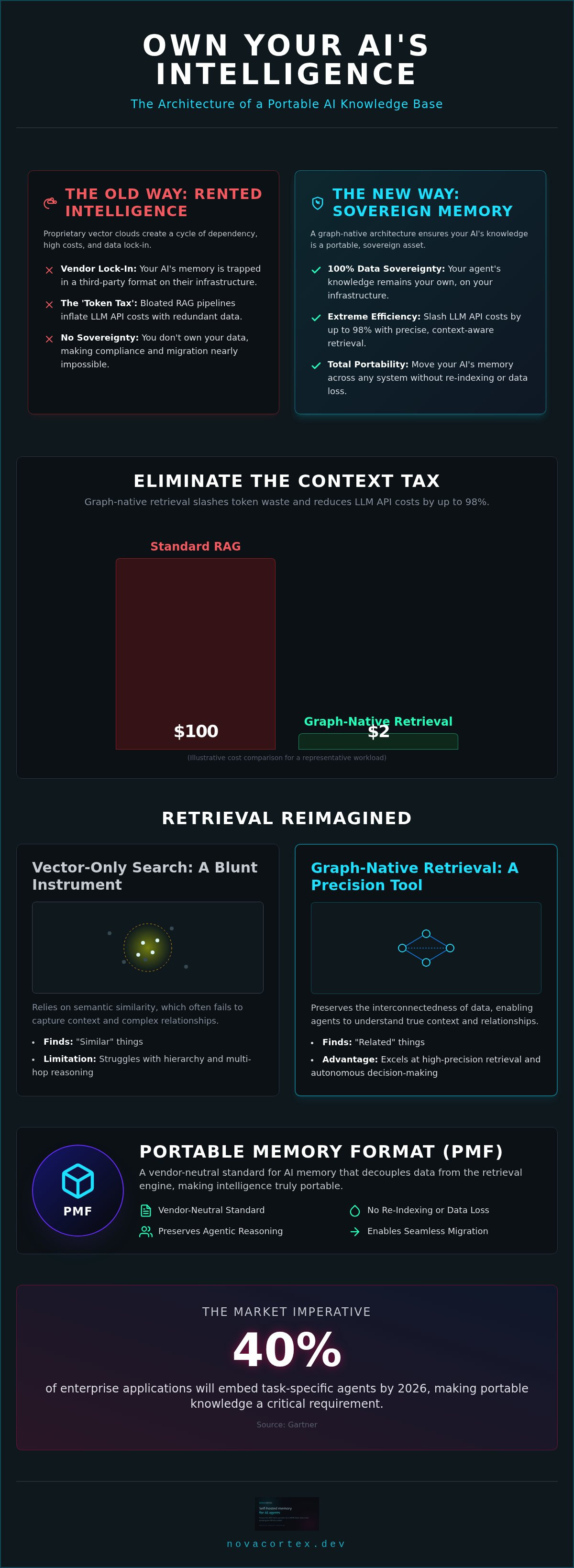
- Eliminate the context tax by shifting from bloated RAG pipelines to graph-native retrieval. This architecture allows you to slash LLM API costs by up to 98% through precise, modular Knowledge Buckets.
- Master the Portable Memory Format (PMF) to ensure agent memory remains persistent and interoperable. It is the engineering blueprint for memory that survives provider shifts and future-proofs your stack.
- Deploy an MCP-native memory server to provide your agents with universal, standardized access to their data. Standardizing your memory layer ensures high-velocity performance across different LLM providers.
The Failure of Static Knowledge Bases in the Agentic Era
Traditional help centers are built for humans to browse. They fail AI agents. By the end of 2026, Gartner predicts 40% of enterprise applications will feature embedded agents. These agents don't need a UI. They need a machine-readable, portable AI knowledge base that functions as a persistent cognitive layer. Current architectures rely on "Data Gravity," where information is trapped in proprietary cloud silos. This creates a massive architectural bottleneck. It forces developers to choose between convenience and control. Static libraries are dead. They were designed for human eyes, not machine logic.
The Token Waste Problem in Standard RAG
Standard Retrieval-Augmented Generation (RAG) is often an engineering shortcut. Most teams simply dump unstructured documents into a context window. This is lazy architecture. It creates a "Context Tax" that inflates LLM API costs through redundant data processing. Every unnecessary token sent to a model is a financial leak. High-performance agents require a more sophisticated approach to Episodic memory. They need to distinguish between long-term facts and session-specific events. Managed clouds add latency and noise. They retrieve too much irrelevant data. This forces the model to work harder and costs you more. It's a waste of compute and capital.
Data Sovereignty: Why 'Managed' Equals 'Locked'
Proprietary vector databases offer ease of use at the cost of ownership. Your data exists in their format, on their infrastructure. This is a liability. In 2026, regulatory pressure for localized data storage is intensifying. Organizations can't afford to have their intellectual property locked in a third-party silo. When your memory layer is tied to a specific provider, you lose the ability to pivot between LLM models. True independence requires moving away from managed environments toward solving the data sovereignty crisis. A portable AI knowledge base ensures that your agent's intelligence remains your own. It allows you to migrate across any infrastructure without losing the context that makes your agent effective. Managed providers sell convenience but deliver dependency. You need a system that prioritizes your sovereignty.
Defining the Portable AI Knowledge Base Architecture
A portable AI knowledge base isn't just a collection of markdown files or a hosted vector index. It is a self-contained, graph-native knowledge layer designed to move with the agent across different environments. This architecture ensures that intelligence isn't a byproduct of a specific cloud provider but an independent asset. For a broader context, check this authoritative industry overview of AI agent memory which highlights the necessity of persistent long-term storage.
Portable Memory Format (PMF) Explained
The portable memory format for AI (PMF) is a vendor-neutral standard for AI memory that decouples data from the retrieval engine.
PMF allows for seamless migration. You can shift your knowledge base from a local Raspberry Pi to a high-performance VPS or a secure edge device without re-indexing or data loss. This format encodes not just text, but the structural relationships required for agentic reasoning. It treats memory as a transportable package. By standardizing the way agent memory is stored and retrieved, PMF removes the technical friction of vendor lock-in.
Graph-Native vs. Vector-Only Retrieval
Flat vector search is a blunt instrument. It relies on semantic similarity, which often fails when an agent needs to understand complex hierarchies or multi-hop relationships. In contrast, graph-native storage preserves the interconnectedness of data points. While vectors find "similar" things, graphs find "related" things. This distinction is critical for autonomous decision-making. High-precision retrieval depends on understanding context, not just matching keywords or embeddings. You can explore the technical trade-offs in our analysis of Redis vs graph memory for AI agents.
Graph-native retrieval offers several advantages over semantic vector matching:
- Relationship Preservation: Knowledge graphs maintain the hierarchy and connections between entities.
- Multi-Hop Reasoning: Agents can traverse nodes to find answers that aren't semantically similar but are logically linked.
- Precision Control: Modular retrieval reduces the noise that typically plagues flat vector databases.
The Model Context Protocol (MCP) acts as the universal connector. It provides the standardized interface needed for agents to interact with their memory layer regardless of the underlying LLM. By utilizing an MCP-native memory server, you eliminate the need for custom integrations every time you switch models. This protocol enforces vendor neutrality. It ensures your portable AI knowledge base remains accessible to any agent in your ecosystem. Developers looking to implement this architecture can start by exploring the NovaCortex repository for open-source memory server implementations.
Efficiency Benchmarks: Reducing Token Usage by 98%
Standard RAG pipelines are financially unsustainable at scale. They treat the context window as a dumping ground for semi-relevant chunks. This approach is an engineering failure that results in massive token waste. A portable AI knowledge base built on graph-native retrieval operates with a different logic. It doesn't just search; it prunes. By isolating data into modular Knowledge Buckets, you ensure the agent only interacts with high-relevance context. This tiered memory structure keeps long-term performance stable without inflating your API bills.
The 98% Token Reduction Mechanism
Graph-native pruning identifies and removes irrelevant nodes before the LLM call occurs. This is a fundamental shift in context window management. In our technical analysis of AI agent long term memory, benchmarks confirmed that this surgical precision reduces token overhead by up to 98%. Long-running agent tasks that would typically exhaust context windows remain lean. You aren't paying for the model to filter noise. You're ensuring the noise never reaches the model in the first place.
The economic impact of this efficiency is absolute. Consider the cost of dumping 100,000 tokens of "relevant" documents into a window versus retrieving 2,000 tokens of precise graph nodes. The latter is not just faster; it's 50 times cheaper. Standard vector search finds similarity but misses the structural relationships that allow for this level of data reduction. Graph-native memory is the only way to maintain complex reasoning while keeping operational costs under control.
Latency and Performance at the Edge
Digital sovereignty is a performance strategy. Hosting your memory layer locally reduces Round Trip Time (RTT) by eliminating third-party cloud hops. You can run a high-performance portable AI knowledge base on a Raspberry Pi 5 or a basic VPS without sacrificing intelligence. This local-first approach removes the "latency tax" inherent in managed vector clouds. It ensures your agent responds in milliseconds, not seconds.
Optimizing for low-power environments requires lean architecture. Managed providers sell bloated systems that require massive compute to hide their inefficiencies. By using the NovaCortex Self-Hosted Edition, you reclaim the speed that cloud-locked data destroys. High-velocity performance is a requirement for autonomous agents in 2026. Localized memory layers provide the sub-millisecond recall necessary for real-time decision-making. Stop waiting for cloud API responses and start running at the speed of your local infrastructure.
Implementing a Portable Knowledge Base with MCP
Implementation is where architectural theory meets engineering reality. To build a truly portable AI knowledge base, you must decouple the memory layer from both the model and the underlying infrastructure. This process begins with containerization. By wrapping your knowledge base in a Docker container, you ensure it can run on a local Raspberry Pi, a secure VPS, or a high-performance edge node without configuration drift. Infrastructure independence is the foundation of digital sovereignty.
The Model Context Protocol (MCP) serves as the universal interface for this architecture. It replaces proprietary, vendor-locked APIs with a standardized communication layer. Implementing an MCP-native memory server allows any agent, regardless of its LLM backend, to query and update its long-term memory with sub-millisecond latency. It creates a plug-and-play ecosystem where you can switch between Claude, GPT-5, or open-weight models like Qwen without re-engineering your data pipeline.
The Power of MCP-Native Memory
By 2026, MCP has emerged as the industry standard for agent interoperability. It provides a structured way for agents to navigate complex datasets without the overhead of custom integrations. When you utilize an MCP native memory server, you're building for a multi-model future. This protocol allows agents to manage their own knowledge state directly, ensuring that context remains persistent even as you rotate models to optimize for cost or performance. It's the technical bridge that makes vendor neutrality a reality.
Modular Knowledge Buckets
Granular control is essential for preventing context contamination. You don't want a coding agent's memory polluted by customer support logs. Knowledge Buckets provide a framework for isolating data by project, domain, or user. This modularity is critical for multi-tenant AI applications where data privacy and precision are non-negotiable. It allows for dynamic bucket switching, ensuring the agent only accesses the specific "Knowledge Bucket" required for its current task.
Effective implementation follows a strict four-step workflow:
- Containerize: Use Docker to package the memory layer for environment-agnostic deployment.
- Standardize: Deploy an MCP-native server to provide universal agent access.
- Segment: Organize data into Knowledge Buckets to maintain high-precision retrieval.
- Synchronize: Set up local sync protocols to ensure consistency across multi-agent environments.
This structured approach ensures your portable AI knowledge base remains lean and efficient. It prevents the "data gravity" that typically pulls organizations back into expensive, proprietary cloud silos. By maintaining local synchronization, you ensure that even in distributed environments, every agent has access to the same sovereign truth. It is a robust, engineering-first solution to the problem of fragmented agent memory.
Sovereign Memory: Deploying NovaCortex Self-Hosted
Deploying the NovaCortex Self-Hosted Edition is the final step in reclaiming your agent's cognitive independence. Most AI agents today are amnesiac. They rely on transient context or third-party vector stores that leak data and inflate operational costs. By hosting your own memory layer, you transform these agents into persistent, sovereign entities. A portable AI knowledge base must live where you control the hardware, whether that's a high-performance VPS, a Raspberry Pi 5, or a localized private server. This is how you move from renting intelligence to owning it.
Self-Hosted vs. Managed AI Memory
The Total Cost of Ownership (TCO) for managed AI memory is deceptive. While cloud providers advertise low entry costs, the long-term "context tax" and data egress fees create a financial trap. Privacy-conscious industries like healthcare and finance are leading the migration to self-hosted editions to avoid these systemic risks. Keeping agent cognition off the public cloud isn't just a security preference; it's a regulatory necessity in 2026. You can evaluate the full breakdown in our self-hosted vs managed AI memory guide. Self-hosting eliminates the middleman and secures your intellectual property within your own perimeter.
Managed services prioritize their own platform's "stickiness" over your system's efficiency. They often use proprietary formats that make migration impossible. NovaCortex breaks this cycle by utilizing the Portable Memory Format (PMF). This ensures that your data remains yours, regardless of where the compute happens. When you control the memory layer, you control the agent's logic. It's a fundamental shift from being a consumer of AI services to being an architect of AI systems.
Getting Started with NovaCortex
NovaCortex provides an open-source advantage through its Apache-2.0 license. This ensures that your infrastructure remains transparent, auditable, and extensible. You aren't locked into a black-box retrieval system. Starting with a single Knowledge Bucket for a prototype is simple, but the architecture is built to scale. As your agent ecosystem grows, you can deploy modular buckets to handle multi-tenant environments without performance degradation. This modularity prevents context contamination and ensures high-precision retrieval across diverse tasks.
This architecture is the engineering solution to the "Data Sovereignty Crisis." It allows you to maintain a portable AI knowledge base that is model-agnostic and infrastructure-independent. You gain the ability to pivot between LLM providers while your agent's core intelligence remains stable and secure. Digital sovereignty is no longer a theoretical goal. It is a technical requirement for any organization that intends to own its AI future. Stop renting your agent's memory. Build a sovereign cognitive layer that you actually own.
Reclaiming the Sovereign Cognitive Stack
The era of renting your agent's intelligence is over. Engineering a portable AI knowledge base isn't just an optimization; it is a fundamental architectural choice for digital sovereignty in 2026. By moving from bloated cloud vector stores to graph-native local memory, you eliminate the context tax and regain control over your most valuable asset: your data. Cloud-locked memory is a liability that your infrastructure can no longer afford to carry.
You have seen the benchmarks. Slashing token costs by 98% and achieving sub-millisecond recall are not theoretical goals. They are the standard for any production-grade agentic system. Utilizing an MCP-native architecture ensures your memory layer remains model-agnostic and resilient to provider shifts. With privacy-first local storage and the Apache-2.0 open-source license, NovaCortex provides the technical foundation to build a persistent cognitive layer that you actually own.
The transition from amnesiac agents to sovereign intelligence starts with your infrastructure. Take the lead and architect a system that prioritizes performance and independence.
Build the future of persistent agent memory today.
Frequently Asked Questions
What makes an AI knowledge base 'portable' compared to standard RAG?
Portability stems from decoupling the memory layer from both the model and the infrastructure. Standard RAG often locks data into proprietary cloud vector stores that are difficult to migrate. A portable AI knowledge base uses the Portable Memory Format (PMF) to allow data migration across a VPS, local hardware, or edge devices without re-indexing. It ensures your agent's intelligence moves with the agent rather than staying tethered to a specific provider's API.
How does graph-native storage reduce token usage by 98%?
Graph-native storage utilizes relationship-based retrieval rather than simple semantic similarity. Instead of dumping large, unstructured document chunks into a context window, the system prunes irrelevant nodes and only retrieves the exact interconnected data required for the task. This surgical precision removes 98% of the noise typically found in standard RAG pipelines. It keeps the context window lean and slashes LLM API costs by focusing only on high-value facts.
Can I run a portable knowledge base on my own local server or VPS?
You can deploy the architecture on any infrastructure you control. The NovaCortex Self-Hosted Edition is designed to run on a Raspberry Pi 5, a dedicated local server, or any standard VPS provider. This flexibility is a core component of digital sovereignty. It allows you to keep sensitive agent cognition within your own perimeter while maintaining sub-millisecond recall speeds that cloud-based alternatives cannot match due to network latency.
What is the Portable Memory Format (PMF) and why is it open source?
PMF is a vendor-neutral standard for storing AI memory that ensures interoperability between different LLM providers. It is released under the Apache-2.0 license to foster a transparent, auditable ecosystem for sovereign intelligence. Being open source prevents the vendor lock-in common with proprietary vector databases. It allows the engineering community to contribute to a shared protocol that prioritizes data ownership and long-term persistence for autonomous agents across different environments.
How does the Model Context Protocol (MCP) help with AI knowledge bases?
MCP acts as the universal communication layer between AI agents and their memory. It standardizes how models like Claude or GPT-5 query and update knowledge sources. By using an MCP-native memory server, you eliminate the need for custom, model-specific integrations. This protocol ensures your portable AI knowledge base remains accessible to any agent in your stack. It simplifies the engineering required to maintain a consistent cognitive layer across multiple LLM providers.
Is a portable knowledge base more secure than a cloud-based vector DB?
Security is significantly enhanced by removing third-party intermediaries from your data pipeline. A self-hosted portable knowledge base keeps your intellectual property off the public cloud, preventing data leaks in managed environments. You control the access logs, encryption, and physical location of the data. For privacy-conscious industries, this local-first approach is the only way to meet strict regulatory requirements for data residency and confidentiality while still leveraging advanced AI capabilities.
What are Knowledge Buckets and how do they organize agent memory?
Knowledge Buckets are modular containers used to segment memory by project, user, or domain. This organization prevents context contamination by ensuring an agent only accesses data relevant to its current objective. You can dynamically switch between buckets in multi-tenant applications to maintain high-precision retrieval. This framework provides granular control over your data, allowing for tiered access and ensuring that memory remains structured and manageable as your agent ecosystem scales.
Does NovaCortex support integration with multiple LLM providers?
NovaCortex is strictly model-agnostic and designed for universal compatibility across the industry. Through its MCP-native architecture, it integrates seamlessly with any model that supports the protocol, including OpenAI, Anthropic, and open-weight models like Qwen or Gemma. This neutrality allows you to swap LLM providers to optimize for cost or performance without losing your agent's long-term memory. You build the knowledge base once and use it across your entire heterogeneous model stack.
FAQ
What makes an AI knowledge base 'portable' compared to standard RAG?
Portability stems from decoupling the memory layer from both the model and the infrastructure. Standard RAG often locks data into proprietary cloud vector stores that are difficult to migrate. A portable AI knowledge base uses the Portable Memory Format (PMF) to allow data migration across a VPS, local hardware, or edge devices without re-indexing. It ensures your agent's intelligence moves with the agent rather than staying tethered to a specific provider's API.
How does graph-native storage reduce token usage by 98%?
Graph-native storage utilizes relationship-based retrieval rather than simple semantic similarity. Instead of dumping large, unstructured document chunks into a context window, the system prunes irrelevant nodes and only retrieves the exact interconnected data required for the task. This surgical precision removes 98% of the noise typically found in standard RAG pipelines. It keeps the context window lean and slashes LLM API costs by focusing only on high-value facts.
Can I run a portable knowledge base on my own local server or VPS?
You can deploy the architecture on any infrastructure you control. The NovaCortex Self-Hosted Edition is designed to run on a Raspberry Pi 5, a dedicated local server, or any standard VPS provider. This flexibility is a core component of digital sovereignty. It allows you to keep sensitive agent cognition within your own perimeter while maintaining sub-millisecond recall speeds that cloud-based alternatives cannot match due to network latency.
What is the Portable Memory Format (PMF) and why is it open source?
PMF is a vendor-neutral standard for storing AI memory that ensures interoperability between different LLM providers. It is released under the Apache-2.0 license to foster a transparent, auditable ecosystem for sovereign intelligence. Being open source prevents the vendor lock-in common with proprietary vector databases. It allows the engineering community to contribute to a shared protocol that prioritizes data ownership and long-term persistence for autonomous agents across different environments.
How does the Model Context Protocol (MCP) help with AI knowledge bases?
MCP acts as the universal communication layer between AI agents and their memory. It standardizes how models like Claude or GPT-5 query and update knowledge sources. By using an MCP-native memory server, you eliminate the need for custom, model-specific integrations. This protocol ensures your portable AI knowledge base remains accessible to any agent in your stack. It simplifies the engineering required to maintain a consistent cognitive layer across multiple LLM providers.
Is a portable knowledge base more secure than a cloud-based vector DB?
Security is significantly enhanced by removing third-party intermediaries from your data pipeline. A self-hosted portable knowledge base keeps your intellectual property off the public cloud, preventing data leaks in managed environments. You control the access logs, encryption, and physical location of the data. For privacy-conscious industries, this local-first approach is the only way to meet strict regulatory requirements for data residency and confidentiality while still leveraging advanced AI capabilities.
What are Knowledge Buckets and how do they organize agent memory?
Knowledge Buckets are modular containers used to segment memory by project, user, or domain. This organization prevents context contamination by ensuring an agent only accesses data relevant to its current objective. You can dynamically switch between buckets in multi-tenant applications to maintain high-precision retrieval. This framework provides granular control over your data, allowing for tiered access and ensuring that memory remains structured and manageable as your agent ecosystem scales.
Does NovaCortex support integration with multiple LLM providers?
NovaCortex is strictly model-agnostic and designed for universal compatibility across the industry. Through its MCP-native architecture, it integrates seamlessly with any model that supports the protocol, including OpenAI, Anthropic, and open-weight models like Qwen or Gemma. This neutrality allows you to swap LLM providers to optimize for cost or performance without losing your agent's long-term memory. You build the knowledge base once and use it across your entire heterogeneous model stack.