Portable Memory Format for AI: Breaking the Vendor Lock-in Cycle

Your AI context is currently a data hostage held in a proprietary silo. Every time you pivot between providers, you are forced to abandon your context or pay a massive tax to reconstruct it. This is a systemic failure of engineering. To break this cycle, you must implement a portable memory format for AI that ensures your data remains independent of the model. It is time to stop treating memory as a vendor-locked feature and start treating it as a sovereign asset.
You already know the friction of sky-high token costs and the waste of redundant context dumping. It is an inefficient way to build. This guide provides the technical blueprint to master an interoperable AI memory architecture. We will show you how to reclaim your data sovereignty and slash token overhead using graph-native layers and Knowledge Buckets. We are moving beyond simple JSON schemas toward a future-proof system using the NovaCortex Self-Hosted Edition and MCP-Native Memory Servers to achieve complete data ownership and high-velocity performance.
Key Takeaways
- Eliminate proprietary context silos by decoupling interaction history from specific LLM providers.
- Stop paying the "Amnesia Tax" by implementing a portable memory format for AI that slashes token overhead and redundant data ingestion.
- Move beyond simple vector storage to graph-native memory architectures capable of mapping complex relationships and non-linear logic.
- Deploy a vendor-neutral transport layer using the Model Context Protocol (MCP) to maintain interoperability across different agent frameworks.
- Reclaim digital sovereignty with self-hosted memory layers that prioritize privacy-first infrastructure and long-term context retention.
What is a Portable Memory Format for AI?
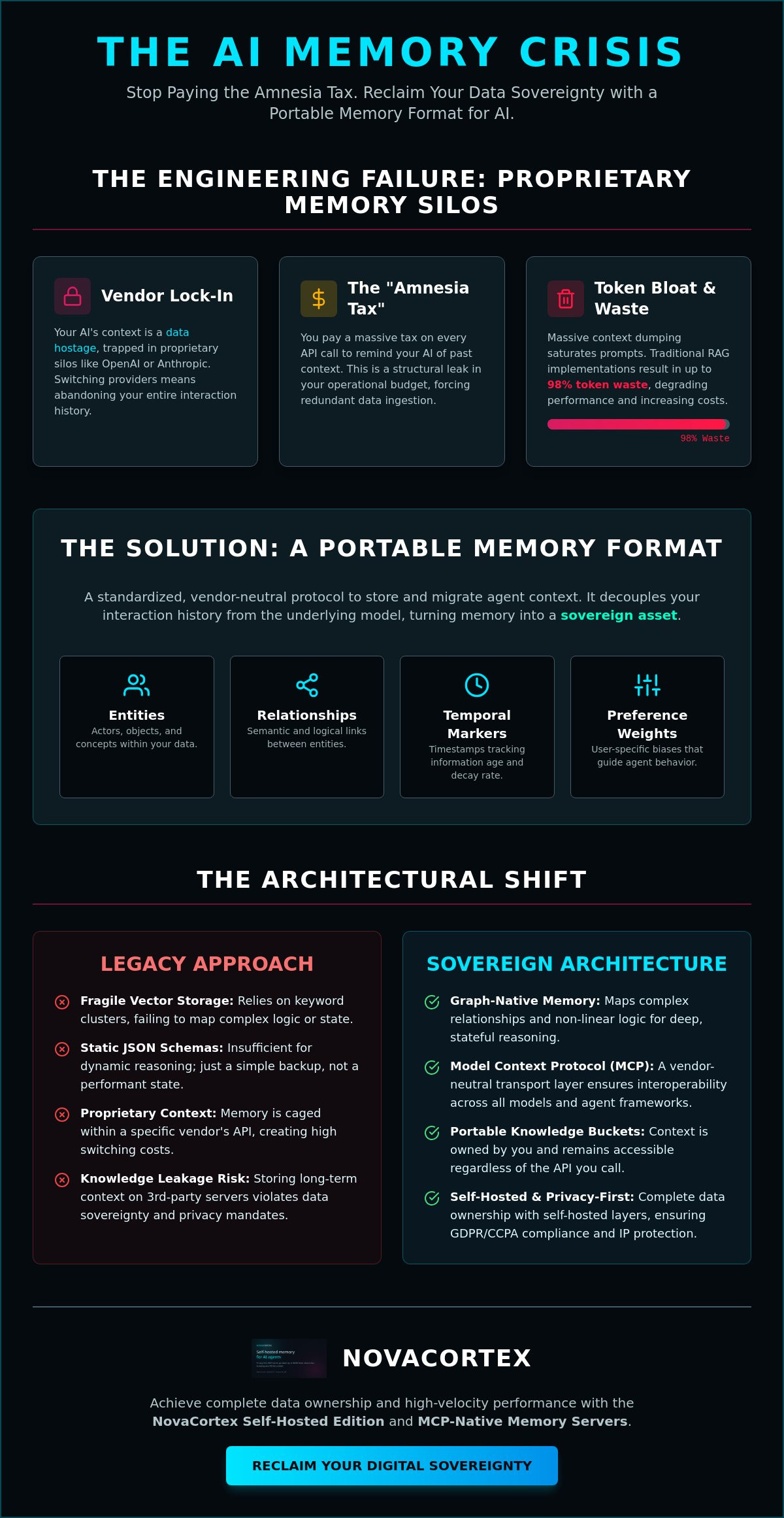
A portable memory format for AI is a standardized, vendor-neutral protocol designed to store and migrate agent context across disparate systems. Think of it as the vCard for the LLM era. Just as a contact card decouples your identity from your specific hardware, this format decouples your interaction history from the underlying model. Currently, your context is trapped. It exists only within the proprietary silos of OpenAI or Anthropic. Moving your data means losing your history. This is an engineering failure that restricts your operational freedom.
The industry is hitting a wall. 2026 has become the year of the "Memory Exodus" because developers are tired of the amnesia tax. They want to switch from cloud-based providers to local instances without starting from zero. A true format requires more than just a chat log. It demands a sophisticated approach to Knowledge representation and reasoning that captures the following core components:
- Entities: The specific actors, objects, and concepts within your data.
- Relationships: The semantic and logical links between those entities.
- Temporal Markers: Timestamps that track when information was learned and its current decay rate.
- Preference Weights: User-specific biases and instructions that guide agent behavior.
The architecture of interoperable context
Interoperability is a technical requirement, not a suggestion. To move context between providers, your architecture must account for different tokenization methods and context window limits. Metadata plays a critical role here. It provides the necessary "glue" that allows a local model to understand the nuance of a conversation originally held with a multi-billion parameter cloud model. Portable Memory Format (PMF) acts as the bridge between model-specific context and user-owned knowledge. It ensures that your Knowledge Buckets remain accessible regardless of the API you call.
Beyond JSON: Why schema alone is not enough
Flat JSON files are insufficient for complex agent reasoning. They are static. They fail to capture the dynamic nature of how an agent retrieves and updates information in real-time. A "portable" format must also be "performant." In high-latency environments, the storage format must support rapid indexing and retrieval. We aren't just moving text; we are moving state. If the format doesn't support the underlying graph logic required for deep reasoning, it isn't truly portable. It is just a backup. True portability requires a system that handles the "web of thought" efficiently, ensuring that your MCP-Native Memory Server can serve context at production speeds.
The Engineering Crisis: Why Proprietary Memory Fails
Proprietary memory is a black hole for enterprise capital. Every API call to a closed model is a transaction with a memory-impaired agent. You pay to remind the machine who you are, what you did yesterday, and how you prefer your outputs structured. This "Amnesia Tax" is a structural leak in your balance sheet. It forces developers to choose between high latency and total context loss. It is a choice no engineer should have to make.
Token bloat is the inevitable byproduct of this failure. Without a portable memory format for AI, teams default to massive context dumping. They shove entire knowledge bases into a single prompt. This creates architectural debt that grows with every interaction. It saturates context windows and degrades reasoning. It turns a lean agent into a bloated, slow, and expensive legacy system. Vector-only retrieval is too fragile for this task. It relies on keyword clusters rather than logical state, making long-term context retention nearly impossible.
Context dumping costs
Traditional RAG implementations often suffer from nearly 98% waste. You are paying for thousands of tokens that the model ignores or misinterprets. As context windows expand, performance often contracts. More data does not equal better intelligence. It often results in "lost in the middle" phenomena where critical details vanish. Proprietary memory layers act as digital cages for user data, ensuring that your most valuable operational history remains non-transferable and expensive.
Sovereignty and privacy
Regulatory pressure is mounting. GDPR and CCPA mandates require granular control over personal data. Storing long-term context in a managed cloud service creates a massive knowledge leakage risk. If your agent's memory lives on a vendor's server, you've already lost control of your intellectual property. Data portability and interoperability are no longer just regulatory suggestions; they are survival requirements for the modern enterprise.
Self-hosting is the only viable path for true enterprise-grade privacy. By utilizing a self-hosted memory layer, you decouple your data from the model's provider. This isn't just about saving money. It is about architectural independence. You need a system that understands the logical relationships behind the data, not just the semantic similarity. Moving to a sovereign architecture ensures your Knowledge Buckets stay under your control, regardless of which LLM you use today or tomorrow.
Graph-Native vs. Vector Storage: A Performance Breakdown
Vector databases are blunt instruments. They solve for semantic similarity but fail at logical coherence. In the race to build a robust portable memory format for AI, many developers default to vector-only storage because it's the path of least resistance. This is a mistake. Vector search identifies items that look similar; it does not understand how those items relate. If your agent needs to remember a specific sequence of logic or a complex hierarchy of user preferences, a simple embedding lookup will eventually return noise. To achieve true interoperability, you need a graph-native architecture that captures the "web of thought."
The industry is currently debating the merits of Vector database vs. graph database models. While vector systems are excellent for broad retrieval, they are prone to hallucinations when context becomes dense. Hybrid approaches are the emerging standard for 2026. By using embeddings to locate the correct entry point (nodes) and graphs to traverse the surrounding context (edges), you ensure that your agent doesn't just find a related document. It reconstructs the specific logic required for the task. Vector DBs find related documents; graph memory reconstructs specific logic.
The limits of similarity search
Closest match is often the wrong answer for agent memory. When an agent queries a vector database, it receives a list of fragments based on mathematical distance. This often leads to the "lost in the middle" phenomenon. In large context windows, the most relevant information is frequently buried or ignored because the model lacks a structural map of the data. Graph traversal solves this. It preserves the logical flow of user interactions, allowing an agent to follow a chain of reasoning rather than just jumping to the nearest keyword cluster. This structural integrity is what makes a memory layer truly portable across different LLM architectures.
Building the graph-native memory layer
Mapping a portable memory format for AI to a graph structure requires more than just storing strings. You must define memory triplets: subject, predicate, and object. These triplets form the backbone of your Knowledge Buckets. Scalability is the primary concern here. Managing millions of these triplets on edge hardware requires a lean, high-velocity approach. Performance benchmarks from early 2026 show that integrated systems, like VAST Data's native vector index, can deliver up to 1,000 queries per second. This is an 11x improvement over older, specialized vector-only databases. When you move beyond flat JSON files to a graph-native layer, you aren't just saving data. You are building a high-performance engine for long-term agent state and reasoning.
Implementing Portable Memory: Token Efficiency and MCP
Implementation is where architectural theory meets engineering reality. Transitioning to a portable memory format for AI requires a disciplined five-step integration process to ensure state persistence across heterogeneous environments. You aren't just moving files; you are establishing a dynamic transport layer for agent intelligence. Follow this protocol to decouple your data from the vendor's gravity:
- Step 1: Decouple state from logic. Extract the session history and user preferences from the agent's internal prompt logic. This ensures the agent remains a stateless processor.
- Step 2: Implement MCP as the transport layer. Utilize the Model Context Protocol (MCP) to standardize how the agent requests and receives context from your external storage.
- Step 3: Prune context via graph-native retrieval. Stop dumping raw logs. Use graph traversal to identify and send only the high-relevance nodes required for the current task.
- Step 4: Sync across local and cloud. Establish a synchronization heartbeat between your local MCP-Native Memory Server and cloud-based LLM providers to maintain a unified memory state.
- Step 5: Validate memory integrity. Run cryptographic checks during provider migration to ensure that context remains uncorrupted and logically consistent.
The MCP-Native advantage
The Model Context Protocol (MCP) is the definitive standard for AI-to-memory communication in 2026. It eliminates the need for brittle, custom-coded middleware. By using an MCP-Native Memory Server, you create a direct, high-velocity link between your data and any compliant LLM. NovaCortex utilizes this protocol to maintain a "living" memory server that updates in real-time. This isn't a static database; it's an active participant in the agent's reasoning loop. It provides a standardized interface that allows you to swap a cloud model for a local instance without re-engineering your retrieval logic.
Achieving 98% token reduction
Traditional RAG is wasteful. Sending entire documents to a context window is an admission of architectural defeat. The Knowledge Bucket approach solves this by segmenting memory into precise, manageable units. Dynamic retrieval ensures you only pay for the tokens that actually contribute to the output. Real-world benchmarking against standard context dumping shows that a portable memory format for AI combined with graph-native pruning can slash API costs by up to 98%. You are no longer paying for the model to "read" irrelevant data. You are providing the exact logical nodes it needs to execute.
Stop subsidizing vendor inefficiencies with bloated API bills. You can deploy your own sovereign context layer today by installing the NovaCortex Self-Hosted Edition to reclaim your data and slash your operational overhead.
NovaCortex: The Sovereign Memory Layer
NovaCortex is the definitive architectural correction to the vendor-locked status quo. It is the physical implementation of the portable memory format for AI that restores data sovereignty to the engineer. While the industry remains trapped in managed service silos, NovaCortex provides a self-hosted engine that prioritizes privacy and performance. You own the infrastructure. You own the interaction history. You own the logical state. This is not a suggestion; it's a requirement for any enterprise serious about AI independence.
Our system is built for high-velocity, graph-native performance. It handles the complex, long-term context that traditional vector storage fails to capture. Because NovaCortex is vendor-neutral by design, it utilizes the PMF to ensure your data remains fluid and transferable. You can deploy this layer anywhere. It scales from massive enterprise clusters to a single Raspberry Pi at the edge. The footprint is lean. The execution is fast. It's designed to be the permanent home for your agent's intelligence, regardless of which LLM is currently processing the tokens.
Engineering for digital sovereignty
Digital sovereignty is a principled stance. We've committed to the Apache-2.0 license because open source is the only foundation for architectural trust. Proprietary memory layers are designed to keep you paying. They create friction when you try to leave. NovaCortex eliminates managed service fees and the infrastructure bloat associated with middleman platforms. Getting started with the NovaCortex Self-Hosted Edition is a direct process. You pull the container, configure your Knowledge Buckets, and point your MCP-Native Memory Server at your data. There are no hidden gates and no proprietary formats.
The future of autonomous agents
Persistent context is the prerequisite for true autonomy. If an agent loses its state when a session ends, it's merely a sophisticated calculator. To achieve real independence, agents must have a memory that exists outside the model's transient context window. NovaCortex enables multi-agent synchronization through a shared, graph-native memory layer. Multiple agents can traverse the same logical web, updating nodes and edges in real-time. This creates a unified intelligence that survives provider migrations and hardware failures. This is how you build systems that don't just respond, but remember. Deploy your own memory layer today and secure your architectural future.
Reclaim Architectural Sovereignty
Proprietary context silos are a relic of early-stage AI adoption. You have now seen how a portable memory format for AI transforms your interaction history from a vendor-locked liability into a sovereign asset. By shifting from flat vector similarity to graph-native logic, you eliminate the "Amnesia Tax" and ensure your agent's state remains persistent across any provider. This isn't just about data portability; it's about building lean, high-velocity systems that respect your infrastructure and your budget. The era of the digital cage is over for teams that prioritize engineering integrity.
The tools for this transition are ready for deployment. With an MCP-native architecture and a principled Apache-2.0 open-source foundation, you can achieve a 98% token reduction while maintaining complete ownership of your Knowledge Buckets. Stop subsidizing the systemic inefficiency of closed models. Stop the amnesia. Deploy NovaCortex on your own infrastructure. It is time to start building on your own terms and lead the industry toward true interoperability.
Frequently Asked Questions
What is the difference between a vector database and a portable memory format?
A vector database is a storage engine for embeddings; a portable memory format for AI is a standardized schema for cross-platform state transfer. While vector engines handle semantic search, the PMF defines how entities and relationships are structured for migration. It's the difference between a hard drive and a file format. You need the format to ensure your data isn't trapped in a specific provider's engine.
How does a portable memory format reduce AI token usage?
Token usage drops because you stop dumping raw context logs into every prompt. By using graph-native retrieval, the system identifies the exact logical nodes required for a task and sends only those. This surgical precision eliminates the massive waste common in traditional RAG implementations. You pay for the intelligence you need, not the noise you've already stored. Precision retrieval is the only way to scale without exploding API costs.
Can I migrate my ChatGPT memory to a self-hosted NovaCortex server?
You can migrate interaction history by exporting your data and mapping it to the Portable Memory Format (PMF). Once the data is structured, you ingest it into the NovaCortex Self-Hosted Edition. This process breaks the proprietary silo. It allows you to move your personalized context from a managed service to your own infrastructure without losing the nuances of past interactions or your established user preferences.
Is the Model Context Protocol (MCP) required for portable memory?
MCP isn't strictly required for storage, but it's essential for standardized transport. It acts as the universal connector between the agent and the memory layer. Without MCP, you're back to writing custom, brittle middleware for every model. Using an MCP-Native Memory Server ensures that your portable memory remains accessible to any compliant LLM. It's the definitive standard for maintaining a vendor-neutral architecture.
What are Knowledge Buckets and how do they organize agent state?
Knowledge Buckets are logical segments used to categorize and isolate specific context domains. They prevent cross-contamination between different projects or user personas. By organizing agent state into these discrete units, you improve retrieval speed and precision. This modular approach allows you to load only the relevant bucket for a specific task. It's an architectural choice that favors lean operations and high-velocity performance over bloated, flat-file storage.
Can NovaCortex run on low-power hardware like a Raspberry Pi?
NovaCortex is designed for high-velocity performance on varied hardware, including edge devices like the Raspberry Pi. The architecture is lean. It avoids the bloated resource requirements of managed cloud databases. By running the self-hosted edition locally, you maintain total data sovereignty and eliminate the latency of round-trip cloud calls. It's an efficient solution for developers building local-first AI agents on constrained hardware.
How does graph-native storage improve AI retrieval precision?
Graph-native storage maps the relationships between data points rather than just their semantic similarity. Vector search often returns "related" noise that lacks logical coherence. Graph traversal follows the specific edges between nodes to reconstruct the user's original reasoning. This structural integrity ensures the agent receives context that is logically relevant, not just mathematically close. It's the difference between keyword matching and true context reconstruction.
Is there a commercial license available for NovaCortex enterprise use?
The NovaCortex Self-Hosted Edition is built on an Apache-2.0 open-source foundation. This provides a transparent, trust-based framework for enterprise deployment. For organizations requiring specialized support or advanced integration features, we offer commercial pathways that build upon this sovereign core. It's a standard-setting approach that balances open-source independence with enterprise-grade reliability. We provide the tools; you maintain the control.

FAQ
The architecture of interoperable context
Interoperability is a technical requirement, not a suggestion. To move context between providers, your architecture must account for different tokenization methods and context window limits. Metadata plays a critical role here. It provides the necessary "glue" that allows a local model to understand the nuance of a conversation originally held with a multi-billion parameter cloud model. Portable Memory Format (PMF) acts as the bridge between model-specific context and user-owned knowledge. It ensures that your Knowledge Buckets remain accessible regardless of the API you call.
Beyond JSON: Why schema alone is not enough
Flat JSON files are insufficient for complex agent reasoning. They are static. They fail to capture the dynamic nature of how an agent retrieves and updates information in real-time. A "portable" format must also be "performant." In high-latency environments, the storage format must support rapid indexing and retrieval. We aren't just moving text; we are moving state. If the format doesn't support the underlying graph logic required for deep reasoning, it isn't truly portable. It is just a backup. True portability requires a system that handles the "web of thought" efficiently, ensuring that your MCP-Native Memory Server can serve context at production speeds. Proprietary memory is a black hole for enterprise capital. Every API call to a closed model is a transaction with a memory-impaired agent. You pay to remind the machine who you are, what you did yesterday, and how you prefer your outputs structured. This "Amnesia Tax" is a structural leak in your balance sheet. It forces developers to choose between high latency and total context loss. It is a choice no engineer should have to make. Token bloat is the inevitable byproduct of this failure. Without a portable memory format for AI, teams default to massive context dumping. They shove entire knowledge bases into a single prompt. This creates architectural debt that grows with every interaction. It saturates context windows and degrades reasoning. It turns a lean agent into a bloated, slow, and expensive legacy system. Vector-only retrieval is too fragile for this task. It relies on keyword clusters rather than logical state, making long-term context retention nearly impossible.
Context dumping costs
Traditional RAG implementations often suffer from nearly 98% waste. You are paying for thousands of tokens that the model ignores or misinterprets. As context windows expand, performance often contracts. More data does not equal better intelligence. It often results in "lost in the middle" phenomena where critical details vanish. Proprietary memory layers act as digital cages for user data, ensuring that your most valuable operational history remains non-transferable and expensive.
Sovereignty and privacy
Regulatory pressure is mounting. GDPR and CCPA mandates require granular control over personal data. Storing long-term context in a managed cloud service creates a massive knowledge leakage risk. If your agent's memory lives on a vendor's server, you've already lost control of your intellectual property. Data portability and interoperability are no longer just regulatory suggestions; they are survival requirements for the modern enterprise. Self-hosting is the only viable path for true enterprise-grade privacy. By utilizing a self-hosted memory layer, you decouple your data from the model's provider. This isn't just about saving money. It is about architectural independence. You need a system that understands the logical relationships behind the data, not just the semantic similarity. Moving to a sovereign architecture ensures your Knowledge Buckets stay under your control, regardless of which LLM you use today or tomorrow. Vector databases are blunt instruments. They solve for semantic similarity but fail at logical coherence. In the race to build a robust portable memory format for AI, many developers default to vector-only storage because it's the path of least resistance. This is a mistake. Vector search identifies items that look similar; it does not understand how those items relate. If your agent needs to remember a specific sequence of logic or a complex hierarchy of user preferences, a simple embedding lookup will eventually return noise. To achieve true interoperability, you need a graph-native architecture that captures the "web of thought." The industry is currently debating the merits of Vector database vs. graph database models. While vector systems are excellent for broad retrieval, they are prone to hallucinations when context becomes dense. Hybrid approaches are the emerging standard for 2026. By using embeddings to locate the correct entry point (nodes) and graphs to traverse the surrounding context (edges), you ensure that your agent doesn't just find a related document. It reconstructs the specific logic required for the task. Vector DBs find related documents; graph memory reconstructs specific logic.
The limits of similarity search
Closest match is often the wrong answer for agent memory. When an agent queries a vector database, it receives a list of fragments based on mathematical distance. This often leads to the "lost in the middle" phenomenon. In large context windows, the most relevant information is frequently buried or ignored because the model lacks a structural map of the data. Graph traversal solves this. It preserves the logical flow of user interactions, allowing an agent to follow a chain of reasoning rather than just jumping to the nearest keyword cluster. This structural integrity is what makes a memory layer truly portable across different LLM architectures.
Building the graph-native memory layer
Mapping a portable memory format for AI to a graph structure requires more than just storing strings. You must define memory triplets: subject, predicate, and object. These triplets form the backbone of your Knowledge Buckets. Scalability is the primary concern here. Managing millions of these triplets on edge hardware requires a lean, high-velocity approach. Performance benchmarks from early 2026 show that integrated systems, like VAST Data's native vector index, can deliver up to 1,000 queries per second. This is an 11x improvement over older, specialized vector-only databases. When you move beyond flat JSON files to a graph-native layer, you aren't just saving data. You are building a high-performance engine for long-term agent state and reasoning. Implementation is where architectural theory meets engineering reality. Transitioning to a portable memory format for AI requires a disciplined five-step integration process to ensure state persistence across heterogeneous environments. You aren't just moving files; you are establishing a dynamic transport layer for agent intelligence. Follow this protocol to decouple your data from the vendor's gravity:
The MCP-Native advantage
The Model Context Protocol (MCP) is the definitive standard for AI-to-memory communication in 2026. It eliminates the need for brittle, custom-coded middleware. By using an MCP-Native Memory Server, you create a direct, high-velocity link between your data and any compliant LLM. NovaCortex utilizes this protocol to maintain a "living" memory server that updates in real-time. This isn't a static database; it's an active participant in the agent's reasoning loop. It provides a standardized interface that allows you to swap a cloud model for a local instance without re-engineering your retrieval logic.
Achieving 98% token reduction
Traditional RAG is wasteful. Sending entire documents to a context window is an admission of architectural defeat. The Knowledge Bucket approach solves this by segmenting memory into precise, manageable units. Dynamic retrieval ensures you only pay for the tokens that actually contribute to the output. Real-world benchmarking against standard context dumping shows that a portable memory format for AI combined with graph-native pruning can slash API costs by up to 98%. You are no longer paying for the model to "read" irrelevant data. You are providing the exact logical nodes it needs to execute. Stop subsidizing vendor inefficiencies with bloated API bills. You can deploy your own sovereign context layer today by installing the NovaCortex Self-Hosted Edition to reclaim your data and slash your operational overhead. NovaCortex is the definitive architectural correction to the vendor-locked status quo. It is the physical implementation of the portable memory format for AI that restores data sovereignty to the engineer. While the industry remains trapped in managed service silos, NovaCortex provides a self-hosted engine that prioritizes privacy and performance. You own the infrastructure. You own the interaction history. You own the logical state. This is not a suggestion; it's a requirement for any enterprise serious about AI independence. Our system is built for high-velocity, graph-native performance. It handles the complex, long-term context that traditional vector storage fails to capture. Because NovaCortex is vendor-neutral by design, it utilizes the PMF to ensure your data remains fluid and transferable. You can deploy this layer anywhere. It scales from massive enterprise clusters to a single Raspberry Pi at the edge. The footprint is lean. The execution is fast. It's designed to be the permanent home for your agent's intelligence, regardless of which LLM is currently processing the tokens.
Engineering for digital sovereignty
Digital sovereignty is a principled stance. We've committed to the Apache-2.0 license because open source is the only foundation for architectural trust. Proprietary memory layers are designed to keep you paying. They create friction when you try to leave. NovaCortex eliminates managed service fees and the infrastructure bloat associated with middleman platforms. Getting started with the NovaCortex Self-Hosted Edition is a direct process. You pull the container, configure your Knowledge Buckets, and point your MCP-Native Memory Server at your data. There are no hidden gates and no proprietary formats.
The future of autonomous agents
Persistent context is the prerequisite for true autonomy. If an agent loses its state when a session ends, it's merely a sophisticated calculator. To achieve real independence, agents must have a memory that exists outside the model's transient context window. NovaCortex enables multi-agent synchronization through a shared, graph-native memory layer. Multiple agents can traverse the same logical web, updating nodes and edges in real-time. This creates a unified intelligence that survives provider migrations and hardware failures. This is how you build systems that don't just respond, but remember. Deploy your own memory layer today and secure your architectural future. Proprietary context silos are a relic of early-stage AI adoption. You have now seen how a portable memory format for AI transforms your interaction history from a vendor-locked liability into a sovereign asset. By shifting from flat vector similarity to graph-native logic, you eliminate the "Amnesia Tax" and ensure your agent's state remains persistent across any provider. This isn't just about data portability; it's about building lean, high-velocity systems that respect your infrastructure and your budget. The era of the digital cage is over for teams that prioritize engineering integrity. The tools for this transition are ready for deployment. With an MCP-native architecture and a principled Apache-2.0 open-source foundation, you can achieve a 98% token reduction while maintaining complete ownership of your Knowledge Buckets. Stop subsidizing the systemic inefficiency of closed models. Stop the amnesia. Deploy NovaCortex on your own infrastructure. It is time to start building on your own terms and lead the industry toward true interoperability.
What is the difference between a vector database and a portable memory format?
A vector database is a storage engine for embeddings; a portable memory format for AI is a standardized schema for cross-platform state transfer. While vector engines handle semantic search, the PMF defines how entities and relationships are structured for migration. It's the difference between a hard drive and a file format. You need the format to ensure your data isn't trapped in a specific provider's engine.
How does a portable memory format reduce AI token usage?
Token usage drops because you stop dumping raw context logs into every prompt. By using graph-native retrieval, the system identifies the exact logical nodes required for a task and sends only those. This surgical precision eliminates the massive waste common in traditional RAG implementations. You pay for the intelligence you need, not the noise you've already stored. Precision retrieval is the only way to scale without exploding API costs.
Can I migrate my ChatGPT memory to a self-hosted NovaCortex server?
You can migrate interaction history by exporting your data and mapping it to the Portable Memory Format (PMF). Once the data is structured, you ingest it into the NovaCortex Self-Hosted Edition. This process breaks the proprietary silo. It allows you to move your personalized context from a managed service to your own infrastructure without losing the nuances of past interactions or your established user preferences.
Is the Model Context Protocol (MCP) required for portable memory?
MCP isn't strictly required for storage, but it's essential for standardized transport. It acts as the universal connector between the agent and the memory layer. Without MCP, you're back to writing custom, brittle middleware for every model. Using an MCP-Native Memory Server ensures that your portable memory remains accessible to any compliant LLM. It's the definitive standard for maintaining a vendor-neutral architecture.
What are Knowledge Buckets and how do they organize agent state?
Knowledge Buckets are logical segments used to categorize and isolate specific context domains. They prevent cross-contamination between different projects or user personas. By organizing agent state into these discrete units, you improve retrieval speed and precision. This modular approach allows you to load only the relevant bucket for a specific task. It's an architectural choice that favors lean operations and high-velocity performance over bloated, flat-file storage.
Can NovaCortex run on low-power hardware like a Raspberry Pi?
NovaCortex is designed for high-velocity performance on varied hardware, including edge devices like the Raspberry Pi. The architecture is lean. It avoids the bloated resource requirements of managed cloud databases. By running the self-hosted edition locally, you maintain total data sovereignty and eliminate the latency of round-trip cloud calls. It's an efficient solution for developers building local-first AI agents on constrained hardware.
How does graph-native storage improve AI retrieval precision?
Graph-native storage maps the relationships between data points rather than just their semantic similarity. Vector search often returns "related" noise that lacks logical coherence. Graph traversal follows the specific edges between nodes to reconstruct the user's original reasoning. This structural integrity ensures the agent receives context that is logically relevant, not just mathematically close. It's the difference between keyword matching and true context reconstruction.
Is there a commercial license available for NovaCortex enterprise use?
The NovaCortex Self-Hosted Edition is built on an Apache-2.0 open-source foundation. This provides a transparent, trust-based framework for enterprise deployment. For organizations requiring specialized support or advanced integration features, we offer commercial pathways that build upon this sovereign core. It's a standard-setting approach that balances open-source independence with enterprise-grade reliability. We provide the tools; you maintain the control.