Privacy-First AI Infrastructure: Engineering Data Sovereignty in 2026

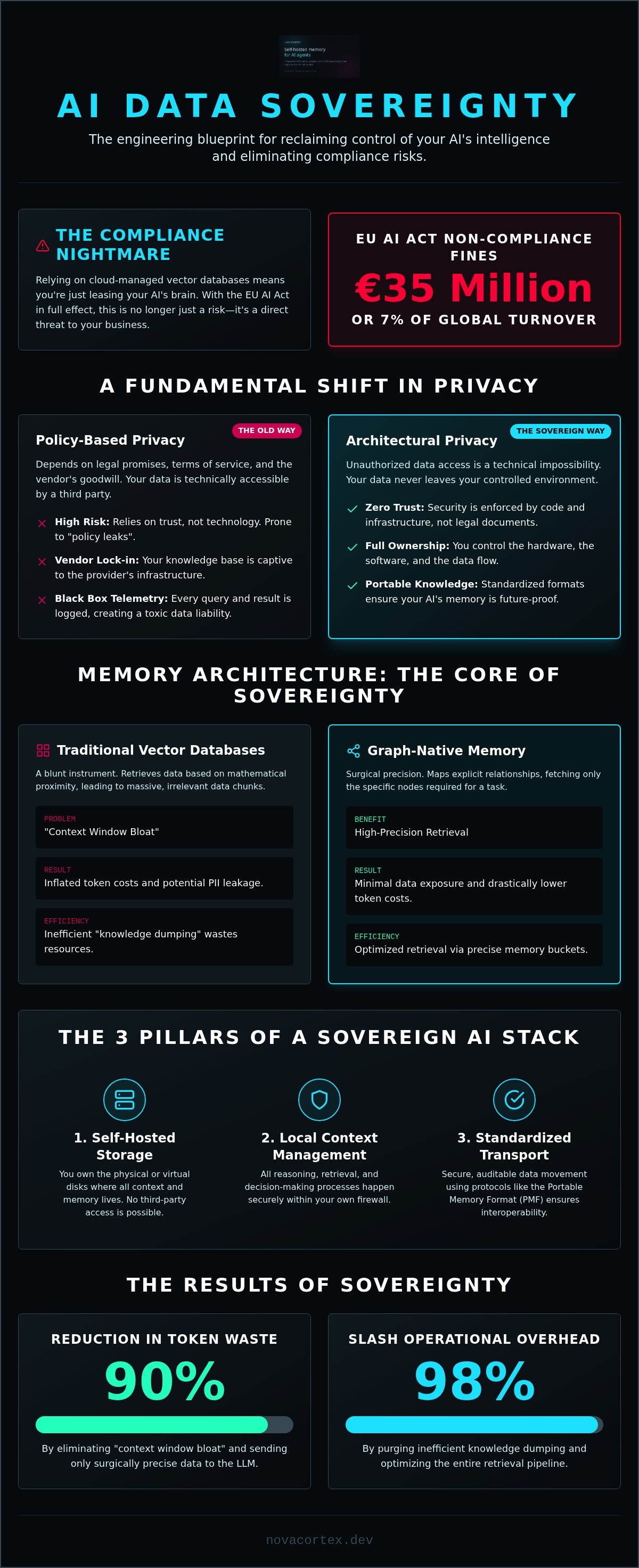
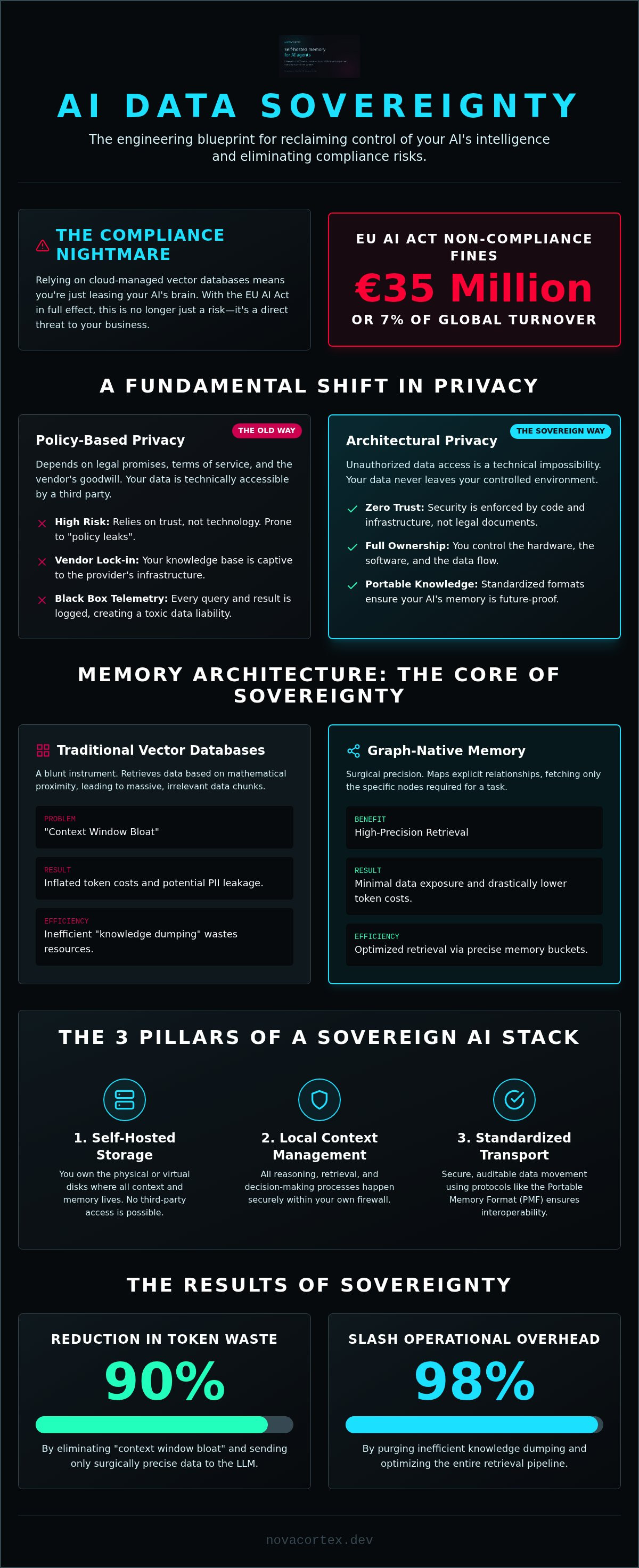
If your AI infrastructure relies on cloud-managed vector databases, you don't own your intelligence. You're just leasing a compliance nightmare. With the EU AI Act now in full effect and non-compliance fines reaching 35 million euros, the era of "move fast and break privacy" is over. True AI data sovereignty isn't a policy checkbox. It's a technical requirement that demands a total rejection of proprietary, black-box memory layers.
You already know the pain of vendor lock-in and the visceral waste of context dumping that inflates your token costs. It's inefficient. It's risky. This article provides the engineering blueprint to reclaim control through a self-hosted, graph-native memory architecture. We'll show you how to implement the Portable Memory Format (PMF) to ensure your knowledge remains your own, regardless of the underlying LLM. You'll learn to build a system that achieves a 90% reduction in token waste while maintaining absolute authority over your knowledge retrieval. We are moving from fragile cloud dependencies to resilient, sovereign systems that treat data as a permanent asset rather than a transient liability.
Key Takeaways
- Shift from policy-based privacy to architectural sovereignty where unauthorized data access is a technical impossibility rather than a legal promise.
- Architect high-precision agent reasoning using graph-native storage to eliminate the "context window bloat" found in traditional vector databases.
- Reclaim AI data sovereignty by deploying self-hosted memory layers that strip away the compliance risks of cloud-managed PII processing.
- Slash operational overhead by up to 98% by purging inefficient "knowledge dumping" and optimizing token retrieval through precise memory buckets.
- Future-proof your infrastructure with the Portable Memory Format (PMF) to ensure total knowledge portability across any LLM or agent framework.
What is AI Data Sovereignty in 2026?
AI data sovereignty is the technical impossibility of unauthorized data access by third-party vendors. It's an architectural reality, not a legal pinky-promise. In 2026, the industry has split into two camps: those relying on Policy-Based Privacy and those building Architectural Privacy. Policy-based privacy depends on terms of service and legal threats. Architectural privacy depends on code and infrastructure. If a vendor holds the keys to your database, you have no sovereignty. Data sovereignty in the context of AI means your agent's reasoning, memory, and training data never leave your controlled environment.
Cloud-managed AI layers create permanent security debt through Black Box telemetry. Every prompt, every retrieved document, and every agentic decision is logged by the provider. This metadata is a goldmine for vendors but a toxic liability for you. True sovereignty requires a rejection of these bloated systems in favor of lean, self-hosted alternatives. You must own the entire stack to eliminate the risk of silent data exfiltration.
Building a sovereign system rests on three specific pillars:
- Self-hosted storage: You own the physical or virtual disks where context lives.
- Local context management: Reasoning and retrieval happen within your firewall.
- Standardized transport protocols: Secure, auditable movement of data between components.
The Shift from Cloud-First to Sovereign AI
Shipping agent telemetry to managed cloud providers is an unacceptable risk for regulated enterprises. When you use a managed vector database, you're leaking your organizational logic. With EU AI Act fines now reaching 35 million euros or 7% of global turnover, the cost of a "policy leak" is too high. On-device and edge-based AI have emerged as the new standard for sovereign infrastructure. This shift centers on the self-hosted AI memory layer. This layer acts as the foundation of persistent cognition, ensuring an agent's long-term memory remains private and portable.
Core Components of a Private AI Stack
A private AI stack requires three distinct layers. First, the Local Inference Engine. You run LLMs on private hardware or secure, private API endpoints. Second, the Memory Layer. You must decouple persistent context from the LLM provider. This prevents vendor capture and keeps your knowledge base independent. Third, the Transport Layer. This secures the control plane between the agent, the memory server, and the model. Without these, your AI data sovereignty is just a suggestion. Ownership of the memory layer is the only way to ensure your AI doesn't become a double agent for your service providers.
The Technical Architecture of Sovereign AI Memory
Stop treating privacy as a legal shield. It's an engineering constraint. Traditional vector databases are built for broad similarity, not surgical precision. This architectural choice leads to "context window bloat," where agents receive massive, irrelevant data chunks just to find a single fact. Every extra byte sent to a cloud LLM is a potential leak point. True AI data sovereignty requires a memory layer that lives on your hardware, whether that's a Raspberry Pi in a closet or a hardened VPS. By hosting the memory layer locally, you ensure that the reasoning process never leaves your controlled environment.
Local knowledge retrieval is the only way to prevent the data leakage inherent in cloud-managed RAG. When you control the retrieval engine, you control the data exposure. This isn't just about security; it's about efficiency. Sending 100KB of "relevant" chunks to a model when only 1KB is needed is a failure of architecture. A sovereign system filters this noise at the source, ensuring only the most vital context is ever transmitted.
Graph-Native vs. Vector Databases for Privacy
Vector search is a blunt instrument. It retrieves data based on mathematical proximity, often pulling in unrelated PII or sensitive context because it "looks" similar in a high-dimensional space. Graph-native storage is different. It maps explicit relationships between entities, allowing for high-precision retrieval. You fetch only the specific nodes required for the task. This minimizes LLM exposure and slashes the data footprint. When evaluating Redis vs graph memory for AI agents, the performance gap in precision is undeniable. Precision is the ultimate privacy feature. By isolating knowledge retrieval to local infrastructure, you eliminate the massive data leakage inherent in cloud-managed RAG systems.
MCP-Native Memory Servers
Interoperability is the enemy of vendor lock-in. The Model Context Protocol (MCP) acts as the "USB port" for AI connectivity. It allows different agents and models to talk to your memory layer without proprietary API wrappers. An MCP native memory server ensures your knowledge base remains under your control. It standardizes the interface while keeping the storage engine private. This architecture aligns with global strategies for AI sovereignty by ensuring that the "brain" of your agent is portable and auditable. You can start building this today by exploring the NovaCortex open-source repository to see how graph-native structures handle persistent context on private infrastructure.
Self-Hosted vs. Cloud-Managed AI Infrastructure
Convenience is the most expensive commodity in engineering. Cloud-managed vector databases offer a seductive setup but hide a predatory "Token Tax." Every time a managed service retrieves a bloated context window, you pay for the inefficiency. For high-utilization workloads, self-hosting is up to 18 times cheaper per million tokens than cloud-based APIs. This isn't just about saving money. It's about fundamental control. In industries like FinTech and HealthTech, AI data sovereignty is the only way to bypass the US CLOUD Act, which allows authorities to compel disclosure from US-based providers regardless of residency.
Managed services are black boxes. You can't audit their telemetry or their internal data handling. Self-hosting shifts the burden of responsibility to your infrastructure, but it rewards you with absolute technical control. Analysis of commercial AI sovereignty offerings shows that the market is moving toward these decoupled, auditable layers. On-premises infrastructure often reaches a breakeven point in under four months compared to recurring cloud fees.
Ending Vendor Lock-in with PMF
Proprietary formats are the new prison. If your agent's memory is trapped in a vendor-specific vector store, you don't own your intelligence. You're just a tenant. The portable memory format for AI (PMF) solves this by providing a vendor-neutral standard. Think of it as the SQLite of AI cognition. It's a structured, graph-native format that ensures your knowledge base remains portable across any model or infrastructure. Sovereignty requires that your data remains an asset, not a locked-in liability.
Deployment Environments for Private AI
Sovereign infrastructure scales with your needs. You can deploy a private memory server on a Raspberry Pi for local testing or scale to enterprise-grade VPS clusters for team-wide agents. Using the NovaCortex Self-Hosted Edition, you can leverage Apache-2.0 open-source code to audit every line of your stack. Knowledge Buckets allow for modular, isolated data management. You can partition sensitive internal data from general knowledge while keeping everything within a single sovereign stack. This modularity ensures that your AI remains lean, fast, and entirely under your command.
Engineering Token Efficiency for Data Privacy
Privacy isn't just about where data lives; it's about how much data moves. There's a visceral link between token usage and security. Every byte sent to a third-party LLM represents a surface area for potential exploitation. If you achieve a 98% reduction in token usage, you effectively eliminate 98% of your data exposure. This is the technical reality of AI data sovereignty. Most systems fail because they treat the context window like a trash bin. "Knowledge dumping" is the industry's worst habit. Standard RAG systems shove entire PDF pages into a prompt because they lack the architectural precision to do anything else. This bloat isn't just expensive. It's a security failure that invites PII leakage by providing the model with data it never needed to see.
Graph-native retrieval identifies the "minimal viable context" for any query. It doesn't pull in a whole document; it pulls the exact nodes and edges required to answer the question. This precision allows for a benchmark of 98% token reduction compared to standard, wasteful RAG implementations. When you minimize the data footprint, you maximize the privacy boundary. You aren't just saving on API costs; you're hardening your infrastructure against accidental disclosure.
The Hidden Cost of Knowledge Dumping
Managed services profit from your waste. They charge per token, so they have zero incentive to help you optimize your retrieval. In enterprise agents, context window bloat leads to the "lost in the middle" phenomenon and significantly higher hallucination rates. More context isn't better. It's just noisier, slower, and riskier. You're paying to increase your own security debt while degrading model performance. Context Management is the practice of filtering knowledge to the absolute minimum required for a specific reasoning task. By stripping away the fluff, you present the LLM with only the facts essential for the current operation. This lean approach is the only way to scale AI without scaling your risk profile.
Precision Retrieval with Knowledge Buckets
Sovereignty requires isolation. Knowledge Buckets allow you to segregate sensitive internal PII from general agent knowledge. This ensures that even if a general bucket is queried, the sensitive data remains logically and physically isolated. Effective systems use tiered memory to handle different cognitive loads. Short-term context handles immediate tasks, while long-term graph-native storage maintains persistent cognition. For a deep dive into the implementation of these structures, consult the guide on AI agent long term memory. By partitioning your data, you prevent a single breach or accidental retrieval from exposing your entire knowledge base.
Implementing NovaCortex for Sovereign AI Systems
NovaCortex Self-Hosted Edition is the technical correction to a market flooded with invasive, cloud-dependent memory layers. It provides the definitive infrastructure for AI data sovereignty by moving persistent context from third-party servers to your own hardware. This isn't a simple database wrapper. It's a specialized, graph-native storage engine designed specifically for the needs of autonomous agents. By implementing an MCP-native memory server, you establish a standardized, private interface that allows any model to access long-term memory without exposing your entire dataset to the provider. You own the control plane. You own the telemetry. You own the intelligence.
The architecture follows a "least-privilege" retrieval model. While traditional RAG systems often leak sensitive information through broad similarity searches, graph-native structures allow agents to retrieve only the specific nodes and edges necessary for the current task. This ensures your agents never forget critical context but never overshare sensitive PII. The future of AI infrastructure is local, interoperable, and entirely sovereign. It's a move away from bloated, centralized systems toward lean, high-velocity nodes that prioritize data ownership over vendor convenience.
NovaCortex Self-Hosted Edition Features
Ownership requires transparency. The core of NovaCortex is open source under the Apache-2.0 license, allowing your security teams to audit every line of code before deployment. This eliminates the "Black Box" risk inherent in proprietary systems. Native support for the Portable Memory Format (PMF) ensures that your knowledge base remains a portable asset rather than a locked-in liability. You can sync memory across multi-environment deployments or export your entire cognitive graph for use in different frameworks with zero friction. For enterprise-grade requirements, the system includes multi-user controls and advanced security protocols to manage data access at scale. This modularity allows you to partition Knowledge Buckets according to internal security clearances.
Getting Started with Digital Sovereignty
Deployment is straightforward and respects your existing infrastructure. You can host NovaCortex on a standard VPS or local server hardware today. This setup places you at the forefront of a global shift toward decentralized intelligence. NovaCortex acts as a standard-setter in this space, championing open-source AI standards that prioritize the builder over the vendor. By reclaiming your memory layer, you achieve true AI data sovereignty while securing your intellectual property against future regulatory shifts and vendor instability. You aren't just installing a tool; you're adopting an architectural standard that protects your agency in an increasingly complex digital landscape.
Reclaiming the Sovereign Stack
The window for reactive privacy measures has closed. In 2026, AI data sovereignty is defined by the technical impossibility of unauthorized access, not the strength of a vendor's legal promises. You've seen how graph-native memory layers eliminate the context window bloat that fuels security risk and financial waste. By moving to a self-hosted, MCP-native architecture, you transform your AI context from a liability held by third parties into a permanent, portable asset.
Engineering independence requires a rejection of black-box telemetry. With an Apache-2.0 open-source core, you can audit your infrastructure and ensure absolute data control. Achieving a 98% token reduction isn't just an optimization; it's a hardening of your entire security perimeter. The future of AI belongs to the builders who own their cognition.
Take the lead in establishing a private, high-velocity intelligence layer that respects your data and your bottom line. It's time to build.
Frequently Asked Questions
What is the difference between privacy-first and cloud-secure AI infrastructure?
Privacy-first infrastructure is defined by architectural control where unauthorized access is technically impossible. Cloud-secure systems rely on policy-based privacy, meaning the vendor promises security but retains the encryption keys. True AI data sovereignty requires a privacy-first approach where you own the physical or virtual disks. This ensures that your organizational logic and sensitive PII never reside in a black-box environment controlled by a third party.
Can I run a sovereign AI memory layer on a Raspberry Pi or local server?
Yes, the NovaCortex Self-Hosted Edition is designed for low-overhead, high-velocity performance on varied hardware. You can deploy it on a Raspberry Pi, a dedicated local server, or a private VPS. This flexibility allows you to keep your agent's memory within your own firewall. By hosting the memory layer locally, you eliminate the risks associated with shipping telemetry to managed cloud providers.
How does graph-native storage improve AI privacy compared to standard vector databases?
Graph-native storage improves privacy through high-precision retrieval of specific nodes and relationships. Standard vector databases often pull in large, "similar" chunks of data that may contain unrelated sensitive information. This "context window bloat" increases data exposure. By fetching only the minimal viable context required for a task, graph-native systems reduce the volume of data sent to the LLM, effectively hardening your security perimeter.
Is self-hosted AI infrastructure more expensive than using managed cloud APIs?
Self-hosting is significantly more cost-effective for high-utilization workloads. Managed cloud APIs charge a "Token Tax" and profit from inefficient context management. For sustained throughput, on-premises infrastructure can be up to 18 times cheaper per million tokens than cloud services. Most enterprises reach a breakeven point in under four months by eliminating recurring managed fees and reducing wasteful token consumption through precise local retrieval.
What is the Model Context Protocol (MCP) and why is it vital for data sovereignty?
The Model Context Protocol (MCP) is an open standard that acts as a universal interface between AI agents and memory layers. It's vital for AI data sovereignty because it prevents vendor lock-in. By using an MCP-Native Memory Server, you ensure that your knowledge base remains interoperable. You can switch LLM providers or agent frameworks without losing your persistent context or being trapped in a proprietary vendor ecosystem.
How does NovaCortex achieve a 98% reduction in token usage while maintaining privacy?
NovaCortex achieves this through surgical, graph-native retrieval rather than "knowledge dumping" entire documents into the context window. It identifies the exact facts and relationships needed for a query. This precision reduces the data footprint by up to 98% compared to standard RAG. Moving less data means less exposure to the model provider, which directly translates to higher privacy and lower operational costs.
Can I migrate my existing cloud-managed vector database to a Portable Memory Format (PMF)?
Yes, the Portable Memory Format (PMF) is designed to be a vendor-neutral standard for AI cognition. You can export your existing knowledge bases and structure them into PMF to reclaim ownership of your data. This migration converts your memory into a portable asset that can be synced across different environments. It breaks the cycle of vendor capture, ensuring your intelligence isn't tied to a single platform.
Does self-hosting my AI memory layer require advanced DevOps or engineering skills?
NovaCortex is built for builders, but the setup is designed to be accessible for anyone comfortable with basic CLI operations. It doesn't require a massive DevOps team to maintain. The system provides a specialized, streamlined tool that handles the complexity of persistent cognition out of the box. You get enterprise-grade security and multi-user controls without the bloat or management overhead of traditional centralized infrastructure.
FAQ
What is the difference between privacy-first and cloud-secure AI infrastructure?
Privacy-first infrastructure is defined by architectural control where unauthorized access is technically impossible. Cloud-secure systems rely on policy-based privacy, meaning the vendor promises security but retains the encryption keys. True AI data sovereignty requires a privacy-first approach where you own the physical or virtual disks. This ensures that your organizational logic and sensitive PII never reside in a black-box environment controlled by a third party.
Can I run a sovereign AI memory layer on a Raspberry Pi or local server?
Yes, the NovaCortex Self-Hosted Edition is designed for low-overhead, high-velocity performance on varied hardware. You can deploy it on a Raspberry Pi, a dedicated local server, or a private VPS. This flexibility allows you to keep your agent's memory within your own firewall. By hosting the memory layer locally, you eliminate the risks associated with shipping telemetry to managed cloud providers.
How does graph-native storage improve AI privacy compared to standard vector databases?
Graph-native storage improves privacy through high-precision retrieval of specific nodes and relationships. Standard vector databases often pull in large, "similar" chunks of data that may contain unrelated sensitive information. This "context window bloat" increases data exposure. By fetching only the minimal viable context required for a task, graph-native systems reduce the volume of data sent to the LLM, effectively hardening your security perimeter.
Is self-hosted AI infrastructure more expensive than using managed cloud APIs?
Self-hosting is significantly more cost-effective for high-utilization workloads. Managed cloud APIs charge a "Token Tax" and profit from inefficient context management. For sustained throughput, on-premises infrastructure can be up to 18 times cheaper per million tokens than cloud services. Most enterprises reach a breakeven point in under four months by eliminating recurring managed fees and reducing wasteful token consumption through precise local retrieval.
What is the Model Context Protocol (MCP) and why is it vital for data sovereignty?
The Model Context Protocol (MCP) is an open standard that acts as a universal interface between AI agents and memory layers. It's vital for AI data sovereignty because it prevents vendor lock-in. By using an MCP-Native Memory Server, you ensure that your knowledge base remains interoperable. You can switch LLM providers or agent frameworks without losing your persistent context or being trapped in a proprietary vendor ecosystem.
How does NovaCortex achieve a 98% reduction in token usage while maintaining privacy?
NovaCortex achieves this through surgical, graph-native retrieval rather than "knowledge dumping" entire documents into the context window. It identifies the exact facts and relationships needed for a query. This precision reduces the data footprint by up to 98% compared to standard RAG. Moving less data means less exposure to the model provider, which directly translates to higher privacy and lower operational costs.
Can I migrate my existing cloud-managed vector database to a Portable Memory Format (PMF)?
Yes, the Portable Memory Format (PMF) is designed to be a vendor-neutral standard for AI cognition. You can export your existing knowledge bases and structure them into PMF to reclaim ownership of your data. This migration converts your memory into a portable asset that can be synced across different environments. It breaks the cycle of vendor capture, ensuring your intelligence isn't tied to a single platform.
Does self-hosting my AI memory layer require advanced DevOps or engineering skills?
NovaCortex is built for builders, but the setup is designed to be accessible for anyone comfortable with basic CLI operations. It doesn't require a massive DevOps team to maintain. The system provides a specialized, streamlined tool that handles the complexity of persistent cognition out of the box. You get enterprise-grade security and multi-user controls without the bloat or management overhead of traditional centralized infrastructure.