Privacy-First AI Infrastructure: Engineering Sovereignty in the Agentic Era

Sending your entire proprietary knowledge base through a third-party LLM context window isn't just a security risk; it's an architectural failure that's bleeding your margins dry. Most engineering teams are currently trapped in a cycle of paying "context taxes" to vector database providers while risking data leakage with every API call. With the EU AI Act now in full enforcement as of August 2026, building a privacy-first AI infrastructure is no longer a luxury for the paranoid. It's a structural requirement for any production-grade agentic system.
You already know that standard RAG is too bloated and expensive for high-velocity operations. This article explains how to architect a self-hosted, graph-native memory layer that secures your sensitive data while slashing LLM token costs by up to 98%. We'll explore how to leverage the Portable Memory Format (PMF) and MCP-native memory servers to create Knowledge Buckets that belong to you, not your vendor. It's time to stop renting intelligence and start owning your infrastructure.
Key Takeaways
- Shift from managed RAG liabilities to a sovereign memory layer that keeps proprietary knowledge on your own hardware.
- Build a privacy-first AI infrastructure using MCP-native architecture to streamline communication between agents and memory.
- Replace noisy vector embeddings with graph-native storage to map data relationships and slash token waste by up to 98%.
- Eliminate vendor lock-in with the Portable Memory Format (PMF), ensuring your AI's long-term context remains interoperable and portable.
- Follow a technical deployment guide to host NovaCortex Knowledge Buckets on a private VPS for secure, local-first operations.
The Privacy-First AI Mandate: Beyond the Cloud Black Box
The cloud is an extraction engine. For years, enterprise software has operated under the assumption that convenience outweighs control. In the age of agentic AI, that assumption is a critical vulnerability. True privacy-first AI infrastructure is not a collection of legal promises or SOC2 reports. It is a technical architecture where proprietary knowledge never leaves hardware you control. If your AI memory sits in a third-party vector database, you don't own your intelligence; you're merely leasing it from a vendor who can see every query, every relationship, and every insight your agents generate.
Current managed Retrieval-Augmented Generation (RAG) models are a liability for data sovereignty. They require you to ship your most sensitive internal documentation to multi-tenant environments where it is processed alongside data from thousands of other companies. Adhering to core data privacy principles requires more than just a legal disclaimer; it demands a technical barrier between your data and the vendor's training set. Most enterprises are currently paying a "Privacy Tax." This is the hidden cost of redundant security layers, complex data processing agreements, and the constant threat of telemetry leakage that exists solely because the infrastructure is hosted by someone else.
The solution is the Sovereign Memory Layer. This is the missing piece of the modern AI stack. It acts as a dedicated, local-first repository for agent cognition, ensuring that the "brain" of your AI remains behind your firewall. By moving memory to the edge or a private VPS, you eliminate the risk of the cloud black box and reclaim full ownership of your intellectual property.
The Failure of Managed Context Windows
Dumping entire knowledge bases into LLM APIs is an engineering anti-pattern. It creates massive data footprints that are impossible to audit. When an agent engages in multi-turn reasoning, the risk of "context leakage" increases with every turn. Information from one session can inadvertently bleed into the model's weights or logs. Many teams rely on encryption-at-rest, but this is insufficient for active AI reasoning. Data must be decrypted to be processed. If that processing happens on a vendor's server, your data is exposed the moment the agent begins to "think."
Defining Architectural Sovereignty
Architectural sovereignty marks the shift from Cloud-First to Local-First AI. Engineering persistent agent cognition requires a dedicated, self-managed server that handles memory independently of the LLM provider. This setup ensures that even if you switch model providers, your agent's memory remains intact and private. Using a self-hosted edition of your memory layer, especially one built on an Apache-2.0 license, ensures long-term project viability. You aren't locked into a proprietary ecosystem that can change its pricing or privacy terms overnight. You own the code, the container, and the data.
Engineering the Self-Hosted Memory Layer for AI Agents
Building a privacy-first AI infrastructure requires moving beyond the "black box" cloud context windows previously discussed. You need a dedicated memory server that acts as a runtime for agent cognition. This architecture is built on two pillars: MCP-native communication and graph-ready storage. In 2026, the hardware requirements for this are surprisingly accessible. A Raspberry Pi 5 can handle a single-user memory layer, while a dedicated VPS with 8GB of RAM provides enough overhead for enterprise-grade multi-agent systems. The objective is to keep the data local and the latency low.
MCP-Native Integration: The Interoperability Standard
The Model Context Protocol (MCP) has effectively killed the need for custom API wrappers. By deploying an MCP-Native Memory Server, you establish a direct, standardized link between your agents and their knowledge. This creates a vendor-neutral storage system. It doesn't matter if you're using a flagship API or a local model; the memory interface remains constant. This approach aligns with the NIST Privacy Framework by ensuring that data access is controlled and audited at the protocol level rather than being hidden inside a proprietary LLM's telemetry logs. Direct MCP links provide the low-latency context retrieval necessary for real-time agentic reasoning without the round-trip delays of third-party vector providers.
Knowledge Buckets: Modularizing Agent Intelligence
Context windows often become cluttered with irrelevant data, leading to "hallucination by noise." Knowledge Buckets solve this by modularizing intelligence. You can isolate sensitive financial data in one bucket and public documentation in another. This isolation ensures that sensitive data is only retrieved when explicitly called for by a specific agent role. It allows you to scale long-term memory without increasing the global context overhead that drives up costs. For multi-agent systems, these buckets act as a shared state. When one agent discovers a new fact, it commits that node to a specific Knowledge Bucket, making it immediately accessible to the rest of the swarm. This collaborative memory is the foundation of high-velocity autonomous operations.
Implementing this architecture isn't just about security; it's about engineering efficiency. If you want to see how these components fit together in a production environment, check out the NovaCortex open-source repository for deployment templates.
Graph-Native Storage: Slashing Token Usage by 98%
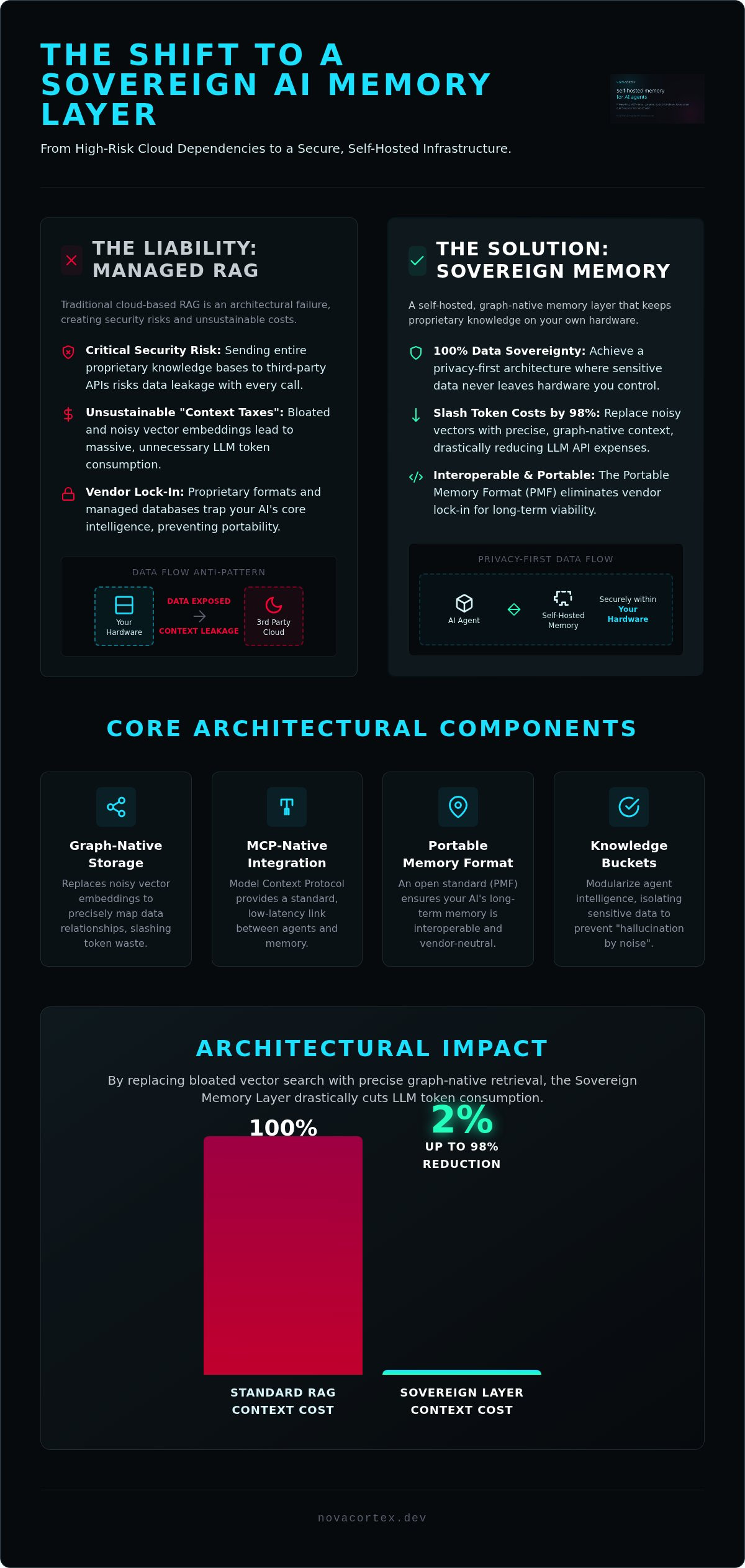
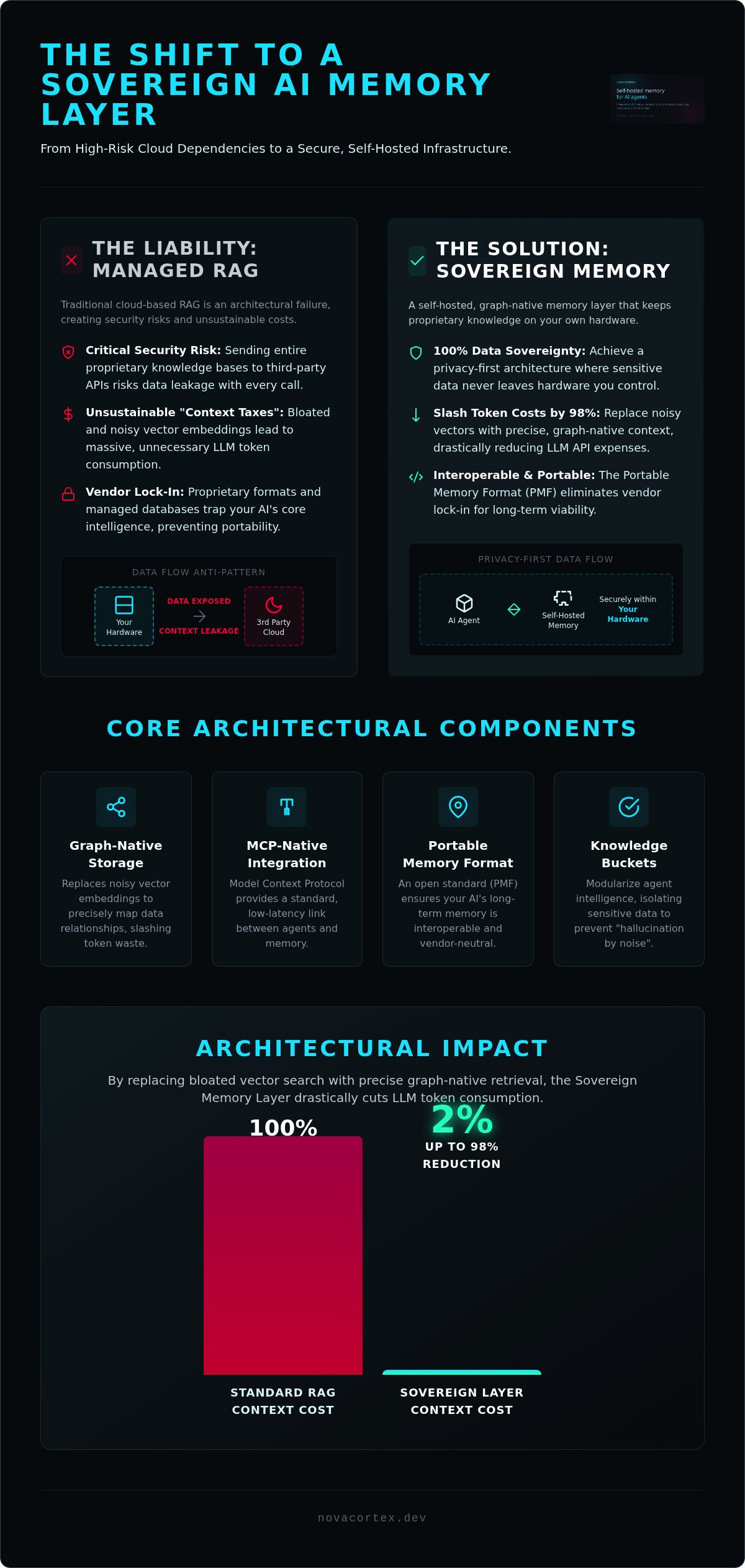
Privacy is usually sold as a sacrifice of speed or cost. In a privacy-first AI infrastructure, it's the opposite. Precision reduces waste. Standard RAG implementations rely on vector similarity, which is a blunt instrument. It retrieves "nearby" chunks based on semantic math, often flooding the LLM context window with irrelevant noise. This isn't just a data management issue; it's a financial drain. Every extra paragraph of "neighbor" data sent to an API is a charge you shouldn't be paying. By moving to a graph-native architecture, you stop paying for the noise and start paying only for the signal.
The Vector Bloat Problem
Traditional vector databases suffer from "semantic sprawl." When an agent asks for a specific fact, a vector search might return five chunks of text that are mathematically similar but contextually useless. This high-K retrieval forces the LLM to sift through garbage to find the signal. If you're comparing Redis vs graph memory for AI agents, the difference in token overhead is staggering. Vector-based systems are inherently noisy. They prioritize proximity over logic, leading to "context window pressure" that degrades reasoning quality and inflates monthly API bills. In production environments, this bloat doesn't just increase costs; it introduces latency that kills the agentic user experience. You don't need more context; you need better context.
Precision Retrieval Engineering
Graph-native storage operates on relationships, not just embeddings. It maps data as nodes and edges, creating a logical web of your proprietary information. When a query hits a graph-native layer, the system identifies a specific "knowledge path" through the data. It retrieves exactly what's needed-nothing more. This granular control is fundamental to achieving true AI sovereignty, as it allows engineers to dictate exactly how an agent traverses proprietary information without relying on a black-box vector provider. In 2026, graph-native memory has transformed token economics by shifting the focus from brute-force context stuffing to surgical data injection.
Benchmarks comparing NovaCortex to standard vector-based RAG show a consistent 98% reduction in token overhead for long-term context tasks. By storing the relationships between data points, NovaCortex Knowledge Buckets allow agents to navigate complex datasets without pulling in entire documents for every query. This precision retrieval keeps your most sensitive data out of the LLM's active context window unless it's absolutely essential. You're no longer dumping your knowledge base into the cloud; you're providing a precise map that the agent follows on your terms.
Portable Memory Formats: Ending AI Vendor Lock-in
Most engineers treat AI memory as a disposable cache. They dump data into a vendor's vector store and hope the pricing remains stable. This is a recipe for technical debt. If you can't export your agent's history and knowledge, you don't own it. The current AI ecosystem is built on "Memory Silos." These are proprietary vaults where your agent's context is held hostage by vector database providers. If you decide to switch from one managed service to another, you're often forced to re-index your entire knowledge base from scratch. This isn't just an inconvenience; it's a strategic failure. Your AI's memory should be as portable as your code. True privacy-first AI infrastructure demands a standard that allows for seamless migration. Without it, you aren't building a sovereign system; you're building a dependency.
The Portable Memory Format (PMF) provides the necessary blueprint for interoperable knowledge. It ensures that the relationships and entities your agents have mapped remain intact, regardless of the underlying hardware or LLM provider. This allows you to migrate between a local Raspberry Pi, a private VPS, or a specialized edge environment without losing a single byte of cognitive state. Data longevity is the goal. Your agent's accumulated wisdom must outlive the lifecycle of any specific model or vendor.
The PMF Specification
Structured AI memory storage is vastly superior to raw JSON or CSV exports. A raw export gives you data. PMF gives you context. It captures the graph-native relationships, specifically the edges and predicates, that define how your agent understands your business. By using a standardized format, you can maintain a single source of truth that is readable by any MCP-native memory server. This is the only way to effectively manage breaking the vendor lock-in cycle that currently plagues the industry. PMF includes metadata for versioning, access control, and knowledge bucket isolation. It ensures that your data remains structured and queryable, even as you scale from a single agent to a complex multi-agent swarm. It is a production-ready standard for the agentic era.
Future-Proofing Agent Cognition
Building infrastructure that supports LLM-agnostic memory is the ultimate hedge against market volatility. If an API provider changes their pricing or terms of service, a sovereign system allows you to point your agents at a new model while retaining their full history. Syncing this memory across local, VPS, and edge environments ensures that your agents remain performant wherever they are deployed. Open-source AI infrastructure plays a critical role here. It provides the transparent, community-vetted foundation needed to maintain digital sovereignty. You shouldn't need a permission slip from a trillion-dollar corporation to access your own agent's past. By adopting the Portable Memory Format (PMF) as the core of your privacy-first AI infrastructure, you ensure that your investment in AI memory is protected for the long term.
Deploying Privacy-First AI Infrastructure with NovaCortex
Transitioning from a managed vector database to a sovereign memory stack is the final step in securing your agentic workflows. It moves your data from a vendor's multi-tenant cloud to a dedicated environment you control. Setting up a privacy-first AI infrastructure with NovaCortex is a direct engineering process that prioritizes ownership over convenience. You'll need a private VPS, a Docker runtime, and a clear mapping of your data silos. The goal is to establish a local-first communication loop where the agent and the memory server reside within the same secure perimeter.
Deployment Logistics
The fastest way to deploy the NovaCortex Self-Hosted Edition is via Docker. This ensures environment parity across your development and production stages. Once the container is active, you'll initialize your first Knowledge Buckets. These buckets aren't just folders; they're isolated graph partitions that allow you to segment sensitive data by agent role or project scope. This modularity prevents cross-contamination of context and simplifies your security audits. For a deeper dive into the architecture, explore the self-hosted AI memory layer pillar. After deployment, configure your firewall to allow only authenticated Model Context Protocol (MCP) traffic, ensuring that your memory layer remains invisible to the public internet.
Optimization and Scale
Tuning the graph-native engine is essential for maintaining low-latency retrieval as your knowledge base grows. Unlike vector databases that slow down with high-dimensional indexing, graph-native systems scale by relationship density. You should monitor your retrieval paths to ensure the engine is identifying the most efficient "knowledge paths" for your queries. Tracking performance is straightforward. Compare the token count of your previous RAG implementation against the graph-retrieved context window. Most engineers see the benchmarked 98% reduction in token overhead within the first week of production use. This efficiency allows you to run more complex agents without ballooning your API costs.
Integrating NovaCortex with multi-agent frameworks like LangChain or AutoGPT requires minimal configuration thanks to its MCP-native design. Simply point your agent's memory server URL to your self-hosted instance. This setup supports high-velocity operations where multiple agents sync state in real-time through shared Knowledge Buckets. It creates a unified cognitive layer that is completely LLM-agnostic. You can swap your model provider in minutes without losing a single node of accumulated wisdom. This is the reality of privacy-first AI infrastructure: total control, zero lock-in, and maximum performance.
Reclaim Your Cognitive Sovereignty
Engineering a privacy-first AI infrastructure is no longer a theoretical exercise for the paranoid. It is a structural requirement for any team serious about long-term data sovereignty and operational efficiency. You've seen how managed vector DBs create noisy context windows and bloated API bills. By switching to a graph-native, self-hosted memory layer, you replace those inefficiencies with precision retrieval and an Apache-2.0 licensed foundation that you actually own.
The shift to MCP-native architecture and Portable Memory Formats (PMF) ensures your agents remain interoperable across any model provider. You've verified the 98% token reduction benchmark. You've understood the mechanics of Knowledge Buckets. It's time to stop renting your intelligence from vendors who treat your proprietary data as a telemetry stream. Build a stack that respects your intellectual property and your margins.
Frequently Asked Questions
What is privacy-first AI infrastructure?
Privacy-first AI infrastructure is a technical architecture where data storage and processing are decoupled from the LLM provider. It ensures that your proprietary knowledge and agent memory reside on hardware you control, such as a local server or a private VPS. By moving the memory layer out of the vendor's cloud, you eliminate the risk of telemetry leakage and reclaim full data sovereignty.
How does a self-hosted memory layer reduce token usage?
It slashes costs by replacing brute-force context stuffing with surgical retrieval. Traditional vector databases retrieve "neighbor" data that often contains irrelevant noise, forcing you to pay for tokens the LLM doesn't need. Graph-native engines identify specific knowledge paths and relationships, sending only the necessary signal to the model. This precision results in a verified 98% reduction in token overhead for long-term context tasks.
Is NovaCortex compatible with my existing LLM (OpenAI, Anthropic, Llama)?
Yes. Compatibility is a core feature of the MCP-native architecture. NovaCortex acts as a standardized memory server that any agent can query regardless of the underlying model. Whether you're calling a flagship API like Claude or running a local Llama instance, the memory interface remains constant. This ensures your privacy-first AI infrastructure remains model-agnostic and future-proof.
Can I run NovaCortex on a Raspberry Pi or local server?
Absolutely. The NovaCortex Self-Hosted Edition is designed for lean, high-velocity operations. A Raspberry Pi 5 provides sufficient compute for personal memory layers or small-team agent swarms. For enterprise-scale deployments requiring massive Knowledge Buckets, a standard private VPS with 8GB of RAM is the recommended baseline for production stability.
How does graph-native storage differ from a vector database?
Vector databases rely on mathematical similarity, which is often imprecise and leads to context bloat. Graph-native storage maps data as nodes and edges, capturing the logical relationships between entities. This allows agents to traverse a knowledge graph to find exact answers rather than sifting through semantically similar but contextually irrelevant text chunks.
What is the Portable Memory Format (PMF)?
PMF is an open-standard blueprint for interoperable AI knowledge. It defines how agent memory and relationships are structured so they can be moved between different infrastructure providers. This format prevents vendor lock-in, allowing you to migrate your agent's entire cognitive history without the need for expensive re-indexing or retraining.
Is NovaCortex truly open source?
The NovaCortex Self-Hosted Edition is licensed under the Apache-2.0 license. This ensures full transparency and prevents proprietary capture of your infrastructure. Developers are free to inspect, modify, and host the code on their own terms, supporting a principled philosophy of digital sovereignty and engineering independence.
How do I secure a self-hosted AI memory server?
Security is enforced through local-first protocols and authenticated MCP links. By hosting the server in a Docker container on a private VPS, you isolate the memory layer from the public web. All communication between your agents and Knowledge Buckets stays within your encrypted perimeter, ensuring that sensitive data is never exposed to LLM provider logs or external threats.
FAQ
What is privacy-first AI infrastructure?
Privacy-first AI infrastructure is a technical architecture where data storage and processing are decoupled from the LLM provider. It ensures that your proprietary knowledge and agent memory reside on hardware you control, such as a local server or a private VPS. By moving the memory layer out of the vendor's cloud, you eliminate the risk of telemetry leakage and reclaim full data sovereignty.
How does a self-hosted memory layer reduce token usage?
It slashes costs by replacing brute-force context stuffing with surgical retrieval. Traditional vector databases retrieve "neighbor" data that often contains irrelevant noise, forcing you to pay for tokens the LLM doesn't need. Graph-native engines identify specific knowledge paths and relationships, sending only the necessary signal to the model. This precision results in a verified 98% reduction in token overhead for long-term context tasks.
Is NovaCortex compatible with my existing LLM (OpenAI, Anthropic, Llama)?
Yes. Compatibility is a core feature of the MCP-native architecture. NovaCortex acts as a standardized memory server that any agent can query regardless of the underlying model. Whether you're calling a flagship API like Claude or running a local Llama instance, the memory interface remains constant. This ensures your privacy-first AI infrastructure remains model-agnostic and future-proof.
Can I run NovaCortex on a Raspberry Pi or local server?
Absolutely. The NovaCortex Self-Hosted Edition is designed for lean, high-velocity operations. A Raspberry Pi 5 provides sufficient compute for personal memory layers or small-team agent swarms. For enterprise-scale deployments requiring massive Knowledge Buckets, a standard private VPS with 8GB of RAM is the recommended baseline for production stability.
How does graph-native storage differ from a vector database?
Vector databases rely on mathematical similarity, which is often imprecise and leads to context bloat. Graph-native storage maps data as nodes and edges, capturing the logical relationships between entities. This allows agents to traverse a knowledge graph to find exact answers rather than sifting through semantically similar but contextually irrelevant text chunks.
What is the Portable Memory Format (PMF)?
PMF is an open-standard blueprint for interoperable AI knowledge. It defines how agent memory and relationships are structured so they can be moved between different infrastructure providers. This format prevents vendor lock-in, allowing you to migrate your agent's entire cognitive history without the need for expensive re-indexing or retraining.
Is NovaCortex truly open source?
The NovaCortex Self-Hosted Edition is licensed under the Apache-2.0 license. This ensures full transparency and prevents proprietary capture of your infrastructure. Developers are free to inspect, modify, and host the code on their own terms, supporting a principled philosophy of digital sovereignty and engineering independence.
How do I secure a self-hosted AI memory server?
Security is enforced through local-first protocols and authenticated MCP links. By hosting the server in a Docker container on a private VPS, you isolate the memory layer from the public web. All communication between your agents and Knowledge Buckets stays within your encrypted perimeter, ensuring that sensitive data is never exposed to LLM provider logs or external threats.