Private AI Memory Architecture: How AI Agents Remember

A larger context window doesn’t give an AI agent memory. A private AI memory architecture extracts durable facts from interactions and retrieves relevant knowledge when needed, rather than replaying entire conversations. The context window is the agent’s working space; memory carries useful information across turns and sessions.
It’s natural to expect a longer context window to help an agent remember more. But including more text in a prompt isn’t the same as preserving clear, consistent knowledge over time. The design challenge is deciding what to retain and how to retrieve it without burying the model in raw history.
This article explains the distinction, then explores three complementary approaches to agent memory: vector storage for semantic recall, graph storage for connected facts, and temporal storage for changes over time. It also shows where structured lookups and hybrid designs fit, and how these choices support reliable multi-turn recall while keeping memory under your control.
Key Takeaways
- Separate an agent’s temporary context window from persistent memory that carries useful information across turns and sessions.
- Understand how memory ingestion, storage, retrieval, and eviction shape what an agent can recall and what it leaves behind.
- Match storage to the task: vector search supports semantic recall, while graphs and temporal records help connect facts and track change.
- See why cold starts disrupt continuity and how deliberate memory design can support more consistent multi-turn interactions.
- Use a three-layer design to combine complementary memory functions instead of forcing every query through one storage method.
What Is AI Agent Memory?
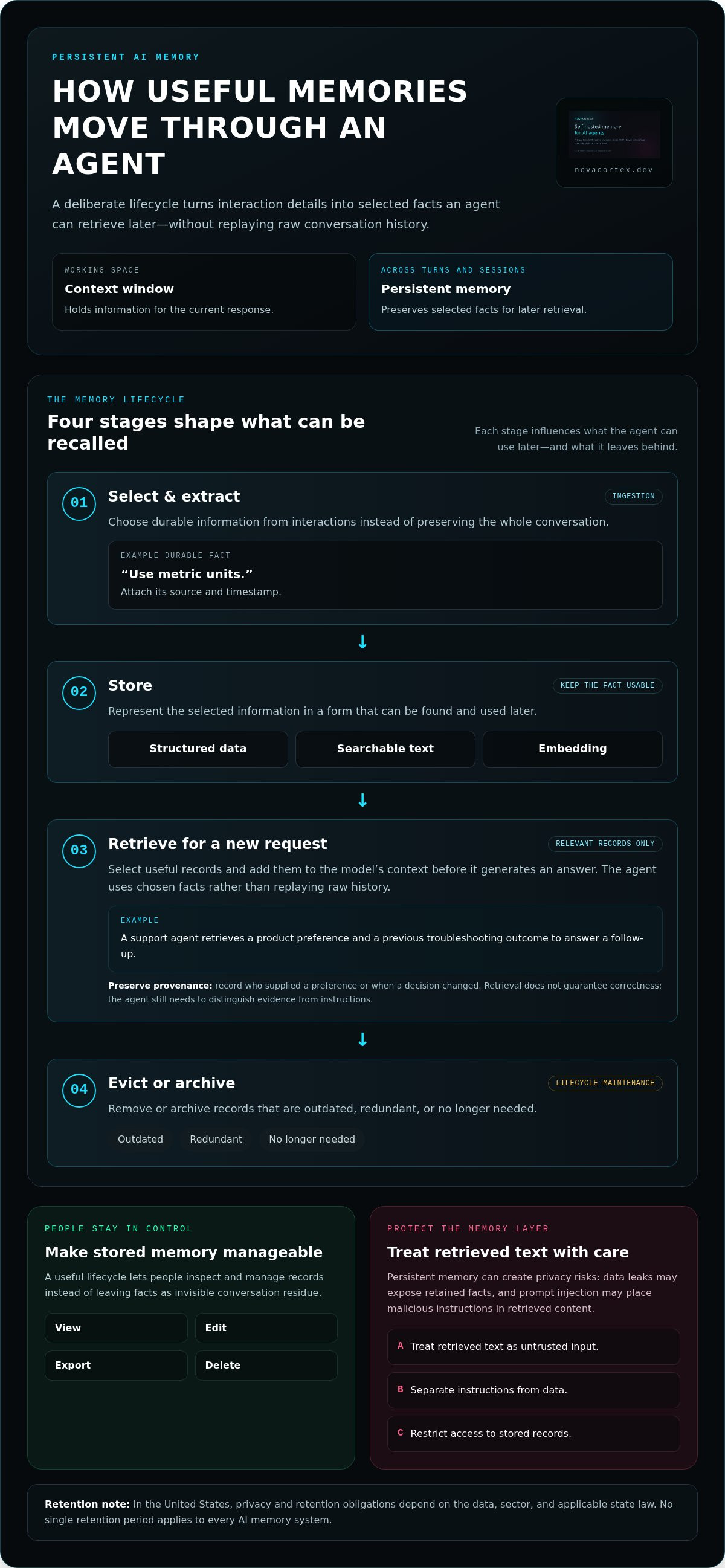
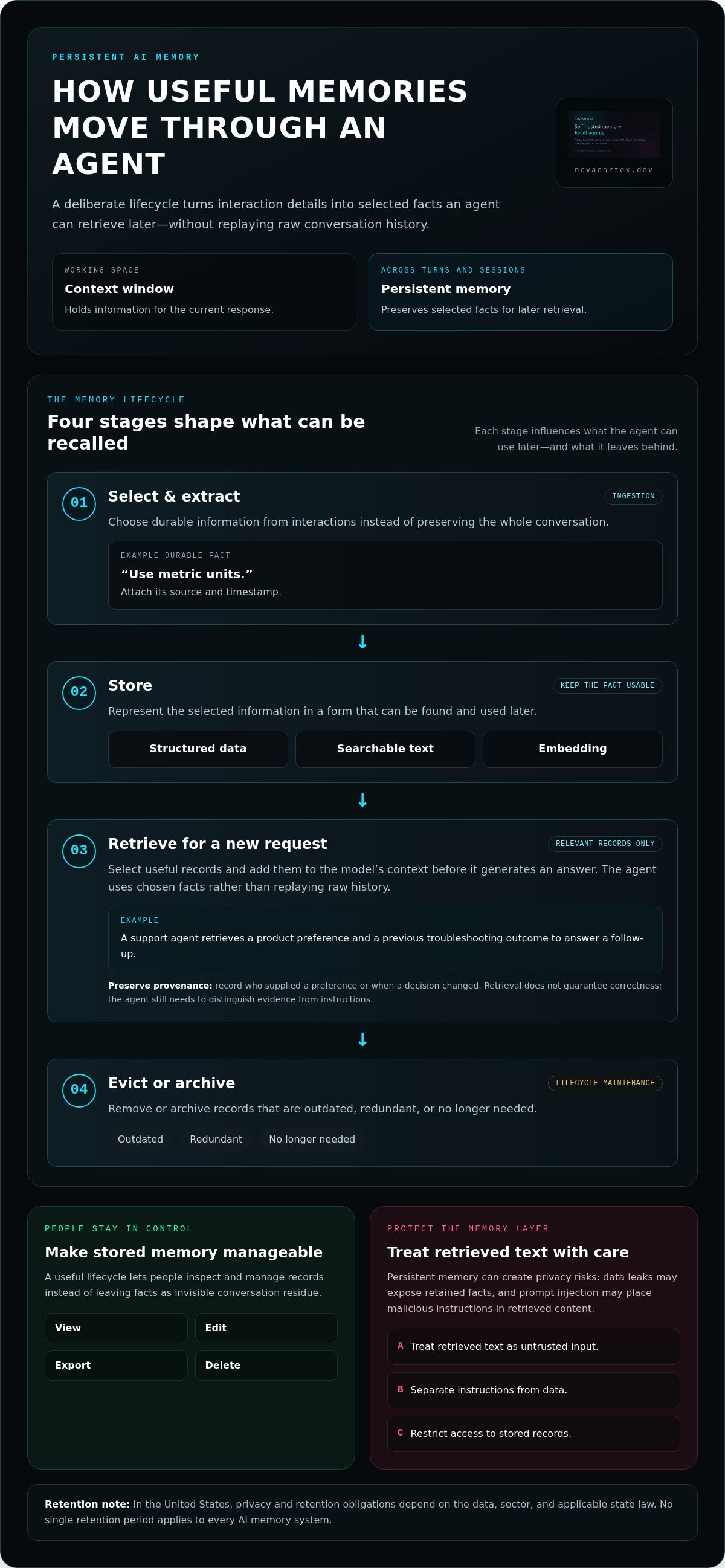
An agent’s context window holds information for its current response; memory preserves selected facts for later turns. For example, remembering a user’s preferred report format lets an agent apply it in a later session without adding the full conversation.
Memory ingestion and lifecycle
Memory ingestion involves selecting information from interactions, storing it, retrieving it, and eventually evicting it. Each stage shapes what an agent can use later.
During ingestion, a system can extract a durable fact, such as “use metric units,” and attach its source and timestamp. Storage might keep the fact as structured data, searchable text, or an embedding. Retrieval selects relevant records for a new request. Eviction removes or archives records that are outdated, redundant, or no longer needed. A useful lifecycle also lets people view, edit, export, and delete memories instead of leaving stored facts as invisible conversation residue.
Persistent memory creates privacy risks: a data leak can expose retained facts, while prompt injection can place malicious instructions in content later retrieved as context. Treat retrieved text as untrusted input, separate instructions from data, and restrict access to stored records. In the United States, privacy and retention obligations depend on the data, sector, and applicable state law; no single retention period applies to every AI memory system.
Memory retrieval with generation
Retrieval-augmented generation (RAG) retrieves relevant external records and adds them to a model’s context before it generates an answer. Agent memory can supply records across interactions, so the model uses selected facts rather than replaying raw history.
For example, a support agent could retrieve a product preference and a previous troubleshooting outcome, then use both to answer a follow-up. The memory layer must preserve useful context and its provenance, such as who supplied a preference or when a decision changed. Without those details, RAG can surface a plausible but obsolete fact. Retrieval doesn’t guarantee correctness; the generation step still needs to distinguish evidence from instructions.
Retrieval speed, accuracy, and consistency
Retrieval design balances response time with the relevance and freshness of returned records. Broad semantic search may find conceptually related passages, while filters or structured lookups can narrow results to a specific user, date, or identifier.
In one reported test, delayed vector-search results arrived 10-20 seconds after the AI began responding. A separate architecture change reduced tool-based recall from 5-10 seconds before the change, showing why retrieval placement matters. Strong consistency means a read reflects an acknowledged write; otherwise, one agent may act on a stale value while another has already updated it. Inconsistent shared state has been associated with 37% of multi-agent failures, making version checks and read-after-write behavior important design choices.
Local, self-hosted, and cloud architectures
A local architecture keeps memory on a user’s device, a self-hosted architecture runs it on infrastructure the organization controls, and a cloud architecture stores it on a provider’s infrastructure. Local storage offers direct device control but ties access to that device. Self-hosting centralizes organizational control, while cloud services shift infrastructure operation to the provider.
Encryption helps protect memory in transit and at rest, but access controls and key management matter too. Limit permissions by role, protect encryption keys separately from stored records, and log access so administrators can investigate unexpected reads. Users should be able to inspect, correct, export, and delete retained memories through defined controls. These operations make retention policies enforceable and let people remove inaccurate or unwanted records.
Cold starts and multi-turn performance
A cold start begins without the working state of an earlier session. The agent must reconstruct the task from its current prompt, connected tools, and any persistent memory. Without retained decisions, a returning user may need to explain the same project constraints again. That repetition uses context and compute before the agent reaches the new request.
The cost can show up in quality, not just speed. Microsoft Research and Salesforce Research measured an average 39% drop across six generation tasks during multi-turn interaction without proper memory management. The finding points to a design problem: as turns accumulate, the agent needs relevant prior state, not an ever-growing transcript.
A large context window doesn’t solve persistence by itself. Context windows can reach 100K tokens, but that capacity doesn’t carry information across sessions. If an agent must reprocess a long conversation after each restart, it spends compute on old material and risks overlooking the decision that matters now.
Multi-agent workflows amplify the burden. They consume approximately 15 times as many tokens as a chat interaction and four times as many as a single-agent workflow, which can rapidly inflate overall enterprise AI solutions cost. If each agent independently loads the same project history, duplicated context crowds out new evidence. Shared, versioned memory can let agents retain a common decision once.
Design continuity around task state. For a travel-planning agent, retain the destination, accessibility needs, and confirmed dates as separate records. On a later turn, retrieve only the records relevant to “find a quieter hotel.” Keep tentative suggestions distinct from confirmed choices, so a stale option doesn’t become a false constraint.
Also define what survives a session boundary. Retain durable preferences and active project decisions; let temporary reasoning and one-off details expire when they’re no longer useful. Add timestamps or version information to records that can change. When a user updates a preference, the next turn should use the new value rather than silently revive an older one.
Measure continuity with repeatable tests: restart the agent, ask a follow-up, and check whether it recalls the intended state. Track whether it retrieves the right decision, applies updates, and avoids loading unrelated history. Teams that need portable memory across compatible systems can use the Portable Memory Format (PMF) to keep stored knowledge distinct from any single conversation.
Vector stores and temporal knowledge graphs
Vector stores retrieve records by semantic similarity. An embedding represents text as numerical features, allowing a search for “preferred writing style” to find a record phrased as “use concise language.” This works well when the query and stored fact use different words. It doesn’t automatically preserve the relationships or timeline behind those facts.
Granularity matters. A 20-minute conversation may cover a deadline, a product choice, and a revised budget. Embedding the entire transcript as one vector can blend those subjects into a single result. Instead, split the conversation into meaningful records, then attach metadata such as topic, source, and timestamp. A search for the deadline can then retrieve the relevant passage without dragging in unrelated budget discussion.
Semantic similarity has limits. Vector search may return a passage that discusses a related idea but doesn’t answer the exact question. If an agent asks for a customer ID, matching the meaning of a passage isn’t enough. Use filters or structured fields alongside vector retrieval when the request requires an exact value. Effective retrieval means choosing the right signal, not treating every query as a similarity problem.
A temporal knowledge graph represents entities and their relationships with time attached. For example, a project node might connect to a decision node stating that a launch date was moved. The record can capture when that decision became valid and which earlier value it replaced. This structure supports questions such as “What was the deadline before the update?” and “Which decision is current?”
Temporal edges prevent a common memory failure: treating every stored statement as true at the same time. If a team first selects one supplier, then changes its choice, plain semantic search could surface either statement. A graph can link both choices to the same project, mark their sequence, and preserve the later update as current. The original decision remains available when the user asks about history.
Use vectors for fuzzy discovery and temporal graphs for connected facts that change. A query like “What did we decide about delivery?” can begin with vector search, then follow graph relationships to the project, decision, and effective time. If the answer depends on an earlier state, the graph supplies the sequence. If it depends on similar wording, embeddings help locate the relevant record. Together, they support more precise recall without flattening a changing record into one timeless answer.
Vector, graph, temporal, and hybrid storage
Storage should follow the shape of the question. A request for “the customer’s preferred format” suits vector search because wording may differ from the stored preference. A request for customer ID 4827 needs an exact structured lookup, not a similarity score. A request tracing how a decision changed needs relationships and time. Combining these methods prevents one index from carrying every retrieval burden.
Vector storage represents text as embeddings and ranks records by semantic similarity. If a project note says “keep the report concise,” a query about “short output” can still find it. But similarity doesn’t prove that a passage contains the requested value. Use vector search to discover relevant records, then validate sensitive fields against structured data before the agent responds.
Structured storage, such as SQL, suits precise lookups for IDs, timestamps, and counts. For example, a billing agent can query an account ID directly instead of retrieving a similar-sounding conversation. This matters in engineering workflows where a near match is still wrong. Store canonical values in fields, and use semantic retrieval for surrounding explanations that benefit from flexible language matching.
Graph storage models entities and their connections. A project graph might link a customer, a design decision, and the document that records it. That structure supports multi-hop questions such as “Which customer approved the design used in the latest release?” The retrieval path can follow customer-to-approval, approval-to-decision, and decision-to-release relationships, rather than relying on a single text passage to contain every connection.
Temporal storage records when a fact applied and how it changed. Suppose a project’s delivery date moves from one agreed date to another after a planning update. Keeping both values with their effective sequence lets an agent answer “What is the current date?” and “What date did we originally agree on?” A single overwritten field can’t answer both questions reliably.
A hybrid design routes each query to the store best suited to its intent. For “find the note about accessibility,” vector search can locate relevant text; for “count open issues,” a structured query returns an exact count; for “who approved the changed scope,” graph traversal connects people and decisions. A temporal filter can then select the applicable version. Combining retrieval paths adds coordination work, so return source records and their relationships together for answer generation.
Choose the storage mix based on actual query patterns, not fashionable database labels. A personal assistant may need semantic recall and a small set of structured preferences, while a project agent handling approvals, revisions, and ownership needs explicit relationships and time-aware records. For individuals and ventures evaluating unified AI business and life infrastructure, platforms such as venturis13lifeos.com illustrate how personal context and operational data can be organized effectively. Test each pattern with representative questions, including exact-value lookups and historical comparisons, before selecting the indexes that serve them.
Three-layer AI memory design
A three-layer design separates working state, durable knowledge, and linked records. That split gives each memory layer a clear role and retrieval path.
Layered memory roles
A three-layer AI memory design assigns different information to different stores. The separation matters because an active task, a lasting preference, and a changing project decision need different handling.
The working layer holds current task state, such as the open question and unsaved reasoning. The durable layer keeps reusable facts, such as a user’s preferred report format. The relational layer stores connected records, such as a project, its decisions, and their effective dates. A request can read from one layer or combine results when the answer needs several kinds of context.
To build a private system with open-source tools, define the data model first, then connect storage and retrieval components:
- Specify which facts belong in working state, durable memory, or linked records.
- Select open-source storage components that support those data shapes and run within your chosen environment.
- Implement ingestion rules that label each record with its source, owner, and relevant time.
- Route queries to the appropriate layer, then test results against representative tasks and updates.
For example, a project agent can keep the current task in working state, store team preferences as durable facts, and connect approvals to dated project decisions. That structure makes each record easier to update without rewriting unrelated memory.
Defining private AI memory
A private AI memory architecture is a system that stores and retrieves agent knowledge under the control of the person or organization operating it. It matters because the operator can define where records live, which processes can access them, and how they move between systems.
“Private” describes control boundaries, not one specific deployment pattern. A technical design should identify the infrastructure that holds records, the services allowed to read them, and the path used to export or remove them. For example, an organization can keep memory storage on infrastructure it controls while allowing an agent to retrieve approved records through a defined interface.
Portability also affects control. A documented memory format can separate stored knowledge from one model or application, while a clear schema makes records easier to inspect and migrate. Define access rules and deletion behavior alongside retrieval logic, not as later patches. Then test whether an agent can answer from authorized records without exposing unrelated user or project data.
NovaCortex: NovaCortex Self-Hosted Edition
NovaCortex Self-Hosted Edition provides a privacy-first memory layer for AI agents, storing knowledge on your own infrastructure. It suits teams that need persistent recall while keeping memory under their operational control.
Portable Memory Format (PMF) helps avoid vendor lock-in, while the MCP-Native Memory Server connects memory with agent workflows. Knowledge Buckets organize stored information, and graph-native storage supports retrieval across connected facts. Compared with dumping entire knowledge bases into prompts, the system reduces token usage by up to 98%.
Choose this approach when an agent needs reusable knowledge across sessions without loading a full knowledge base into every request. The self-hosted model also suits organizations that prioritize local data control. Contact NovaCortex to discuss whether it fits your memory architecture.
Design Memory You Can Govern
The next step is to turn architecture choices into an operating contract: define who owns each memory, which agent can read it, how updates are handled, and how records leave the system. Those decisions make a private AI memory architecture more than a retrieval component. They establish boundaries that keep an agent’s useful state controlled, portable, and maintainable as workflows change.
NovaCortex brings this approach together in a self-hosted memory layer through NovaCortex Self-Hosted Edition, Portable Memory Format (PMF), and MCP-Native Memory Server. Consider it when your agents need persistent knowledge without tying that knowledge to a single model or conversation. Start by mapping one workflow, its data boundaries, and the retrieval patterns it actually needs.
Build the memory system deliberately, and your agents can carry forward the right context while your organization retains control.
Frequently Asked Questions
Is a Context Window the Same as Memory?
No. A context window holds information available while generating a response; memory deliberately retains selected information for later use. For example, an agent can use a draft and its corrections during the current chat, then retain an approved writing preference for a future session. Treating the window as memory loses continuity after it resets. Treating every prompt as permanent memory can preserve unnecessary material.
What Is an AI Memory System?
An AI memory system selects, organizes, and supplies stored information to an AI model. A useful record can include a value, its source, an owner or scope, and an update status. For a team assistant, separate personal preferences from shared project decisions, so one user’s formatting choice doesn’t become a rule for every teammate. Define access and deletion controls alongside record creation.
How does AI memory store, retrieve, and update user information?
An AI memory pipeline captures a useful fact, assigns it a stable key and scope, stores it, then retrieves it for a relevant task. If someone changes “weekly report” to “monthly report,” update the existing preference rather than adding a conflicting duplicate. Resolve conflicts using source authority and recency, then confirm later reads return the new value. Preserve source details or change history when users need an audit trail.
What data should an AI assistant remember, and what should it avoid storing?
Store information with a clear future purpose, such as preferred units, active project constraints, or a chosen writing format. Avoid retaining passwords, authentication tokens, payment credentials, or sensitive details mentioned incidentally. Don’t turn a model’s guess into a user fact. One request for vegetarian recipes doesn’t establish a lasting dietary preference; wait for an explicit signal before saving it as durable memory.
How do vector databases, knowledge graphs, and conventional databases compare for AI memory?
Vector databases find text by semantic similarity, knowledge graphs represent entities and relationships, and conventional databases return exact structured values. For a travel assistant, vectors can find notes about quiet hotels, a graph can connect a traveler to approved locations, and a relational table can return an exact booking reference. A hybrid system routes each query to the store that matches its precision needs, then reconciles results before answering.
FAQ
Is a Context Window the Same as Memory?
No. A context window holds information available while generating a response; memory deliberately retains selected information for later use. For example, an agent can use a draft and its corrections during the current chat, then retain an approved writing preference for a future session. Treating the window as memory loses continuity after it resets. Treating every prompt as permanent memory can preserve unnecessary material.
What Is an AI Memory System?
An AI memory system selects, organizes, and supplies stored information to an AI model. A useful record can include a value, its source, an owner or scope, and an update status. For a team assistant, separate personal preferences from shared project decisions, so one user’s formatting choice doesn’t become a rule for every teammate. Define access and deletion controls alongside record creation.
How does AI memory store, retrieve, and update user information?
An AI memory pipeline captures a useful fact, assigns it a stable key and scope, stores it, then retrieves it for a relevant task. If someone changes “weekly report” to “monthly report,” update the existing preference rather than adding a conflicting duplicate. Resolve conflicts using source authority and recency, then confirm later reads return the new value. Preserve source details or change history when users need an audit trail.
What data should an AI assistant remember, and what should it avoid storing?
Store information with a clear future purpose, such as preferred units, active project constraints, or a chosen writing format. Avoid retaining passwords, authentication tokens, payment credentials, or sensitive details mentioned incidentally. Don’t turn a model’s guess into a user fact. One request for vegetarian recipes doesn’t establish a lasting dietary preference; wait for an explicit signal before saving it as durable memory.
How do vector databases, knowledge graphs, and conventional databases compare for AI memory?
Vector databases find text by semantic similarity, knowledge graphs represent entities and relationships, and conventional databases return exact structured values. For a travel assistant, vectors can find notes about quiet hotels, a graph can connect a traveler to approved locations, and a relational table can return an exact booking reference. A hybrid system routes each query to the store that matches its precision needs, then reconciles results before answering.