Reducing AI Agent Token Usage: A Practical 2026 Guide

Your agent’s biggest token leak may not be its prompt. It may be the same oversized context being sent again and again. To reduce AI agent token usage without weakening answers, start by changing what the model receives, not by stripping out information it needs.
Repeated prompts, verbose tool outputs, and unmanaged conversation history all add up across agent runs. Cutting context blindly can lower token counts while increasing missed details and unreliable responses. The goal is leaner context with the right knowledge available when a task calls for it.
This guide shows you how to find avoidable token use, trim repeated or irrelevant content, and use retrieval-based memory to provide task-relevant information instead of dumping entire knowledge bases into a prompt. You’ll also learn how to compare token use and answer quality before and after each change by testing consistent tasks and measurements. No guesswork, just practical optimizations you can check against your agent’s real workload.
Key Takeaways
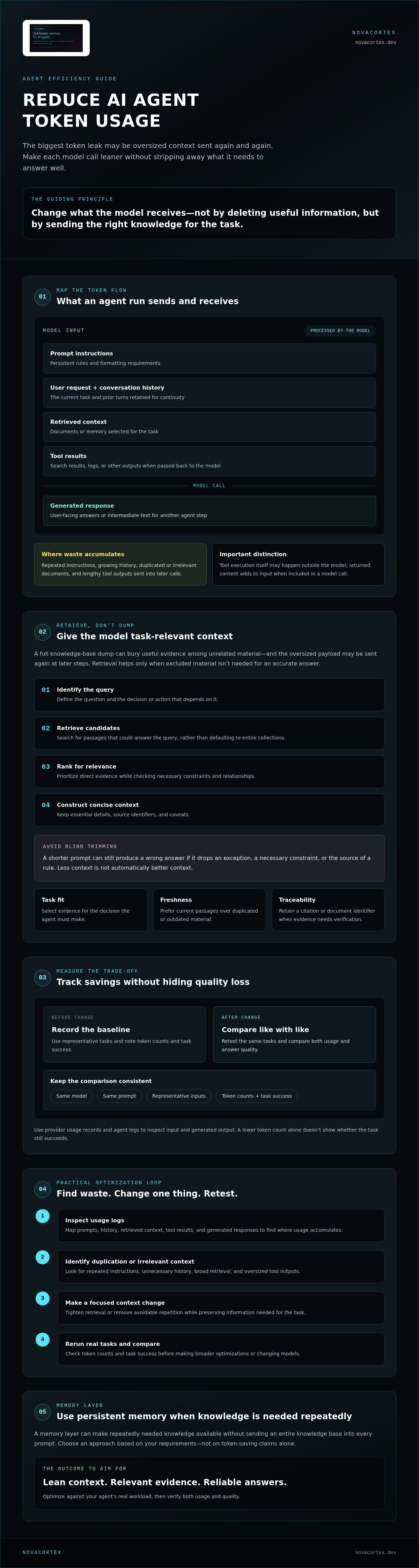
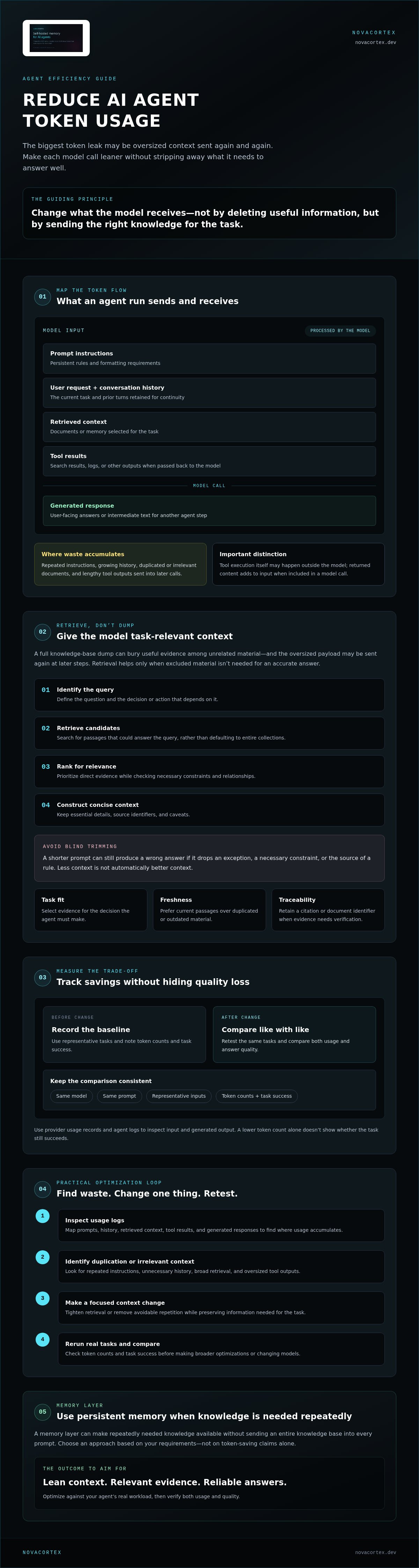
- Map tokens across prompts, conversation history, retrieved context, tool results, and generated responses to find where agent runs accumulate avoidable usage.
- To reduce AI agent token usage, retrieve and rank task-relevant knowledge instead of forwarding an entire knowledge base.
- Compare token counts and task success using the same model, prompt, and representative inputs before and after each change.
- Use usage logs to identify duplication, tighten retrieval, and retest real tasks before changing models or making broader optimizations.
- Add a persistent memory layer when knowledge is repeatedly needed. Choose an approach based on your requirements, not token-saving claims alone.
Where AI Agent Token Usage Goes Before the Model Answers
An agent’s token usage includes the text a model processes as input and the tokens it generates as output during a task. The model may be a large language model (LLM), but an agent run usually involves more than one prompt and response. Instructions, conversation history, retrieved passages, and tool results can all become part of what the model sees.
Context overhead is input carried into a model call beyond what the current task needs, although some context is essential for a correct answer. That distinction matters: reducing AI agent token usage doesn’t mean deleting useful information. It means identifying repeated or irrelevant content while preserving what the model needs to do the job.
Which parts of an agent run consume tokens?
Provider usage records commonly separate input tokens from generated output tokens. Inspect both. Input can include system instructions, the user’s request, accumulated conversation history, retrieved documents, and tool results included in the next model call. Output covers the model’s generated response, which may be a user-facing answer or content used by another agent step.
Repeated material adds up across calls. If an agent sends the same long system instructions and growing conversation history each time, that input is processed again throughout the run. Tool execution itself may happen outside the model, but any returned content passed into a model call contributes to its input. A search query can be small; a lengthy result page pasted into the next prompt is not.
- Prompt instructions: Persistent rules and formatting requirements.
- Conversation history: Prior turns retained for continuity.
- Retrieved context: Documents or memory selected for the task.
- Tool results: Outputs such as search results or logs, when sent back to the model.
- Generated responses: Answers and intermediate text produced by the model.
Why dumping a knowledge base is inefficient
Forwarding an entire knowledge base can bury the useful passage among unrelated material. Irrelevant documents still occupy context, and the same oversized payload may be included again at later steps. That means more input to process without a guarantee of better answers.
For example, an agent answering a question about one deployment setting may not need every project note, troubleshooting log, and policy document. Instead, make relevant knowledge available for retrieval and pass only the useful subset into the model’s context. For a broader look at persistent agent memory and this design choice, see the self-hosted AI memory layer article.
Reduce AI Agent Token Usage by Retrieving Only Relevant Context
Retrieval replaces a full knowledge-base dump with a smaller set of information selected for the current task. Done well, it gives the model enough evidence to make a decision without loading every potentially related document. Retrieval reduces input only when the excluded material isn’t needed to answer accurately. A shorter context is not automatically a better one.
Use a deliberate retrieval pipeline:
- Identify the query: Define the question the agent must resolve and the decision or action that depends on it.
- Retrieve candidates: Search for passages that could answer the query rather than entire collections by default.
- Rank relevance: Prioritize evidence that directly supports the task, while checking for necessary constraints and relationships.
- Construct context: Assemble concise input that retains necessary details, source identifiers, and caveats.
For example, an agent checking whether a configuration meets a policy may need the relevant rule, the current configuration, and the source of that rule. A snippet containing the rule’s main sentence but omitting an exception or its source can be shorter and still lead to a wrong answer. Don’t truncate context until you know which details are essential to the decision.
Choose context by task, relevance, and freshness
Retrieval quality depends on the task, not just a similarity score. Prefer concise, current source passages over broad collections containing duplicated or outdated material. If the agent must verify a claim, retain a citation, document identifier, or other provenance marker so it can distinguish evidence from an unsupported summary. Relevant material without freshness or traceability can still produce an unreliable answer.
Use structured memory instead of repeated knowledge dumps
Persistent memory can keep reusable knowledge available outside each request. The system can retrieve it when a task needs it instead of attaching it to every prompt. Graph-native storage can help when a useful answer depends on connections among facts, such as a component, its configuration, and a related constraint. Storage choices involve trade-offs; explore this Redis versus graph memory comparison for a focused discussion.
Token efficiency is an engineering trade-off, not a context-trimming contest. The ACL Anthology paper Token-Efficient Multi-Fidelity Optimization offers a research perspective on token-efficient optimization. For a practical implementation to inspect, review the open-source NovaCortex memory-layer project. Test retrieval results and answer quality against your own agent tasks.
Measure Token Savings Without Hiding Quality Regressions
A lower token count is useful only if the agent still completes the task correctly. To find out whether a change helps, compare the original workflow with the optimized one under controlled conditions. Keep the task set, model, system prompt, and representative inputs consistent. Record any differences. Otherwise, a token reduction may reflect a different workload rather than a better design.
Build a fair before-and-after token test
Run the same representative tasks through both versions. Use provider-reported usage records where available, and track input and output separately. Also record the size of the retrieved payload and whether each task succeeded. If you report a percentage reduction, state the baseline and calculation: (baseline tokens minus optimized tokens) divided by baseline tokens. Without the denominator, the percentage is hard to interpret or reproduce.
Compact comparison template
Baseline: Original workflow, input tokens, output tokens, retrieval payload, task result.
Change: What was modified, such as retrieval scope or duplicated context.
Token delta: Baseline total compared with optimized total, with the calculation stated.
Quality result: Accuracy, task completion, and any missing context or new failure.
Keep these measures distinct. Retrieval payload describes what your system selected; provider usage records describe what the model processed. A smaller retrieval result doesn’t prove token savings unless the reduction appears in the model’s recorded input.
Check quality, latency, and failure modes
Review answers against the same success criteria in both runs. Did the agent get the facts right, complete the requested action, and use the required context? Inspect failures closely: retrieval may miss a key constraint, surface stale material, or return unrelated passages that still consume input. Note latency and retries too, since a token reduction that triggers extra calls may not improve the overall workflow.
NovaCortex reports reductions of up to 98% compared with sending entire knowledge bases to a model. Treat this as a scenario-dependent figure, not a general expectation. Before relying on it or comparing it with another result, verify the benchmark setup, workload, baseline, and calculation. Apply the same discipline to any claim about how much an optimization can reduce AI agent token usage.
A Practical Workflow to Cut Waste Across Agent Runs
You don’t need to switch models first. Start with the agent you already run, inspect what it sends at each step, and change one source of excess context at a time. This makes it easier to identify which change helps and catch quality regressions before they reach production.
- Capture usage logs. Record input and output tokens for real runs, along with the prompt, retrieved material, tool results, and task outcome. Look for payloads that repeat across calls.
- Remove duplication. Consolidate overlapping system instructions and avoid resending information already available in the active context. Summarize conversation history only when the summary preserves the facts and constraints the next step needs.
- Constrain retrieval. Retrieve passages for the current task instead of attaching a broad corpus. Check that relevant constraints, relationships, and source details survive selection.
- Set task-specific limits. Define how much context each task should receive, then test edge cases where a short or unusual request depends on less obvious information.
- Retest representative tasks. Compare token records and task results with the baseline. Keep changes that reduce avoidable usage without degrading accuracy or completion.
These steps separate quick prompt cleanup from architectural changes. Removing a repeated instruction is a small edit. Moving reusable knowledge out of prompts and retrieving it on demand changes how the agent manages context across runs. Start with the simple fixes. Consider persistent memory when the same knowledge is repeatedly pasted into requests or shared across tasks.
Add retrieval and persistent memory selectively
Keep stable, reusable facts outside repeated prompts and fetch them when a task needs them. Don’t add a memory layer just to reduce AI agent token usage if a concise prompt already handles the workflow. For agents that need persistent context through the Model Context Protocol, see the MCP-native memory server guide for protocol-level context.
Make each optimization measurable. Change one part of the workflow, rerun the same representative tasks, and compare token use and outcomes before moving to the next change.
When a Memory Layer Helps Reduce AI Agent Token Usage
A memory layer is useful when agents repeatedly need the same knowledge but only a small portion applies to any single task. Instead of attaching that knowledge to every request, the system can store it outside the prompt and retrieve relevant information as needed. This can help reduce AI agent token usage, but it isn’t automatically the right fix for every workflow.
Choose memory when context repeats across tasks
Look for repeated payloads in your agent logs. Do several workflows keep receiving the same product facts, project conventions, or operating constraints? Do different tasks need different slices of a larger knowledge base? Those are signs that selective retrieval may be worth testing. If the context is small, stable, and used only once, a concise prompt is often simpler than adding infrastructure.
Memory also adds design work. Consider how knowledge is stored, retrieved, kept current, and made available to the agent. The benefit comes from retrieving useful context reliably, not from moving data out of the prompt by itself.
Evaluate NovaCortex against your workload
NovaCortex is an open-source, Apache-2.0, self-hosted memory-layer option, not a universal requirement. Its offering includes graph-native storage, an MCP-native memory server, and Portable Memory Format (PMF), designed to avoid vendor lock-in. Graph-native retrieval is intended for knowledge where relationships among facts matter. Assess MCP and PMF against your existing architecture, and check current project documentation for capabilities and deployment requirements before adopting them.
Start with a representative set of agent runs. Compare the current workflow with a retrieval-based version, and check:
- Relevance: Does retrieval return the facts and constraints the task needs?
- Token usage: Do provider-reported input and output counts change?
- Task quality: Does the agent still answer accurately and complete the task?
- Fit: Can you use the storage, deployment, and protocol approach in your environment?
Use your baseline as the reference point. Don’t treat a smaller prompt or a broad token-saving claim as proof of improvement unless your own workload shows lower usage without a drop in answer quality. A memory layer should solve a recurring context problem, not create one.
Build a Leaner Agent Workflow
To reduce AI agent token usage, start by identifying what each model call receives, then trim duplication and retrieve only the context the task needs. Keep essential constraints and source details intact. Measure input and output tokens alongside task success so lower usage doesn’t conceal weaker answers.
A persistent memory layer may help when agents repeatedly need different pieces of a larger knowledge base. NovaCortex is an open-source project under Apache-2.0, designed for self-hosted deployment on infrastructure such as a server, VPS, or Raspberry Pi. Its reported reduction of up to 98% compares with dumping entire knowledge bases, but the result depends on the scenario. Verify the benchmark conditions and test the approach against your own baseline before drawing conclusions.
Start small: inspect real runs, make one change, and check both token records and answer quality. Each measured improvement gives you a sound basis for the next architectural decision.
Keep the useful context. Cut the repeated payload. Your agent can get leaner without losing what makes it accurate.
Frequently Asked Questions
How can I reduce AI agent token usage without lowering answer quality?
Reduce repeated or irrelevant context, then check that the agent still performs well on the same tasks. Inspect prompts, conversation history, retrieved passages, and tool results to find content sent repeatedly or not needed for the current decision. Make one change at a time, compare provider-reported token counts, and evaluate accuracy and task completion. Keep essential constraints, relationships, and source details instead of trimming context blindly.
What causes AI agents to use so many tokens?
Agent token use often accumulates across multiple model calls. Input may include system instructions, conversation history, retrieved documents, and tool results passed back to the model. Generated answers and intermediate outputs add output tokens. Repeated instructions or oversized context can be processed again at later steps, so inspect usage across the full run, not just the first prompt or final answer.
Does summarizing conversation history reduce token usage?
It can, if the summary replaces a longer history and preserves the information needed for the next step. Keep active goals, decisions, constraints, unresolved questions, and relevant source details. A summary that drops an exception or changes a fact may save input tokens but cause errors. Compare the summarized workflow with the original on representative tasks, tracking both token use and answer quality.
Can retrieval-augmented generation reduce token consumption?
Yes. Retrieval-augmented generation can provide a model with selected passages instead of an entire knowledge base. Savings depend on what the system retrieves and sends in each model call. Irrelevant or duplicated passages still add input, and retrieval that omits a key constraint can hurt answer quality. Measure the model’s actual input tokens and evaluate retrieval relevance alongside task success.
How do I calculate token savings for an AI agent?
Run the same representative tasks through the baseline and optimized workflows, keeping the model, prompt, and inputs consistent. Calculate the reduction as (baseline tokens minus optimized tokens) divided by baseline tokens, then multiply by 100 for a percentage. State what the baseline includes and whether you counted input, output, or both. Report task quality separately so a lower token count doesn’t hide failed or weaker answers.
Does a larger context window mean an agent uses more tokens?
No. A larger context window increases how much information a model can accept, but it doesn’t automatically mean the agent sends more. Actual usage depends on the input and output generated during each call. However, a larger available window can make it easier to pass unnecessarily broad context. Track provider-reported tokens and send only the context the task requires, even when the model can handle more.
Can AI agent memory reduce repeated context tokens?
Yes, persistent memory can keep reusable knowledge outside repeated prompts and retrieve relevant information when a task needs it. This may help when multiple agent tasks reuse different parts of a larger knowledge base. For a small, stable prompt used once, a separate memory layer may add unnecessary complexity. Test retrieval relevance, token counts, and task quality against your existing workflow before adopting one.
Can NovaCortex reduce AI agent token usage by up to 98%?
NovaCortex reports reductions of up to 98% compared with dumping entire knowledge bases into a model. Treat this as a scenario-dependent claim, not a guaranteed result for every agent or workload. The outcome depends on the baseline and the context the workflow would otherwise send. Before relying on or comparing the figure, verify its benchmark conditions and test the approach against your own tasks.
FAQ
Which parts of an agent run consume tokens?
Provider usage records commonly separate input tokens from generated output tokens. Inspect both. Input can include system instructions, the user’s request, accumulated conversation history, retrieved documents, and tool results included in the next model call. Output covers the model’s generated response, which may be a user-facing answer or content used by another agent step. Repeated material adds up across calls. If an agent sends the same long system instructions and growing conversation history each time, that input is processed again throughout the run. Tool execution itself may happen outside the model, but any returned content passed into a model call contributes to its input. A search query can be small; a lengthy result page pasted into the next prompt is not.
How can I reduce AI agent token usage without lowering answer quality?
Reduce repeated or irrelevant context, then check that the agent still performs well on the same tasks. Inspect prompts, conversation history, retrieved passages, and tool results to find content sent repeatedly or not needed for the current decision. Make one change at a time, compare provider-reported token counts, and evaluate accuracy and task completion. Keep essential constraints, relationships, and source details instead of trimming context blindly.
What causes AI agents to use so many tokens?
Agent token use often accumulates across multiple model calls. Input may include system instructions, conversation history, retrieved documents, and tool results passed back to the model. Generated answers and intermediate outputs add output tokens. Repeated instructions or oversized context can be processed again at later steps, so inspect usage across the full run, not just the first prompt or final answer.
Does summarizing conversation history reduce token usage?
It can, if the summary replaces a longer history and preserves the information needed for the next step. Keep active goals, decisions, constraints, unresolved questions, and relevant source details. A summary that drops an exception or changes a fact may save input tokens but cause errors. Compare the summarized workflow with the original on representative tasks, tracking both token use and answer quality.
Can retrieval-augmented generation reduce token consumption?
Yes. Retrieval-augmented generation can provide a model with selected passages instead of an entire knowledge base. Savings depend on what the system retrieves and sends in each model call. Irrelevant or duplicated passages still add input, and retrieval that omits a key constraint can hurt answer quality. Measure the model’s actual input tokens and evaluate retrieval relevance alongside task success.
How do I calculate token savings for an AI agent?
Run the same representative tasks through the baseline and optimized workflows, keeping the model, prompt, and inputs consistent. Calculate the reduction as (baseline tokens minus optimized tokens) divided by baseline tokens, then multiply by 100 for a percentage. State what the baseline includes and whether you counted input, output, or both. Report task quality separately so a lower token count doesn’t hide failed or weaker answers.
Does a larger context window mean an agent uses more tokens?
No. A larger context window increases how much information a model can accept, but it doesn’t automatically mean the agent sends more. Actual usage depends on the input and output generated during each call. However, a larger available window can make it easier to pass unnecessarily broad context. Track provider-reported tokens and send only the context the task requires, even when the model can handle more.
Can AI agent memory reduce repeated context tokens?
Yes, persistent memory can keep reusable knowledge outside repeated prompts and retrieve relevant information when a task needs it. This may help when multiple agent tasks reuse different parts of a larger knowledge base. For a small, stable prompt used once, a separate memory layer may add unnecessary complexity. Test retrieval relevance, token counts, and task quality against your existing workflow before adopting one.
Can NovaCortex reduce AI agent token usage by up to 98%?
NovaCortex reports reductions of up to 98% compared with dumping entire knowledge bases into a model. Treat this as a scenario-dependent claim, not a guaranteed result for every agent or workload. The outcome depends on the baseline and the context the workflow would otherwise send. Before relying on or comparing the figure, verify its benchmark conditions and test the approach against your own tasks.