Secure AI Agent Storage: Engineering Data Sovereignty for Agentic Systems

Handing your agent’s long-term memory to a cloud-hosted vector store is an architectural surrender. With the EU AI Act entering full enforcement this August 2026, data residency is no longer a suggestion; it's a hard engineering requirement. Most developers currently struggle with high-latency context retrieval and the massive token waste caused by dumping entire knowledge bases into a prompt. If you are building for production, you don't need another third-party API. You need secure AI agent storage built on the principle of architectural sovereignty.
You likely recognize that vendor lock-in and "black box" memory are the primary bottlenecks to scaling agentic systems. This article provides a blueprint for engineering local-first, graph-native memory layers that restore control. You'll discover why architectural sovereignty is the only way to secure AI agent memory without sacrificing performance or privacy. We will examine the shift toward stateless architectures using the latest MCP specifications and provide a roadmap for reducing LLM API costs while maintaining full ownership of your agent's long-term knowledge.
Key Takeaways
- Learn why self-hosting is the only viable path to secure AI agent storage that satisfies strict regulatory compliance while eliminating "man-in-the-middle" security risks.
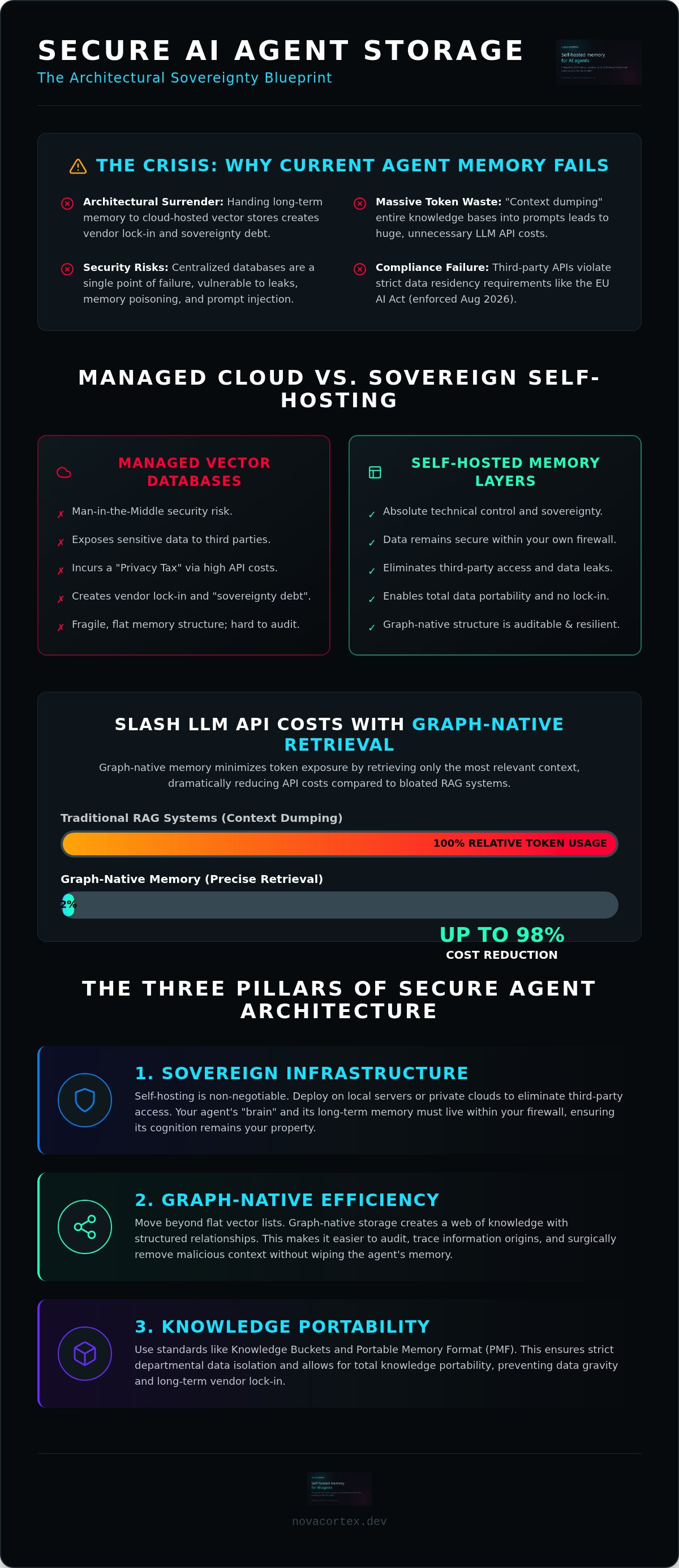
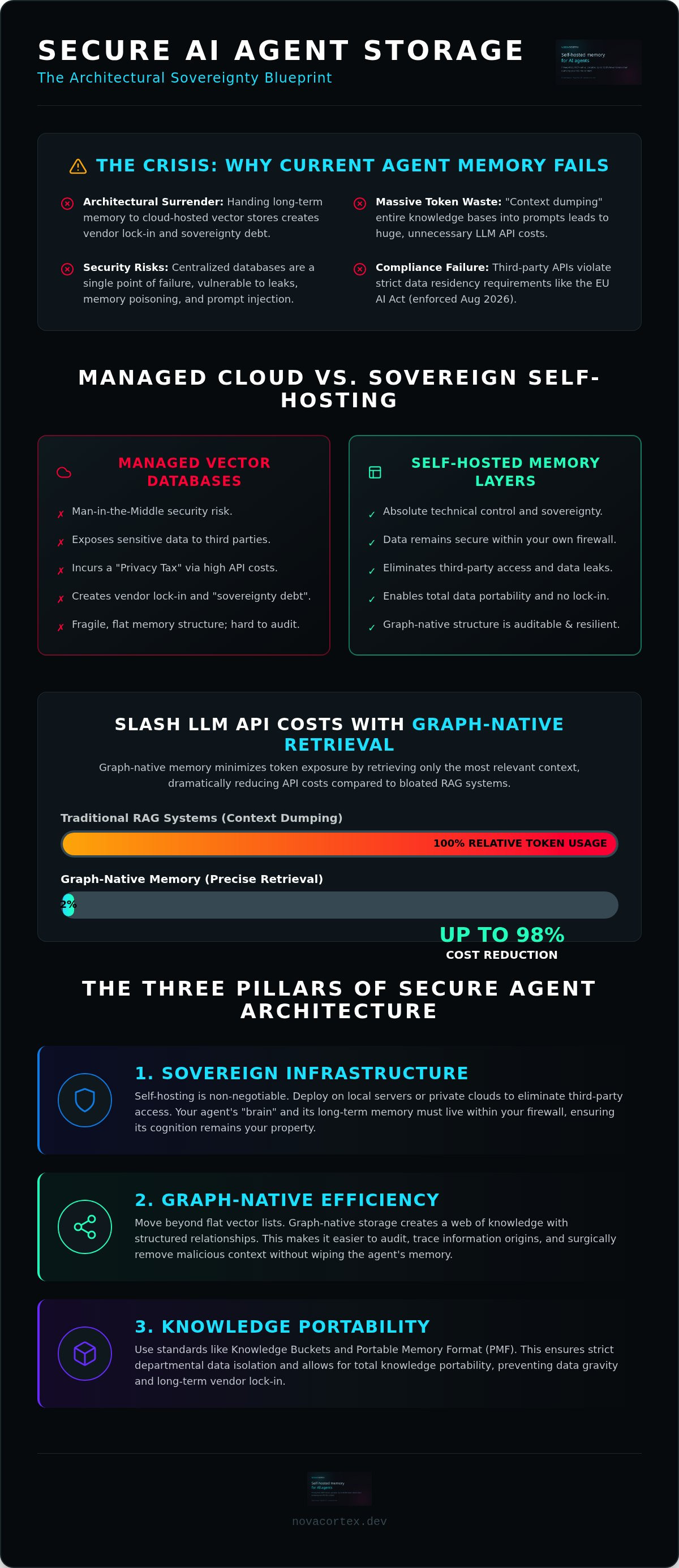
- Discover how graph-native retrieval minimizes token exposure and slashes LLM API costs by up to 98% compared to bloated, traditional RAG systems.
- Understand the role of the Model Context Protocol (MCP) in building a stateless, scalable memory layer that remains under your absolute technical control.
- Identify the "Privacy Tax" associated with managed cloud vector databases and how to reclaim sovereignty through local-first infrastructure.
- Master the implementation of Knowledge Buckets and Portable Memory Format (PMF) to ensure departmental data isolation and total knowledge portability.
The Security Crisis of Agentic Memory: Why RAG Isn't Enough
Agents aren't static applications. They are autonomous actors. This autonomy requires a massive influx of data, which simultaneously expands the attack surface. Traditional Retrieval-Augmented Generation (RAG) is insufficient for enterprise-grade security. It treats memory as a transient retrieval pipe. True secure AI agent storage is an architectural discipline. It goes beyond AES-256 encryption. It focuses on where data lives, how it is isolated, and who controls the retrieval logic.
The paradox of autonomy is clear. Agents need more data than traditional apps to make high-stakes decisions. They require access to emails, internal databases, and private documentation. Yet, every new data point increases the risk of a leak. You cannot simply limit the data; the agent becomes useless. You must change how the storage is engineered. Most current RAG pipelines suffer from "context dumping." They shove unsanitized knowledge into prompts to ensure the LLM has enough information. This is a security failure. It leaks sensitive metadata and internal business logic to third-party LLM providers. Centralized vector databases exacerbate this risk. They create a single point of failure for your entire agentic ecosystem. If the cloud provider is compromised, your agent's memory becomes an open book for attackers.
The Hidden Cost of Data Gravity
Storing agent memory in managed cloud stores builds "sovereignty debt." Data gravity ensures that once your knowledge base reaches a certain scale, it is too expensive or complex to move. This compromises Data sovereignty. You lose the legal right to control where your data resides and who can access it. In multi-tenant environments, metadata exfiltration is a silent threat. Your agent’s memory is its most valuable asset. It belongs on your hardware, not in a third-party API. Sovereignty is not a feature; it is a requirement for survival in a regulated market.
Prompt Injection and Memory Poisoning
Flat memory structures are inherently fragile. A single malicious prompt can poison an agent's long-term knowledge base. If the memory layer does not support strict isolation, that poison spreads across every future interaction. Graph-native storage solves this problem through structured relationships. It creates a web of knowledge that is significantly easier to audit than a flat list of vectors. You can trace exactly where a piece of information originated. This allows for surgical removal of malicious context without wiping the agent's entire history. Auditability is the only cure for memory poisoning in autonomous systems. Without it, your secure AI agent storage remains a vulnerability waiting to be exploited.
The Three Pillars of Secure AI Agent Storage Architectures
Engineering for agentic systems requires a departure from traditional SaaS-first thinking. Architectural sovereignty is the foundation. Most developers focus on sandboxing the agent's execution environment, yet they leave the memory layer exposed in a managed cloud. This is a critical oversight. To build secure AI agent storage, you must focus on three pillars: sovereignty, efficiency, and portability. These pillars transform memory from a vulnerable data dump into a resilient, high-velocity asset. This approach aligns with the NIST AI Risk Management Framework, which emphasizes the necessity of maintaining control and transparency over the data driving automated decision-making. You cannot manage risk you do not own.
Sovereign Infrastructure: Why Self-Hosting is Non-Negotiable
Data residency is not enough. You need technical control. Deploying self-hosted AI memory layers on local servers or private clouds eliminates third-party access to an agent's internal state. When you use a managed vector store, the provider has a "god-view" of your agent's long-term knowledge. This creates a massive man-in-the-middle risk. Self-hosting ensures that the "brain" of your agent lives within your firewall. It removes the reliance on external APIs that can change their terms, hike prices, or suffer breaches. Sovereignty means your agent's cognition remains your property.
Graph-Native vs. Vector Storage for Security
The debate regarding Redis vs graph memory for AI agents is a security discussion disguised as a performance one. Vector databases are blunt instruments. They retrieve data based on similarity, often pulling in irrelevant or sensitive neighboring chunks that bloat the prompt. This "context dumping" increases the blast radius of a single query. Graph-native storage is surgical. It allows for granular access control at the entity level. You can restrict an agent's access to specific nodes or relationships within the knowledge graph. This precision reduces token exposure and ensures that secure AI agent storage provides only the exact context required for the task. If you want to see this precision in action, you can explore the open-source core of graph-native systems.
Portability is the final pillar. Vendor lock-in is a security vulnerability. If your agent's memory is trapped in a proprietary cloud format, you are at the mercy of that vendor's security posture. Adopting a Portable Memory Format (PMF) ensures your data remains interoperable. It allows you to move your agent's entire knowledge base between different environments without data loss or re-indexing. True security requires the ability to migrate instantly if a platform is compromised. By combining local-first infrastructure with graph-native precision and portable formats, you create a zero-trust memory layer designed for the age of autonomous agents.
Managed Vector Databases vs. Self-Hosted Memory Layers
Managed vector stores offer speed. They demand your data in return. This is the "Privacy Tax," a hidden cost where convenience is traded for architectural control. When you ship your agent’s knowledge to a third-party cloud, you aren't just paying for compute; you are handing over the keys to your agent's cognitive history. Every retrieval request in a cloud-based RAG setup introduces latency and a man-in-the-middle risk. Data must travel from your application to the vector store and then to the LLM provider. This multi-hop journey creates several points of failure that traditional encryption cannot fully patch. The recent NIST inquiry into AI agent security underscores these vulnerabilities, specifically highlighting the risks of unauthorized data access in autonomous systems. True secure AI agent storage requires a local-first approach that keeps the data path short and sovereign.
Vendor lock-in is the final strategic risk. Proprietary data formats act as knowledge jails. If your memory layer is tied to a specific cloud provider's indexing logic, migrating becomes a multi-month engineering nightmare. NovaCortex resolves this by providing a self-hosted, graph-native alternative. It bridges the gap between the high performance of managed services and the absolute privacy of local infrastructure. By keeping the memory layer on your hardware, you eliminate third-party metadata exposure and reclaim digital sovereignty.
The Case for Portable Memory Formats
Knowledge should be decoupled from the inference provider. Every knowledge base needs a portable memory format for AI to prevent the vendor lock-in cycle. Using the Portable Memory Format (PMF) ensures that your agent's state remains accessible across different LLM generations. You shouldn't have to re-index your entire enterprise brain just because you switched from one model to another. PMF allows you to treat memory as a modular asset, ensuring that your secure AI agent storage remains agile and future-proof.
Cost Efficiency as a Security Feature
Lean context retrieval is a security necessity, not just a budget item. Bloated prompts lead to "context leakage," where unnecessary sensitive data is processed by the model. NovaCortex reduces token usage by up to 98% through graph-native retrieval. This precision ensures that only the relevant entities and relationships are exposed to the LLM, significantly shrinking the attack surface. High-efficiency retrieval is the most effective way to manage AI agent long term memory without inflating your API bill or your risk profile. Self-managed infrastructure provides the highest ROI by combining technical independence with lean operations.
Implementation: Building an MCP-Native Secure Memory Layer
Implementing secure AI agent storage requires moving from abstract policy to concrete architecture. The goal is to build a memory layer that is invisible to third parties yet highly accessible to authorized agents. This blueprint uses the Model Context Protocol (MCP) to standardize how agents interact with persistent state. Sovereignty is achieved when the memory layer becomes a controlled extension of your own infrastructure, not a remote API call.
Step 1: Deploy an MCP native memory server on private hardware or a secured VPS. This keeps the communication channel between the agent and its memory within your network. Step 2: Configure Knowledge Buckets to enforce departmental data isolation. A customer service agent doesn't need access to legal contracts. Step 3: Implement identity-bound access for multi-agent environments. Every agent must verify its non-human identity before retrieving context. Step 4: Establish automated sync and backup via the Portable Memory Format (PMF). This ensures data resilience without sacrificing the ability to migrate between different environments or LLM providers.
Standardizing Memory Access with MCP
The Model Context Protocol (MCP) acts as a universal interface for AI connectivity. It creates a secure, standardized bridge between agents and memory. Most developers currently rely on custom API wrappers that introduce security vulnerabilities through inconsistent authentication or logging. MCP eliminates this risk. It allows you to build interoperable agents that respect local data boundaries by default. The agent never interacts with the raw database; it requests context through a controlled protocol that enforces your specific security parameters. This is how you scale agentic systems without losing technical oversight.
Knowledge Buckets and Modular State Management
Flat memory structures invite lateral privilege escalation. If an agent's execution environment is compromised, a flat structure gives the attacker access to the entire enterprise knowledge base. Knowledge Buckets solve this through modular state management. You can isolate agent state into specific, permissioned containers. This hierarchical permissioning ensures that agents only access the long-term memory required for their specific role. Audit trails become a native feature. You can track exactly how and when an agent accessed its bucket, providing the granular transparency needed for compliance with the EU AI Act or NIST frameworks. Modular storage is the only way to maintain a zero-trust posture in a multi-agent ecosystem.
NovaCortex: The Sovereign Standard for Agent Storage
NovaCortex Self-Hosted Edition is the necessary correction to a market obsessed with cloud-centric waste. It is not just a database. It is an engineering statement that rejects the industry trend of context dumping and vendor lock-in. By providing a graph-native, MCP-native architecture, it establishes the benchmark for secure AI agent storage. You no longer have to choose between high-velocity performance and absolute data privacy. NovaCortex delivers both on your own terms, ensuring that your agent's cognitive history remains your exclusive property.
The architecture is built for the reality of modern engineering. It scales horizontally across private infrastructure, from a single developer's Raspberry Pi to a clustered enterprise VPS. This flexibility ensures that digital sovereignty is accessible at every stage of the development lifecycle. By meeting the latest Model Context Protocol standards, NovaCortex ensures that your memory layer is interoperable, modular, and resilient against the shifting landscape of LLM providers. It is the foundation for a future-proof AI stack that prioritizes technical independence over proprietary convenience.
Engineering Persistent Agent Cognition
AI amnesia is a failure of architecture, not intelligence. When agents lose context, they lose utility. NovaCortex solves this by anchoring agent cognition in a persistent, local-first memory layer. This eliminates the latency inherent in cloud-based RAG pipelines and prevents the metadata exfiltration common in multi-tenant environments. You can scale from a single experimental agent to a massive, multi-user, multi-agent ecosystem without rewriting your retrieval logic. Local-first memory ensures that your agents remain sharp, responsive, and secure, even in high-load production scenarios where every millisecond and every token matters.
Getting Started with NovaCortex Self-Hosted
Trust is built on transparency. The NovaCortex core is released under the Apache-2.0 open-source license, allowing you to audit every line of code that handles your sensitive enterprise knowledge. This transparency is the cornerstone of secure AI agent storage. It allows you to build with confidence, knowing that no hidden backdoors or proprietary "telemetry" are phoning home. Whether you are deploying Knowledge Buckets for departmental isolation or using the Portable Memory Format (PMF) to ensure long-term data mobility, NovaCortex provides the specialized tools required for professional AI engineering.
Deploy your sovereign memory layer today
Reclaiming Architectural Sovereignty
The era of black-box memory is over. Relying on managed vector stores for autonomous systems is an invitation for metadata exfiltration and systemic amnesia. You've seen that secure AI agent storage requires more than simple encryption; it demands a local-first, graph-native architecture that keeps context precise and sovereign. By adopting MCP-native standards and modular Knowledge Buckets, you eliminate the risks of lateral privilege escalation while slashing token waste by up to 98%.
Digital sovereignty is a technical requirement for any enterprise operating under the EU AI Act or NIST frameworks. NovaCortex provides the Apache-2.0 open-source core and graph-native performance needed to build resilient, independent agentic systems. You have the blueprint. Now, you need the tools to execute.
Take control of your agent's long-term knowledge. Build for performance, privacy, and permanence.
Frequently Asked Questions
What is secure AI agent storage, and why does it matter in 2026?
Secure AI agent storage is the practice of isolating an agent's long-term knowledge within private, self-managed infrastructure. It matters because autonomous agents require massive datasets to function, creating a high-risk attack surface. With the EU AI Act in full enforcement as of August 2026, failing to secure these non-human identities leads to massive fines and systemic vulnerabilities. Sovereignty is now a hard engineering requirement.
How does self-hosting an AI memory layer improve security compared to cloud vector stores?
Self-hosting eliminates the "Privacy Tax" and man-in-the-middle risks inherent in third-party APIs. When you host your own memory layer, you maintain absolute control over the data path. Cloud vector stores expose sensitive metadata to external providers. Local-first secure AI agent storage ensures that your agent’s cognitive history remains behind your firewall, satisfying strict data residency and sovereignty requirements.
What is the Model Context Protocol (MCP), and how does it relate to secure storage?
MCP is an open standard that creates a secure, uniform interface between AI systems and data sources. It replaces fragile, custom API wrappers that often introduce security holes. By using an MCP-Native Memory Server, you establish a standardized retrieval pipe. This ensures that agents only access the specific context they are authorized to view, preventing unauthorized data exfiltration and lateral privilege escalation.
Can secure storage actually reduce my LLM token costs?
Yes, by up to 98% in high-load scenarios. Traditional RAG systems often "dump" irrelevant context into prompts to compensate for poor retrieval. Graph-native storage is surgical. It retrieves only the exact entities and relationships needed for the task. This precision lowers token usage, which reduces both your LLM API bill and the exposure of sensitive data to the model provider during processing.
What are the risks of vendor lock-in for AI agent knowledge bases?
Vendor lock-in turns your agent's memory into a "knowledge jail." If your data is trapped in a proprietary cloud format, you cannot migrate to better models or cheaper infrastructure without expensive re-indexing. Using the Portable Memory Format (PMF) ensures your memory layer is modular. This allows you to move your agent's state across different LLM generations and hosting environments instantly without losing intelligence.
How do I prevent prompt injection from corrupting my agent's long-term memory?
You use hierarchical isolation via Knowledge Buckets. Flat memory structures allow a single malicious prompt to poison the entire knowledge base. By segmenting data into isolated buckets, you limit the "blast radius" of an attack. Graph-native structures also provide a clear audit trail. You can trace and delete poisoned nodes without wiping the agent's entire cognitive history or affecting unrelated data sets.
Is NovaCortex compatible with existing agent frameworks like LangChain or AutoGPT?
NovaCortex is designed for interoperability through its MCP-native architecture. It integrates with any framework that supports standard protocol calls. Because it uses the Portable Memory Format (PMF), it decouples the storage layer from the execution framework. This allows you to build secure AI agent storage that works across LangChain, AutoGPT, or custom-built internal agentic systems without introducing proprietary friction or technical debt.
What hardware is required to run a self-hosted AI memory server?
Hardware requirements are lean. You can deploy the NovaCortex core on anything from a Raspberry Pi for edge testing to a dedicated enterprise VPS for production workloads. The system is designed for high-velocity performance on commodity hardware. Because it is graph-native, it doesn't require the massive GPU clusters typically associated with LLM inference, making sovereign storage accessible and cost-effective for any engineering team.
FAQ
What is secure AI agent storage, and why does it matter in 2026?
Secure AI agent storage is the practice of isolating an agent's long-term knowledge within private, self-managed infrastructure. It matters because autonomous agents require massive datasets to function, creating a high-risk attack surface. With the EU AI Act in full enforcement as of August 2026, failing to secure these non-human identities leads to massive fines and systemic vulnerabilities. Sovereignty is now a hard engineering requirement.
How does self-hosting an AI memory layer improve security compared to cloud vector stores?
Self-hosting eliminates the "Privacy Tax" and man-in-the-middle risks inherent in third-party APIs. When you host your own memory layer, you maintain absolute control over the data path. Cloud vector stores expose sensitive metadata to external providers. Local-first secure AI agent storage ensures that your agent’s cognitive history remains behind your firewall, satisfying strict data residency and sovereignty requirements.
What is the Model Context Protocol (MCP), and how does it relate to secure storage?
MCP is an open standard that creates a secure, uniform interface between AI systems and data sources. It replaces fragile, custom API wrappers that often introduce security holes. By using an MCP-Native Memory Server, you establish a standardized retrieval pipe. This ensures that agents only access the specific context they are authorized to view, preventing unauthorized data exfiltration and lateral privilege escalation.
Can secure storage actually reduce my LLM token costs?
Yes, by up to 98% in high-load scenarios. Traditional RAG systems often "dump" irrelevant context into prompts to compensate for poor retrieval. Graph-native storage is surgical. It retrieves only the exact entities and relationships needed for the task. This precision lowers token usage, which reduces both your LLM API bill and the exposure of sensitive data to the model provider during processing.
What are the risks of vendor lock-in for AI agent knowledge bases?
Vendor lock-in turns your agent's memory into a "knowledge jail." If your data is trapped in a proprietary cloud format, you cannot migrate to better models or cheaper infrastructure without expensive re-indexing. Using the Portable Memory Format (PMF) ensures your memory layer is modular. This allows you to move your agent's state across different LLM generations and hosting environments instantly without losing intelligence.
How do I prevent prompt injection from corrupting my agent's long-term memory?
You use hierarchical isolation via Knowledge Buckets. Flat memory structures allow a single malicious prompt to poison the entire knowledge base. By segmenting data into isolated buckets, you limit the "blast radius" of an attack. Graph-native structures also provide a clear audit trail. You can trace and delete poisoned nodes without wiping the agent's entire cognitive history or affecting unrelated data sets.
Is NovaCortex compatible with existing agent frameworks like LangChain or AutoGPT?
NovaCortex is designed for interoperability through its MCP-native architecture. It integrates with any framework that supports standard protocol calls. Because it uses the Portable Memory Format (PMF), it decouples the storage layer from the execution framework. This allows you to build secure AI agent storage that works across LangChain, AutoGPT, or custom-built internal agentic systems without introducing proprietary friction or technical debt.
What hardware is required to run a self-hosted AI memory server?
Hardware requirements are lean. You can deploy the NovaCortex core on anything from a Raspberry Pi for edge testing to a dedicated enterprise VPS for production workloads. The system is designed for high-velocity performance on commodity hardware. Because it is graph-native, it doesn't require the massive GPU clusters typically associated with LLM inference, making sovereign storage accessible and cost-effective for any engineering team.