Secure AI Agent Storage: Engineering Sovereign Memory for 2026

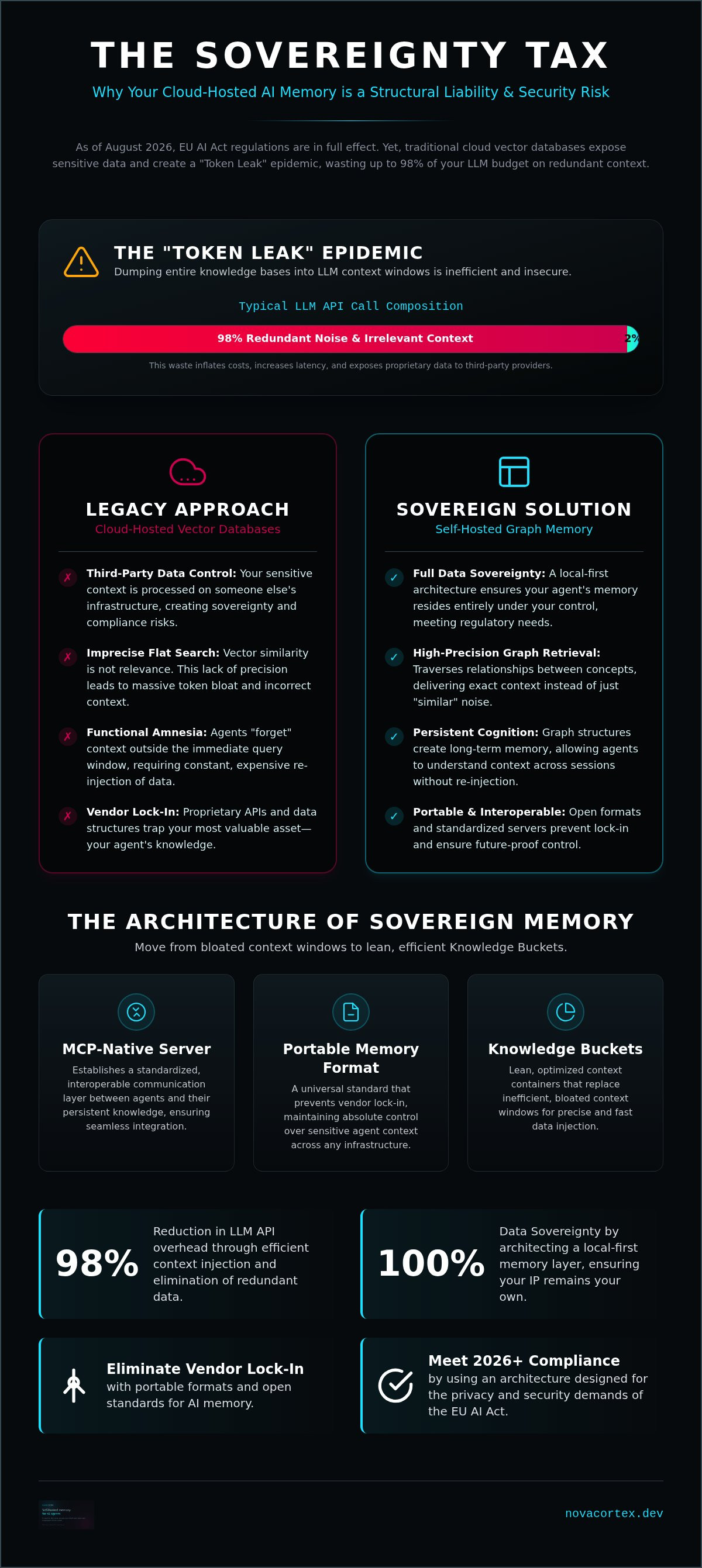
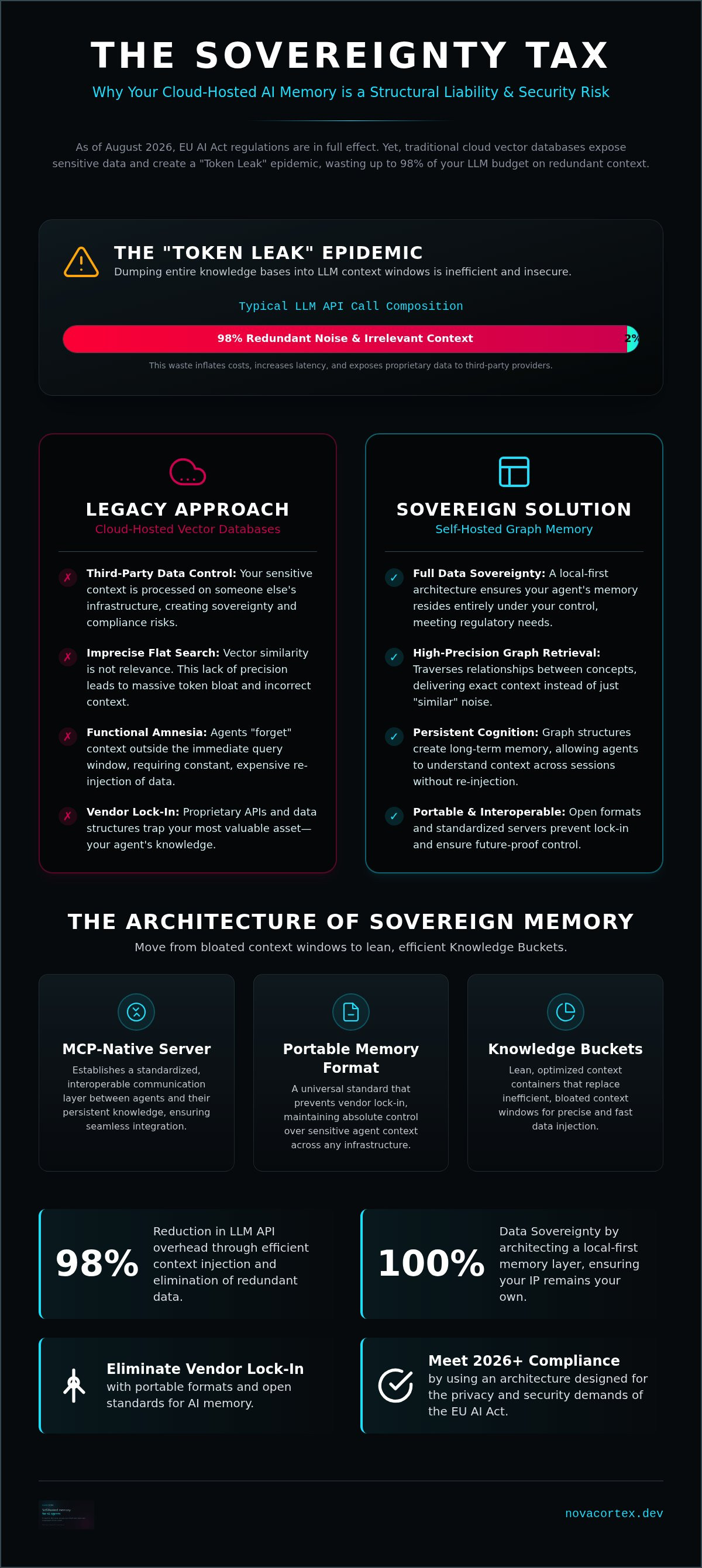
Your cloud-hosted vector database isn't a secure vault; it's a structural leak waiting for a regulatory audit. As of August 2026, the EU AI Act's core obligations are now in full effect, yet 45% of organizations still struggle to secure the tools their agents use. If you're still piping sensitive context through proprietary APIs, you're paying a sovereignty tax that costs you both data control and 98% of your token budget on redundant noise. Implementing secure AI agent storage is no longer a luxury for the privacy-conscious; it's a mandatory engineering requirement for any enterprise that values its intellectual property.
You likely realize the current vector-as-a-service model is a trap designed for vendor lock-in. We're here to show you a more resilient path. You'll learn how to architect a privacy-first, self-hosted memory layer that eliminates reliance on third-party clouds while delivering fast, graph-native retrieval. This guide covers the deployment of MCP-native memory servers and the use of Portable Memory Format (PMF) to ensure your agent's knowledge remains yours. We'll break down how to move from bloated, expensive context windows to lean, sovereign Knowledge Buckets that run on everything from a Raspberry Pi to an enterprise VPS.
Key Takeaways
- Eliminate redundant context waste by replacing flat vector search with high-precision, graph-native retrieval.
- Architect secure AI agent storage using a local-first approach to ensure full data sovereignty and meet 2026 regulatory requirements.
- Deploy an MCP-native memory server to establish a standardized, interoperable communication layer between your agents and their persistent knowledge.
- Utilize the Portable Memory Format (PMF) to prevent vendor lock-in and maintain absolute control over sensitive agent context across any infrastructure.
- Reduce LLM API overhead by up to 98% through efficient Knowledge Bucket management and optimized context injection.
The Architecture of Secure AI Agent Storage
Secure AI storage is not a cold archive. It's the persistent, local-first management of an autonomous agent's context, serving as a live extension of its cognitive process. Most current implementations fail because they treat storage as a passive bucket. In reality, secure AI agent storage requires an active memory layer that maintains state across session boundaries without compromising the underlying data. This isn't just about saving files; it's about engineering a system where the agent's knowledge remains accessible, relevant, and entirely under your control.
The industry currently suffers from a "Token Leak" epidemic. Developers frequently dump entire knowledge bases into LLM context windows, hoping the model sorts it out. This is a security disaster. It exposes proprietary data to third-party providers and burns through budgets at an unsustainable rate. Statistics from 2026 indicate that 98% of tokens are wasted on redundant context. To fix this, we must transition from static storage to self-hosted AI memory layers that prioritize data sovereignty over cloud convenience.
Static Data vs. Dynamic Agent Memory
Traditional databases fail to capture the "state" of an agent. They're designed for structured retrieval, not the evolving intent of an autonomous entity. If an agent cannot map relationships between past actions and current goals, it suffers from functional amnesia. Graph-native structures are essential here. They allow for complex relationship mapping that flat vector databases simply cannot replicate. By traversing nodes of related concepts at high velocity, the agent reduces its reliance on the LLM to "guess" context. AI memory is a cognitive extension that provides persistent identity and logic, not just a passive data repository.
The Security Risks of Cloud-Hosted Context
Proprietary vector clouds introduce unacceptable risks for enterprise deployments. Multi-tenant environments are prone to "context sniffing," where sensitive data might be exposed during high-load processing or through host-level vulnerabilities. Encryption at rest is a baseline, but it's insufficient for active agent cognition. When data is decrypted for retrieval within a third-party infrastructure, your control vanishes. secure AI agent storage must reside where you have absolute authority. Self-hosting is the only architectural choice that eliminates the residency concerns inherent in the current cloud-first model, ensuring your agent's internal world remains private.
Why Vector Databases Fail the Security and Efficiency Test
Vector databases are the industry's favorite stopgap. They're useful for basic semantic search, but they fail as a robust foundation for secure AI agent storage. The core issue is the precision problem. Vector search identifies "similar" data points based on mathematical proximity, but similarity doesn't equal relevance or accuracy. In high-stakes engineering, a "similar" configuration file is simply a wrong configuration file. This lack of precision creates massive token bloat. Flat retrieval forces agents to ingest a mountain of irrelevant noise just to find one signal. It's inefficient. It's expensive. It's a performance penalty that high-velocity agents can't afford to pay.
When evaluating Redis vs graph memory for AI agents, the trade-off becomes clear. Key-value stores and traditional caches like Redis offer raw speed but lack the relational intelligence required for complex reasoning. They can't navigate the nuances of your data's architecture. For security-conscious builds, you need a system that understands how data points connect, not just how they look on a coordinate plane.
The Amnesia Effect in Vector-Only Architectures
Agents built on flat vector stores suffer from functional decay. Once a piece of information falls out of the immediate vector window, the agent "forgets" the context. This amnesia forces developers to constantly re-inject context, ballooning API costs and increasing the attack surface. Solving AI agent long term memory requires graph-based associations that link concepts logically rather than just numerically. Without this, agents hallucinate. These hallucinations aren't just annoying; they're security risks that contradict the safety standards outlined in the NIST AI Risk Management Framework.
Graph-Native: The Secure Alternative
Graph-native storage is the superior methodology for sovereign memory. It enables precise, high-velocity retrieval by traversing explicit relationships between data nodes. This isn't a suggestion; it's a technical fact. By isolating only the exact context needed, you can reduce token usage by 98%. This lean approach doesn't just save money. It enhances security by maintaining strict data provenance. Every piece of context has a clear lineage. You can audit exactly where a piece of information came from and how it relates to the agent's current task. If you're ready to move beyond wasteful vector clouds, you can examine our open-source implementation to see how graph structures transform agent reliability.
Engineering Data Sovereignty: The Case for Self-Hosting
The "Local-First" AI movement has matured into the industry standard for 2026. This shift isn't about nostalgia for on-premise hardware; it's a cold calculation regarding risk and performance. Cloud-hosted memory is a liability. It introduces latency, unpredictable costs, and a total lack of control over the data lifecycle. When you analyze self-hosted vs managed AI memory, the engineering choice is clear. Managed services are black boxes that prioritize their own platform growth over your data integrity. Self-hosting is the only way to ensure secure AI agent storage remains under your direct jurisdiction.
Hardware requirements have democratized. You don't need a server farm to run an effective memory layer. Efficient, graph-native systems can run on anything from a Raspberry Pi to an enterprise VPS. This versatility makes digital sovereignty an accessible engineering requirement rather than a high-cost luxury. It allows developers to build systems that are resilient to external outages and regulatory shifts. In a landscape where data residency is a legal mandate, the ability to pin your agent's context to specific, owned hardware is an absolute necessity.
Ending Vendor Lock-in with Portable Memory Formats
Proprietary AI ecosystems are designed to build "memory silos." These silos trap your agent's context in closed formats, making it impossible to switch providers without losing months of accumulated knowledge. This is a deliberate strategy to enforce vendor lock-in. Adopting a portable memory format for AI is the only escape. By utilizing the Portable Memory Format (PMF), you maintain data mobility. Your agent's knowledge becomes a portable asset that you can sync across different frameworks and infrastructure providers. It turns your data into a liquid resource rather than a frozen liability.
Infrastructure Flexibility: From VPS to the Edge
Modern engineering demands total infrastructure flexibility. Your memory layer must be as portable as your code. This is why secure AI agent storage is moving toward the edge. Deploying memory servers in air-gapped environments or on private local networks eliminates the "middleman" risks associated with traditional cloud setups. You can scale from a single developer instance to complex, multi-user enterprise controls without changing your core architecture. This pragmatic approach ensures that your agent's cognition stays close to the source of the data, reducing latency and maximizing security. It provides the freedom to deploy where the work happens, not just where the cloud provider has a data center.
Implementing an MCP-Native Memory Server
Interoperability is the primary bottleneck in autonomous systems. Without a standard protocol, agents remain trapped in bespoke API wrappers that are brittle, insecure, and impossible to scale. The Model Context Protocol (MCP) provides the necessary correction. Established as the open standard for connecting AI agents to external data sources, MCP enables a unified handshake between the LLM and your persistent storage. Implementing an MCP native memory server ensures that your secure AI agent storage isn't an isolated island; it's a standardized node in a wider cognitive network.
Configuring a secure memory server requires a shift toward modularity. You don't want a monolithic data dump. Instead, you define specific endpoints that allow agents to request context based on their specific role and permissions. By standardizing the communication layer, you eliminate the security vulnerabilities inherent in custom-built middleware. MCP handles the heavy lifting of context negotiation, allowing you to focus on the architecture of the memory itself rather than the plumbing of the API. This protocol-first approach ensures that as your agent swarm grows, your security posture remains consistent and manageable.
Modular Memory with Knowledge Buckets
Data isolation is a non-negotiable requirement for enterprise compliance. Knowledge Buckets allow you to partition sensitive data into discrete, permissioned environments. This prevents a "marketing agent" from accidentally retrieving proprietary source code or sensitive financial records. When managing multi-agent swarms, these buckets act as the primary firewall against data leakage. Knowledge Buckets ensure that agent context remains strictly compartmentalized, preventing the cross-contamination of logic and private data across your infrastructure. This modularity allows for precise state synchronization; agents only share what they're explicitly authorized to know, maintaining a clean audit trail for every retrieval event.
Low-Latency Retrieval Protocols
Real-time responsiveness is the difference between a tool and a teammate. High-latency memory layers break the chain of agent reasoning, leading to timeouts and logic errors. Graph-native indexing reduces retrieval overhead by navigating pre-defined relationships instead of performing exhaustive flat scans. This architectural choice provides a massive performance boost, especially when dealing with the complex datasets common in 2026 deployments. Security is baked into the protocol level. MCP provides a robust, standardized framework that beats custom API wrappers by reducing the attack surface. It's a leaner, faster, and more secure way to manage active agent cognition without the bloat of traditional cloud middleware.
NovaCortex: The Standard for Sovereign AI Memory
NovaCortex Self-Hosted Edition is the definitive engineering response to the data sovereignty crisis. While cloud providers offer convenience, they fail to provide the control necessary for high-stakes autonomous systems. NovaCortex serves as the specialized tool for builders who reject bloated, restrictive systems. It isn't just another database; it's a dedicated memory layer engineered for digital sovereignty. By integrating graph-native storage, NovaCortex transforms how agents interact with context, shifting from wasteful semantic guessing to precise relational retrieval. It provides the architectural foundation required to maintain persistent agent identity without external dependencies.
The performance metrics are absolute. NovaCortex delivers a 98% token reduction by eliminating the redundant noise that plagues traditional vector-only architectures. This efficiency is paired with full support for the Portable Memory Format (PMF), ensuring your data remains a mobile asset rather than a locked-in liability. Built on an Apache-2.0 foundation, the system provides maximum transparency for security audits. It bridges the gap between raw data and active agent cognition, providing a reliable, high-velocity structure for secure AI agent storage in 2026. This isn't just a storage solution; it's the engine for persistent, reliable agent cognition.
Deploying NovaCortex on Your Infrastructure
Setup is fast and modular. You can deploy NovaCortex via Docker for immediate testing or move to bare metal for performance-critical production environments. The system is designed to run on anything from a Raspberry Pi to a high-density enterprise VPS, mirroring the flexibility of your existing codebases. For organizations requiring advanced oversight, the Self-Hosted Edition includes enterprise management features, offering enhanced security protocols and multi-user controls. It allows you to maintain a lean operation while scaling to meet complex compliance mandates. You get the power of an enterprise memory layer with the independence of a local-first build.
Start building sovereign AI agents with NovaCortex
Future-Proofing Your AI Infrastructure
The roadmap for 2026 and beyond focuses on deepening interoperability across the AI stack. NovaCortex is the pragmatic choice for builders who prioritize long-term stability over short-term hype. It acts as a standard-setter, pushing the industry toward better technical practices like MCP-native communication and portable context. While the core is open source, we provide direct engineering support and commercial terms for organizations with non-Apache-2.0 requirements. This ensures you have the specialized backing needed to maintain architectural superiority as the autonomous agent landscape evolves. We are building for a future where memory is sovereign, portable, and permanent.
Engineering Persistent Cognitive Sovereignty
Cloud-hosted context is a structural weakness that compromises both your data integrity and your engineering budget. In 2026, the shift toward graph-native, self-hosted memory is the only logical path for builders who demand absolute control. You've seen the technical reality: flat vector databases are too imprecise for complex agent reasoning, and proprietary silos are designed to keep you trapped. By adopting secure AI agent storage through a local-first architecture, you eliminate redundant token waste and reclaim the "brain" of your autonomous systems.
NovaCortex provides the specialized toolset needed to bridge the gap between raw data and persistent cognition. With verified 98% token savings and an MCP-native architecture, it's the standard for professional agent development. Choosing an open source (Apache-2.0) foundation ensures your infrastructure remains transparent and resilient against regulatory shifts. It's time to stop renting context and start owning your intelligence.
Build systems that remember. Build systems that belong to you.
Frequently Asked Questions
What is the most secure way to store AI agent memory?
The most secure method for secure AI agent storage is deploying a self-hosted memory layer on your own infrastructure, such as a private VPS or local server. This eliminates third-party "context sniffing" risks and ensures full data sovereignty. Unlike cloud-hosted vector databases, a self-hosted approach keeps decrypted data within your security perimeter. Using an Apache-2.0 open-source foundation like NovaCortex allows for transparent security audits and absolute jurisdiction over the agent's cognitive state.
Can I run a secure AI memory server on a Raspberry Pi?
Yes, you can run a secure memory server on a Raspberry Pi. NovaCortex is engineered for lean operations, allowing it to function effectively on edge hardware or low-resource local environments. This portability makes it an ideal choice for developers who need to maintain air-gapped or localized memory layers. By shifting the processing to the edge, you reduce latency and remove the vulnerabilities associated with transmitting sensitive agent context over public networks.
How does graph-native storage improve AI agent security?
Graph-native storage improves security by providing high-precision retrieval and strict data provenance. Instead of returning "similar" but potentially irrelevant data points like flat vector search, graph structures traverse explicit relationships between nodes. This prevents the agent from ingesting incorrect or malicious context that could lead to logic failures. Additionally, every piece of retrieved information has a clear lineage, making it easier to audit how the agent reached specific conclusions or accessed sensitive data.
What is the difference between a vector database and an AI memory layer?
A vector database is a passive storage bucket designed for mathematical similarity searches, whereas an AI memory layer is an active cognitive extension. Traditional databases focus on static retrieval, often returning noise that leads to token bloat. An AI memory layer uses relational intelligence to maintain the agent's state and identity across sessions. It prioritizes relevance over mere proximity, ensuring the agent has access to a structured, evolving knowledge base rather than a flat list of vectors.
How do I prevent my AI agent from leaking sensitive data to an LLM provider?
You prevent data leakage by implementing local-first retrieval and using Knowledge Buckets to modularize agent permissions. By isolating sensitive information into specific, permissioned buckets, you ensure that only the exact context required for a task is ever sent to the LLM. This targeted extraction minimizes the amount of proprietary data exposed to third-party APIs. Combining this with secure AI agent storage ensures that your primary knowledge base never leaves your controlled infrastructure.
Is NovaCortex compatible with the Model Context Protocol (MCP)?
NovaCortex is fully compatible with the Model Context Protocol (MCP) and includes an MCP-Native Memory Server. This compatibility establishes a standardized communication layer between your agents and their persistent storage. By using MCP, you eliminate the need for brittle, custom API wrappers that often introduce security vulnerabilities. This protocol-first approach ensures that your memory layer is interoperable with any LLM or agent framework that supports the MCP standard, future-proofing your AI infrastructure.
How can I reduce my AI agent token costs by 98%?
You reduce token costs by replacing exhaustive context dumping with graph-native indexing. Most agents waste 98% of their token budget on redundant or irrelevant data because flat vector search lacks precision. NovaCortex uses relational traversal to isolate only the specific nodes of information required for a prompt. This lean approach significantly shrinks the context window, allowing you to achieve high-velocity performance without the massive API overhead associated with traditional knowledge retrieval methods.
What is the Portable Memory Format (PMF) and why does it matter?
The Portable Memory Format (PMF) is an open standard that enables data mobility and prevents vendor lock-in. It allows you to export and sync your agent's knowledge across different frameworks and infrastructure providers without losing relational context. PMF matters because it ensures your agent's "brain" remains a liquid asset that you own. Without a portable format, your data is trapped in proprietary silos, making it impossible to migrate or evolve your AI stack as technology advances.
FAQ
What is the most secure way to store AI agent memory?
The most secure method for secure AI agent storage is deploying a self-hosted memory layer on your own infrastructure, such as a private VPS or local server. This eliminates third-party "context sniffing" risks and ensures full data sovereignty. Unlike cloud-hosted vector databases, a self-hosted approach keeps decrypted data within your security perimeter. Using an Apache-2.0 open-source foundation like NovaCortex allows for transparent security audits and absolute jurisdiction over the agent's cognitive state.
Can I run a secure AI memory server on a Raspberry Pi?
Yes, you can run a secure memory server on a Raspberry Pi. NovaCortex is engineered for lean operations, allowing it to function effectively on edge hardware or low-resource local environments. This portability makes it an ideal choice for developers who need to maintain air-gapped or localized memory layers. By shifting the processing to the edge, you reduce latency and remove the vulnerabilities associated with transmitting sensitive agent context over public networks.
How does graph-native storage improve AI agent security?
Graph-native storage improves security by providing high-precision retrieval and strict data provenance. Instead of returning "similar" but potentially irrelevant data points like flat vector search, graph structures traverse explicit relationships between nodes. This prevents the agent from ingesting incorrect or malicious context that could lead to logic failures. Additionally, every piece of retrieved information has a clear lineage, making it easier to audit how the agent reached specific conclusions or accessed sensitive data.
What is the difference between a vector database and an AI memory layer?
A vector database is a passive storage bucket designed for mathematical similarity searches, whereas an AI memory layer is an active cognitive extension. Traditional databases focus on static retrieval, often returning noise that leads to token bloat. An AI memory layer uses relational intelligence to maintain the agent's state and identity across sessions. It prioritizes relevance over mere proximity, ensuring the agent has access to a structured, evolving knowledge base rather than a flat list of vectors.
How do I prevent my AI agent from leaking sensitive data to an LLM provider?
You prevent data leakage by implementing local-first retrieval and using Knowledge Buckets to modularize agent permissions. By isolating sensitive information into specific, permissioned buckets, you ensure that only the exact context required for a task is ever sent to the LLM. This targeted extraction minimizes the amount of proprietary data exposed to third-party APIs. Combining this with secure AI agent storage ensures that your primary knowledge base never leaves your controlled infrastructure.
Is NovaCortex compatible with the Model Context Protocol (MCP)?
NovaCortex is fully compatible with the Model Context Protocol (MCP) and includes an MCP-Native Memory Server. This compatibility establishes a standardized communication layer between your agents and their persistent storage. By using MCP, you eliminate the need for brittle, custom API wrappers that often introduce security vulnerabilities. This protocol-first approach ensures that your memory layer is interoperable with any LLM or agent framework that supports the MCP standard, future-proofing your AI infrastructure.
How can I reduce my AI agent token costs by 98%?
You reduce token costs by replacing exhaustive context dumping with graph-native indexing. Most agents waste 98% of their token budget on redundant or irrelevant data because flat vector search lacks precision. NovaCortex uses relational traversal to isolate only the specific nodes of information required for a prompt. This lean approach significantly shrinks the context window, allowing you to achieve high-velocity performance without the massive API overhead associated with traditional knowledge retrieval methods.
What is the Portable Memory Format (PMF) and why does it matter?
The Portable Memory Format (PMF) is an open standard that enables data mobility and prevents vendor lock-in. It allows you to export and sync your agent's knowledge across different frameworks and infrastructure providers without losing relational context. PMF matters because it ensures your agent's "brain" remains a liquid asset that you own. Without a portable format, your data is trapped in proprietary silos, making it impossible to migrate or evolve your AI stack as technology advances.