Self-Hosted AI Knowledge Base for Healthcare Compliance: Engineering Data Sovereignty

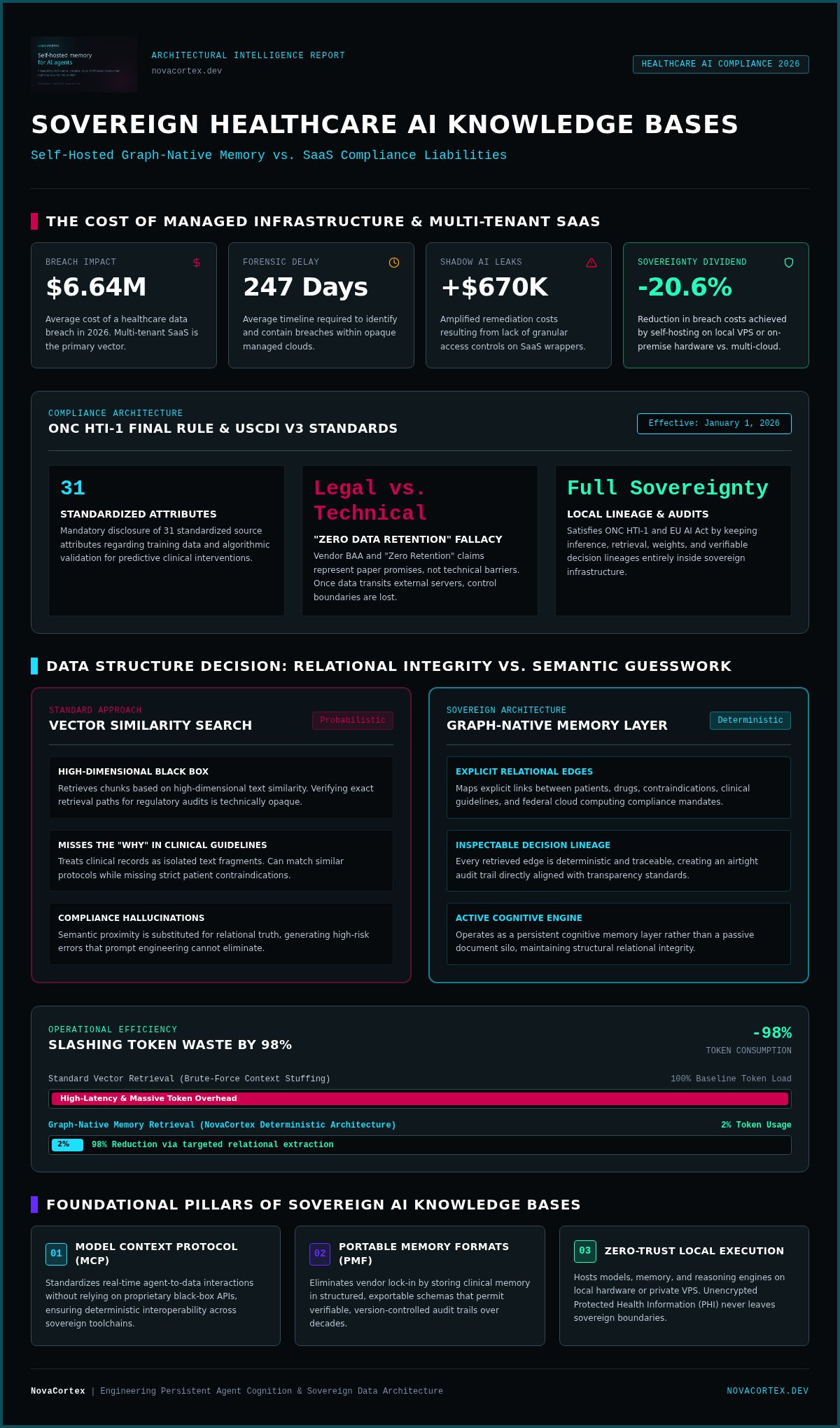
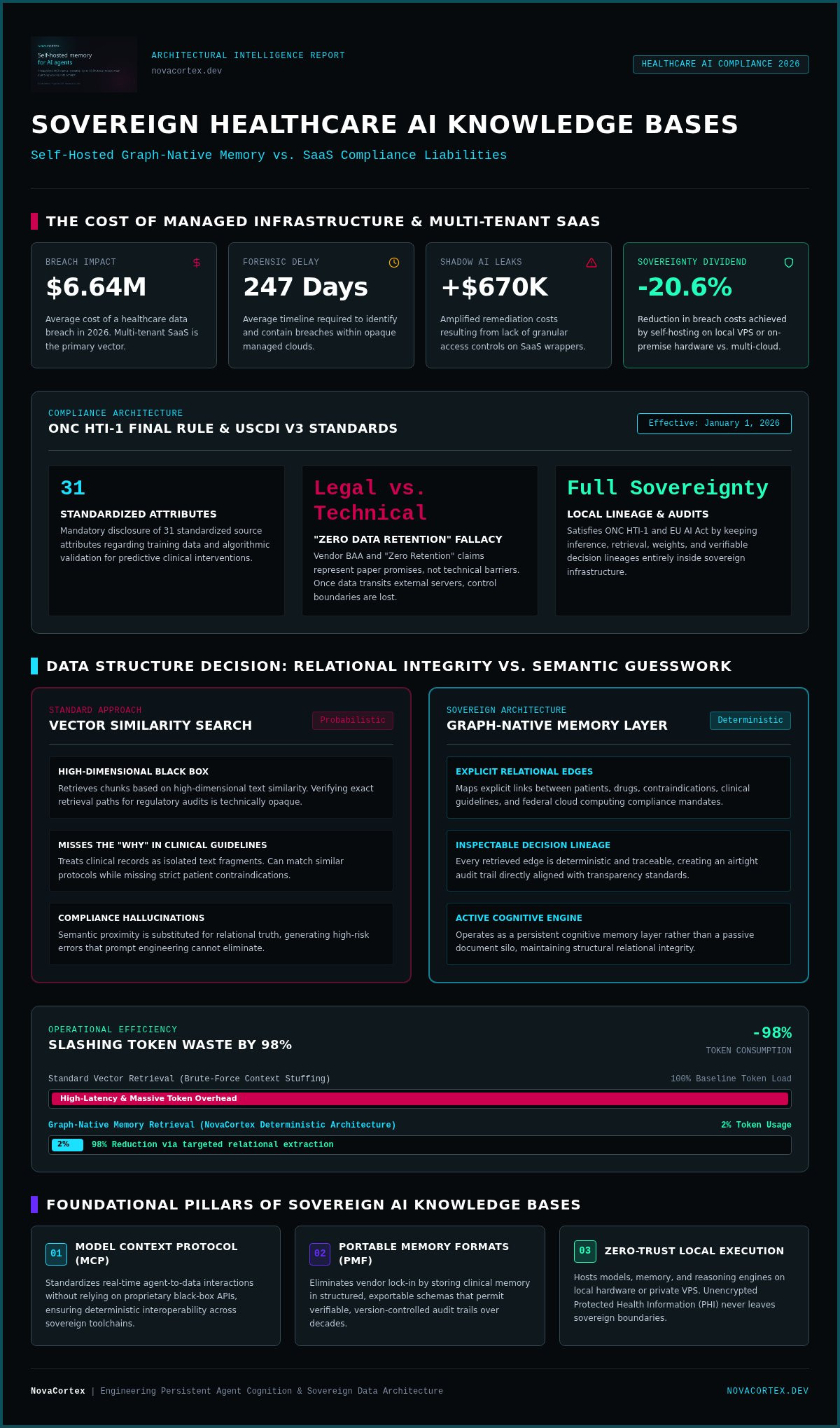
Executing a Business Associate Agreement with a cloud AI vendor provides legal cover; it does not provide data sovereignty. In 2026, healthcare data breaches cost an average of $6.64 million. Multi-tenant SaaS environments remain the primary vector for these catastrophic leaks. You understand that trusting a third-party provider with unencrypted patient data is a liability your infrastructure cannot afford. Transitioning to a self-hosted AI knowledge base is the only way to ensure that sensitive PHI never leaves your sovereign boundary. It is time to stop treating compliance as a paperwork exercise and start treating it as an architectural requirement.
This article explores how to engineer a privacy-first, graph-native AI memory layer that satisfies the latest ONC HTI-1 transparency standards and the EU AI Act. You will learn how to replace wasteful, high-latency vector retrieval with a deterministic system that slashes token usage by 98 percent. We break down the implementation of the Model Context Protocol (MCP) and the use of Portable Memory Formats (PMF) to eliminate vendor lock-in. From zero-trust storage to long-term auditability, we are moving beyond the limitations of black box AI toward a lean, high-velocity knowledge architecture built for the future of medicine.
Key Takeaways
- Architect a self-hosted AI knowledge base to move beyond the legal risks of cloud-based "Zero Data Retention" claims and ensure absolute data sovereignty for PHI.
- Understand why graph-native relational integrity is superior to vector semantic similarity for maintaining the complex entity relationships required in medical compliance.
- Leverage the Model Context Protocol (MCP) and Portable Memory Format (PMF) to eliminate vendor lock-in and create inspectable, version-controlled audit trails.
- Achieve a 98 percent reduction in token usage by replacing brute-force context stuffing with precision, graph-native memory retrieval.
The Compliance Paradox: Why SaaS AI Fails Healthcare Standards
SaaS AI providers offer a seductive but dangerous trade-off. They promise advanced reasoning in exchange for your most sensitive clinical data. In 2026, healthcare data breaches reached a record average cost of $6.64 million per incident. Relying on "Zero Data Retention" policies is a dangerous gamble on a vendor's internal logging practices. These claims are merely legal promises; they are not technical barriers. If the data transits to an external server, the boundary of your control has already been breached.
True data sovereignty requires total jurisdictional and technical control over digital records. Under the ONC HTI-1 Final Rule and USCDI v3 standards effective January 1, 2026, healthcare organizations must provide algorithmic transparency for predictive interventions. This includes publishing 31 standardized source attributes regarding training data and validation. Achieving this level of transparency is impossible when your intelligence layer sits behind a proprietary API. A self-hosted AI knowledge base is the only architecture that ensures local execution and verifiable data lineage.
We must distinguish between a simple document repository and a true memory layer. A repository is a passive silo. A memory layer is an active, persistent cognitive engine that understands relationships between patients, protocols, and regulations. Transitioning to a self-hosted AI knowledge base allows you to build this intelligence locally, ensuring that every retrieval and inference cycle remains within your sovereign hardware.
The Failure of Managed Infrastructure for Regulated Data
Managed RAG services operate as black boxes. They ingest sensitive records into proprietary vector clouds where forensic audits are technically impossible. If a breach occurs, healthcare entities face an average of 247 days to identify and contain the event. You cannot perform a meaningful audit on a system where you don't own the underlying infrastructure. SaaS wrappers lack the granular access controls required to prevent "Shadow AI" leaks, which can add up to $670,000 in amplified remediation costs. Managed infrastructure is a liability, not a service.
Digital Sovereignty as a Technical Requirement
Compliance in 2026 is an engineering problem, not a policy one. Self-hosting eliminates the "man-in-the-middle" by keeping inference and retrieval on local VPS or on-premise hardware. This architectural shift reduces breach costs by 20.6 percent compared to multi-cloud environments. By deploying a self-hosted AI memory layer, you transform static data into a persistent cognitive system. It allows you to maintain the lineage of every clinical decision the AI assists. You own the hardware, the weights, and the memory. This is the only way to achieve the digital sovereignty required for modern medicine.
Graph-Native Memory vs. Vector Databases in Compliance Workflows
Standard Retrieval-Augmented Generation (RAG) relies on vector similarity. This is a probabilistic gamble. Healthcare compliance requires deterministic logic. Vector databases find things that look similar in a high-dimensional space. Compliance requires knowing they are related through explicit, verifiable links. In a self-hosted AI knowledge base, the choice of data structure determines your ability to survive an audit. Semantic proximity is a poor substitute for relational integrity.
Healthcare data is inherently graph-native. A patient history is not a collection of isolated text chunks. It is a web of connections between drugs, contraindications, clinical guidelines, and federal HHS guidance on cloud computing compliance. When an agent retrieves data to assist a clinical decision, it must understand these edges. Vector search often misses the "why" behind a relationship. It retrieves a similar protocol that might be contraindicated for a specific patient profile. This architectural flaw leads to compliance hallucinations that no prompt engineering can fix.
Why Vector Databases Fall Short for Compliance
Vector space is high-dimensional and opaque. When an agent retrieves a rule from a vector store, verifying the retrieval path is difficult. This lack of explainability is a major hurdle for regulatory transparency. In the Redis vs graph memory for AI agents debate, the winner for regulated industries is clear. Vector stores like Redis are fast. They are also context-poor. They force the LLM to guess the relationship between retrieved chunks. This "context dumping" wastes tokens and obscures the data lineage required for forensic audits.
The Graph-Native Advantage: Precise Retrieval
Graph-native memory maintains the provenance of every node. You can trace an AI's output back to the exact clinical guideline or FHIR resource that influenced it. By using Knowledge Buckets, you can engineer modular, permissioned data access. This ensures that clinical data remains isolated from administrative records. Engineering AI agent long term memory requires this level of relational precision. It allows multiple agents to synchronize their state without losing the underlying medical logic.
A self-hosted AI knowledge base built on a graph architecture ensures your audit trail is immutable. You aren't just storing text; you are storing a verifiable map of medical knowledge. To see how this architecture functions in production, you can examine the core logic in the NovaCortex repository.
Core Architecture: MCP and Portable Memory Formats
Proprietary AI silos are the antithesis of medical data sovereignty. When you lock your organizational intelligence into a vendor-specific vector database, you surrender control over your audit trails. A self-hosted AI knowledge base requires a standardized, open architecture to remain compliant. The Model Context Protocol (MCP) serves as this architectural bridge. It decouples the reasoning engine from the data layer. By following the NIST AI Risk Management Framework, engineers can build systems that are explainable, secure, and resilient to vendor instability.
The goal is total interoperability. An MCP native memory server allows you to swap foundation models without rebuilding your knowledge graph. It provides a stateless protocol core that manages tool calls and resource retrieval locally. This ensures that your PHI remains within the sovereign boundary while still benefiting from the latest advancements in LLM reasoning. Standardized protocols are not just a convenience. They are a compliance requirement for long-term medical data retention.
Engineering Interoperability with MCP
Deploying an MCP-native server on local infrastructure transforms how agents interact with knowledge. Instead of rigid API calls, you use a standardized interface for multi-round-trip requests. This architecture passes healthcare security audits by providing a clear, inspectable path for every data retrieval. It moves the industry toward vendor-neutral AI storage. You no longer need to worry about database connection strings or plaintext PHI leaking into third-party telemetry logs. The protocol handles the handshake; your local hardware handles the data.
Future-Proofing with Portable Memory Format (PMF)
Healthcare organizations must avoid proprietary binary formats that lead to data rot. The Portable Memory Format (PMF) is a schema-validated, version-controlled standard for agent memory. It allows for seamless cross-environment syncing between air-gapped systems and local VPS instances. PMF supports the "Right to Portability" enshrined in modern data regulations. It ensures that your organizational memory is human-readable and machine-interoperable. You don't just store data; you store it in a format that survives the lifecycle of any single software vendor. This is the foundation of a truly independent self-hosted AI knowledge base.
Implementation Guide: Deploying a Sovereign Healthcare AI Knowledge Base
Infrastructure selection is not a matter of convenience; it's a matter of liability. You cannot build a self-hosted AI knowledge base on a foundation of insecure defaults. For organizations requiring absolute isolation, air-gapped hardware remains the gold standard. For most enterprise applications, a hardened local server or a VPS with strict data residency controls provides the necessary balance of performance and security. The goal is to move from a posture of trust to a posture of architectural verification.
Infrastructure Selection for Maximum Sovereignty
Hardening your local environment for HIPAA-compliant AI workloads requires more than just encryption at rest. You must account for data in transit and diagnostic metadata. Many "one-click" cloud setups leave insecure ports open or default to shared storage. When choosing between self-hosted vs managed AI memory, remember that managed services are black boxes. They fail the transparency requirements of the ONC HTI-1 rule. Sovereignty demands that you own every layer of the stack. This reduces breach damages by an average of 20.6 percent compared to multi-tenant cloud environments.
Knowledge Bucket Configuration
Granular access control is the primary defense against internal data leaks. Knowledge Buckets allow you to segment data by compliance domain. Clinical notes, billing records, and regulatory protocols should never sit in a single, flat repository. By automating the ingestion of these documents into the graph layer, you create a structured map of ePHI. This architecture supports real-time context synchronization across multi-agent teams without exposing the entire database to every query. It ensures that an administrative agent never gains access to the relational nodes of a clinical patient record.
The memory layer acts as a "context firewall." It intercepts raw data and passes only the precisely retrieved, graph-native entities to the LLM. This prevents the "context dumping" that leads to data leakage and high token costs. In clinical environments, retrieval latency is a critical metric. Benchmarks using LongMemEval show that this architecture achieves an 80.0 percent performance score while operating fully offline. By replacing brute-force document re-injection with precision graph retrieval, you ensure that your self-hosted AI knowledge base remains both fast and compliant.
NovaCortex: Slashing Token Waste by 98% in Regulated Environments
Standard Retrieval-Augmented Generation (RAG) is a brute-force exercise in context stuffing. It re-injects dozens of dense document chunks into the LLM prompt on every turn. This creates a massive "token tax" that inflates operational costs and increases latency. NovaCortex eliminates this waste through a graph-native architecture. Instead of dumping raw text, it extracts typed entities and relational triples once. By querying only the exact sub-graph relevant to the prompt, it achieves a 98 percent reduction in inference token usage. This isn't just about speed; it's about making your self-hosted AI knowledge base economically viable at scale.
Transparency is a non-negotiable requirement for healthcare compliance. NovaCortex is open source under the Apache-2.0 license. This allows your security team to inspect every line of code, ensuring no hidden telemetry or proprietary black boxes exist. You gain a verifiable chain of custody for every clinical insight. Deploying a self-hosted AI knowledge base with NovaCortex means you own the logic, the memory, and the audit trail. It is the definitive correction to the bloat of managed AI wrappers.
The Economics of Self-Hosted AI Memory
Large-scale healthcare deployments cannot tolerate the high-latency overhead of traditional vector databases. When you scale to thousands of patients and millions of clinical records, the ROI of token efficiency becomes undeniable. NovaCortex reduces the compute requirements for on-premise GPUs by minimizing the input context size. You get better performance with less hardware. This lean, graph-native approach allows your organization to exit the cycle of endless API credit consumption. You move from a variable expense model to a fixed, sovereign infrastructure model.
Digital Sovereignty with NovaCortex Self-Hosted
Regulatory audits require more than just data; they require data provenance. NovaCortex leverages the Portable Memory Format (PMF) to provide a human-readable, version-controlled record of agent cognition. This integrates seamlessly with existing healthcare middleware via the Model Context Protocol (MCP). You can connect local reasoning models to internal FHIR APIs without exposing plaintext PHI to the public internet. This architecture fulfills the promise of digital sovereignty by keeping the intelligence layer as portable as the data it processes.
Engineering Sovereign Intelligence
Digital sovereignty in healthcare is no longer a luxury; it's a statutory requirement for the next decade of AI deployment. By moving to a self-hosted AI knowledge base, you eliminate the "man-in-the-middle" and secure your organization against the $6.64 million average cost of data breaches. Graph-native memory layers provide the relational integrity that vector databases lack. This architecture ensures your audit trails remain immutable and your clinical logic remains precise.
NovaCortex provides the blueprint for this transition. With an Apache-2.0 open-source license and an MCP-native architecture, it slashes token waste by 98% while keeping your data portable via the Portable Memory Format. You now have the technical roadmap to build a persistent, compliant memory layer that scales on local hardware without the risk of vendor lock-in or secondary data mining.
Take control of your architectural future. Build for longevity, not just for the current API cycle. Your data belongs under your control.
Frequently Asked Questions
Is a self-hosted AI knowledge base truly HIPAA compliant?
Self-hosting provides the technical architecture for HIPAA compliance by maintaining absolute data sovereignty. Unlike SaaS wrappers that rely on legal promises, a self-hosted AI knowledge base keeps ePHI within your local firewall. This eliminates the risk of data leakage during transit to third-party servers. You maintain total control over access logs and diagnostic metadata; this is a requirement for surviving a federal OCR audit.
How does graph-native memory reduce token usage compared to vector search?
Graph-native memory eliminates the brute-force context stuffing typical of standard RAG. Instead of re-injecting thousands of tokens of raw text, NovaCortex retrieves only the specific relational triples and entities relevant to the query. This precision allows for a 98% reduction in token waste. You stop paying the token tax for irrelevant document chunks and start operating with a lean, high-velocity context window that respects your GPU's limits.
Can I run NovaCortex on a standard VPS or do I need specialized hardware?
You don't need specialized hardware to deploy NovaCortex. The system is engineered for efficiency and runs on standard VPS instances, local servers, or even a Raspberry Pi. Because graph-native retrieval minimizes the compute load on your inference engine, you can achieve high performance on modest infrastructure. This flexibility allows healthcare organizations to maintain sovereign control without the capital expenditure of massive GPU clusters or proprietary hardware appliances.
What is the Portable Memory Format (PMF) and why does it matter for healthcare?
PMF is a schema-validated, non-proprietary format that ensures your organizational intelligence remains human-readable and machine-interoperable. In healthcare, this matters for long-term data retention and regulatory Right to Portability requirements. It prevents vendor lock-in by allowing you to migrate agent memories across different local environments. You own the memory files; this ensures your audit trails survive even if you switch foundation models or reasoning engines.
How does the Model Context Protocol (MCP) improve agent performance?
The Model Context Protocol (MCP) acts as the standardized bridge between your reasoning models and your local data layer. It improves performance by managing multi-round-trip requests and tool calls through a stateless protocol core. This architecture reduces latency and ensures that agents retrieve the exact context needed for clinical decision support. It transforms your self-hosted AI knowledge base into a high-velocity cognitive engine that operates with deterministic precision.
Does self-hosting an AI knowledge base require a dedicated DevOps team?
Self-hosting doesn't require a massive DevOps team. NovaCortex is built by engineers for engineers, focusing on a modular and structured organization that simplifies deployment. The open-source Apache-2.0 codebase provides the transparency needed for rapid configuration and hardening. While you need basic server management skills, the system eliminates the complexity of managing proprietary, multi-tenant cloud configurations or opaque SaaS integrations that often hide insecure default settings.
Can I migrate my existing vector database to NovaCortex?
Migrating from a legacy vector database to NovaCortex is a direct process of restructuring data into Knowledge Buckets. You move from fuzzy semantic similarity to deterministic relational integrity. This transition ensures that your AI agents understand the explicit connections between medical entities rather than just their proximity in a vector space. The PMF supports structured ingestion to ensure your existing knowledge remains usable and portable during the architectural upgrade.
How does NovaCortex handle multi-user permissions in a healthcare setting?
NovaCortex manages sensitive data through Knowledge Buckets, which provide granular access controls for different organizational roles. You can segment clinical patient records from administrative billing data at the database level. This ensures that agents only access the specific relational nodes required for their assigned task. In a healthcare setting, this context firewall prevents unauthorized exposure of PHI while maintaining the collaborative benefits of a shared, graph-native memory layer.
FAQ
Is a self-hosted AI knowledge base truly HIPAA compliant?
Self-hosting provides the technical architecture for HIPAA compliance by maintaining absolute data sovereignty. Unlike SaaS wrappers that rely on legal promises, a self-hosted AI knowledge base keeps ePHI within your local firewall. This eliminates the risk of data leakage during transit to third-party servers. You maintain total control over access logs and diagnostic metadata; this is a requirement for surviving a federal OCR audit.
How does graph-native memory reduce token usage compared to vector search?
Graph-native memory eliminates the brute-force context stuffing typical of standard RAG. Instead of re-injecting thousands of tokens of raw text, NovaCortex retrieves only the specific relational triples and entities relevant to the query. This precision allows for a 98% reduction in token waste. You stop paying the token tax for irrelevant document chunks and start operating with a lean, high-velocity context window that respects your GPU's limits.
Can I run NovaCortex on a standard VPS or do I need specialized hardware?
You don't need specialized hardware to deploy NovaCortex. The system is engineered for efficiency and runs on standard VPS instances, local servers, or even a Raspberry Pi. Because graph-native retrieval minimizes the compute load on your inference engine, you can achieve high performance on modest infrastructure. This flexibility allows healthcare organizations to maintain sovereign control without the capital expenditure of massive GPU clusters or proprietary hardware appliances.
What is the Portable Memory Format (PMF) and why does it matter for healthcare?
PMF is a schema-validated, non-proprietary format that ensures your organizational intelligence remains human-readable and machine-interoperable. In healthcare, this matters for long-term data retention and regulatory Right to Portability requirements. It prevents vendor lock-in by allowing you to migrate agent memories across different local environments. You own the memory files; this ensures your audit trails survive even if you switch foundation models or reasoning engines.
How does the Model Context Protocol (MCP) improve agent performance?
The Model Context Protocol (MCP) acts as the standardized bridge between your reasoning models and your local data layer. It improves performance by managing multi-round-trip requests and tool calls through a stateless protocol core. This architecture reduces latency and ensures that agents retrieve the exact context needed for clinical decision support. It transforms your self-hosted AI knowledge base into a high-velocity cognitive engine that operates with deterministic precision.
Does self-hosting an AI knowledge base require a dedicated DevOps team?
Self-hosting doesn't require a massive DevOps team. NovaCortex is built by engineers for engineers, focusing on a modular and structured organization that simplifies deployment. The open-source Apache-2.0 codebase provides the transparency needed for rapid configuration and hardening. While you need basic server management skills, the system eliminates the complexity of managing proprietary, multi-tenant cloud configurations or opaque SaaS integrations that often hide insecure default settings.
Can I migrate my existing vector database to NovaCortex?
Migrating from a legacy vector database to NovaCortex is a direct process of restructuring data into Knowledge Buckets. You move from fuzzy semantic similarity to deterministic relational integrity. This transition ensures that your AI agents understand the explicit connections between medical entities rather than just their proximity in a vector space. The PMF supports structured ingestion to ensure your existing knowledge remains usable and portable during the architectural upgrade.
How does NovaCortex handle multi-user permissions in a healthcare setting?
NovaCortex manages sensitive data through Knowledge Buckets, which provide granular access controls for different organizational roles. You can segment clinical patient records from administrative billing data at the database level. This ensures that agents only access the specific relational nodes required for their assigned task. In a healthcare setting, this context firewall prevents unauthorized exposure of PHI while maintaining the collaborative benefits of a shared, graph-native memory layer.