Self-Hosted AI Memory for Financial Services: Architecture and Evaluation
What if an AI agent’s most useful context became your least-governed data store? Financial workflows need continuity, but prompts, logs, retrieval stores, and persistent memory each create different boundaries for sensitive information. Choosing self-hosted AI memory for financial services can give teams more control over where memory is stored, but self-hosting alone does not establish security or regulatory compliance.
A memory layer can retain information across sessions, so teams need to know what it stores, who can retrieve it, and how its use is audited. Treat memory as a controlled data layer, not as disposable prompt context.
This article explains where memory fits in an agent architecture and how to evaluate self-hosted, managed, and custom-built approaches using consistent criteria. You’ll examine data boundaries, access controls, auditability, portability, retrieval quality, and operational responsibility, then identify practical questions to resolve before a pilot. The goal is a useful decision framework, not a false choice between control and capability.
Key Takeaways
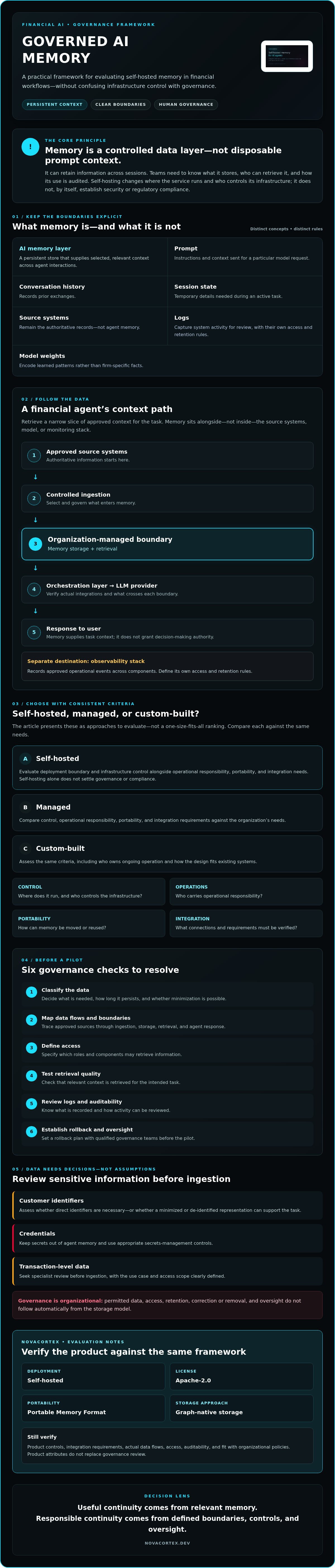
- Define memory separately from prompts, logs, conversation history, source systems, and model weights so you can set clear data boundaries.
- Map the flow from approved source data through ingestion, storage, retrieval, and agent response. Keep the memory layer distinct from the model and orchestration stack.
- Evaluate self-hosted AI memory for financial services alongside managed and custom-built approaches, comparing control, operations, portability, and integration needs.
- Before a pilot, classify data, map flows, define access, test retrieval, review logs, and establish a rollback plan with qualified governance teams.
- Assess NovaCortex against those criteria, including its self-hosted deployment, Apache-2.0 licensing, Portable Memory Format, and graph-native storage. Verify product controls and integration requirements.
Why Financial Services Need a Governed AI Memory Layer
Financial workflows often span multiple sessions and information sources. An analyst may need an assistant to recall approved research context; a service team may need it to retrieve an internal procedure. Without a governed memory layer, teams may push large knowledge collections into prompts or rely on scattered conversation histories. Neither approach clearly defines what persists, who can access it, or when it should be removed.
What does persistent memory change for a financial AI agent?
An AI memory layer is a persistent store that supplies selected, relevant context across agent interactions. Instead of replaying an entire knowledge collection in every session, an agent can retrieve specific facts that help it respond. Memory supports continuity; it does not grant the agent authority to make financial decisions.
Keep the architecture boundaries explicit. A prompt is the instruction and context sent for a particular model request. Conversation history records prior exchanges, while session state holds temporary details needed during an active task. Source systems remain the authoritative records. Logs capture system activity for review, and model weights encode learned patterns rather than firm-specific facts. The broader concept of computer memory helps frame storage and retrieval, but an AI memory layer has its own application-level rules for what to retain and return.
Consider three illustrative uses. A research assistant could retrieve approved background from earlier work. An internal knowledge tool could surface a relevant procedure without reloading a full document library. A service operations agent could recall a team-approved workflow while a staff member handles a request. In each case, memory supplies context for the task; it does not replace source records or human review.
Which information should stay outside agent memory?
Classify information before ingestion. For each data type, ask whether the agent needs it, how long it should persist, which roles may retrieve it, and how it can be corrected or removed. Data minimization, retention, and access boundaries are decisions for the organization and its qualified risk, security, and compliance teams. They do not follow automatically from a choice of storage model.
- Customer identifiers: Assess whether direct identifiers are necessary or whether a minimized or de-identified representation can support the task.
- Credentials: Keep secrets out of agent memory and use appropriate secrets-management controls.
- Transaction-level data: Seek specialist review before ingestion, with the use case and access scope clearly defined.
Self-hosting changes where the memory service runs and who controls its infrastructure. It does not remove governance obligations or resolve questions about permitted data, access, retention, and oversight. For self-hosted AI memory for financial services, control starts with the deployment boundary; governance depends on the policies and controls built around it.
How Self-Hosted AI Memory Fits a Financial Agent Architecture
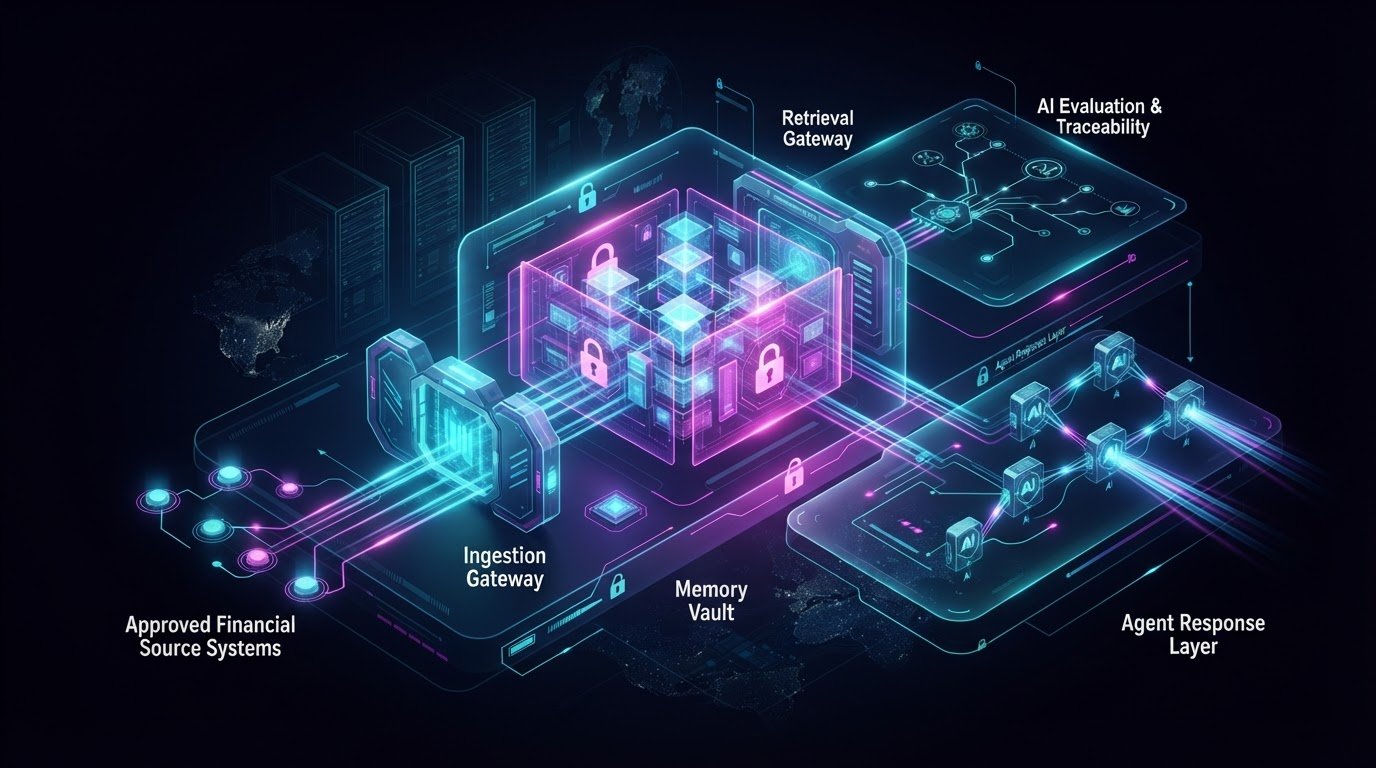
A financial agent should retrieve a narrow slice of approved context, not ingest an entire repository each time it runs. A typical flow moves selected information from governed sources into memory, then retrieves relevant context for the agent’s task. The memory service sits alongside, rather than inside, the model, source systems, or monitoring stack.
Illustrative flow and trust boundaries:
Approved source systems → controlled ingestion → organization-managed boundary: memory storage and retrieval → orchestration layer → LLM provider → response to user
An observability stack records approved operational events across components. It is a separate destination with its own access and retention rules.
Before implementation, map what data crosses each boundary, which components can access it, and what gets recorded. Use the diagram as a reference architecture, not as a specification for any product. Verify actual integrations, data flows, and security controls against the selected deployment.
Where do retrieval, memory, and source records belong?
Source systems remain authoritative. Memory provides context to an agent, but should not silently become the system of record for balances, transactions, or customer profiles. A retrieval result should include enough context for the task and a path back to the approved source when verification is needed.
Graph relationships can connect related entities and facts, such as a policy, a business unit, and an approved procedure. That structure may help retrieval follow relationships, but it does not guarantee relevance or accuracy. Test results against representative queries, and check whether retrieved context points back to the right approved source. MCP can provide an integration protocol between a memory server and compatible clients; it is not an access-control policy or security guarantee. Governance reviews can use frameworks such as the NIST AI Risk Management Framework to structure risk discussions.
What changes when the memory layer is self-hosted?
Self-hosted AI memory for financial services places the memory service on infrastructure managed by the organization or its chosen operator. That changes the operational boundary, not the work required to secure it. Assign clear owners for patching, backups, monitoring, access controls, and incident response. Also decide how the service connects to the LLM and observability stack.
For a deeper look at component boundaries and data movement, see this self-hosted AI memory layer architecture guide. Teams evaluating an implementation can also review the NovaCortex source repository and verify its current deployment requirements and supported integrations before testing it in their environment.
Self-Hosted vs Managed Memory: Compare Control, Risk, and Operations
The hosting choice moves responsibility; it does not erase it. Self-hosted AI memory for financial services can place storage within infrastructure the organization controls, while a managed service may reduce day-to-day platform work. A custom-built layer offers design flexibility but leaves the organization responsible for building and maintaining its own implementation. None is universally safest. Compare the full operating model, then route the decision through risk approval. Governance discussions should also account for transparency and accountability, themes explored in AI governance in financial services.
Evaluation area
Self-hosted
Managed
Custom-built
Data control
Where does data reside, and who operates the environment?
What data is processed or retained, and what do contracts say about location and handling?
Can the design enforce required boundaries, and who validates them?
Operations
Can the team own updates, backups, monitoring, and recovery?
Which operational tasks does the provider handle, and which remain internal?
Can the organization support the service throughout its lifecycle?
Portability
Can memory be exported and migrated in a usable format?
Can data be inspected and retrieved if the service changes?
Are formats and interfaces documented well enough to avoid a one-off dead end?
Integration
Does it fit existing identity, orchestration, and monitoring systems?
Are integrations compatible with the organization’s architecture?
Can the team maintain connectors as systems evolve?
When is self-hosting a better fit for a financial organization?
Self-hosting may suit teams with explicit data-boundary requirements, infrastructure capacity, and clear ownership of integrations. It also demands operational discipline. Before committing, confirm that named staff can maintain updates, backups, monitoring, access controls, and recovery processes. Infrastructure control is not a substitute for security review or risk approval.
How should teams evaluate lock-in and portability?
Test whether memory can be exported, inspected, migrated, and governed independently of a model provider. A portable format can support migration planning, but it does not guarantee effortless interoperability. Check what metadata, relationships, and access rules survive export and import, and whether the destination can use them as intended. For a deeper look at the trade-offs, see this portable memory format guide.
How to Evaluate Security and Governance Before a Financial AI Pilot
A pilot should test the controls around memory, not just whether retrieval produces useful answers. Treat self-hosted AI memory for financial services as a governed data workflow: define what enters, who can retrieve it, what gets recorded, and how the system can be stopped or rolled back.
Deployment location alone does not establish regulatory compliance. GDPR, PCI DSS, SOC 2, and the NIST AI Risk Management Framework raise different obligations or assessment questions. Ask qualified privacy, security, compliance, and legal teams which apply to the use case and how they should shape the pilot. Technical controls support governance; they do not replace legal interpretation or internal approval.
Run a structured pilot review
- Classify data. Identify the information the use case needs, its sensitivity, and what should be excluded or minimized.
- Map data flows. Trace ingestion, memory storage, retrieval, model requests, logs, and deletion across system boundaries.
- Set access. Define approved users and services, then check whether access can be scoped by user, agent, dataset, or operational role.
- Test retrieval. Use approved representative tasks with synthetic or otherwise authorized data. Check relevance, stale or conflicting context, latency, and token consumption against defined expectations.
- Review logs. Confirm what events are recorded, who can inspect them, and whether monitoring and audit needs are met. Verify capabilities in product documentation.
- Define rollback. Specify who can pause the pilot, how memory is disabled or removed, and how teams handle failures or restore service.
Verify controls and failure handling
Ask how authentication and authorization work, how data is encrypted, and how retention, deletion, and backups are handled. Check actual settings and evidence rather than relying on a deployment label or general security statement. Confirm that access boundaries match the intended workflow and that audit logging, monitoring, and incident-response processes are documented for the chosen setup.
Quality testing needs clear limits. Record expected retrieval results and test for irrelevant, outdated, or contradictory memories. Define human review points before outputs influence consequential workflows. Document failure handling and explicitly prohibit actions the agent must not take autonomously. A pilot should show both where memory helps and where it must defer to a person or authoritative system.
Keep the evidence together: data classification, flow diagrams, access decisions, test results, control documentation, and rollback steps. This gives internal reviewers a concrete basis for deciding whether the pilot can proceed, needs remediation, or should stop.
Where NovaCortex Fits in a Self-Hosted Financial AI Evaluation
NovaCortex is one implementation to assess against the architecture, data boundaries, and governance criteria established for a financial AI pilot. Its relevant characteristics include self-hosted deployment, Apache-2.0 licensing for the NovaCortex Self-Hosted Edition, a portable memory format, and graph-native storage. These features can support infrastructure ownership and flexible retrieval, but they do not establish that a deployment meets an organization’s security or compliance requirements.
Which NovaCortex capabilities are relevant to financial teams?
Self-hosting allows the memory layer to run on infrastructure managed by the organization or its chosen operator. That can align with defined data-boundary needs, while leaving the organization responsible for operational work such as updates, backups, monitoring, and recovery. Confirm current deployment requirements and assess the setup against internal controls.
The Portable Memory Format is designed to reduce dependency on a single vendor. Treat portability as a migration capability to test, not a promise of effortless interoperability. Check whether data and relationships can be exported, inspected, and restored in the target environment.
Graph-native storage represents connections between facts and entities. Evaluate whether those relationships help retrieve the context your workflows need, using representative tasks and approved data. NovaCortex also provides an MCP-native memory server, but MCP compatibility alone does not guarantee a fit or a secure integration. Verify the supported clients, data flows, and access boundaries against your intended stack.
NovaCortex reports up to 98% lower token usage compared with sending entire knowledge bases. Treat this as a qualified claim, not an expected result for every workload. Before relying on it, request and review the benchmark methodology, including the comparison baseline, task, dataset, and measurement conditions. Then measure token consumption in your own controlled pilot.
What should teams verify before adopting it?
Review current documentation for deployment requirements, supported integrations, security controls, maintenance responsibilities, and available support options. Verify access boundaries, retrieval behavior, audit requirements, and recovery procedures in a controlled environment. Confirm product-specific controls from current documentation and test them directly rather than assuming them from the self-hosted model or license.
For a practical evaluation of self-hosted AI memory for financial services, start with a narrow, approved use case. Inspect the repository, confirm technical requirements with the teams who will operate and govern the deployment, then test with authorized data. Record retrieval quality, operational findings, and unresolved risks before deciding whether to expand the pilot.
Set the Boundary, Then Test the Fit
A financial AI memory layer should be treated as governed data infrastructure, not disposable prompt context. Keep memory distinct from authoritative source records, define what can persist, and retrieve only the context each task needs. These boundaries make security reviews and pilot decisions more concrete.
Choosing self-hosted AI memory for financial services means weighing infrastructure control against operational responsibility. Compare hosting models using the same criteria, then test access, retrieval quality, logging, and recovery with approved data. A deployment choice alone does not settle security or compliance questions.
NovaCortex is one option to evaluate. Its Self-Hosted Edition is open source under Apache-2.0, supports deployment on infrastructure selected by the organization, and uses a Portable Memory Format designed to reduce vendor lock-in. Treat these as implementation characteristics to verify against your environment, not as a substitute for reviewing controls, integrations, and operational requirements.
Start with a narrow, governed pilot and let evidence guide the next step. Review the NovaCortex repository as a starting point for your technical evaluation.
Frequently Asked Questions
What is self-hosted AI memory for financial services?
Self-hosted AI memory for financial services is a persistent store, deployed on infrastructure selected by the organization, that provides approved context to an AI agent across interactions. Instead of resending a full knowledge collection with every request, an agent can retrieve relevant information from memory. It is distinct from prompts, temporary session state, conversation logs, and authoritative financial source systems.
Is self-hosted AI memory automatically compliant with financial regulations?
No. Hosting memory on infrastructure controlled by an organization does not automatically satisfy applicable regulatory, contractual, or internal requirements. Compliance depends on the use case, data, controls, and broader operating environment. Ask qualified legal, privacy, security, and compliance teams to assess relevant requirements, such as GDPR or PCI DSS where applicable, and document their review. Treat deployment location as one architectural factor, not proof of compliance.
Can financial AI agents store customer or transaction data in persistent memory?
Possibly, but only after the organization determines that the data is appropriate for the specific use case and defines safeguards. Classify information first, minimize what is retained, set access and retention boundaries, and have specialists review customer identifiers and transaction-level records before ingestion. Consider whether the task can use less sensitive or de-identified context. Do not let convenience turn persistent memory into an uncontrolled copy of source data.
How do you secure a self-hosted AI memory layer?
Start by verifying authentication, authorization, encryption, retention, deletion, backup, and recovery controls in the actual deployment. Scope access by user, agent, dataset, or operational role where supported. Review audit logging, monitoring, patching, and incident-response procedures, then test them in a controlled environment. Assign owners for ongoing operations. Self-hosting can give an organization more infrastructure control, but the organization still needs to implement and validate its security controls.
What is the difference between AI memory and a financial system of record?
A financial system of record holds authoritative business data, such as official transaction or account records. AI memory stores selected context to help an agent respond across tasks. It may summarize or connect information, but should not silently replace the source record. Design retrieval so users can verify important facts against the authoritative system, especially when an agent’s output could affect a financial workflow.
Should a financial organization choose self-hosted or managed AI memory?
Choose based on data boundaries, operational capacity, integration needs, portability, and risk review, not on a blanket claim that one model is safest. Self-hosting offers more control over the infrastructure boundary but requires operational ownership. Managed services may reduce platform maintenance, while raising questions about contracts, data location, and vendor dependency. Compare these factors for the specific workflow, then get internal approval before deployment.
How can a team test an AI memory layer before production?
Run a controlled pilot with an approved use case and synthetic or otherwise authorized test data. Measure retrieval relevance, stale or conflicting context, response latency, and token consumption against defined expectations. Test access boundaries, logs, deletion, and recovery as well as answer quality. Document human review points, prohibited autonomous actions, failure handling, and rollback steps. Use the results to decide whether to proceed, remediate, or stop.
FAQ
What does persistent memory change for a financial AI agent?
An AI memory layer is a persistent store that supplies selected, relevant context across agent interactions. Instead of replaying an entire knowledge collection in every session, an agent can retrieve specific facts that help it respond. Memory supports continuity; it does not grant the agent authority to make financial decisions. Keep the architecture boundaries explicit. A prompt is the instruction and context sent for a particular model request. Conversation history records prior exchanges, while session state holds temporary details needed during an active task. Source systems remain the authoritative records. Logs capture system activity for review, and model weights encode learned patterns rather than firm-specific facts. The broader concept of computer memory helps frame storage and retrieval, but an AI memory layer has its own application-level rules for what to retain and return. Consider three illustrative uses. A research assistant could retrieve approved background from earlier work. An internal knowledge tool could surface a relevant procedure without reloading a full document library. A service operations agent could recall a team-approved workflow while a staff member handles a request. In each case, memory supplies context for the task; it does not replace source records or human review.
Which information should stay outside agent memory?
Classify information before ingestion. For each data type, ask whether the agent needs it, how long it should persist, which roles may retrieve it, and how it can be corrected or removed. Data minimization, retention, and access boundaries are decisions for the organization and its qualified risk, security, and compliance teams. They do not follow automatically from a choice of storage model. Self-hosting changes where the memory service runs and who controls its infrastructure. It does not remove governance obligations or resolve questions about permitted data, access, retention, and oversight. For self-hosted AI memory for financial services, control starts with the deployment boundary; governance depends on the policies and controls built around it. A financial agent should retrieve a narrow slice of approved context, not ingest an entire repository each time it runs. A typical flow moves selected information from governed sources into memory, then retrieves relevant context for the agent’s task. The memory service sits alongside, rather than inside, the model, source systems, or monitoring stack. Illustrative flow and trust boundaries: Approved source systems → controlled ingestion → organization-managed boundary: memory storage and retrieval → orchestration layer → LLM provider → response to user An observability stack records approved operational events across components. It is a separate destination with its own access and retention rules. Before implementation, map what data crosses each boundary, which components can access it, and what gets recorded. Use the diagram as a reference architecture, not as a specification for any product. Verify actual integrations, data flows, and security controls against the selected deployment.
Where do retrieval, memory, and source records belong?
Source systems remain authoritative. Memory provides context to an agent, but should not silently become the system of record for balances, transactions, or customer profiles. A retrieval result should include enough context for the task and a path back to the approved source when verification is needed. Graph relationships can connect related entities and facts, such as a policy, a business unit, and an approved procedure. That structure may help retrieval follow relationships, but it does not guarantee relevance or accuracy. Test results against representative queries, and check whether retrieved context points back to the right approved source. MCP can provide an integration protocol between a memory server and compatible clients; it is not an access-control policy or security guarantee. Governance reviews can use frameworks such as the NIST AI Risk Management Framework to structure risk discussions.
What changes when the memory layer is self-hosted?
Self-hosted AI memory for financial services places the memory service on infrastructure managed by the organization or its chosen operator. That changes the operational boundary, not the work required to secure it. Assign clear owners for patching, backups, monitoring, access controls, and incident response. Also decide how the service connects to the LLM and observability stack. For a deeper look at component boundaries and data movement, see this self-hosted AI memory layer architecture guide. Teams evaluating an implementation can also review the NovaCortex source repository and verify its current deployment requirements and supported integrations before testing it in their environment. The hosting choice moves responsibility; it does not erase it. Self-hosted AI memory for financial services can place storage within infrastructure the organization controls, while a managed service may reduce day-to-day platform work. A custom-built layer offers design flexibility but leaves the organization responsible for building and maintaining its own implementation. None is universally safest. Compare the full operating model, then route the decision through risk approval. Governance discussions should also account for transparency and accountability, themes explored in AI governance in financial services. Evaluation area Self-hosted Managed Custom-built Data control Where does data reside, and who operates the environment? What data is processed or retained, and what do contracts say about location and handling? Can the design enforce required boundaries, and who validates them? Operations Can the team own updates, backups, monitoring, and recovery? Which operational tasks does the provider handle, and which remain internal? Can the organization support the service throughout its lifecycle? Portability Can memory be exported and migrated in a usable format? Can data be inspected and retrieved if the service changes? Are formats and interfaces documented well enough to avoid a one-off dead end? Integration Does it fit existing identity, orchestration, and monitoring systems? Are integrations compatible with the organization’s architecture? Can the team maintain connectors as systems evolve?
When is self-hosting a better fit for a financial organization?
Self-hosting may suit teams with explicit data-boundary requirements, infrastructure capacity, and clear ownership of integrations. It also demands operational discipline. Before committing, confirm that named staff can maintain updates, backups, monitoring, access controls, and recovery processes. Infrastructure control is not a substitute for security review or risk approval.
How should teams evaluate lock-in and portability?
Test whether memory can be exported, inspected, migrated, and governed independently of a model provider. A portable format can support migration planning, but it does not guarantee effortless interoperability. Check what metadata, relationships, and access rules survive export and import, and whether the destination can use them as intended. For a deeper look at the trade-offs, see this portable memory format guide. A pilot should test the controls around memory, not just whether retrieval produces useful answers. Treat self-hosted AI memory for financial services as a governed data workflow: define what enters, who can retrieve it, what gets recorded, and how the system can be stopped or rolled back. Deployment location alone does not establish regulatory compliance. GDPR, PCI DSS, SOC 2, and the NIST AI Risk Management Framework raise different obligations or assessment questions. Ask qualified privacy, security, compliance, and legal teams which apply to the use case and how they should shape the pilot. Technical controls support governance; they do not replace legal interpretation or internal approval.
Which NovaCortex capabilities are relevant to financial teams?
Self-hosting allows the memory layer to run on infrastructure managed by the organization or its chosen operator. That can align with defined data-boundary needs, while leaving the organization responsible for operational work such as updates, backups, monitoring, and recovery. Confirm current deployment requirements and assess the setup against internal controls. The Portable Memory Format is designed to reduce dependency on a single vendor. Treat portability as a migration capability to test, not a promise of effortless interoperability. Check whether data and relationships can be exported, inspected, and restored in the target environment. Graph-native storage represents connections between facts and entities. Evaluate whether those relationships help retrieve the context your workflows need, using representative tasks and approved data. NovaCortex also provides an MCP-native memory server, but MCP compatibility alone does not guarantee a fit or a secure integration. Verify the supported clients, data flows, and access boundaries against your intended stack. NovaCortex reports up to 98% lower token usage compared with sending entire knowledge bases. Treat this as a qualified claim, not an expected result for every workload. Before relying on it, request and review the benchmark methodology, including the comparison baseline, task, dataset, and measurement conditions. Then measure token consumption in your own controlled pilot.
What should teams verify before adopting it?
Review current documentation for deployment requirements, supported integrations, security controls, maintenance responsibilities, and available support options. Verify access boundaries, retrieval behavior, audit requirements, and recovery procedures in a controlled environment. Confirm product-specific controls from current documentation and test them directly rather than assuming them from the self-hosted model or license. For a practical evaluation of self-hosted AI memory for financial services, start with a narrow, approved use case. Inspect the repository, confirm technical requirements with the teams who will operate and govern the deployment, then test with authorized data. Record retrieval quality, operational findings, and unresolved risks before deciding whether to expand the pilot. A financial AI memory layer should be treated as governed data infrastructure, not disposable prompt context. Keep memory distinct from authoritative source records, define what can persist, and retrieve only the context each task needs. These boundaries make security reviews and pilot decisions more concrete. Choosing self-hosted AI memory for financial services means weighing infrastructure control against operational responsibility. Compare hosting models using the same criteria, then test access, retrieval quality, logging, and recovery with approved data. A deployment choice alone does not settle security or compliance questions. NovaCortex is one option to evaluate. Its Self-Hosted Edition is open source under Apache-2.0, supports deployment on infrastructure selected by the organization, and uses a Portable Memory Format designed to reduce vendor lock-in. Treat these as implementation characteristics to verify against your environment, not as a substitute for reviewing controls, integrations, and operational requirements. Start with a narrow, governed pilot and let evidence guide the next step. Review the NovaCortex repository as a starting point for your technical evaluation.
What is self-hosted AI memory for financial services?
Self-hosted AI memory for financial services is a persistent store, deployed on infrastructure selected by the organization, that provides approved context to an AI agent across interactions. Instead of resending a full knowledge collection with every request, an agent can retrieve relevant information from memory. It is distinct from prompts, temporary session state, conversation logs, and authoritative financial source systems.
Is self-hosted AI memory automatically compliant with financial regulations?
No. Hosting memory on infrastructure controlled by an organization does not automatically satisfy applicable regulatory, contractual, or internal requirements. Compliance depends on the use case, data, controls, and broader operating environment. Ask qualified legal, privacy, security, and compliance teams to assess relevant requirements, such as GDPR or PCI DSS where applicable, and document their review. Treat deployment location as one architectural factor, not proof of compliance.
Can financial AI agents store customer or transaction data in persistent memory?
Possibly, but only after the organization determines that the data is appropriate for the specific use case and defines safeguards. Classify information first, minimize what is retained, set access and retention boundaries, and have specialists review customer identifiers and transaction-level records before ingestion. Consider whether the task can use less sensitive or de-identified context. Do not let convenience turn persistent memory into an uncontrolled copy of source data.
How do you secure a self-hosted AI memory layer?
Start by verifying authentication, authorization, encryption, retention, deletion, backup, and recovery controls in the actual deployment. Scope access by user, agent, dataset, or operational role where supported. Review audit logging, monitoring, patching, and incident-response procedures, then test them in a controlled environment. Assign owners for ongoing operations. Self-hosting can give an organization more infrastructure control, but the organization still needs to implement and validate its security controls.
What is the difference between AI memory and a financial system of record?
A financial system of record holds authoritative business data, such as official transaction or account records. AI memory stores selected context to help an agent respond across tasks. It may summarize or connect information, but should not silently replace the source record. Design retrieval so users can verify important facts against the authoritative system, especially when an agent’s output could affect a financial workflow.
Should a financial organization choose self-hosted or managed AI memory?
Choose based on data boundaries, operational capacity, integration needs, portability, and risk review, not on a blanket claim that one model is safest. Self-hosting offers more control over the infrastructure boundary but requires operational ownership. Managed services may reduce platform maintenance, while raising questions about contracts, data location, and vendor dependency. Compare these factors for the specific workflow, then get internal approval before deployment.
How can a team test an AI memory layer before production?
Run a controlled pilot with an approved use case and synthetic or otherwise authorized test data. Measure retrieval relevance, stale or conflicting context, response latency, and token consumption against defined expectations. Test access boundaries, logs, deletion, and recovery as well as answer quality. Document human review points, prohibited autonomous actions, failure handling, and rollback steps. Use the results to decide whether to proceed, remediate, or stop.