Self-Hosted AI Memory: Navigating Apache 2.0 and Commercial Licensing
The belief that open-source licensing alone equals enterprise readiness is a dangerous architectural myth. While Apache 2.0 provides a functional foundation, it doesn't shield your infrastructure from the complexities of patent litigation or the chaos of unmanaged context. You're likely feeling the pressure of rising token costs and the looming threat of vendor lock-in from managed services. Securing a self-hosted AI memory commercial license isn't just a compliance checkbox. It's a strategic move to reclaim digital sovereignty and ensure long-term scalability.
We agree that your data belongs under your control, not trapped in a proprietary black box. This article provides a technical blueprint to master the licensing landscape and build a robust, sovereign memory layer. You'll learn how to define the boundaries between open-source cores and commercial tiers to ensure your agent infrastructure remains compliant and efficient. We'll explore the transition to a high-velocity architecture that slashes token waste by up to 98% and provides the multi-user controls your enterprise requires for production-grade deployment.
Key Takeaways
- Define the evolution from stateless LLM interactions to persistent, stateful memory engines that power autonomous agents.
- Navigate the legal protections of Apache 2.0 and determine when your infrastructure requires a self-hosted AI memory commercial license for enterprise-grade security.
- Unlock a 98% reduction in token waste by implementing graph-native storage and high-velocity context retrieval.
- Establish a sovereign data layer using the Portable Memory Format (PMF) to maintain total control over your organizational knowledge.
- Identify the architectural requirements for multi-user controls and RBAC that ensure your AI deployments remain compliant and scalable.
The Rise of Self-Hosted AI Memory Infrastructure
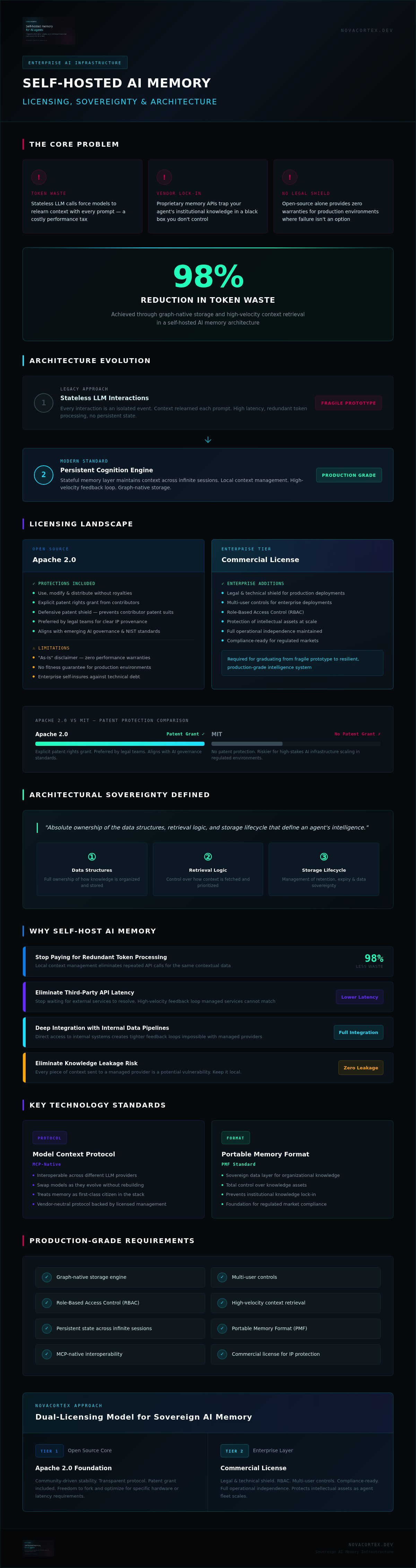
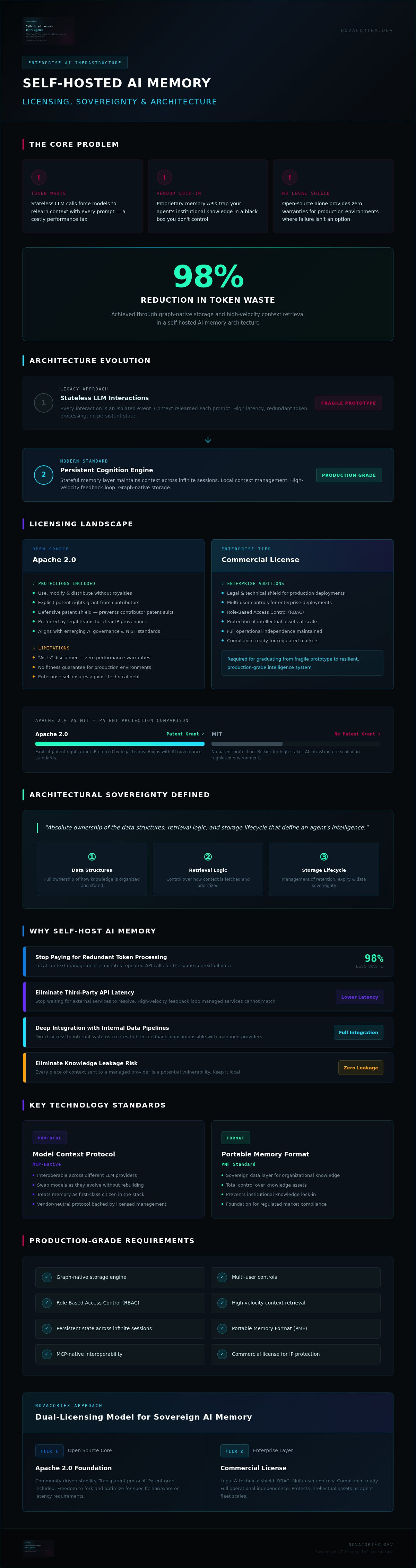
Stateless LLM calls are a performance tax. Early AI implementations treated every interaction as an isolated event, forcing the model to relearn context with every prompt. This approach is architectural waste. Modern agents require a persistent cognition engine. We define the AI memory layer as the dedicated infrastructure that maintains state, history, and context across infinite sessions. It transforms a reactive chatbot into a proactive agent. By 2026, the industry has reached a breaking point with managed vector databases. High latency, opaque pricing, and rigid schemas are driving enterprises toward self-hosted alternatives. Sovereignty is no longer a luxury; it's a requirement for survival in a regulated market.
The shift to stateful architectures is a move toward efficiency. When context is managed locally, you stop paying for redundant token processing. You stop waiting for third-party APIs to resolve. Self-hosting allows for deeper integration with internal data pipelines, creating a high-velocity feedback loop that managed services cannot match. For many organizations, securing a self-hosted AI memory commercial license is the first step in graduating from a fragile prototype to a resilient, production-grade intelligence system.
The Sovereignty Crisis in AI Development
Vendor lock-in is a slow-motion disaster for enterprise architecture. Relying on proprietary memory APIs means your agent's institutional knowledge is trapped in a black box. This creates a massive knowledge leakage risk. Every piece of context sent to a managed provider is a potential vulnerability. Architectural sovereignty in AI memory is the absolute ownership of the data structures, retrieval logic, and storage lifecycle that define an agent's intelligence. Without this control, you don't own your AI; you're just renting it. Transitioning to an enterprise-grade framework under a self-hosted AI memory commercial license provides the legal and technical shield necessary to protect these intellectual assets while maintaining full operational independence.
MCP-Native Memory: The New Integration Standard
Integration used to be a nightmare of custom wrappers and fragile middleware. The Model Context Protocol (MCP) has eliminated that friction. It's the new standard for memory servers, ensuring that your memory layer remains interoperable across different LLM providers. Using the Apache 2.0 license for the core protocol ensures transparency and community-driven stability. However, enterprise scaling demands more than just basic connectivity. It requires vendor-neutral protocols backed by licensed management tools. MCP-native architecture allows you to swap models as they evolve without rebuilding your entire memory foundation. It treats memory as a first-class citizen in the stack, independent of the compute layer.
Understanding Apache 2.0 in the Context of AI Memory
Apache 2.0 is the industry standard for permissive infrastructure. It grants developers the freedom to use, modify, and distribute software without paying royalties. For AI memory layers, this permissiveness is vital. It allows teams to fork core logic and optimize it for specific hardware or latency requirements. However, this freedom comes with an "As-Is" disclaimer. Open-source maintainers provide the code but offer zero warranties regarding performance or fitness for a particular purpose. This is the primary driver behind the transition to a self-hosted AI memory commercial license for production environments where failure isn't an option. Without a commercial tier, your enterprise is essentially self-insuring against technical debt and architectural flaws.
Patent Protection and Intellectual Property
Startups often overlook the legal nuances of the Patent Grant clause. Unlike the MIT license, Apache 2.0 includes an explicit grant of patent rights from contributors to users. This creates a defensive shield. It prevents a contributor from later suing you for patent infringement based on the code they provided. For high-stakes AI infrastructure, this protection is non-negotiable. Legal teams prioritize Apache 2.0 over MIT because it aligns with emerging AI governance and standards that demand clear intellectual property provenance. It ensures your memory layer doesn't become a legal liability as your agent fleet scales. If you're building a persistent cognition engine, you need the peace of mind that your foundation won't be pulled out from under you by a patent troll.
The Redistribution Reality for AI Startups
Building a commercial product on top of an open-source engine is a common strategy. Apache 2.0 facilitates this by allowing you to bundle the software into a proprietary offering. You must maintain the original copyright notices and include a copy of the license. This creates a legal "Safe Harbour" where developers can innovate on top of proven foundations without the overhead of building every data structure from scratch. Apache 2.0 provides a clear path for redistribution that protects both the original author and the secondary developer. While the core remains open, the management layer often requires the advanced features found in a self-hosted AI memory commercial license. This hybrid approach balances speed with enterprise-grade governance. You can explore the core implementation on GitHub to see how these licensing principles apply to real-world memory architecture and start building your sovereign stack today.
Commercial Licenses vs. Open Source: Bridging the Enterprise Gap
The "Open Core" model is the dominant architecture for persistent AI memory. Apache 2.0 gives you the raw engine. It handles the basic storage and retrieval logic. But for an enterprise, the raw engine isn't enough. You need the management layer. This is where a self-hosted AI memory commercial license becomes essential. It bridges the gap between a hobbyist project and a production-grade cognition engine. While the core code is free, the features that keep your data safe and your agents organized are found in the commercial tier.
Security isn't a suggestion. It's a requirement. Open-source cores rarely include Role-Based Access Control (RBAC) or native multi-tenancy. Without these, your internal data is a flat file accessible to any agent in the fleet. This lack of structure leads to cross-contamination and security breaches. Regulatory bodies are increasingly focused on regulatory considerations for AI infrastructure and data sovereignty, making local control over memory access a legal necessity. A commercial agreement provides the indemnification and liability coverage that "As-Is" open-source licenses lack.
When Apache 2.0 is Not Enough
Enterprises don't operate in a vacuum. You have auditors. You have compliance officers. Apache 2.0 doesn't provide audit logs or granular multi-user controls. If you're running air-gapped systems or high-compliance workloads, you need hardened security features. These are the tools that prevent context leakage between different user sessions. Moving to a licensed model allows for custom redistribution terms that standard permissive licenses don't support. It ensures your infrastructure is ready for the scrutiny of an enterprise security review.
The ROI of Licensed Support
Maintenance is a silent killer of engineering velocity. Every hour your senior devs spend debugging memory retrieval is an hour they aren't building product. Licensed support provides direct access to the engineers who wrote the core. This isn't just about fixing bugs; it's about architectural optimization. With specialized support, you can fine-tune your retrieval logic to achieve a 98% reduction in token waste. This direct ROI often covers the cost of the self-hosted AI memory commercial license within months. Efficiency is the ultimate competitive advantage. You can verify the performance of the core engine by reviewing the NovaCortex repository before committing to an enterprise tier.
Evaluating Your Licensing Needs for Scalable AI Memory
Scaling an agent fleet forces a hard look at infrastructure. A single agent prototype is easy to manage. A thousand production agents handling diverse data streams is a different reality. You must assess your data volume and the sensitivity of the knowledge being stored. If you're managing proprietary IP or customer data, a basic open-source setup lacks the multi-tenancy required for safety. A self-hosted AI memory commercial license isn't just a legal requirement for certain scales; it's the gateway to enterprise governance. It ensures your memory layer remains a robust cognition engine rather than a fragmented liability.
Technical efficiency is the only way to maintain margins as you scale. Inefficient context retrieval doesn't just slow down your agents; it drains your budget. Every irrelevant token sent to an LLM is a sunk cost. By prioritizing a memory layer that integrates deeply with your stack, you reclaim control over your operational expenses. Consider these evaluation factors:
- Fleet Size: Does your architecture support concurrent memory access for hundreds of agents?
- Data Sensitivity: Do you need air-gapped security or advanced encryption at rest?
- Compliance: Are you required to provide audit logs for every context retrieval?
- Integration: Does your stack require a native MCP-Native Memory Server for cross-model interoperability?
The Token Efficiency Metric
Token waste is a systemic flaw in standard RAG implementations. Most systems rely on raw vector search, which often returns noisy context. NovaCortex changes this equation. Using graph-native retrieval, we reduce token usage by up to 98%. This level of precision is the direct result of a specialized memory architecture. When you calculate the delta between wasteful context and lean, high-velocity retrieval, the ROI becomes undeniable. Linking your service tier to these performance metrics ensures your self-hosted AI memory commercial license pays for itself through reduced API overhead. Efficiency is the ultimate competitive advantage in a high-token-cost environment.
Data Portability and Future-Proofing
Sovereignty requires the ability to move. You can't be truly independent if your data is trapped in a proprietary format. The Portable Memory Format for AI is our answer to the vendor lock-in cycle. It ensures your Knowledge Buckets remain accessible and interoperable, regardless of your current licensing tier. This standard-setting approach keeps your long-term AI memory healthy. It allows for a seamless transition between different hosting models. To see how these choices stack up against other architectures, read our analysis of Self-Hosted vs Managed AI Memory and how it solves agent amnesia.
NovaCortex: A Dual-Licensing Model for Sovereign AI Memory
NovaCortex is the architectural correction the industry needs. We've built the NovaCortex Self-Hosted Edition to provide a high-velocity path from experimentation to enterprise-grade deployment. The core logic remains open under Apache 2.0, ensuring transparency and community stability. However, scaling an agent fleet requires more than just raw storage. It requires a self-hosted AI memory commercial license to unlock the management tools necessary for production environments. This dual-licensing model respects your need for open-source flexibility while providing the professional-grade security your organization demands.
Deployment is a matter of choice, not a technical hurdle. Our architecture is designed to run on everything from a Raspberry Pi for edge computing to an Enterprise VPS for massive context loads. Because NovaCortex is an MCP-Native Memory Server, it integrates directly with any agent framework using the Model Context Protocol. You aren't building custom connectors; you're using a standard that ensures your memory layer is as portable as your agents. This is digital sovereignty in practice.
Enterprise-Grade Management and Security
Organizations scaling AI agents cannot afford flat data structures. We introduced Knowledge Buckets to provide logical isolation for sensitive data. This feature allows you to segment context by department, user, or security level, preventing the risk of knowledge leakage. When you secure a self-hosted AI memory commercial license, you gain access to these advanced management features along with Role-Based Access Control (RBAC). For air-gapped or high-compliance environments, NovaCortex provides the sovereign deployment options needed to maintain absolute data privacy without sacrificing the 98% token reduction our graph-native retrieval provides.
Get Started with Sovereign Memory
Moving from a community core to an enterprise-ready system shouldn't involve a migration nightmare. Our use of the Portable Memory Format (PMF) ensures that your data remains interoperable as you scale. You can transition from the Apache 2.0 core to a commercial license without re-indexing your entire knowledge base. This path provides you with dedicated support and custom licensing terms that standard open-source agreements lack. It's time to reclaim your context and build on a foundation that respects your ownership.
Secure Your Architectural Sovereignty
Digital sovereignty is the only viable path for production-grade AI. Relying on opaque managed services invites vendor lock-in and unpredictable context latency. You now have the technical blueprint to navigate the transition from permissive open-source cores to enterprise-ready management systems. Securing a self-hosted AI memory commercial license is the definitive move that transforms raw data into a governed, multi-user cognition engine. This transition isn't just about compliance; it's about architectural performance. By implementing graph-native storage precision and an MCP-Native architecture, you eliminate the systemic waste inherent in standard RAG pipelines. Achieving a 98% reduction in token usage provides the direct ROI required to justify your architectural independence. Your agents deserve a memory layer that remains as lean as it is secure. Reclaim your context and build for the long term.
Your infrastructure is your competitive edge. Take control of your data and start building a high-velocity, sovereign memory layer today.
Frequently Asked Questions
Is the Apache 2.0 license truly free for commercial use in AI memory?
Apache 2.0 allows you to use, modify, and distribute software for any purpose, including commercial products. It's a permissive license that requires you to include the original copyright and license notice. While the code is free, you bear all risk under the "As-Is" clause. Organizations requiring indemnification or advanced governance often transition to a self-hosted AI memory commercial license to secure their infrastructure against legal and operational gaps that open source cannot cover.
What are the main differences between NovaCortex Apache 2.0 and the commercial license?
The Apache 2.0 version provides the core graph-native storage and retrieval engine. It's built for developers who need a sovereign memory layer. The commercial license adds the enterprise management stack. This includes Knowledge Buckets for data isolation, Role-Based Access Control (RBAC), and multi-user governance tools. You also get dedicated support and service level agreements (SLAs) that ensure your production agents maintain high-velocity performance without downtime or context leakage across different user sessions.
Can I redistribute NovaCortex as part of my own commercial AI agent platform?
You can redistribute the Apache 2.0 core as part of your platform, provided you follow the notice requirements. However, if your platform requires advanced multi-tenancy or if you want to offer the software under proprietary terms without disclosing the source, you need a self-hosted AI memory commercial license. This path simplifies compliance for SaaS providers. It allows you to build a scalable agent infrastructure while leveraging NovaCortex as a robust, enterprise-grade memory backbone for your customers.
Does a commercial license for AI memory include patent protection?
Apache 2.0 includes an explicit patent grant from contributors, which is a significant advantage over the MIT license. This protects you from patent litigation related to the core code. A commercial license takes this further by providing legal indemnification. While the open-source version is provided without warranty, the commercial agreement offers the liability protection that enterprise legal teams require. It ensures your organization isn't exposed when deploying high-stakes AI infrastructure in regulated industries.
How does self-hosting AI memory reduce token costs by 98%?
Standard RAG systems often overwhelm LLMs by dumping entire document chunks into the context window. This creates massive token waste. NovaCortex uses graph-native storage to index relationships between data points. Our retrieval engine identifies the precise fragments needed for a specific query, reducing token usage by up to 98%. This high-velocity approach slashes API costs and improves model reasoning by providing a lean, relevant context window instead of a bloated, noisy data dump.
What happens to my data if I stop paying for a commercial license?
Your data remains your property. Because NovaCortex uses the Portable Memory Format (PMF), your knowledge is never trapped in a proprietary silo. If you terminate a commercial agreement, you retain access to your stored data and the core Apache 2.0 functionality. You only lose access to the advanced management interface, multi-user controls, and dedicated support. This architecture ensures digital sovereignty by preventing vendor lock-in, allowing you to move your memory layer between different hosting tiers as needed.
Is NovaCortex compatible with the Model Context Protocol (MCP)?
NovaCortex is an MCP-Native Memory Server. It's designed to function as a standardized bridge between your stored knowledge and any LLM that supports the Model Context Protocol. This native integration eliminates the need for complex, custom middleware. It ensures that your memory layer is interoperable across different agent frameworks and model providers. By following this standard, NovaCortex allows you to swap models or tools without rebuilding your entire memory infrastructure or losing persistent context.
Do I need a commercial license for a single-user self-hosted deployment?
A single-user deployment typically doesn't require a commercial license. The Apache 2.0 edition provides all the necessary tools for individual developers or small-scale sovereign projects. You get the full power of graph-native retrieval and PMF support. The commercial tier is designed for organizations that need to manage multiple users, enforce strict access controls, or require enterprise-grade security audits. If you aren't scaling an agent fleet across a team, the open-source core is your starting point.
FAQ
Is the Apache 2.0 license truly free for commercial use in AI memory?
Apache 2.0 allows you to use, modify, and distribute software for any purpose, including commercial products. It's a permissive license that requires you to include the original copyright and license notice. While the code is free, you bear all risk under the "As-Is" clause. Organizations requiring indemnification or advanced governance often transition to a self-hosted AI memory commercial license to secure their infrastructure against legal and operational gaps that open source cannot cover.
What are the main differences between NovaCortex Apache 2.0 and the commercial license?
The Apache 2.0 version provides the core graph-native storage and retrieval engine. It's built for developers who need a sovereign memory layer. The commercial license adds the enterprise management stack. This includes Knowledge Buckets for data isolation, Role-Based Access Control (RBAC), and multi-user governance tools. You also get dedicated support and service level agreements (SLAs) that ensure your production agents maintain high-velocity performance without downtime or context leakage across different user sessions.
Can I redistribute NovaCortex as part of my own commercial AI agent platform?
You can redistribute the Apache 2.0 core as part of your platform, provided you follow the notice requirements. However, if your platform requires advanced multi-tenancy or if you want to offer the software under proprietary terms without disclosing the source, you need a self-hosted AI memory commercial license. This path simplifies compliance for SaaS providers. It allows you to build a scalable agent infrastructure while leveraging NovaCortex as a robust, enterprise-grade memory backbone for your customers.
Does a commercial license for AI memory include patent protection?
Apache 2.0 includes an explicit patent grant from contributors, which is a significant advantage over the MIT license. This protects you from patent litigation related to the core code. A commercial license takes this further by providing legal indemnification. While the open-source version is provided without warranty, the commercial agreement offers the liability protection that enterprise legal teams require. It ensures your organization isn't exposed when deploying high-stakes AI infrastructure in regulated industries.
How does self-hosting AI memory reduce token costs by 98%?
Standard RAG systems often overwhelm LLMs by dumping entire document chunks into the context window. This creates massive token waste. NovaCortex uses graph-native storage to index relationships between data points. Our retrieval engine identifies the precise fragments needed for a specific query, reducing token usage by up to 98%. This high-velocity approach slashes API costs and improves model reasoning by providing a lean, relevant context window instead of a bloated, noisy data dump.
What happens to my data if I stop paying for a commercial license?
Your data remains your property. Because NovaCortex uses the Portable Memory Format (PMF), your knowledge is never trapped in a proprietary silo. If you terminate a commercial agreement, you retain access to your stored data and the core Apache 2.0 functionality. You only lose access to the advanced management interface, multi-user controls, and dedicated support. This architecture ensures digital sovereignty by preventing vendor lock-in, allowing you to move your memory layer between different hosting tiers as needed.
Is NovaCortex compatible with the Model Context Protocol (MCP)?
NovaCortex is an MCP-Native Memory Server. It's designed to function as a standardized bridge between your stored knowledge and any LLM that supports the Model Context Protocol. This native integration eliminates the need for complex, custom middleware. It ensures that your memory layer is interoperable across different agent frameworks and model providers. By following this standard, NovaCortex allows you to swap models or tools without rebuilding your entire memory infrastructure or losing persistent context.
Do I need a commercial license for a single-user self-hosted deployment?
A single-user deployment typically doesn't require a commercial license. The Apache 2.0 edition provides all the necessary tools for individual developers or small-scale sovereign projects. You get the full power of graph-native retrieval and PMF support. The commercial tier is designed for organizations that need to manage multiple users, enforce strict access controls, or require enterprise-grade security audits. If you aren't scaling an agent fleet across a team, the open-source core is your starting point.