Self-Hosted AI Middleware: Engineering the Sovereign Agent Stack in 2026

Your cloud AI provider is a leak. Every token sent to a third-party API is a tax on your sovereignty and a liability on your balance sheet. By 2026, relying on stateless cloud models for agentic workflows is a structural failure. You've seen the spiralling costs of cloud RAG and the inconsistent memory that plagues generic agents. You're right to be concerned about data privacy leaks. The industry is reaching a breaking point where performance requires independence. Deploying self-hosted AI middleware is no longer an edge case; it's the foundation of the sovereign agent stack.
We agree that the current dependency on bloated, restrictive systems is unsustainable. This article demonstrates why moving to self-hosted AI middleware is the critical move for achieving a 90% reduction in token waste and absolute data sovereignty. You'll discover how to architect a system using MCP-native memory servers and the Portable Memory Format (PMF) to ensure your agents possess interoperable, persistent memory. We provide a technical blueprint for building a lean, high-velocity infrastructure that keeps your data where it belongs: under your control.
Key Takeaways
- Transition from fragile cloud-dependent APIs to a local-first architecture to reclaim data sovereignty and eliminate privacy leaks.
- Learn why self-hosted AI middleware is the essential orchestration layer for managing persistent context and model communication in 2026.
- Move beyond limited vector databases toward graph-native storage to preserve data hierarchies and improve complex agent reasoning.
- Implement Model Context Protocol (MCP) standards to ensure your agent stack remains interoperable and free from proprietary vendor lock-in.
- Drastically lower operational overhead by using context-aware filtering to achieve up to a 98% reduction in unnecessary token consumption.
The Great Decoupling: Why Self-Hosted AI Middleware is Trending
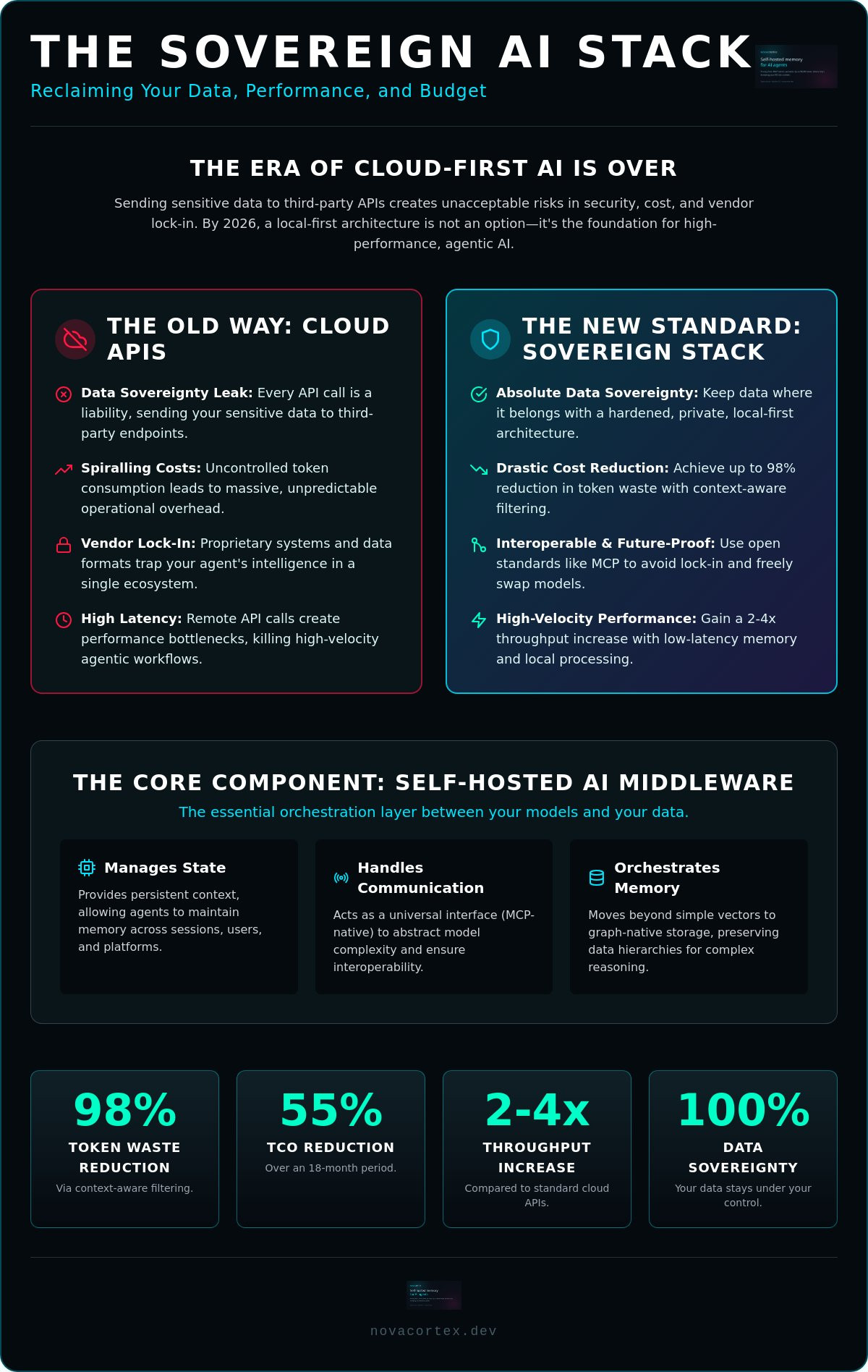
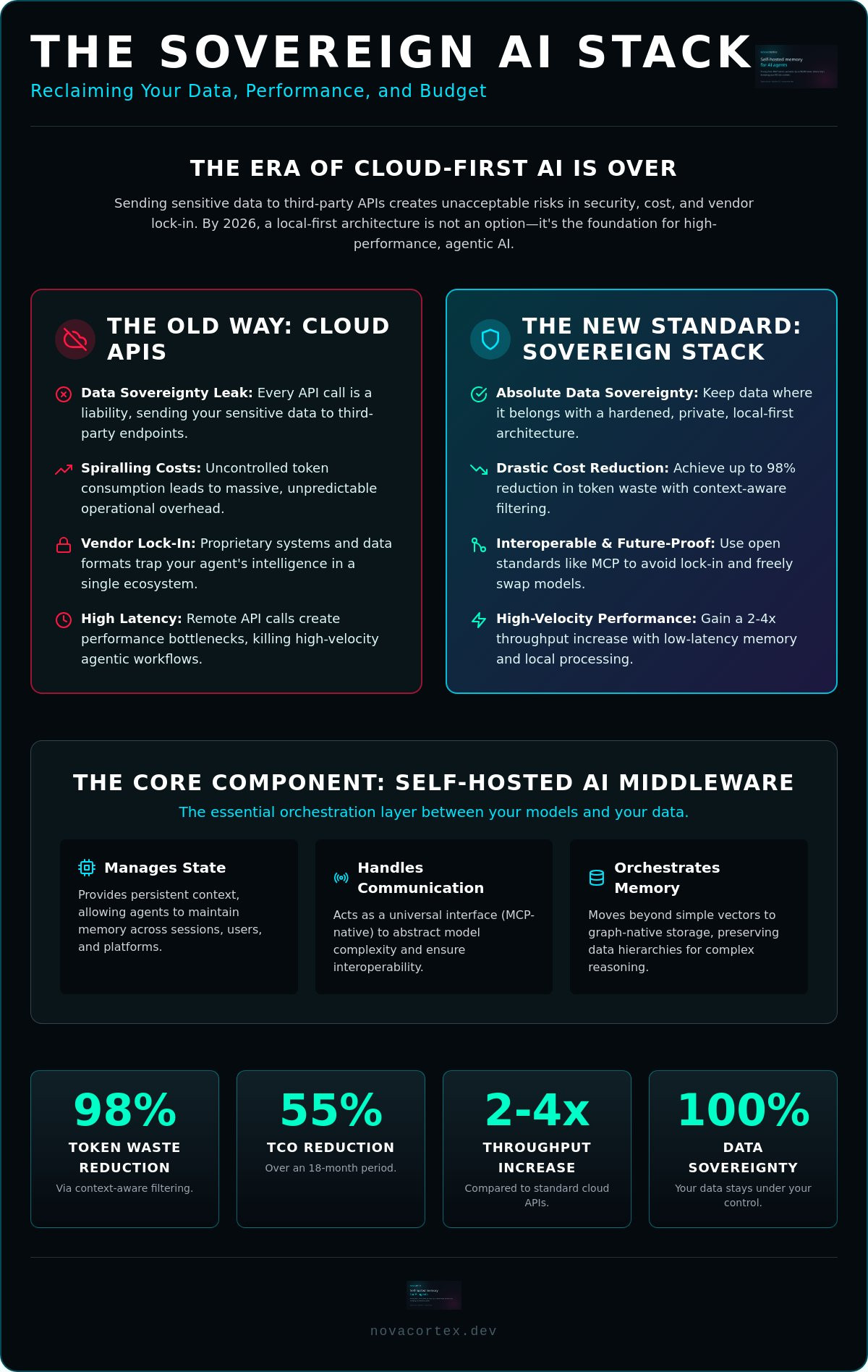
The era of cloud-first AI is ending. By 2026, the architectural liability of sending sensitive enterprise data to third-party endpoints has become too high to ignore. Organizations are moving away from monolithic dependencies; they are reclaiming the stack. This transition to local-first environments isn't just a trend. It's a necessary correction to the security and cost flaws inherent in early cloud-based agent frameworks.
At the center of this shift is Middleware. In the AI stack, this layer acts as the connective tissue between raw models and persistent cognition. It manages state, handles model communication, and orchestrates complex memory retrieval. Self-hosted AI middleware is the only way to ensure this orchestration happens in an isolated, controlled environment. It turns a leaky API-only framework into a hardened, private system that keeps your data where it belongs.
Sovereignty Over Convenience
The black box approach to AI is no longer acceptable. Engineers demand total visibility into the context layer to understand how agents are making decisions. Regulatory pressure is a major driver here. With the EU AI Act’s Article 50 coming into effect on August 2, 2026, and the Connecticut Data Privacy Act amendments active as of July 1, 2026, data control is now mandatory. This environment requires vendor-neutral AI storage to avoid the intelligence tax of proprietary clouds. If your agent's memory is locked in a cloud provider's database, you don't own your agent's intelligence. Sovereignty is the only hedge against vendor lock-in.
The Performance Paradox
Speed is the currency of autonomous agents. Cloud latency is the silent killer of high-velocity workflows. An agent that waits for a remote API response is an agent that lags behind the real-time needs of the business. By moving to private infrastructure, teams can implement low-latency AI memory that responds in milliseconds. Recent benchmarks show that using self-hosted AI middleware with frameworks like vLLM, which reached version 0.25.1 in July 2026, can provide a 2-4x throughput increase compared to standard cloud APIs. When you factor in that self-hosting can lead to a 55% reduction in TCO over 18 months, the move from cloud to local isn't just about privacy. It's about engineering a leaner, faster machine.
Engineering Persistent Context: The Role of MCP-Native Middleware
Statelessness is the enemy of agentic autonomy. In 2026, the industry has consolidated around the Model Context Protocol (MCP) to solve the fragmentation of AI integrations. MCP acts as the universal interface, a standard that allows models to interact with external tools and memory without custom, brittle codebases. By adopting an MCP-native approach, developers ensure their agents aren't just reacting to the last prompt, but are operating within a continuous, persistent environment. This is where self-hosted AI middleware becomes indispensable. It abstracts the underlying complexity of switching between models like Llama 3 or specialized coding LLMs, ensuring your agent logic remains intact even when you swap the inference engine.
Building a sovereign stack requires more than just local compute. It requires an architecture that survives the next model upgrade cycle. When you decouple the memory layer from the LLM provider, you eliminate the risk of proprietary lock-in. This architectural independence is a core recommendation for organizations following the NIST AI Risk Management Framework to build trustworthy, resilient systems. Middleware provides this decoupling by serving as the persistent context layer, allowing agents to maintain state across sessions, users, and platforms.
Standardising Agent Communication
The MCP native memory server is the 2026 architect’s choice for a reason. It provides a standardized protocol for multi-agent synchronization, ensuring that different agents can access a shared pool of knowledge without data collisions. This setup treats memory as a global resource rather than a model-specific silo. It is the only way to build complex, multi-agent workflows that remain stable under enterprise-scale loads.
The Middleware Layer Defined
AI middleware is the protocol-driven layer that manages persistent agent state. To understand its position, map the sovereign stack: Hardware, OS, Model, Middleware, and finally, the Agent. In this hierarchy, middleware functions as the "Knowledge Router" for RAG workflows, filtering and directing context to reduce noise. You can examine the implementation details of these routing protocols in our open-source repository. This layer is what transforms a raw self-hosted AI middleware deployment into a high-functioning cognitive engine.
Persistent context is the differentiator. Session-based memory is temporary and fragile; it disappears the moment the process ends. Persistent context, managed through specialized middleware, allows an agent to remember a technical decision made six months ago and apply it to a new deployment today. This level of reliability is what separates an experimental chatbot from a production-ready autonomous agent.
Beyond Vector Search: The Shift to Graph-Native Memory Architectures
Vector search is a blunt instrument. It relies on mathematical proximity in a high-dimensional space; it ignores the semantic relationships that define complex logic. For an agent to function as more than a retrieval script, it needs a memory layer that understands hierarchy and causality. Relying solely on vector embeddings leads to context fragmentation and systemic inefficiency. In 2026, the transition to self-hosted AI middleware that integrates graph-native storage is the only way to support sophisticated reasoning. This architecture moves beyond simple keyword matching toward true relational understanding.
The shift isn't about abandoning vectors. It's about Hybrid Retrieval. Vectors are excellent for "fuzzy" matching; graphs are superior for traversing explicit links. This architectural evolution is central to the development of Persistent Personal Assistants that actually retain knowledge across disparate tasks. Without a graph layer, agents lose the thread of multi-step processes. They become stateless entities trapped in a stateful world. By combining these methodologies, you eliminate the "intelligence tax" of repeated, failed retrievals and incoherent agent responses.
Vector vs. Graph: The Context War
Vector search fails at multi-hop reasoning. If you ask an agent to trace a decision through a chain of command, vector retrieval returns a list of related documents but fails to connect the actors. This failure is a primary source of agentic hallucinations. By utilizing high-performance AI memory that prioritizes relational data, you give the agent a map, not just a list of coordinates. Graph-native structures provide the rigid logic required for enterprise-grade stability. They replace the guesswork of proximity with the certainty of defined connections.
Modular Knowledge Buckets
Stop dumping raw data into your self-hosted AI middleware. The "data dump" approach creates cognitive noise that chokes context windows and inflates token waste. In 2026, the standard is structured Knowledge Buckets. These are discrete, manageable units of memory that allow for precise retrieval and tiered access controls. This modularity ensures that the agent's context remains relevant and lean.
- Relevance Scoring: Middleware evaluates the utility of a bucket before passing it to the LLM to ensure only high-impact data consumes the context window.
- TTL (Time-to-Live): Temporary context expires automatically to prevent memory bloat and maintain a lean, high-velocity stack.
- Access Control: Modularity enables granular permissions. You can ensure agents only "remember" what they are authorized to see in complex, multi-user environments.
This modularity is what allows the sovereign stack to scale. It transforms a messy pile of embeddings into a high-velocity cognitive stack that respects both performance and privacy. By organizing memory into Knowledge Buckets, you provide the structure necessary for agents to perform long-term, multi-objective tasks without losing their way in a sea of irrelevant tokens.
Strategic Implementation: Reducing Token Waste and Vendor Lock-in
Local compute is not a license for architectural sloppiness. Many engineers fall into the trap of assuming that because they aren't paying per-token API fees, context window efficiency no longer matters. This is a fallacy. VRAM is a finite resource; context window bloat is the primary bottleneck for high-performance agentic stacks. Massive context injections increase time-to-first-token (TTFT) and degrade model reasoning capabilities. Deploying self-hosted AI middleware allows for precise context management that preserves hardware longevity and minimizes latency. Efficiency is the difference between a responsive agent and a system that chokes on its own history.
The 98% Token Reduction Framework
Brute force context dumping is engineering malpractice. Effective self-hosted AI middleware utilizes selective retrieval and recursive summarization to keep the context window lean. By leveraging the graph-native structures discussed in previous sections, the system identifies only the most relevant nodes for any given query. This targeted approach can reduce the volume of data sent to the inference engine by up to 98%. It ensures that the model focuses on the signal rather than drowning in the noise of irrelevant conversation history. Token efficiency is an engineering requirement, not a cloud-only concern. Even on private hardware, every wasted token is a tax on system throughput and agent intelligence.
- Selective Retrieval: Querying only relevant Knowledge Buckets instead of the entire database.
- Recursive Summarization: Distilling long-term memories into high-density semantic snapshots.
- Context Pruning: Automatically removing redundant or low-relevance tokens before inference.
Eliminating Vendor Lock-in
Proprietary memory formats are the new silos. In 2026, the danger isn't just model lock-in; it's the inability to migrate your agent's cognitive history between environments. If your data is trapped in a non-standardized vector store, you're tethered to that provider's roadmap. The solution is the portable memory format for AI (PMF). PMF ensures that your graph-native memory is interoperable across different hardware and middleware versions. It allows you to move your stack from a local Raspberry Pi testing environment to an enterprise VPS without losing a single bit of relational context. Building with Apache-2.0 licensed middleware ensures your stack remains sovereign and future-proof. You own the model, you own the hardware, and with PMF, you finally own the memory.
Migrating from cloud-managed memory to a self-hosted layer requires a phased approach. Start by mirroring cloud context to a local PMF-compliant store. Once the local graph reaches parity, pivot the orchestration layer to prioritize the self-hosted middleware. This strategy ensures zero downtime while reclaiming your data sovereignty. It's a calculated move toward a leaner, more resilient infrastructure that rejects the bloat of external dependencies.
NovaCortex: Deploying a Privacy-First Memory Layer
NovaCortex Self-Hosted Edition is the definitive solution for the sovereign agent stack. It isn't just a database. It's a specialized orchestration layer designed for agentic cognition in isolated environments. Whether you're running on a Raspberry Pi for edge processing or an enterprise VPS for global operations, NovaCortex provides the necessary scale without sacrificing data ownership. It is built on the core principles of digital sovereignty. It rejects the pay-to-play model of cloud memory entirely. By implementing self-hosted AI middleware like NovaCortex, you ensure your agent's intelligence remains a private, high-performance asset.
Architecture for Digital Sovereignty
Privacy is a foundation, not a feature. NovaCortex uses Knowledge Buckets to enforce strict data segregation. This is essential for enterprise environments where multi-user controls are mandatory. You can isolate sensitive HR data from general operational knowledge while using a single middleware instance. This is the technical advantage of a graph-native architecture. It allows for complex relational queries without the cross-contamination risks inherent in flat vector stores. The Portable Memory Format (PMF) ensures this data is never trapped. You own the schema. You own the storage. You own the intelligence.
Management features in NovaCortex are built for scale. Organizations can define specific access tiers, ensuring that agents only retrieve the context they are authorized to handle. This reduces context window pressure and prevents data leaks within the organization. It's a lean, modular approach to memory that treats context as a governed resource. This level of control is impossible in black-box cloud environments where data is often co-mingled or used for provider-side training. By maintaining local control, you bypass the structural vulnerabilities of third-party API dependencies.
Getting Started with NovaCortex
Deployment is direct. The MCP-native memory server integrates seamlessly with your existing local models. If you're running Llama 3 via Ollama or high-throughput inference with vLLM, which reached version 0.25.1 in July 2026, NovaCortex acts as the cognitive bridge. The setup process respects your time and your hardware. You aren't forced into a specific ecosystem; you are given the tools to build your own.
- Pull the NovaCortex Docker image to your local hardware or private VPS.
- Initialize your Knowledge Buckets based on specific agentic requirements.
- Connect your local model endpoints using the standardized Model Context Protocol.
- Configure the TTL and relevance scoring to maintain a high-velocity stack.
This setup eliminates the latency of cloud hops. It provides a 2-4x throughput increase for language model inference compared to API-based alternatives. You aren't just building a chatbot. You're engineering a sovereign cognitive system that survives the next model upgrade. The shift to self-hosted AI middleware is the only way to build agents that are both intelligent and independent. Reclaim your stack and secure your data.
Deploy NovaCortex Self-Hosted Edition
Reclaim Your Cognitive Stack
The Great Decoupling is a technical necessity. By 2026, the architectural liability of cloud-managed memory has become unsustainable. We've established that self-hosted AI middleware is the bridge between raw local compute and persistent agent cognition. You now have the blueprint to replace leaky, stateless APIs with a graph-native memory layer that understands relationships, not just mathematical proximity. This transition ensures your agents function as coherent, reliable entities rather than fragmented retrieval scripts.
Efficiency remains the ultimate engineering metric. By leveraging MCP-native memory servers and Knowledge Buckets, you can achieve up to a 98% reduction in token waste while maintaining absolute data sovereignty. This isn't just about privacy; it's about building high-velocity systems that outperform bloated cloud dependencies. The tools are ready. The protocols are standardized. It's time to stop renting intelligence and start owning your cognitive stack. Your infrastructure should be as independent as the agents you build.
Take control of your agent's memory and performance. The path to independent, production-ready AI is open. Build with confidence and secure your digital future. Reclaiming your stack is the only way to lead in the age of autonomous agents.
Frequently Asked Questions
What is self-hosted AI middleware exactly?
Self-hosted AI middleware is the orchestration layer that manages state, memory, and model communication on your own infrastructure. It acts as the connective tissue between raw inference engines and autonomous agents. By deploying this locally, you replace fragile cloud dependencies with a hardened, private system. This layer is essential for engineering a sovereign stack where data never leaves your controlled environment.
How does self-hosted middleware reduce LLM token costs?
Middleware reduces costs by implementing context-aware filtering and selective retrieval. Instead of dumping raw data into the context window, it identifies the most relevant nodes within your Knowledge Buckets. This precision reduces context window pressure and results in a 98% reduction in token waste. It ensures your hardware resources are focused on signal rather than processing irrelevant background noise.
Can I run NovaCortex on my own hardware like a Raspberry Pi?
Yes. NovaCortex Self-Hosted Edition is designed for maximum deployment flexibility. Its lean architecture allows it to run effectively on low-power hardware like a Raspberry Pi for edge use cases. For larger implementations, it scales seamlessly to enterprise VPS environments. This portability ensures that your memory layer can follow your agents wherever the compute is located.
What is the difference between a vector database and an AI memory layer?
Traditional vector databases rely on mathematical proximity, which often fails at multi-hop reasoning. An AI memory layer like NovaCortex uses graph-native storage to preserve explicit relationships and hierarchies between data points. This structure prevents the hallucinations and context fragmentation that occur when agents lose the semantic thread in a flat vector space.
Does NovaCortex support the Model Context Protocol (MCP)?
NovaCortex is built as an MCP-Native Memory Server. It utilizes the Model Context Protocol to provide a standardized interface for agents and tools. This native support ensures that your self-hosted AI middleware remains interoperable with the broader AI ecosystem. It allows for multi-agent synchronization and tool integration without the need for brittle, custom-coded connectors.
Why is a portable memory format important for AI agents?
The Portable Memory Format (PMF) prevents cognitive lock-in. It allows you to migrate an agent's relational history between different hardware and middleware versions without losing semantic integrity. Without a portable format, your agent's intelligence is trapped in a proprietary silo. PMF ensures your data remains a sovereign asset that moves with your infrastructure.
Is NovaCortex open source?
NovaCortex is open source under the Apache-2.0 license. This commitment to transparency allows engineers to audit the codebase and customize the memory layer for specific architectural needs. Open-source licensing ensures that your sovereign stack is built on a foundation of vendor neutrality. It guarantees that you maintain control over your agentic infrastructure indefinitely.
How does self-hosting improve AI agent privacy?
Self-hosting eliminates the risk of data leaks via third-party APIs. By running your memory and orchestration layers locally, you keep sensitive information within your private security perimeter. This approach ensures compliance with strict regulations like the EU AI Act. Using self-hosted AI middleware transforms data privacy from a compliance check into a core architectural advantage for your organization.
FAQ
What is self-hosted AI middleware exactly?
Self-hosted AI middleware is the orchestration layer that manages state, memory, and model communication on your own infrastructure. It acts as the connective tissue between raw inference engines and autonomous agents. By deploying this locally, you replace fragile cloud dependencies with a hardened, private system. This layer is essential for engineering a sovereign stack where data never leaves your controlled environment.
How does self-hosted middleware reduce LLM token costs?
Middleware reduces costs by implementing context-aware filtering and selective retrieval. Instead of dumping raw data into the context window, it identifies the most relevant nodes within your Knowledge Buckets. This precision reduces context window pressure and results in a 98% reduction in token waste. It ensures your hardware resources are focused on signal rather than processing irrelevant background noise.
Can I run NovaCortex on my own hardware like a Raspberry Pi?
Yes. NovaCortex Self-Hosted Edition is designed for maximum deployment flexibility. Its lean architecture allows it to run effectively on low-power hardware like a Raspberry Pi for edge use cases. For larger implementations, it scales seamlessly to enterprise VPS environments. This portability ensures that your memory layer can follow your agents wherever the compute is located.
What is the difference between a vector database and an AI memory layer?
Traditional vector databases rely on mathematical proximity, which often fails at multi-hop reasoning. An AI memory layer like NovaCortex uses graph-native storage to preserve explicit relationships and hierarchies between data points. This structure prevents the hallucinations and context fragmentation that occur when agents lose the semantic thread in a flat vector space.
Does NovaCortex support the Model Context Protocol (MCP)?
NovaCortex is built as an MCP-Native Memory Server. It utilizes the Model Context Protocol to provide a standardized interface for agents and tools. This native support ensures that your self-hosted AI middleware remains interoperable with the broader AI ecosystem. It allows for multi-agent synchronization and tool integration without the need for brittle, custom-coded connectors.
Why is a portable memory format important for AI agents?
The Portable Memory Format (PMF) prevents cognitive lock-in. It allows you to migrate an agent's relational history between different hardware and middleware versions without losing semantic integrity. Without a portable format, your agent's intelligence is trapped in a proprietary silo. PMF ensures your data remains a sovereign asset that moves with your infrastructure.
Is NovaCortex open source?
NovaCortex is open source under the Apache-2.0 license. This commitment to transparency allows engineers to audit the codebase and customize the memory layer for specific architectural needs. Open-source licensing ensures that your sovereign stack is built on a foundation of vendor neutrality. It guarantees that you maintain control over your agentic infrastructure indefinitely.
How does self-hosting improve AI agent privacy?
Self-hosting eliminates the risk of data leaks via third-party APIs. By running your memory and orchestration layers locally, you keep sensitive information within your private security perimeter. This approach ensures compliance with strict regulations like the EU AI Act. Using self-hosted AI middleware transforms data privacy from a compliance check into a core architectural advantage for your organization.