Self-Hosted LLM Memory Layer: Engineering Sovereign Agent Context in 2026

Your AI agent's amnesia isn't a hardware limitation; it's a deliberate architectural failure born from cloud dependency. When 44% of companies cite data privacy as their primary barrier to AI adoption, the standard practice of dumping sensitive context into proprietary vector databases is no longer viable. You need a self-hosted LLM memory layer that prioritizes local control over vendor-locked APIs. It's the only way to stop the bleed of inefficient, bloated token usage. Lean systems require better logic.
You already know that long-running sessions shouldn't feel like starting from zero every hour. You're tired of watching your margins evaporate into the void of redundant context windows. This article provides the blueprint to end that cycle. You'll master the engineering required to eliminate agent amnesia while maintaining 100% data sovereignty. We're moving beyond simple semantic search. We'll explore how to deploy a production-ready system using NovaCortex Self-Hosted Edition and the Portable Memory Format (PMF). This briefing details how to achieve a 90%+ reduction in token waste through MCP-native memory servers and modular Knowledge Buckets.
Key Takeaways
- Eliminate the "Context Tax" by replacing transient RAG with a persistent, external cognition engine designed for long-running sessions.
- Compare graph-native and vector-only architectures to enable deep relational reasoning and superior chain-of-thought retrieval.
- Reclaim 100% data ownership by deploying a self-hosted LLM memory layer that bypasses the security risks and costs of managed cloud providers.
- Future-proof your agentic stack with the Model Context Protocol (MCP) and Portable Memory Format (PMF) to ensure seamless state transfer between models.
- Deploy a production-ready, Apache-2.0 licensed memory server to achieve 90%+ reductions in token waste while maintaining total local control.
Beyond Transient Context: The Case for a Dedicated Memory Layer
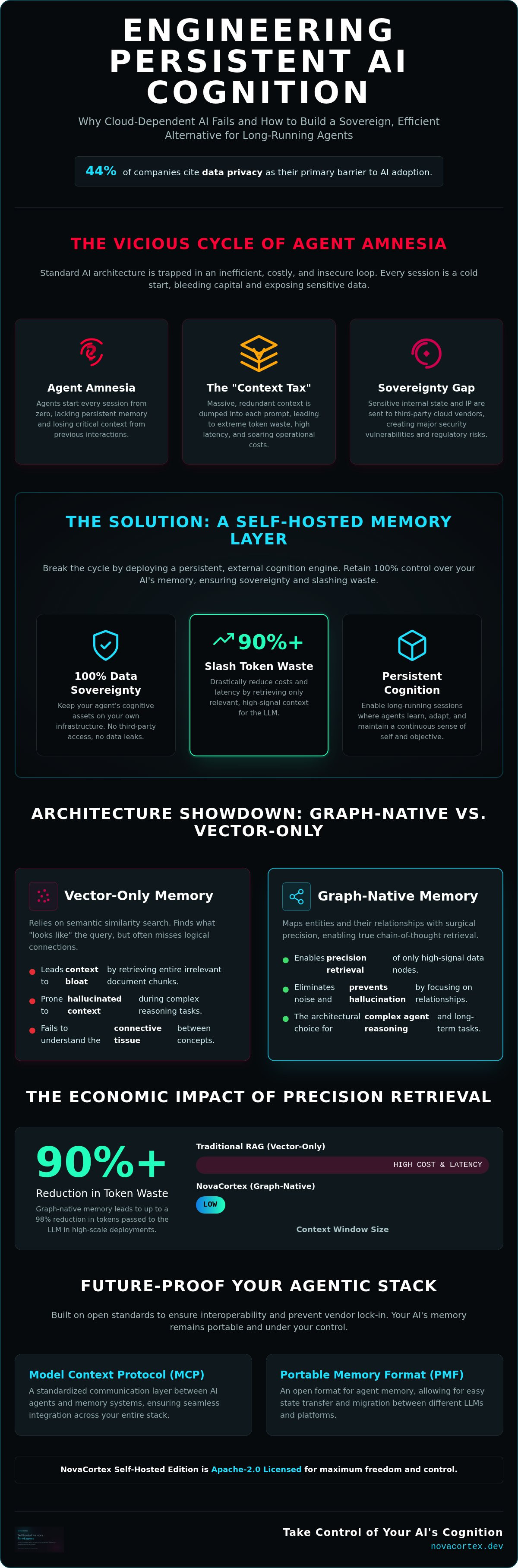
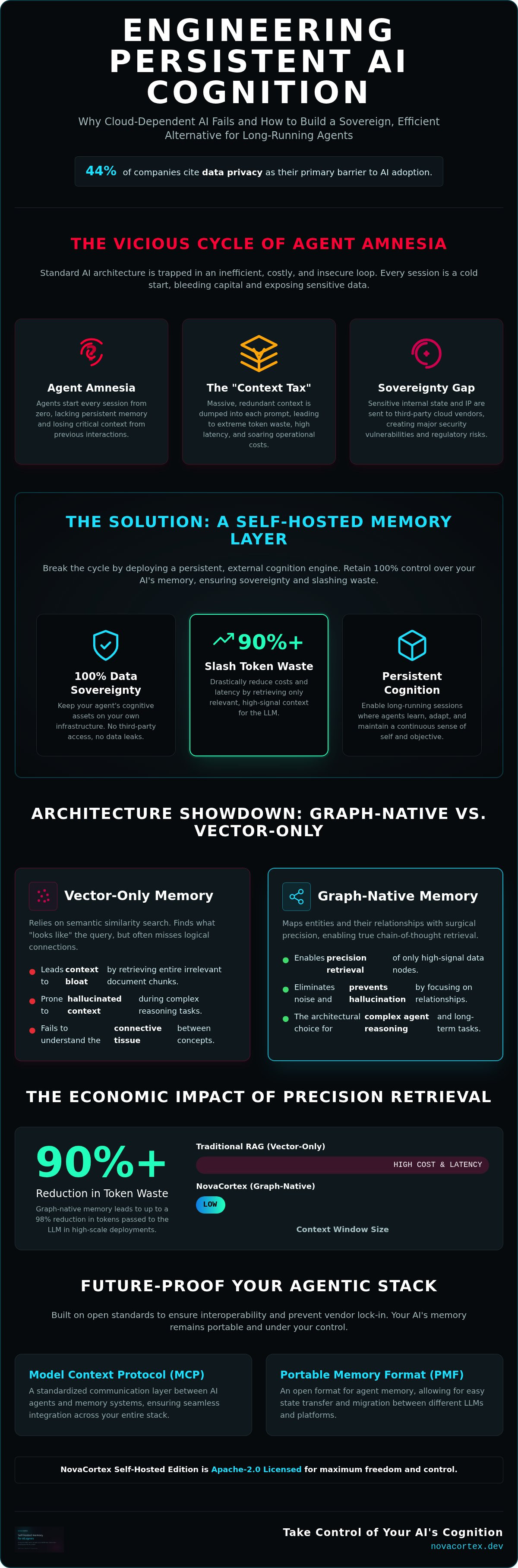
A self-hosted LLM memory layer is not a temporary cache or a glorified buffer. It is an external, persistent cognition engine designed to provide agents with a continuous sense of self and objective. In 2026, the transition from stateless API calls to stateful agentic workflows is mandatory for production utility. Relying on transient context windows is an engineering dead end. It forces agents to operate in a perpetual state of "Day Zero," where every interaction is a cold start. We are moving toward self-hosted AI memory layers to solve this fundamental architectural flaw.
We must address the "Context Tax." Standard RAG and context-dumping strategies are economically unsustainable. When you shove tens of thousands of tokens into a prompt to maintain state, you aren't just increasing latency. You're burning capital. Every redundant token processed by an LLM is a direct tax on your operational margins. Efficient builders don't dump context; they manage it through a structured, sovereign layer that selectively retrieves only what is essential for the current task.
The Failure of Traditional RAG
Traditional RAG depends on a Vector database to perform semantic retrieval. It's a useful tool for search, but a poor substitute for memory. Vector search alone frequently results in hallucinated context during complex reasoning tasks because it lacks relational depth. It finds what is "similar," not necessarily what is "relevant" to the logic chain. High-volume retrieval loops create a massive latency bottleneck that kills agent responsiveness. This leads to data amnesia. Agents lose the thread in long-running tasks, drifting away from the primary objective as the context window fills with noise. They forget the "why" behind their actions.
The Sovereignty Mandate
Digital sovereignty is a non-negotiable requirement. Sending your agent's internal state and history to a third-party cloud is an architectural vulnerability. It's a leak of intellectual property and operational intelligence. Regulatory frameworks like the GDPR and the 2026 updates to the AI Act demand strict local control over data processing. A recent survey indicated that 44% of organizations view data privacy as the single largest barrier to AI integration. Engineering for offline-first or air-gapped environments is the only way to ensure 100% data sovereignty. Managed memory providers offer convenience at the cost of your autonomy. True builders choose the self-hosted LLM memory layer to maintain control over their most sensitive cognitive assets.
Graph-Native vs. Vector-Only: Choosing Your Storage Architecture
Vector databases are built for similarity search. They excel at finding blocks of text that look like your query, but they fail at understanding the connective tissue between concepts. In a self-hosted LLM memory layer, relying solely on vector search is a recipe for context bloat. You end up dumping entire documents into the context window just to capture a single relevant fact. This is why the industry is shifting toward graph-native storage. The debate between Redis vs graph memory for AI agents highlights a critical fork in the road: do you want a fast cache or a relational mind?
The Precision of Graph-Native Retrieval
Knowledge graphs map entities and their relationships with surgical precision. Unlike the flat structure of vector embeddings, graph-native memory allows an agent to traverse links between ideas. This enables "chain-of-thought" retrieval. When an agent recalls a specific user preference, it automatically activates connected nodes representing related past decisions or constraints. This selective node activation reduces noise by ensuring the context window only contains high-signal data. Graph-native memory is the architecture of choice for complex agent reasoning. By focusing on the relationship between data points rather than just semantic similarity, you eliminate the "hallucinated context" that plagues standard RAG setups.
Token Efficiency Benchmarks
The economic advantage of graph-native storage is undeniable. In high-scale deployments, retrieving only relevant nodes instead of entire document chunks leads to a 98% reduction in token usage. Modern research into dynamic memory management for LLMs confirms that optimizing how state is handled is the primary lever for performance. Vector search often results in "context bloating" during long agentic loops, as the system repeatedly retrieves redundant information. Graph traversal maintains a lean state by pinpointing exact data requirements. While vector search latency is predictable, graph-native systems offer superior intelligence density. You're paying for reasoning, not for the LLM to read through irrelevant noise. You can inspect the production benchmarks to see how this architecture sustains high-velocity agent performance without the traditional cloud tax.
The Sovereignty Gap: Why Managed Memory Layers Fail Builders
Managed memory providers market themselves as the "production-ready" choice, but they obscure a critical reality: they are black boxes. When you outsource your agent's context, you fall into a Proprietary Trap. These services keep their most effective retrieval algorithms closed-source, forcing you to rely on their specific optimizations without any visibility into the logic. This isn't just a technical inconvenience. It's an architectural vulnerability. The debate between self-hosted vs managed AI memory isn't just about the monthly bill; it's about who owns the cognitive state of your agents.
The total cost of ownership (TCO) for managed infrastructure often scales poorly as your agentic workflows expand. High-frequency memory writes and complex relational lookups incur heavy API costs that don't exist in a self-hosted LLM memory layer. Builders are realizing that sovereignty and performance are inextricably linked. If you don't control the storage format, you don't control the intelligence.
Ending Vendor Lock-in
Proprietary memory formats create "memory silos." Once your agent's knowledge is trapped in a provider's database, migrating to a different LLM or a more efficient retrieval system becomes a nightmare. These providers use opaque serialization that makes your data non-portable. This is why the industry is returning to Apache-2.0 licensed infrastructure. By adopting a transparent taxonomy of LLM memory, you ensure that your agent's history remains accessible and interoperable. You shouldn't need a provider's permission to move your own data. Open standards are the only defense against the looming threat of vendor lock-in.
Local Performance Optimization
Speed is a feature. Managed memory layers rely on external API calls that introduce significant network latency. A self-hosted LLM memory layer eliminates these round-trips entirely. By leveraging local NVMe storage and high-speed RAM, you can achieve sub-10ms retrieval times. This level of responsiveness is essential for real-time agentic loops where every millisecond counts. You can scale your memory layer on a private VPS, a local server cluster, or even a Raspberry Pi for edge applications. The hardware is yours. The performance is guaranteed.
Some argue that self-hosting is too complex for small teams. This is a myth perpetuated by those who profit from your dependency. Modern containerization and MCP-native servers have reduced the deployment overhead to minutes. You don't need a massive DevOps team to run a sovereign stack. You just need the right architecture.
Architecting for Interoperability: MCP and Portable Formats
Interoperability is the final pillar of a sovereign agent stack. Without it, you have simply traded a cloud silo for a local one. The Model Context Protocol (MCP) serves as the universal language that bridges the gap between your agents and your data. By deploying a self-hosted LLM memory layer that is MCP-native, you decouple the intelligence from the storage. This protocol, governed by the Agentic AI Foundation since its transition from Anthropic in late 2024, ensures that your infrastructure remains model-agnostic and framework-independent. You aren't just building a database; you're building a standardized communication channel for cognition.
Sovereignty requires more than just local storage. It requires a Portable Memory Format (PMF) to prevent your data from becoming stagnant. PMF is a JSON-based serialization standard proposed in May 2026 that allows you to move an agent's entire cognitive state between different environments or LLM providers. Without this, you remain locked in, even if the server is under your desk. A self-hosted LLM memory layer built on PMF ensures that as models evolve, your agent's history and learned relationships evolve with them.
The MCP-Native Advantage
The primary advantage of MCP is its ability to allow any agent framework, whether it's CrewAI, AutoGen, or LangGraph, to communicate with a single memory server. Standardizing the interface between long-term memory and the LLM context window eliminates the need for brittle, custom-coded connectors. Setting up an MCP native memory server simplifies the developer workflow by providing drop-in compatibility. You build the logic once. You deploy it across your entire agentic fleet. This architecture ensures that your memory layer acts as a centralized source of truth, rather than a fragmented collection of framework-specific caches.
Implementing Knowledge Buckets
We manage state through Knowledge Buckets. These are modular containers designed for specific agent tasks or domains. Instead of a monolithic data dump, Knowledge Buckets allow you to partition memory. This makes it possible to sync and export specific subsets of knowledge across different environments using the PMF standard. You can move a "Research Bucket" from a local dev machine to a production cluster without losing the relational depth of the graph. PMF ensures your agent’s memory is as portable as your code. This modularity is what allows for high-velocity scaling in multi-agent systems where specialized agents must share state without creating a context bottleneck.
NovaCortex: The Production-Ready Self-Hosted Memory Layer
NovaCortex Self-Hosted Edition is the architectural correction to the sovereignty gap. It is the definitive self-hosted LLM memory layer for builders who refuse to compromise on data ownership. While competitors push managed black boxes that hide their retrieval logic, NovaCortex operates on an Apache-2.0 open-source core. This isn't a marketing slogan; it's a "privacy-first" engineering ethos. It ensures your agent's cognitive state stays within your security perimeter, where it belongs. You own the code. You own the context. You own the future of your AI stack.
The feature set is a direct response to the inefficiencies of the current market. By combining graph-native storage with MCP-native connectivity and PMF-enabled state management, NovaCortex eliminates the trade-offs between power and privacy. You get the 98% token reduction of relational retrieval without the vulnerability of cloud-locked data. You aren't just deploying a database. You're installing a sovereign cognition engine that scales with your ambition rather than your provider's pricing tiers.
Enterprise-Grade Management
Scaling from a single local agent to an organizational fleet requires robust governance. NovaCortex provides advanced multi-user controls and enhanced security protocols designed specifically for high-stakes environments. It manages the transition from local dev environments to production clusters with zero friction. If your organization requires non-Apache-2.0 terms or dedicated architectural support, commercial licenses are available. This provides the stability of enterprise software without the bloat of traditional corporate AI platforms. You keep the control. We provide the infrastructure.
Getting Started with NovaCortex
Deployment is engineered for speed. You can launch NovaCortex via Docker or on a private VPS in minutes, bypassing the complexity often associated with self-hosted stacks. The setup process is direct. Once the container is active, you connect your first agent via the MCP-native server. Whether you're using CrewAI, LangGraph, or a custom framework, the integration is a drop-in operation. There are no proprietary SDKs to learn and no hidden API costs to monitor. Your self-hosted LLM memory layer scales with your local hardware, ensuring that your operational costs remain predictable as your agentic capabilities grow.
Deploy NovaCortex Self-Hosted Edition today
Engineering Sovereign Agent Intelligence
Engineering for the future of AI requires a fundamental rejection of cloud-locked, transient memory. By deploying a self-hosted LLM memory layer, you replace bloated context windows with a lean, graph-native architecture that treats agent history as a relational asset. This shift isn't just about privacy; it's about operational efficiency. You're building a persistent cognition engine that remains model-agnostic and fully under your control.
The architecture is clear. An MCP-native system built on an Apache-2.0 open-source core provides the stability and 98% token reduction required for production-scale agent fleets. You no longer have to choose between advanced reasoning and data ownership. By adopting the Portable Memory Format (PMF), you ensure that your agent's learned state is as portable as your code.
Reclaim your digital sovereignty. Stop paying the "context tax" to providers who keep their best algorithms in a black box. The tools to build stateful, sovereign agents are ready for deployment on your own infrastructure.
Take the lead in the agentic revolution. Build with confidence and own your intelligence.
Frequently Asked Questions
What exactly is a self-hosted LLM memory layer?
A self-hosted LLM memory layer is an external, persistent cognition engine deployed on your own infrastructure. It moves beyond transient context windows to store agent state locally. This architecture prevents agent amnesia by ensuring long-term knowledge is retrieved selectively rather than dumped into the prompt. It acts as the central source of truth for your agentic workflows while maintaining 100% data sovereignty and total control over your most sensitive cognitive assets.
How does graph-native memory reduce token usage by 98%?
Graph-native storage maps specific entities and relationships instead of storing flat document chunks. When an agent queries a self-hosted LLM memory layer, the system traverses relevant nodes rather than pulling entire files. This surgical precision eliminates the context tax associated with standard vector search. You only process the exact facts required for the reasoning step, which results in a 98% reduction in token usage for high-scale production environments.
Can I use NovaCortex with frameworks like LangChain or AutoGen?
Yes, NovaCortex is designed for universal compatibility via its MCP-native memory server. This standardized interface allows any agent framework, including LangChain, AutoGen, and CrewAI, to connect to the memory layer without brittle, custom connectors. You simply point your framework's tool-calling logic to the NovaCortex endpoint. This decoupling ensures your memory remains framework-agnostic and fully portable across different development stacks. It simplifies the developer workflow while maintaining high-velocity performance across your agent fleet.
Do I need a GPU to run a self-hosted memory layer?
No, a dedicated GPU is not a requirement for hosting the memory layer itself. The system is optimized for high-velocity performance on standard CPU architectures. Retrieval and graph traversal prioritize local NVMe storage and RAM efficiency over raw parallel processing power. While the LLM performing the reasoning might require a GPU, the self-hosted LLM memory layer operates leanly on standard VPS or local server hardware. This keeps your operational costs predictable and your infrastructure manageable.
What is the Portable Memory Format (PMF) and why does it matter?
The Portable Memory Format (PMF) is a JSON-based open standard for serializing an agent's cognitive state. It matters because it prevents vendor lock-in. PMF allows you to export an agent's entire history and learned relationships from one system and import them into another. This ensures your data isn't trapped in a proprietary database. It makes your agent's memory as portable and interoperable as your source code, allowing for seamless migration between different models or environments.
Is NovaCortex truly open source?
Yes, the core of NovaCortex is released under the Apache-2.0 license. This permissive license allows you to inspect, modify, and deploy the software on your own infrastructure without restrictive proprietary hooks. We believe digital sovereignty requires total transparency. For organizations needing advanced multi-user controls or dedicated support, we offer commercial licenses and a managed edition. However, the foundational memory server remains open and accessible to all builders committed to privacy-first engineering and open standards.
How does a self-hosted memory layer improve AI agent privacy?
Privacy is improved by keeping the agent's internal state within your own security perimeter. Traditional managed memory layers force you to externalize sensitive context to third-party clouds, creating an architectural vulnerability. A self-hosted LLM memory layer ensures that zero data leaves your local environment during the retrieval process. This approach is essential for meeting strict regulatory requirements like the GDPR or the 2026 AI Act updates. You maintain absolute control over your agent's history and knowledge.
What hardware is required to host my own memory server?
The hardware requirements are remarkably lean. You can deploy NovaCortex on a private VPS, a local server cluster, or even a Raspberry Pi for edge applications. High-speed NVMe storage and at least 8GB of RAM are recommended for sub-10ms retrieval times in production environments. Because the system focuses on efficient graph traversal rather than heavy inference, it doesn't require the massive compute clusters associated with model training. This allows for sovereign memory deployment at a fraction of cloud costs.
FAQ
What exactly is a self-hosted LLM memory layer?
A self-hosted LLM memory layer is an external, persistent cognition engine deployed on your own infrastructure. It moves beyond transient context windows to store agent state locally. This architecture prevents agent amnesia by ensuring long-term knowledge is retrieved selectively rather than dumped into the prompt. It acts as the central source of truth for your agentic workflows while maintaining 100% data sovereignty and total control over your most sensitive cognitive assets.
How does graph-native memory reduce token usage by 98%?
Graph-native storage maps specific entities and relationships instead of storing flat document chunks. When an agent queries a self-hosted LLM memory layer, the system traverses relevant nodes rather than pulling entire files. This surgical precision eliminates the context tax associated with standard vector search. You only process the exact facts required for the reasoning step, which results in a 98% reduction in token usage for high-scale production environments.
Can I use NovaCortex with frameworks like LangChain or AutoGen?
Yes, NovaCortex is designed for universal compatibility via its MCP-native memory server. This standardized interface allows any agent framework, including LangChain, AutoGen, and CrewAI, to connect to the memory layer without brittle, custom connectors. You simply point your framework's tool-calling logic to the NovaCortex endpoint. This decoupling ensures your memory remains framework-agnostic and fully portable across different development stacks. It simplifies the developer workflow while maintaining high-velocity performance across your agent fleet.
Do I need a GPU to run a self-hosted memory layer?
No, a dedicated GPU is not a requirement for hosting the memory layer itself. The system is optimized for high-velocity performance on standard CPU architectures. Retrieval and graph traversal prioritize local NVMe storage and RAM efficiency over raw parallel processing power. While the LLM performing the reasoning might require a GPU, the self-hosted LLM memory layer operates leanly on standard VPS or local server hardware. This keeps your operational costs predictable and your infrastructure manageable.
What is the Portable Memory Format (PMF) and why does it matter?
The Portable Memory Format (PMF) is a JSON-based open standard for serializing an agent's cognitive state. It matters because it prevents vendor lock-in. PMF allows you to export an agent's entire history and learned relationships from one system and import them into another. This ensures your data isn't trapped in a proprietary database. It makes your agent's memory as portable and interoperable as your source code, allowing for seamless migration between different models or environments.
Is NovaCortex truly open source?
Yes, the core of NovaCortex is released under the Apache-2.0 license. This permissive license allows you to inspect, modify, and deploy the software on your own infrastructure without restrictive proprietary hooks. We believe digital sovereignty requires total transparency. For organizations needing advanced multi-user controls or dedicated support, we offer commercial licenses and a managed edition. However, the foundational memory server remains open and accessible to all builders committed to privacy-first engineering and open standards.
How does a self-hosted memory layer improve AI agent privacy?
Privacy is improved by keeping the agent's internal state within your own security perimeter. Traditional managed memory layers force you to externalize sensitive context to third-party clouds, creating an architectural vulnerability. A self-hosted LLM memory layer ensures that zero data leaves your local environment during the retrieval process. This approach is essential for meeting strict regulatory requirements like the GDPR or the 2026 AI Act updates. You maintain absolute control over your agent's history and knowledge.
What hardware is required to host my own memory server?
The hardware requirements are remarkably lean. You can deploy NovaCortex on a private VPS, a local server cluster, or even a Raspberry Pi for edge applications. High-speed NVMe storage and at least 8GB of RAM are recommended for sub-10ms retrieval times in production environments. Because the system focuses on efficient graph traversal rather than heavy inference, it doesn't require the massive compute clusters associated with model training. This allows for sovereign memory deployment at a fraction of cloud costs.