Stateful AI Agent Architecture: Engineering Persistent Cognition in 2026

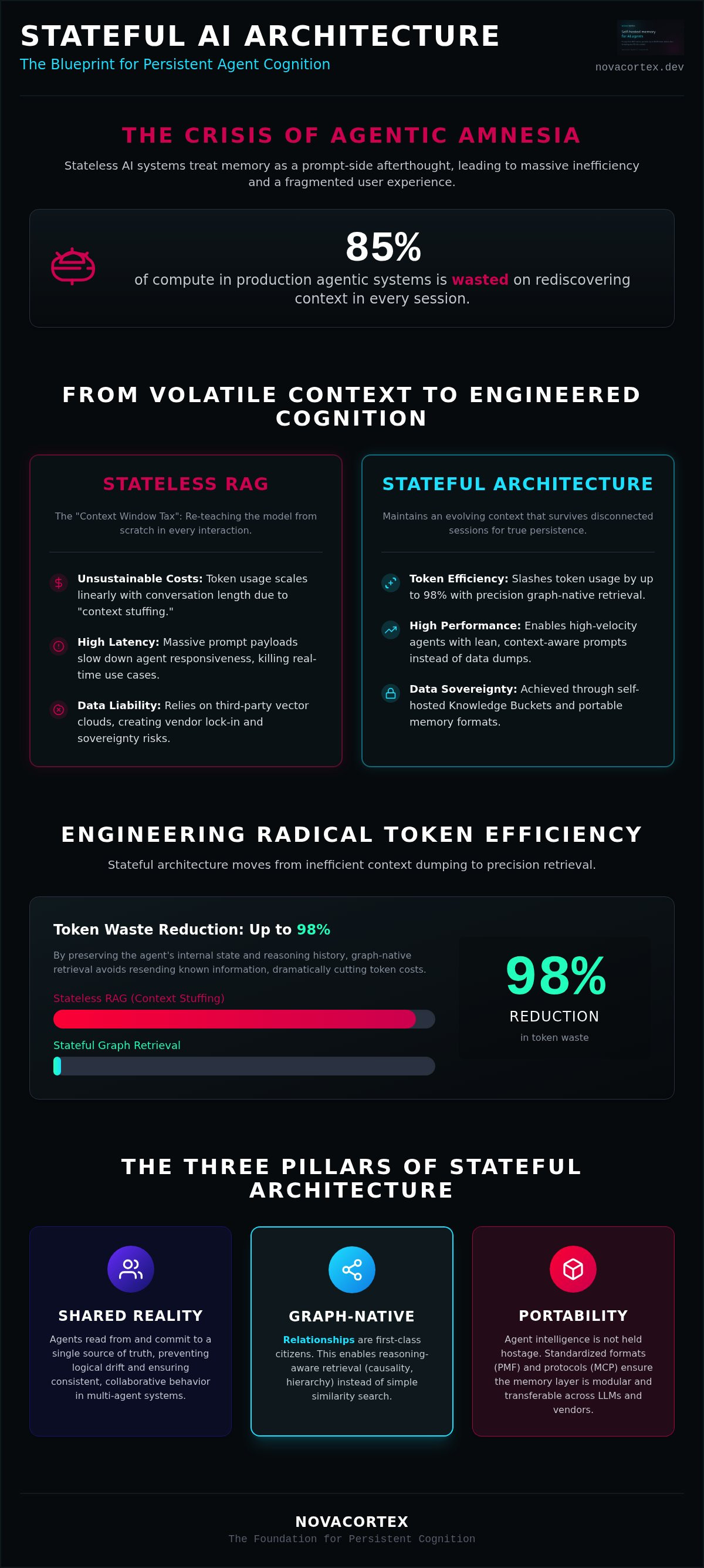
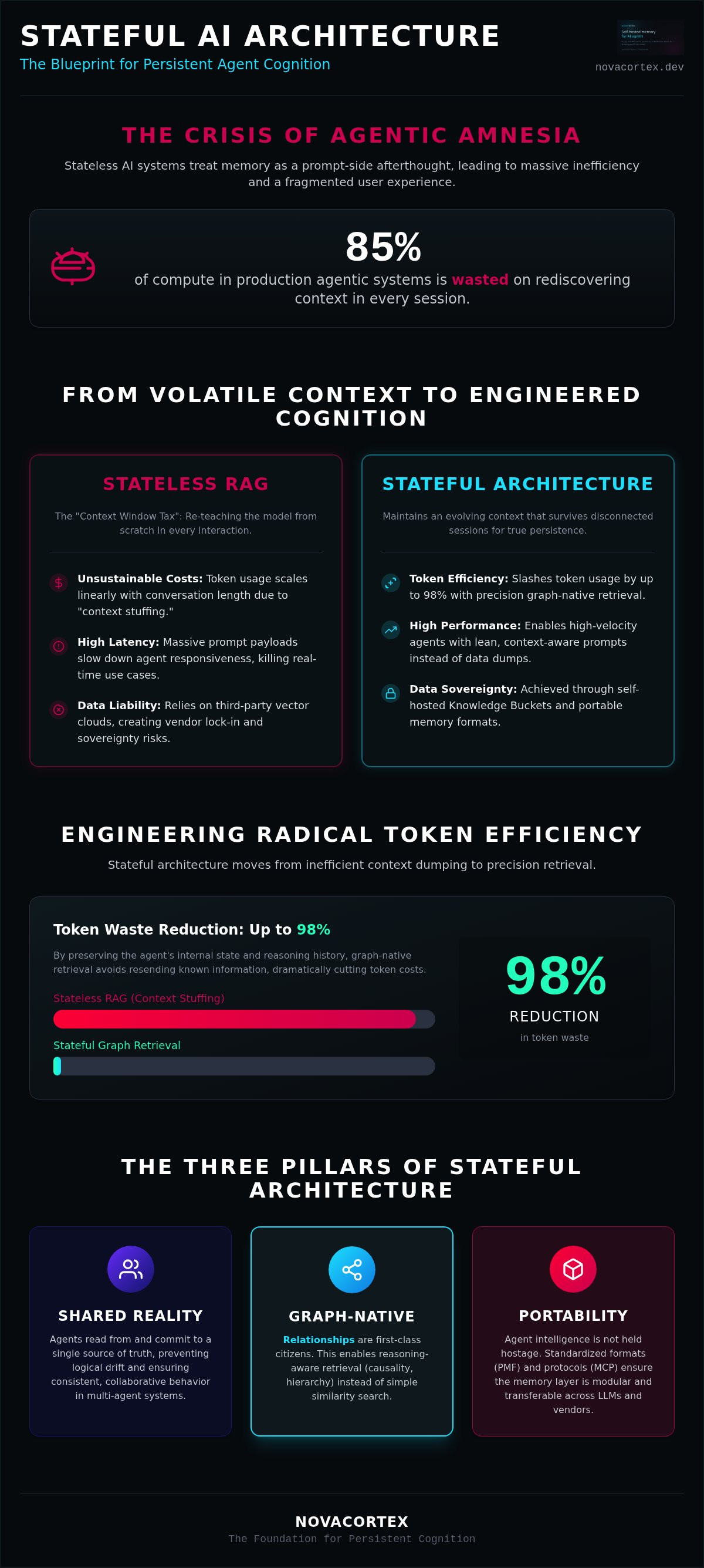
Research suggests that 85% of compute in production agentic systems is wasted on rediscovering context. This is agentic amnesia. It is the inevitable result of treating memory as a prompt-side afterthought. To build systems that perform in 2026, you must move beyond stateless models. A robust stateful AI agent architecture is the only way to achieve persistent cognition without bankrupting your project on token costs.
You know the frustration of context stuffing. It is expensive; it is inefficient; it is a temporary fix for a structural flaw. This article provides the architectural blueprints to build agents that remember. We will show you how to reduce token waste by up to 98% using graph-native storage and self-hosted Knowledge Buckets. You will master a path to data sovereignty that avoids the trap of proprietary vector clouds through MCP-native memory servers and portable memory formats. We are moving from volatile context lakes to engineered, persistent cognition.
Key Takeaways
- Define the shift from stateless prompt hacks to a resilient stateful AI agent architecture that preserves context without manual re-injection.
- Optimize compute resources by leveraging graph-native retrieval to slash token usage by up to 98% while maintaining high precision.
- Implement the Model Context Protocol (MCP) as a standardized memory server to ensure seamless interoperability across multi-agent environments.
- Reclaim data ownership by deploying self-hosted Knowledge Buckets that prevent vendor lock-in and secure your proprietary intelligence.
- Utilize the Portable Memory Format (PMF) to build modular, transferable state layers that evolve alongside your agent's capabilities.
Beyond Vector Search: The Crisis of Agentic Amnesia
Stateless systems are failing. Most current implementations rely on a "Context Window Tax" where the developer pays to re-teach the model every time a session begins. This is not intelligence; it is expensive repetition. A true stateful AI agent architecture enables an Intelligent agent to maintain a persistent, evolving context that survives disconnected sessions. Without this, agents fall into the "Amnesia Loop." They lose track of user intent, forget previous logic chains, and deliver a fragmented user experience that feels like starting from zero every time. This amnesia is the primary barrier to autonomous performance.
Stateless Retrieval-Augmented Generation (RAG) is essentially a search engine with a chat interface. It lacks true cognitive persistence. While RAG finds relevant documents based on similarity, a stateful AI agent architecture preserves the agent's internal state, reasoning history, and user-specific nuances. It is the difference between reading a textbook every morning and actually knowing the subject. One is a lookup; the other is cognition.
The Economic Failure of Stateless RAG
Standard RAG implementations are hitting an economic wall. As conversation history grows, token counts skyrocket to maintain "relevance." Context Stuffing is the inefficient practice of over-providing data to compensate for poor retrieval. This bloat drains budgets and kills performance. The consequences of this architectural failure are clear:
- Token costs that scale linearly with conversation length, making long-term agents unsustainable.
- Hallucinations triggered by overwhelming the model with irrelevant or contradictory context.
- Systemic latency that degrades the user experience as the model parses massive prompt payloads.
Massive context windows introduce significant latency, slowing down agent responsiveness until the system becomes unusable for real-time applications. High-velocity agents require lean prompts, not data dumps.
Data Sovereignty vs. Managed Memory
Sending sensitive state data to proprietary third-party vector clouds is a strategic liability. In 2026, enterprises are rejecting managed memory silos that lock data behind proprietary APIs. The pivot toward self-hosted AI memory layers is driven by the necessity of absolute data sovereignty. For regulated industries, local-first infrastructure is a hard requirement. You cannot outsource your agent's long-term memory to a vendor who might change their terms of service or pricing on a whim. True independence requires owning the memory layer entirely.
The Three Pillars of Stateful Architecture: Shared, Graph-Native, and Portable
Engineering a resilient stateful AI agent architecture requires more than a simple database connection. It demands a structural shift in how we define "Cognitive State." Instead of treating memory as a static list of text chunks, we must treat it as a dynamic, interconnected graph. This transition rests on three non-negotiable pillars. Pillar 1 is Shared Reality. In multi-agent environments, agents must read from and commit to a single source of truth to prevent logical drift. Pillar 2 is Graph-Native Storage. Relationships between data points are often more valuable than the data itself. Pillar 3 is Portability. Your agent's intelligence should not be a hostage to a specific LLM provider or vector cloud. Standardizing these layers is critical for building executable, verifiable, and stateful AI agent systems that don't collapse under their own technical debt.
Graph-Native Memory vs. Vector Databases
Vector databases are excellent for "vibe checks," but they fail at logic. When you compare Redis vs graph memory for AI agents, the difference in relational depth becomes obvious. Vector search identifies similarity; graph traversals identify hierarchy, causality, and ownership. A vector search might find a relevant document, but a graph traversal understands that "Document A" was superseded by "Document B" because of "User Action C." This reasoning-aware context retrieval is the foundation of persistent cognition. It allows agents to navigate complex data structures with surgical precision rather than dumping entire namespaces into a prompt. Developers can audit these logic paths by exploring the implementation details on GitHub.
The Portable Memory Format (PMF) Standard
The industry is moving away from proprietary silos. Adopting a portable memory format for AI is the only way to ensure long-term data ownership. PMF acts as a vendor-neutral knowledge layer. It allows you to migrate an agent's entire cognitive state between different LLM providers or frameworks without losing a single logical connection. This portability prevents vendor lock-in and ensures your investment in agent training remains an asset rather than a liability. By decoupling the reasoning engine from the memory format, you build a stateful AI agent architecture that is future-proof and truly sovereign. It is the difference between renting a brain and owning one.
Engineering Token Efficiency: Graph Retrieval vs. Context Dumping
Context dumping is an engineering failure. It is the lazy solution to a complex retrieval problem. Most developers treat the prompt like a landfill, throwing in every potentially relevant text chunk and hoping the model sorts it out. This approach is mathematically unsustainable. A stateful AI agent architecture replaces this waste with surgical precision. By utilizing graph-native retrieval, engineering teams can reduce AI agent token usage by up to 98%. This is achieved through Selective Contextualization. Instead of saturating the context window with a massive vector search dump, the system retrieves only the exact nodes and relational edges required for the current reasoning step. Token efficiency is a byproduct of retrieval precision, not just compression. Mastering these foundational concepts of stateful AI is mandatory for anyone building high-velocity agentic systems in 2026.
Knowledge Buckets: Modular State Management
Memory needs boundaries. Knowledge Buckets allow you to architect agent memory into discrete, specialized containers. You don't need an agent's entire historical interaction log to solve a specific technical ticket. Modular memory prevents context pollution by ensuring that irrelevant data never enters the active prompt. This tiered approach enables sophisticated state management features:
- Priority Weighting: Ensuring critical system instructions or user preferences always take precedence in the retrieval hierarchy.
- TTL (Time-To-Live): Automatically purging transient state data that is no longer relevant to the agent's current objectives.
- Task-Specific Scoping: Loading only the "buckets" necessary for a specific sub-routine to keep the reasoning engine lean.
Benchmarking the Cost of State
Managed vector clouds are a strategic tax on your scaling potential. The Total Cost of Ownership (TCO) for proprietary memory silos grows exponentially as your agent population expands. In contrast, self-hosted graph memory provides a predictable, high-performance alternative that scales without the vendor markup. The ROI of high-precision retrieval is visible in both the balance sheet and the user experience. Reliable AI agent long term memory drives user retention by eliminating the need for repetitive input. In high-volume deployments, the ability to maintain persistent cognition while minimizing token overhead is the difference between a profitable product and a subsidized experiment. Efficiency is not an option; it is a requirement for architectural survival.
Implementing the Model Context Protocol (MCP) for Stateful Interoperability
Interoperability is the final frontier of agentic engineering. To build a resilient stateful AI agent architecture, you must move beyond custom API wrappers and fragile middleware. The Model Context Protocol (MCP) provides the standardized transport layer required for seamless context exchange. By identifying an MCP native memory server as your architectural core, you decouple the reasoning engine from the data layer. This separation allows agents to query, update, and persist state without being tethered to a specific model provider or orchestration framework.
Implementation follows a rigorous, four-step engineering path. First, define an MCP-native schema for agent state that prioritizes graph relationships over flat text. Second, deploy a self-hosted memory server on your private infrastructure; sovereignty is a hard requirement for enterprise-grade security. Third, connect your agents via standard MCP hooks for direct, low-overhead memory access. Finally, implement state synchronization across your agent fleet to ensure every node in the system operates on the same committed reality. This protocol-first approach eliminates the "integration tax" that plagues legacy AI systems.
Low-Latency Context Retrieval via MCP
Latency kills agentic performance. The MCP architecture eliminates the traditional middleware tax by enabling direct communication between the agent and the memory server. Optimizing the transport layer for sub-50ms context delivery is essential for high-velocity operations. When your agents can retrieve persistent state in milliseconds, they feel responsive and intelligent rather than sluggish and disconnected. Securing these connections in a self-hosted environment requires strict network policies and local-first authentication, ensuring that your cognitive state remains within your controlled perimeter.
Multi-Agent Synchronization Strategies
Concurrent agent operations often lead to the "Split-Brain" problem. This occurs when two agents attempt to update the same state based on conflicting perceptions, leading to logical drift. Solving this requires graph-native locks and committed states to maintain decision coherence. By using a shared memory server, multi-agent systems can collaborate on complex goals without overwriting each other's progress. Real-world collaboration depends on this shared, verifiable truth. It turns a collection of isolated scripts into a unified, stateful system capable of long-term planning and execution.
NovaCortex: The Blueprint for Persistent Agent Cognition
NovaCortex Self-Hosted Edition is the definitive correction to the industry's reliance on volatile context. It is not a wrapper or a managed service; it is a hardened engine designed for a stateful AI agent architecture. By moving the memory layer directly onto your private infrastructure, you eliminate the systemic risks and high costs of managed vector silos. Your data never leaves your control. This privacy-first approach is the only viable path for enterprises that prioritize security and long-term cognitive persistence. It is built for engineers who refuse to compromise on data sovereignty.
The engine utilizes a graph-native storage model to handle complex, relational data structures. While legacy systems rely on simple similarity scores, NovaCortex understands the hierarchy and causality of agent interactions. This allows for the selective contextualization required to keep reasoning engines lean and accurate. It is the blueprint for building systems that don't just retrieve data but actually maintain a coherent internal state across thousands of disconnected sessions. It turns a stateless model into a persistent intelligence.
Self-Hosted Deployment Flex
Deployment is fast and resource-efficient. You can run the NovaCortex core on a VPS, local server, or even a Raspberry Pi with minimal overhead. The Apache-2.0 open source core ensures that your architectural foundation remains open and auditable. Scaling is a matter of logical organization, not hardware acquisition. You can transition from a single specialized agent to a massive, multi-agent enterprise memory layer using the same lean infrastructure. This high-performance core is built for engineering reality, not corporate bloat. It respects your compute budget while delivering enterprise-grade reliability.
Reclaiming the Memory Layer
Forgetful AI is a choice, and it's a poor one. The era of treating agent memory as a temporary prompt-side hack is over. The future of the industry belongs to systems that are local, portable, and persistent. By implementing NovaCortex, you aren't just adding a feature; you're reclaiming the memory layer. You're ensuring that every logical connection your agents build remains a permanent asset. It's time to stop renting intelligence from proprietary clouds and start owning your cognitive state. Reclaim your infrastructure and build for the long term.
Deploy NovaCortex Self-Hosted Edition today
Reclaim Cognitive Sovereignty
Stateless agents are a technical debt you can no longer afford. Engineering persistent cognition requires a fundamental shift to a stateful AI agent architecture that prioritizes graph-native relational memory and privacy-first, self-hosted infrastructure. We've moved past the era of context stuffing and amnesia loops. You now have the blueprints to build agents that learn, evolve, and persist without draining your compute budget on redundant tokens.
By deploying these systems on your own hardware, you achieve a 98% reduction in token usage while securing absolute data sovereignty. This isn't just about efficiency; it's about owning the intelligence you build. The tools for modular, portable, and persistent memory are ready. Stop renting your agent's brain from proprietary clouds and start building for the long term.
The transition to persistent agentic systems is the next major milestone in software architecture. Take control of your memory layer and lead the shift toward sovereign intelligence.
Frequently Asked Questions
What is the difference between a vector database and a stateful AI memory layer?
Vector databases prioritize similarity search while a stateful memory layer prioritizes relational persistence. Vector DBs provide "vibe checks" by retrieving chunks based on distance. A stateful layer like NovaCortex uses graph-native storage to preserve hierarchy and causality. This allows agents to understand how data points relate over time rather than just finding similar-sounding text. It's the technical difference between a static search index and a dynamic, working brain.
How does stateful architecture reduce LLM API costs?
It slashes costs by eliminating the need for context stuffing. Instead of dumping entire knowledge bases into every prompt, a stateful AI agent architecture uses selective contextualization to retrieve only the exact nodes required. NovaCortex reduces token usage by up to 98% by maintaining a lean context window. You stop paying the "amnesia tax" of re-sending the same data across disconnected sessions. This efficiency makes long-term agent deployments economically viable.
Can I run a stateful AI agent architecture on-premises?
Yes, and for 2026 enterprises, it is the standard requirement. NovaCortex Self-Hosted Edition is designed specifically for local infrastructure, VPS, or hardware as lean as a Raspberry Pi. This ensures absolute data sovereignty. You keep your proprietary intelligence behind your own firewall rather than leaking sensitive state data to third-party vector clouds or proprietary managed silos. It is a firm rejection of bloated, restrictive systems that compromise your privacy.
What is the Model Context Protocol (MCP) and why does it matter for state?
MCP is an open standard that decouples the reasoning engine from the data source. It provides a universal transport layer for context exchange. For stateful systems, it matters because it prevents vendor lock-in. By using an MCP-Native Memory Server, you can swap LLM providers without rebuilding your memory infrastructure. It ensures that your agent's cognitive state remains interoperable across different frameworks and models, maintaining a single source of truth.
How do Knowledge Buckets help in managing agent memory?
Knowledge Buckets provide modular state management by partitioning data into discrete, task-specific containers. This prevents context pollution. An agent doesn't need its entire interaction history to execute a specific sub-routine. By scoping memory into buckets, you can implement priority weighting and TTL (Time-To-Live) for transient data. It keeps the agent's focus sharp and its prompt payload efficient, ensuring that only the most relevant relational nodes enter the context window.
Does a stateful architecture increase latency in agent responses?
No, it actually improves responsiveness by reducing prompt bloat. While there is a retrieval step, the time saved by the LLM processing a 98% smaller prompt far outweighs the graph query latency. NovaCortex is engineered for high-velocity performance, delivering context in sub-50ms. Leaner context windows result in faster "Time to First Token," making your agents feel more decisive and human-like. Efficient retrieval is the prerequisite for high-performance agentic systems.
Is NovaCortex compatible with existing agent frameworks like LangChain or AutoGPT?
It is built for maximum interoperability. Because NovaCortex uses the Model Context Protocol and a Portable Memory Format (PMF), it integrates with any framework that supports standard API hooks or MCP servers. It acts as a specialized memory layer that replaces the primitive, stateless memory modules found in generic frameworks. You get enterprise-grade persistence without abandoning your current orchestration stack. It is a necessary correction to the fragmented toolsets currently on the market.
What happens to the agent state if I change LLM providers?
Your agent state remains intact because it is decoupled from the model. Using the Portable Memory Format (PMF) ensures that your agent's intelligence is transferable. Since the stateful AI agent architecture resides on your infrastructure, the model is merely a swappable reasoning engine. You can move from one provider to another without losing the relational context or history that your agent has spent months building. Your cognitive assets remain under your control.
FAQ
What is the difference between a vector database and a stateful AI memory layer?
Vector databases prioritize similarity search while a stateful memory layer prioritizes relational persistence. Vector DBs provide "vibe checks" by retrieving chunks based on distance. A stateful layer like NovaCortex uses graph-native storage to preserve hierarchy and causality. This allows agents to understand how data points relate over time rather than just finding similar-sounding text. It's the technical difference between a static search index and a dynamic, working brain.
How does stateful architecture reduce LLM API costs?
It slashes costs by eliminating the need for context stuffing. Instead of dumping entire knowledge bases into every prompt, a stateful AI agent architecture uses selective contextualization to retrieve only the exact nodes required. NovaCortex reduces token usage by up to 98% by maintaining a lean context window. You stop paying the "amnesia tax" of re-sending the same data across disconnected sessions. This efficiency makes long-term agent deployments economically viable.
Can I run a stateful AI agent architecture on-premises?
Yes, and for 2026 enterprises, it is the standard requirement. NovaCortex Self-Hosted Edition is designed specifically for local infrastructure, VPS, or hardware as lean as a Raspberry Pi. This ensures absolute data sovereignty. You keep your proprietary intelligence behind your own firewall rather than leaking sensitive state data to third-party vector clouds or proprietary managed silos. It is a firm rejection of bloated, restrictive systems that compromise your privacy.
What is the Model Context Protocol (MCP) and why does it matter for state?
MCP is an open standard that decouples the reasoning engine from the data source. It provides a universal transport layer for context exchange. For stateful systems, it matters because it prevents vendor lock-in. By using an MCP-Native Memory Server, you can swap LLM providers without rebuilding your memory infrastructure. It ensures that your agent's cognitive state remains interoperable across different frameworks and models, maintaining a single source of truth.
How do Knowledge Buckets help in managing agent memory?
Knowledge Buckets provide modular state management by partitioning data into discrete, task-specific containers. This prevents context pollution. An agent doesn't need its entire interaction history to execute a specific sub-routine. By scoping memory into buckets, you can implement priority weighting and TTL (Time-To-Live) for transient data. It keeps the agent's focus sharp and its prompt payload efficient, ensuring that only the most relevant relational nodes enter the context window.
Does a stateful architecture increase latency in agent responses?
No, it actually improves responsiveness by reducing prompt bloat. While there is a retrieval step, the time saved by the LLM processing a 98% smaller prompt far outweighs the graph query latency. NovaCortex is engineered for high-velocity performance, delivering context in sub-50ms. Leaner context windows result in faster "Time to First Token," making your agents feel more decisive and human-like. Efficient retrieval is the prerequisite for high-performance agentic systems.
Is NovaCortex compatible with existing agent frameworks like LangChain or AutoGPT?
It is built for maximum interoperability. Because NovaCortex uses the Model Context Protocol and a Portable Memory Format (PMF), it integrates with any framework that supports standard API hooks or MCP servers. It acts as a specialized memory layer that replaces the primitive, stateless memory modules found in generic frameworks. You get enterprise-grade persistence without abandoning your current orchestration stack. It is a necessary correction to the fragmented toolsets currently on the market.
What happens to the agent state if I change LLM providers?
Your agent state remains intact because it is decoupled from the model. Using the Portable Memory Format (PMF) ensures that your agent's intelligence is transferable. Since the stateful AI agent architecture resides on your infrastructure, the model is merely a swappable reasoning engine. You can move from one provider to another without losing the relational context or history that your agent has spent months building. Your cognitive assets remain under your control.