Stateful AI Agents: Engineering Persistent Cognition and Memory Layers

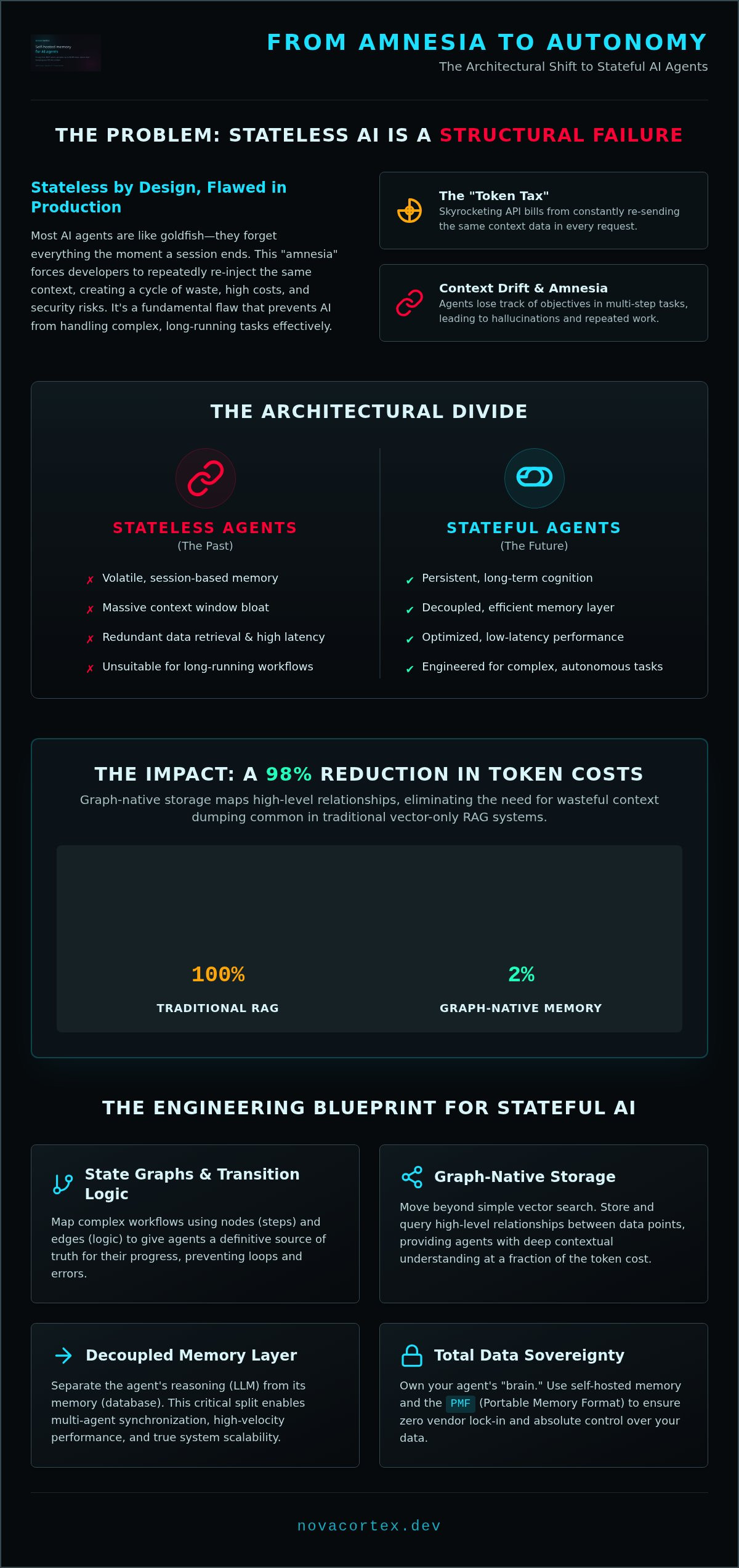
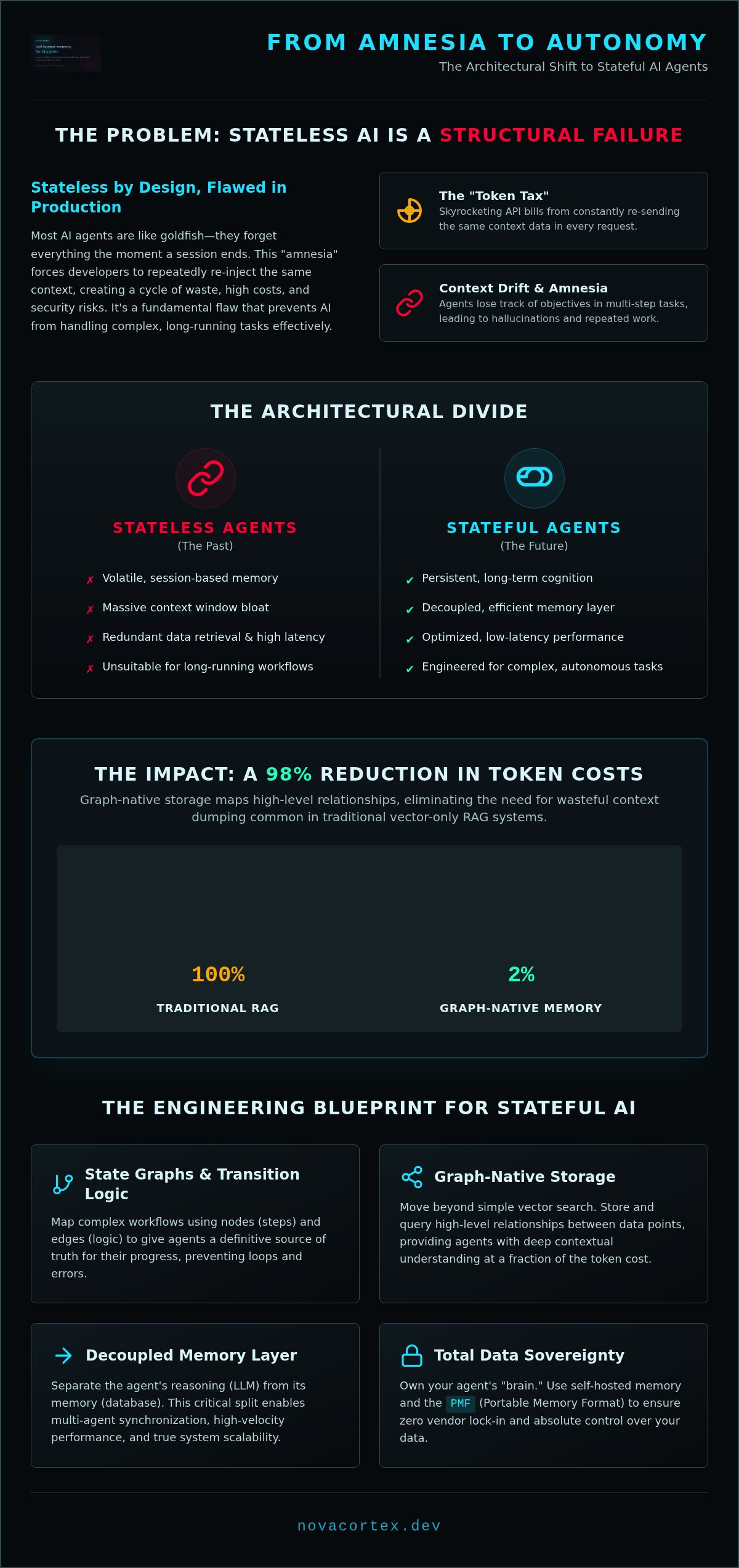
Most AI agents are essentially goldfish with expensive credit cards. They forget critical context the moment a session ends. This forces you to pay for the same tokens repeatedly. This isn't just a technical oversight; it's a structural failure that drains budgets and compromises performance. To build at scale, you need stateful AI agents that possess persistent cognition and a memory layer that doesn't rely on wasteful, redundant context dumping.
You've likely felt the frustration of watching API bills skyrocket while your agents struggle with long-running workflows. We agree that constant context injection is a leaky bucket and a massive security risk. This article provides the architectural blueprint to eliminate agent amnesia and slash your token costs by 98%. You'll master the engineering behind graph-native storage and absolute data sovereignty. We'll explore how to implement self-hosted memory layers and the Portable Memory Format to ensure your agents maintain high-velocity performance without the bloat of traditional RAG systems.
Key Takeaways
- Understand the structural shift from stateless models to stateful AI agents that maintain persistent context and progress across complex, long-running workflows.
- Master the use of state graphs and decoupled memory layers to manage logic transitions without overwhelming the context window.
- Implement graph-native storage to map high-level relationships, slashing token costs by 98% compared to traditional vector-only retrieval.
- Secure your production environment against common engineering pitfalls like race conditions and state corruption in multi-agent systems.
- Establish total data sovereignty using the NovaCortex Self-Hosted Edition and the Portable Memory Format (PMF) to ensure zero vendor lock-in.
The Amnesia Problem: Why Stateless AI Fails in Production
Standard LLM implementations are stateless by design. Each request is a blank slate. This architecture works for basic chatbots but collapses when applied to autonomous workflows. Stateful AI agents represent a necessary correction to this flaw. These systems are engineered to persist context, user preferences, and task progress across multiple sessions. Without state, you're essentially rebuilding the agent's brain every time you hit an API endpoint. It's inefficient, expensive, and technically regressive.
Statelessness imposes a heavy "Token Tax." As your project's knowledge base grows, you're forced to shove more data into every prompt to ensure the agent remembers the task. This is a massive waste of resources. Research into token-efficient frameworks shows that optimized retrieval can reduce output usage by up to 97% compared to traditional methods. In a stateless environment, you pay for the same context repeatedly. It's a burn rate that kills the ROI of production agents before they even scale.
One-shot Q&A models excel at isolated facts but fail at multi-step reasoning. If an agent needs to execute a complex deployment pipeline, it must know exactly what occurred at step two to succeed at step nine. Stateless agents lose the thread. They hallucinate progress or repeat finished tasks because they lack a record of their own actions. We're seeing a critical shift from simple RAG, which just fetches data, to persistent agent cognition, which maintains a continuous chain of thought.
Defining the Stateful Architecture
Engineering a stateful system requires a clear distinction between working memory and persistent memory. Working memory handles the immediate context window. Persistent memory stores long-term schema and historical interactions. This mirrors the logic of a stateful protocol in networking, where the system tracks the state of the interaction rather than treating every packet as an isolated event. Context windows are a temporary patch. They are finite and volatile. Persistent state is the only way to support reliable autonomous decision-making loops.
The Hidden Inefficiencies of Stateless Workflows
Stateless systems suffer from redundant data retrieval. You're re-sending the same knowledge base every turn, creating massive latency bottlenecks and unnecessary compute overhead. This bloat slows down execution speed and increases the probability of errors. Context Drift is the erosion of agent intent over long-form interactions as the original directive gets buried under unsorted data. Stateful AI agents solve this by anchoring the agent's focus within a dedicated memory layer, ensuring that intent remains sharp regardless of session length.
Architecting State: Beyond Simple Context Windows
Building stateful AI agents requires more than appending chat logs to a prompt. It demands a rigorous structural approach. We must move away from the "message history" mindset and toward structured state management. If your application logic is also your memory store, you've already failed. You've created a monolithic bottleneck that won't scale. Proper architecture decouples execution from persistence. This ensures that the agent's logic remains lean while its knowledge remains accessible and structured.
State Graphs and Transition Logic
State graphs provide the necessary framework for complex autonomy. In this model, nodes represent specific execution steps. Edges represent conditional transition logic. This creates a definitive source of truth for agent progress. It prevents the agent from looping or losing track of its objectives. Integrating MCP native memory servers allows for interoperable state management across diverse environments. This protocol standardizes how agents read from and write to external memory layers, effectively turning a localized bot into a globally aware operative.
The Model Context Protocol (MCP) is the emerging standard for this interaction. It allows for a clean separation of concerns. The LLM handles the reasoning. The memory server handles the persistence. This division of labor is essential for multi-agent synchronization. When multiple agents operate in the same environment, they must share a consistent state to avoid collision or redundant work. Without a centralized, protocol-driven memory, you get chaos. With it, you get a coordinated swarm. You can explore these patterns in the NovaCortex repository to see high-velocity state management in action.
Persistent Context Management
Effective AI agent memory relies on structured state objects rather than raw text blocks. Storing state as JSON or graph nodes allows for targeted updates and prevents race conditions in parallel workflows. When two agents attempt to update the same memory segment, the system must enforce atomicity. This precision also enables deep user-specific tailoring. An agent's "personality" isn't just a system prompt; it's the accumulated state of past interactions, preferences, and verified facts stored in a persistent layer. This architecture ensures that the agent evolves with the user, maintaining high-fidelity intent without the drift typical of stateless systems.
Graph-Native Memory: Engineering for 98% Token Efficiency
Vector databases are the industry default for RAG, but they are fundamentally flawed for high-fidelity autonomy. They rely on semantic similarity. Similarity is not logic. Stateful AI agents built on top of vector stores often suffer from the "lost in the middle" problem, where the model ignores critical context buried in a massive, unsorted prompt dump. This isn't just a minor inefficiency; it's a structural failure that forces developers to pay for redundant tokens while receiving degraded reasoning.
Graph-native memory solves this by mapping relationships rather than just similarity scores. It doesn't just find related text; it traverses the logical connections between entities. This preserves the "why" behind the data. When you compare Redis vs graph memory for AI agents, the difference in retrieval precision is stark. While key-value stores provide raw speed, graph-native storage provides the structural context required for complex, multi-step tasks. This architectural shift allows agents to maintain a coherent chain of thought across thousands of interactions without losing the thread.
Vector Search vs. Graph Memory
Traditional vector search is a brute-force approach to context. It retrieves chunks of text based on mathematical proximity in high-dimensional space. This often pulls in irrelevant noise that bloats the context window. Graph memory is surgical. By using nodes and edges to define state, the agent only retrieves the precise information required for the current execution step. This methodology eliminates the noise, ensuring that the most relevant facts are always prioritized within the model's limited attention span.
The Mechanics of Knowledge Buckets
We modularize memory using Knowledge Buckets to prevent context bloat. Knowledge Buckets are isolated, addressable memory units for specific agent tasks. Instead of searching the entire database, the agent only accesses the specific bucket triggered by the state graph. This dynamic retrieval strategy is the key to achieving a 98% token reduction. You aren't dumping a library into a prompt; you're providing a single, verified page of information. This lean operation slashes costs and significantly reduces latency, as the model processes a fraction of the data compared to standard stateless workflows.
The speed advantage of graph traversal over vector comparison is undeniable. Vector search requires compute-intensive calculations across the entire index. Graph traversal is a pointer-based operation that scales with the complexity of the relationship, not the size of the dataset. For developers building autonomous systems, this means faster response times and lower infrastructure overhead. It's the difference between an agent that guesses and an agent that knows.
Implementation Guide: Avoiding the 5 Failure Modes of Stateful Agents
Engineering stateful AI agents requires a transition from a "build and hope" mindset to a "design for failure" architecture. Production environments are inherently messy. Parallel execution is the standard, not the exception. Without a robust strategy for state integrity, your agents will eventually corrupt their own memory or hallucinate progress based on fragmented data. We must address the specific technical debt that emerges when agents are allowed to remember across sessions.
Race conditions are the silent killers of autonomous workflows. If two agents attempt to update the same memory node simultaneously, the final state becomes non-deterministic. Some developers suggest "sticky sessions" as a fix, but this approach is a trap. It breaks horizontal scalability and creates single points of failure. Instead, implement distributed locking or optimistic concurrency control at the storage layer. Stale state is equally dangerous. An agent acting on context from three steps ago is a liability. You need a centralized source of truth that ensures every read operation reflects the most recent write in real time.
Prompt drift occurs when the accumulated state begins to outweigh the core system instructions. If the memory layer is too noisy, the agent loses its original directive and begins to wander. You must enforce a strict hierarchy where the core logic remains isolated from the fluctuating state. Data sovereignty is the final hurdle. Sending sensitive state to managed vector clouds introduces unacceptable privacy risks and potential regulatory exposure. For enterprise-grade security, you must keep the memory layer behind your own firewall to ensure total control over the knowledge lifecycle.
Solving for Scalability and Consistency
Scalability depends on a decoupled architecture. Using a self-hosted AI memory layer allows you to maintain total control over data residency while scaling horizontally. A centralized memory server acts as the arbiter for all stateful writes, ensuring consistency across a distributed swarm of agents. This setup prevents the fragmentation that occurs when state is trapped within individual application instances, allowing for a unified cognitive layer that grows with your infrastructure.
Evaluation and Iteration
Stateful evaluation is a continuous lifecycle. You cannot just test the model; you must test the state transitions. Observe agent behavior in production, capture the state at the point of failure, and turn it into a deterministic test case. This approach allows you to iterate on the graph logic without breaking existing functionality. It's the only way to manage the trade-off between the flexibility of stateful logic and the rigid security requirements of the modern enterprise.
NovaCortex: The Self-Hosted Standard for Stateful Agents
NovaCortex isn't just another library. It's a technical standard for agentic cognition. We built the NovaCortex Self-Hosted Edition to solve the privacy crisis inherent in managed AI services. Sending your internal operational logic to a third-party vector cloud is a structural security flaw. You're effectively leasing your agent's mind from a vendor who can change the terms at any time. We reject that model. Our Apache-2.0 memory layer ensures that stateful AI agents remain entirely under your control, whether they're running on a Raspberry Pi or a high-performance enterprise VPS.
Digital sovereignty is a requirement, not an option. By hosting your own memory layer, you eliminate the latency of external API calls and the risk of sensitive data exposure. You've already seen how graph-native storage slashes token costs by 98%. NovaCortex brings that efficiency into your own data center. It provides the physical infrastructure for the persistent state logic we've discussed, ensuring your agents remain sharp, focused, and secure without relying on bloated, restrictive third-party ecosystems.
Portable Memory Format (PMF) Explained
Vendor lock-in is the enemy of engineering innovation. The Portable Memory Format (PMF) treats AI agent long term memory as a first-class citizen in the DevOps pipeline. Memory should be as portable as a Docker container. PMF allows you to move agent context across different environments, models, and providers without re-indexing your entire knowledge base. This isn't just about convenience; it's about architectural independence. You own the schema. You own the data. You own the sovereignty of the agentic state.
The PMF standard is designed for high-velocity performance. It modularizes state into structured objects that are easily serializable and transferable. This means you can train an agent in a sandbox and move its entire cognitive history to production in seconds. No re-indexing. No data loss. Just persistent, portable cognition that scales with your needs.
Getting Started with NovaCortex
Deployment is direct and modular. You start by configuring your first Knowledge Bucket. These are isolated units of memory designed for specific tasks, preventing the context bloat that plagues stateless systems. Integration is seamless through MCP-native drivers. These drivers allow your agents to interact with the memory server using standardized protocols, ensuring that your logic remains decoupled from your storage. You aren't just building a bot; you're engineering a persistent cognitive system that respects your infrastructure and your data.
The roadmap to digital sovereignty starts with a single command. Stop leasing your agent's memory and start owning it. Build systems that remember, learn, and perform without the "token tax" or the privacy risks of the cloud.
Deploy NovaCortex on your own infrastructure today
Engineering Persistent Agentic Autonomy
Statelessness is a technical debt you can no longer afford to carry. We've moved past the era of prompt dumping and session amnesia. By adopting an architecture centered on stateful AI agents, you replace wasteful redundancy with surgical precision. Graph-native performance isn't just about raw speed; it's about reducing token usage by 98% while maintaining a coherent chain of thought across complex workflows. This structural shift ensures your agents remain reliable operatives instead of expensive, forgetful chatbots.
Real autonomy requires absolute digital sovereignty. The NovaCortex Self-Hosted Edition provides an Apache-2.0 memory layer that keeps your sensitive operational logic behind your own firewall. You own the memory, you own the format, and you own the results. It's time to build systems that don't just process data but actually learn and persist within your own infrastructure. This is the new standard for enterprise-grade intelligence.
Take control of your agent's cognition today. The tools for persistent, high-velocity intelligence are ready for immediate deployment.
Frequently Asked Questions
What is the difference between a stateful and a stateless AI agent?
Stateless agents treat every request as an isolated event with no memory of prior turns. Stateful AI agents maintain a persistent record of context, progress, and user preferences across multiple sessions. This shift from forgetful to persistent allows for complex, multi-step workflows. While stateless models require massive prompt injection to catch up, stateful systems leverage a dedicated memory layer to anchor intent and ensure logical continuity.
How do stateful agents reduce LLM token costs?
Stateful systems eliminate the need to re-send the entire knowledge base or chat history with every prompt. By modularizing memory into Knowledge Buckets, the agent only retrieves the precise information required for the current execution step. This surgical retrieval can reduce token usage by 98% compared to traditional context dumping. You stop paying for redundant data and start paying only for high-value reasoning, significantly lowering your operational burn rate.
Can I use a standard vector database for stateful AI memory?
You can, but it's often suboptimal for complex logic. Standard vector databases rely on semantic similarity, which lacks the structural relationships needed for persistent cognition. Graph-native storage is superior because it maps the connections between data points using nodes and edges. While vector search is a brute-force proximity match, graph memory provides the precise transition logic required for stateful AI agents to navigate long-running autonomous tasks without losing context.
What is the Model Context Protocol (MCP) and why does it matter for state?
MCP is an open standard that decouples the reasoning engine from the storage layer. It provides a universal interface for agents to interact with external memory servers. This matters because it prevents monolithic bottlenecks where logic and state are trapped in the same application. By using an MCP-native memory server, you ensure that multiple agents can access a shared, consistent source of truth, facilitating coordinated multi-agent synchronization across diverse technical environments.
How do I prevent race conditions in multi-agent stateful systems?
Preventing race conditions requires implementing distributed locking or optimistic concurrency control at the memory layer. When multiple agents attempt to update the same state object simultaneously, the system must enforce atomicity to prevent data corruption. Avoid sticky sessions which break horizontal scaling. Instead, use a centralized memory arbiter that manages stateful writes. This ensures every agent reads the most recent, verified state, maintaining a deterministic lifecycle for all autonomous operations.
Is it possible to self-host a stateful AI memory layer for privacy?
Yes, self-hosting is the only way to maintain total data sovereignty. Using the NovaCortex Self-Hosted Edition allows you to keep sensitive state behind your own firewall, eliminating the privacy risks of third-party vector clouds. This architecture ensures that your agent's knowledge and operational logic remain internal. It's a critical requirement for enterprise security, where sending proprietary context to managed external services would create unacceptable regulatory and security vulnerabilities.
What happens to the state if the AI agent crashes mid-task?
Persistent state management ensures that progress is saved at every transition node. If an agent crashes, it doesn't lose its mind or restart from scratch. Upon reboot, the agent queries the memory layer to retrieve its last verified state and resumes from the exact point of failure. This resilience is a core advantage of stateful AI agents. It transforms volatile interactions into reliable, long-running processes that survive infrastructure hiccups.
How does the Portable Memory Format (PMF) prevent vendor lock-in?
PMF makes memory as portable as a Docker container. It allows you to move agent context across different models, environments, or providers without re-indexing your data. Most managed services trap your knowledge in proprietary formats, forcing you to stay on their platform. PMF breaks this restriction by providing a technical standard for state serialization. You own the data and the schema, giving you the freedom to migrate your agent's cognition wherever it's needed.
FAQ
What is the difference between a stateful and a stateless AI agent?
Stateless agents treat every request as an isolated event with no memory of prior turns. Stateful AI agents maintain a persistent record of context, progress, and user preferences across multiple sessions. This shift from forgetful to persistent allows for complex, multi-step workflows. While stateless models require massive prompt injection to catch up, stateful systems leverage a dedicated memory layer to anchor intent and ensure logical continuity.
How do stateful agents reduce LLM token costs?
Stateful systems eliminate the need to re-send the entire knowledge base or chat history with every prompt. By modularizing memory into Knowledge Buckets, the agent only retrieves the precise information required for the current execution step. This surgical retrieval can reduce token usage by 98% compared to traditional context dumping. You stop paying for redundant data and start paying only for high-value reasoning, significantly lowering your operational burn rate.
Can I use a standard vector database for stateful AI memory?
You can, but it's often suboptimal for complex logic. Standard vector databases rely on semantic similarity, which lacks the structural relationships needed for persistent cognition. Graph-native storage is superior because it maps the connections between data points using nodes and edges. While vector search is a brute-force proximity match, graph memory provides the precise transition logic required for stateful AI agents to navigate long-running autonomous tasks without losing context.
What is the Model Context Protocol (MCP) and why does it matter for state?
MCP is an open standard that decouples the reasoning engine from the storage layer. It provides a universal interface for agents to interact with external memory servers. This matters because it prevents monolithic bottlenecks where logic and state are trapped in the same application. By using an MCP-native memory server, you ensure that multiple agents can access a shared, consistent source of truth, facilitating coordinated multi-agent synchronization across diverse technical environments.
How do I prevent race conditions in multi-agent stateful systems?
Preventing race conditions requires implementing distributed locking or optimistic concurrency control at the memory layer. When multiple agents attempt to update the same state object simultaneously, the system must enforce atomicity to prevent data corruption. Avoid sticky sessions which break horizontal scaling. Instead, use a centralized memory arbiter that manages stateful writes. This ensures every agent reads the most recent, verified state, maintaining a deterministic lifecycle for all autonomous operations.
Is it possible to self-host a stateful AI memory layer for privacy?
Yes, self-hosting is the only way to maintain total data sovereignty. Using the NovaCortex Self-Hosted Edition allows you to keep sensitive state behind your own firewall, eliminating the privacy risks of third-party vector clouds. This architecture ensures that your agent's knowledge and operational logic remain internal. It's a critical requirement for enterprise security, where sending proprietary context to managed external services would create unacceptable regulatory and security vulnerabilities.
What happens to the state if the AI agent crashes mid-task?
Persistent state management ensures that progress is saved at every transition node. If an agent crashes, it doesn't lose its mind or restart from scratch. Upon reboot, the agent queries the memory layer to retrieve its last verified state and resumes from the exact point of failure. This resilience is a core advantage of stateful AI agents. It transforms volatile interactions into reliable, long-running processes that survive infrastructure hiccups.
How does the Portable Memory Format (PMF) prevent vendor lock-in?
PMF makes memory as portable as a Docker container. It allows you to move agent context across different models, environments, or providers without re-indexing your data. Most managed services trap your knowledge in proprietary formats, forcing you to stay on their platform. PMF breaks this restriction by providing a technical standard for state serialization. You own the data and the schema, giving you the freedom to migrate your agent's cognition wherever it's needed.