The Context Window Fallacy: Myth-Busting LLM API Cost Reduction

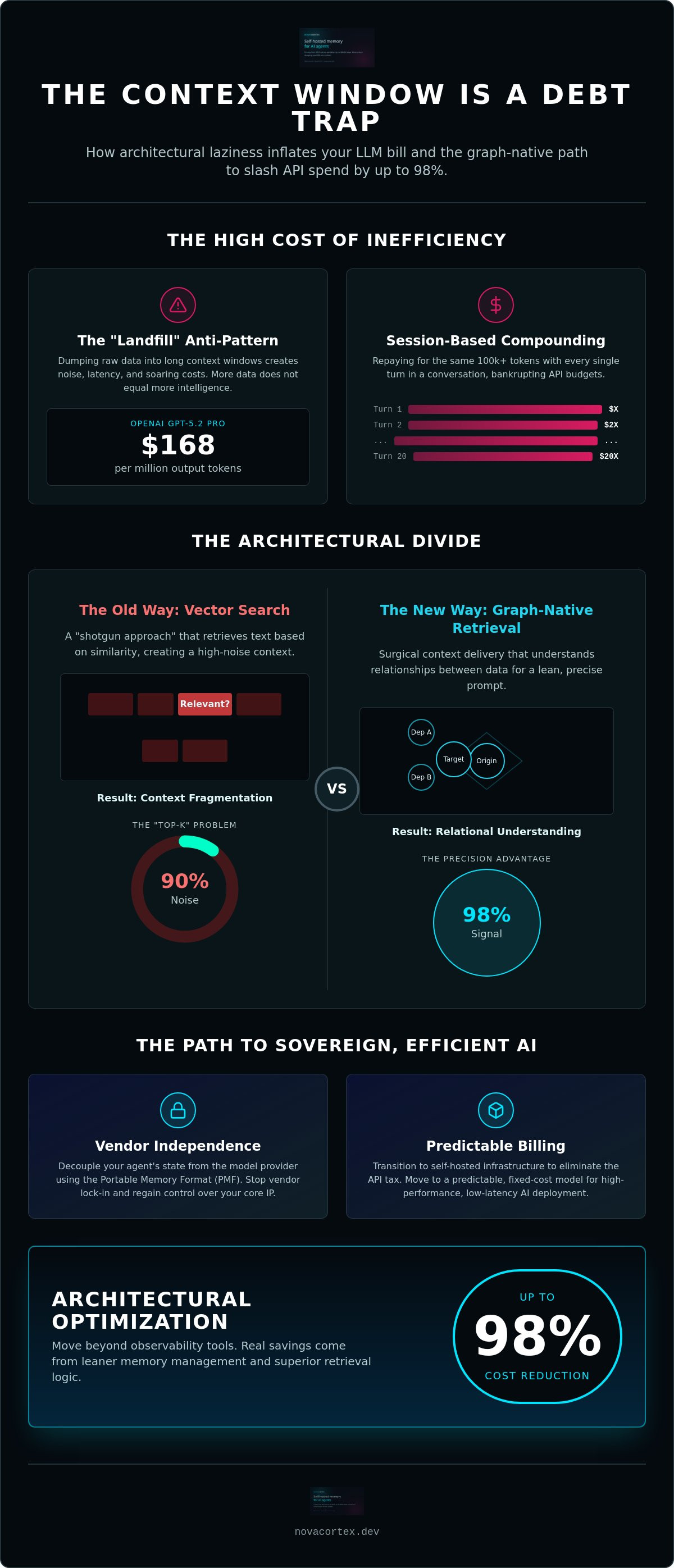
Your 128k context window isn't a feature. It's a debt trap designed to mask architectural laziness. Most engineering teams treat the prompt like a landfill, dumping raw vectors into the model and hoping for the best. You've watched your margins evaporate as OpenAI GPT-5.2 Pro costs hit $168 per million output tokens. You're feeling the token tax every time your agent performance degrades under the weight of its own memory. It's a systemic failure of design, not a limitation of the technology.
We agree that the current trajectory is unsustainable. To truly reduce LLM API costs, you must stop relying on vendor-managed bloat and start building for efficiency. This article promises to show you how to re-engineer your AI memory layer to slash API spend by up to 98%. We'll explore the shift from wasteful vector-dumping to graph-native retrieval. We'll also explain why sovereign control over your memory infrastructure is the only path to predictable billing and low-latency performance.
Key Takeaways
- Stop treating long-context windows as a solution for memory; they introduce noise and trigger quadratic cost scaling that kills margins.
- Move beyond the "Top-K" retrieval problem where 90% of retrieved data is wasted tokens, and embrace relational memory structures.
- Implement architectural optimizations rather than just observability tools to reduce LLM API costs by up to 98% through leaner memory management.
- Decouple your agent's state from the model provider using the Portable Memory Format (PMF) to ensure digital sovereignty and vendor independence.
- Transition to self-hosted infrastructure like NovaCortex to eliminate the API tax and achieve predictable, high-performance AI deployment.
Myth #1: Larger Context Windows Solve AI Forgetfulness
Engineering is about trade-offs. It's about precision. When you dump a 200-page PDF into a prompt, you aren't engineering; you're surrendering to the "Laziness Tax." Many developers believe that massive context windows are a silver bullet for AI memory. They're wrong. The Context Window Fallacy is an architectural anti-pattern where developers treat raw prompt volume as a substitute for structured, high-precision information retrieval. More data does not equal more intelligence. It equals more noise, higher latency, and a direct assault on your margins.
Every token you send has a price. In a typical production application, input tokens from long system prompts and bloated context can account for 42% of the total bill. If you're using OpenAI GPT-5.2 Pro, those output tokens climb to $168 per million. When you rely on the model to "find" the answer in a sea of irrelevant text, you're paying a premium for the model to do work that your infrastructure should have handled. This isn't just inefficient; it's a financial trap. To reduce LLM API costs, you must stop treating the prompt as a data landfill.
The Economic Reality of Token Usage
Token costs aren't linear in practice. They compound. Session-based workflows often involve sending the same context back and forth across 20 or 30 turns. If your context is 100k tokens, you're re-paying for those same tokens every single time the user sends a message. This session-based compounding can bankrupt an API budget before the first month of production is over. High-precision retrieval is the only way to reduce LLM API costs while maintaining a responsive user experience. You need to calculate the real ROI of retrieval precision. Every irrelevant chunk of text you filter out before it hits the model is pure profit.
This emphasis on operational efficiency and ROI is similar to how Computer Market Research helps global enterprises automate and streamline their channel management and sales incentive programs.
Attention Dilution and Retrieval Accuracy
LLMs possess a finite amount of "attention." As the context grows, the attention mechanism dilutes. This leads to the "Lost in the Middle" phenomenon, where models ignore critical information buried in the center of a large prompt. While standard Retrieval-augmented generation (RAG) attempts to solve this, many implementations still default to over-retrieval. They pull 10 or 20 chunks of text because their search logic is weak. This bloat degrades instruction following. A model struggling to process 128k tokens is less likely to follow complex formatting rules or logic chains. Smaller prompts aren't just cheaper; they're smarter. High-velocity performance requires a lean memory layer that prioritizes relevance over volume.
Myth #2: Vector Databases are the Gold Standard for RAG
Vector databases are the industry's favorite blunt instrument. They rely on cosine similarity, essentially a mathematical "vibe check" that identifies text segments that look similar but lack relational depth. This is the core of the Top-K problem. When your RAG system retrieves the top 10 chunks of text to ensure coverage, you're likely injecting 90% noise into your prompt. It's a shotgun approach to a sniper's problem. You end up paying for thousands of tokens that the model must sift through, only to find a single relevant sentence.
The industry's obsession with these stores ignores a fundamental truth: a large context window comes at a cost that isn't just financial. It's a performance bottleneck. Every irrelevant token retrieved via semantic search dilutes the model's focus. To truly reduce LLM API costs, you need surgical precision, not fuzzy proximity. You don't need more data; you need better connections between the data you already have.
Vector Search Inefficiencies
Semantic search is inherently "fuzzy." It retrieves based on word embeddings, which often misses the logical hierarchy of your data. This leads to context fragmentation. When you slice a document into 500-token chunks, the connective tissue, the "why" and the "how", often gets left on the cutting room floor. Traditional vector stores also struggle with complex metadata filtering. They can tell you that two paragraphs are similar, but they can't tell you that Paragraph A is a prerequisite for understanding Paragraph B. You compensate by sending more chunks, which balloons your bill.
The Graph-Native Advantage
Graph-native storage changes the math. Instead of flat chunks, data is stored as concepts (nodes) and relationships (edges). This allows for surgical context delivery. If an agent needs to know about a specific system dependency, a graph-native layer retrieves only that node and its direct neighbors. This approach is how architectures like NovaCortex enable a 98% reduction in token waste. It turns retrieval into a logical traversal rather than a statistical guess.
By modularizing knowledge into relational structures, you move beyond the "R" in RAG. You aren't just augmenting generation; you're optimizing it. This is the only way to reduce LLM API costs at scale. You stop paying for the model to read the whole book when it only needs one specific page. Graph memory mimics human cognitive retrieval, providing the "big picture" through relationships rather than volume. It is the necessary correction to the bloated, vector-heavy status quo.
Myth #3: Metering and Caching are Sufficient for Cost Control
Metering is a passive activity. Monitoring your dashboard while your burn rate skyrockets is not a strategy. It's an autopsy. Many engineering teams rely on observability tools to track token usage, but visibility is not the same as efficiency. You cannot observe your way out of a fundamentally flawed architecture. If your system is dumping 10k tokens of noise into every prompt, knowing exactly how much that noise costs doesn't stop the bleeding. It only quantifies the failure.
Operational metering describes the problem without offering a resolution. To truly reduce LLM API costs, you must shift from passive monitoring to active structural optimization. The goal isn't to see where the money goes; the goal is to build an infrastructure that refuses to waste it, much like how LicenseIQ helps companies identify and recover wasted spend on Microsoft 365 licenses.
The False Security of Caching
Caching is the industry's favorite band-aid. While providers like Anthropic offer up to 90% savings on cache hits and OpenAI provides 75% discounts on cached reads, the reality of agentic workflows is far less optimistic. Agents are dynamic. They change their state, their goals, and their retrieved context constantly. This volatility kills cache-hit ratios. A 5-minute TTL, as seen in Anthropic’s March 2026 update, is functionally useless if every subsequent prompt is 5% different from the last.
Managing a complex semantic caching layer also introduces significant infrastructure overhead. You're adding latency and engineering debt to solve a problem that shouldn't exist. Caching is a reactive tactic. It masks poor retrieval logic rather than fixing it. If you rely on caching to make your margins work, your business model is at the mercy of prompt variance.
Strategic Context Retrieval
True optimization happens at the architectural level through aggressive context pruning. This means moving beyond "metering" and toward a system that understands the logical structure of your data. Model routing is often cited as a solution, with the potential to save 40-70% on costs. However, cascading to smaller models often breaks the logic chain for complex tasks. You end up paying twice: once for the cheap model to fail, and again for the expensive model to fix the error.
The most effective way to reduce LLM API costs is to ensure the token is never sent in the first place. Architectural precision beats operational monitoring every time because it solves the root cause of waste rather than merely reporting the expense. You need to modularize your agent state and prune context with surgical intent. Stop watching the meter and start re-engineering the engine.
Engineering a Lean Memory Layer with NovaCortex
Engineering isn't about watching a dashboard. It's about building systems that cannot fail by design. While competitors focus on managed SDKs that further entrench you in their ecosystems, NovaCortex focuses on decoupling. We treat memory as a sovereign asset, not a model dependency. By re-engineering the memory layer from the ground up, you move beyond the limitations of "Top-K" retrieval and start utilizing high-precision data structures. This is the only sustainable way to reduce LLM API costs while scaling complex agentic workflows.
The core of this architecture is the Portable Memory Format (PMF). This open standard allows you to extract your agent's state and knowledge from one provider and move it to another without losing the relational context. You stop being a tenant in a vendor's database and start being the owner of your own cognitive infrastructure. When you self-host the NovaCortex Self-Hosted Edition, you eliminate the middleman and the margin they tack onto every token. It's a shift from paying for their cloud overhead to paying only for the compute you actually use.
The Power of Knowledge Buckets
Context bloat is a silent margin killer. To fight this, we utilize Knowledge Buckets to isolate context and keep agent memory modular. Instead of a single, massive vector dump, memory is partitioned into logical units. This prevents "Context Rot," a state where outdated or irrelevant information persists in the prompt and degrades model reasoning. By implementing a portable memory format for AI, you ensure that your agent only accesses the specific bucket required for the task at hand. It's surgical. It's efficient. It's the primary driver behind achieving a 98% reduction in token waste.
MCP-Native Architecture
Interoperability shouldn't be an afterthought. Integrating an mcp native memory server is the future of persistent context. The Model Context Protocol (MCP) allows your AI agents to communicate with your memory server through a standardized, low-latency interface. This reduces middleware latency and eliminates the token overhead typically associated with proprietary wrappers. You get direct protocol access, ensuring that context delivery is consistent across multiple agent frameworks.
To reduce LLM API costs at the enterprise level, you must standardize your context delivery. Stop building custom connectors for every new model. Use a protocol that respects your data sovereignty and your engineering time. If you're ready to stop paying the laziness tax, it's time to build a leaner stack. Explore the NovaCortex repository on GitHub and start deploying sovereign memory infrastructure today.
Transitioning to Sovereign, Cost-Efficient AI Infrastructure
Managed AI infrastructure is a rent-seeking model. Every token you send to a third-party vector provider or a closed-source memory service carries a margin that doesn't benefit your product. To effectively reduce LLM API costs, you must own the substrate where your agent's memory lives. Self-hosting isn't just about privacy. It's about economic survival in a high-token-cost environment. When you control the memory infrastructure, you stop paying for a vendor's cloud overhead and start paying only for raw compute.
The "Build vs. Buy" debate in AI is often framed as a choice between speed and control. This is a false dichotomy. With the right architecture, self-hosting provides both. By moving your memory layer in-house, you eliminate the "API tax" that kills margins as you scale. This transition allows you to move from a state of dependency to a state of digital sovereignty, where your agent's intelligence is a permanent asset rather than a metered service.
Deploying the NovaCortex Self-Hosted Edition
NovaCortex is engineered for lean, high-velocity operations. You don't need a massive GPU cluster to manage a sophisticated graph-memory layer. High-performance memory servers can run on everything from a Raspberry Pi for local edge agents to an enterprise VPS for global scale. The hardware requirements are minimal because the efficiency is in the logic, not the brute force of the search.
Integrating with your existing stack is seamless through Apache-2.0 open source tools. This ensures your infrastructure remains interoperable and free from restrictive licensing. As your user base grows, your costs remain predictable. You escape the trap of linear cost scaling where more users equal a proportional, margin-crushing hike in API spend. You're building a foundation that scales without the financial bloat; for businesses looking to extend this efficiency to their physical workspace, you can explore AI Vending Service for zero-cost, high-quality vending solutions from Pura Vida Air.
The Path to Digital Sovereignty
Privacy-first architecture is a significant cost-saver. When you own the memory layer, you eliminate the need for expensive PII-scrubbing middleware or external anonymization services. Your data never leaves your controlled environment until the final, pruned prompt is ready for the LLM. This reduces the complexity of your stack and the number of billable services in your pipeline.
Implementing a self-hosted AI memory layer is the final step in creating production-ready AI. It ends the era of vendor lock-in. You can swap LLM providers in minutes because your agent’s cognition is stored in your own local Knowledge Buckets. To reduce LLM API costs permanently, you must stop treating memory as a model feature and start treating it as sovereign infrastructure. Deploy NovaCortex today and stop paying the inefficiency tax.
Reclaim Your Cognitive Infrastructure
The era of architectural laziness is over. Relying on massive context windows and fuzzy vector search is a recipe for margin erosion and performance decay. Engineering demands precision. By transitioning to a graph-native memory layer and adopting sovereign infrastructure, you eliminate the noise that bankrupts your API budget. This shift is the only sustainable way to reduce LLM API costs while scaling complex agentic workflows.
You now have the blueprint to escape vendor lock-in. With a verified 98% token reduction and graph-native performance, NovaCortex provides the lean memory layer your agents require. It's time to stop paying the inefficiency tax to model providers and take full control of your data substrate. Our tools are Apache-2.0 open source and built for builders who value digital sovereignty and high-velocity performance.
Deploy the NovaCortex Self-Hosted Edition on GitHub and start building high-performance AI that respects your margins. The future of AI is lean, sovereign, and entirely under your control. Build for the long term.
Frequently Asked Questions
How exactly does graph-native memory reduce LLM API costs?
Graph-native memory eliminates the "Top-K" retrieval problem by replacing statistical vector guesses with surgical concept traversal. Instead of dumping ten 500-token chunks into a prompt to ensure coverage, you send only the specific nodes and relationships relevant to the query. This precision eliminates up to 98% of token waste. You stop paying for the model to process irrelevant noise and focus your spend on actual intelligence.
Is self-hosting a memory layer difficult to maintain for small teams?
Self-hosting is straightforward because our architecture is designed as a modular, containerized service. Maintenance is minimal once the MCP-Native Memory Server is integrated into your stack. Small teams gain immediate cost predictability and data sovereignty without the overhead of managing a full-scale managed vector database. For organizations looking to scale efficiently, using an AI-powered platform like humae.io can further streamline workforce management while the technical team focuses on architectural precision. It's a set-and-forget architecture that prioritizes engineering efficiency over operational complexity.
Can I use NovaCortex with existing vector databases like Pinecone?
NovaCortex is engineered to replace the need for traditional vector databases in RAG workflows, though it can coexist as a relational layer. You don't need Pinecone or Weaviate to manage agent memory when using our graph-native approach. By moving to a sovereign memory model, you eliminate the subscription fees and latency of managed vector providers while gaining superior retrieval accuracy.
What is the difference between context compaction and graph-native retrieval?
Context compaction is a compression tactic that attempts to fit more data into a window; graph-native retrieval is an architectural strategy that ensures only the right data is sent. Compaction still forces you to pay for noise, it just makes the noise smaller. Graph-native retrieval solves the root cause of waste by pruning context with surgical intent before it ever reaches the API.
Does reducing token usage affect the quality of the AI response?
Reducing token usage through precision actually improves response quality by minimizing attention dilution. Models follow instructions more reliably when they aren't forced to sift through irrelevant context. Leaner prompts reduce the "lost in the middle" phenomenon and allow the LLM to focus its full reasoning capacity on the core task. Efficiency and accuracy are directly correlated in production AI systems.
What are the hardware requirements for the NovaCortex Self-Hosted Edition?
The NovaCortex Self-Hosted Edition is lightweight and runs on everything from a Raspberry Pi 5 to a standard cloud VPS. It doesn't require high-end GPUs because the heavy lifting is done through relational logic rather than brute-force vector arithmetic. Most production deployments require less than 4GB of RAM and minimal CPU overhead, making it an ideal cost-saver for lean engineering teams.
How does the Portable Memory Format (PMF) prevent vendor lock-in?
The Portable Memory Format (PMF) decouples your agent's state from any specific model or database provider. It standardizes how knowledge and relationships are stored, allowing you to migrate your entire memory layer between different hosting environments. You own the cognitive substrate. This independence ensures you can always chase the best price-to-performance ratio without rewriting your entire memory architecture.
Is NovaCortex compatible with all major LLM providers like OpenAI and Anthropic?
NovaCortex is fully compatible with any model that supports standard prompt interfaces, including OpenAI, Anthropic, and Google Gemini. It acts as a middleware-free memory server that structures data before it hits the API. This cross-provider compatibility is essential to reduce LLM API costs, as it allows you to route high-precision context to whichever model currently offers the best margins.

FAQ
The Economic Reality of Token Usage
Token costs aren't linear in practice. They compound. Session-based workflows often involve sending the same context back and forth across 20 or 30 turns. If your context is 100k tokens, you're re-paying for those same tokens every single time the user sends a message. This session-based compounding can bankrupt an API budget before the first month of production is over. High-precision retrieval is the only way to reduce LLM API costs while maintaining a responsive user experience. You need to calculate the real ROI of retrieval precision. Every irrelevant chunk of text you filter out before it hits the model is pure profit.
Attention Dilution and Retrieval Accuracy
LLMs possess a finite amount of "attention." As the context grows, the attention mechanism dilutes. This leads to the "Lost in the Middle" phenomenon, where models ignore critical information buried in the center of a large prompt. While standard Retrieval-augmented generation (RAG) attempts to solve this, many implementations still default to over-retrieval. They pull 10 or 20 chunks of text because their search logic is weak. This bloat degrades instruction following. A model struggling to process 128k tokens is less likely to follow complex formatting rules or logic chains. Smaller prompts aren't just cheaper; they're smarter. High-velocity performance requires a lean memory layer that prioritizes relevance over volume. Vector databases are the industry's favorite blunt instrument. They rely on cosine similarity, essentially a mathematical "vibe check" that identifies text segments that look similar but lack relational depth. This is the core of the Top-K problem. When your RAG system retrieves the top 10 chunks of text to ensure coverage, you're likely injecting 90% noise into your prompt. It's a shotgun approach to a sniper's problem. You end up paying for thousands of tokens that the model must sift through, only to find a single relevant sentence. The industry's obsession with these stores ignores a fundamental truth: a large context window comes at a cost that isn't just financial. It's a performance bottleneck. Every irrelevant token retrieved via semantic search dilutes the model's focus. To truly reduce LLM API costs, you need surgical precision, not fuzzy proximity. You don't need more data; you need better connections between the data you already have.
Vector Search Inefficiencies
Semantic search is inherently "fuzzy." It retrieves based on word embeddings, which often misses the logical hierarchy of your data. This leads to context fragmentation. When you slice a document into 500-token chunks, the connective tissue, the "why" and the "how", often gets left on the cutting room floor. Traditional vector stores also struggle with complex metadata filtering. They can tell you that two paragraphs are similar, but they can't tell you that Paragraph A is a prerequisite for understanding Paragraph B. You compensate by sending more chunks, which balloons your bill.
The Graph-Native Advantage
Graph-native storage changes the math. Instead of flat chunks, data is stored as concepts (nodes) and relationships (edges). This allows for surgical context delivery. If an agent needs to know about a specific system dependency, a graph-native layer retrieves only that node and its direct neighbors. This approach is how architectures like NovaCortex enable a 98% reduction in token waste. It turns retrieval into a logical traversal rather than a statistical guess. By modularizing knowledge into relational structures, you move beyond the "R" in RAG. You aren't just augmenting generation; you're optimizing it. This is the only way to reduce LLM API costs at scale. You stop paying for the model to read the whole book when it only needs one specific page. Graph memory mimics human cognitive retrieval, providing the "big picture" through relationships rather than volume. It is the necessary correction to the bloated, vector-heavy status quo. Metering is a passive activity. Monitoring your dashboard while your burn rate skyrockets is not a strategy. It's an autopsy. Many engineering teams rely on observability tools to track token usage, but visibility is not the same as efficiency. You cannot observe your way out of a fundamentally flawed architecture. If your system is dumping 10k tokens of noise into every prompt, knowing exactly how much that noise costs doesn't stop the bleeding. It only quantifies the failure. Operational metering describes the problem without offering a resolution. To truly reduce LLM API costs, you must shift from passive monitoring to active structural optimization. The goal isn't to see where the money goes. The goal is to build an infrastructure that refuses to waste it.
The False Security of Caching
Caching is the industry's favorite band-aid. While providers like Anthropic offer up to 90% savings on cache hits and OpenAI provides 75% discounts on cached reads, the reality of agentic workflows is far less optimistic. Agents are dynamic. They change their state, their goals, and their retrieved context constantly. This volatility kills cache-hit ratios. A 5-minute TTL, as seen in Anthropic’s March 2026 update, is functionally useless if every subsequent prompt is 5% different from the last. Managing a complex semantic caching layer also introduces significant infrastructure overhead. You're adding latency and engineering debt to solve a problem that shouldn't exist. Caching is a reactive tactic. It masks poor retrieval logic rather than fixing it. If you rely on caching to make your margins work, your business model is at the mercy of prompt variance.
Strategic Context Retrieval
True optimization happens at the architectural level through aggressive context pruning. This means moving beyond "metering" and toward a system that understands the logical structure of your data. Model routing is often cited as a solution, with the potential to save 40-70% on costs. However, cascading to smaller models often breaks the logic chain for complex tasks. You end up paying twice: once for the cheap model to fail, and again for the expensive model to fix the error. The most effective way to reduce LLM API costs is to ensure the token is never sent in the first place. Architectural precision beats operational monitoring every time because it solves the root cause of waste rather than merely reporting the expense. You need to modularize your agent state and prune context with surgical intent. Stop watching the meter and start re-engineering the engine. Engineering isn't about watching a dashboard. It's about building systems that cannot fail by design. While competitors focus on managed SDKs that further entrench you in their ecosystems, NovaCortex focuses on decoupling. We treat memory as a sovereign asset, not a model dependency. By re-engineering the memory layer from the ground up, you move beyond the limitations of "Top-K" retrieval and start utilizing high-precision data structures. This is the only sustainable way to reduce LLM API costs while scaling complex agentic workflows. The core of this architecture is the Portable Memory Format (PMF). This open standard allows you to extract your agent's state and knowledge from one provider and move it to another without losing the relational context. You stop being a tenant in a vendor's database and start being the owner of your own cognitive infrastructure. When you self-host the NovaCortex Self-Hosted Edition, you eliminate the middleman and the margin they tack onto every token. It's a shift from paying for their cloud overhead to paying only for the compute you actually use.
The Power of Knowledge Buckets
Context bloat is a silent margin killer. To fight this, we utilize Knowledge Buckets to isolate context and keep agent memory modular. Instead of a single, massive vector dump, memory is partitioned into logical units. This prevents "Context Rot," a state where outdated or irrelevant information persists in the prompt and degrades model reasoning. By implementing a portable memory format for AI, you ensure that your agent only accesses the specific bucket required for the task at hand. It's surgical. It's efficient. It's the primary driver behind achieving a 98% reduction in token waste.
MCP-Native Architecture
Interoperability shouldn't be an afterthought. Integrating an mcp native memory server is the future of persistent context. The Model Context Protocol (MCP) allows your AI agents to communicate with your memory server through a standardized, low-latency interface. This reduces middleware latency and eliminates the token overhead typically associated with proprietary wrappers. You get direct protocol access, ensuring that context delivery is consistent across multiple agent frameworks. To reduce LLM API costs at the enterprise level, you must standardize your context delivery. Stop building custom connectors for every new model. Use a protocol that respects your data sovereignty and your engineering time. If you're ready to stop paying the laziness tax, it's time to build a leaner stack. Explore the NovaCortex repository on GitHub and start deploying sovereign memory infrastructure today. Managed AI infrastructure is a rent-seeking model. Every token you send to a third-party vector provider or a closed-source memory service carries a margin that doesn't benefit your product. To effectively reduce LLM API costs, you must own the substrate where your agent's memory lives. Self-hosting isn't just about privacy. It's about economic survival in a high-token-cost environment. When you control the memory infrastructure, you stop paying for a vendor's cloud overhead and start paying only for raw compute. The "Build vs. Buy" debate in AI is often framed as a choice between speed and control. This is a false dichotomy. With the right architecture, self-hosting provides both. By moving your memory layer in-house, you eliminate the "API tax" that kills margins as you scale. This transition allows you to move from a state of dependency to a state of digital sovereignty, where your agent's intelligence is a permanent asset rather than a metered service.
Deploying the NovaCortex Self-Hosted Edition
NovaCortex is engineered for lean, high-velocity operations. You don't need a massive GPU cluster to manage a sophisticated graph-memory layer. High-performance memory servers can run on everything from a Raspberry Pi for local edge agents to an enterprise VPS for global scale. The hardware requirements are minimal because the efficiency is in the logic, not the brute force of the search. Integrating with your existing stack is seamless through Apache-2.0 open source tools. This ensures your infrastructure remains interoperable and free from restrictive licensing. As your user base grows, your costs remain predictable. You escape the trap of linear cost scaling where more users equal a proportional, margin-crushing hike in API spend. You're building a foundation that scales without the financial bloat.
The Path to Digital Sovereignty
Privacy-first architecture is a significant cost-saver. When you own the memory layer, you eliminate the need for expensive PII-scrubbing middleware or external anonymization services. Your data never leaves your controlled environment until the final, pruned prompt is ready for the LLM. This reduces the complexity of your stack and the number of billable services in your pipeline. Implementing a self-hosted AI memory layer is the final step in creating production-ready AI. It ends the era of vendor lock-in. You can swap LLM providers in minutes because your agent’s cognition is stored in your own local Knowledge Buckets. To reduce LLM API costs permanently, you must stop treating memory as a model feature and start treating it as sovereign infrastructure. Deploy NovaCortex today and stop paying the inefficiency tax. The era of architectural laziness is over. Relying on massive context windows and fuzzy vector search is a recipe for margin erosion and performance decay. Engineering demands precision. By transitioning to a graph-native memory layer and adopting sovereign infrastructure, you eliminate the noise that bankrupts your API budget. This shift is the only sustainable way to reduce LLM API costs while scaling complex agentic workflows. You now have the blueprint to escape vendor lock-in. With a verified 98% token reduction and graph-native performance, NovaCortex provides the lean memory layer your agents require. It's time to stop paying the inefficiency tax to model providers and take full control of your data substrate. Our tools are Apache-2.0 open source and built for builders who value digital sovereignty and high-velocity performance. Deploy the NovaCortex Self-Hosted Edition on GitHub and start building high-performance AI that respects your margins. The future of AI is lean, sovereign, and entirely under your control. Build for the long term.
How exactly does graph-native memory reduce LLM API costs?
Graph-native memory eliminates the "Top-K" retrieval problem by replacing statistical vector guesses with surgical concept traversal. Instead of dumping ten 500-token chunks into a prompt to ensure coverage, you send only the specific nodes and relationships relevant to the query. This precision eliminates up to 98% of token waste. You stop paying for the model to process irrelevant noise and focus your spend on actual intelligence.
Is self-hosting a memory layer difficult to maintain for small teams?
Self-hosting is straightforward because our architecture is designed as a modular, containerized service. Maintenance is minimal once the MCP-Native Memory Server is integrated into your stack. Small teams gain immediate cost predictability and data sovereignty without the overhead of managing a full-scale managed vector database. It's a set-and-forget architecture that prioritizes engineering efficiency over operational complexity.
Can I use NovaCortex with existing vector databases like Pinecone?
NovaCortex is engineered to replace the need for traditional vector databases in RAG workflows, though it can coexist as a relational layer. You don't need Pinecone or Weaviate to manage agent memory when using our graph-native approach. By moving to a sovereign memory model, you eliminate the subscription fees and latency of managed vector providers while gaining superior retrieval accuracy.
What is the difference between context compaction and graph-native retrieval?
Context compaction is a compression tactic that attempts to fit more data into a window; graph-native retrieval is an architectural strategy that ensures only the right data is sent. Compaction still forces you to pay for noise, it just makes the noise smaller. Graph-native retrieval solves the root cause of waste by pruning context with surgical intent before it ever reaches the API.
Does reducing token usage affect the quality of the AI response?
Reducing token usage through precision actually improves response quality by minimizing attention dilution. Models follow instructions more reliably when they aren't forced to sift through irrelevant context. Leaner prompts reduce the "lost in the middle" phenomenon and allow the LLM to focus its full reasoning capacity on the core task. Efficiency and accuracy are directly correlated in production AI systems.
What are the hardware requirements for the NovaCortex Self-Hosted Edition?
The NovaCortex Self-Hosted Edition is lightweight and runs on everything from a Raspberry Pi 5 to a standard cloud VPS. It doesn't require high-end GPUs because the heavy lifting is done through relational logic rather than brute-force vector arithmetic. Most production deployments require less than 4GB of RAM and minimal CPU overhead, making it an ideal cost-saver for lean engineering teams.
How does the Portable Memory Format (PMF) prevent vendor lock-in?
The Portable Memory Format (PMF) decouples your agent's state from any specific model or database provider. It standardizes how knowledge and relationships are stored, allowing you to migrate your entire memory layer between different hosting environments. You own the cognitive substrate. This independence ensures you can always chase the best price-to-performance ratio without rewriting your entire memory architecture.
Is NovaCortex compatible with all major LLM providers like OpenAI and Anthropic?
NovaCortex is fully compatible with any model that supports standard prompt interfaces, including OpenAI, Anthropic, and Google Gemini. It acts as a middleware-free memory server that structures data before it hits the API. This cross-provider compatibility is essential to reduce LLM API costs, as it allows you to route high-precision context to whichever model currently offers the best margins.