The Engineering Guide to Self-Hosted LLM Memory Layers in 2026

Dumping your entire chat history into a context window isn't engineering. It is a resource leak. Every time you force a model to re-process thousands of tokens to "remember" a past interaction, you are paying a tax on architectural inefficiency. You already feel the friction of agent amnesia and the mounting costs of cloud-siloed memory. Relying on managed vector databases doesn't just drain your budget; it surrenders your data sovereignty. To survive the 2026 EU AI Act compliance hurdles, you need a self-hosted LLM memory layer that keeps data under your own roof.
This guide provides the technical blueprint to reclaim control. You will learn to implement the Portable Memory Format (PMF) and graph-native storage to achieve a 98% reduction in token usage. We will master the deployment of MCP-native memory servers and private Knowledge Buckets to ensure your agents maintain high-velocity retrieval and full ownership of their cognitive history. This is the path to building lean, sovereign, and high-performance AI systems that own their own intelligence.
Key Takeaways
- Eliminate agent amnesia by shifting from wasteful, stateless context dumping to a dedicated and persistent memory architecture.
- Deploy a self-hosted LLM memory layer to reclaim data sovereignty and bypass the hidden costs of managed cloud silos.
- Optimize retrieval performance by replacing blunt vector search with graph-native storage to reduce token waste by up to 98%.
- Future-proof your stack using the Model Context Protocol (MCP) and Portable Memory Format (PMF) for vendor-neutral agent knowledge.
- Master the deployment of NovaCortex Self-Hosted Edition to ensure full ownership of agent cognitive history on private hardware.
Beyond Statelessness: The Case for a Dedicated LLM Memory Layer
LLMs are fundamentally amnesiac. They operate in a vacuum. Every session starts from zero unless you manually shovel context into the prompt. This "leaky bucket" approach to context windows isn't a feature; it's an architectural debt. Statelessness carries a heavy price: increased latency, token bloat, and cognitive drift. We must shift from "retrieval as a service" to "memory as infrastructure." A dedicated self-hosted LLM memory layer provides a persistent, graph-native state that allows agents to actually learn and evolve without the overhead of massive, redundant prompts.
The Limitations of Traditional RAG
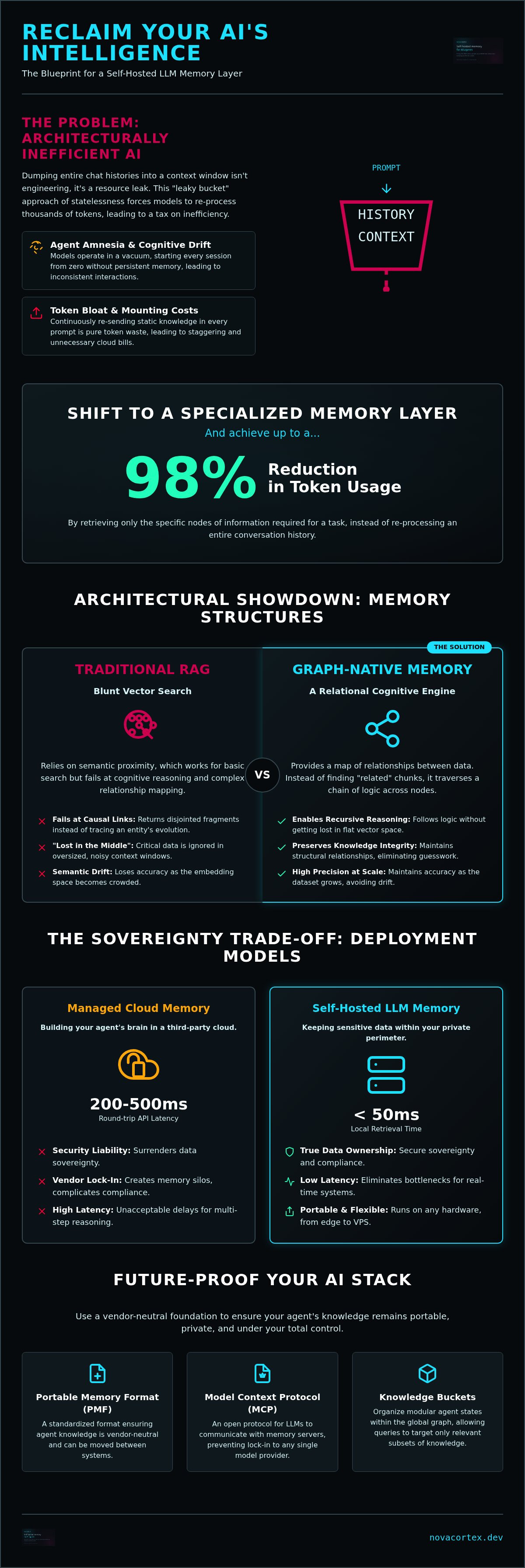
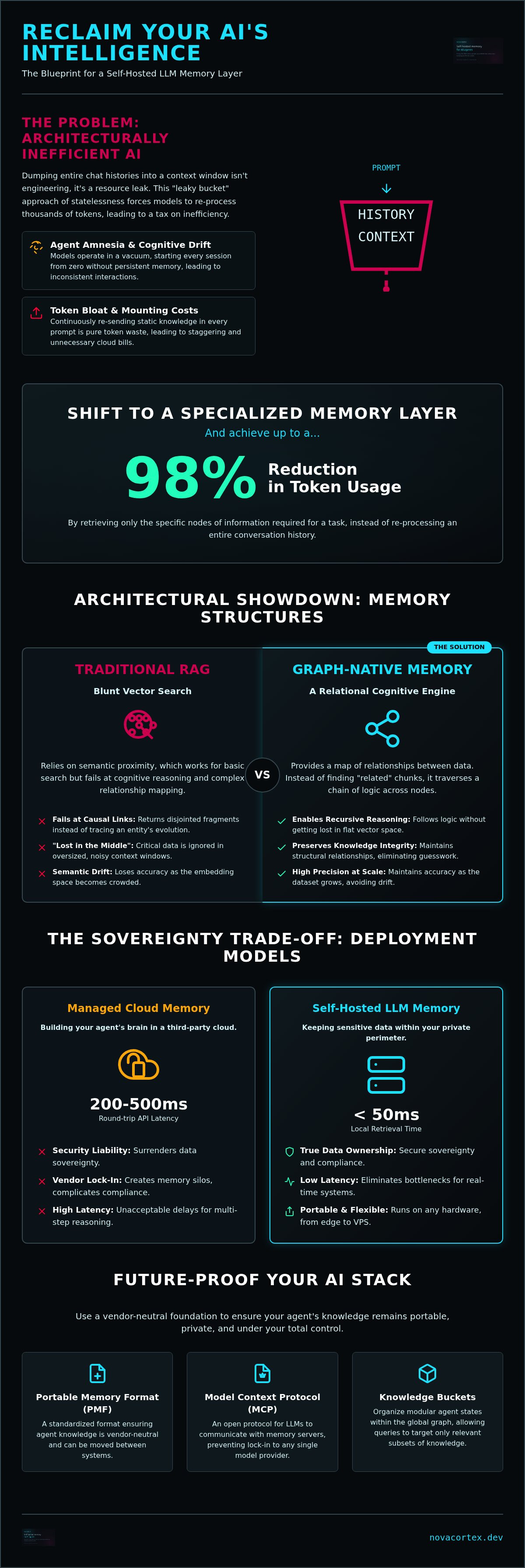
Vector databases are blunt instruments. They excel at semantic similarity but fail at complex relationship mapping. If you ask about an entity's evolution over time, a standard vector search often returns disjointed fragments. This triggers the "lost in the middle" phenomenon where models ignore critical data buried in the center of an oversized context window. The financial cost is equally staggering. Re-sending static knowledge in every prompt is pure token waste. Engineering benchmarks indicate that moving to a specialized memory layer can lead to a 98% reduction in token usage by retrieving only the specific nodes required for the task.
Digital Sovereignty and the Memory Silo
Sending proprietary knowledge to managed vector DBs is a security liability. You're building your agent's brain in a third-party cloud. With the EU AI Act enforceable as of August 2, 2026, data governance is a hard requirement. High-risk AI systems must control their data pipelines from end to end. Managed services create memory silos that make GDPR or CCPA compliance nearly impossible to audit effectively.
Self-hosting is the only path to true data ownership. A self-hosted LLM memory layer keeps sensitive data within your private perimeter, removes vendor lock-in, and eliminates unpredictable egress fees. You aren't just storing data; you're securing your digital sovereignty. Your agent's knowledge remains portable, private, and under your total control. This architectural choice defines whether your AI is a temporary tool or a permanent corporate asset.
Architecting the Self-Hosted Memory Layer: Graph-Native vs. Vector
Vector databases are blunt instruments. They rely on semantic proximity, which works for basic search but fails for cognitive reasoning. When an agent needs to understand the causal link between two events, proximity isn't enough. It needs a map. A self-hosted LLM memory layer built on graph-native storage provides this map. Instead of just finding "related" text chunks, it traverses relationships. This architecture enables recursive reasoning, allowing the agent to follow a chain of logic across multiple nodes of information without getting lost in the noise of a flat vector space.
In complex knowledge bases, precision is the only metric that matters. Benchmarks show that graph-native retrieval maintains high accuracy even as the dataset scales, whereas vector-only systems suffer from "semantic drift" as the embedding space becomes crowded. By mapping the exact relationships between entities, you eliminate the guesswork of similarity scores. This isn't just about finding data; it's about preserving the structural integrity of knowledge.
Graph-Native Memory: A Technical Breakdown
This architecture treats agent experiences as a web of data. Nodes represent entities or events. Edges define the relationships between them. Properties store the specific metadata that gives the connection context. To keep this manageable, we use Knowledge Buckets. These buckets allow you to organize modular agent states, ensuring the system only queries relevant subsets of the global graph. Graph-native memory is the evolution of RAG for 2026, transforming static retrieval into a dynamic, relational cognitive engine.
The Self-Hosted Advantage: Local Compute and Low Latency
Managed memory services introduce unacceptable round-trip API latency. Every memory retrieval adds 200 to 500ms of overhead. When your agent is performing multi-step reasoning, these delays compound into a sluggish user experience. A self-hosted LLM memory layer eliminates this bottleneck. By running a local memory server, you reduce retrieval time to sub-50ms levels. This performance gain is critical for real-time autonomous systems that require high-velocity feedback loops.
You can deploy this infrastructure on anything from edge hardware like a Raspberry Pi to an enterprise VPS. This flexibility ensures that your agent's "brain" is always physically close to the compute. For a deeper dive into how this compares to traditional caching, see our guide on Redis vs Graph Memory for AI Agents. To start building your own private infrastructure, you can explore the NovaCortex repository and deploy your first node today.
Self-Hosted vs. Managed Memory: The Sovereignty Trade-off
Managed services are a seductive trap. They promise instant scalability but deliver a "Black Box" architecture that you cannot audit or optimize. When you rely on third-party providers like Pinecone, you aren't just storing data; you're surrendering the logic of your agent's cognitive retrieval. You can't see how the weights are applied or why specific memories are prioritized. This lack of transparency is a critical failure point for any system requiring high-precision reasoning or strict regulatory compliance. You are effectively renting a brain that you don't own and cannot fully control.
Self-hosting is the only defensive play for an engineer. A self-hosted LLM memory layer removes the ceiling on your performance and the floor on your data security. In 2026, the maintenance burden is negligible. Modern orchestration tools and standardized binaries mean running your own memory server is a "set and forget" operation. You trade a few minutes of initial configuration for total ownership and the elimination of unpredictable API rate limits and egress fees. It's the difference between being a tenant and being a sovereign builder.
Ending Vendor Lock-in with Portable Memory Format (PMF)
Vendor lock-in is the silent killer of AI innovation. Most managed services use proprietary data structures that make migration a nightmare. We solve this with the Portable Memory Format (PMF). It's an open standard that ensures your agent's knowledge remains interoperable and fluid. Whether you are moving between local servers or different cloud providers, PMF preserves the relational integrity of your memory graph. You can learn more about Portable Memory Format for AI and how it breaks the cycle of dependency.
Total Cost of Ownership (TCO) Analysis
The math for self-hosting is undeniable. Managed tiers often charge per request, which punishes you for building active, high-utility agents. By deploying NovaCortex Self-Hosted Edition on a standard VPS, you replace escalating monthly subscriptions with a fixed, low-cost infrastructure. The primary driver of value is token efficiency. Because our graph-native approach enables a 98% reduction in token usage, the savings on LLM API calls alone often pay for the hosting costs within the first month of operation. You aren't just saving money; you're building an immutable, owned knowledge base that grows in value without increasing your overhead. This is how you scale intelligence without scaling debt.
Implementation: Building an MCP-Native Memory Server
The Model Context Protocol (MCP) is the bridge that ends the era of custom, fragile connectors. By using a standardized interface, your LLM can interact with a self-hosted LLM memory layer as if it were a local system resource. This shift eliminates the architectural debt of building bespoke retrieval logic for every new agent framework. Implementation is a matter of deploying the right binary and defining your data boundaries through clear, modular structures.
- Step 1: Deployment. Spin up the NovaCortex Self-Hosted Edition on your private infrastructure. Whether you're using Docker or a bare-metal binary, ensure the instance has low-latency access to your agent compute to minimize round-trip times.
- Step 2: Partitioning. Configure Knowledge Buckets to isolate specific agent tasks. Modularizing memory prevents the system from querying irrelevant data, which keeps retrieval fast and maintains high precision across different domains.
- Step 3: Integration. Connect the MCP server to your framework of choice, such as LangChain or AutoGPT. Most 2026-era frameworks support MCP out of the box, requiring only a host URL and local authentication credentials.
- Step 4: Observability. Monitor your memory health. Track retrieval precision and node density to ensure the graph isn't becoming cluttered with low-value data that could lead to cognitive drift.
MCP Architecture for Low-Latency Retrieval
Middleware is where performance goes to die. MCP-native servers solve this by handling direct context injection into the prompt stream, bypassing traditional wrappers that add unnecessary processing overhead. When you run an MCP Native Memory Server, you're looking at startup times under 50ms and retrieval speeds that match local file system I/O. This efficiency is the only way to support complex, multi-turn reasoning without the agent lagging behind the user's intent. It's the difference between a real-time assistant and a sluggish, batch-processed script.
Scaling Memory with Knowledge Buckets
Treating memory as one giant database is a rookie mistake. It leads to context contamination, where an agent retrieves a memory from a completely unrelated task. Knowledge Buckets allow you to implement tiered memory: use a high-speed cache for short-term session state and the primary graph for long-term storage. Knowledge Buckets prevent context contamination by ensuring that the agent only traverses nodes relevant to its current operational scope. This modular approach is how you scale a self-hosted LLM memory layer to handle thousands of concurrent sessions without a drop in precision.
Future-Proofing Your AI with NovaCortex
The future of AI belongs to sovereign infrastructure. Rented intelligence is a liability. Every byte of data sent to a managed provider is a piece of your company's cognitive edge that you no longer fully control. By implementing a self-hosted LLM memory layer, you stop the leak. You transition from being a consumer of black-box services to an architect of private, high-performance intelligence. NovaCortex serves as the open-source standard for this transition, providing the graph-native foundation required for truly autonomous agents.
Scaling to 100% data ownership is a deliberate process. It starts with local testing on developer workstations to validate retrieval precision and node density. Once the logic is sound, you scale to a private VPS or on-premise hardware for production workloads. This progression ensures that your agent's knowledge base remains portable and immutable. You aren't just building a tool; you're cultivating an asset that grows in value without increasing vendor dependency.
Joining the Sovereign AI Movement
Developer rights are foundational to NovaCortex. We use the Apache-2.0 license to ensure you have the freedom to build, modify, and deploy without restrictive strings. This isn't just about code; it's about establishing a standard for digital sovereignty. Contributing to the ecosystem helps harden the Portable Memory Format (PMF) and expands the library of MCP-native tools. You can take the first step by visiting our repository and integrating it into your stack.
Conclusion: The End of Agent Amnesia
The shift from stateless to stateful AI is inevitable. Context windows are temporary; memory is permanent. We've moved beyond the era of "leaky bucket" prompts and entered the age of persistent agent cognition. Reclaiming your data sovereignty isn't just a compliance requirement; it's a competitive necessity. Architects who master the self-hosted LLM memory layer will lead the next wave of AI development. For a deeper dive into the architectural principles behind this shift, explore our Self-Hosted AI Memory Layer Pillar. Stop renting your agent's brain. Build it on iron you own.
Architecting Persistent Cognitive Sovereignty
The era of amnesiac AI agents is over. Relying on stateless context windows is no longer just an inefficiency; it is a structural liability. By deploying a self-hosted LLM memory layer, you replace wasteful context dumping with precise, graph-native performance. This shift ends agent amnesia and secures your data under a transparent Apache-2.0 license. You are no longer renting a brain. You are building a permanent cognitive asset.
Implementing NovaCortex allows you to realize a 98% reduction in token usage. You gain the speed of local retrieval and the security of private infrastructure. The transition from rented, black-box silos to owned, portable memory is the defining move for engineers in 2026. It's time to stop patching context leaks and start architecting persistent intelligence on iron you control.
The tools are ready and the benchmarks are clear. Take command of your agent's memory and lead the industry toward a leaner, more sovereign future.
Frequently Asked Questions
What exactly is a self-hosted LLM memory layer?
A self-hosted LLM memory layer is a dedicated infrastructure component that stores and retrieves agent state on private hardware. It replaces the wasteful practice of dumping raw chat history into context windows. By hosting it yourself, you maintain absolute control over data residency and retrieval logic. This architectural layer acts as a persistent cognitive core for autonomous agents, ensuring they don't lose track of long-running sessions.
How does NovaCortex reduce token usage by 98%?
It achieves this by shifting from brute-force context stuffing to graph-native retrieval. Instead of re-sending thousands of tokens of chat history, the system only injects the specific, high-relevance nodes required for the current task. Benchmarks confirm this surgical precision eliminates nearly all redundant data processing. This efficiency translates directly into lower API costs and faster response times for your production agents.
Is a self-hosted memory layer more secure than a managed vector database?
Yes, because it eliminates the need to transmit proprietary knowledge to third-party cloud silos. A self-hosted LLM memory layer keeps all sensitive data within your private network perimeter. This setup simplifies compliance with the EU AI Act and GDPR by providing a clear, auditable trail of data processing. You own the hardware, the database, and the encryption keys without surrendering control to a vendor.
Can I run NovaCortex on a local server or Raspberry Pi?
You can deploy the NovaCortex Self-Hosted Edition on any hardware that supports standard containerization or binary execution. The system is designed for high-velocity performance even on edge devices like a Raspberry Pi. This flexibility allows you to keep agent memory physically close to the compute. It is an ideal solution for local research or decentralized enterprise deployments where low latency is non-negotiable.
What is the Model Context Protocol (MCP) and why is it native to NovaCortex?
MCP is an open standard that allows LLMs to communicate with external tools and data sources without custom middleware. NovaCortex uses an MCP-native architecture to ensure seamless integration with any compliant agent framework. This reduces the engineering overhead of building fragile, bespoke connectors. It is the standard for 2026, enabling low-latency context injection and broad interoperability across the entire AI stack.
Does NovaCortex support the Portable Memory Format (PMF)?
It supports PMF as the primary standard for all memory storage and exports. This format ensures that your agent's knowledge isn't trapped in a proprietary silo. You can move your graph-native memory between different servers or providers without losing relational integrity. PMF is the technical foundation for vendor-neutral AI infrastructure and long-term data sovereignty. It makes your agent's brain portable and future-proof.
How does graph-native storage differ from standard vector search?
Vector search finds text based on semantic similarity; graph-native storage maps the actual relationships between entities. While vector databases are blunt instruments, graphs allow agents to traverse complex logical chains. This enables deeper reasoning and prevents the "lost in the middle" phenomenon. Graphs provide the structural context that flat vector spaces simply cannot replicate, making them the superior choice for complex agent memory.
Is NovaCortex open source?
NovaCortex is licensed under the Apache-2.0 open-source license. This gives developers the absolute right to inspect, modify, and deploy the code in any environment. There are no restrictive licenses or hidden traps. We believe that the infrastructure of intelligence must be open and auditable to ensure a future of sovereign, independent AI development. You can contribute to the ecosystem and build with total freedom.
FAQ
What exactly is a self-hosted LLM memory layer?
A self-hosted LLM memory layer is a dedicated infrastructure component that stores and retrieves agent state on private hardware. It replaces the wasteful practice of dumping raw chat history into context windows. By hosting it yourself, you maintain absolute control over data residency and retrieval logic. This architectural layer acts as a persistent cognitive core for autonomous agents, ensuring they don't lose track of long-running sessions.
How does NovaCortex reduce token usage by 98%?
It achieves this by shifting from brute-force context stuffing to graph-native retrieval. Instead of re-sending thousands of tokens of chat history, the system only injects the specific, high-relevance nodes required for the current task. Benchmarks confirm this surgical precision eliminates nearly all redundant data processing. This efficiency translates directly into lower API costs and faster response times for your production agents.
Is a self-hosted memory layer more secure than a managed vector database?
Yes, because it eliminates the need to transmit proprietary knowledge to third-party cloud silos. A self-hosted LLM memory layer keeps all sensitive data within your private network perimeter. This setup simplifies compliance with the EU AI Act and GDPR by providing a clear, auditable trail of data processing. You own the hardware, the database, and the encryption keys without surrendering control to a vendor.
Can I run NovaCortex on a local server or Raspberry Pi?
You can deploy the NovaCortex Self-Hosted Edition on any hardware that supports standard containerization or binary execution. The system is designed for high-velocity performance even on edge devices like a Raspberry Pi. This flexibility allows you to keep agent memory physically close to the compute. It is an ideal solution for local research or decentralized enterprise deployments where low latency is non-negotiable.
What is the Model Context Protocol (MCP) and why is it native to NovaCortex?
MCP is an open standard that allows LLMs to communicate with external tools and data sources without custom middleware. NovaCortex uses an MCP-native architecture to ensure seamless integration with any compliant agent framework. This reduces the engineering overhead of building fragile, bespoke connectors. It is the standard for 2026, enabling low-latency context injection and broad interoperability across the entire AI stack.
Does NovaCortex support the Portable Memory Format (PMF)?
It supports PMF as the primary standard for all memory storage and exports. This format ensures that your agent's knowledge isn't trapped in a proprietary silo. You can move your graph-native memory between different servers or providers without losing relational integrity. PMF is the technical foundation for vendor-neutral AI infrastructure and long-term data sovereignty. It makes your agent's brain portable and future-proof.
How does graph-native storage differ from standard vector search?
Vector search finds text based on semantic similarity; graph-native storage maps the actual relationships between entities. While vector databases are blunt instruments, graphs allow agents to traverse complex logical chains. This enables deeper reasoning and prevents the "lost in the middle" phenomenon. Graphs provide the structural context that flat vector spaces simply cannot replicate, making them the superior choice for complex agent memory.
Is NovaCortex open source?
NovaCortex is licensed under the Apache-2.0 open-source license. This gives developers the absolute right to inspect, modify, and deploy the code in any environment. There are no restrictive licenses or hidden traps. We believe that the infrastructure of intelligence must be open and auditable to ensure a future of sovereign, independent AI development. You can contribute to the ecosystem and build with total freedom.