The Self-Hosted AI Memory Layer: Engineering Persistent Agent Cognition

Your AI agents aren't failing because of low IQ. They're failing because of architectural amnesia. Every time you restart a session, you pay the Context Tax, re-uploading the same data while your proprietary insights remain trapped in a vendor's silo. Engineering a self-hosted AI memory layer is the only way to stop renting cognition and start owning it. You already know that third-party memory APIs are a liability to your data sovereignty. It is time for a more precise, sovereign approach to persistent intelligence.
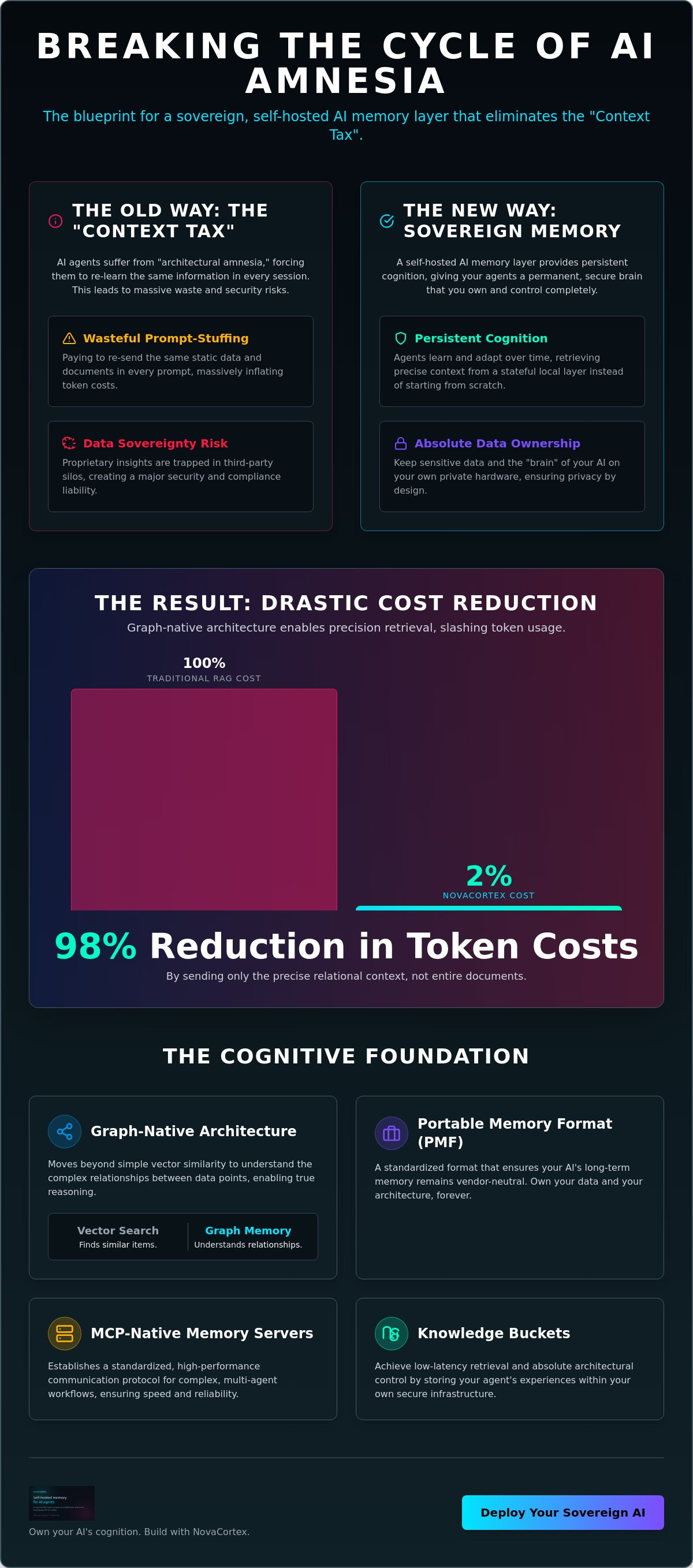
We're going to master the architecture of persistent agent cognition to slash your token costs by 98% and eliminate context drift. This guide provides the technical blueprint for deploying MCP-Native Memory Servers and utilizing Portable Memory Formats (PMF) to ensure your data remains vendor-neutral. You'll learn to implement NovaCortex Knowledge Buckets to achieve low-latency retrieval and absolute architectural control. We're moving past the era of bloated, stateless prompts into a future of lean, high-velocity engineering reality that respects your data and your bottom line.
Key Takeaways
- Eliminate the "Context Tax" by transitioning from wasteful prompt-stuffing to a persistent, sovereign cognitive architecture.
- Deploy a self-hosted AI memory layer to secure absolute data ownership and remove the risks associated with third-party memory APIs.
- Leverage graph-native Knowledge Buckets to achieve a 98% reduction in token costs through superior relational context retrieval.
- Future-proof your agent architecture with the Portable Memory Format (PMF), ensuring your AI's long-term memory remains vendor-neutral and portable.
- Master the deployment of MCP-Native Memory Servers to establish a standardized, high-performance communication protocol for agentic workflows.
Beyond Vector Search: The Case for a Self-Hosted AI Memory Layer
Traditional RAG is a temporary patch for a structural flaw. Most developers treat AI memory as a simple retrieval task, but true intelligence requires a sovereign cognitive extension. A self-hosted AI memory layer moves your agents beyond the limitations of session-based chat and into the territory of persistent, multi-agent long-term memory. It's the difference between an agent that reads a manual for every task and one that possesses persistent memory of every previous interaction. When you own the infrastructure, you own the cognition. This shift transforms your agents from stateless calculators into persistent entities that learn and adapt over time without needing constant hand-holding.
Dumping massive knowledge bases into prompts is not a strategy; it's an engineering failure. It forces the LLM to waste compute on static information that should've been processed once and stored locally. This inefficiency doesn't just slow down your agents. It creates a massive "Context Tax" that compounds with every user interaction. By shifting to a local-first memory architecture, you keep sensitive RAG data off third-party servers and ensure your system remains privacy-compliant by design. You shouldn't have to trust a vendor with the proprietary insights that give your business its competitive edge.
The Economic Reality of Token Waste
High-volume agentic workflows are often built on a foundation of redundant data. If you're paying for the same 2,000 tokens of context in every prompt, you're subsidizing the LLM provider's profit margins at the expense of your own. Local memory retrieval prevents these unnecessary reasoning cycles by delivering only the specific, relevant nodes required for the current task. The Context Tax is the cumulative cost of re-sending static knowledge in every prompt instead of retrieving it from a stateful local layer. A self-hosted AI memory layer allows for aggressive context pruning and summarization that happens before the prompt is even constructed. This means you aren't just saving on tokens; you're improving the quality of the LLM's output by removing noise that often leads to hallucinations.
Data Sovereignty in the Age of Agentic AI
Regulated industries such as FinTech and HealthTech face a unique challenge: they can't trust third-party memory APIs with sensitive data. Sending proprietary insights to a vendor's "memory cloud" is a liability that most legal teams won't approve. Building with the NovaCortex Self-Hosted Edition allows you to secure the "brain" of your AI on a private VPS or local hardware. This approach utilizes Apache-2.0 licensed components to ensure your infrastructure remains future-proof and independent. Self-hosting also provides the low-latency response times that cloud-based memory APIs often lack. You're protecting the intellectual property of your agent's long-term experience within your own Knowledge Buckets while eliminating the round-trip delay of external API calls.
Graph-Native Architecture: How NovaCortex Achieves 98% Token Reduction
Traditional vector databases are essentially high-dimensional filing cabinets. They're useful for finding similar documents, but they cannot reason about the connections between them. If your agent needs to understand the specific impact of a 2024 budget cut on a 2026 product launch, a vector search will likely fail. It lacks the relational logic required to bridge those gaps. A self-hosted AI memory layer built on graph-native architecture solves this by mapping knowledge as a web of interconnected nodes. It doesn't just store data; it stores the relationships that give that data meaning.
Precision is the enemy of waste. NovaCortex doesn't just retrieve similar text; it retrieves the exact logical path required for a specific query. By sending only the required context nodes to the LLM, we've benchmarked a 98% reduction in token usage compared to naive RAG systems that flood the context window with redundant, "maybe-relevant" chunks. This level of architectural control is essential for enterprise-grade compliance. Adhering to the NIST AI Risk Management Framework requires knowing exactly why an AI made a decision. Graph-native memory provides that audit trail by making the retrieval process transparent and traceable.
Vector vs. Graph: Choosing the Right Cognitive Foundation
Vector search excels at similarity, but it's a blunt instrument for complex logic. Knowledge Graphs excel at identifying relationships and maintaining logical consistency. A hybrid self-hosted AI memory layer is the only way to build a reliable cognitive foundation. This approach eliminates the "lost in the middle" phenomenon where models ignore information buried in the center of overstuffed context windows. By providing a high-density, low-token prompt, you ensure the LLM stays focused on the task at hand without the distraction of irrelevant noise.
The Logic of Knowledge Buckets
We organize memory into Knowledge Buckets to move away from monolithic, unmanageable data piles. This modularity allows for granular multi-user controls and permission-based access. Knowledge Buckets prevent cross-contamination by isolating specific datasets so one agent's context doesn't leak into another's reasoning. This ensures that a financial agent doesn't hallucinate using data from a marketing bucket. It's a clean, scalable way to manage multi-agent environments. If you're ready to stop paying for redundant tokens and start building a smarter system, explore the NovaCortex Self-Hosted Edition.
Portable Memory Format (PMF) and Ending Vendor Lock-in
Proprietary AI memory APIs are a trap. When you build your agent's long-term cognition on a vendor's closed-source database, you're succumbing to "Brain Lock." If that provider hikes prices, changes terms, or deprecates their API, your agent effectively suffers a lobotomy. This isn't just a technical risk; it's a strategic failure. A self-hosted AI memory layer must prioritize data portability to ensure that your agent's experiences belong to you, not a third-party corporation. By adopting the Portable Memory Format (PMF), you decouple the intelligence from the infrastructure.
Interoperability is the prerequisite for enterprise-grade AI adoption in 2026. PMF allows you to move your memory stores seamlessly between local servers, high-performance VPS, and edge devices. This flexibility is built on the technical fusion of knowledge graphs and LLMs, a concept detailed in research on Graph-Native Architecture. It ensures that your data remains structured, searchable, and, most importantly, transferable. You shouldn't be locked into a single stack when the pace of innovation demands architectural agility. Ownership isn't just about where the data sits; it's about how easily you can move it.
Architecture for Longevity
The inference engine is ephemeral. Models like GPT-4 or Claude 3.5 will be replaced, but your agent's memory should be permanent. PMF ensures your AI agent outlives its underlying LLM provider by decoupling the memory layer from the inference engine. If you switch providers, your agent retains its history, preferences, and logic. Syncing this memory across distributed agent fleets becomes a matter of standard protocol rather than complex custom engineering. It's about building for the next decade, not the next billing cycle. You're creating a durable cognitive asset that gains value as it grows.
The Open Source Advantage
Building on proprietary black boxes is a liability. The industry is gravitating toward Apache-2.0 licenses because they provide the transparency and freedom required for sovereign infrastructure. Community-driven improvements in context retrieval algorithms ensure that your self-hosted AI memory layer stays at the cutting edge without vendor intervention. Leveraging NovaCortex for vendor-neutral storage gives you the tools to manage these complex data structures with precision. You aren't just deploying a tool; you're establishing a standard for digital independence that respects your engineering reality. It's time to stop renting your agent's brain and start owning the format it thinks in.
Implementation: Deploying an MCP-Native Memory Server
Deploying a self-hosted AI memory layer is no longer a weekend project for hobbyists. It is a production requirement for any engineer serious about agentic autonomy. The Model Context Protocol (MCP) has emerged as the definitive standard for managing AI context. It establishes a universal interface that allows different models and frameworks to interact with your memory server without the need for fragile, custom glue code. Whether you're running on a Raspberry Pi 5 for local prototyping or a high-performance VPS for enterprise workloads, the deployment logic remains consistent and reproducible.
Hardware requirements are lean but specific. For basic local-first memory, a system with 8GB of RAM is sufficient for handling standard Knowledge Buckets. Production environments that require high-velocity retrieval across multi-agent fleets should utilize NVMe storage and multi-core CPU architectures to eliminate I/O bottlenecks. You can deploy using Docker for immediate environment isolation or native binaries for performance-critical edge cases. Once the self-hosted AI memory layer is active, integration with popular frameworks like LangChain and AutoGPT is a matter of pointing their context managers to your local MCP endpoint.
- Pull the official Docker image for the MCP-Native Memory Server.
- Define your environment variables to initialize specific Knowledge Buckets.
- Mount your persistent storage volumes to ensure memory survives container restarts.
- Configure the MCP client in your agent framework to enable long-term recall.
The MCP Advantage for Developers
MCP standardizes the handshake between LLMs and your memory infrastructure. It reduces integration friction by providing a ready-made server architecture that handles protocol negotiation automatically. This results in low-latency context retrieval that feels native to the model's reasoning cycle. You aren't just building a database. You're extending the model's operational context window through a high-performance protocol that prioritizes speed and technical precision.
Scaling from Prototype to Production
Moving beyond a single-user setup requires robust management. You must configure multi-user controls and advanced permission layers to ensure strict data isolation. Monitoring memory usage and retrieval precision metrics is non-negotiable for maintaining system health over time. Periodic memory pruning is essential to remove obsolete or low-relevance nodes and maintain high-velocity performance. If you're ready to establish a professional-grade environment, get started with the NovaCortex Self-Hosted Edition today.
Sovereign AI: Scaling with NovaCortex Enterprise
Scaling a self-hosted AI memory layer reaches a tipping point where manual orchestration becomes a bottleneck. While individual servers are perfect for prototyping, organizational-grade agent fleets require multi-tenant management and hardened security protocols. Transitioning to NovaCortex Enterprise allows teams to move from managing infrastructure to perfecting cognition. It provides a path for enterprise scaling that remains fully sovereign, unlike competitor platforms that force data into proprietary clouds. You keep the architecture local while gaining the high-availability features required for production environments.
Your first step toward scaling isn't buying more compute. It's auditing your current token waste. Most engineering teams find that their "Context Tax" is significantly higher than they estimated, often due to redundant data residing in unoptimized prompts. By formalizing your memory architecture, you establish a baseline for autonomous agent frameworks that can truly operate independently. NovaCortex serves as the foundational layer for these systems, ensuring that as your agent count grows, your token efficiency remains high and your data remains your own.
Managed Infrastructure vs. Private VPS
Evaluating maintenance overhead against absolute control is a pragmatic necessity. A private VPS offers total isolation but demands constant patches and manual backups. Managed NovaCortex environments maintain the spirit of digital sovereignty while offloading the operational burden. This is particularly critical during complex knowledge graph migrations, where professional support ensures your agent's long-term memory remains intact and logically consistent. You get the benefits of a managed service without the liability of a third-party data silo.
The Roadmap to Autonomous Intelligence
The ultimate goal is autonomous intelligence. We're building agents that learn and evolve without human intervention, synchronizing their states across global infrastructures. This requires a stateful layer that is both portable and persistent. By standardizing on the Portable Memory Format (PMF) and MCP-Native Memory Servers, you're creating a future-proof ecosystem where agents collaborate across disparate Knowledge Buckets. This architecture ensures that when one agent learns a new relationship, that insight is instantly available to the entire fleet. It's time to stop building stateless tools and start engineering persistent cognition. Deploy your sovereign memory layer with NovaCortex to secure your place in the next generation of agentic architecture.
Own Your Cognitive Infrastructure
The era of renting your AI's intelligence is over. We've moved past the inefficiency of vector-only retrieval and the wasteful "Context Tax" of bloated, stateless prompts. By deploying a self-hosted AI memory layer, you secure absolute data sovereignty while achieving a benchmarked 98% token reduction in your RAG workflows. This isn't just about saving costs; it's about engineering a persistent cognitive foundation that belongs entirely to you. You've seen the technical blueprint. Now it's time for execution.
Leveraging Apache-2.0 open-source components ensures total architectural freedom and eliminates the risk of vendor brain lock. You can now integrate agents seamlessly using the MCP-Native standard, guaranteeing that your memory layer is as portable as it is powerful. The transition from session-based chat to persistent intelligence is an engineering necessity for any production-grade agentic fleet. It's time to build systems that learn, adapt, and scale without vendor interference or proprietary restrictions. Your agents deserve a memory that doesn't expire at the end of a session.
Establish your sovereign infrastructure and take control of your data roadmap today. Start building with NovaCortex Self-Hosted Edition to deploy a high-velocity memory layer that respects your engineering reality. Build for the next decade of autonomous intelligence.
Frequently Asked Questions
What is a self-hosted AI memory layer?
A self-hosted AI memory layer is a private infrastructure designed to store and manage persistent cognition for AI agents. It replaces stateless, prompt-heavy interactions with a durable long-term memory that you own and control. By hosting this layer on your own hardware or VPS, you eliminate the "Context Tax" and ensure total data sovereignty. It's the only way to build agents that possess a persistent sense of history without relying on third-party APIs.
How does graph-native memory reduce token usage compared to vector databases?
Graph-native memory reduces token usage by identifying precise logical relationships between data nodes rather than relying on blunt similarity matches. Traditional vector databases often flood the context window with "maybe-relevant" text chunks that inflate costs and confuse models. By retrieving only the exact nodes required for a specific query, our architecture achieves a 98% reduction in token consumption. This precision ensures your LLM stays focused on reasoning rather than filtering through redundant noise.
Can I run NovaCortex on a Raspberry Pi?
You can absolutely run the NovaCortex Self-Hosted Edition on a Raspberry Pi 5. The system is engineered for lean, high-velocity performance on local hardware with at least 8GB of RAM. While a Pi is ideal for prototyping sovereign AI systems or managing smaller Knowledge Buckets, it provides a stable foundation for testing MCP-native integrations. Scaling to a high-performance VPS is a seamless transition once your production requirements exceed the I/O limits of edge hardware.
What is the Portable Memory Format (PMF) and why does it matter?
The Portable Memory Format (PMF) is a vendor-neutral interchange standard that ensures your agent's cognition isn't trapped in a proprietary silo. It allows you to move long-term memory between different servers and inference engines without losing the logical structure of your data. This matters because it prevents "Brain Lock," where your AI's experiences become a liability controlled by a single provider. PMF guarantees that your agent's memory is a durable, transferable business asset.
How does the Model Context Protocol (MCP) work with AI memory?
The Model Context Protocol (MCP) acts as a standardized handshake between your LLM and the self-hosted AI memory layer. It provides a universal interface that allows agents to query persistent memory with minimal integration friction and low latency. By using an MCP-native server architecture, you eliminate the need for fragile, custom-built connectors for every new model. This protocol ensures that your memory infrastructure remains interoperable and ready for the next generation of autonomous agent frameworks.
Is NovaCortex compatible with LangChain and other agent frameworks?
NovaCortex is fully compatible with LangChain, AutoGPT, and other major agent frameworks via its MCP-native server implementation. You simply point your framework's context manager to your local server endpoint to enable persistent recall and stateful reasoning. This native integration removes the architectural bloat associated with custom memory wrappers. It allows you to focus on engineering agent behavior while the memory layer handles the heavy lifting of relational retrieval and data persistence.
What are Knowledge Buckets in the context of AI memory?
Knowledge Buckets are modular, isolated segments of memory used to partition data for specific agents or users. They prevent cross-contamination by ensuring that sensitive information in one bucket doesn't leak into the reasoning cycles of another agent. This granular control is vital for enterprise environments that require strict data isolation and permission-based access. By segmenting your memory, you maintain a high-velocity system that is both secure and logically organized for multi-agent workflows.
How do I migrate my existing vector database to a self-hosted memory layer?
Migrating to a self-hosted AI memory layer requires exporting your existing vector embeddings and re-indexing them into a graph-native structure. NovaCortex includes specialized tools to map these similarity-based chunks into relational nodes within Knowledge Buckets. This process transforms your data from a flat list of vectors into a dense, logical web of interconnected facts. It upgrades your retrieval mechanism from simple similarity search to high-precision, context-aware cognition that drastically reduces your operational token costs.

FAQ
The Economic Reality of Token Waste
High-volume agentic workflows are often built on a foundation of redundant data. If you're paying for the same 2,000 tokens of context in every prompt, you're subsidizing the LLM provider's profit margins at the expense of your own. Local memory retrieval prevents these unnecessary reasoning cycles by delivering only the specific, relevant nodes required for the current task. The Context Tax is the cumulative cost of re-sending static knowledge in every prompt instead of retrieving it from a stateful local layer. A self-hosted AI memory layer allows for aggressive context pruning and summarization that happens before the prompt is even constructed. This means you aren't just saving on tokens; you're improving the quality of the LLM's output by removing noise that often leads to hallucinations.
Data Sovereignty in the Age of Agentic AI
Regulated industries such as FinTech and HealthTech face a unique challenge: they can't trust third-party memory APIs with sensitive data. Sending proprietary insights to a vendor's "memory cloud" is a liability that most legal teams won't approve. Building with the NovaCortex Self-Hosted Edition allows you to secure the "brain" of your AI on a private VPS or local hardware. This approach utilizes Apache-2.0 licensed components to ensure your infrastructure remains future-proof and independent. Self-hosting also provides the low-latency response times that cloud-based memory APIs often lack. You're protecting the intellectual property of your agent's long-term experience within your own Knowledge Buckets while eliminating the round-trip delay of external API calls. Traditional vector databases are essentially high-dimensional filing cabinets. They're useful for finding similar documents, but they cannot reason about the connections between them. If your agent needs to understand the specific impact of a 2024 budget cut on a 2026 product launch, a vector search will likely fail. It lacks the relational logic required to bridge those gaps. A self-hosted AI memory layer built on graph-native architecture solves this by mapping knowledge as a web of interconnected nodes. It doesn't just store data; it stores the relationships that give that data meaning. Precision is the enemy of waste. NovaCortex doesn't just retrieve similar text; it retrieves the exact logical path required for a specific query. By sending only the required context nodes to the LLM, we've benchmarked a 98% reduction in token usage compared to naive RAG systems that flood the context window with redundant, "maybe-relevant" chunks. This level of architectural control is essential for enterprise-grade compliance. Adhering to the NIST AI Risk Management Framework requires knowing exactly why an AI made a decision. Graph-native memory provides that audit trail by making the retrieval process transparent and traceable.
Vector vs. Graph: Choosing the Right Cognitive Foundation
Vector search excels at similarity, but it's a blunt instrument for complex logic. Knowledge Graphs excel at identifying relationships and maintaining logical consistency. A hybrid self-hosted AI memory layer is the only way to build a reliable cognitive foundation. This approach eliminates the "lost in the middle" phenomenon where models ignore information buried in the center of overstuffed context windows. By providing a high-density, low-token prompt, you ensure the LLM stays focused on the task at hand without the distraction of irrelevant noise.
The Logic of Knowledge Buckets
We organize memory into Knowledge Buckets to move away from monolithic, unmanageable data piles. This modularity allows for granular multi-user controls and permission-based access. Knowledge Buckets prevent cross-contamination by isolating specific datasets so one agent's context doesn't leak into another's reasoning. This ensures that a financial agent doesn't hallucinate using data from a marketing bucket. It's a clean, scalable way to manage multi-agent environments. If you're ready to stop paying for redundant tokens and start building a smarter system, explore the NovaCortex Self-Hosted Edition. Proprietary AI memory APIs are a trap. When you build your agent's long-term cognition on a vendor's closed-source database, you're succumbing to "Brain Lock." If that provider hikes prices, changes terms, or deprecates their API, your agent effectively suffers a lobotomy. This isn't just a technical risk; it's a strategic failure. A self-hosted AI memory layer must prioritize data portability to ensure that your agent's experiences belong to you, not a third-party corporation. By adopting the Portable Memory Format (PMF), you decouple the intelligence from the infrastructure. Interoperability is the prerequisite for enterprise-grade AI adoption in 2026. PMF allows you to move your memory stores seamlessly between local servers, high-performance VPS, and edge devices. This flexibility is built on the technical fusion of knowledge graphs and LLMs, a concept detailed in research on Graph-Native Architecture. It ensures that your data remains structured, searchable, and, most importantly, transferable. You shouldn't be locked into a single stack when the pace of innovation demands architectural agility. Ownership isn't just about where the data sits; it's about how easily you can move it.
Architecture for Longevity
The inference engine is ephemeral. Models like GPT-4 or Claude 3.5 will be replaced, but your agent's memory should be permanent. PMF ensures your AI agent outlives its underlying LLM provider by decoupling the memory layer from the inference engine. If you switch providers, your agent retains its history, preferences, and logic. Syncing this memory across distributed agent fleets becomes a matter of standard protocol rather than complex custom engineering. It's about building for the next decade, not the next billing cycle. You're creating a durable cognitive asset that gains value as it grows.
The Open Source Advantage
Building on proprietary black boxes is a liability. The industry is gravitating toward Apache-2.0 licenses because they provide the transparency and freedom required for sovereign infrastructure. Community-driven improvements in context retrieval algorithms ensure that your self-hosted AI memory layer stays at the cutting edge without vendor intervention. Leveraging NovaCortex for vendor-neutral storage gives you the tools to manage these complex data structures with precision. You aren't just deploying a tool; you're establishing a standard for digital independence that respects your engineering reality. It's time to stop renting your agent's brain and start owning the format it thinks in. Deploying a self-hosted AI memory layer is no longer a weekend project for hobbyists. It is a production requirement for any engineer serious about agentic autonomy. The Model Context Protocol (MCP) has emerged as the definitive standard for managing AI context. It establishes a universal interface that allows different models and frameworks to interact with your memory server without the need for fragile, custom glue code. Whether you're running on a Raspberry Pi 5 for local prototyping or a high-performance VPS for enterprise workloads, the deployment logic remains consistent and reproducible. Hardware requirements are lean but specific. For basic local-first memory, a system with 8GB of RAM is sufficient for handling standard Knowledge Buckets. Production environments that require high-velocity retrieval across multi-agent fleets should utilize NVMe storage and multi-core CPU architectures to eliminate I/O bottlenecks. You can deploy using Docker for immediate environment isolation or native binaries for performance-critical edge cases. Once the self-hosted AI memory layer is active, integration with popular frameworks like LangChain and AutoGPT is a matter of pointing their context managers to your local MCP endpoint.
The MCP Advantage for Developers
MCP standardizes the handshake between LLMs and your memory infrastructure. It reduces integration friction by providing a ready-made server architecture that handles protocol negotiation automatically. This results in low-latency context retrieval that feels native to the model's reasoning cycle. You aren't just building a database. You're extending the model's operational context window through a high-performance protocol that prioritizes speed and technical precision.
Scaling from Prototype to Production
Moving beyond a single-user setup requires robust management. You must configure multi-user controls and advanced permission layers to ensure strict data isolation. Monitoring memory usage and retrieval precision metrics is non-negotiable for maintaining system health over time. Periodic memory pruning is essential to remove obsolete or low-relevance nodes and maintain high-velocity performance. If you're ready to establish a professional-grade environment, get started with the NovaCortex Self-Hosted Edition today. Scaling a self-hosted AI memory layer reaches a tipping point where manual orchestration becomes a bottleneck. While individual servers are perfect for prototyping, organizational-grade agent fleets require multi-tenant management and hardened security protocols. Transitioning to NovaCortex Enterprise allows teams to move from managing infrastructure to perfecting cognition. It provides a path for enterprise scaling that remains fully sovereign, unlike competitor platforms that force data into proprietary clouds. You keep the architecture local while gaining the high-availability features required for production environments. Your first step toward scaling isn't buying more compute. It's auditing your current token waste. Most engineering teams find that their "Context Tax" is significantly higher than they estimated, often due to redundant data residing in unoptimized prompts. By formalizing your memory architecture, you establish a baseline for autonomous agent frameworks that can truly operate independently. NovaCortex serves as the foundational layer for these systems, ensuring that as your agent count grows, your token efficiency remains high and your data remains your own.
Managed Infrastructure vs. Private VPS
Evaluating maintenance overhead against absolute control is a pragmatic necessity. A private VPS offers total isolation but demands constant patches and manual backups. Managed NovaCortex environments maintain the spirit of digital sovereignty while offloading the operational burden. This is particularly critical during complex knowledge graph migrations, where professional support ensures your agent's long-term memory remains intact and logically consistent. You get the benefits of a managed service without the liability of a third-party data silo.
The Roadmap to Autonomous Intelligence
The ultimate goal is autonomous intelligence. We're building agents that learn and evolve without human intervention, synchronizing their states across global infrastructures. This requires a stateful layer that is both portable and persistent. By standardizing on the Portable Memory Format (PMF) and MCP-Native Memory Servers, you're creating a future-proof ecosystem where agents collaborate across disparate Knowledge Buckets. This architecture ensures that when one agent learns a new relationship, that insight is instantly available to the entire fleet. It's time to stop building stateless tools and start engineering persistent cognition. Deploy your sovereign memory layer with NovaCortex to secure your place in the next generation of agentic architecture. The era of renting your AI's intelligence is over. We've moved past the inefficiency of vector-only retrieval and the wasteful "Context Tax" of bloated, stateless prompts. By deploying a self-hosted AI memory layer, you secure absolute data sovereignty while achieving a benchmarked 98% token reduction in your RAG workflows. This isn't just about saving costs; it's about engineering a persistent cognitive foundation that belongs entirely to you. You've seen the technical blueprint. Now it's time for execution. Leveraging Apache-2.0 open-source components ensures total architectural freedom and eliminates the risk of vendor brain lock. You can now integrate agents seamlessly using the MCP-Native standard, guaranteeing that your memory layer is as portable as it is powerful. The transition from session-based chat to persistent intelligence is an engineering necessity for any production-grade agentic fleet. It's time to build systems that learn, adapt, and scale without vendor interference or proprietary restrictions. Your agents deserve a memory that doesn't expire at the end of a session. Establish your sovereign infrastructure and take control of your data roadmap today. Start building with NovaCortex Self-Hosted Edition to deploy a high-velocity memory layer that respects your engineering reality. Build for the next decade of autonomous intelligence.
What is a self-hosted AI memory layer?
A self-hosted AI memory layer is a private infrastructure designed to store and manage persistent cognition for AI agents. It replaces stateless, prompt-heavy interactions with a durable long-term memory that you own and control. By hosting this layer on your own hardware or VPS, you eliminate the "Context Tax" and ensure total data sovereignty. It's the only way to build agents that possess a persistent sense of history without relying on third-party APIs.
How does graph-native memory reduce token usage compared to vector databases?
Graph-native memory reduces token usage by identifying precise logical relationships between data nodes rather than relying on blunt similarity matches. Traditional vector databases often flood the context window with "maybe-relevant" text chunks that inflate costs and confuse models. By retrieving only the exact nodes required for a specific query, our architecture achieves a 98% reduction in token consumption. This precision ensures your LLM stays focused on reasoning rather than filtering through redundant noise.
Can I run NovaCortex on a Raspberry Pi?
You can absolutely run the NovaCortex Self-Hosted Edition on a Raspberry Pi 5. The system is engineered for lean, high-velocity performance on local hardware with at least 8GB of RAM. While a Pi is ideal for prototyping sovereign AI systems or managing smaller Knowledge Buckets, it provides a stable foundation for testing MCP-native integrations. Scaling to a high-performance VPS is a seamless transition once your production requirements exceed the I/O limits of edge hardware.
What is the Portable Memory Format (PMF) and why does it matter?
The Portable Memory Format (PMF) is a vendor-neutral interchange standard that ensures your agent's cognition isn't trapped in a proprietary silo. It allows you to move long-term memory between different servers and inference engines without losing the logical structure of your data. This matters because it prevents "Brain Lock," where your AI's experiences become a liability controlled by a single provider. PMF guarantees that your agent's memory is a durable, transferable business asset.
How does the Model Context Protocol (MCP) work with AI memory?
The Model Context Protocol (MCP) acts as a standardized handshake between your LLM and the self-hosted AI memory layer. It provides a universal interface that allows agents to query persistent memory with minimal integration friction and low latency. By using an MCP-native server architecture, you eliminate the need for fragile, custom-built connectors for every new model. This protocol ensures that your memory infrastructure remains interoperable and ready for the next generation of autonomous agent frameworks.
Is NovaCortex compatible with LangChain and other agent frameworks?
NovaCortex is fully compatible with LangChain, AutoGPT, and other major agent frameworks via its MCP-native server implementation. You simply point your framework's context manager to your local server endpoint to enable persistent recall and stateful reasoning. This native integration removes the architectural bloat associated with custom memory wrappers. It allows you to focus on engineering agent behavior while the memory layer handles the heavy lifting of relational retrieval and data persistence.
What are Knowledge Buckets in the context of AI memory?
Knowledge Buckets are modular, isolated segments of memory used to partition data for specific agents or users. They prevent cross-contamination by ensuring that sensitive information in one bucket doesn't leak into the reasoning cycles of another agent. This granular control is vital for enterprise environments that require strict data isolation and permission-based access. By segmenting your memory, you maintain a high-velocity system that is both secure and logically organized for multi-agent workflows.
How do I migrate my existing vector database to a self-hosted memory layer?
Migrating to a self-hosted AI memory layer requires exporting your existing vector embeddings and re-indexing them into a graph-native structure. NovaCortex includes specialized tools to map these similarity-based chunks into relational nodes within Knowledge Buckets. This process transforms your data from a flat list of vectors into a dense, logical web of interconnected facts. It upgrades your retrieval mechanism from simple similarity search to high-precision, context-aware cognition that drastically reduces your operational token costs.